


- 3.0Impact Factor
- 6.0CiteScore
- 20 daysTime to First Decision
Environmental Functional Materials for Water and Wastewater Treatment: Recent Advances and Challenges
This special issue belongs to the section “Wastewater Treatment and Reuse“.
Special Issue Information
Dear Colleagues,
Water is the most important aspect of human life and the development of civilization. Today, a severe crisis in relation to water resources is ahead of us. The main sources of water contamination include waste-water discharge from industries, agricultural activities, municipal wastewater and environmental and global changes. The presence of toxic substances, heavy metals, dyes and microorganisms, even in trace amounts, has a potential threat to the natural development of the eco-system and human health. Recently, environmental and functional materials with unique characteristics and excellent performances have brought a high level of innovation in the sector of water decontamination. Thus, it is important and necessary to develop new strategies to synthesize environmental and functional materials with controlled properties, which will provide unprecedented opportunities to explore cost-effective and environmentally acceptable water purification processes.
The aim of this issue is to discuss the recent development of environmental and functional materials for their applications in water decontamination. The recent development of novel environmental and functional materials in design, synthesis, characterization and their promising application potential will be greatly appreciated. Moreover, we paid attention to the interaction and mechanism among materials, microstructure and the performances in water decontamination. We are asking for the submission of (i) Research Articles, (ii) Review articles; (iii) Communications/Letters from editors on the following topics (but not limited to):
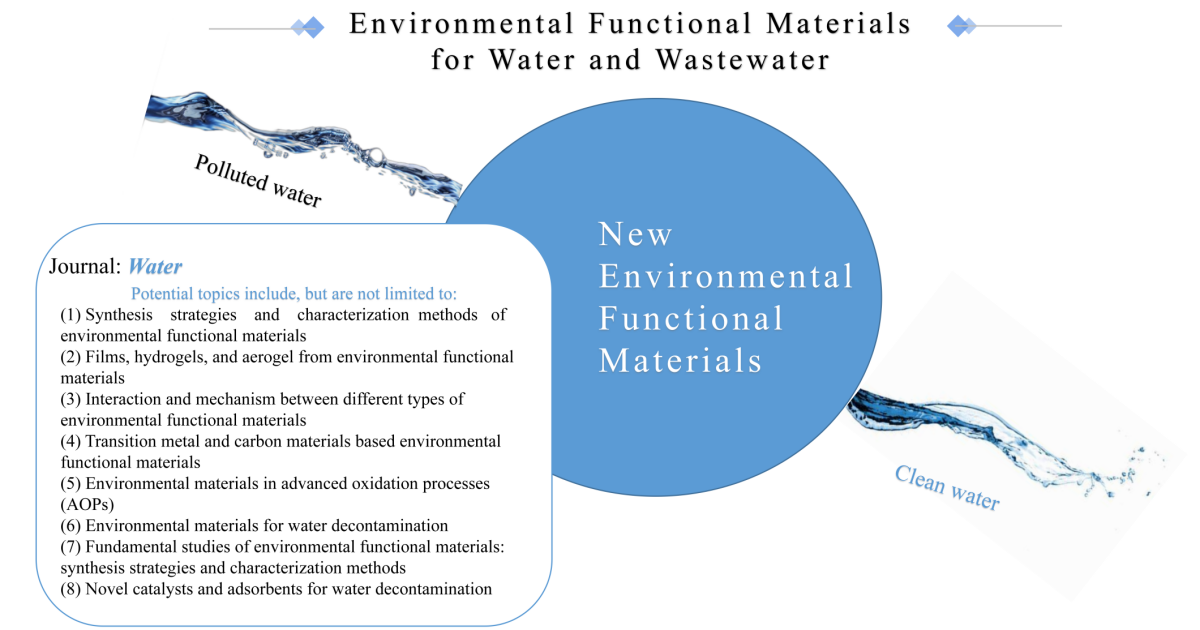
Potential topics include, but are not limited to:
(1) Synthesis strategies and characterization methods of environmental functional materials;
(2) Films, hydrogels and aerogel from environmental functional materials;
(3) Interaction and mechanism between different types of environmental functional materials;
(4) Transition metal and carbon material-based environmental functional materials;
(5) Environmental materials in advanced oxidation processes (AOPs);
(6) Environmental materials for water decontamination;
(7) Fundamental studies of environmental functional materials: synthesis strategies and characterization methods;
(8) Novel catalysts and adsorbents for water decontamination.
Prof. Dr. Xiuwen Cheng
Dr. Junjing Li
Guest Editors
Manuscript Submission Information
Manuscripts should be submitted online at www.mdpi.com by registering and logging in to this website. Once you are registered, click here to go to the submission form. Manuscripts can be submitted until the deadline. All submissions that pass pre-check are peer-reviewed. Accepted papers will be published continuously in the journal (as soon as accepted) and will be listed together on the special issue website. Research articles, review articles as well as short communications are invited. For planned papers, a title and short abstract (about 250 words) can be sent to the Editorial Office for assessment.
Submitted manuscripts should not have been published previously, nor be under consideration for publication elsewhere (except conference proceedings papers). All manuscripts are thoroughly refereed through a single-blind peer-review process. A guide for authors and other relevant information for submission of manuscripts is available on the Instructions for Authors page. Water is an international peer-reviewed open access semimonthly journal published by MDPI.
Please visit the Instructions for Authors page before submitting a manuscript. The Article Processing Charge (APC) for publication in this open access journal is 2600 CHF (Swiss Francs). Submitted papers should be well formatted and use good English. Authors may use MDPI's English editing service prior to publication or during author revisions.
Keywords
- environmental functional materials
- water and wastewater
- water decontamination
- advanced oxidation processes
- microstructure
- interaction and mechanism
Benefits of Publishing in a Special Issue
- Ease of navigation: Grouping papers by topic helps scholars navigate broad scope journals more efficiently.
- Greater discoverability: Special Issues support the reach and impact of scientific research. Articles in Special Issues are more discoverable and cited more frequently.
- Expansion of research network: Special Issues facilitate connections among authors, fostering scientific collaborations.
- External promotion: Articles in Special Issues are often promoted through the journal's social media, increasing their visibility.
- e-Book format: Special Issues with more than 10 articles can be published as dedicated e-books, ensuring wide and rapid dissemination.
Published Papers
Get Alerted
Add your email address to receive forthcoming issues of this journal.


