




Advanced Electronic Noses and Tongues Systems for Environmental Monitoring
A Special Issue of Sensors (ISSN 1424-8220) belonging to the section "Electronic Sensors".
Deadline for manuscript submissions: 30 September 2026 | Viewed by 1015
Editors

Interests: thin films; functional molecular systems; sensors and transducers; electrical and optical properties of materials; biomedical sciences
Special Issues, Collections and Topics in MDPI journals

Interests: condensed matter physics (optical and electrical properties, functional materials); ultrathin films and surface physics; molecular electronics and photonics; nanotechnology and nanostructured interfaces; colloidal and self-organized systems; biomimetic and biofunctional membranes; effects of radiation on biological systems; interdisciplinary research (physics, materials science, bioengineering)
Special Issues, Collections and Topics in MDPI journals

Interests: air quality assessment in open and closed environments; air pollution in industrial and densely populated areas; development and implementation of analytical procedures for environmental monitoring; impact assessment of toxic contaminants on human health
Special Issues, Collections and Topics in MDPI journals
Special Issue Information
Dear Colleagues,
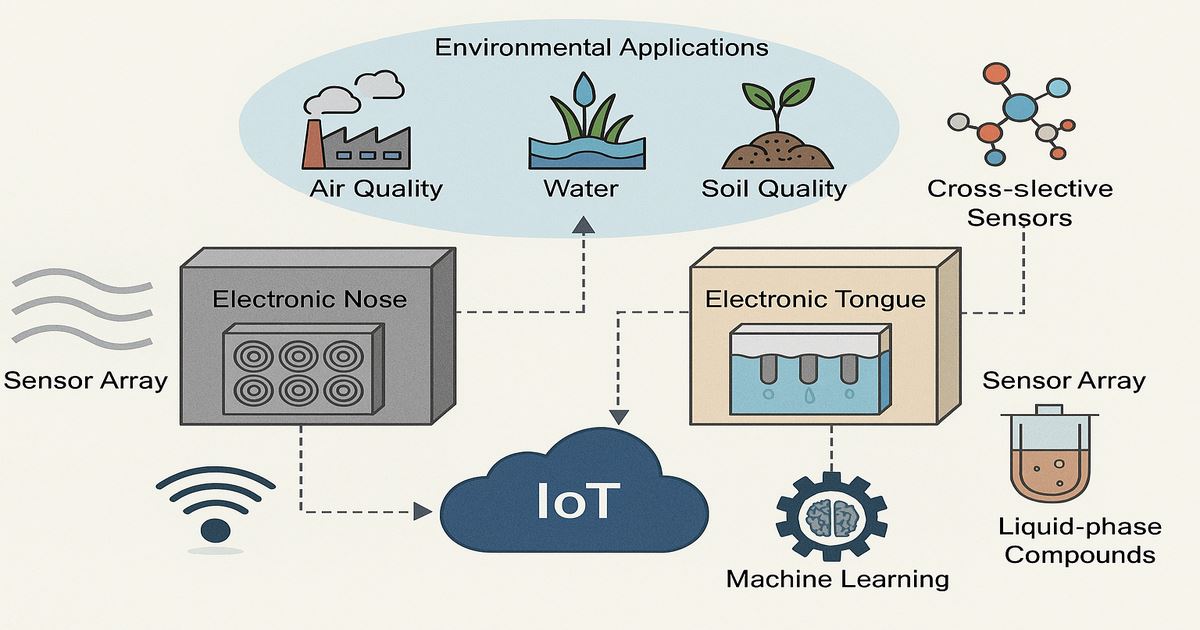
Electronic noses and tongues have evolved remarkably over the last three decades, progressing from early laboratory prototypes to sophisticated analytical platforms capable of real-time and in situ environmental monitoring. These bio-inspired multisensor systems, which emulate the human senses of smell and taste through cross-selective sensor arrays, have become indispensable tools for detecting and classifying volatile and liquid-phase compounds in complex natural environments. Their evolution has been accelerated by advances in nanostructured materials, microfabrication, signal conditioning, and machine-learning algorithms, enabling accurate, selective, and adaptive chemical recognition.
This Special Issue seeks to gather recent advances and future perspectives on the design, modeling, and application of advanced electronic nose and tongue systems for environmental and industrial applications. We invite interdisciplinary contributions that integrate materials science, physics, chemistry, and data-driven analytics to build autonomous, low-cost, and intelligent sensing networks capable of operating under real-world conditions.
Recent cutting-edge research explores the use of metal oxides and two-dimensional materials, molecularly imprinted polymers, and photonic or electrochemical architectures, combined with embedded deep learning models for drift compensation, feature extraction, and multisensor data fusion. Integration with IoT infrastructures, robotic platforms, and portable field devices now enables continuous, distributed monitoring of air, water, and soil quality with unprecedented resolution and reliability.
We welcome original research articles, comprehensive reviews, and communications reporting innovative materials, novel transduction mechanisms, AI-enhanced signal processing, and validated field applications in environmental sensing.
Dr. Paulo A. Ribeiro
Prof. Dr. Maria Raposo
Dr. Pedro C. Moura
Guest Editors
Manuscript Submission Information
Manuscripts should be submitted online at www.mdpi.com by registering and logging in to this website. Once you are registered, click here to go to the submission form. Manuscripts can be submitted until the deadline. All submissions that pass pre-check are peer-reviewed. Accepted papers will be published continuously in the journal (as soon as accepted) and will be listed together on the special issue website. Research articles, review articles as well as short communications are invited. For planned papers, a title and short abstract (about 250 words) can be sent to the Editorial Office for assessment.
Submitted manuscripts should not have been published previously, nor be under consideration for publication elsewhere (except conference proceedings papers). All manuscripts are thoroughly refereed through a single-anonymized peer-review process. A guide for authors and other relevant information for submission of manuscripts is available on the Instructions for Authors page. Sensors is an international peer-reviewed open access semimonthly journal published by MDPI.
Please visit the Instructions for Authors page before submitting a manuscript. The Article Processing Charge (APC) for publication in this open access journal is 2600 CHF (Swiss Francs). Submitted papers should be well formatted and use good English. Authors may use MDPI's English editing service prior to publication or during author revisions.
Keywords
- electronic nose
- electronic tongue
- environmental monitoring
- volatile organic compounds (VOC)
- functional nanomaterials
- molecularly imprinted polymers
- machine learning
- sensor drift compensation
- IoT-based sensing
- data fusion
Benefits of Publishing in a Special Issue
- Ease of navigation: Grouping papers by topic helps scholars navigate broad scope journals more efficiently.
- Greater discoverability: Special Issues support the reach and impact of scientific research. Articles in Special Issues are more discoverable and cited more frequently.
- Expansion of research network: Special Issues facilitate connections among authors, fostering scientific collaborations.
- External promotion: Articles in Special Issues are often promoted through the journal's social media, increasing their visibility.
- Reprint: MDPI Books provides the opportunity to republish successful Special Issues in book format, both online and in print.
Further information on MDPI's Special Issue policies can be found here.
