Skip to Content
You are currently on the new version of our website. Access the old version .
  • 34 days
    Time to First Decision

All Articles (79)

  • Communication
  • Open Access

Background/Objectives: The short-term effect of Janus kinase inhibitors (JAKis) on renal function in patients with rheumatoid arthritis (RA) was examined in a hypothesis-generating, exploratory study. Methods: RA patients treated with JAK inhibitors and, as a control group, those receiving golimumab and continuing treatment for one or more years were enrolled. They were monitored every 3 months for disease activity using the Simplified Disease Activity Index (SDAI), functional capacity using the Health Assessment Questionnaire Disability Index (HAQ), and renal function using the estimated glomerular filtration rate (eGFR) calculated from creatinine (Cr) and cystatin C (CysC). Patients were categorized by medication, and average values were computed. Two groups for each drug were then compared statistically. Results: A total of 144 patients were analyzed: 24 on tofacitinib, 43 on baricitinib, 21 on upadacitinib, 21 on filgotinib, and 35 on golimumab. Background factors did not differ significantly among groups. Improvements in CDAI and HAQ at any time point also showed no significant differences. eGFR based on Cr showed a significant decline in the baricitinib and filgotinib groups at one year after starting JAKi treatment compared with the other JAKi groups; however, there was no significant difference when using CysC. Conclusions: These results indicate that there is no significant difference in renal function decline among the JAKi drugs over a short period, despite differences in their metabolic pathways and renal excretion patterns.

13 February 2026
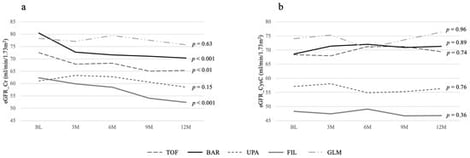
Estimated glomerular filtration rate (eGFR) from baseline over one year at every three months. Symbols on the right of each graph show the statistical significance (p-value) in the trend of eGFR in each drug group. There was no significant difference in eGFR across all pairs of groups at any time point. (a): eGFR based on creatinine. (b): eGFR based on cystatin C.
  • Systematic Review
  • Open Access

Background: Autoinflammatory bone disorders are rare, non-infectious inflammatory conditions that primarily involve the skeleton, most commonly presenting as chronic nonbacterial osteomyelitis (CNO) or chronic recurrent multifocal osteomyelitis (CRMO). Less frequently, they occur in the context of Mendelian syndromes such as Majeed syndrome, deficiency of the interleukin-1 receptor antagonist (DIRA), and pyogenic arthritis; pyoderma gangrenosum; and acne (PAPA) syndrome. Given the role of IL-1-driven innate immune dysregulation across these bone disorders, and the growing, though heterogeneous, clinical experience with IL-1 blockade, this review maps and critically appraises the available evidence on canakinumab in autoinflammatory bone disorders. Methods: We systematically searched PubMed and the Cochrane Library (English, inception–July 2025) and screened ClinicalTrials.gov. Eligible reports included any case reports/series describing canakinumab use in autoinflammatory bone disorders (CNO/CRMO, Majeed, DIRA, PAPA). Results: Six publications met the inclusion criteria (one case series, five case reports; 10 patients). Complete responses were reported in all three patients with Majeed syndrome and in two patients with sporadic CRMO associated with systemic features. Partial responses occurred in two additional sporadic CRMO cases, while no meaningful response was documented in DIRA. No interventional trials of canakinumab were identified on ClinicalTrials.gov for CNO/CRMO, Majeed, DIRA, or PAPA. Conclusions: Although the role of IL-1 in the pathogenesis of autoinflammatory bone disease provides a rationale for IL-1 blockade, evidence for canakinumab remains limited and heterogeneous, precluding definitive conclusions. Indicators of benefits appear most consistently in Majeed syndrome and in selected CRMO phenotypes.

4 February 2026

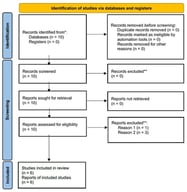
PRISMA 2020 flow diagram of study selection for the current work. * All the records were identified through PubMed/MEDLINE. No additional studies were identified via the Cochrane Library, and no interventional trials of canakinumab were registered on ClinicalTrials.gov for CNO/CRMO, Majeed, DIRA, or PAPA. ** One original article was excluded because it mentioned exposure to canakinumab but provided no extractable patient-level data beyond concomitant sJIA. Three reports were excluded since they were not original articles.
  • Systematic Review
  • Open Access

Effectiveness of Aquatic Exercise in the Management of Fibromyalgia Syndrome: A Systematic Review and Meta-Analysis

  • Sebastián Eustaquio Martín Pérez,
  • Jennifer Díaz García and
  • Isidro Miguel Martín Pérez
  • + 2 authors

Background/Objectives: Fibromyalgia syndrome (FMS) is a chronic condition characterized by widespread pain, fatigue, sleep disturbances, and psychological symptoms. Aquatic exercise offers the benefits of physical activity with reduced mechanical stress. This meta-analysis evaluated the effectiveness of AE on pain, functional physical status, and health-related quality of life. Methods: A PRISMA-guided systematic review and meta-analysis (PROSPERO CRD42025115158) included randomized and non-randomized trials up to October 2025 from MEDLINE (PubMed), Cochrane Library, PEDro, CINAHL Complete, SPORTDiscus, and Academic Search Ultimate. Eligible participants were adults diagnosed with FMS undergoing AE programs, alone or combined with other modalities. Standardized mean differences (SMD) with 95% confidence intervals were pooled using random- or fixed-effects models. Methodological quality, risk of bias, and certainty of evidence were evaluated using the PEDro scale, the RoB 2.0 tool, and the GRADE approach. Results: 27 trials (n = 1785; >95% women; mean age 44–62 years) were included. AE significantly improved pain (SMD = −0.92; 95% CI: −1.03 to −0.80; p < 0.00001), physical function (SMD = −0.74; 95% CI: −0.84 to −0.63; p < 0.00001), and HRQoL (SMD = 0.57; 95% CI: 0.42 to 0.72; p < 0.00001). Effects were consistent across time frames, though overall heterogeneity was considerable (Tau2 = 4.93; I2 = 97%). The mean PEDro score was 5.2/10, and RoB 2.0 indicated moderate methodological limitations mainly due to a lack of blinding. Evidence certainty was low for the main outcomes and moderate for adverse events. Conclusions: Aquatic exercise is an effective and safe complementary therapy for patients with FMS, alleviating pain while enhancing function and quality of life. However, methodological variability and small sample sizes warrant further high-quality trials to confirm these findings and explore underlying mechanisms.

2 February 2026

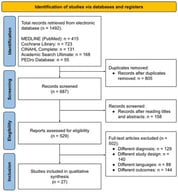
PRISMA 2020 flow diagram.

Background: Immunomodulatory therapies, including biologic and targeted synthetic disease-modifying antirheumatic drugs (DMARDs) have reshaped the treatment of autoimmune diseases. They alter host defenses, but the current landscape of associated infectious risk is not fully defined. Objective: A scoping review of recent literature was conducted to characterize infectious complications associated with modern immunomodulatory biologic agents, summarize current pathogen patterns, and highlight recommendations for prevention and early recognition in clinical practice. Methods: Following PRISMA-ScR guidelines, a systematic search was performed on Scopus, Science Direct, and PubMed for studies published since 2023. Inclusion criteria focused on adult human subjects, exposure to immunomodulatory therapy, and reported infectious outcomes. Studies focusing exclusively on antineoplastic agents without established use in autoimmune diseases were excluded. After screening 1046 unique records, 16 studies were included in the final review. Findings: High-dose glucocorticoids remain a primary driver of serious infections across autoimmune diseases. Newer agents present mechanism-specific risk profiles. JAK inhibitors are associated with herpes zoster, while TNF-α inhibitors are linked to opportunistic bacterial infections and reactivation of granulomatous infections. B-cell depletion with rituximab correlates with hypogammaglobulinemia and its associated infections, whereas belimumab may offer a lower infection risk in non-renal SLE. Recent post hoc analyses (2023–2025) quantify the elevated risk of herpes zoster with JAK inhibitors compared to TNF inhibitors, particularly in older populations. Conclusions: The infectious risk associated with biologic and targeted DMARDs varies by mechanism. While glucocorticoids remain a primary driver of serious infections, newer data highlights specific vulnerabilities with JAK inhibitors (herpes zoster) and B-cell depletion (hypogammaglobulinemia) that require targeted risk stratification. This review shows the urgent need for individualized risk stratification, targeted prophylaxis (e.g., for Pneumocystis or zoster), and pre-therapy screening to balance therapeutic efficacy with patient safety.

22 January 2026

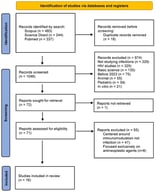
PRISMA 2020 flow diagram for this scoping review.

News & Conferences

Issues

Open for Submission

Editor's Choice

Get Alerted

Add your email address to receive forthcoming issues of this journal.

XFacebookLinkedIn
Rheumato - ISSN 2674-0621