
Communication

Short-Term Influence of Administering Janus Kinase Inhibitor on Renal Function in Patients with Rheumatoid Arthritis

1
Department of Rheumatology and Musculoskeletal Medicine, Yoshii Hospital, 6-7-5 Nakamura-Ohashidori, Shimanto City 787-0033, Kochi, Japan
2
Department of Rheumatology, Kochi Memorial Hospital, 4-13 Shiromi-cho, Kochi 780-0824, Kochi, Japan
3
Department of Rheumatology, Dohgo Onsen Hospital, 21-21 Himetsuka-Otsu, Matsuyama 790-0858, Ehime, Japan
*
Author to whom correspondence should be addressed.
Rheumato 2026, 6(1), 7; https://doi.org/10.3390/rheumato6010007

Submission received: 5 January 2026 / Revised: 2 February 2026 / Accepted: 6 February 2026 / Published: 13 February 2026

Abstract

Background/Objectives: The short-term effect of Janus kinase inhibitors (JAKis) on renal function in patients with rheumatoid arthritis (RA) was examined in a hypothesis-generating, exploratory study. Methods: RA patients treated with JAK inhibitors and, as a control group, those receiving golimumab and continuing treatment for one or more years were enrolled. They were monitored every 3 months for disease activity using the Simplified Disease Activity Index (SDAI), functional capacity using the Health Assessment Questionnaire Disability Index (HAQ), and renal function using the estimated glomerular filtration rate (eGFR) calculated from creatinine (Cr) and cystatin C (CysC). Patients were categorized by medication, and average values were computed. Two groups for each drug were then compared statistically. Results: A total of 144 patients were analyzed: 24 on tofacitinib, 43 on baricitinib, 21 on upadacitinib, 21 on filgotinib, and 35 on golimumab. Background factors did not differ significantly among groups. Improvements in CDAI and HAQ at any time point also showed no significant differences. eGFR based on Cr showed a significant decline in the baricitinib and filgotinib groups at one year after starting JAKi treatment compared with the other JAKi groups; however, there was no significant difference when using CysC. Conclusions: These results indicate that there is no significant difference in renal function decline among the JAKi drugs over a short period, despite differences in their metabolic pathways and renal excretion patterns.

1. Introduction

Rheumatoid arthritis (RA) is a disease that can lead to renal function decline due to persistent systemic inflammation, immune complex deposition, and long-term exposure to nephrotoxic agents [1]. Fifteen years have passed since Janus kinase inhibitors (JAKi) were approved for the treatment of RA. In clinical practice, they are now a vital part of Phase 2 of the T2T treatment approach. Currently, five JAKi are available in Japan for RA. Among them, two are mainly excreted through the kidneys, baricitinib (BAR) and filgotinib (FIL), both of which have restriction notes in the package insert [2,3]. It is reasonable to assume that metabolic pathways could increase the workload on the kidneys. JAK/STAT pathways promote glomerular fibrosis, which can lead to renal dysfunction [4,5,6,7,8]. JAK inhibitors suppress JAK/STAT pathways, potentially helping to prevent renal dysfunction [9]. However, few studies have examined their impact on renal function in real-world practice [10,11]. Some JAK inhibitors inhibit OCT2, MATE1, and MATE2-K, thereby reducing renal tubular creatinine excretion and increasing serum creatinine levels [12]. However, they do not inhibit renal function, and the effect of JAK inhibitors on renal function in clinical practice is unknown. Here, we examine the short-term effects of JAKi use on kidney function using a retrospective, hypothesis-generating, exploratory study.

2. Materials and Methods

Patients with RA who met the 2010 ACR/EULAR classification criteria [13] were recruited. They were treated according to the treat-to-target principle [14] and started on JAK inhibitors at our institution. Outpatients who continued for one or more years from September 2014 to November 2023 were enrolled in the study. Patients who dropped out for any reason within one year were excluded. As a control group, RA patients who met the classification criteria and received golimumab (GLM) from September 2011 to April 2022 were enrolled, and the same exclusion criteria were applied to these control patients.
Patient background information, including sex, age, anti-citrullinated polypeptide antibody (ACPA) titer, rheumatoid factor (RF) titer, use of biological or targeted synthetic disease-modifying antirheumatic drugs (bDMARDs or tsDMARDs) from Phase 2 onward (naive or subsequent), methotrexate usage rate (MTX-R), glucocorticoid usage rate (GC-R), and presence or absence of polypharmacy at the start of JAKi treatment (baseline; BL), was extracted from the medical records of the study patients. Additionally, estimated glomerular filtration rate (eGFR), Simplified Disease Activity Index (SDAI) as a marker of disease activity, Health Assessment Questionnaire Disability Index (HAQ) as a measure of activities of daily living (ADL), and pain score using a visual analog scale (PS-VAS) at baseline and three months afterward to assess pain severity were collected. Patients were classified by medication, and average values were calculated for each drug administered. These average parameter values, excluding eGFR, within each drug group, especially age and SDAI at BL, were adjusted using propensity score matching and then compared statistically with those in the control group. For eGFR, two values were calculated and compared: eGFR_Cr, based on creatinine, and eGFR_CysC, based on cystatin C.
The primary endpoint of the study is the change in eGFR over one year. Mean eGFR was calculated for each drug, and changes in eGFR were assessed at baseline (BL) and every three months thereafter. eGFR and overall change in each JAKi drug group during the treatment period were compared with those of the control group. Changes in chronic kidney disease (CKD) stage classification from BL to one year were also compared for each drug group, with worsening, no change, or improvement defined using Grade 3a/3b as the boundary.
Other parameters, including SDAI, HAQ, and PS-VAS from baseline, were also compared between the drug groups over the one-year period.

2.1. Statistical Procedures

For statistical analysis, t-tests compared two groups, and ANOVA compared multiple groups. A repeated-measures ANOVA evaluated changes over time, and a chi-square test assessed changes in CKD grade. Analyses were conducted using StatMac:Plus® v. 8.0.4.0 (Walnut Grove, CA, USA). Significance was set at p < 0.05.

2.2. Ethical Considerations

The study design and ethical considerations were reviewed and approved by the Ethics Committee of the study institution before the study began (approval number: G-Cl-2024-5). Subjects remained anonymous, and patients or their families provided informed consent.

3. Results

A total of 185 patients were analyzed, including 30 on tofacitinib (TOF), 51 on BAR, 39 on Upadacitinib (UPA), 30 on FI, and 35 on GLM. After PSM (matching rate ≥ 80%; caliper width ≤ 0.2; covariate balance after PSM ≤ 0.2 for every drug group: Supplementary Table S1), a total of 144 patients were analyzed: 24 on TOF, 43 on BAR, 21 on UPA, 21 on FIL, and 35 on GLM. Baseline demographics are presented in Table 1. There were no significant differences in mean age, RA disease duration, ACPA and RF titers, SDAI, HAQ, PS-VAS, eGFR based on Cr and CysC, MTX-R, GC-R, or polypharmacy rate. No patients had proteinuria.
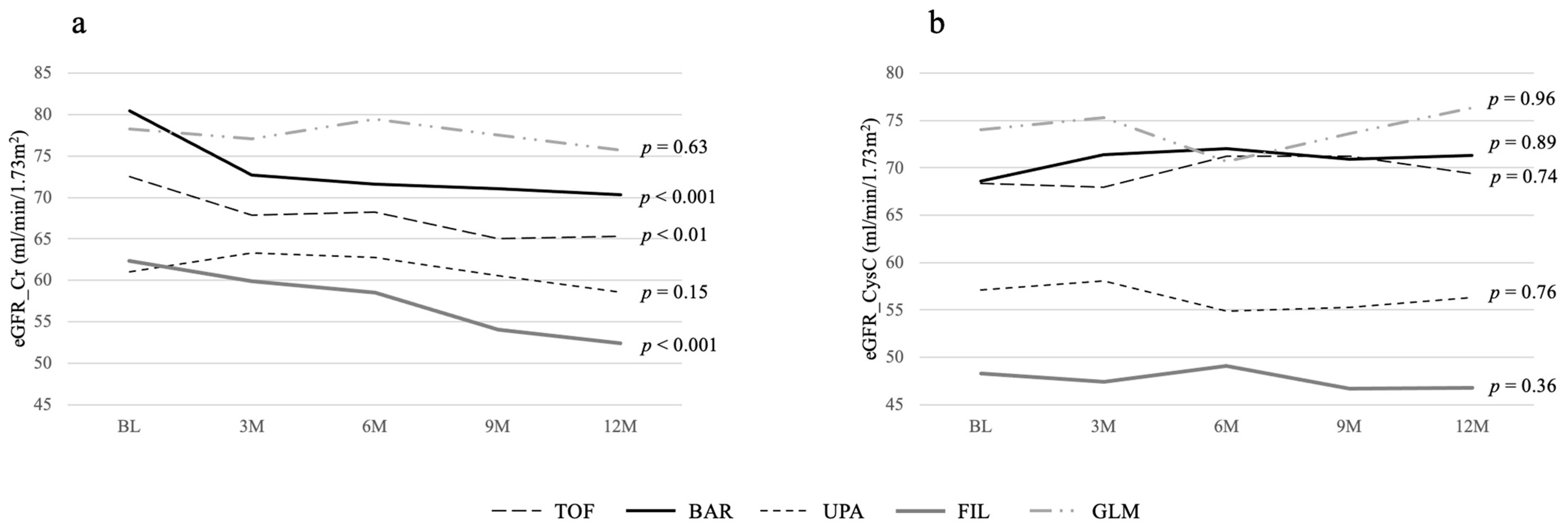
The mean eGFR based on Cr at baseline and at months 3, 6, 9, and 12 showed no significant differences between any pairs of drug groups. However, the eGFR at month 12 in the BAR and FIL groups was significantly lower than at BL (p < 0.05). Over one year, the eGFR trend showed an upward pattern in the BAR, FIL (p < 0.001), and TOF (p < 0.01) groups. The GLM and UPA groups did not show any significant trend (Figure 1a).
The mean eGFR_CysC at baseline and at months 3, 6, 9, and 12 did not differ significantly across any of the drug groups. Each group also showed no significant trend in eGFR_CysC over 1 year (Figure 1b).
The CKD stage classification showed no significant change across any of the drug groups. However, in the ≤G3a group, there were noticeably more cases of deterioration than improvement compared with the ≥G3b group in every drug category, with a clear trend in the JAKi groups relative to the GLM group. There were no significant differences in the number of cases between better and worse outcomes within each drug group (Table 2).
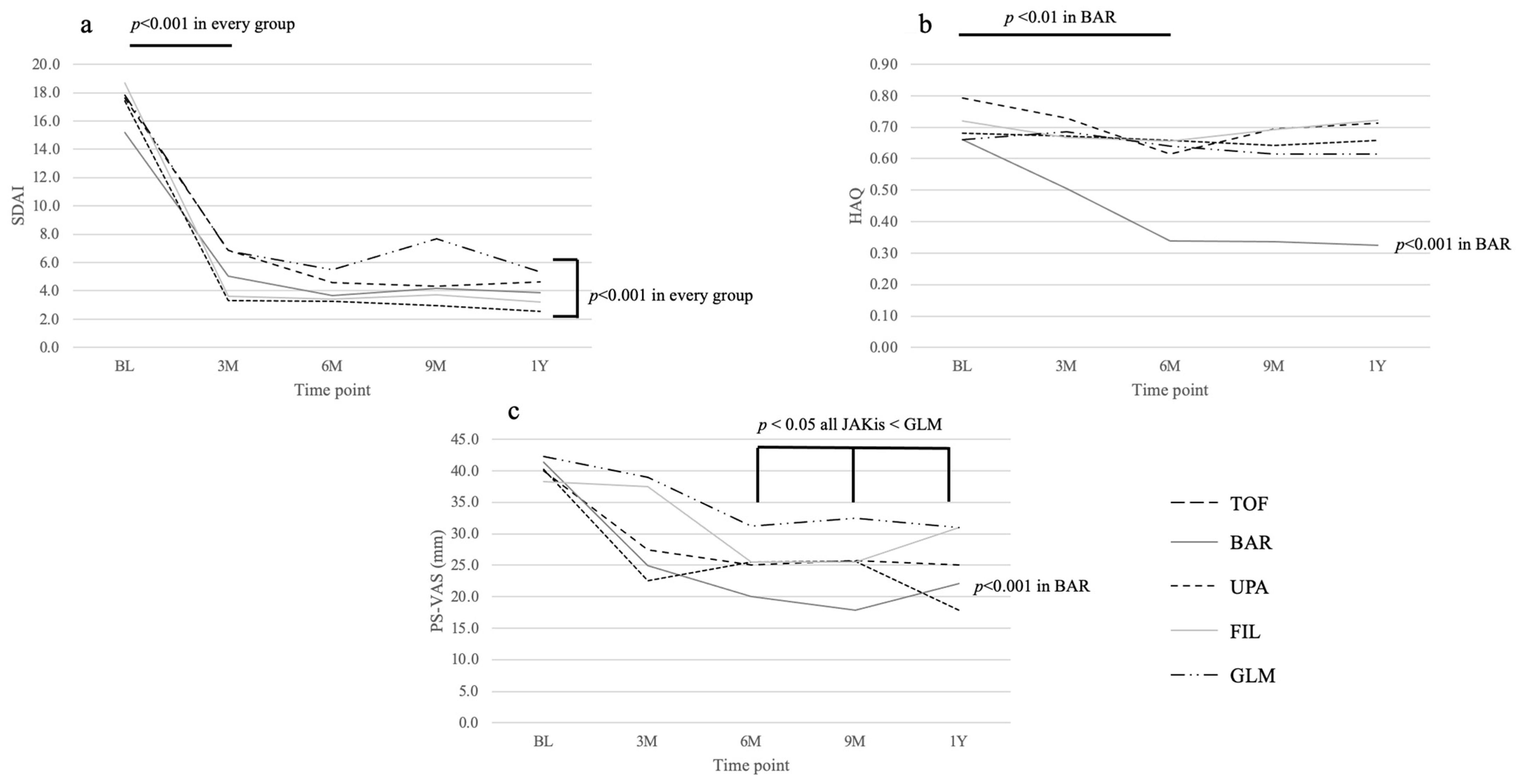
The mean SDAI score at baseline and at months 3, 6, 9, and 12 did not differ significantly across drug groups. A significant decrease from BL was observed at month 3 in each group (p < 0.001). After month 6, no further significant improvements were observed. All groups showed significant downward trends in the SDAI score over the year (p < 0.001) (Figure 2a).
Mean HAQ scores at baseline and at months 3, 6, 9, and 12 did not differ significantly among the drug groups. However, HAQ scores at months 3 and 6 in the BAR group were significantly lower than at baseline (p < 0.01). The BAR group showed a significant downward trend in HAQ scores (p < 0.001), whereas the other groups showed no significant trends over the year (Figure 2b).
At baseline and month 3, the average PS-VAS did not differ significantly between any JAKi group and the GLM group; however, the BAR group had significantly lower PS-VAS scores than the GLM group at months 6, 9, and 12 (p < 0.05). All groups showed a downward trend in PS-VAS from baseline to month 12 (p < 0.001) (Figure 2c).

4. Discussion

JAK inhibitors are small-molecule drugs that are clinically effective, comparable to biologics, and important for treating RA. Their metabolic pathways vary by drug. They are mainly divided into two groups: TOF, UPA, and Peficitinib, which are primarily eliminated via feces, and BAR and FIL, which are mainly excreted in urine.
Because fecal excretion is processed by the liver, it is not recommended for patients with severe liver damage. Conversely, urinary excretion is often contraindicated in patients with severe renal dysfunction [1,2,15,16,17,18]. The only indication is 100 mg FIL, which is allowed in patients with severe renal dysfunction [19]. The use of JAK inhibitors in patients with renal dysfunction is either prohibited or severely limited. The main reasons are not nephrotoxicity but concerns about drug safety [11,20].
However, renal excretion and nephrotoxicity are distinct phenomena and not synonymous with decreased renal function. Although administering urinary-excreted JAK inhibitors to patients with impaired renal function is considered contraindicated because of adverse effects from increased drug retention and unstable blood concentrations, renal toxicity caused by the drug does not necessarily lead to further functional decline. Even drugs excreted via feces are contraindicated in patients with severe renal dysfunction, mainly because of unstable blood concentrations [2,3,21,22]. However, to the best of my knowledge, no studies have examined the effect of JAK inhibitors on kidney function as a primary clinical outcome in real-world practice. In this study, we aimed to examine whether there are differences in changes in renal function among JAK inhibitors with different metabolic pathways.
JAKis are potentially creatinine-retaining drugs that suppress creatinine excretion from the renal tubule, resulting in a small elevation of creatinine [23]. One Japanese study found that serum creatinine was significantly higher in patients with RA receiving JAKis than in those receiving interleukin-6 (IL-6) inhibitors [24]. Another Japanese study reported that renal function was preserved in patients with RA who had moderate renal impairment [25]. The elevation in serum creatinine may reflect increased muscle volume [26]. JAKis suppress IL-6 overexpression, thereby exerting potent anti-inflammatory effects [1]. Overall, JAKis are likely to maintain renal function.
In this study, we aimed to eliminate confounding factors that could affect eGFR, so we used propensity score matching before making comparisons. Patients receiving JAK inhibitors were heterogeneous in terms of the drugs they received. Therefore, a control group was established, and potential confounding factors were matched to those in the control group using propensity score matching. As a result, although the number of cases decreased, the significant differences in candidate confounding factors disappeared. However, because body composition factors such as BMI and muscle mass and cardio-renal factors such as blood pressure and cardiac function were not originally measured, much data were missing and could not be analyzed.
We chose golimumab for the control group because it is a heavy-chain protein with low immunogenicity, a trait shared with monoclonal antibodies produced in transgenic mice [27]. Results showed no decline in renal function during follow-up in the control group. Compared with the control group, the JAKi groups showed a slight downward trend in creatinine-based eGFR during follow-up. Although statistical significance was observed only in the BAR and FIL groups at month 12, no downward trend was observed when cystatin C was used as the marker. Therefore, we emphasize that the observed eGFR_Cr decline is likely a physiological rather than a pathological phenomenon.
Urinary excretion of creatinine-based eGFR decreased significantly over one year. In contrast, fecal excretion type (excluding TOF) and GLM did not change significantly during this period. However, cystatin C-based eGFR did not decrease significantly in any drug group. The same was true for CKD classification. In the groups with CKD ≤ G3a and even in the group with CKD ≥ G3b, the same number of patients, or more, achieved a better CKD stage at month 12 than at baseline, excluding the UPA, as shown in Table 2.
Creatinine is commonly used in clinical settings as an indicator of kidney function; however, because it is primarily secreted by striated muscle, its levels are significantly affected by muscle mass [28]. Therefore, if ADL improves, activity levels increase, and muscle mass grows during treatment, eGFR may appear to decrease. In contrast, cystatin C is secreted by cells throughout the body and remains unaffected by muscle mass [29,30]. Consequently, it is thought to reflect kidney function more accurately. The absence of significant changes in eGFR_CysC during treatment suggests that JAK inhibitors did not impair renal function. These findings imply that the potential nephrotoxicity of JAK inhibitors, even for urine-excretion types, can be ruled out in the short term. This applies to both urinary and non-urinary excretion. While monitoring remains important, there is little reason to hesitate when administering the drug in cases of renal dysfunction, at least for short-term use.
This study did not analyze body composition, such as body mass index or sarcopenia. These factors are important for calculating eGFR, yet data are lacking in clinical studies. However, this study aimed to determine whether changes in eGFR calculated using cystatin C are affected by JAK inhibitor administration. It is believed that eGFR_CysC, at least, is not affected by body size. eGFR is expected to change over time with changes in blood pressure, but the absence of a significant change over time suggests that no factors would overturn the results regarding the effect of JAK inhibitors on renal function itself.
The limitations of this study include the following: (1) It is not a mid- to long-term follow-up study. (2) It was conducted at a single institution. Therefore, longitudinal data collected at multiple institutions over a long period are necessary to confirm the results. (3) The number of cases was small, and the populations in each group were clinically heterogeneous. Therefore, selection bias is recognized. (4) Adjustments for factors that may affect renal function, such as body mass index, baseline sarcopenia, and blood pressure control status, were not made. Therefore, a comprehensive study regarding JAK inhibitors and renal dysfunction is necessary. However, a report investigated the influence of NSAIDs on renal dysfunction and found no harmful decline in eGFR in patients with RA [31]. Therefore, it is important to emphasize that the results are not definitive. Longer-term results from studies conducted at multiple institutions are awaited.

5. Conclusions

We examined the effects of JAK inhibitors on the decline in kidney function among patients treated for more than 1 year. As a result, there was no significant decline in renal function during this period, as measured by cystatin C-based eGFR.

Supplementary Materials

The following supporting information can be downloaded at: https://www.mdpi.com/article/10.3390/rheumato6010007/s1, Supplementary Table S1: Demographics in the crude dataset at baseline.

Author Contributions

Conceptualization, I.Y.; Methodology, I.Y. and N.S.; Software, I.Y.; Validation, I.Y., T.C., and N.S.; Formal Analysis, I.Y.; Investigation, I.Y.; Resources, I.Y., T.C., and N.S.; Data Curation, I.Y.; Writing—Original Draft Preparation, I.Y.; Writing—Review and Editing, I.Y., T.C. and N.S.; Visualization, I.Y.; Supervision, T.C. and N.S.; Project Administration, I.Y. All authors have read and agreed to the published version of the manuscript.

Funding

This research received no external funding.

Institutional Review Board Statement

This study was approved by the Genyu Ethics Committee (approval number: G-Cl-2024-6) on 27 December 2024, in accordance with the ethical standards set forth in the 1964 Declaration of Helsinki and its subsequent amendments. In addition, anonymity was ensured for all patients and their families who participated in this study, and no names or addresses that could identify these individuals were disclosed.

Informed Consent Statement

Anonymity was ensured for all patients and families who participated in this study, and no names or addresses were provided that could identify these individuals. Informed consent was obtained from all subjects involved in the study.

Data Availability Statement

The data that support the findings of this study are not openly available due to reasons of sensitivity and are available from the corresponding author upon reasonable request.

Acknowledgments

The author acknowledges Kaoru Kuwabara, Sayori Masuoka, Eri Morichika, and Aoi Yoshida for their dedicated data collection. The author also acknowledges Saori Tamura for the identical X-ray imaging techniques. During the preparation of this manuscript/study, the authors used Grammarly (version 1.152.1.0) for the purposes of improving the manuscript’s readability and language. The authors have reviewed and edited the output and take full responsibility for the content of this publication.

Conflicts of Interest

None of the authors and their families have shared income or property with any person, or received any grants or other financial support for this study.

References

  1. Ichinose, K. The Interplay Between Rheumatoid Arthritis and Chronic Kidney Disease: From Mechanisms to Treatment. J. Clin. Med. 2025, 15, 108. [Google Scholar] [CrossRef]
  2. Available online: https://www.accessdata.fda.gov/drugsatfda_docs/label/2022/207924s006lbl.pdf (accessed on 26 August 2025).
  3. Available online: https://www.ema.europa.eu/en/documents/product-information/jyseleca-epar-product-information_en.pdf (accessed on 26 August 2025).
  4. Chuang, P.Y.; He, J.C. JAK/STAT signaling in renal diseases. Kidney Int. 2010, 78, 231–234. [Google Scholar] [CrossRef]
  5. Brosius, F.C., 3rd; He, J.C. JAK inhibition and progressive kidney disease. Curr. Opin. Nephrol. Hypertens. 2015, 24, 88–95. [Google Scholar] [CrossRef] [PubMed]
  6. Zhang, Y.; Jin, D.; Kang, X.; Zhou, R.; Sun, Y.; Lian, F.; Tong, X. Signaling Pathways Involved in Diabetic Renal Fibrosis. Front. Cell Dev. Biol. 2021, 9, 696542. [Google Scholar] [CrossRef] [PubMed]
  7. Liu, J.; Wang, F.; Luo, F. The Role of JAK/STAT Pathway in Fibrotic Diseases: Molecular and Cellular Mechanisms. Biomolecules 2023, 13, 119. [Google Scholar] [CrossRef] [PubMed]
  8. Lee, S.H.; Kim, K.H.; Lee, S.M.; Park, S.J.; Lee, S.; Cha, R.H.; Lee, J.W.; Kim, D.K.; Kim, Y.S.; Ye, S.K.; et al. STAT3 blockade ameliorates LPS-induced kidney injury through macrophage-driven inflammation. Cell Commun. Signal. 2024, 22, 476. [Google Scholar] [CrossRef] [PubMed]
  9. Mohamed, M.F.; Trueman, S.; Feng, T.; Anderson, J.; Marbury, T.C.; Othman, A.A. Characterization of the Effect of Renal Impairment on Upadacitinib Pharmacokinetics. J. Clin. Pharmacol. 2019, 59, 856–862. [Google Scholar] [CrossRef]
  10. Hilley, P.; Con, D.; Choy, M.C.; Srinivasan, A.; De Cruz, P. Upadacitinib in end stage renal disease: A case of acute severe ulcerative colitis. JGH Open 2023, 7, 1012–1015. [Google Scholar] [CrossRef]
  11. Nakayama, Y.; Onishi, A.; Yamamoto, W.; Yoshikawa, A.; Shiba, H.; Yoshida, N.; Son, Y.; Shirasugi, I.; Maeda, T.; Katsushima, M.; et al. Safety of Janus kinase inhibitors compared to biological DMARDs in patients with rheumatoid arthritis and renal impairment: The ANSWER cohort study. Clin. Exp. Med. 2024, 24, 97. [Google Scholar] [CrossRef]
  12. Zhang, Y.; Warren, M.S.; Zhang, X.; Diamond, S.; Williams, B.; Punwani, N.; Huang, J.; Huang, Y.; Yeleswaram, S. Impact on creatinine renal clearance by the interplay of multiple renal transporters: A case study with INCB039110. Drug Metab. Dispos. 2015, 43, 485–489. [Google Scholar] [CrossRef]
  13. Aletaha, D.; Neogi, T.; Silman, A.J.; Funovits, J.; Felson, D.T.; Bingham, C.O., 3rd; Birnbaum, N.S.; Burmester, G.R.; Bykerk, V.P.; Cohen, M.D.; et al. 2010 Rheumatoid arthritis classification criteria: An American College of Rheumatology/European League Against Rheumatism collaborative initiative. Ann. Rheum. Dis. 2010, 69, 1892. [Google Scholar] [CrossRef] [PubMed]
  14. Smolen, J.S.; Aletaha, D.; Bijlsma, J.W.; Breedveld, F.C.; Boumpas, D.; Burmester, G.; Combe, B.; Cutolo, M.; de Wit, M.; Dougados, M.; et al. Treating rheumatoid arthritis to target: Recommendations of an international task force. Ann. Rheum. Dis. 2011, 70, 1519. [Google Scholar] [CrossRef]
  15. Vyas, D.; O’Dell, K.M.; Bandy, J.L.; Boyce, E.G. Tofacitinib: The First Janus Kinase (JAK) inhibitor for the treatment of rheumatoid arthritis. Ann. Pharmacother. 2013, 47, 1524–1531. [Google Scholar] [CrossRef] [PubMed]
  16. Nash, P.; Kerschbaumer, A.; Dörner, T.; Dougados, M.; Fleischmann, R.M.; Geissler, K.; McInnes, I.; Pope, J.E.; van der Heijde, D.; Stoffer-Marx, M.; et al. Points to consider for the treatment of immune-mediated inflammatory diseases with Janus kinase inhibitors: A consensus statement. Ann. Rheum. Dis. 2021, 80, 71–87. [Google Scholar] [CrossRef]
  17. Nishimura, A.; Tateiwa, M.; Tajima, S.; Tada, T. Efficacy of peficitinib in two patients with rheumatoid arthritis on maintenance hemodialysis. J. Rural Med. 2022, 17, 193–195. [Google Scholar] [CrossRef]
  18. Stamatis, P.; Bogdanos, D.P.; Sakkas, L.I. Upadacitinib tartrate in rheumatoid arthritis. Drugs Today 2020, 56, 723–732. [Google Scholar] [CrossRef]
  19. Grimm, S.E.; Wijnen, B.; Riemsma, R.; Fayter, D.; Armstrong, N.; Ahmadu, C.; Brandts, L.; Misso, K.; Kirwan, J.R.; Kleijnen, J.; et al. Filgotinib for Moderate to Severe Rheumatoid Arthritis: An Evidence Review Group Perspective of a NICE Single Technology Appraisal. Pharmacoeconomics 2021, 39, 1397–1410. [Google Scholar] [CrossRef] [PubMed]
  20. Okamoto, N.; Atsumi, T.; Takagi, M.; Takahashi, N.; Takeuchi, T.; Tamura, N.; Nakajima, A.; Nakajima, A.; Fujii, T.; Matsuno, H.; et al. Safety of baricitinib in Japanese patients with rheumatoid arthritis in clinical use: 3-year data of all-case postmarketing surveillance study. Mod. Rheumatol. 2025, 35, 215–224. [Google Scholar] [CrossRef]
  21. Available online: https://www.accessdata.fda.gov/drugsatfda_docs/label/2025/203214s038%2C208246s025%2C213082s010lbl.pdf?utm_source=chatgpt.com (accessed on 26 August 2025).
  22. Available online: https://www.accessdata.fda.gov/drugsatfda_docs/label/2019/211675s000lbl.pdf (accessed on 26 August 2025).
  23. Riese, R.J.; Krishnaswami, S.; Kremer, J. Inhibition of JAK kinases in patients with rheumatoid arthritis: Scientific rationale and clinical outcomes. Best Pract. Res. Clin. Rheumatol. 2010, 24, 513–526. [Google Scholar] [CrossRef]
  24. Tada, M.; Okano, T.; Mamaoto, K.; Yamada, Y.; Orita, K.; Mandai, K.; Anno, S.; Iida, T.; Inui, K.; Koike, T. Comparison of creatine kinase elevation caused by Janus kinase inhibitors and interleukin-6 inhibitors in patients with rheumatoid arthritis: A propensity score-matched study. Arch. Rheumatol. 2024, 39, 350–357. [Google Scholar] [CrossRef]
  25. Maeyama, A.; Kondo, M.; Harada, H.; Shono, E.; Nagamine, R.; Tsuru, T.; Inoue, Y.; Nakashima, M.; Yamasaki, Y.; Niiro, H.; et al. Efficacy and safety of baricitinib in rheumatoid arthritis patients with moderate renal impairment: A multicenter propensity score matching study. BMC Rheumatol. 2024, 8, 69. [Google Scholar] [CrossRef]
  26. Bennett, J.L.; Hollingsworth, K.G.; Pratt, A.G.; Degnan, A.E.A.; Gorman, G.S.; Feeney, C.; Naamane, N.; Nsengimana, J.; Sayer, A.A.; Anderson, A.E.; et al. Skeletal muscle effects of Janus kinase inhibition in rheumatoid arthritis (RAMUS): A single-arm, experimental medicine study. Lancet Rheumatol. 2026, 8, e42–e52. [Google Scholar] [CrossRef] [PubMed]
  27. Available online: https://www.accessdata.fda.gov/drugsatfda_docs/label/2011/125289s0064lbl.pdf (accessed on 27 August 2025).
  28. Shahbaz, H.; Rout, P.; Gupta, M. Creatinine Clearance. In StatPearls [Internet]; StatPearls Publishing: Treasure Island, FL, USA, 2024. Available online: https://www.ncbi.nlm.nih.gov/books/NBK544228/ (accessed on 26 August 2025).
  29. Haines, R.W.; Fowler, A.J.; Liang, K.; Pearse, R.M.; Larsson, A.O.; Puthucheary, Z.; Prowle, J.R. Comparison of Cystatin C and Creatinine in the Assessment of Measured Kidney Function during Critical Illness. Clin. J. Am. Soc. Nephrol. 2023, 18, 997–1005. [Google Scholar] [CrossRef] [PubMed]
  30. Farrington, D.K.; Surapaneni, A.; Matsushita, K.; Seegmiller, J.C.; Coresh, J.; Grams, M.E. Discrepancies between Cystatin C-Based and Creatinine-Based eGFR. Clin. J. Am. Soc. Nephrol. 2023, 18, 1143–1152. [Google Scholar] [CrossRef]
  31. Möller, B.; Pruijm, M.; Adler, S.; Scherer, A.; Villiger, P.M.; Finckh, A. Chronic NSAID use and long-term decline of renal function in a prospective rheumatoid arthritis cohort study. Ann. Rheum. Dis. 2015, 74, 718–723. [Google Scholar] [CrossRef] [PubMed]
Figure 1. Estimated glomerular filtration rate (eGFR) from baseline over one year at every three months. Symbols on the right of each graph show the statistical significance (p-value) in the trend of eGFR in each drug group. There was no significant difference in eGFR across all pairs of groups at any time point. (a): eGFR based on creatinine. (b): eGFR based on cystatin C.
Rheumato 06 00007 g001
Figure 2. Simplified Disease Activity Index (SDAI), Health Assessment Questionnaire Disability Index (HAQ), and pain score using a visual analog scale (PS-VAS) from baseline over one year at every three months. p-values in the trend of each indicator in each drug group. The bar above the graph illustrates a significant difference in each indicator compared to the baseline or compared to the indicator in the control group (golimumab; GLM) at each time point. (a): The SDAI score. (b): The HAQ score. (c): PS-VAS.
Rheumato 06 00007 g002
Table 1. Demographic characteristics in each drug group at baseline.
TOF (N = 24)BAR (N = 43)UPA (N = 21)FIL (N = 21)GLM (N = 35)Statistical Significance
Female proportion70.6%72.4%66.7%86.7%86.4%n.s.
Mean age at baseline68.8 (11.9)68.2 (12.2)73.6 (10.8)74.9 (17.1)67.5 (9.7)n.s.
Disease duration at baseline9.4 (7.2)12.7 (7.6)13.1 (7.6)14.5 (7.9)9.7 (7.0)n.s.
Naïve rate 59.4%60.5%66.7%47.6%51.4%n.s.
ACPA titer (positive rate)336.0 (76.5%)396.7 (82.8%)293.6 (77.1%)151.4 (73.3%)118.1 (54.5%)n.s. (n.s.)
RF titer (positive rate)217.6 (76.5%)219.1 (82.8%)165.6 (77.1%)219.9 (80.0%)165.9 (63.5%)n.s. (n.s.)
SDAI17.6 (7.3)15.2 (9.2)17.4 (6.3)18.7 (14.1)17.8 (6.9)n.s.
HAQ0.792 (0.511)0.660 (0.590)0.681 (0.485)0.720 (0.582)0.660 (0.513)n.s.
PS-VAS (mm)40.0 (26.7)41.4 (23.3)40.2 (33.0)38.3 (35.6)42.3 (29.1)n.s.
eGFR_Cr (ml/min/1.73 m2)72.5 (24.9)80.5 (22.6)61.0 (28.1)62.3 (26.8)78.3 (18.4)n.s.
eGFR_CysC (ml/min/1.73 m2)68.4 (18.1)68.6 (24.3)57.1 (20.1)48.3 (21.6)74.1 (11.8)n.s.
MTX usage rate 82.4%72.4%71.4%71.4%86.4%n.s.
GC usage rate 8.3%4.7%4.8%4.8%5.7%n.s.
NSAID usage rate33.3%30.2%33.3%28.6%34.3%n.s.
Polypharmacy rate29.4%25.2%20.0%21.4%19.0%n.s.
proteinuria0%0%0%0%0%n.s.
In parentheses, standard deviations are presented. Abbreviations: TOF, tofacitinib; BAR, baricitinib; UPA, upadacitinib; FIL, filgotinib; GLM, golimumab; ACPA, anti-citrullinated polypeptide antibodies; RF, rheumatoid factor; SDAI, Simplified Disease Activity Index; HAQ, Health Assessment Questionnaire Disability Index; PS-VAS, pain score using a visual analog scale; eGFR_Cr, estimated glomerular filtration rate calculated with creatinine; eGFR_CysC, estimated glomerular filtration rate calculated with cystatin C; MTX, methotrexate; GC, glucocorticoid; NSAID, non-steroidal anti-inflammatory drug.
Table 2. Changes in CKD stage classification from the baseline to one year after for each drug group.
Creatinine-BasedCystatin C-Based
BARbetterNCworse BARbetterNCworse
≤G3a3131743≤G3a313343
≥G3b136≥G3b7134
FILbetterNCworse FILbetterNCworse
≤G3a12521≤G3a11121
≥G3b274≥G3b4113
TOFbetterNCworse TOFbetterNCworse
≤G3a351224≤G3a217124
≥G3b031≥G3b220
UPAbetterNCworse UPAbetterNCworse
≤G3a16421≤G3a07321
≥G3b352≥G3b263
GLMbetterNCworse GLMbetterNCworse
≤G3a322735≤G3a321335
≥G3b021≥G3b242
Abbreviations: TOF, tofacitinib; BAR, baricitinib; UPA, upadacitinib; FIL, filgotinib; GLM, golimumab; ≤G3a, a patient group whose CKD stage is no worse than Grade-3a; G3b, a patient group whose CKD stage is no better than Grade-3b in the chronic kidney diseases classification criteria; NC, not changed.
Disclaimer/Publisher’s Note: The statements, opinions and data contained in all publications are solely those of the individual author(s) and contributor(s) and not of MDPI and/or the editor(s). MDPI and/or the editor(s) disclaim responsibility for any injury to people or property resulting from any ideas, methods, instructions or products referred to in the content.