

- Article

A Machine Learning Framework for Daily Mangrove Net Ecosystem Exchange Prediction from 2000 to 2025
- Linlin Ruan,
- Li Zhang and
- Jian Zuo
- + 4 authors
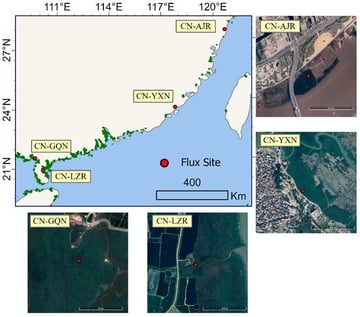
Mangrove ecosystems are important blue carbon systems and play a critical role in understanding carbon cycling and responses to climate change. However, accurate regional estimation of Net Ecosystem Exchange (NEE) remains challenging due to the environmental complexity and spatial heterogeneity. This study combined eddy covariance observations from four mangrove sites along China’s southeastern coast (natural and restored mangrove forests) with multi-source remote sensing and environmental reanalysis data to construct three variable schemes (site observations only, with added vegetation indices, and comprehensive multi-source variables). We compared three machine learning models for daily NEE prediction, including eXtreme Gradient Boosting (XGBoost), Random Forest (RF), and Support Vector Machine (SVM). The results showed that: (1) Restored and natural mangroves exhibited similar temporal NEE dynamics and consistently functioned as carbon sinks, restored mangrove sites showed greater cross-site variability. Among the study sites, CN-LZR exhibited the strongest cumulative carbon uptake. (2) Scheme 3 combined with the XGBoost algorithm achieved the highest predictive accuracy, reaching an R2 of 0.73 across sites. Differences among machine learning models were primarily associated with their ability to capture nonlinear interactions between atmospheric and hydrological variables, with tree-based models outperforming SVM. (3) SHAP analysis indicated that radiation-related variables were the dominant drivers of NEE, while hydrological influences were site-dependent; and (4) Regional upscaling indicated that all sites consistently functioned as long-term carbon sinks, with CN-LZR exhibiting slightly higher daily mean carbon uptake than the other sites. This study presented the first machine learning framework for estimating daily-scale NEE in mangroves, providing methodological and data support for regional carbon flux assessment and blue carbon management.
22 February 2026
![Average image and text intra-modal similarity scores for natural datasets (Flickr30K and MSCOCO) and remote sensing datasets (RSITMD and RSICD) using different encoders. The ViT variants are derived from the CLIP image encoder. Paraphrase-MiniLM-L6-v2 [20], all-mpnet-base-v2 [20], and bge-large-en-v1.5 [21] are specifically trained for text similarity computation.](https://mdpi-res.com/cdn-cgi/image/w=281,h=192/https://mdpi-res.com/remotesensing/remotesensing-18-00662/article_deploy/html/images/remotesensing-18-00662-g001-550.jpg)