Article

Ski Areas and Snow Reliability Decline in the European Alps Under Increasing Global Warming—A Remote Sensing Perspective


1
German Remote Sensing Data Center (DFD), Earth Observation Center (EOC), German Aerospace Center (DLR), 82234 Weßling, Germany
2
Geological Survey of Denmark and Greenland (GEUS), 1350 Copenhagen, Denmark
3
Institute for Geography and Geology, University of Wuerzburg, 97074 Wuerzburg, Germany
4
IDC Tourism and Leisure in Mountain Regions, University of Innsbruck, 6020 Innsbruck, Austria
*
Author to whom correspondence should be addressed.
Remote Sens. 2026, 18(3), 491; https://doi.org/10.3390/rs18030491
Submission received: 9 December 2025 / Revised: 19 January 2026 / Accepted: 31 January 2026 / Published: 3 February 2026
(This article belongs to the Section Environmental Remote Sensing)

Highlights

What are the main findings?
  • We provide the first long-term remote sensing assessment of snow reliability for ski tourism in the European Alps by combining nearly 40 years of Landsat-based snowline elevation with ski infrastructure and elevation data.
  • Our results show that snow reliability has decreased in nearly all Alpine ski areas, with the strongest losses in the late season and more pronounced declines at the geographical edges of the Alps.
What are the implications of the main findings?
  • The findings indicate that Alpine snow seasons are shortening at rates near or above previous high scenario projections, resulting in increasing pressure on winter tourism and a rising dependence on snowmaking.

Abstract
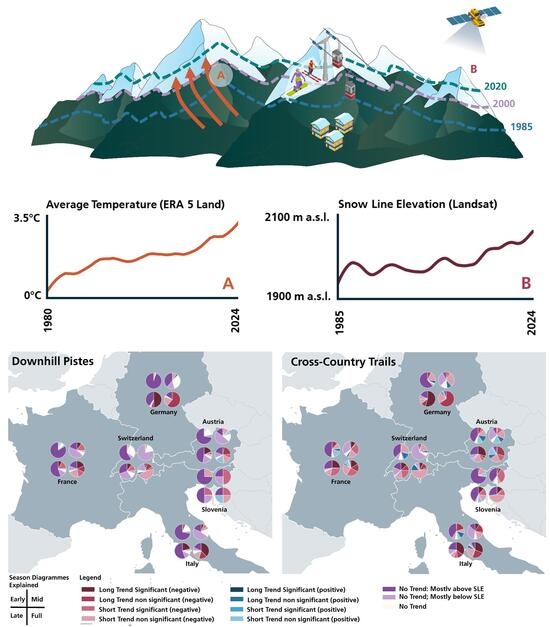
The snowpack in the European Alps is declining due to global warming, which affects both the amount of seasonal snow and the timing of accumulation and melt. As the European Alps is the largest winter tourism destination in the world by revenue, this decline in natural snow poses an existential threat to the sector. Several smaller ski areas have closed permanently since 1980, and all Alpine regions face rising costs due to an increasing reliance on snowmaking. Professional winter sports are also affected, with several canceled events in recent years due to unsuitable snow conditions. In this study, we present the first remote sensing-based assessment of long-term snow reliability for winter tourism in the European Alps. Using snowline elevation (SLE) data derived from Landsat observations from 1985 to 2024, combined with OpenStreetMap ski infrastructure data and digital elevation models, we quantified the monthly snow coverage of ski area segments across 43 Alpine basins. Theil–Sen trends and Mann–Kendall significances were calculated for the full season and for three subseasons, with quality checks applied to guarantee sufficient data coverage. The results show predominantly negative trends across all seasons, with the strongest declines occurring in the late season. In this period, 97.8% of all downhill ski areas and 99.5% of the cross-country ski areas for which a trend was derived exhibited negative trends. For the full season, the corresponding shares were 94% for downhill ski areas and 99.2% for cross-country ski areas. In addition, areas located at the geographical edges of the European Alps showed more pronounced negative trends compared with the core regions. These findings align with previous studies on the subject and highlight the ongoing shortening of natural snow seasons and thus the increased challenges for the winter tourism sector in the Alps.

Graphical Abstract

1. Introduction

Rising temperatures are causing a persistent reduction in natural snow in the European Alps, with far-reaching consequences for winter sports. This change affects both the amount of seasonal snow and the timing of accumulation and melt, thereby altering key conditions for Alpine winter tourism [1,2,3]. However, considering both the declining snowpack and the economic relevance of winter tourism in the European Alps, comparative region-wide assessments based on satellite data are still limited, which this study aims to address by providing an initial systematic assessment.
Determining comprehensive numbers that describe the extent and relevance of the winter tourism industry in the Alps is challenged by limited data availability, data fragmentation, and prevailing business practices. However, through a combination of the scientific literature, open-source data, reports from industry and non-governmental organizations (NGOs), and news articles, the scope can be roughly approximated. Global ski tourism reached 366 million skier visits in the 2023/24 season. The European Alps accounted for 162.5 million of these visits, which equals a share of 44.4 percent of the global attendance. This makes the Alps the most ski tourism-intensive region worldwide [4]. The European Alps host more than 20,000 km of downhill skiing pistes [5] and 8000 km of cross-country trails [5]. According to an industry report regarding Austrian ropeway operators, the overall gross revenue of the winter tourism industry in Austria for the 2023/24 season was estimated at EUR 12.6 billion [6]. When extrapolated based on ski lift visits per country across the Alpine region [4], the total winter tourism revenue can be approximated at around EUR 40 billion. For the purpose of this paper, the Alpine region is defined as the parts of Austria, France, Germany, Italy, Slovenia, and Switzerland within the Alpine Convention perimeter [7]. Moreover, our rough estimations do not account for country-specific differences in purchasing power or price levels. Depending on the economic output and the size of the winter tourism industry in the respective country, the industry accounts for a considerable share of the GDP in alpine countries. In Austria, for instance, winter tourism contributed around 6% to the GDP in the year 2024 [6,8]. It must, however, be noted that winter tourism not only plays a considerable role in the overall economic structure of these alpine countries but also generates value added in predominantly remote and thus economically weaker regions [9,10]. For instance, in Swiss mountain regions, as described in industry statistics from the Swiss Ropeway Association, tourism as a whole accounts for around 20% of the gross regional product and about 25% of all jobs, with winter tourism representing a major share of this economic activity [11]. Due to the impacts of climate change, winter tourism in the European Alps faces potentially existential threats and challenges [3,10,12]. The air temperature in the Alps is warming faster than the global average and has already increased by approximately 2.0 ± 0.3 °C compared to pre-industrial levels [13,14]. Since 1980, the warming rate has accelerated to about 0.5 °C per decade, with an estimated temperature increase of 1.3–1.5 °C over this period (1980–2022) [15,16]. This results in a decline in the snowpack in the European alps, especially in the early (November/December) and late (March/April) periods of the season, as shown by various studies [1,2,17,18]. Based on the data of Köhler [18], the snowline elevation (SLE) has risen by 157 m since 1980 on average over our study area, which corresponds to a rise of approximately 104–120 m per 1 °C warming. This not only threatens the foundational needs of the industry but also raises the costs for infrastructure and the operation of ski areas, due to the increased demand for snowmaking, and it increases the uncertainty in predicting slope conditions and thus skier visits [10,12,19,20]. Even though the scientific evidence base on this subject is limited, reports and news articles allow an approximation of at least 500 ski area closings since 1950 in the European Alps, due—at least partly—to altering climatic conditions (France: Métral [21,22]; Switzerland: Galichet and Tombez [23]; Austria: Steiger et al. [24]; Italy: Bonardo et al. [25], Euronews [26]; Germany: DPA/The Local Germany [27], Bergbahnen.org [28]; General: OECD [29], marmotamaps [30]). Furthermore, Mitterwallner et al. [3] project that, in the European Alps, the mean number of natural annual snow cover days in current ski areas will decrease from historical values (1981–2010) from 218 to 137 days by 2071–2100 under a high-emissions scenario (SSP3-7.0), corresponding to the loss of 81 snow cover days. They also find that, globally, around 13% of all current ski areas are projected to lose 100% of their annual snow cover days and a further 20% to lose between 50% and 100% by 2071–2100 under the SSP3-7.0 scenario. This is consistent with François et al. [12], who quantify a snow supply risk for European ski tourism and show that, without snowmaking, 53% and 98% of the 2234 ski resorts studied in Europe would face a very high snow supply risk at global warming levels of 2 °C and 4 °C, respectively. In the same study, the annual water demand for snowmaking is projected to increase by roughly 8–25% at 2 °C and 14–42% at 4 °C warming compared to 1961–1990, depending on the country. These findings are broadly in line with Damm et al. [31], who estimate that +2 °C global warming would shorten the natural ski season by an average of about 19 days across 119 European NUTS-3 regions.
This not only manifests as a shift in revenue from small, low-altitude ski areas to larger, high-altitude ski areas but also as a reduction in skier visits in the affected regions [3,10,12]. In response to the increasingly challenging climatic conditions and rising economic pressures, the use of snowmaking in the Alps has become increasingly widespread [12]. Similarly to other aspects of the winter tourism industry, scientific evidence on the extent snowmaking is limited. However, if we combine the numbers stated in an industry report on Swiss ropeway operators [11] and the ski piste data from OpenStreetMap, which we also use for our analysis [5], it can be approximated that around 60% or ≈12,000 km of downhill pistes are artificially snowed in the European Alps. A survey by Aigner et al. [32] estimates that, in Austria, annually, 48.9 to 53 Mio. m3 of freshwater and 260 to 309 GWh electrical power are used for snowmaking. Again, using the OSM data [5] to scale these values up to the entire Alps, we estimate that snowmaking requires ∼132–143 Mio. m3 water and ∼706–839 GWh of electrical power annually. These estimates do not take into account local power-generating and water supply infrastructure and efficiency, or the altitude levels of the ski areas, and only serve as a general indicator.
Apart from the challenges seen in winter tourism, global warming can be observed as a disruptive factor in professional winter sports. Considering all Winter Olympics outdoor disciplines, 52 competitions have been canceled entirely or partly due to a lack of snow and high temperatures since the 2022/23 season. Out of these 52 cancellations worldwide, 47 affected competitions in the European Alps (compiled from the organizing bodies’ databases—skiing and snowboarding: [33]: biathlon [34]; bobsleigh and skeleton: [35]; luge: [36]). This is of particular interest as, with the Winter Olympics 2026 (in Milan/Cortina, IT) and 2030 (in the French Alps), as well as multiple World Championships in Olympic disciplines (e.g., downhill skiing in Crans Montana, CH, 2027 and Val Gardena, IT, 2031; freestyle skiing and snowboarding in Montafon, AT, 2027; biathlon in Hochfilzen, AT, 2028), the European Alps have been selected to host various top-level winter sport championships, complementing the annual events organized at different competitive levels in these disciplines. [33,34,37].
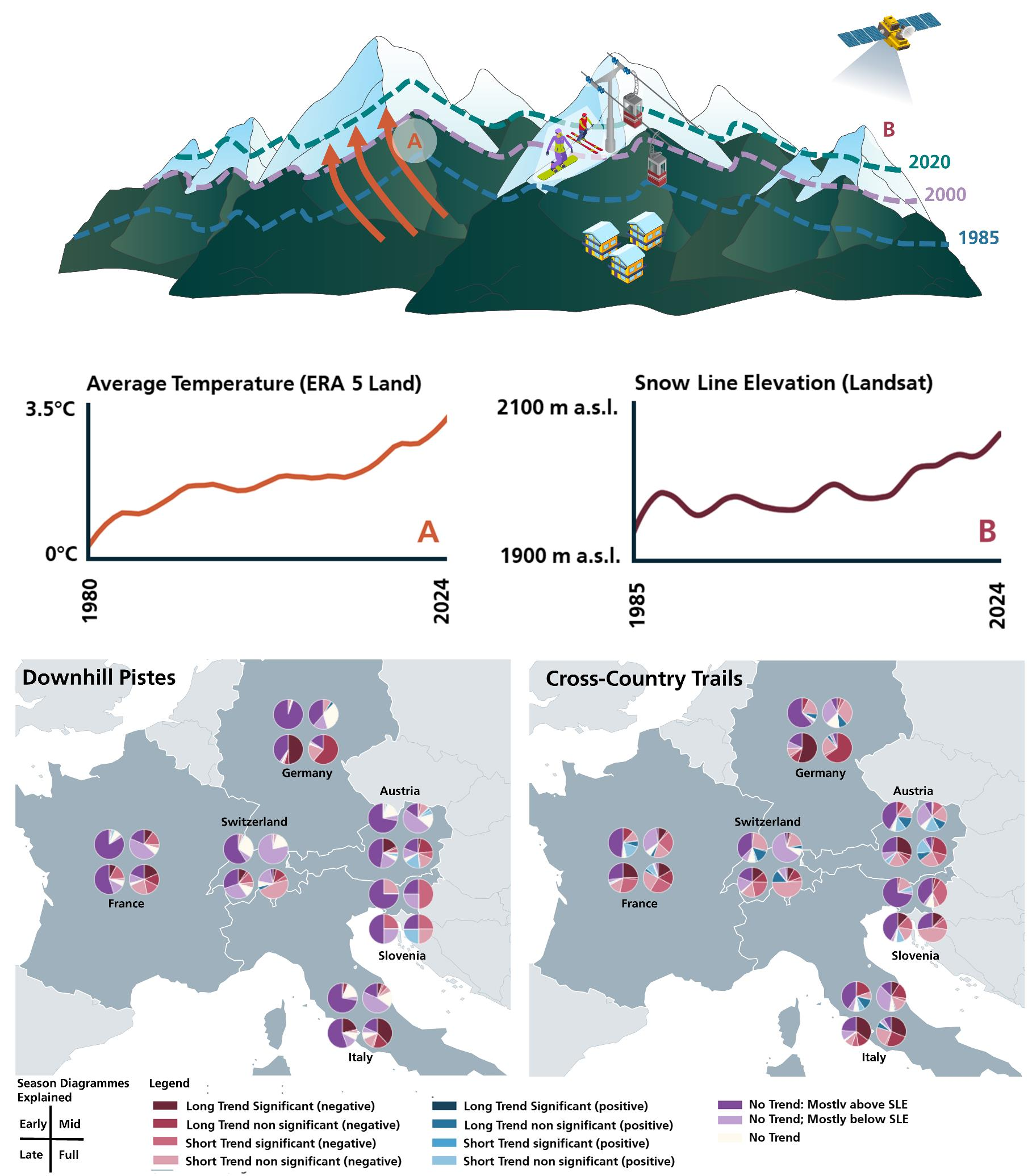
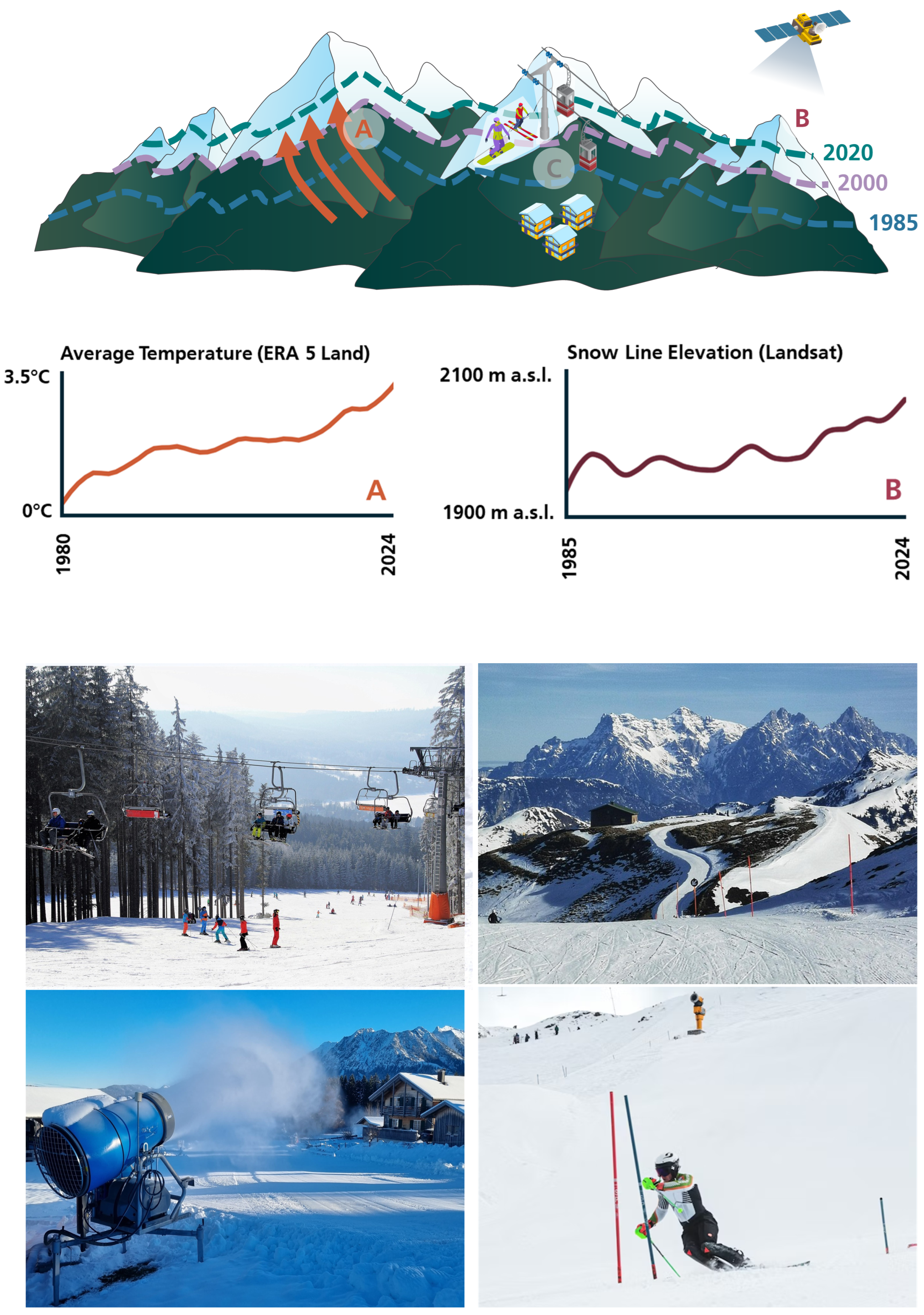
In general, these developments within the snowpack in the European Alps due to anthropogenic climate change have been described in various studies and scales, which show general agreement regarding a decline of the overall snowpack [38], whether it is measured as the snow cover duration (SCD; [17]), snow water equivalents (SWE; [1,39]), SLE [2], or melt-out days [40] (Figure 1A). Additionally, studies agree regarding the shortened snow season and thus shorter accumulation and melt periods. The impact of these developments on winter tourism in the European Alps has been thoroughly studied at multiple spatial scales (for example, a small scale [41], country scale [9,42,43], Europe [12,31,44], and globally [3,45]), and these studies show general agreement regarding increased risks, an increased reliance on snowmaking, and higher operating costs and economical risks for ski area operators and the regions in which they are embedded. However, the existing studies on the subject rely either on in situ snow measurements [9] or on snow models [3,12,31,41,42,44]. Some studies use satellite remote sensing data to some extent [46] or monitor the snowpack itselft, bu without connecting the data to tourism data [1,2,17,47]. Moreover, to our knowledge, there has been no comprehensive remote sensing study conducted on the impact of global warming on winter tourism in the European Alps to date (Figure 1B). This study aims to close this gap with a straightforward approach based on available data, as remote sensing enables a large-scale comparison, valid for the entirety of the study region (Figure 1C).
Figure 1. Schematic illustration of the circumstances analyzed in this study. (A) Climate change is increasing the average temperatures in the Alps. (B) Using Landsat, the impact of warming on the snowline elevation can be detected. (C) The increasing snowline elevation influences winter tourism in the Alps, whose extent is analyzed in this study. Modeled after Koehler et al. [2] with their data, as well as temperature data from ERA5-Land [48]. Images: top left—ski lift and skiers, illustrating the infrastructure in ski areas; top right—ski piste in an area with low snow coverage; bottom left—snow cannon producing artificial snow; bottom right—professional skier during a slalom run. Image sources: bottom left—private; all others—Pixbay.com. Graph illustrated with symbols from freepik.com and the University of Maryland.
Remotesensing 18 00491 g001

2. Materials and Methods

2.1. Definitions

Various papers on skiing and winter sports use different terminologies. To avoid confusion and to ensure clarity in this study, this section defines the terminology used throughout the paper.
Downhill Skiing: Refers to the style of skiing that uses gravity as the main means of propulsion and is therefore mostly performed in steep, mountainous areas. It is often also referred to as alpine skiing. We use the term downhill to avoid confusion with the geographical term alpine. Abbreviated as DH in the remainder of this paper.
Cross-Country Skiing: Refers to a style of skiing that mainly relies on the skier’s own propulsion and is therefore mostly performed in relatively flat areas, as opposed to downhill skiing. Abbreviated as CC in the remainder of this paper.
(Ski) Piste(s): Specially prepared lanes for downhill skiing. Used instead of ski slope to avoid confusion with the statistical meaning of slope.
(Ski) Trail(s): Specially prepared lanes for cross-country skiing. Used instead of ski slope to avoid confusion with the statistical meaning of slope.
Ski Area: A network of connected skiing pistes or trails (independent of skiing style). Often referred to as a ski resort; however, we use the term ski area as it refers only to the pistes/trails themselves and not to the surrounding touristic infrastructure. The term is used for both cross-country and downhill areas and further specified if necessary.

2.2. Data

This paper is based on and uses the SLE data generated by Köhler [18], based on the method developed by Koehler et al. [2]. The SLE data are a product based on Landsat 5–9 data from 1984–2024 that average the SLE per month and basin. Landsat 5 had an overpass time of 16 days, resulting in a maximum of two overpasses per month. Since the launch of Landsat 7 in 1999, there have been two Landsat satellites in operation at all times. These multiple satellites operate with a temporal offset, resulting in a revisit time of eight days. All Landsat products have a spatial resolution of 30 m. The SLE estimation is performed for the months of November through April and for 43 river basins in the European Alps. Section 2.4.1 contains a more detailed description of the SLE derivation performed by Koehler et al. [2] and Köhler [18]. The data were provided as basin-wide SLE, based on the level 7 basins from the HydroBasins dataset of the HydroSHEDS project [49] within the Alpine Convention [7]. The data on DH ski piste and CC trail geometries were obtained from OpenStreetMap (OSM) using overpass turbo [5]. We used the bounding box of the river basins from the SLE product and queried overpass turbo using way[“piste:type”=“downhill”] for DH pistes as well as way[“piste:type”=“nordic”] for cross-country trails. We clipped the resulting line segments to the extents of the SLE basins. The DEM used for both SLE derivation [2] and the slope and trail geometries was the Copernicus Global and European Digital Elevation Model (DEM) in the GLO-30 variant [50]. The GLO-30 product is a digital surface model with a spatial resolution of one arcsecond (30 m), matching the Landsat data used in Koehler et al. [2] and Köhler [18]. The absolute vertical accuracy of the GLO-30 DEM is >4 m (90 percent linear error) [50].

2.3. Study Area

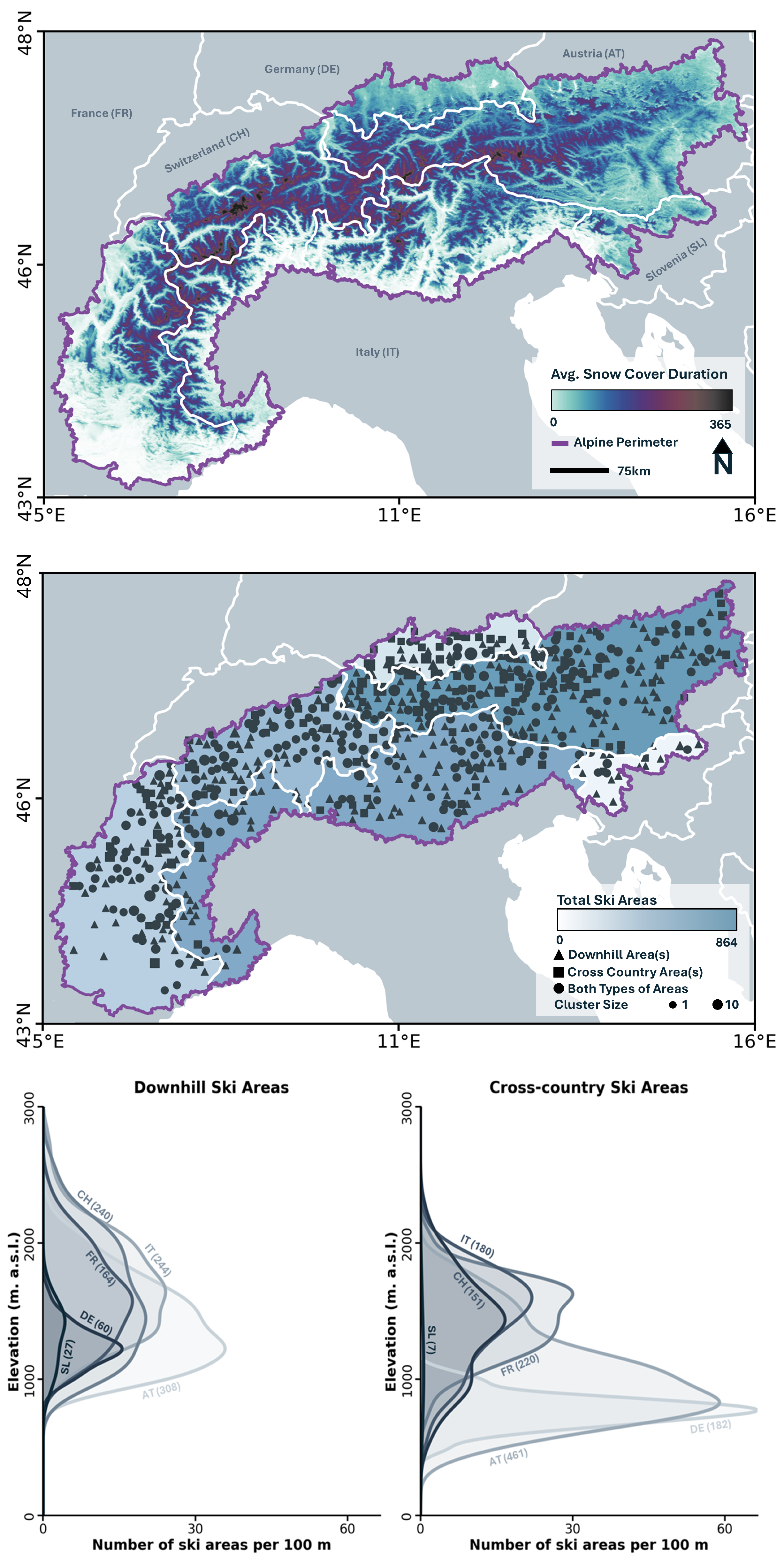
The study area encompasses 43 major river basins in the European Alps. The basins are the level 7 basins from the HydroBasins dataset of the HydroSHEDS project [49] within the Alpine Convention [7] and are displayed in Figure 2. The study area stretches from 43.7°N/4.85°E, near Avignon, France, to 48.36°N/16.43°E, east of Vienna, Austria. The snow in the area is mostly defined as maritime [51]. Figure 2 (taken from Koehler et al. [2]) shows the entire study area, as well as the included basins and their designations.
Figure 2. (Top) Study area examined in this paper. The Alps (purple perimeters denote the average snow cover duration Roessler and Dietz [17] to indicate areas with high snowpacks). (Middle) Ski areas in the Alps by type. The countries are colored according to the total number of ski areas, and multiple ski areas are clustered (8 km cluster) for visualization. (Bottom) Distribution of the analyzed ski areas by mean elevation and country for both downhill (left) and cross-country (right).
Remotesensing 18 00491 g002

2.4. Methods

2.4.1. Snow Classification and SLE Derivation
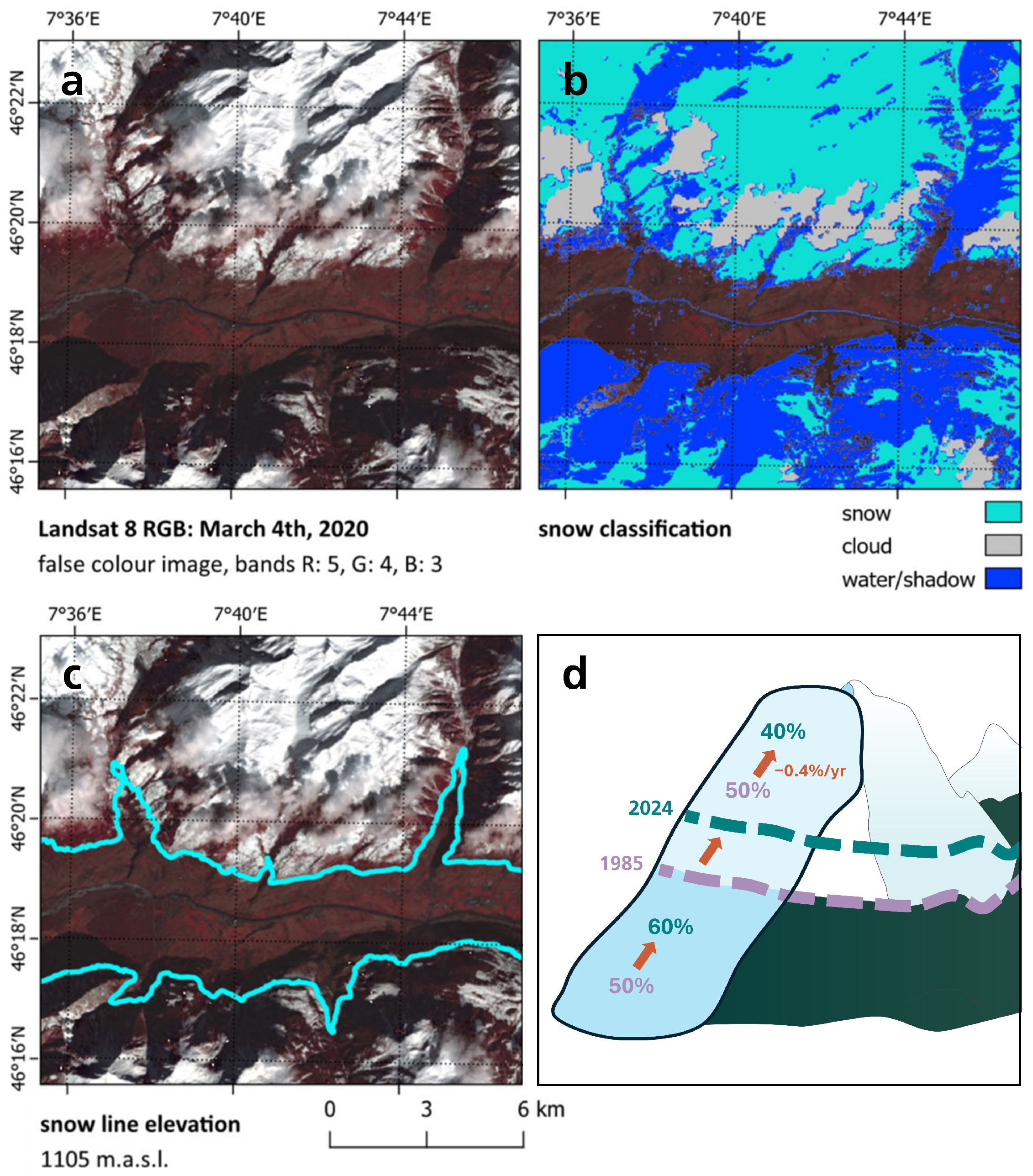
The SLE data used in this paper were generated by Köhler [18] based on Koehler et al. [2], who used a snow classification algorithm developed and described by Hu [52,53,54] for data from the Moderate-Resolution Imaging Spectroradiometer (MODIS) [55,56,57]. The algorithm uses a threshold-based scheme combining the SnowPEx temperature and shadow thresholding [58] with an index-based approach. Furthermore, a decision tree evaluated thresholds in the green and near-infrared (NIR) bands, the Normalized Difference Snow Index (NDSI) [59], and the Normalized Difference Vegetation Index (NDVI) [56,60], with additional masks for temperatures above 288 K; water was evaluated with the Normalized Difference Water Index (NDWI) [61] above 0 and green reflectance below 0.2; shadow was evaluated based on low short-wave infrared (SWIR), green, and the NDVI; and clouds were evaluated using FMASK [62]. The algorithm was applied by Koehler et al. [2] on Landsat 5, 7, and 8/9 data from 1985 to 2022 and again by Köhler [18] for the years 1985 to 2024.
SLE retrieval was performed following Krajčí et al. [63] and Hu et al. [53]. In this approach, the snowline elevation is the altitude for which the number of pixels of snow below or clear land above the line is minimized. To assess the quality and reliability for each SLE estimate, three indices were calculated: the representativeness index (RI), indicating the share of valid pixels used for the estimation; the root mean square error (RMSE), describing the vertical deviation of misclassified pixels; and the error index (EI), describing the relative share of classification errors. SLEs with RI values below 0.2 were excluded to ensure sufficient data coverage. The remaining observations were then averaged to monthly mean values and, combined with linear interpolation, yielded a continuous SLE time series from 1985 to 2024, each with 472 data points per basin, representing 472 months in the time series data [2]. In addition, Figure 3 shows an example of the SLE workflow.
Figure 3. Example of SLE derivation and trend calculation. (a) Landsat 8 RGB image; (b) snow, cloud, and water classification; (c) derived snowline elevation; (d) schematic illustration of trend derivation for one ski slope. The trend slope is shown in orange. (ac) were originally published in Koehler et al. [2]. Image sources: (ac) [2]; (d) adapted from a symbol from the University of Maryland symbol database.
Remotesensing 18 00491 g003

2.4.2. Quality Criteria and Trend Calculation

To ensure the reliability of the snowline elevation (SLE) data used in this study, a multi-step quality control procedure was implemented at the basin level. Since SLE retrieval is based on linear interpolation, years with limited satellite coverage may fail to accurately reflect the low winter SLE due to persistent cloud cover [2]. Therefore, we used the seasonal SLE range to identify years with insufficient data quality. Annual minimum and maximum SLE values were used to calculate this range, which represents the seasonal variability of the snowline. For each basin, a reference distribution (Q75) was established based on the baseline period 2000–2010.
Based on exploratory tests and visual inspection of the SLE time series, two thresholds were defined to balance data retention with quality assurance: early years prior to 2000 were flagged as low quality if their SLE range fell below 70% of the reference Q75, while later years were flagged when their 9-year rolling median range dropped below 50% of the reference. These values were chosen to reflect the improved data density and reliability of Landsat 7–9 compared to Landsat 5, while ensuring that only years with clearly reduced seasonal variability, likely driven by data gaps rather than true SLE dynamics, were excluded. If six years from the early period were flagged, trend estimation was restricted to Landsat 7–9 (1999–2024), which offer improved coverage compared to Landsat 5 (up to 1999).
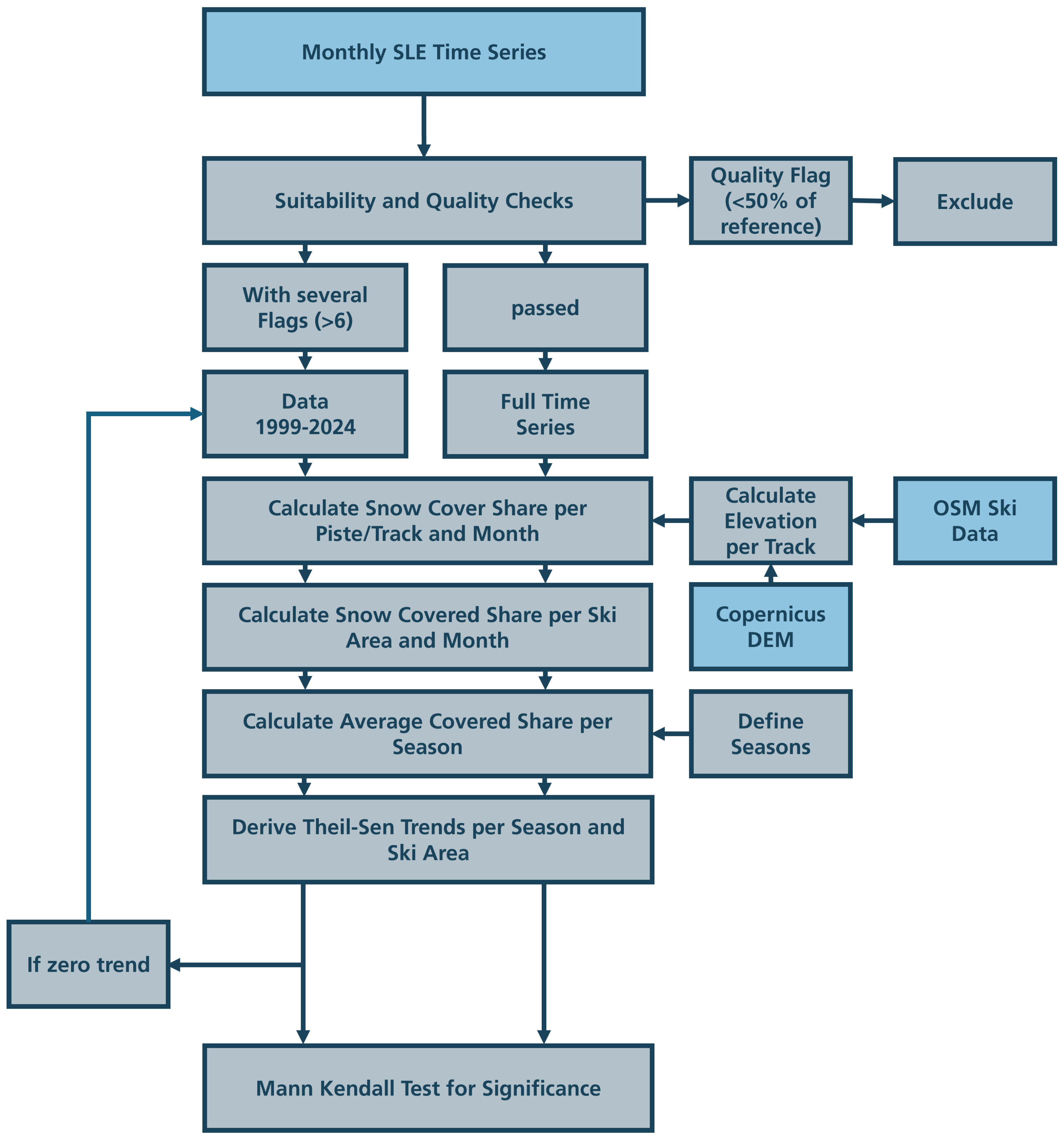
For an improved understanding of the seasonal behavior of the SLE dynamics, we defined four seasons: early (November, December), mid (January, February), late (March, April), and full (November through April). For every season, the snow-covered share of each piste or trail over the included months was averaged. Subsequently, trend estimation per season was performed using the non-parametric Theil–Sen slope estimator [64] in combination with the Mann–Kendall significance test [65]. Figure 3d shows an example of trend calculation. Additionally, if trends for the full period (1985–2024) were statistically null, the analysis was repeated for the shorter period 1999–2024 to achieve a more comprehensive assessment. A schematic illustration of the method described in this section can be found in Figure 4.
Figure 4. Flowchart illustration of the quality control and trend calculation applied in this study.
Remotesensing 18 00491 g004

3. Results

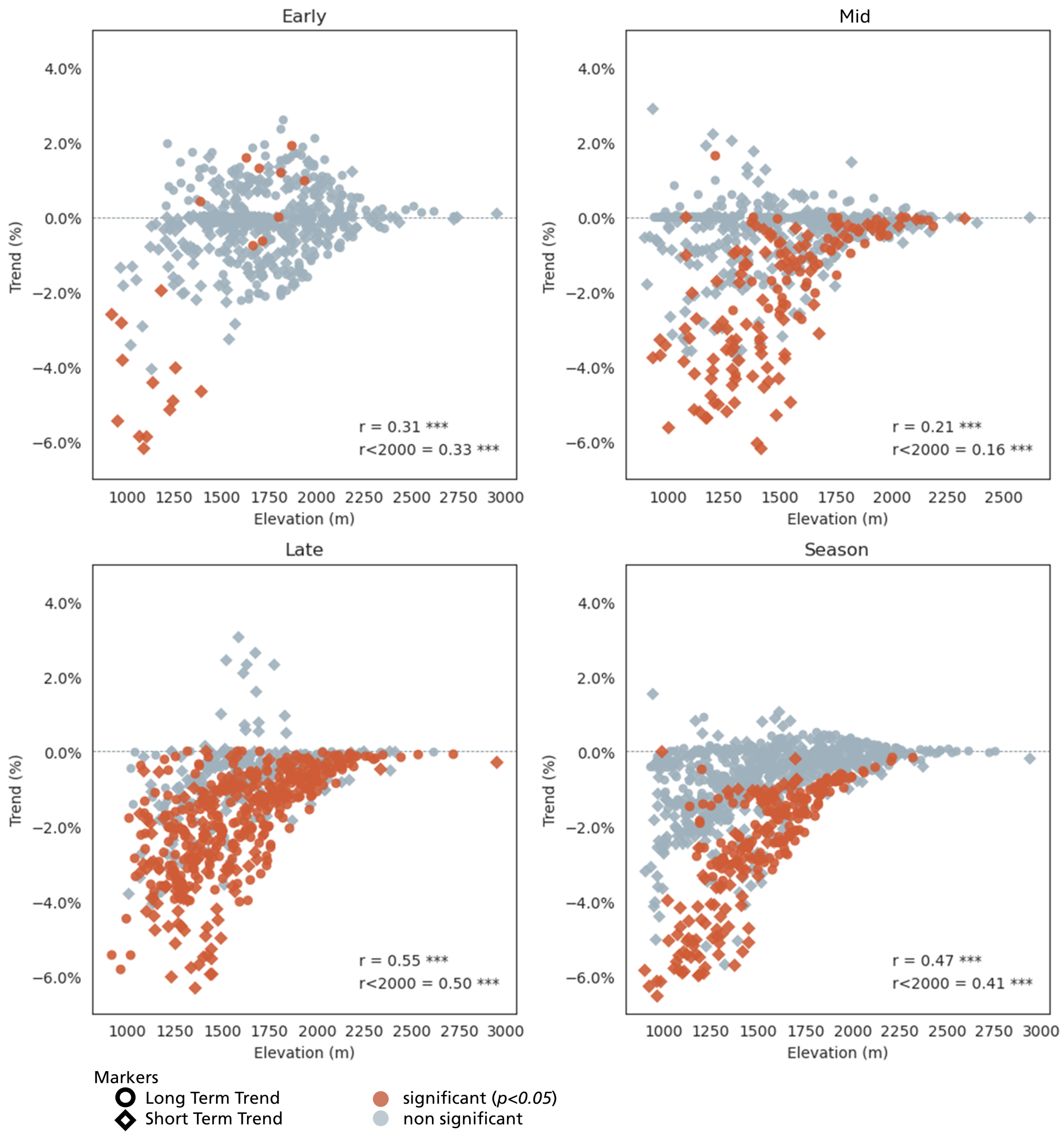
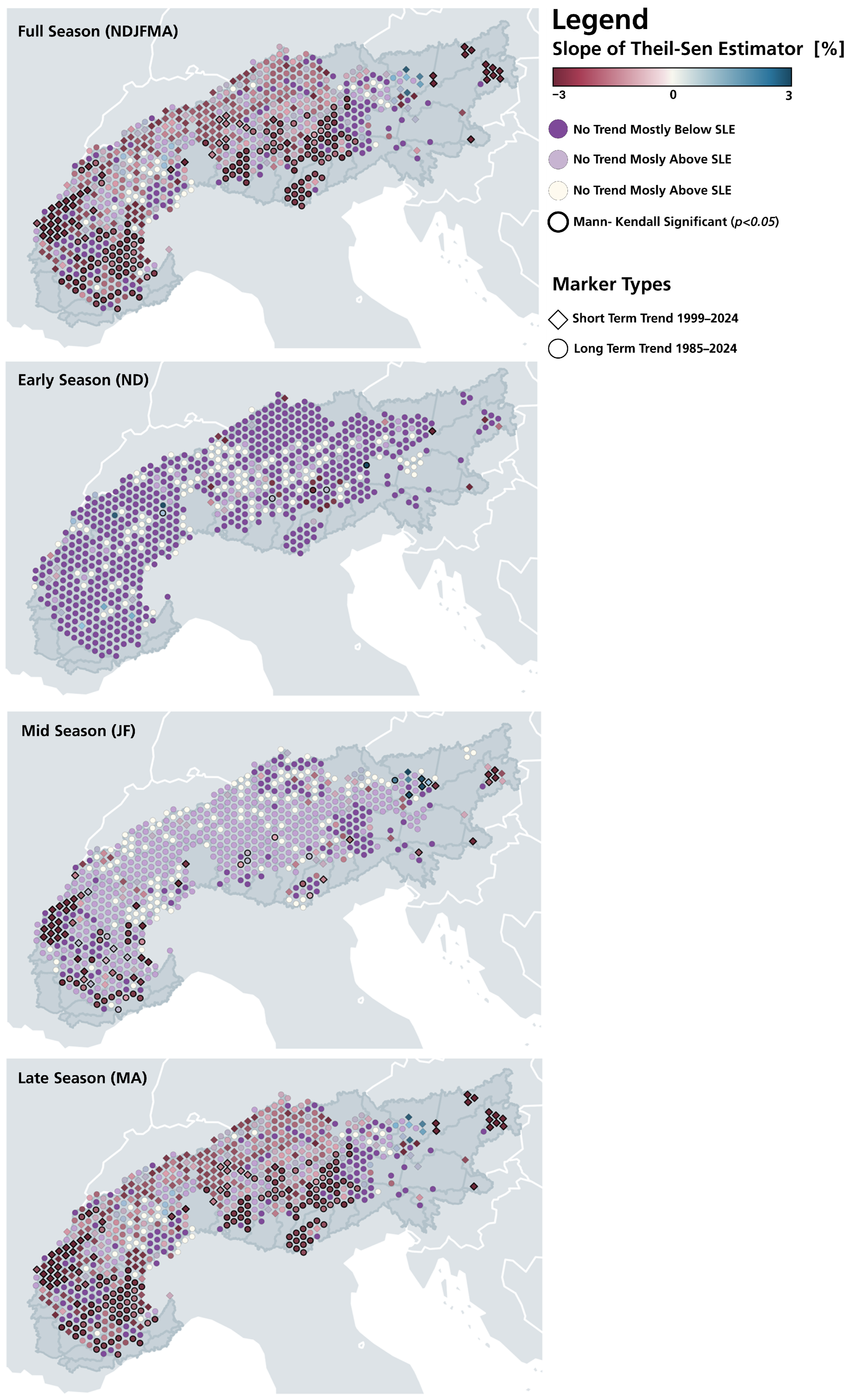
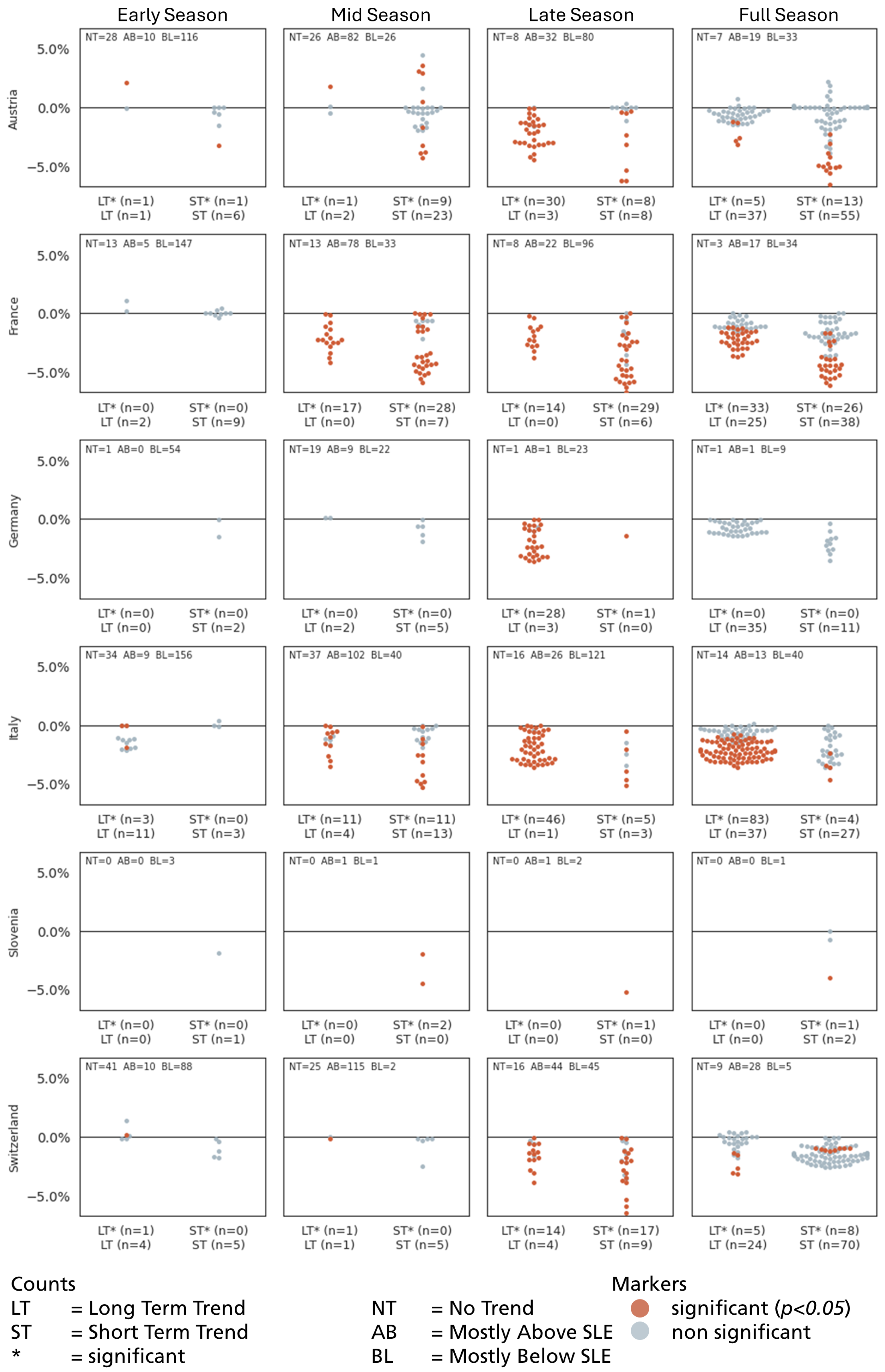
On average, the SLE increased at a rate of 3.1 m/year during the November-April period across the study area from 1985 to 2024. For the more recent period from 2000 to 2024, the rate was 7.4 m/year for the same area and seasonal window. This section shows how this influenced the ski areas in the European Alps. The results of our analysis are presented separately for each skiing discipline, with downhill skiing in Section 3.1 and Section 3.2 for cross-country skiing. For each discipline, we provide a map of the trend strengths (Figure 5 for DH and Figure 8 for CC), an overview of the trend strengths (Figure 6 for DH and Figure 9 for CC), and a scatterplot illustrating the relationship between the trend magnitude and elevation (Figure 7 for DH and Figure 10 for CC). The resulting trends and markers are designated as LT for long-term trends (i.e., 1985–2024) and ST for short-term trends (1999–2024). An asterisk (*) is used to mark significant trends. All trends are expressed as percentages. In this context, the percentage trend shows the fitted annual change rate in the share of piste or trail kilometers that lie above the snowline elevation (SLE), relative to the total piste/trail length of a ski area. Consider the following readability example.
  • Assume the following: A ski area ranges from 1000 m a.s.l. to 1500 m a.s.l. and has a total of 500 km of pistes. The pistes are evenly distributed across this elevation range. The SLE rises by 10 m per year.
  • At the start, the SLE is at 1000 m a.s.l. All 500 km of piste lies above the SLE. The share is 100%.
  • After one year, the SLE is at 1010 m a.s.l. and 10 km of piste lies below the SLE, so 490 km still lies above it. The share above the SLE is 98%.
  • After 20 years, the SLE is at 1200 m a.s.l. and 200 km of piste lies below the SLE, so 300 km lies above it. The share above the SLE is 60%.
  • The trend shows the yearly change rate for the share of piste kilometers that lies above the SLE, which in this example is −2%.

3.1. Downhill Ski Areas
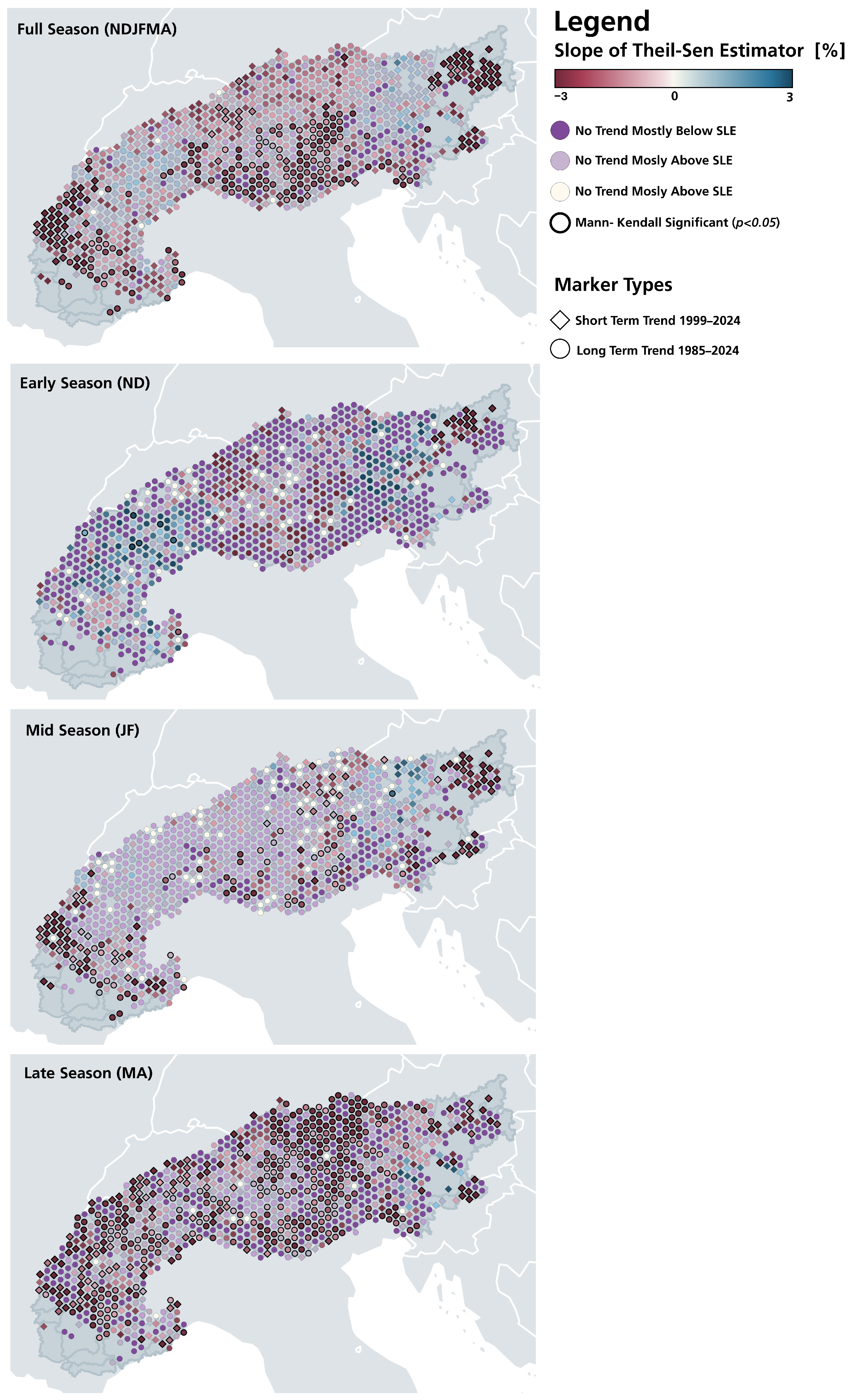
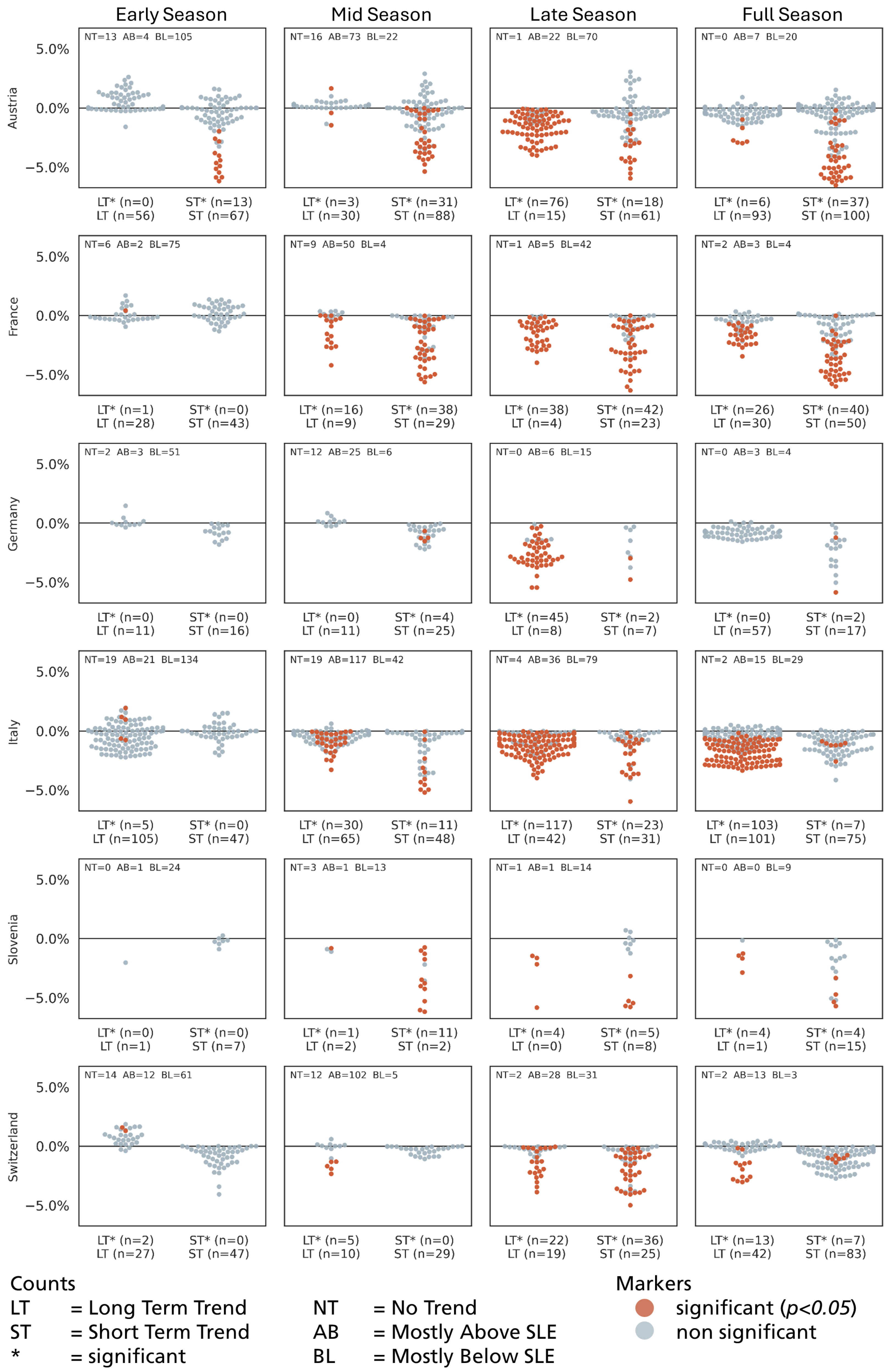
For DH pistes, our method derived 1030 ski areas in the Alps. Of these, 781 had a negative trend considering the full season (November to April). Of these, 401 were based on the full time series (152 significant) and 380 based on the Landsat 7–9 time series (1999–2024) due to the quality criteria applied on the Landsat 5 data. Moreover, 97 of these were significant. On average, the trend was −1.11%. Geographically, especially the southern (mainly Italy) and southwestern (mainly France) regions, as well as the Eastern Alps (Austria and Slovenia), showed the strongest decreasing trends. Regarding single seasons, it becomes evident that the late season (March and April) in particular has seen a strong decrease in snow-covered pistes. Only 21 out of the 1030 ski areas showed a positive trend, and none of them were significant, in contrast to 651 areas with negative trends (LT* 302, LT 88, ST* 125, ST 135). On average, over all ski areas in which a trend could be derived, the late-season trends were −0.94%. The geographical distribution of the strongest decreasing trends in the late season is similar to that of the full season; however, there is an additional cluster in the Northeastern Alps (mainly Germany) with strong and significant decreasing trends. For the early and mid-season, the majority of the ski areas for which a trend could be derived have seen a negative trend. However, in both cases, for the largest portion of the ski areas, a trend could not be derived, as the ski areas predominantly were lying either below (early season) or above (mid-season) the average SLE. For the full season, the downhill ski areas in Slovenia have the steepest decreasing trends (−1.81%), while the ski areas in Switzerland have the least decreasing trends (0.73%). In the late season, Germany has seen the steepest decrease (−1.78%), and Italy has the smallest decrease (−0.74%). The corresponding extremes for the early and mid-season can be found in Austria (early, steepest; −0.2%) and France (early, no decline, slightly positive; 0.07%), as well as Slovenia (mid, steepest; −1.41%) and Switzerland (mid, least; −0.12%). However, note that these averages were calculated only on the basins where a trend could be derived and thus only represent these downhill ski areas. A full overview of the average trends is shown in Table 1. The late and full seasons show moderate correlations between the trend strength and mean elevation, with values of 0.55 and 0.47. Both correlations are statistically significant. A visual inspection initially suggested a stronger relationship for ski areas located below 2000 m a.s.l. To examine this, we calculated the correlations only for these lower-elevation areas. However, the resulting correlations were weaker in both seasons, with values of 0.50 and 0.41, although both remained significant.
Figure 5. Theil–Sen trends in the share of downhill ski piste kilometers in the European Alps located above the SLE, by ski area and (sub-)season.
Remotesensing 18 00491 g005
Figure 6. Theil–Sen trends in the share of downhill ski piste kilometers in the European Alps located above the SLE, by ski area, season, and time series base (long 1980–2024, short 1999–2024). The significant trends are shown in orange.
Remotesensing 18 00491 g006
Figure 7. Theil–Sen trends in the share of downhill ski piste kilometers in the European Alps located above the SLE, by ski area, as a function of the mean elevation. Two types of Pearson correlations are shown: one over the full elevation range (r) and one (r < 2000) for ski areas under 2000 m.a.s.l. Asterisks (***) are used to mark significant correlations (p < 0.001).
Remotesensing 18 00491 g007
Table 1. Average trends for downhill ski areas per country, season, and time period. The trends are shown as long-term (LT), short-term (ST), and overall (O). All trend slopes are in percentages per year.
EarlyMidLateFull
LTSTOLTSTOLTSTOLTSTO
Austria0.57−1.03−0.200.11−0.87−0.38−1.48−1.06−0.83−0.47−1.61−1.01
France0.060.200.07−0.85−1.77−0.90−1.38−1.98−1.20−1.08−2.16−1.65
Germany0.11−0.77−0.130.15−0.94−0.31−2.41−2.17−1.78−0.80−2.40−1.10
Italy−0.42−0.12−0.16−0.65−1.35−0.43−1.09−1.30−0.74−1.13−1.15−0.98
Slovenia−2.03−0.24−0.11−0.93−3.36−1.41−2.77−2.09−1.16−1.48−2.76−1.81
Switzerland0.81−0.86−0.10−0.59−0.35−0.12−0.93−1.59−0.83−0.45−1.05−0.73

3.2. Cross-Country Ski Areas

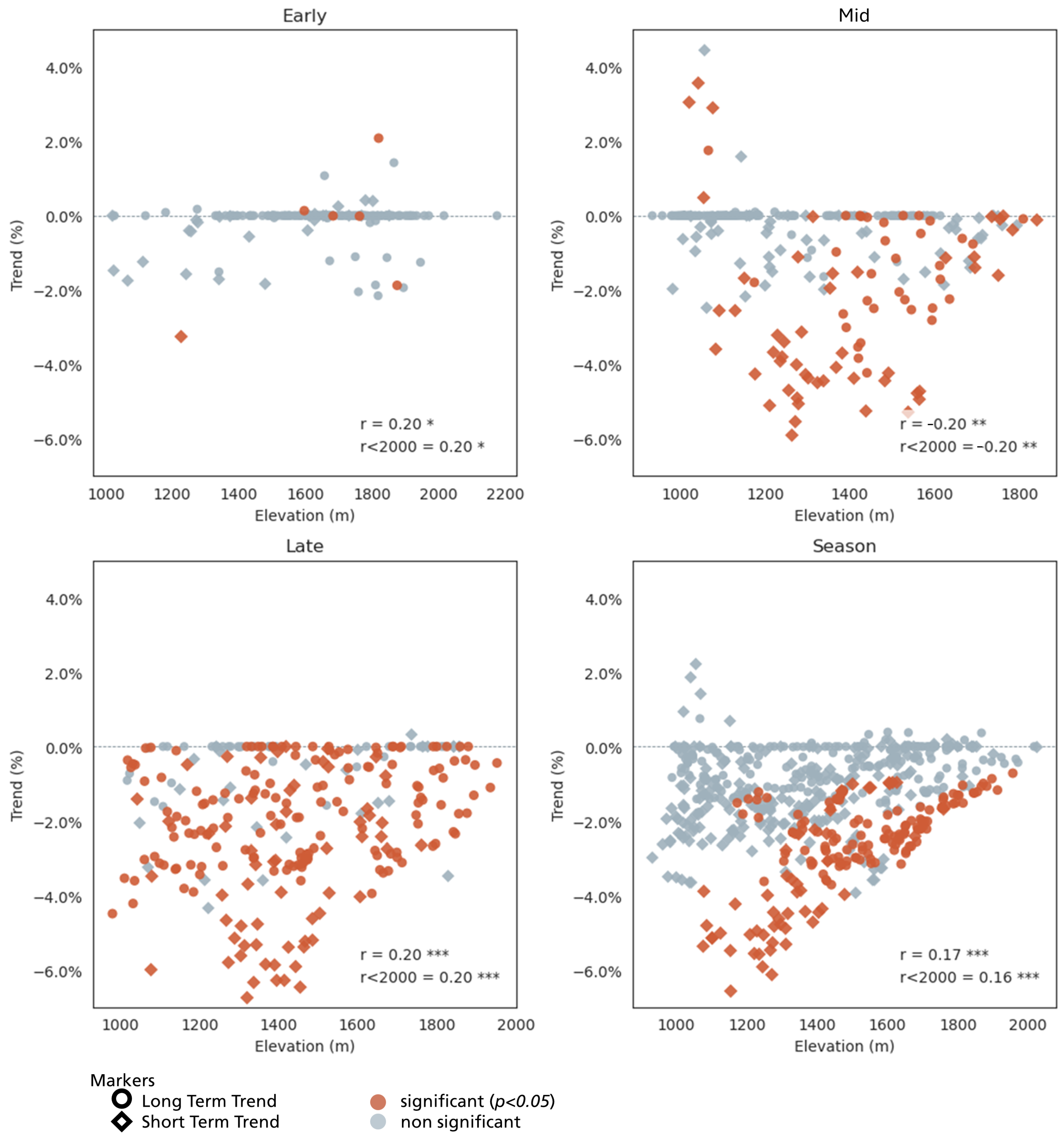
Our method derived 730 CC ski areas in the European Alps. Over the full season, 498 of these have seen a decreasing trend in their snow-covered slopes (LT* 126, LT 147, ST* 52, ST 173). Geographically, a pattern similar to that for the DH ski areas emerges, with strong negative clusters in mainly Italy and France. The average trend for the full season is −1.1%. For the late season, the spatial pattern is similar to that for the DH areas, with the accumulation of strongly negative trends in Southern Germany as well as Central Austria. Compared to the DH ski areas, most CC ski areas lie mostly under the SLE in France and Italy for the late season; thus, no trend could be derived for the regions that showed strongly decreasing trends on the downhill side. In the late season, 222 ski areas had a negative trend (LT* 123, LT 11, ST* 60, ST 19); however, 367 ski areas were predominantly below the SLE and thus had no trend for the late season. The average trend for the late season was −0.94%. As for the DH ski areas, in the early season, the majority of the basins are situated under the SLE and thus no trend could be derived. In the mid-season, the majority of the ski areas are situated above it and therefore also no trend could be derived. However, there is a difference for the CC ski areas as, in the Western Alps (France), a cluster of CC ski areas with negative trends can be observed. The most negative trends for the full season can be observed in France (−1.54%), while the flattest trends for the full season are found in Austria (−0.74%). For the late season, cross-country areas in Slovenia have the steepest negative trends (−1.3%), while the least negative trends are found in CC areas in Italy (−0.51%). Moreover, for the early and mid-season, Slovenia has the steepest trends (0.46% and 1.6%, respectively), while France even has slightly positive trends in the early season (0.01%), and Switzerland has the flattest trends in the mid-season (−0.02%). A full overview of the average trends is shown in Table 2. For the CC ski areas, there is only a minimal connection between the mean elevation and the trend strength.
Figure 8. Theil–Sen trends in the share of cross-country trail kilometers per ski area in the European Alps located above the SLE, by ski area and per (sub-)season.
Remotesensing 18 00491 g008
Figure 9. Theil–Sen trends in the share of cross-country ski trail kilometers in the European Alps located above the SLE, by ski area, season, and time series base (long 1980–2024, short 1999–2024). The significant trends are shown in orange.
Remotesensing 18 00491 g009
Figure 10. Theil–Sen trends in the share of cross-country ski trail kilometers in the European Alps located above the SLE, by ski area, as a function of the mean elevation. Two types of Pearson correlations are shown: one over the full elevation range (r) and one (r < 2000) for ski areas under 2000 m.a.s.l. Asterisks are used to mark significant correlations (*** = p < 0.001; ** = p < 0.01; * = p < 0.05).
Remotesensing 18 00491 g010
Table 2. Average trends for cross-country ski areas, season, and time period. The trends are shown as long-term (LT), short-term (ST), and overall (O).
EarlyMidLateFull
LTSTOLTSTOLTSTOLTSTO
Austria1.01−0.83−0.020.44−0.46−0.08−2.04−1.60−0.55−0.80−1.35−0.74
France0.620.010.01−2.11−2.71−0.74−1.96−3.42−0.84−1.66−2.73−1.54
Germany−0.74−0.030.10−0.89−0.07−1.87−1.41−1.04−0.75−2.05−0.86
Italy−1.160.09−0.07−1.35−1.88−0.30−1.88−2.96−0.51−1.69−2.17−1.24
Slovenia−1.83−0.46−3.20−1.60−5.20−1.30−1.56−1.17
Switzerland0.26−1.04−0.03−0.07−0.65−0.02−1.39−2.35−0.58−0.68−1.48−0.91

4. Discussion

4.1. Contextualization of the Results

Our results confirm that winter tourism in the European Alps is operating under increasingly adverse conditions, with generally reduced snow availability and shortened seasons. The results show that snow cover suitable for skiing has been declining since 1985, particularly in the late season (March and April) and in the outer regions of the Alps. Both the seasonal and geographical patterns align well with the existing literature. All studies mentioned in this discussion found similar tendencies, namely that declines are sharper in the shoulder seasons and at the geographical edges of the Alps compared to the mid-season and central regions. Therefore, these general patterns are not discussed in more detail here. Nevertheless, although nuanced differences may arise due to the methods, data, or variables considered, and comparability is not always straightforward, we consider it useful to contextualize our results within the existing literature by approximating mean change rates over long-term prediction periods.
Several studies have examined large-scale developments in ski tourism in recent years, typically using scenario-based projections. Mitterwallner et al. [3] investigated snow cover days and projected that, under SSP5-8.5, the mean number of snow cover days in the European Alps would decrease from 218 (baseline 1950–2010) to 129 (2070–2100), corresponding to a reduction of 40.8%. Considering the trends that we found (DH, LT: –0.45 to –1.48; CC, LT: –0.68 to –1.69), it becomes evident that the rate of snow cover loss in the European Alps is close to, or even above, the rate projected by Mitterwallner et al. [3] for the highest warming scenario. François et al. [12] conducted a multivariate, pan-European risk assessment, including the water demand for snowmaking. They modeled an increase in water demand of +14% to +42% under 4 °C warming. Compared with our observed snow loss rates, it appears that the decline in the natural snow supply is progressing faster than the modeled increase in water availability.
Damm et al. [31] examined the entire Alps and assessed impacts on overnight stays in ski resorts. They found similar seasonal patterns for overnight stays, but their non-linear predictions cannot be directly compared to our change rates.
Country-specific studies provide further context. Willibald et al. [9] analyzed Swiss ski areas using a probabilistic approach under RCP8.5. They found that, by 2100, 80% of skiing days would be lost in medium-elevation areas (100% at low elevations), considering only natural snow. Their baseline (1980–2019) yields change rates for both the full and late season that are higher in magnitude than ours (full DH, LT –0.45/CC, LT –0.68; late DH, LT –0.39/CC, LT –1.39). For Austria, Steiger and Scott [66] projected a reduction of 61 days from the 1981–2010 baseline to the 2080s under RCP8.5. This corresponds to a generally higher change rate than seen in our full-season results (DH, LT –0.47/CC, LT –0.8) but matches our late-season trends well (DH, LT –1.48/CC, LT –2.04). For Slovenia, Pogačar et al. [67] analyzed several factors influencing winter tourism in the eight largest ski resorts, including days with at least 5 cm of snow cover. Their figures suggest a reduction of around 30–40% under RCP8.5 (baseline 1980–2010 vs. 2071–2100), with regional and altitudinal differences. Slovenia shows some of the strongest decreasing trends in our analysis (full season DH, LT –1.48; late DH, LT –2.77), situating our results above the highest scenario in Pogačar et al. [67]. For Germany, no studies allow direct comparison, but Kloos et al. [68] confirm similar patterns. In France, Spandre et al. [42] analyzed the snow reliability line, a concept that is similar to the SLE. They projected that, relative to 1986–2005, the groomed snow reliability line would rise by up to 850 m by 2100 under RCP8.5, rendering most ski resorts inoperable. Over a forecasting period of 95 years (1995–2090), this corresponds to a change rate of 8.94 m/yr, very similar to the 8.1 m/yr found by Koehler et al. [2], on whose data and methods this study is based. Spandre et al. [69] reported similar results. Finally, Steiger and Scott [70] assessed snow reliability in 93 potential Olympic and Paralympic Winter Games host regions worldwide, only analyzing the ski area that was located at the highest elevation per region. They projected that, under RCP8.5, reliable host regions would decline from 94% to 52% (OWG, February) and from 53% to 12% (PWG, March) by the 2080s. While these global assessments are not directly comparable to ours, their Western European results (Italy 2026, France 2030) show climate reliability scores decreasing from 25 to 6 in February and from 7 to 1 in March. Over 2000–2080, this corresponds to reductions of 0.95%/yr (February) and 1.08%/yr (March). Compared to our mid-season trends for France (DH, LT –1.08/CC, LT –1.66) and Italy (DH, LT –1.13/CC, LT –1.69), and our late-season trends (France: DH, LT –1.38/CC, LT –1.96; Italy: DH, LT –1.09/CC, LT –1.88), our observed rates appear faster.
Note that, for all comparisons, we used the long-term trend (LT), as these are based on 40 years of data and thus represent viable climate trends [71]. Short-term (ST) trends are systematically lower than LT trends (see Figure 6 and Figure 9). This could reflect either an underestimation in our LT derivation (see Section 4.2) or an acceleration in the actual trends. In both cases, it must be considered that even the generally lower LT trends show that, in comparison with the existing literature, the rate at which natural snow cover in the Alps is receding is close to, or even above, that predicted in the highest warming scenarios.
In Section 1, we outlined the economic challenges facing ski resort operators and winter tourism destinations in the European Alps. Our results now show that, especially in the peripheral regions of the European Alps, these challenges have become highly pressing, as snow is receding at a rapid pace, often corresponding to the highest warming scenarios. This indicates that ski areas in these regions have increasingly less time to adapt to global warming. As the trends are of a similar magnitude at all altitudes, the question for ski area operators and winter tourism destinations might not be if but when and how they must adapt to this snow loss. If warming continues at the current rate, mitigation measures such as snowmaking and snow grooming seem to be only temporary solutions. With less snow in general and higher temperatures, snow grooming becomes increasingly less feasible. The operational cost for snowmaking can be expected to increase, as the overall area reliant on snowmaking will increase proportionally to the SLE retreat. Therefore, especially considering the shortening season shown in our results, all ski area operators and winter sport destinations must consider adaption and transformation strategies beyond winter skiing and winter tourism. Such strategies might include transformation to a full-year destination—for instance, by installing mountain bike infrastructure—or diversification into niche markets [72,73].

4.2. Limitations

The results of this study should be considered among a series of influencing factors. Firstly, they are based on the SLE estimation of Koehler et al. [2]. As Koehler et al. [2] discuss, this method relies on Landsat, which, in its early years, provided only overpasses every 16 days. Depending on cloudiness, several months are missing in the time series and were interpolated, introducing limitations in depicting the actual winter snowline elevation. While the share varies by basin, in the time series from Köhler [18], which are used in this study, 18.3% (median over all basins) of the observations were interpolated due to insufficient data quality, e.g., shadows and clouds. This share drops to 11% for observations after 1999. We mitigated this by applying a quality criterion that flagged years with insufficient coverage and by calculating trends only for 1999–2024 in basins with too many flagged years, where Landsat offered more overpasses per month.
Furthermore, Köhler [18] describes a saturation effect in SLE estimation that occurs when the calculated SLE exceeds the highest point of a basin, potentially affecting early- and late-season estimates in years with little snow. The SLE data represent basin averages and therefore do not account for local conditions such as slope, aspect, forest cover, or wind exposure. As a result, certain pistes and trails may be over- or underestimated. Some ski areas also lie consistently above or below the seasonal SLE, meaning that their conditions cannot be assessed with this approach. This does not imply that these areas lack snow or are inherently safe; it simply reflects the limits of the method.
For cross-country skiing, the SLE-based approach is less suitable, since many trails lie entirely above or below the SLE. Consequently, cross-country skiing areas are underrepresented in the trend analysis. For both skiing styles, areas mostly above or below the SLE, where no trend could be derived, may still experience snow changes. However, since the elevation analysis revealed no significant correlation between the elevation and trend magnitude, we assume that areas where no trend could be derived experience similar trend strengths as those included in the analysis. The main implication of this limitation is therefore the underestimation of the number of affected areas, rather than of the trend magnitudes themselves.
More generally, the fact that not all ski areas are suitable for our trend calculation may indicate the underestimation of the overall effect of the receding SLE, as some areas might appear unaffected because their trends could not be quantified using our method. However, the consistent trends in the analyzed ski areas, their independence of elevation, and the coherent seasonal and regional patterns suggest that this underestimation is primarily methodological rather than an indication of different dynamics in the excluded areas. Most of these areas are located at relatively low or high elevations. Ski areas mostly below the SLE are likely already exposed to substantial snow loss, while areas mostly above the SLE can expect similar challenges in the future as the SLE continues to rise. This suggests that the impacts of a receding SLE on ski operations may be underestimated in our analysis. Overall, this issue highlights the need for a higher temporal resolution, since monthly values may miss snow dynamics that develop over hours or days, which are critical for ski operations.
In addition, it is necessary to consider that this study does not provide projections but trends based on historical observations. Therefore, the results describe past changes. Statements concerning future change can only be made under the assumption that warming rates and precipitation patterns remain similar to those seen in the study period. If these trends are extrapolated, unknown uncertainties would be introduced, as non-linear responses to a changing warming rate or precipitation might occur. Our results should thus only be interpreted as evidence of an ongoing change and its spatial patterns and not as forecasts. All statements in this discussion regarding the future of winter tourism in the Alps rely on our found changes, the fact that they coincide with high warming rates (see Section 4.1), and the assumption that similar warming rates will occur in the future. These statements are of only a qualitative nature and have no additional quantitative significance.
Furthermore, it is necessary to mention that snow grooming and snowmaking could potentially alter the local snowline and thus the implications of our analysis. However, the method given by Koehler et al. [2] defines the SLE as the elevation where the numbers of snow pixels on barren land and bare pixels in snow cover are minimized. As this is averaged over a basin, thus including mostly mountains with no skiing activity, this local alteration of the snowline was not considered an issue in our approach; however, it must be kept in mind for more local studies.
Our method is further constrained by the choice of the Theil–Sen estimator, which requires more data points than conventional regression but is more robust given the challenges of the dataset. The combination of seasonal division, Theil–Sen trends, and the SLE method therefore represents an initial, straightforward remote sensing-based approach to quantifying winter tourism conditions in the European Alps. It is intended as an approximation and a region-wide screening tool, which is why individual ski areas are not named or analyzed separately. Ski areas derived from OpenStreetMap represent only the physical extent of the terrain and not operational linkages; jointly managed areas therefore appear as separate units, consistent with the topographical logic of the SLE approach. In conclusion, this study is to be interpreted as a general, alpine analysis, showing overall spatial and temporal trends. If individual ski areas are to be compared, a deeper analysis based on the single Landsat scene per area would need to be carried out, potentially enhanced with in situ data.
Nevertheless, remote sensing offers important advantages. It provides a comparable framework across regions, enabling consistent large-scale assessments. Thus, while our study represents a first step, further refinement with a higher spatial resolution and the integration of weather data would be valuable, as this would avoid the need for interpolation and provide finer detail than most existing snow models for the Alps.

5. Conclusions

The snowpack in the European Alps is declining due to global warming. Snow falls later and melts earlier, and the overall amounts are decreasing. This threatens the winter tourism sector in the region—the world’s largest by attendance. Since 1980, hundreds of mostly low-elevation ski areas in the European Alps have closed at least partly because of these climatic changes, and all Alpine ski regions face rising costs as they become increasingly dependent on snowmaking. Professional winter sports are similarly affected, with several competitions canceled due to unsuitable conditions, which is notable given that the next two Olympic Winter Games will take place in the European Alps. We analyzed monthly snowline elevation (SLE) data from Landsat (1980 to 2024) for 43 Alpine basins and combined them with OpenStreetMap (OSM) ski infrastructure and a digital elevation model (DEM) to analyze snow coverage developments on downhill ski pistes and cross-country trails. For each ski area, we computed Theil–Sen trends and Mann–Kendall significances for the full season and three subseasons, using either the full time series or, if coverage was insufficient, the period of 1999 to 2024. We found the following:
  • Across all investigated basins, the SLE increased by about 157 m on average over the study period (1985–2024).
  • The vast majority of the trends were negative for all subseasons, as well as the full season.
  • The most negative trends were found in the late season, where 97.8% of all downhill ski areas and 99.5% of the cross-country ski areas had a negative trend, where a trend could be derived.
  • Over the full season, 94% of the downhill ski areas and 99.2% of the cross-country ski areas had a negative trend, where a trend could be derived.
  • Geographically, the strongest negative trends, for all seasons and both downhill and cross-country, could be found at the edges of the Alps, in the north (Germany), east (Austria), and south (Slovenia and Italy), as well as the west (France).
  • The only season for which positive trends were found in all countries was the early season; however, only six of them were significant for downhill and four for cross-country.
  • In the early season, most ski areas were predominantly located below the average SLE; therefore, no trends could be derived. In the mid-season, most of them were above the SLE, resulting in the same issue.
These results confirm the current state of the literature, showing a generally declining natural snowpack in the European Alps in regard to winter tourism. They are in line with the existing literature concerning seasonal and geographical patterns. However, as shown in the Discussion, the rate at which the snow cover is receding can be placed at the upper end of existing predictions, consistent with the RCP8.5 warming scenario or even exceeding it. Our findings therefore consolidate the current scientific message regarding winter tourism in the Alps, highlighting shorter seasons and an increased reliance on snowmaking. If warming and the accompanying retreat of the snowline continue along the identified trajectories, only a few ski areas in the Alps will have sufficient snow cover to operate profitably by the end of the century, even with snowmaking. This does not only imply a potential loss of jobs and revenue in regions that are already economically weak, but it also affects professional winter sports. Consistent with existing studies, the number of regions that are able to host not only Olympic and Paralympic Winter Games but also other competitions at various levels will decline sharply.

Author Contributions

Conceptualization, S.S., C.B., C.K. (Claudia Kuenzer), and A.D.; methodology, S.S., C.K. (Christina Krause), and J.K.; code, S.S. and C.K. (Christina Krause); writing—original draft preparation, S.S.; writing—review and editing, all authors; supervision, C.K. (Claudia Kuenzer) and A.D.; contextualization of results, S.S., G.A., C.B. and A.D. All authors have read and agreed to the published version of the manuscript.

Funding

This work and its publication were supported by the DLR EO4AlpineRisks Project.

Data Availability Statement

The raw data supporting the conclusions of this article will be made available by the authors on request.

Conflicts of Interest

The authors declare no conflicts of interest.

Abbreviations

The following abbreviations are used in this manuscript:
CCCross-Country
DHDownhill
EIError Index
GDPGross Domestic Product
GRPGross Regional Product
LTLong-Term
NGOsNon-Governmental Organizations
NDSINormalized Difference Snow Index
NDVINormalized Difference Vegetation Index
NDWINormalized Difference Water Index
NIRNear-Infrared
OOverall
OSMOpenStreetMap
OWGOlympic Winter Games
PWGParalympic Winter Games
RIRepresentativeness Index
RMSERoot Mean Square Error
SCDSnow Cover Duration
SLESnowline Elevation
SWESnow Water Equivalents
STShort-Term
SWIRShort-Wave Infrared

References

  1. Matiu, M.; Crespi, A.; Bertoldi, G.; Carmagnola, C.M.; Marty, C.; Morin, S.; Schöner, W.; Cat Berro, D.; Chiogna, G.; De Gregorio, L.; et al. Observed snow depth trends in the European Alps: 1971 to 2019. Cryosphere 2021, 15, 1343–1382. [Google Scholar] [CrossRef]
  2. Koehler, J.; Bauer, A.; Dietz, A.J.; Kuenzer, C. Towards forecasting future snow cover dynamics in the European Alps—The potential of long optical remote-sensing time series. Remote Sens. 2022, 14, 4461. [Google Scholar] [CrossRef]
  3. Mitterwallner, V.; Steinbauer, M.; Mathes, G.; Walentowitz, A. Global reduction of snow cover in ski areas under climate change. PLoS ONE 2024, 19, e0299735. [Google Scholar] [CrossRef] [PubMed]
  4. Vanat, L. 2025 International Report on Snow & Mountain Tourism: Overview of the Key Industry Figures for Ski Resorts, 17th ed.; TheBookEdition: Geneva, Switzerland, 2025. [Google Scholar]
  5. OpenStreetMap Contributors. OpenStreetMap Data Extracted via the Overpass API. Data © OpenStreetMap Contributors, Available Under the Open Database License (ODbL) v1.0. 2025. Available online: https://overpass-api.de/ (accessed on 1 December 2025).
  6. Wirtschaftskammer Österreich. Seilbahnen—Geschäftericht 2023–2024. Technical Report, Fachverband Seilbahnen, Wirtschaftskammer Österreich. 2024. Available online: https://www.wko.at/oe/transport-verkehr/seilbahnen/seilbahnen-geschaeftsbericht-2023-2024.pdf (accessed on 1 December 2025).
  7. Eurac Research. Alpine Convention Perimeter (Version 2025) [Data Set]. Permanent Secretariat of the Alpine Convention. 2025. Available online: https://www.atlas.alpconv.org/layers/geonode:Alpine_Convention_Perimeter_2025 (accessed on 1 December 2025).
  8. World Bank. World Development Indicators: GDP (Current US$). World Bank Open Data Portal, 2024. License: CC BY 4.0. Available online: https://data.worldbank.org/indicator/NY.GDP.MKTP.CD (accessed on 1 December 2025).
  9. Willibald, F.; Kotlarski, S.; Ebner, P.P.; Bavay, M.; Marty, C.; von Trentini, F.; Ludwig, R.; Grêt-Regamey, A. Vulnerability of ski tourism towards internal climate variability and climate change in the Swiss Alps. Sci. Total Environ. 2021, 784, 147054. [Google Scholar] [CrossRef]
  10. Steiger, R.; Scott, D.; Abegg, B.; Pons, M.; Aall, C. A critical review of climate change risk for ski tourism. Curr. Issues Tour. 2019, 22, 1343–1379. [Google Scholar] [CrossRef]
  11. Seilbahnen Schweiz. Fakten & Zahlen 2025 zur Schweizer Seilbahnbranche. Technical Report, Seilbahnen Schweiz. 2025. Available online: https://www.seilbahnen.org/service/publikationen (accessed on 1 December 2025).
  12. François, H.; Samacoïts, R.; Bird, D.N.; Köberl, J.; Prettenthaler, F.; Morin, S. Climate change exacerbates snow-water-energy challenges for European ski tourism. Nat. Clim. Change 2023, 13, 935–942. [Google Scholar] [CrossRef]
  13. Dumont, M.; Rabatel, A.; Eckert, N.; Marty, C. The European Alps in a changing climate: Physical trends and impacts. Comptes Rendus Geosci. 2025, 357, 25–42. [Google Scholar] [CrossRef]
  14. Forster, P.; Meinshausen, N.; Palmer, M.; Hawcroft, M. Indicators of Global Climate Change 2024: Annual update of key indicators of the state of the climate system and human influence. Earth Syst. Sci. Data 2025, 17, 2641–2670. [Google Scholar] [CrossRef]
  15. Gobiet, A.; Kotlarski, S.; Beniston, M.; Heinrich, G.; Rajczak, J.; Stoffel, M. 21st century climate change in the European Alps—A review. Sci. Total Environ. 2014, 493, 1138–1151. [Google Scholar] [CrossRef]
  16. Pepin, N.; Bradley, R.; Diaz, H. Climate Changes and Their Elevational Patterns in the Mountains of the World. Rev. Geophys. 2022, 60, e2020RG000730. [Google Scholar] [CrossRef]
  17. Roessler, S.; Dietz, A.J. Development of global snow cover—Trends from 23 years of global snowpack. Earth 2023, 4, 1–22. [Google Scholar] [CrossRef]
  18. Köhler, J. Predicting Future Snow Line Elevation Dynamics in the Alps—The Potential of Long Earth Observation Time Series. Ph.D. Thesis, Universität Würzburg, Würzburg, Germany, 2024. [Google Scholar] [CrossRef]
  19. Scott, D.; Knowles, N.; Steiger, R. Is snowmaking climate change maladaptation? J. Sustain. Tour. 2024, 32, 282–303. [Google Scholar] [CrossRef]
  20. Leal Filho, W.; Dinis, M.A.P.; Nagy, G.J.; Fracassi, U.; Aina, Y.A. A ticket to where? Dwindling snow cover impacts the winter tourism sector as a consequence of climate change. J. Environ. Manag. 2024, 356, 120554. [Google Scholar] [CrossRef] [PubMed]
  21. Métral, P.A. La Montagne désarmée, une Analyse des Trajectoires Territoriales des Stations de Ski Abandonnées Françaises. Ph.D. Thesis, Université Grenoble Alpes, Grenoble, France, 2025. [Google Scholar]
  22. Métral, P.A. Les trajectoires de reconversion post-touristiques des stations de ski fermées françaises. Géocarrefour 2021, 95. [Google Scholar] [CrossRef]
  23. Galichet, J.; Tombez, V. In der Schweiz Rosten 65 Skilifte vor Sich Hin. RTS (Radio Télévision Suisse). 2023. Available online: https://www.swissinfo.ch/ger/wirtschaft/in-der-schweiz-rosten-65-skilifte-vor-sich-hin/48958340 (accessed on 1 December 2025).
  24. Steiger, R.; Damm, A.; Prettenthaler, F.; Pröbstl-Haider, U. Climate change and winter outdoor activities in Austria. J. Outdoor Recreat. Tour. 2021, 34, 100330. [Google Scholar] [CrossRef]
  25. Bonardo, V.; Bosica, M.; Apostolo, C.; Boccadoro, M.; Carollo, I.; Corradini, P.; Cozzarini, E.; Dematteis, M.; Moroni, A.; Omizzolo, A.; et al. Neve Diversa—Una Montagna Diversa è Possibile? Il Punto sul Turismo Invernale Nell’era Della Crisi Climatica. Report. 2025. Available online: https://de.scribd.com/document/839117796/Nevediversa-2025 (accessed on 1 December 2025).
  26. Euronews. Delaying the Inevitable: Italy’s Desperate Attempts to Revive Snowless Ski Resorts. 2023. Available online: https://www.euronews.com/green/2023/04/03/delaying-the-inevitable-italys-desperate-attempts-to-revive-snowless-ski-resorts (accessed on 1 December 2025).
  27. DPA/The Local Germany. ‘No Future’: How the Climate Crisis Is Changing Germany’s Alpine Ski Resorts. 2024. Available online: https://www.thelocal.de/20240318/no-future-how-the-climate-crisis-is-changing-germanys-alpine-ski-resorts (accessed on 1 December 2025).
  28. Bergbahnen.org. Seilbahndatenbank—Datenbank zu Seilbahnen in Deutschland und der Schweiz. 2025. Available online: https://www.bergbahnen.org/ (accessed on 1 December 2025).
  29. OECD. Climate Change in the European Alps: Adapting Winter Tourism and Natural Hazards Management; OECD Publishing: Paris, France, 2007. [Google Scholar] [CrossRef]
  30. Marmotamaps. Wieso es Weniger Skigebiete in den Alpen Gibt. 2023. Available online: https://marmotamaps.com/de/blog/wieso-es-weniger-skigebiete-in-den-alpen-gibt/ (accessed on 1 December 2025).
  31. Damm, A.; Greuell, W.; Landgren, O.; Prettenthaler, F. Impacts of +2 °C global warming on winter tourism demand in Europe. Clim. Serv. 2017, 7, 31–46. [Google Scholar] [CrossRef]
  32. Aigner, G.; Steiger, R.; Mayer, M. Snowmaking in Austria: Resource Consumption and Greenhouse Gas Emissions. In Proceedings of the International Mountain Conference, Innsbruck, Austria, 14–18 September 2025. [Google Scholar]
  33. International Ski and Snowboard Federation. FIS Official Website. 2025. Available online: https://www.fis-ski.com/ (accessed on 1 December 2025).
  34. International Biathlon Union. IBU Official Website. 2025. Available online: https://www.biathlonworld.com/ (accessed on 1 December 2025).
  35. International Bobsleigh & Skeleton Federation. IBSF Official Website. 2025. Available online: https://www.ibsf.org/ (accessed on 1 December 2025).
  36. International Luge Federation. FIL Official Website. 2025. Available online: https://www.fil-luge.org/ (accessed on 1 December 2025).
  37. International Olympic Committee. IOC Official Website. 2025. Available online: https://www.olympics.com/ (accessed on 1 December 2025).
  38. Schilling, S.; Dietz, A.; Kuenzer, C. Snow water equivalent monitoring—A review of large-scale remote sensing applications. Remote Sens. 2024, 16, 1085. [Google Scholar] [CrossRef]
  39. Terzago, S.; von Hardenberg, J.; Palazzi, E.; Provenzale, A. Snow water equivalent in the Alps as seen by gridded data sets, CMIP5 and CORDEX climate models. Cryosphere 2017, 11, 1625–1645. [Google Scholar] [CrossRef]
  40. Barrou Dumont, Z.; Gascoin, S.; Inglada, J.; Dietz, A.; Köhler, J.; Lafaysse, M.; Monteiro, D.; Carmagnola, C.; Bayle, A.; Dedieu, J.P.; et al. Trends in the annual snow melt-out day over the French Alps and Pyrenees from 38 years of high-resolution satellite data (1986–2023). Cryosphere 2025, 19, 2407–2429. [Google Scholar] [CrossRef]
  41. Morin, S.; François, H.; Réveillet, M.; Sauquet, E.; Crochemore, L.; Branger, F.; Leblois, É.; Dumont, M. Simulated hydrological effects of grooming and snowmaking in a ski resort on the local water balance. Hydrol. Earth Syst. Sci. 2023, 27, 4257–4277. [Google Scholar] [CrossRef]
  42. Spandre, P.; Francois, H.; Verfaillie, D.; Lafaysse, M.; Deque, M.; Eckert, N.; George, E.; Morin, S. Climate controls on snow reliability in French Alps ski resorts. Sci. Rep. 2019, 9, 8043. [Google Scholar] [CrossRef] [PubMed]
  43. Mayer, M.; Abegg, B. Development of summer skiing days in Austrian glacier ski areas in the first two decades of the twenty-first century. Int. J. Biometeorol. 2024, 68, 547–564. [Google Scholar] [CrossRef]
  44. Morin, S.; Samacoïts, R.; François, H.; Carmagnola, C.M.; Abegg, B.; Demiroglu, O.; Pons, M.; Soubeyroux, J.M.; Lafaysse, M.; Franklin, S.; et al. Pan-European meteorological and snow indicators of climate change impact on ski tourism. Clim. Serv. 2021, 22, 100215. [Google Scholar] [CrossRef] [PubMed]
  45. Scott, D.; Hall, C.M.; Gössling, S. Global tourism vulnerability to climate change. Ann. Tour. Res. 2019, 77, 49–61. [Google Scholar] [CrossRef]
  46. Ebner, P.P.; Koch, F.; Premier, V.; Marin, C.; Hanzer, F.; Carmagnola, C.M.; François, H.; Günther, D.; Monti, F.; Hargoaa, O.; et al. Evaluating a prediction system for snow management. Cryosphere 2021, 15, 3949–3973. [Google Scholar] [CrossRef]
  47. Gascoin, S.; Grizonnet, M.; Bouchet, M.; Salgues, G.; Hagolle, O. Theia Snow collection: High-resolution operational snow cover maps from Sentinel-2 and Landsat-8 data. Earth Syst. Sci. Data 2019, 11, 493–514. [Google Scholar] [CrossRef]
  48. Muñoz-Sabater, J.; Dutra, E.; Agustí-Panareda, A.; Albergel, C.; Arduini, G.; Balsamo, G.; Boussetta, S.; Choulga, M.; Harrigan, S.; Hersbach, H.; et al. ERA5-Land: A state-of-the-art global reanalysis dataset for land applications. Earth Syst. Sci. Data 2021, 13, 4349–4383. [Google Scholar] [CrossRef]
  49. Lehner, B.; Verdin, K.; Jarvis, A. HydroSHEDS: Seamless Hydrographic Data for Global and Regional Applications. 2025. Available online: https://www.hydrosheds.org/ (accessed on 1 December 2025).
  50. Copernicus Digital Elevation Model (DEM) GLO-30. Copernicus Data Space Ecosystem, 2023. Global 30 m Digital Surface Model (DSM). Available online: https://dataspace.copernicus.eu/explore-data/data-collections/copernicus-contributing-missions/collections-description/COP-DEM (accessed on 14 November 2025).
  51. Sturm, M.; Liston, G.E. Revisiting the Global Seasonal Snow Classification: An Updated Dataset for Earth System Applications. J. Hydrometeorol. 2021, 22, 2917–2938. [Google Scholar] [CrossRef]
  52. Hu, Z.; Dietz, A.; Kuenzer, C. The potential of retrieving snow line dynamics from Landsat during the end of the ablation seasons between 1982 and 2017 in European mountains. Int. J. Appl. Earth Obs. Geoinf. 2019, 78, 138–148. [Google Scholar] [CrossRef]
  53. Hu, Z.; Dietz, A.J.; Kuenzer, C. Deriving regional snow line dynamics during the ablation seasons 1984–2018 in European mountains. Remote Sens. 2019, 11, 933. [Google Scholar] [CrossRef]
  54. Hu, Z.; Dietz, A.; Zhao, A.; Uereyen, S.; Zhang, H.; Wang, M.; Mederer, P.; Kuenzer, C. Snow moving to higher elevations: Analyzing three decades of snowline dynamics in the Alps. Geophys. Res. Lett. 2020, 47, e2019GL085742. [Google Scholar] [CrossRef]
  55. Klein, A.G.; Hall, D.K.; Riggs, G.A. Improving snow cover mapping in forests through the use of a canopy reflectance model. Hydrol. Process. 1998, 12, 1723–1744. [Google Scholar] [CrossRef]
  56. Poon, S.; Valeo, C. Investigation of the MODIS snow mapping algorithm during snowmelt in the northern boreal forest of Canada. Can. J. Remote Sens. 2006, 32, 254–267. [Google Scholar] [CrossRef]
  57. Metsämäki, S.; Pulliainen, J.; Salminen, M.; Luojus, K.; Wiesmann, A.; Solberg, R.; Böttcher, K.; Hiltunen, M.; Ripper, E. Introduction to GlobSnow Snow Extent products with considerations for accuracy assessment. Remote Sens. Environ. 2015, 156, 96–108. [Google Scholar] [CrossRef]
  58. Ripper, E.; Schwaizer, G.; Nagler, T.; Metsämäki, S.; Törmä, M.; Fernandes, R.; Crawford, C.J.; Painter, T.H.; Rittger, K. Guidelines for the Generation of Snow Extent Products from High Resolution Optical Sensors. Technical Report, The Satellite Snow Product Intercomparison and Evaluation Exercise (SnowPEx), 2019. Deliverable D8, Version 2.1, 17 April 2019. Available online: https://snowpex.enveo.at/doc/D08_Guidelines_for_the_generation_of_snow_extent_products_from_HR_optical_sensors_FINAL_v2.1.pdf (accessed on 1 December 2025).
  59. Hall, D.K.; Riggs, G.A.; Salomonson, V.V. Development of methods for mapping global snow cover using Moderate Resolution Imaging Spectrometer data. Remote Sens. Environ. 1995, 54, 127–140. [Google Scholar] [CrossRef]
  60. Tucker, C. Red and photographic infrared linear combinations for monitoring vegetation. Remote Sens. Environ. 1979, 8, 127–150. [Google Scholar] [CrossRef]
  61. Gao, B. NDWI—A normalized difference water index for remote sensing of vegetation liquid water from space. Remote Sens. Environ. 1996, 58, 257–266. [Google Scholar] [CrossRef]
  62. Zhu, Z.; Wang, S.; Woodcock, C.E. Improvement and expansion of the Fmask algorithm: Cloud, cloud shadow, and snow detection for Landsats 4–7, 8, and Sentinel-2 images. Remote Sens. Environ. 2015, 159, 269–277. [Google Scholar] [CrossRef]
  63. Krajčí, P.; Holko, L.; Perdigão, R.A.; Parajka, J. Estimation of regional snowline elevation (RSLE) from MODIS images for seasonally snow-covered mountain basins. J. Hydrol. 2014, 519, 1769–1778. [Google Scholar] [CrossRef]
  64. Sen, P. Estimates of the regression coefficient based on Kendall’s tau. J. Am. Stat. Assoc. 1968, 63, 1379–1389. [Google Scholar] [CrossRef]
  65. Hirsch, R.M.; Slack, J.R.; Smith, R.A. Techniques of trend analysis for monthly water quality data. Water Resour. Res. 1982, 18, 107–121. [Google Scholar] [CrossRef]
  66. Steiger, R.; Scott, D. Ski tourism in a warmer world: Increased adaptation and regional economic impacts in Austria. Tour. Manag. 2020, 77, 104032. [Google Scholar] [CrossRef]
  67. Pogačar, T.; Kuk, R.; Kokot, K.; Turnšek, M. Identifying the tourism sector’s exposure to climate change utilizing two different climate datasets: The case of three climatically diverse locations in Slovenia. Int. J. Biometeorol. 2025, 69, 1541–1556. [Google Scholar] [CrossRef]
  68. Kloos, S.; Bigalke, C.; Neumair, M.; Menzel, A. Weather, weekday, and vacation effects on webcam recorded daily visitor numbers in the alpine winter season. Int. J. Biometeorol. 2024, 68, 305–316. [Google Scholar] [CrossRef]
  69. Spandre, P.; François, H.; Verfaillie, D.; Pons, M.; Vernay, M.; Lafaysse, M.; George, E.; Morin, S. Winter tourism under climate change in the Pyrenees and the French Alps: Relevance of snowmaking as a technical adaptation. Cryosphere 2019, 13, 1325–1347. [Google Scholar] [CrossRef]
  70. Steiger, R.; Scott, D. Climate change and the climate reliability of hosts in the second century of the Winter Olympic Games. Curr. Issues Tour. 2025, 28, 3661–3674. [Google Scholar] [CrossRef]
  71. World Meteorological Organization. WMO Guidelines on the Calculation of Climate Normals (WMO-No. 1203); World Meteorological Organization: Geneva, Switzerland, 2017. [Google Scholar]
  72. Alpine Convention Working Group Sustainable Tourism. Directions for Innovation in Alpine Tourist Destinations: Towards Innovative Tourist Strategies in Alpine Sites. Working Group Report, Alpine Convention, Innsbruck, 2018. Working Group Sustainable Tourism 2016–2018. Available online: https://www.alpconv.org/fileadmin/user_upload/Fotos/Banner/Topics/tourism/VI_Report_Innovation_Tourism_FINAL.pdf (accessed on 1 December 2025).
  73. Stanković, M.; Marić, I.; Stanković, J.; Trišić, I. Prospects for Sustainable Tourism in Mountain Protected Areas: A Case Study of Southeastern Serbia. Mt. Res. Dev. 2024, 44, R26–R34. [Google Scholar] [CrossRef]
Disclaimer/Publisher’s Note: The statements, opinions and data contained in all publications are solely those of the individual author(s) and contributor(s) and not of MDPI and/or the editor(s). MDPI and/or the editor(s) disclaim responsibility for any injury to people or property resulting from any ideas, methods, instructions or products referred to in the content.