Skip Content
You are currently on the new version of our website. Access the old version .

All Articles (9,795)

During the Joseon Dynasty, Korean Buddhism intentionally negotiated its survival and ongoing relevance in response to the predominance of Neo-Confucian state ideology by aligning Buddhist teaching with Confucian ethical ideals, especially filial piety. This process can be clearly observed in two well-known apocryphal texts—the Bulseol daebo bumo eunjung gyeong (佛說大報父母恩重經, Eunjung gyeong) and the Bulseol jangsu myeoljoe hojedongja darani gyeong (佛說長壽滅罪護諸童子陀羅尼經, Jangsu gyeong)—whose acceptance in Joseon Korea was largely dependent on their Confucian-inspired ethical substance. This article explores how the material aspects of these texts—such as woodblock printing methods, visual programs, book formats, and meticulous colophons—operated as means for integrating Buddhist doctrinal themes with Confucian moral standards. By focusing on the 1452 woodblock editions produced at Wŏnamsa Temple, this research highlights materiality as an influential factor in enabling the visual and ritual spread of Buddhist filial ethics and thereby supporting Buddhism’s cultural legitimacy in a Confucian-dominated environment. Using a material culture lens, this study addresses a notable gap in the current research—which has typically emphasized textual interpretation at the expense of material dimensions—and offers insight into how religious groups strategically utilized materiality to adapt within changing socio-cultural contexts.

7 February 2026
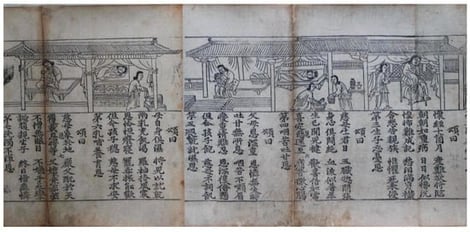
Depiction of the Ten Graces presented in an image-above, text-below arrangement, positioned in the opening section of the Eunjung gyeong.

The mechanisms of aim-setting and decision-making in criminal activity as a four-level hierarchical structure were presented for the Russian criminals known as ‘vory v zakonie’. The first level represents a basic concept of saving one’s own life, borrowed from the Torah. The second level, the ‘Thieves’ Law’, is a set of mental models that has much in common with the adaptation and misinterpretation of old religious and legal systems. The third level is a set of general concepts and ideas about what Good or Evil is in the form of words called ‘Notions’. These levels have no material form; they reflect themselves in models of behaviour and argot as a collective output. The fourth level in the material form of page-long ‘secrete messages’, containing some models of behaviour, are the ‘Frames’ (how to behave in imprisonment), wherein the ‘Vory’s Commandments’ (how to behave at large for young criminals) do not belong to the criminal ideology. This criminal ideology, a discrete antisystem, is enriched by the three ideas found in old religious and legal systems proposed as the ‘fifth feeling of Time’: the memory of the soul in the endless time being awoken after reincarnation, making the past as if it never happened, and knowing the future.

9 February 2026

In her excellent volume Open Socrates: The Case for a Philosophical Life, Agnes Callard juxtaposes Socrates’s conclusion that the meaningfulness of life is a function of consistent critical inquiry into existence with Leo Tolstoy’s contrary insistence that existential meaning ensues from living life without constant interruptions of self-reflection. These two perspectives functionally identify the tension between whether individuals may linguistically express opinions on truth and meaning or must negotiate in some manner with an inescapable silence regarding how best to comprehend and communicate discrete interpretations of the significance and veracity of lived experience. This present article investigates that tension and how it depends on the poetic and apophatic characteristics of language to both Say and Unsay how meaning and truth may be conceived. Salient positions from Ludwig Wittgenstein and William Franke provide introductory material to set the context for a closer examination of the complementary hermeneutics of the French philosopher Paul Ricoeur and the American poet Wallace Stevens. Both thinkers concur that properly analyzing meaning and truth requires a reliance on the creative imagination with its privileging of poetic language and its dependence on the humility of an incredulous faith in approximating an operative asymptotic approach to existential meaning.

7 February 2026

Pastorally Shaping Theological Engagements with Cancer

  • Ronald T. Michener and
  • Brian C. Macallan

The editors first met each other via email in early 2020 [...]

7 February 2026

News & Conferences

Issues

Open for Submission

Editor's Choice

Reprints of Collections

Spirituality, Resilience and Posttraumatic Growth
Reprint

Spirituality, Resilience and Posttraumatic Growth

Editors: Heather Boynton, Jo-Ann Vis
Localization, Globalization and Glocalization
Reprint

Localization, Globalization and Glocalization

Paradigm Shifts in the Study of Transmission and Transformation of Buddhism in Asia and Beyond
Editors: Jinhua Chen, Ru Zhan

Get Alerted

Add your email address to receive forthcoming issues of this journal.

XFacebookLinkedIn
Religions - ISSN 2077-1444