From India to China: The Origin and Transmission of the Han Dynasty’s Column–Arch–Buddha Motif from a Pan-Asian Perspective
Abstract
1. Introduction
2. Buddhist Elements in Octagonal Columns in the Han Dynasty and Their Indian Origins
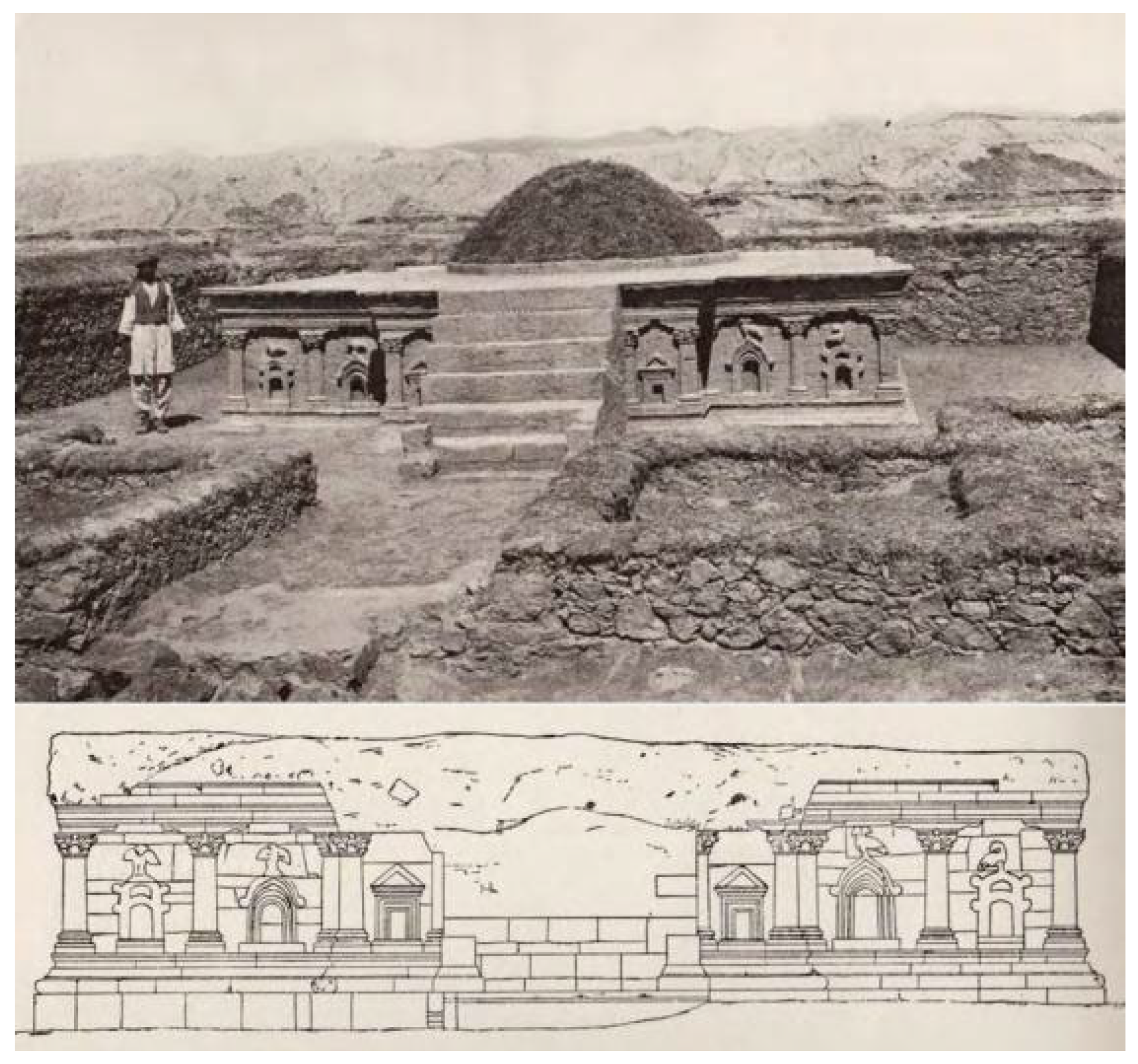
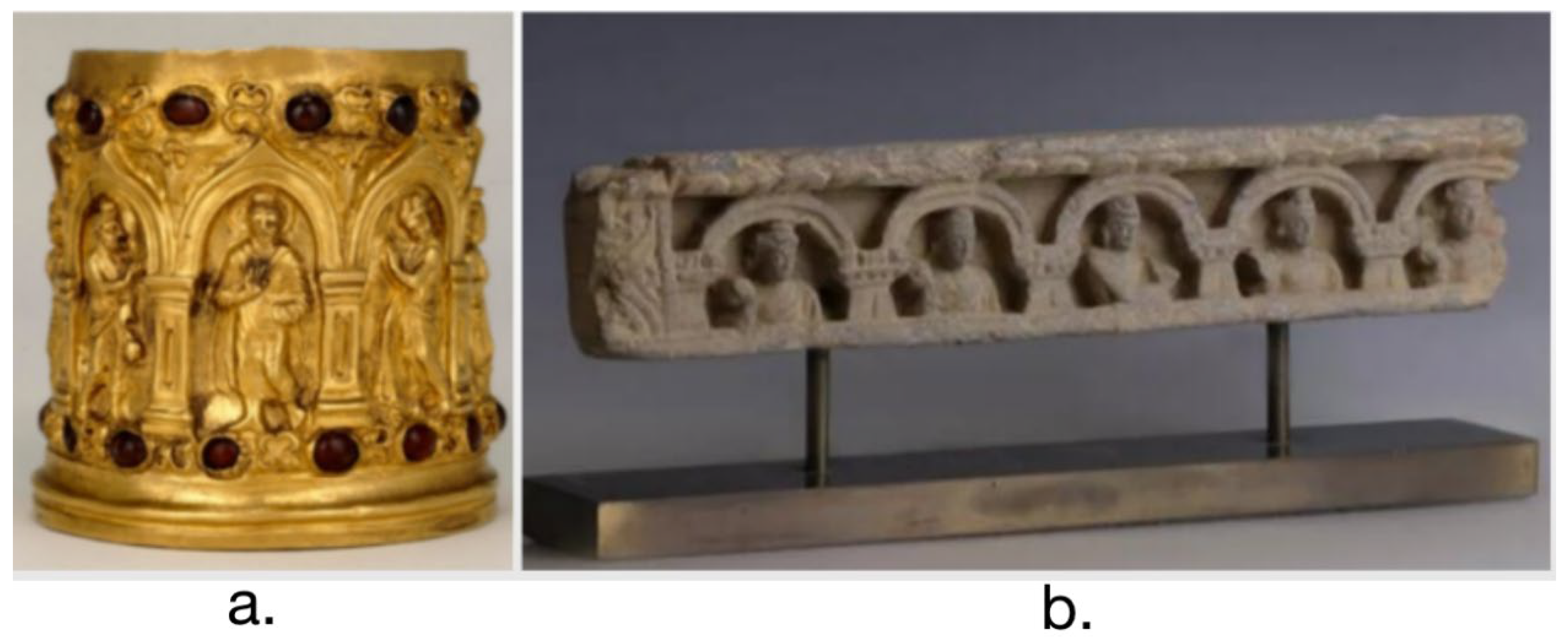
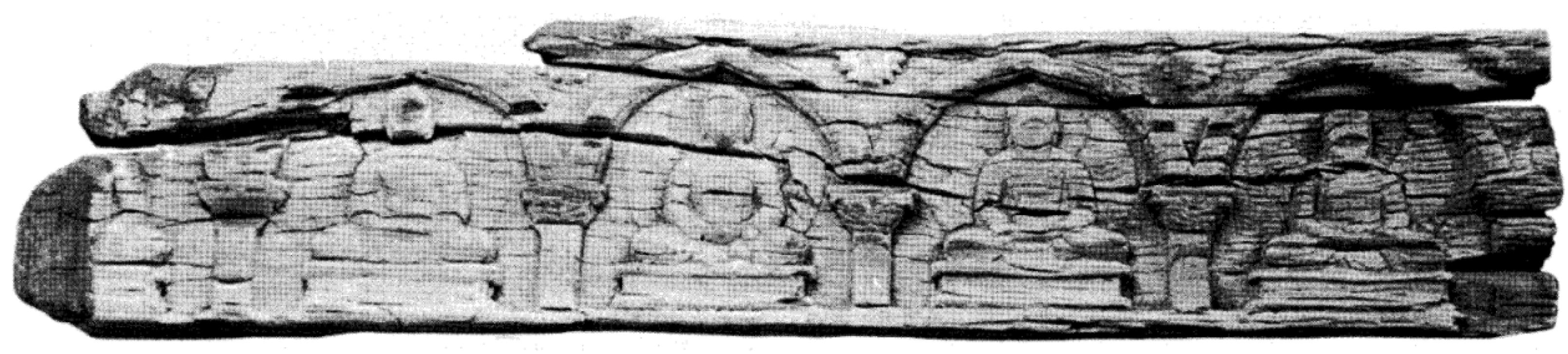
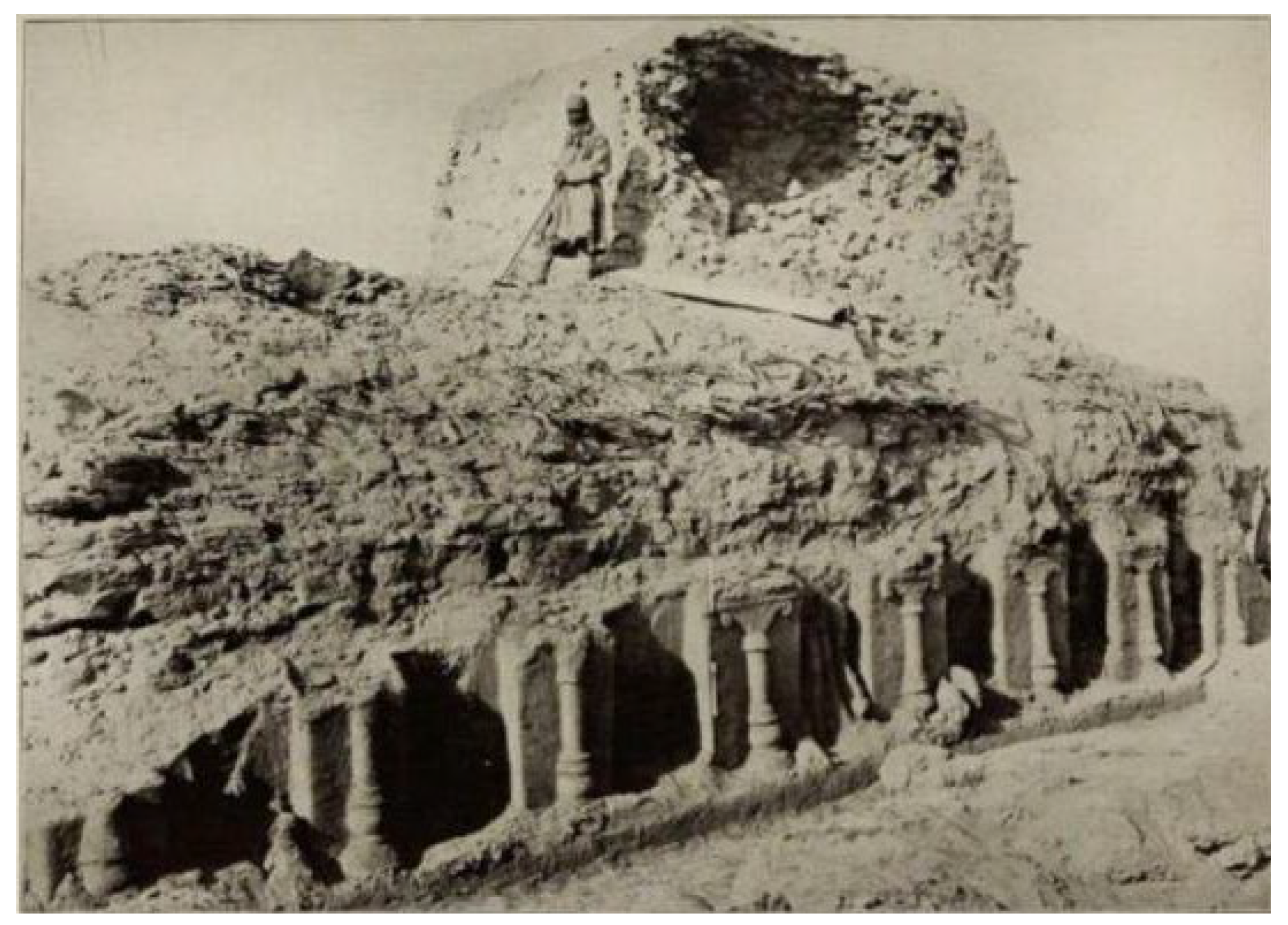
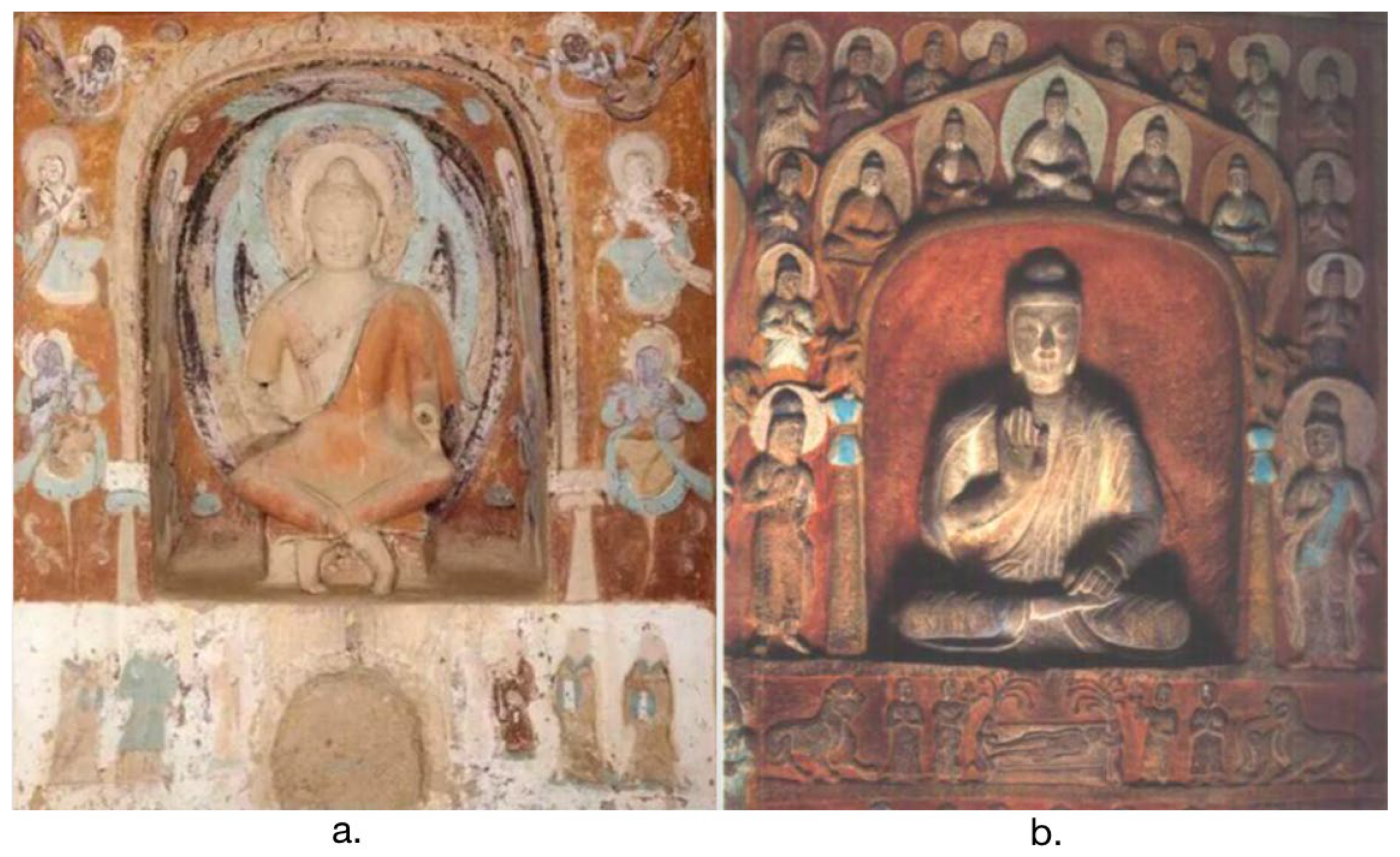
3. The Han Dynasty “Column–Arch” and the Indian “Column–Arch–Buddha” Architectural Motif
- (1)
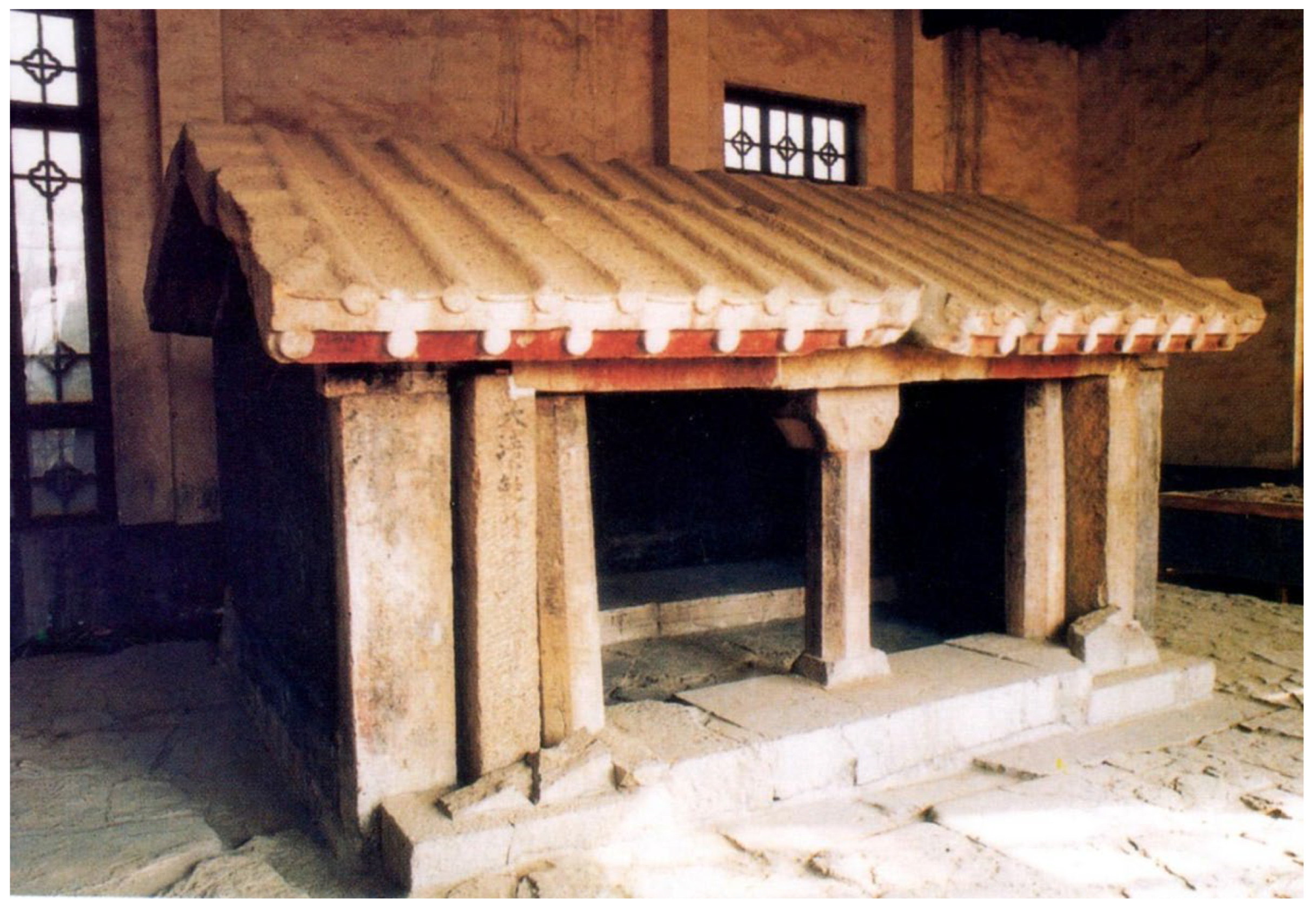
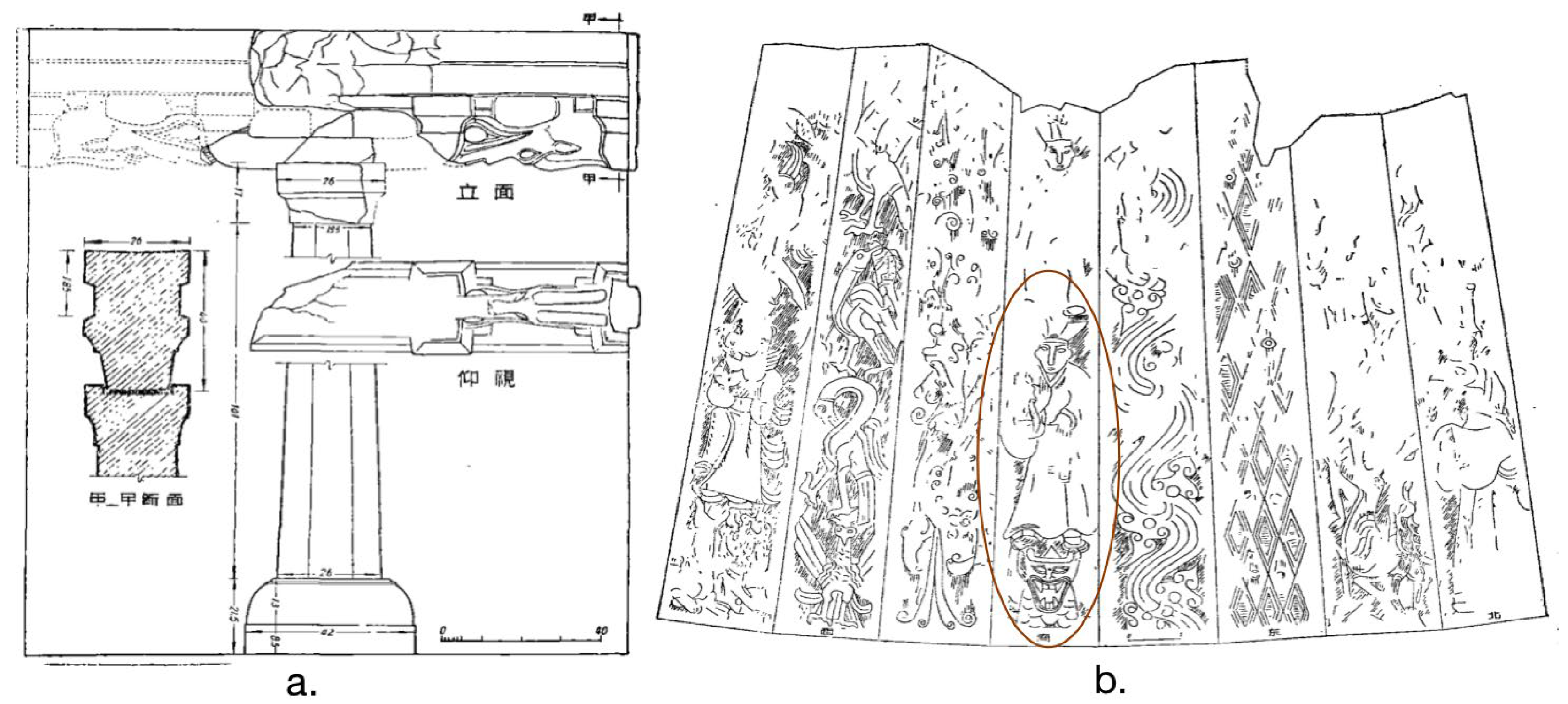
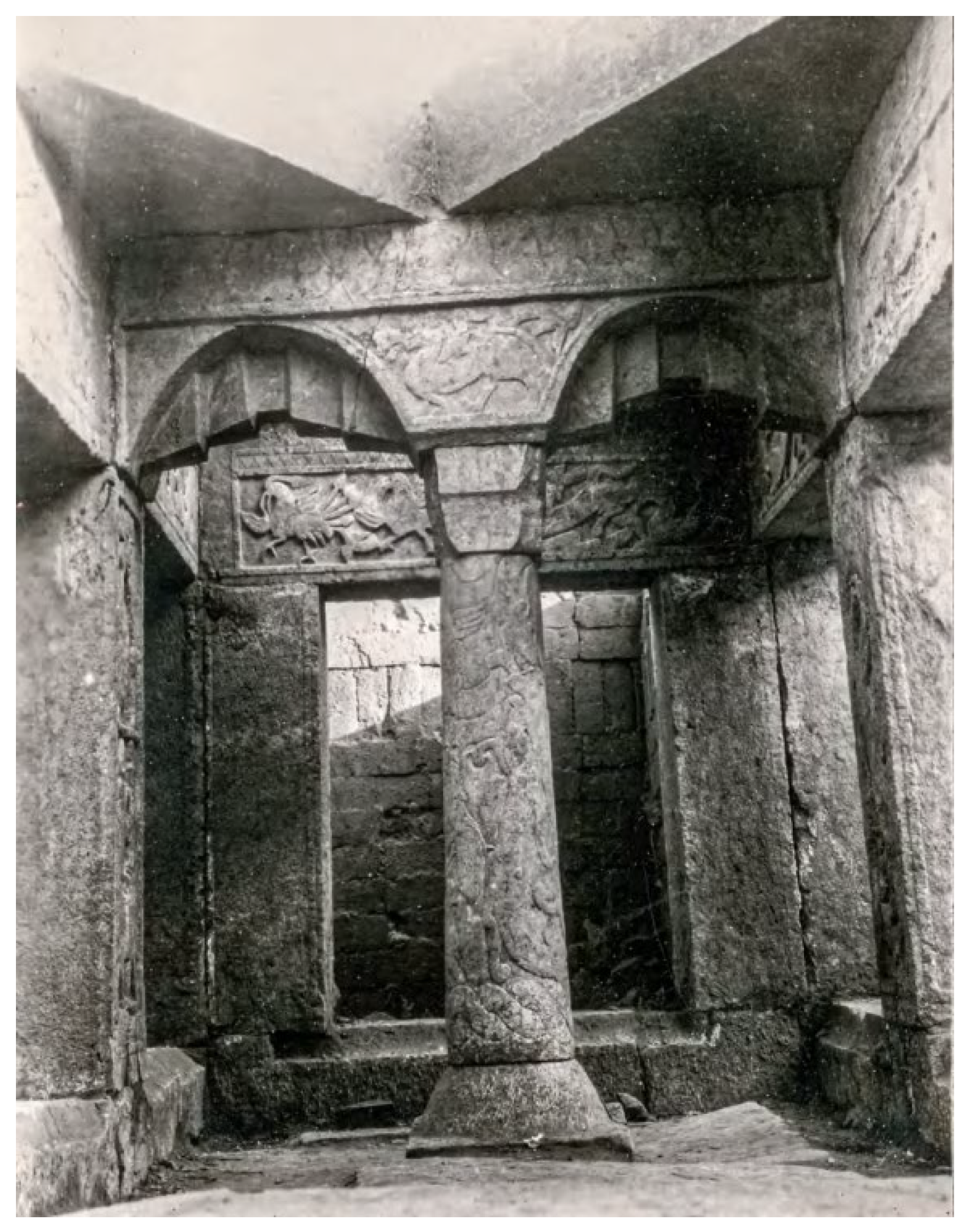
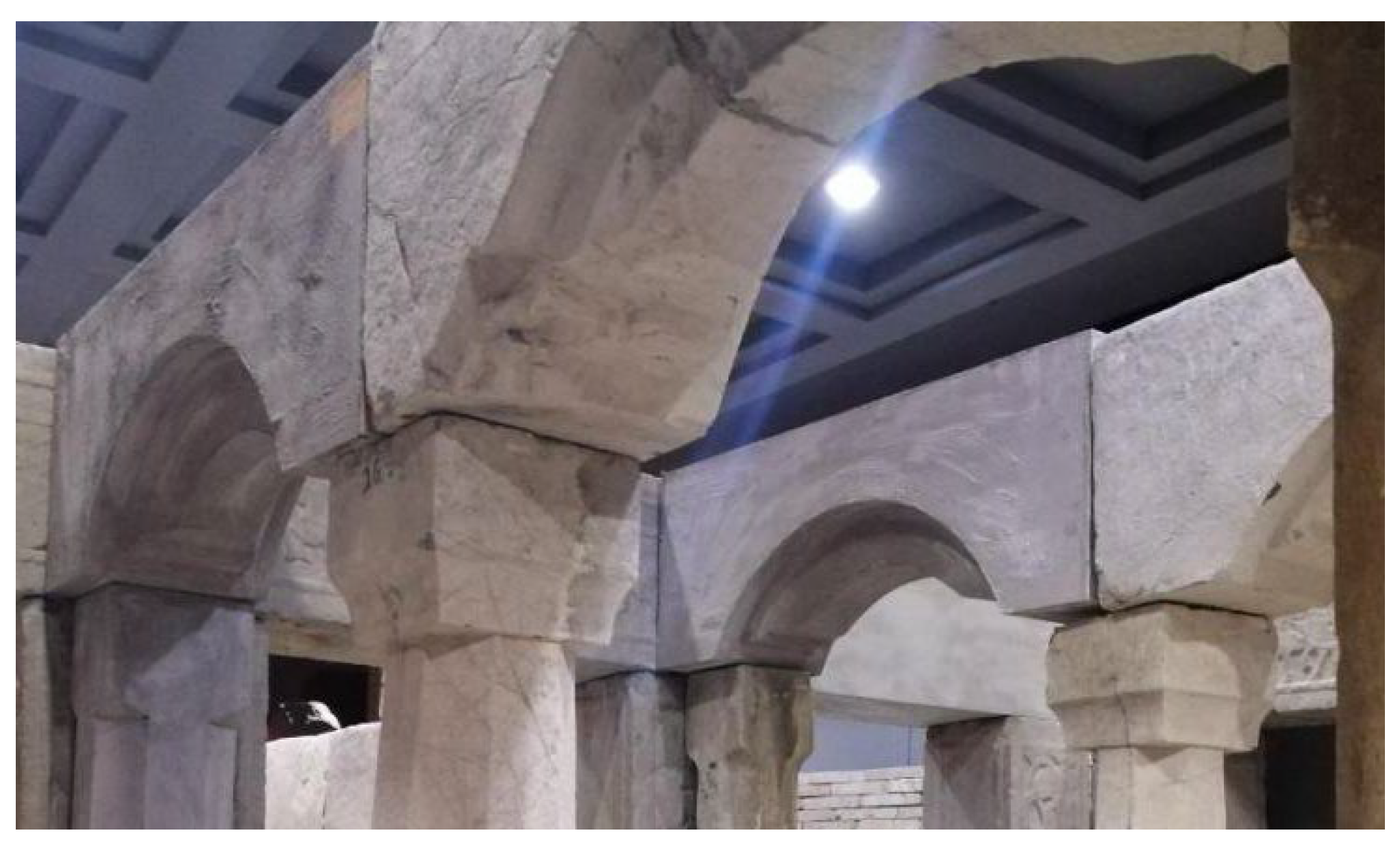
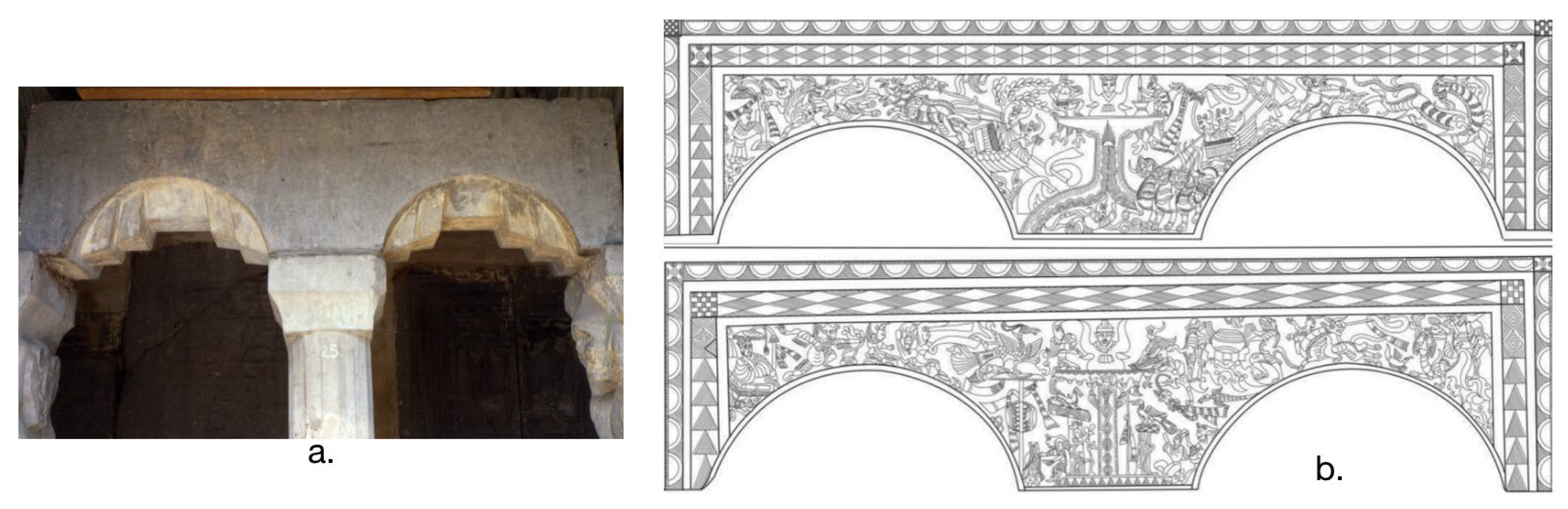
- Dashenliuzhuang Tomb, Ju County (Shandong): Two sets of tapered octagonal columns supporting twin arches in the front chamber (plain surfaces) (Figure 3a).
- (2)
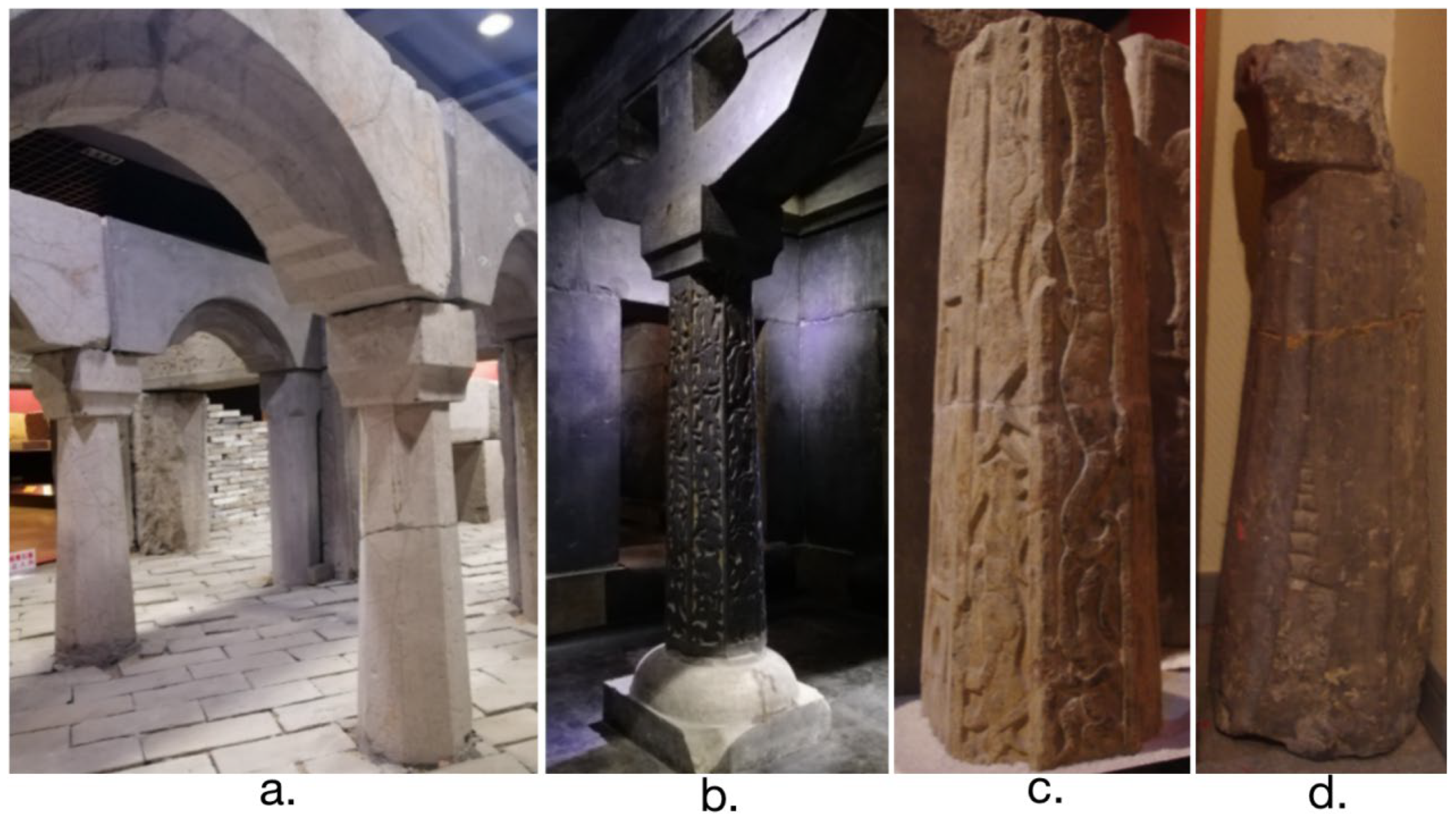
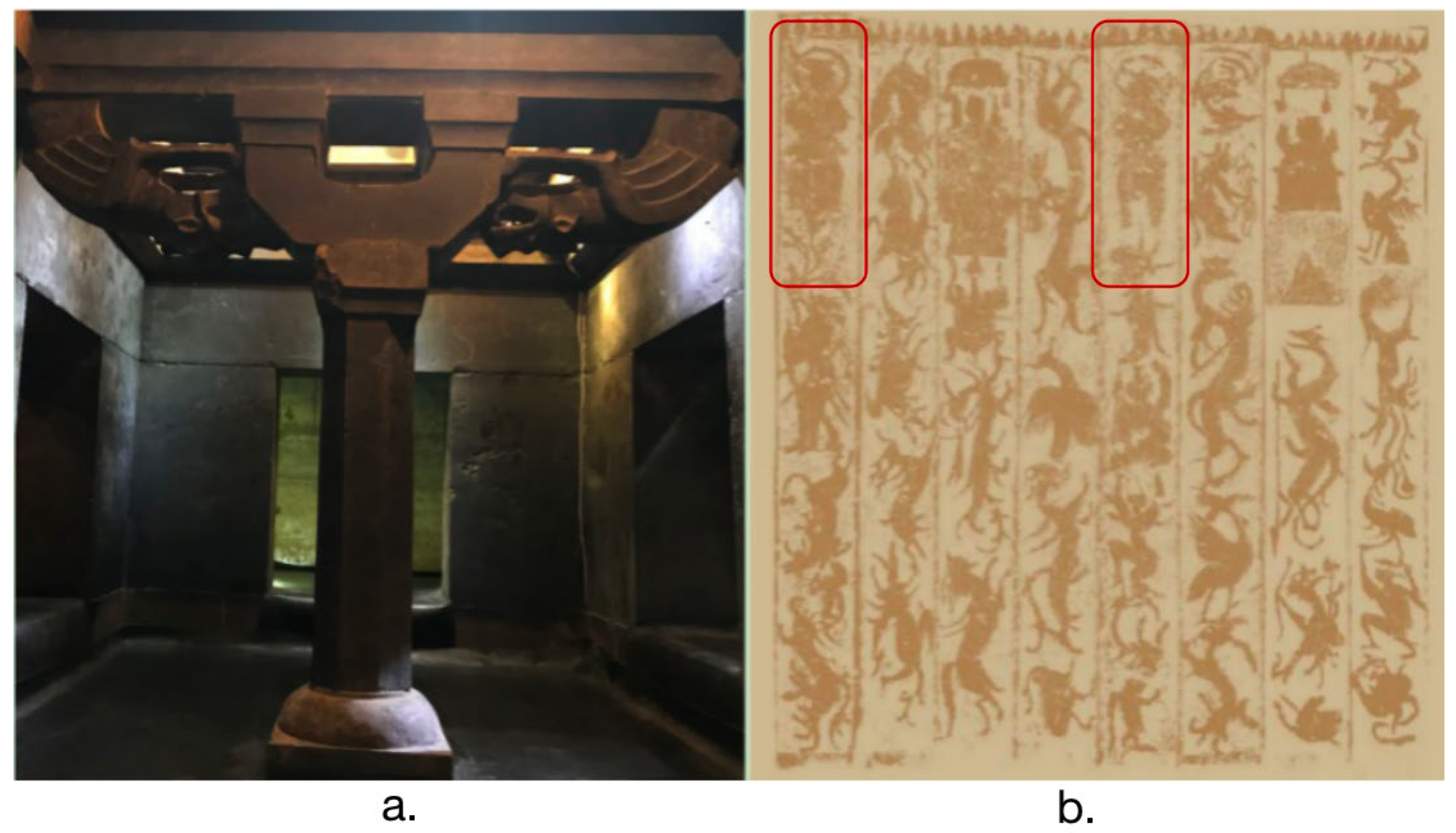
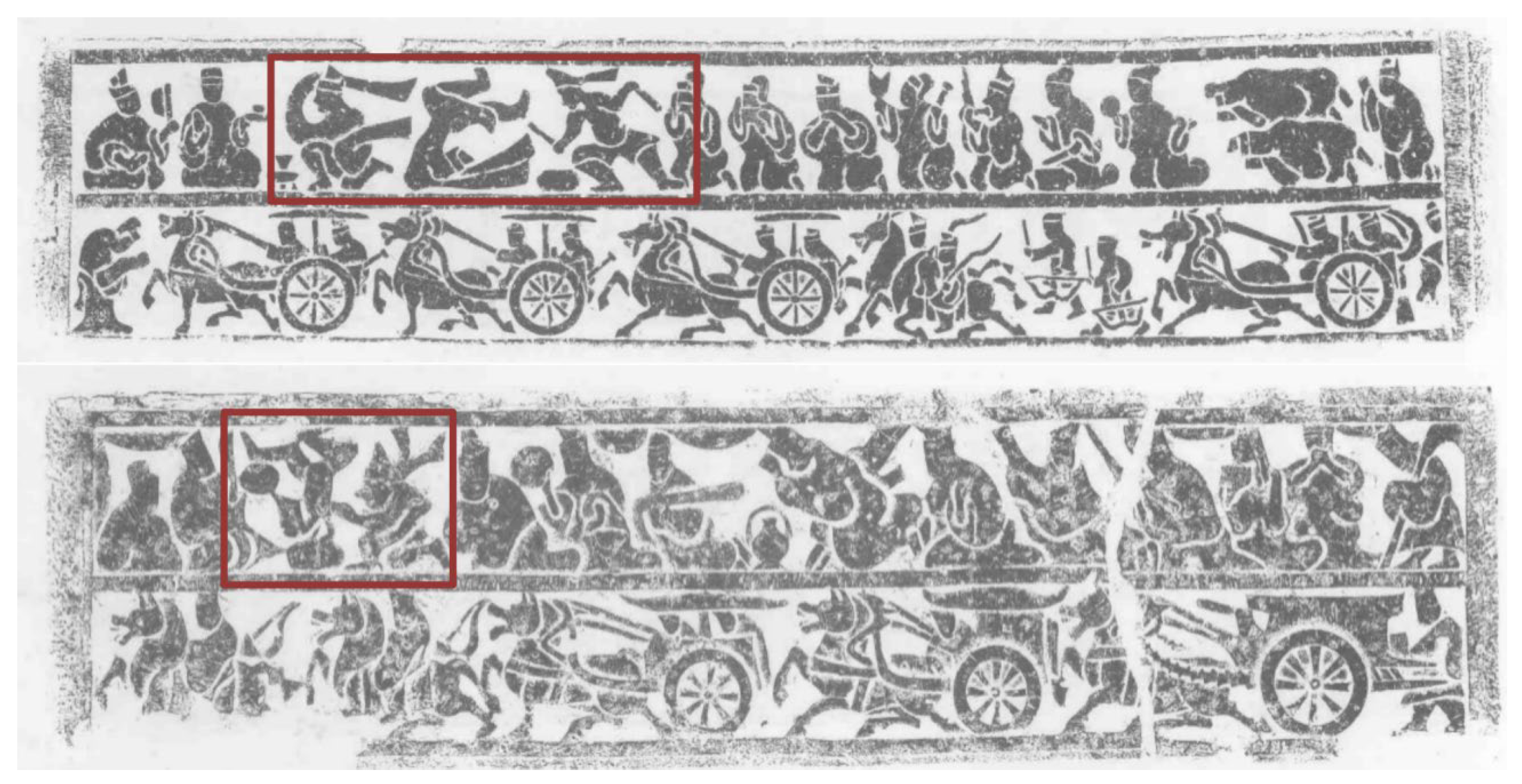
- Wubaizhuang Tomb (Shandong): Hexadecagonal columns paired with twin arches (eastern and western pairs) in the front chamber, both carved with high-relief motifs (Figure 12).
- (3)
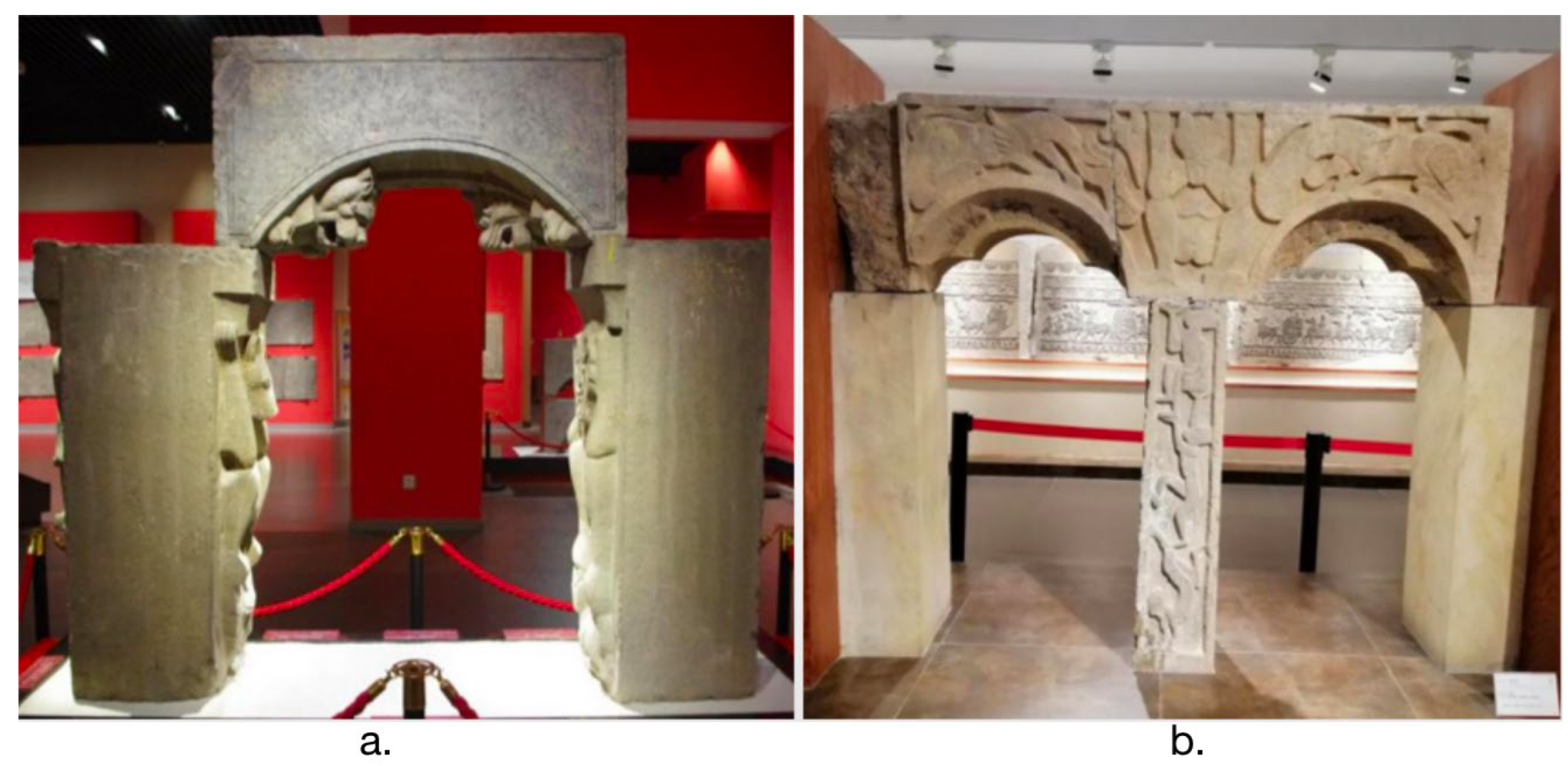
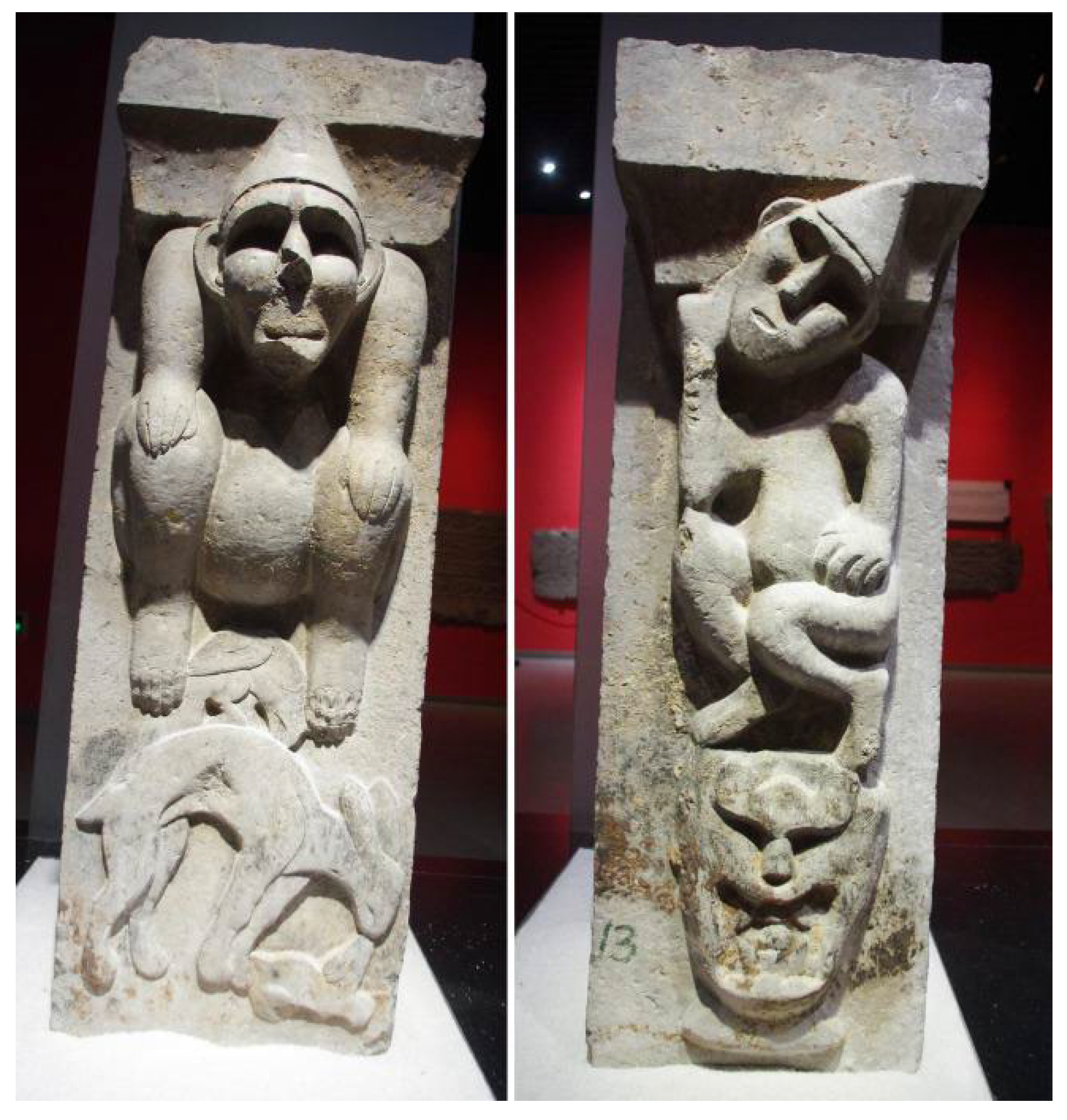
- Wubaizhuang Tomb (Shandong): Square columns supporting a single arch in the central chamber. Columns depict high-relief tigers and bears; the arch interior features carved lion heads (Figure 13a).
- (4)
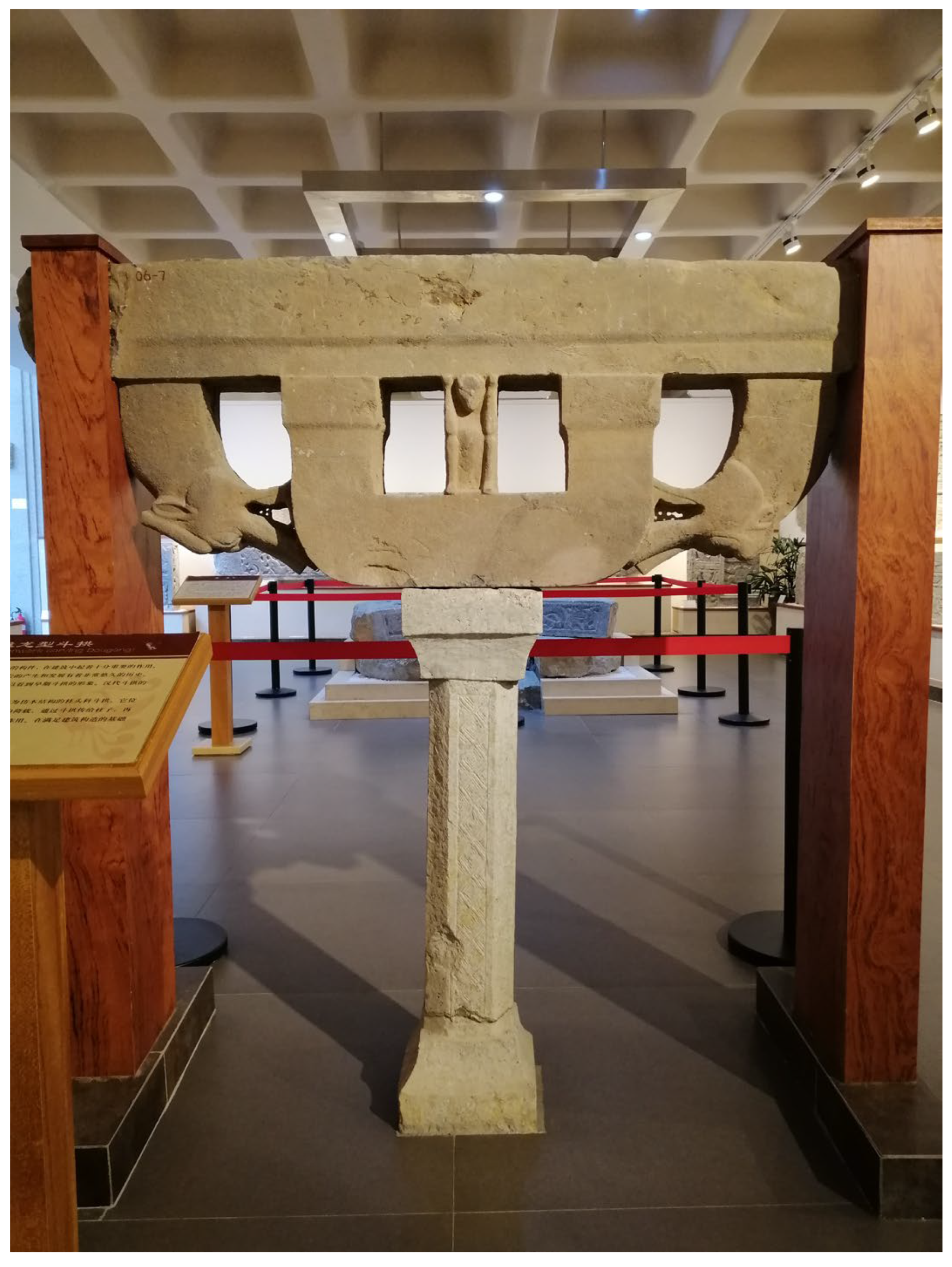
- Xuzhou Han Stone Relief Museum (Jiangsu): Twin-arch structure adorned with auspicious beast imagery (Figure 13b).
- (5)
- Zhangguanzhuang Tomb, Linyi (Shandong): Twin-arch in the front chamber decorated with auspicious beasts (Figure 14).
- (1)
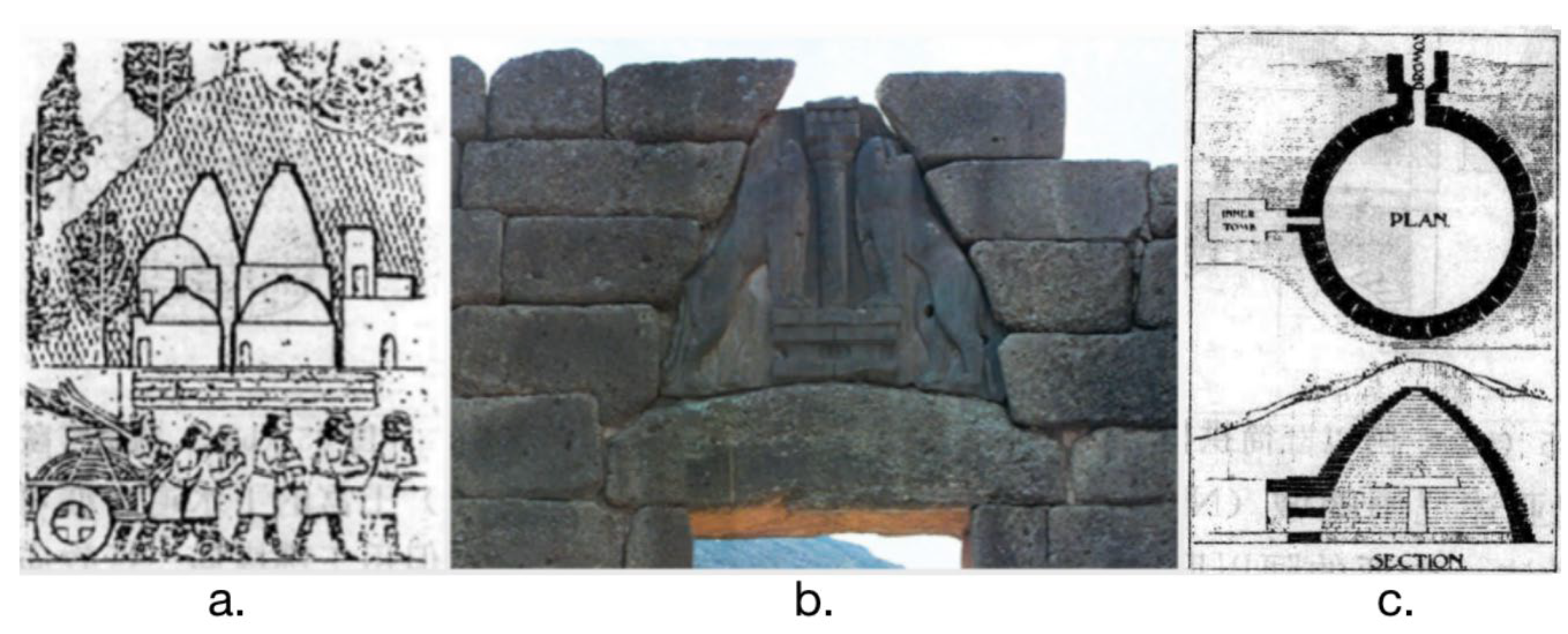
- Parabolic vaulted structures depicted on Assyrian reliefs at Nineveh (Figure 15a);
- (2)
- Corbelled roofs at India’s Harappa site (c. 2000–1500 BCE);
- (3)
- Corbelled Lion Gate lintel at Mycenae citadel (Figure 15b);
- (4)
- Corbelled dome of the Treasury of Atreus at Mycenae (Figure 15c).
4. Fragmented Transmission and Reinterpretation of the “Column–Arch–Buddha” Motif in Han China
5. Conclusions
Author Contributions
Funding
Institutional Review Board Statement
Informed Consent Statement
Data Availability Statement
Acknowledgments
Conflicts of Interest
| 1 | For related research, regarding the Buddhist figures depicted in the stone reliefs of the Yinan Han tomb, Zeng Zhaoyu proposed the concept of “Buddha-like Chinese deities”; Yu Weichao argued that Buddha images from the Han period generally belonged to the context of indigenous Chinese proto-Daoism; Takashi Irisawa put forward the notion of “divine Buddhas” (shenxian fotuo 神仙佛陀), which Wen Yucheng later simplified to “immortal-Buddhas” (xianfo 仙佛), among others. See: (Edwards 1954, pp. 103–5; Zeng et al. 1956. pp. 65–67; Yu 1980, pp. 68–77; Wu 1986, pp. 263–352; Irisawa 1992, p. 65; Wen 2000, p. 43). |
| 2 | Proponents of the Han Dynasty theory include institutions such as the Shaanxi Provincial Institute of Archaeology 陝西考古研究院 and scholars such as Ran Wanli 冉萬里, Lothar von Falkenhausen, Li Min 李旻, Robert L. Brown, Huang Chunhe 黃春和 and Cui Mengze 崔夢澤. See (Shaanxi Academy Archaeology 2022, pp. 3–27; Ran et al. 2022, pp. 82–94; Lei 2022; Huang 2022, pp. 47–56; Cui 2024, pp. 73–76). Additionally, at the Zhejiang University international conference “Gandharan Art and the Civilization of the Silk Road” (犍陀羅藝術與絲路文明國際學術會議) on 11 May 2025, Joe Cribb and Juhyung Rhi presented arguments supporting this view. Scholars supporting the Sixteen Kingdoms–Northern Wei theory can be found in (X. Yang 2021; Yao 2022, pp. 17–29; W. Li and Zhu 2022, pp. 183–91; He 2023, pp. 122–31; Cui 2024, pp. 73–76; Zhang 2024, pp. 1–20). |
| 3 | When Segalen proposed this view, no rock-cut tombs had yet been discovered in the Henan and Xuzhou regions of the heartland of Central Plains. Now, however, increasing archeological evidence and research support this view (Chen Li 2017). |
| 4 | According to Han Dynasty historical records, the term “Western Regions” (Xiyu) initially referred to the Tarim Basin and the areas surrounding the Tianshan Mountains, located to the west of the Hexi Corridor. As the Han people’s geographical knowledge of the West expanded, the scope of this term gradually extended westward to include parts of West Asia, South Asia, and the Mediterranean region. |
| 5 | The dating of architectural sites from the Kushan Kanishka period, along with the Bimaran gold reliquary and coinage depicting Buddha images discussed later in this text, has been established through prolonged scholarly discourse to approximately c.127 CE. Refer to Robert Bracey’s comprehensive 2017 study, see (Bracey 2017, p. 48). |
| 6 | When discussing the distinctive nature of the transmission of Indian Buddhist art into China, Professor Miao Zhe noted that during the Han Dynasty, the Chinese reception of Buddha images prioritized form over substance; Buddhist elements in Han art often retained only the external appearance of foreign forms, and their purpose or nature was not necessarily grounded in genuine Buddhist faith. By the medieval period, however, the content and meaning of Buddha images were largely transmitted alongside their formal attributes. See (Miao 2007, p. VI). |
| 7 | The term “Hu people” 胡人 reflects Han historiography’s collective designation for Silk Road populations, not an ethnic classification, maintaining the historical designations for the Xiongnu 匈奴 peoples of the Mongolian Plateau, as well as for the Central/Western Asian and Indian populations, as documented in Han Dynasty texts. All references to the Xiongnu steppe confederation and Western Region’s polities strictly follow toponyms and ethnonyms preserved in Han historiographical sources, including the Shiji 《史記》 (Records of the Grand Historian) (Sima 2006), Hanshu 《漢書》 (Book of Han), and Houhanshu 《後漢書》 (Book of the Later Han), without inferring modern ethnic correlations. |
| 8 | Terms such as “immortal-Buddhas” (Xianfo 仙佛) and “divine Buddhas” (Shenxianfotuo 神仙佛陀) lack a uniformly established or clearly defined conceptual framework. Nevertheless, their referent is relatively evident. In essence, they denote the consistent amalgamation of Buddha images with indigenous Chinese motifs of deities and auspicious symbols during the Han Dynasty. To the Han people, the Buddha was perceived as a divine being capable of conferring immortality, rather than being understood in the Indian or Central Asian sense, i.e., as a religious leader, an awakened one, or an enlightened teacher. See (Irisawa 1992, p. 65; Wen 2000, p. 43; Hu and Zhang 2019, pp. 131–34). For the analogous term “Buddha-Deity”佛神, see (He 2017, pp. 295–331). |
References
- Bracey, Robert. 2017. The Date of Kanishka since 1960. Indian Historical Review 44: 48. [Google Scholar] [CrossRef] [Scilit]
- Chang, Qing 常青. 1991. Liang Han zhuan shi gongding jianzhu tanyuan 兩漢磚石拱頂建築探源 [The source of brick and stone arch building in Han Dynasty]. Ziran kexueshi yanjiu 自然科學史研究 3: 293. [Google Scholar]
- Chang, Qing. 1992. Xiyu wenming yu Huaxia jianzhu de bianqian 西域文明與華夏建築的變遷 [The Change of Western Civilization and Chinese Architecture]. Changsha: Hunanjiaoyuchubanshe 湖南教育出版社. [Google Scholar]
- Chen, Suting 陳素婷. 2017. A Study on the Classification of Columns in Han Dynasty Stone Carving Tombs in Xuzhou Area 徐州地區漢畫像石墓柱分類研究. Master’s thesis, Jiangsu Normal University, Xuzhou, China. [Google Scholar]
- Chen, Xuan 陳軒. 2019. Dong Han shuzhuzhu yu walengzhu de chubu yanjiu 東漢束竹柱與瓦棱柱的初步研究 [A Preliminary Study of Reeded Columns and Fluted Columns in Eastern Han Dynasty]. Kaogu 考古 5: 93–101. [Google Scholar]
- Chen, Xuan 陳軒. 2021. Rethinking foreign influences on stone-carved tombs in early China. World Archaeology 53: 200–23. [Google Scholar] [CrossRef] [Scilit]
- Cribb, Job. 1984. The Origin of the Buddha Image–The Numismatic Evidence. In South Asian Archaeology 1981. Edited by Allchin Bridget. University of Cambridge Oriental Publications, 34. Cambridge: University of Cambridge, pp. 231–44. [Google Scholar]
- Cui, Mengze 崔夢澤. 2024. Xinchu xian xianyang chengrenmu donghan jintong foxiang yanjiu 新出西安咸陽成任墓東漢金銅佛像研究 [Reaserch on the Newly Discovered Bronze Buddha Statues of the Eastern Han Dynasty from the Chengren Tomb in Xianyang, Xian]. Zongjiaoxue Yanjiu 宗教學研究 2: 73–76. [Google Scholar]
- Dunhuang Wuwu yanjiusuo 敦煌文物研究所. 1999. Zhongguoshiku Dunhuangmogaoku 中國石窟敦煌莫高窟 [Mogao Grottoes in Dunhuang, China]. Beijing: Wenwuchubanshe 文物出版社. [Google Scholar]
- Edwards, Richard. 1954. The Cave Reliefs at Ma Hao. Zurich: Artibus Asiae, vol. XVIII, pp. 103–25. [Google Scholar]
- Falser, Michael. 2015. The Graeco-Buddhist style of Gandhara—A ‘Storia ideologica’, or: How a discourse makes a global history of art. Journal of Art Historiography 13: MF1. [Google Scholar]
- Fan, Ye 范瞱. 2007. Houhanshu 後漢書 [Book of the Later Han]. Shanghai: Zhonghuashuju 中華書局, p. 418. [Google Scholar]
- He, Zhiguo 何志國. 2017. Hanjin Foxiang Zonghe Yanjiu 漢晉佛像綜合研究 [Comprehensive Study of Han-Jin Period Buddha Images]. Shanghai: Shanghai People’s Publishing House 上海人民出版社, pp. 295–331. [Google Scholar]
- He, Zhiguo 何志國. 2023. Xianyang chutu “Donghan qingtong foxiang” xianyi 咸陽出土”東漢青銅佛像”獻疑 [Questioning the Bronze Buddha Statue of the Eastern Han Dynasty from Xianyang]. Zhongyuan Wenwu 中原文物 6: 122–31. [Google Scholar]
- Hou, Can 侯燦. 2001. Wei Jin xiyuzhangshi zhi loulan shizheng 魏晉西域長史治樓蘭實證—樓蘭問題駁難之一 [Verifying the Administrative Seat of the Western Regions Chief Official at Loulan during the Wei-Jin Period: A Polemical Refutation on Loulan Studies]. Xiyuyanjiu 西域研究 4: 66–72. [Google Scholar]
- Hu, Wenjun 胡文峻, and Haiping Zhang 張海平. 2019. Shilun Handai fojiaoyishu de sange fenqi huo leixing jiqi gengbencahyixing 試論漢代佛教藝術的三個分期或類型及其根本差異性 [Three Stages or Types of Han Dynasty Buddhist Art and Their Fundamental Differences]. Xingxiang Shixue 形象史學 2: 122–39. [Google Scholar]
- Huang, Chunhe 黃春和. 2022. Xianyang chengren mu chutu foxiang de niandia chandi ji xiangguan wenti chutan 咸陽成任墓出土佛像的年代產地及相關問題初探 [Preliminary Exploration of the Date, Origin, and Related Issues of the Buddha Images Unearthed from the Chengren Tomb in Xianyang]. Shoucangjia 收藏家 11: 47–56. [Google Scholar]
- Irisawa, Takashi 入澤崇. 1992. Shenxianfotuo 神仙佛陀 [immortal-Buddha hybrids]. Dongnanwenhua 東南文化 3: 65. [Google Scholar]
- Kaneko, Tamio 金子民雄, ed. 1988. Sven Hedin to Roran okoku ten スウエン・ヘテインと樓蘭王國展 (Sven Hedin and the Kingdom of Lou-Ian). Tokyo: Japan Cultural Association and Asahi shimbun. [Google Scholar]
- Lei, Jie 雷潔. 2022. Faxian Zhongguo Zuizaode Jintong Foxiang: Kaogu de Tuduan 發現中國最早的金銅佛像: 考古的推斷[Discovering the Earliest Gilt Bronze Buddhist Statues in China: Archaeological Inferences]. The Paper: Private History 澎湃新聞·私家歷史, March 6.
- Li, Chen 李晨. 2017. Rethinking the Origins of Han Dynasty Stone-Carved Tombs. World Archaeology 49: 700–17. [Google Scholar] [CrossRef] [Scilit]
- Li, Chongfeng 李崇峰. 2014. Fojiao kaogu 佛教考古:從印度到中國 [Buddhist Archaeology From Indian to China]. Shanghai: Shanghai guji chubanshe 上海古籍出版社. [Google Scholar]
- Li, Wenwen 李雯雯, and Hu Zhu 朱滸. 2022. Xianyang chengren mudi chutu jintong foxiang fengge yanjiu 咸陽成任墓地出土金銅佛像風格研究 [Study on the Style of Gilt Copper Buddha Statues Unearthed from the Tomb in Chengren Village, Xianyang]. Zhongguo Meishu Yanjiu 中國美術研究 3: 184–91. [Google Scholar]
- Linyi Shi bowuguan 臨沂市博物館. 2018. Linyi Wubaizhuang hanhuaxiang shimu 臨沂吳白莊漢畫像石墓 (Linyi Wubai Zhuang Han Dynasty Stone Tomb). Taipei: Qilu shushe 齊魯書社. [Google Scholar]
- Liu, Yi 劉屹. 2025. Donghan shiqi de foxiang yu fojiao tuxiang 東漢時期的佛像與佛教圖像 [Buddha Statues and Buddhist Imagery during the Eastern Han Dynasty]. Chinese Historical Studies 《中國史研究》 3: 75–93. [Google Scholar]
- Marshall, John Hubert. 1951. Excavations at Taxila–the Stupas and Monasteries at Jauliāñ. Calcutta: Superintendent Government Printing. [Google Scholar]
- Miao, Zhe 繆哲. 2007. Han Dai yishu zhong wailai muti juli—Yi huaxiangshi wei zhongxin 漢代藝術中外來母題舉例—以畫像石為中心 [Example of Foreign Motif in Han Dynasty Art—Centered on Stone Carving]. Ph.D. dissertation, Nanjing Normal University, Nanjing, China. [Google Scholar]
- Mu, Yongkang 牟永抗. 1984. Shaoxing 306 hao Yuemu chuyi 紹興306號越墓芻議 [A Discussion on Shaoxing No. 306 Yue Tomb]. Wenwu 文物 1: 30–35. [Google Scholar]
- Nanjing Bowuyuan 南京博物院. 1957. Changli shuiku Hanmuqun fajue jianbao 昌梨水庫漢墓群發掘簡報 [A Brief Report on the Excavation of Han Tombs in Changli Reservoir]. Wenwu cankao ziliao 文物參考資料 12: 29–40. [Google Scholar]
- Nanjing Bowuyuan 南京博物院. 1981. Xuzhou Qingshanquan Baiji Dong Han huaxiangshi mu 徐州青山泉白集東漢畫像石墓 [Xuzhou Qingshanquan Baiji Eastern Han Dynasty Stone Carving Tomb]. Kaogu 考古 2: 137–50. [Google Scholar]
- Quan, Hong 全洪, and Zaoxin Li 李灶新. 2019. Nanyue gongyuan yixzhi bajiaoshizhu de haiwaiwenhua yinsu kaocha 南越宮苑遺址八角形石柱的海外文化因素考察 [Overseas cultural factors investigation of octagonal stone columns at the Nanyue Palace Site]. Wenwu 文物 10: 69–78. [Google Scholar]
- Ran, Wanli 冉萬里, Ming Li 李明, and Zhanrui Zhao 赵占锐. 2022. Xianyang Chengren mudi chutu Donghan jintong foxiang yanjiu 咸陽成任墓地出土東漢金銅佛像研究 [Study of the Eastern Han Gilded Bronze Buddha Statues Unearthed from the Chengren Cemetery, Xianyang]. Kaogu yu Wenwu 考古與文物 1: 82–94. [Google Scholar]
- Rawson, Jessica. 1999. The Eternal Palaces of the Western Han: A New View of the Universe. Artibus Asiae 59: 5–58. [Google Scholar] [CrossRef] [Scilit]
- Rawson, Jessica. 2010. Tombs of the Han Dynasty. In China’s Terracotta Army. Edited by Kerstin Goransson and Jeremy Rawson. Stockholm: Museum of Far Eastern Antiquities, pp. 79–88. [Google Scholar]
- Rawson, Jessica. 2012. China and Northern Neighbours. In The Search for Immortality: Tomb Treasures of Han China. Edited by Jensen Cheng-Sheng Lin. New Haven: Yale University Press. [Google Scholar]
- Rhie, Marlin. 1999. Early Buddhist Art of China and Central Asia: Later Han, Three Kingdoms and Western Chin in China and Bactria to Shan-Shan in Central Asia. Boston: Brill Leiden Boston Koin, vol. 1. [Google Scholar]
- Ruan, Rongchun 阮荣春. 1997. ‘Fojiao Nanchuanzhilu’ Beishen Shandong Nanbu—Lun Linyi, Yinan Huaxiangshi Zhongde Wailaiyingxiang ‘佛教南傳之路’北滲山東南部——論臨沂畫像石中的外來因素 [“The Road of Buddhism to the South” spread to the south of Shandong—On the external factors in Linyi stone sculptures]. Gugong Wenwu Yuekan 故宮文物月刊 166: 87. [Google Scholar]
- Segalen, Victor. 1930. Zhongguo xibu kaogu ji 中國西部考古記 (Premier Exposé des Résultats Archéologiques Obtenus dans la Chine Occidentale par la Mission Gilbert de Voisins Jean Latirgue et Victor Segalen). Translated by Chengjun Feng 馮承鈞. Shanghai: Shangwu Yinshuguan 商務印書館. [Google Scholar]
- Shaanxi Academy Archaeology 陝西省考古研究院. 2022. Shanxi xiangyang chengren mudi donghan jianzumu fajue jianbao 陝西咸陽成任墓地東漢家家族墓發掘簡報 [Preliminary Report of the Excavationof the Eastern Han Family Tombs at the Chengren Cemetery in Xianyang, Shaanxi]. Kaogu Yu Wenwu 考古與文物 1: 3–27. [Google Scholar]
- Shandong Sheng wenwu kaogu yanjiuyuan 山東省文物考古研究院. 2023. Linyi zhangguanzhuang handai huaxiangshimu 臨沂張官莊漢代畫像石墓 [The Tomb with Stone Reliefs of the Han Dynasty at Zhangguanzhuang Village, Linyi]. Jinan: Haidai kaogu 海岱考古. [Google Scholar]
- Shandongsheng Bowuguan 山東省博物館, and Shandong Sheng wenwu kaogu yanjiusuo 山東省文物考古研究所. 1982. Shandong Han huaxiangshi xuanji 山東漢畫像石選集 [Selected Collection of Han Stone Carvings in Shandong]. Taipei: Qilu shushe 齊魯書社. [Google Scholar]
- Sima, Qian 司馬遷. 2006. Shiji 史記 [Records of the Grand Historian]. Shanghai: Zhonghua shuju 中華書局. [Google Scholar]
- Sirén, Osvald. 1930. A History of Early Chinese Art II: The Han Period. London: Ernest Benn. [Google Scholar]
- Soper, Alexander. 1947. The ‘Dome of Heaven’ in Asia. The Art Bulletin 29: 225–48. [Google Scholar] [CrossRef] [Scilit] [PubMed]
- Stein, Aurel. 1912. Ruins of Desert Cathay, Personal Narrative of Explorations in Central Asia and Western Most China. Pl.XXIII. London: Macmillan. [Google Scholar]
- Tang, Changshou 唐長壽. 1993. Leshan yamu he Pengshan yamu 樂山崖墓和彭山崖墓 [Leshan Cliff Tombs and Pengshan Cliff Tombs]. Chengdu: Dianzi keji daxue chubanshe 電子科技大學出版社. [Google Scholar]
- Thorp, Robert L. 1979. Mortuary Art and Architecture of Early Imperial China. Ph.D. thesis, University of Kansas, Lawrence, Kansas. [Google Scholar]
- Wang, Yun 王雲. 2017. Yindu zaoqi fojiao shiku 印度早期佛教石窟 [Early Buddhist Grottoes in India]. Zhongguo yishu 中國藝術 4: 71, 73, 75. [Google Scholar]
- Wen, Yucheng 溫玉成. 2000. Zaoqi fojiao chuchuan Zhongguo nanfang zhilu zhiyi 早期佛教初傳中國南方之路質疑 [Questioning the Road of Early Buddhism’s First Transmission to Southern China]. Sichuan wenwu 四川文物 2: 43. [Google Scholar]
- Wu, Hung. 1986. Buddhist Elements in Early Chinese Art (2nd and 3rd Centuries A.D.). Artibus Asiae 47: 263–303+305–352. [Google Scholar] [CrossRef] [Scilit]
- Wu, Hung. 1995. Monumentality in Early Chinese Art and Architecture. Stanford: Stanford University Press. [Google Scholar]
- Xiangfan wenwu kaogu yanjiusuo 襄樊文物考古研究所. 2010. Hubei xiangfan fancheng caiyu sanguomu fajue jianbao 湖北襄樊樊城菜越三國墓發掘簡報 [Excavation Report of the Three Kingdoms Tomb at Caiyue]. Wenwu 文物 9: 13. [Google Scholar]
- Yang, Aiguo 楊愛國. 2017. Han Dai de duojiao shizhu 漢代的多角石柱 [The multi cornered stone columns of the Han Dynasty]. Xingxiang shixue 形象史學 (Visual Historiography) 2: 35. [Google Scholar]
- Yang, Xin 陽新. 2021. Guanyu Xianyang danghanmu chutu tongfo de niandai fenxi 關於咸陽東漢墓出土銅佛的年代分析. Available online: https://mp.weixin.qq.com/s/0LAq9l1218BhC4Olrvyxng (accessed on 7 September 2024).
- Yao, Chongxin 姚崇新. 2022. Guanyu xianyang chengren donghanmu chutu jintong foxiang de jige wenti 關於咸陽成任東漢墓出土金銅佛像的幾個問題 [Several Questions about the Gilt Bronze Buddha Statues Unearthed from the Tomb of Eastern Han Dynasty at Chengren in Xianyang]. Wenbo Xuekan 文博學刊 2: 17–29. [Google Scholar]
- Yu, Weichao 俞偉超. 1980. Donghan fojiao tuxiang kao 東漢佛教圖像考 [A Study of Buddhist Iconography in the Eastern Han Period]. Wenwu 文物 5: 68–77. [Google Scholar]
- Yungang Shiku Wenwu baoguansuo 雲崗石窟保管所. 2016. Zhongguo shiku Yungang shiku (2) 中國石窟.雲岡石窟(二) [Chinese Grottoes. Yungang Grottoes II]. Beijing: Wenwu chubanshe 文物出版社. [Google Scholar]
- Zeng, Zhaoyu 曾昭燏, Baogeng Jiang 蔣寶庚, and Zhongyi Li 黎忠義. 1956. Yinan gu huaxiangshimu fajue baogao 沂南古畫像石墓發掘報告 [Excavation Report of the Ancient Stone Relief Tomb at Yinan]. Beijing: Wenhuabu wenwu guanliju (Cultural Relics Bureau, Ministry of Culture), p. 66. [Google Scholar]
- Zhang, Liming. 2024. Re-Study of the Gilt Bronze Buddha Statuettes Unearthed from the Eastern Han Dynasty Tomb in Chengren Village, Xianyang City, China. Religions 15: 1476. [Google Scholar] [CrossRef] [Scilit]
- Zhejiangsheng wenwu guanli weiyuanhui 浙江省文物管理委員會. 1984. Shaoxing 306 hao Zhanguo mu fajue jianbao 紹興306號戰國墓發掘簡報 [Excavation Report of Shaoxing No. 306 Warring States Tomb]. Wenwu 文物 1: 10–26. [Google Scholar]
- Zhongguo Guojia Bowuguan Tianye Kaogu Yanjiu Zhongxin 國家博物館田野考古中心, Nanjing Bowuyuan Kaogu Yanjiusuo 南京博物院考古研究所, Lianyungang Shi Wenwu Guanli Weiyuanhui Bangongshi 連雲港市文物管理委員會辦公室, and Lianyungang Shi Bowuguan 連雲港市博物館. 2010. Lianyungang Kongwangshan 連雲港孔望山 [Kongwang Mountain, Lianyungang]. Beijing: Wenwu Chubanshe 文物出版社. [Google Scholar]
- Zhu, Hu 朱滸. 2017. Han huaxiang Huren tuxiang yanjiu 漢畫像胡人圖像研究 [A Study of the Iconography of Non-Han Peoples in the Han Dynasty]. Beijing: Sanlianshudian 三聯書店. [Google Scholar]



| Structural Elements | Indian Prototypes (an Integrated Whole) | Han Mortuary Adaptation (a Modular Assemblage) |
|---|---|---|
| Octagonal columns | Lion capital | Either plain surfaces or auspicious motifs |
| Arched beams | Symbolism of ritual niches | Celestial Gate metaphor |
| Buddha statues | Ritual worship | Syncretic figures |
Disclaimer/Publisher’s Note: The statements, opinions and data contained in all publications are solely those of the individual author(s) and contributor(s) and not of MDPI and/or the editor(s). MDPI and/or the editor(s) disclaim responsibility for any injury to people or property resulting from any ideas, methods, instructions or products referred to in the content. |
© 2026 by the authors. Licensee MDPI, Basel, Switzerland. This article is an open access article distributed under the terms and conditions of the Creative Commons Attribution (CC BY) license.
Share and Cite
Hu, W.; Zhu, X.; Zhu, H. From India to China: The Origin and Transmission of the Han Dynasty’s Column–Arch–Buddha Motif from a Pan-Asian Perspective. Religions 2026, 17, 119. https://doi.org/10.3390/rel17010119
Hu W, Zhu X, Zhu H. From India to China: The Origin and Transmission of the Han Dynasty’s Column–Arch–Buddha Motif from a Pan-Asian Perspective. Religions. 2026; 17(1):119. https://doi.org/10.3390/rel17010119
Chicago/Turabian StyleHu, Wenjun, Xuguang Zhu, and Hu Zhu. 2026. "From India to China: The Origin and Transmission of the Han Dynasty’s Column–Arch–Buddha Motif from a Pan-Asian Perspective" Religions 17, no. 1: 119. https://doi.org/10.3390/rel17010119
APA StyleHu, W., Zhu, X., & Zhu, H. (2026). From India to China: The Origin and Transmission of the Han Dynasty’s Column–Arch–Buddha Motif from a Pan-Asian Perspective. Religions, 17(1), 119. https://doi.org/10.3390/rel17010119