


Abstract
During the Joseon Dynasty, Korean Buddhism intentionally negotiated its survival and ongoing relevance in response to the predominance of Neo-Confucian state ideology by aligning Buddhist teaching with Confucian ethical ideals, especially filial piety. This process can be clearly observed in two well-known apocryphal texts—the Bulseol daebo bumo eunjung gyeong (佛說大報父母恩重經, Eunjung gyeong) and the Bulseol jangsu myeoljoe hojedongja darani gyeong (佛說長壽滅罪護諸童子陀羅尼經, Jangsu gyeong)—whose acceptance in Joseon Korea was largely dependent on their Confucian-inspired ethical substance. This article explores how the material aspects of these texts—such as woodblock printing methods, visual programs, book formats, and meticulous colophons—operated as means for integrating Buddhist doctrinal themes with Confucian moral standards. By focusing on the 1452 woodblock editions produced at Wŏnamsa Temple, this research highlights materiality as an influential factor in enabling the visual and ritual spread of Buddhist filial ethics and thereby supporting Buddhism’s cultural legitimacy in a Confucian-dominated environment. Using a material culture lens, this study addresses a notable gap in the current research—which has typically emphasized textual interpretation at the expense of material dimensions—and offers insight into how religious groups strategically utilized materiality to adapt within changing socio-cultural contexts.
1. Introduction
During the Joseon Dynasty (1392–1910), Korean Buddhism operated within a socio-political environment structured by Neo-Confucian state ideology, which posed persistent challenges to Buddhist institutional authority and ethical legitimacy (Koh 2003). Rather than withdrawing from public life, Buddhist communities actively adjusted their modes of teaching, ritual practice, and textual production in ways that resonated with Confucian moral discourse, particularly the virtue of filial piety (Kor. hyo, 孝). Among the various strategies employed, the production and circulation of Buddhist scriptures that explicitly addressed family ethics constituted an important medium through which Buddhism negotiated its position within a Confucian-dominated moral order. Two apocryphal sutras—the Bulseol daebo bumo eunjung gyeong (佛說大報父母恩重經; Fo shuo Dabao Fumu Enzhong Jing, hereafter Eunjung gyeong, “Sutra on the Profound Kindness of Parents”) and the Bulseol jangsu myeoljoe hojedongja darani gyeong (佛說長壽滅罪護諸童子陀羅尼經; Fo shuo Changshou Miezui Huzhu Tongzi Tuoluoni Jing, hereafter Jangsu gyeong, “Sutra of Longevity, Eradicating Sins, and Protection for Children”)—became especially prominent in this context. Although neither text originated within the Indian Buddhist canon,1 both emerged from a broader East Asian Buddhist milieu and circulated widely in multiple printed and illustrated formats prior to their reception in Korea. Their subsequent acceptance in Joseon society has often been explained in terms of doctrinal content, particularly their emphasis on filial piety, parental benevolence, and prayers for familial well-being2, values closely aligned with Neo-Confucian ethics (Walraven 2012; Nam 2004). The existing scholarship has therefore tended to frame these sutras primarily as examples of doctrinal or ethical accommodation.
This study approaches the issue from a complementary perspective by shifting analytical attention to materiality. Rather than treating the physical form of these sutras as secondary to their textual meaning, it asks how printing techniques, visual representations, book layouts, and records of patronage conditioned the ways in which filial ethics were articulated, circulated, and ritually enacted. In doing so, the article addresses a gap in the existing literature, which has generally privileged textual interpretation while paying comparatively little attention to the material and visual dimensions of Joseon Buddhist print culture. The principal case examined here is the 1452 woodblock-print editions of the Eunjung gyeong and Jangsu gyeong produced at Wŏnamsa Temple in Wanju, Jeolla Province. These editions preserve unusually rich bibliographical, visual, and paratextual evidence, including narrative illustrations, detailed colophons, and indications of ritual use. Because such features survive in an integrated form, the Wŏnamsa prints provide a particularly suitable site for examining how Confucian-oriented Buddhist values were articulated through material means in early Joseon Korea. At this stage, the article does not presume the effects of these material strategies but treats the editions as an analytical locus through which their functions and implications can be examined. Methodologically, the analysis focuses on three interrelated material dimensions: (1) visual sequencing and narrative illustration, (2) page layout and book format, and (3) colophonic documentation of patronage and devotional intent. These dimensions make it possible to situate the Wŏnamsa editions alongside selected East Asian precedents—such as illustrated sutras and moral manuals—without proposing an exhaustive comparative survey. The comparative frame is therefore limited and functional, serving to clarify how similar material strategies were employed across different cultural contexts for ethical instruction and persuasion. This study suggests that material strategies—including printing format, visual narration, and documented patronage—enabled these sutras to operate as vehicles for Confucian-oriented Buddhist ethics, thereby contributing to the negotiation of religious identity and ethical norms within Neo-Confucian moral order.
2. Negotiating Filial Piety: Apocryphal Buddhist Texts and the Integration of Confucian Ethics
The evolving relationship between Korean Buddhist apocryphal literature and Confucian ethics—particularly during the late Goryeo and Joseon periods—has emerged as a significant subject of contemporary academic inquiry. Once Neo-Confucianism was institutionalized as the state ideology, Buddhism encountered substantial obstacles to its societal influence and political legitimacy. A substantial body of scholarship has already examined this rapprochement between Buddhism and Confucianism from the perspectives of intellectual history, royal policy, and ritual practice, including the works of Walraven, Muller, Vermeersch, and others. Rather than attempting a comprehensive survey of that literature, this article complements it by focusing specifically on the material and visual dimensions of two apocryphal sutras as a distinct yet closely related site of negotiation. Rather than retreating from the public sphere, Buddhist institutions adapted by rearticulating their teachings to correspond more closely with dominant Confucian values, placing particular emphasis on filial piety.3 This adaptability is apparent in the composition, circulation, and acceptance of apocryphal sutras—texts produced in East Asia and ascribed to the Buddha, which frequently reinterpret Buddhist principles to align with regional ethical paradigms.4
Among these texts, the Eunjung gyeong emerged as the most widely published and distributed Buddhist sutra in Joseon Korea. Its primary focus on filial duty echoed the essential Confucian virtue underpinning the official doctrine of the era. Research by Korean scholars indicates that the widespread circulation of the Eunjung gyeong from the late Goryeo period to the Joseon period paralleled the ascendancy of Neo-Confucian thought, a development that has often been interpreted as one mode by which Buddhist communities aligned their ethical messaging with an ascendant Neo-Confucian moral regime.5 By centering filial piety, the sutra functioned as both doctrinal validation and a conduit for cultural negotiation, enabling Buddhism to maintain its significance amid shifting ideological landscapes.6 The Jangsu gyeong, while the subject of fewer studies,7 also exemplifies this synthesis of Buddhist practice with Confucian familial ethics. Its liturgical emphasis on prayers for longevity, health, and the safeguarding of descendants corresponded directly with Confucian priorities of lineage preservation and family welfare (Nam 2004, p. 50). Although the precise origins of the text are uncertain—with the text having likely been composed somewhere in East Asia and possibly Korea—it achieved lasting popularity by harmonizing Buddhist devotional acts with core values that defined Joseon society.
Recent scholarship increasingly recognizes that, beyond doctrinal content, the materiality of these sutras—including their methods of production, illustrative schemes, codex structures, and colophons recording patronage—was crucial in shaping their ethical reception and social authority.8 Illustrated editions of the Eunjung gyeong became especially influential during the Joseon period, often aligning with and shaping the conventions of contemporary Confucian morality manuals. Patronage from royal and elite circles further established these texts as paradigms of filial virtue, while their vivid imagery and ritual integration broadened their appeal to audiences with different levels of literacy.9 The visual and performative aspects, therefore, are fundamental for understanding how these sutras conveyed moral values and contributed to the construction of religious identity in Joseon Korea. In light of these observations, this study emphasizes the agency of materiality as a critical dynamic allowing Buddhist apocryphal texts to engage meaningfully with Confucian ideals. Rather than interpreting physical features as mere ornamentation, this research suggests that material strategies—such as the use of woodblock printing, narrative illustrations, sturdy bindings, and carefully inscribed colophons—were central to making Buddhist teachings on filial piety persuasive and ritually significant within the socio-religious context of Joseon. This perspective elucidates a complex interaction among textual form, material culture, and ideological adaptation that enabled Buddhism to maintain its relevance and adaptability.
This chapter thus establishes the foundation for a subsequent in-depth investigation of the 1452 Wŏnamsa editions of the Eunjung gyeong and Jangsu gyeong. The following section reviews prior scholarship and historical developments, situating these sutras within the expansive East Asian Buddhist and Confucian frameworks. Later chapters examine the distinct material properties of the Wŏnamsa prints and assess their contribution to mediating doctrinal Buddhism and Confucian ethical principles during early Joseon Korea.
3. Bibliographical Features and Material Characteristics of the 1452 Wŏnamsa Editions
The 1452 woodblock-print editions of the Eunjung gyeong and Jangsu gyeong, produced at Wŏnamsa Temple in Wanju, Jeollabuk-do Province, mark a pivotal phase in the early Joseon Buddhist print tradition. Issued less than a decade after the original Hwaamsa editions were presumably destroyed by fire, Wŏnamsa editions were urgently reproduced to ensure the continued circulation of these sacred texts. The close geographical proximity between Wŏnamsa and Hwaamsa, both located in the Wanju region, suggests practical and economic motivations for expediting the reprinting process. Only two copies of the Hwaamsa prints are known to survive, underscoring their rarity, whereas the Wŏnamsa editions exhibit a notably higher level of craftsmanship and editorial refinement. This edition is officially designated as a Tangible Cultural Property of Jeollabuk-do Province, reflecting its exceptional historical and cultural value.10
The extant Eunjung gyeong edition is preserved as a single-volume codex consisting of twenty-two leaves. Each leaf measures approximately 27.5 × 33.0 cm, and the printed area (kwanggwak, 匡郭) is about 19.5 cm in height. The layout follows typographical conventions established in the late Goryeo period and continued into early Joseon print culture, with seven to eight lines per half-leaf and approximately fifteen characters per line. Margins appear only along the upper and lower edges. In place of standard running titles (Kor. pansim, 版心), folio numbering is marked as “Eun 1” (恩一) within the designated running-title space, indicating the persistence of Goryeo editorial practices despite the mid-fifteenth-century production date. Overall, the quality of woodblock carving and printing in the Wŏnamsa edition surpasses that of the earlier Hwaamsa versions, attesting to both technical skill and meticulous editorial planning.
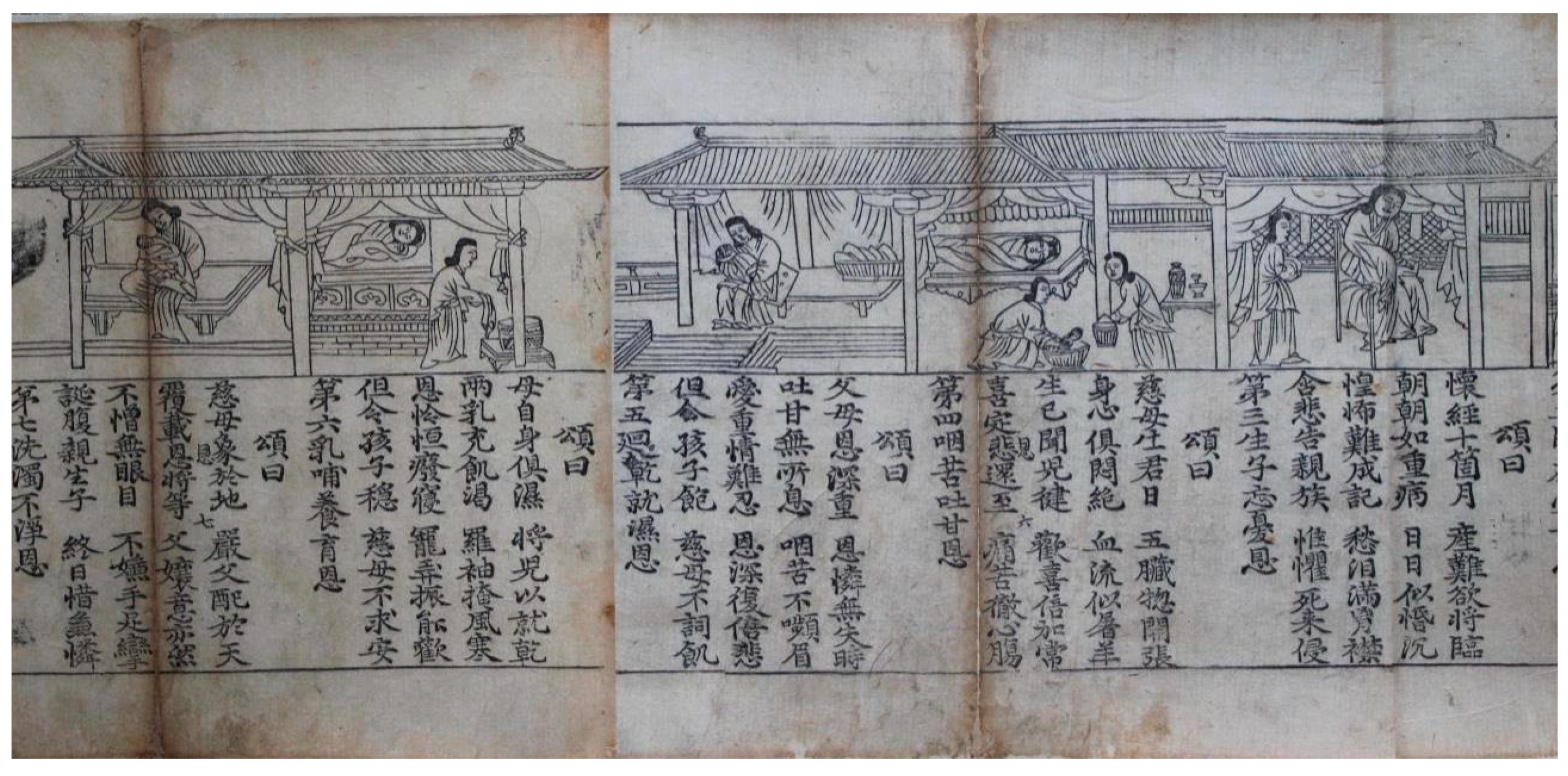
More significant for the present study is the program of twenty-one woodblock illustrations that structure readers’ engagement with the text. The Ten Graces Diagram (Kor. Sibeundo 十恩圖) appears in an “image-above, text-below” format (Kor. Sangdo hamun 上圖下文) in the opening section, whereas later illustrations—including the Eight Parables Diagram (Kor. Palbiyudo 八譬喩圖) and related cycles—are presented in a “text-before, image-after” sequence (Kor. Jeonmun huho 前文後圖). Art-historical studies have demonstrated that such programs do not function merely as ornamentation but operate as narrative devices that visually articulate episodes described in the sutra (Murray 2007; Berezkin 2015). In keeping with the methodological approach outlined above, this study therefore treats the Wŏnamsa illustrations not as illustrative supplements but as integral components of the sutras’ ethical and ritual design, in dialogue with material–textual and art-historical approaches to Buddhist visual storytelling (Murray 2007; Berezkin 2015; Huang 2018).
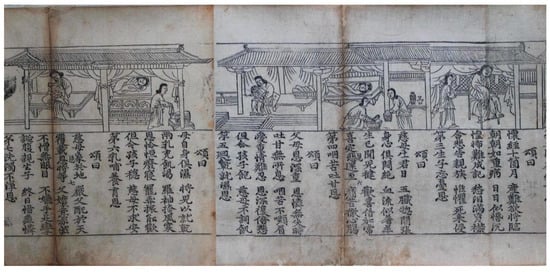
This design is especially evident in the Ten Grace sequence, which depicts a mother’s pregnancy, childbirth, nursing, and tireless care for her child, inviting viewers to contemplate concrete scenes of parental sacrifice (Murray 2007). In Figure 1, the mother–child relationship is rendered visually dominant: the central figures are enlarged and aligned on the primary axis, while secondary actors recede toward the margins, and directional gazes and gestures converge on the mother’s acts of care, thereby guiding the viewer to read parental kindness as the interpretive center of the sequence. In Wŏnamsa editions, the series is thus not simply illustrated but materially choreographed as an adaptive medium: repeated vignettes accumulate across the page into a legible moral logic that guides attention and interpretation. As visual pedagogy, the program translates filial gratitude and karmic causality into affectively charged scenes that can be apprehended at a glance, reducing the reliance on continuous textual decoding and enabling Confucian–Buddhist ethical convergence to become operational within the act of reading and looking.
Figure 1.
Depiction of the Ten Graces presented in an image-above, text-below arrangement, positioned in the opening section of the Eunjung gyeong.
A similar mechanism governs the Eight Parables cycle, repeatedly staged in the jeonmun hudo pattern: the admonitory passage establishes the normative frame, and the subsequent image functions as interpretive closure, fixing the moral reading through a contrastive staging of peril and rescue, consequence and release. Through this text-to-image sequencing, karmic causality becomes visually navigable, and the viewer’s affect is channeled toward repentance and resolve—so that filial obligation is reinforced as a ritually enacted disposition, rather than an abstract proposition (Huang 2018). For viewers with a limited facility in classical Chinese, the visual sequence thereby offers an alternative pathway for grasping the sutra’s ethical content, supporting moral comprehension among audiences with varying levels of textual competence (Berezkin 2015; Huang 2018). In this way, the Wŏnamsa illustrations function both pedagogically—by organizing doctrinal teaching into coherent narrative units—and devotionally—by structuring embodied contemplation and affective response within a guided sequence of looking, reading or recitation, and reflection (Murray 2007; Huang 2018). As Park (1998) and Kim (2014) argue for comparable moralizing illustration cycles, such narrative programs can be understood as “morality plays” in print, translating complex Buddhist and Confucian concepts into an accessible visual language that reinforces the sutra’s ethical message.
The following example demonstrates how the Wŏnamsa page operates as an adaptive medium, coordinating image placement and reading rhythm to produce a guided ethical response. Figure 1 shows the Ten Graces opening in the characteristic “image-above, text-below” arrangement.
Beyond the visual program, the Wŏnamsa editions’ material and paratextual evidence—especially colophon data and later preservation traces—clarifies how these books circulated, were safeguarded, and accrued social meaning over time. The colophon identifies Oh Hyo-myeon (吳孝綿) of the Boseong Oh clan (寶城吳氏) as a principal donor. Genealogical studies further suggest that he was the great-grandfather of Oh Eung-seong (吳應星), who later produced the first Korean vernacular translation (eonhae 諺解) of the Eunjung gyeong in Wanju in 1545; taken together, these traces plausibly indicate an intergenerational continuity linking local patterns of patronage to subsequent vernacular transmission.
Material records also clarify the afterlife of the surviving copy. Conservation documentation and catalog descriptions indicate that it bears traces consistent with fire exposure and that it was recovered from within a Buddha statue (a context that helps explain its relative physical preservation), after which it subsequently underwent conservation treatment; it is now preserved in scroll format (gwonjabon 卷子本) while retaining substantial physical integrity. The Eunjung gyeong is preserved together with the Jangsu gyeong in the Guryongam Hermitage collection, and temple records, colophon evidence, and modern bibliographical surveys converge to suggest that both works were likely produced as a coordinated pair at Wŏnamsa Temple in 1452. The Jangsu gyeong colophon specifically records that it was carved in the third year of the Gyeongtae era (1452) at Wŏnamsa, thereby confirming the shared provenance and chronology of the two editions.
Read in tandem, the pair underscores the editions’ dual orientation: they integrate contemplation on filial piety with supplications for familial longevity and well-being. As rare material witnesses to this line of production—especially in light of the presumed loss of the Hwaamsa blocks—the Wŏnamsa editions occupy a distinctive place in Korean Buddhist print heritage, offering unusually rich evidence for how woodblock craftsmanship, illustrative programs, and paratextual documentation jointly mediated ethical teaching and devotional practice in mid-fifteenth-century Korea (Song 2006, p. 280). From a material perspective, they exemplify how physical presentation—elaborate illustration, robust binding, and prominent colophons—mediated ethical teachings for both literate and less-literate audiences and laid the groundwork for later vernacular translations (T. Han 1996, p. 320). Accordingly, these bibliographical and material features illuminate a formative process of cultural adaptation in early Joseon, wherein Buddhism negotiated its position within a Neo-Confucian context, which demonstrates the material book’s integral function in doctrinal propagation and social validation (Nam 2004, pp. 138–39).
4. Materiality as an Adaptive Medium: Manuscript Agency and Visual Pedagogy
Following scholarship in material religion and manuscript studies, this article treats these sutras as media whose format, imagery, and paratextual features condition how doctrinal meanings are apprehended and enacted. From this perspective, materiality does not merely transmit preexisting teachings but functions as an adaptive medium through which visual arrangement and physical form shape doctrinal efficacy and facilitate modes of Confucian–Buddhist ethical convergence. Recent research in Buddhist studies and material religion has emphasized that sacred texts should be analyzed not only for their doctrinal substance but also for their tangible structure, visual presentation, and practical application, as these dimensions fundamentally shape how texts communicate and are interpreted in practice. This approach aligns with the broader concept of “manuscript agency,” which suggests that a manuscript or printed text acts not simply as a neutral carrier of language but as an engaged force within historical processes. As material philologist Stephen G. Nichols memorably remarked, a manuscript is “not … a passive record, but a historical document thrusting itself into history,” and its materiality transforms it into a form of “cultural drama” in its own right.11 Additionally, scholars of religion have argued that the labor-intensive procedures involved in giving textual content a material form—such as inscribing it on palm-leaves or reproducing it in codex format—are crucial for transporting and transmitting religion across diverse social and cultural settings. In other words, the manner in which a scripture materializes—whether as a scroll, a codex, a woodblock-printed booklet, embellished with images or charms—plays a decisive role in shaping its meaning and enabling its adaptation to new environments. Accordingly, discussions of material agency and manuscript function in this section are grounded not only in theoretical reflection but also in established scholarship on material religion and the historical use of religious texts in East Asia.
Within Joseon Buddhism, the material composition of the Eunjung gyeong and Jangsu gyeong was purposefully designed to mediate between Buddhist doctrines and Confucian values. The woodblock-printed codex form of these sutras, for instance, rendered them portable, durable, and easily reproducible—qualities that facilitated broad circulation and encouraged their regular use in everyday religious or educational contexts. This material accessibility contrasted with the more esoteric or monastic writings that typically remained confined to manuscript circulation within monastery libraries. In this framework, the materiality of the book—affordability, durability, and visual refinement—endowed the sutras with a form of grassroots influence. They were present in private homes and personal hands, transmitting Buddhist ethical teachings directly into the fabric of daily life. These domestic uses did not stand in opposition to more restricted ritual deployments. Rather, the same kinds of printed sutras could circulate simultaneously in household spaces and monastic or ritual settings, occupying multiple positions within the religious landscape. Additionally, the publishers of these Joseon texts amplified their didactic function through visual elements. Each woodblock-printed copy was more than a compilation of characters; it frequently incorporated instructive illustrations and well-considered design to support readers. As seen in the 1452 Wŏnamsa edition, woodcut images were aligned with pivotal scenes in the sutra narratives. These visuals served as pedagogical tools, reinforcing the sutras’ teachings on filial piety even for readers who might not be literate in classical Chinese. This exemplary use of images is consistent with broader East Asian conventions of moral education through visual aids—in fact, such illustrations likely both shaped and were shaped by Confucian illustrated primers like the Oryun Haengsil-do (“Illustrated Guide to the Five [Confucian] Relationships”). As a result, the material book itself functioned as a multimedia object: bringing together scripture, annotation (including vernacular Hangul glosses in later Joseon versions), and visual content in a unified form intended for teaching and ritual. This integration of text and imagery encapsulates what may be termed “embodied pedagogy.” The material sutras engaged both visual and tactile senses to communicate their ideas, thus expanding their accessibility to wider segments of society (including semi-literate communities) and embedding Confucian familial principles within Buddhist practice through tangible and approachable means.
The concept of material agency becomes particularly salient when examining the ritual uses of these books. They were not only objects for reading and viewing; rather, they were enshrined, chanted, and handled as sacred objects. For instance, copies of the Eunjung gyeong and Jangsu gyeong were frequently placed inside Buddhist statues or stupas as protective objects, a practice attested in published excavation and conservation records documenting fifteenth-century printed sutras recovered from enshrinement deposits within Buddha images. Through these ritual practices, the physical sutra acquired the status of a talisman or sacred relic—its material form was ascribed the capacity to grant merit and protection. The coexistence of ordinary reading copies and enshrined, talismanic copies therefore represents not a contradiction but a spectrum of use, ranging from didactic engagement in everyday life to highly sacralized contexts in which the book itself was treated as a relic. This complicates the distinction between text and object, as the sutra in its tangible form was believed to possess spiritual power. Such notions reflect a broader Buddhist understanding that scriptures, when instantiated materially and venerated, function as efficacious agents (similarly to icons or relics) in their own right. In the context of Joseon, even a printed book advocating filial piety could be venerated on a family altar or in temple halls, thereby sacralizing Confucian virtues through Buddhist ritual. The inclusion of colophons and sponsor dedications, carefully produced in these editions, enhanced the social influence of these physical texts. These features documented the filial or pious intentions motivating each printing initiative (for example, “to repay the grace of parents” or to petition for an elder’s health), thereby disseminating normative messages concerning the values being promoted. Fundamentally, the material properties—format, illustrations, colophon, paper, and ink—interacted to mediate and transmit the ethical teachings of the sutras. The physical book was not a passive vessel; it functioned as an active medium, shaping how the message was received and incorporated into Joseon society.
When contemporary theory and the Joseon period’s historical record are drawn from, it is evident that materiality functioned as a mediating force between Buddhism and Confucianism. By utilizing the “agency” of physical texts—their capacity to instruct, influence, and sanctify through their material form and presence—Joseon Buddhists facilitated the integration of ostensibly “foreign” scriptures into the fabric of local moral culture. The Jangsu gyeong, although apocryphal, developed into a cherished household sutra largely because its manuscript and print traditions were so thoroughly adapted to Korean conditions: it was produced domestically, visually compelling, suitable for ritual use, and explicitly aligned with Confucian family values. This example powerfully illustrates how old texts in their material forms could produce new meanings and foster new relationships; in this instance, it demonstrated that Buddhist piety towards the Buddha and one’s parents could coexist. As a material culture theorist observes, the manuscript or printed book “thrusts itself into history” through its tangible character; in Joseon, the use of woodblock-printed sutras centered on filial piety firmly embedded Buddhism within Confucian society, narrating a new episode in religious adaptation through material means. Understanding materiality as an adaptive medium encourages the recognition that religious history is inscribed not only in doctrines and ideas but also carved in woodblocks, depicted on mulberry paper, and transported by adherents. The tangible sutras of Joseon functioned as active agents within the cultural sphere, negotiating between two ethical traditions and supporting Buddhism’s persistence during an era defined by Confucian ascendancy. This theoretical perspective resonates with the broader “material turn” in religious studies, highlighting that, by analyzing how sacred texts are produced, perceived, and circulated, one obtains a more nuanced appreciation of how religions practically transform and endure in their respective cultural contexts.
5. Visual Didacticism and Ritual Efficacy in Confucian–Buddhist Convergence
Drawing on art-historical discussions of visual didacticism—narrative illustration in which sequential images are designed to structure moral understanding and emotional engagement, rather than merely to embellish a text—this section analyzes how the 1452 Wŏnamsa editions advanced Confucian–Buddhist convergence through materially organized visual pedagogy (Murray 2007). Building on the descriptive findings above, it argues that the woodblock-printed Eunjung gyeong and Jangsu gyeong were crafted as interactive moral tools, combining illustration cycles, reader-oriented formats, and explicitly articulated patronage to render filial piety socially legible and ritually actionable within Joseon’s Confucian ethical environment.12 A focused analysis of these features enhances our understanding of how the Wŏnamsa prints served as a conduit between doctrinal Buddhism and the social ethics of Joseon society, making complex spiritual teachings accessible through recognizable moral frameworks. The moralizing function is visible not only in the images but also already in the conditions of production. Woodblock technology facilitated broad dissemination across regions and social strata, while the colophons frame publication as merit dedicated to family well-being and the practice of filial piety.13 Extensive donor lists carefully document both lay and monastic sponsors, frequently accompanied by vows or rationales that explicitly refer to familial motivations. Particularly prominent among the patrons was Oh Hyo-myeon of the Boseong Oh lineage, who directly articulated his wish to repay parental benevolence by supporting the publication (Song 2006, pp. 261–82). The familial aspect of this sponsorship was consequential beyond the bounds of ritual, shaping later developments; most notably, Oh Hyo-myeon’s great-grandson Oh Eung-seong produced the earliest vernacular Korean translation of the Eunjung gyeong in 1545, based on this specific Wŏnamsa edition. In this way, acts of filial patronage not only shaped religious practice but also spurred scholarly and linguistic progress, thereby further embedding Confucian family values within Buddhist textual production.
At the level of page design, the 1452 editions deploy a systematic woodblock illustration program that extends the ethical work signaled by their paratexts. In the Eunjung gyeong volume, this program is especially concentrated in the twenty-one images that frame the Ten Graces and Eight Parables cycles, embedding moral instruction into a guided sequence of viewing and reading. By repeatedly pairing narrative images of parental care, suffering, and karmic consequence with succinct textual explanations, the Wŏnamsa prints lead viewers through a structured sequence of moral reflections: the reader first recognizes familiar familial situations, then confronts their ethical and karmic implications, and finally is guided toward specific devotional responses such as recitation, ritual offering, or renewed filial conduct. This step-by-step linkage between image, text, and prescribed practice is precisely what enables the visual program to function as both pedagogy and devotion (Huang 2018). This mechanism corresponds to what art-historical discussions of East Asian narrative illustration describe as “visual didacticism,” whereby sequential images are designed to elicit moral insight and emotional engagement (Murray 2007). These visual elements operated comparably to morality plays, translating complex Buddhist doctrines into forms that were readily intelligible to viewers, including those with limited literacy.14 This deployment of visual pedagogy mirrored that found in contemporary Confucian didactic works, such as the Illustrated Guide to the Five Relationships (Kor. Oryun Haengsil-do, 五倫行實圖); both forms shared aims and stylistic conventions. The effectiveness of these pedagogical illustrations was later affirmed in the Joseon period, with monarchs like King Jeongjo (正祖, r. 1776–1800) formally advocating for newly printed versions of the Eunjung gyeong as standard guides to filial piety, thereby equating them in status with Confucian classics.15 Furthermore, the physical presentation of these sutras was integral to their function as ethical and ritual objects. Made with resilient, high-quality paper and fashioned in portable designs, the texts were suited for both private devotional use and communal ritual settings.16 Their durable construction promoted long-term preservation, as evidenced by their survival inside Buddhist statues—a testament to ritual practices linking spiritual safeguarding with filial commitment. In practical terms, the sutras served in diverse life-cycle ceremonies, including blessings for children, prayers, and memorial observances, consistently enacting Confucian virtues through repeated ritual performances.17
Finally, the socio-cultural impact resulting from these combined visual and material strategies was considerable. Their broad dissemination, accessible vernacular renderings, and adaptability for ritual application allowed for deep societal integration, bridging lay communities and elite circles.18 This integrative approach garnered overt support from members of the Confucian-oriented elite and royal authorities, demonstrating Buddhism’s capacity to align its practices with dominant Confucian ethical standards. By integrating filial principles into every stage of the sutras’ production, illustration, and ritual use, Joseon Buddhism maintained enduring influence, effectively embedding itself within the normative moral discourse of its era. The 1452 Wŏnamsa editions thus stand as more than a fusion of doctrinal teachings; they exemplify an advanced cultural amalgamation realized through coordinated visual, material, and literary strategies. Taken together, these observations demonstrate that the visual analysis presented here is not impressionistic but is grounded in sustained engagement with relevant art-historical, bibliographical, and religious-studies scholarship.
6. Conclusions
This study has illuminated how Joseon-era Korean Buddhism strategically adapted its material culture to harmonize with dominant Neo-Confucian ethics, thereby establishing its social legitimacy and spiritual relevance during a time when Confucianism reshaped Korean ideological landscapes. By concentrating on the apocryphal Eunjung gyeong and Jangsu yeong, this research shows that the convergence of text and material form was crucial in mediating moral values, allowing Buddhism to depict filial piety not as a rival teaching but as a complementary virtue consonant with Confucian ideals.
The 1452 Wŏnamsa woodblock-print editions serve as pivotal artifacts, encapsulating advanced visual didacticism and material excellence—with precisely carved blocks, durable portable bindings, and comprehensive patronage records—that collectively transformed Buddhist filial teachings into accessible and ritually potent cultural emblems. Their rich program of narrative illustrations, such as the Ten Graces and Eight Parables, directly integrated familiar Confucian moral imagery, making nuanced Buddhist ethics both comprehensible and attractive to a broad spectrum of society, including those with limited literacy (Berezkin 2015). This cross-pollination of Buddhist and Confucian moral pedagogy demonstrates an intentional cultural accommodation, positioning Buddhist texts to serve functions analogous to Confucian morality manuals, a role that was further validated by royal patronage during later Joseon periods. Additionally, the explicit familial patronage documented in the colophons, exemplified by figures like Oh Hyo-myeon and his great-grandson’s vernacular translation in 1545, reveals that devotional sponsorship was closely interwoven with Confucian filial principles, deepening the sutras’ reach within both lay and scholarly communities. Such a tradition of patronage underscores the importance of local elites in facilitating the texts’ cultural and political recognition.
The ritual uses of these sutras—found enshrined in Buddhist statues and employed in life-cycle ceremonies—reveal their function as sacred, merit-generating objects that connect Buddhist spiritual authority with Confucian family ethics. Their widespread circulation through numerous reprints and vernacular versions highlights Buddhism’s enduring assimilation into Joseon society, often transcending official Neo-Confucian reservations or resistance.
For reference, a list of Joeseon editions if provided in Appendix A (Table A1).
In sum, this study substantially enhances our understanding of how materiality operates as an active mediator in religious and ethical transformation. The Wŏnamsa editions demonstrate that early Joseon Buddhist communities engaged more than verbal doctrine, strategically employing print technology, visual culture, format innovation, and documented patronage to embed and legitimize their teachings within Confucian moral frameworks. This complex approach secured Buddhism’s endurance, adaptability, and prosperity under Neo-Confucian hegemony, contributing valuable perspectives on religious resilience and the pivotal influence of material culture in reconfiguring belief systems during major cultural transitions.
Author Contributions
Writing—original draft, J.S. and H.K.; writing—review and editing, J.S. and H.K. All authors have read and agreed to the published version of the manuscript.
Funding
This research received no external funding.
Institutional Review Board Statement
Not applicable.
Informed Consent Statement
Not applicable.
Data Availability Statement
No new data were created or analyzed in this study.
Conflicts of Interest
The authors declare no conflicts of interest.
Appendix A
Table A1.
Editions of the Jangsu Gyeong Published During the Joseon Dynasty.
Notes
| 1 | During the Joseon Dynasty, Buddhism responded to the predominance of Neo-Confucian ideology by promoting sutras that aligned with Confucian ethical principles, especially filial piety; see, e.g., Nam (2004), p. 122. |
| 2 | Certain Buddhist scriptures circulating on the Korean Peninsula were classified as apocryphal (wěijīng 偽經) in Chinese canonical catalogs (jīnglù 經錄), although Korean Buddhism often engaged such texts, irrespective of canonical status. On this point, see T. Han (1996), pp. 314–22. |
| 3 | On Joseon Buddhism’s strategic accommodation of Confucian ethical norms—especially filial piety—see Walraven (2012) and Muller (2019). |
| 4 | On apocryphal scriptures as a vehicle for adapting Buddhist teachings to local Confucian ethical frameworks, see Vermeersch (2020) and Kim (2020). |
| 5 | On the correlation between the sutra’s late Goryeo-Joseon circulation and the consolidation of Neo-Confucianism, see Song (2006); for comparative and contextual discussions, see Walraven (2012), Muller (2019), and Vermeersch (2020); for transmission-focused bibliographical analysis, see Nam (2004). |
| 6 | For an argument that the continued prominence of the Eunjung gyeong reflects a deliberate Buddhist strategy of ethical accommodation centered on filial piety, see Guo (2023). |
| 7 | On the origins and the Confucian ethical orientation of the Jangsu gyeong (including the possibility of compilation on the Korean Peninsula), see Lee (2023), Lin (2021), Shi (2011), and Wu (2010) |
| 8 | On the significance of illustrated editions and material culture in propagating Buddhist ethical messages in conjunction with Confucian moral literature, see Kim (2020) and Muller (2019) |
| 9 | On the role of royal patronage in establishing these texts as authoritative models for filial piety in Joseon, see C. Han (2013). |
| 10 | For the official designation and basic catalog information on the 1452 Wŏnamsa edition, see Cultural Heritage Administration (CHA) (2025) Bibliographical details are further confirmed through KABC (Dongguk University Institute of Buddhist Studies 2025). |
| 11 | For theoretical framing on material philology, see Nichols (1997), pp. 10–11. |
| 12 | For bibliographical and pedagogical discussions of the Eunjung gyeong in Korean print culture, see Song (2000), pp. 179–81 and Ch’ŏn (1990), p. 312. |
| 13 | For bibliographical studies of Korean editions and transmission, see Song and Park (2010), pp. 209–11. |
| 14 | For an exploration of the pedagogical efficacy of visual storytelling in Korean Buddhist sutra prints, see Park (1998) and Song (2006). |
| 15 | The official sanctioning of Buddhist texts for moral instruction, particularly during the reign of King Jeongjo, is addressed by C. Han (2013). |
| 16 | For research on the physical formats of Korean Buddhist scriptures and their ritual applications, see Park (1998) and Kim (2014). |
| 17 | For comprehensive discussions on the function of Buddhist scriptures within life-cycle ceremonies, see Kim (2011). |
| 18 | For broader contextual discussions, see Evon (2023) and Choi (2007). |
References
Primary Sources
(X 17 Foshuo Changshou Miezui Hu zhutongzi Touluoni Jing 佛說長壽滅罪護諸童子陀羅尼經 [The Dharani Sūtra of the Buddha on Longevity, the Extinction of Offences, And the Protection of Young Children]) X 17 Foshuo Changshou Miezui Hu zhutongzi Touluoni Jing 佛說長壽滅罪護諸童子陀羅尼經 [The Dharani Sūtra of the Buddha on Longevity, the Extinction of Offences, And the Protection of Young Children]. Translated by Buddhapāli (Fotuoboli佛陁波利), One juan, vol. X 17, pp. 7.394a–400b.(X: Manji Shinsan Dai Nihon Zokuzōkyō 卍新纂大日本續藏經 [Revised Reprint of the Dai Nihon Zokuzōkyō] 1975–1989) X: Manji Shinsan Dai Nihon Zokuzōkyō 卍新纂大日本續藏經 [Revised Reprint of the Dai Nihon Zokuzōkyō]. 1975–1989. Edited by Kawamura Kōshō 河村照孝 and et al. 88 vols. Tokyo: Kokusho Kankōkai.Secondary Sources
- Berezkin, Rostislav. 2015. Pictorial Versions of the Mulian Story in East Asia (Tenth–Seventeenth Centuries): On the Connections of Religious Painting and Storytelling. Fudan Journal of the Humanities and Social Sciences 8: 95–120. [Google Scholar] [CrossRef] [Scilit]
- Choi, Yeon-sik. 2007. To Survive as a Buddhist Monk in a Confucian State: Gihwa’s Response to Jeong Do-jeon’s Critique of Buddhism. Korea Journal 47: 104–33. [Google Scholar] [CrossRef] [Scilit]
- Ch’ŏn, Hyebong 천혜봉. 1990. Han’guk Chŏnjŏk Insoesa 韓國典籍印刷史 [The History of Printing in Korean Texts]. Seoul: PŎM’USA. [Google Scholar]
- Cultural Heritage Administration (CHA). 2025. Bulseol Daebo Bumo Eunjung Gyeong 佛說大報父母恩重經. Jeollabuk-do Tangible Cultural Heritage No. 273. Available online: https://www.heritage.go.kr (accessed on 30 July 2025).
- Dongguk University Institute of Buddhist Studies. 2025. Korean Buddhist Canon Bibliographical Database (KABC). Entry: “Wŏnamsa (圓岩寺) Edition of the Eunjung Gyeong”. Available online: https://kabc.dongguk.edu (accessed on 16 December 2025).
- Evon, Gregory N. 2023. Salvaging Buddhism to Save Confucianism in Chosŏn Korea (1392–1910). Amherst: Cambria Press. [Google Scholar]
- Guo, Jing. 2023. The Buddhist Concept of “Filial Piety” in the Context of Early Chinese Buddhist Scripture Translation. Religions 14: 1507. [Google Scholar] [CrossRef] [Scilit]
- Han, Choonsoon 한춘순. 2013. Chosŏn Myŏngjongdae pulgyo chŏngch’aek kwa kŭ sŏnggyŏk 조선 명종대 불교정책과 그 성격 [Buddhist Policy and Its Charater During the Reign of King Myungjong in the Chosŏn]. Hanguk sasang sahak 한국사상사학 [The Association For The Study of Korean History of Thoughts] 44: 83–123. [Google Scholar]
- Han, Taesik 韓泰植. 1996. Kanhantoude tsukureta gigikyoni tsuite 韓半島で作られた疑偽経について [An Apocryphal Sutra Written in Korea]. Indogaku Bukkyogaku Kenkyu 印度學佛教學研究 [Journal of Indian and Buddhist Studies] 45: 322–14. [Google Scholar] [CrossRef] [Scilit]
- Huang, Shih-shan Susan. 2018. Illustrating the Efficacy of the Diamond Sutra in Vernacular Buddhism (通俗佛教版畫所見的金剛經靈驗力). National Palace Museum Research Quarterly 故宮學術季刊 35: 35–120. [Google Scholar]
- Kim, Chahyŏn 김자현. 2014. Pumo ŭnjung kyŏng ŭi pyŏnch’ŏn kwa tosang ŭi hyŏngsŏng kwajŏng yŏn’gu 『父母恩重經』의 변천과 圖像의 형성과정 연구 [Research on changes to the Sūtra on Repaying the Kindness of Parents and the formational process of its illustrations]. Pulgyo misul sahak 불교미술사학 18: 67–96. [Google Scholar]
- Kim, Seong U. K. 2020. Kwanŭm (Avalokiteśvara) Divination: Buddhist Reconciliation with Confucianism in the Late Chosŏn. Religions 11: 209. [Google Scholar] [CrossRef] [Scilit]
- Kim, Yongdeok 김용덕. 2011. Pulgyo ŭirye p’ungsok ŭi ŭimi yŏn’gu-chŏnggi ŭirye rŭl cgybgsun ŭro 불교의례 풍속의 의미 연구—정기의례를 중심으로 [A Study on the Significance of Buddhist Ritual Customs–Focusing ont the Regular Rituals]. Pigyo minsokhak 比較民俗學 [Asian Comparative Folklore] 46: 227–54. [Google Scholar]
- Koh, Young jin. 2003. Neo-Confucianism as the Dominant Ideology in Joseon. Korea Journal 43: 59–86. [Google Scholar]
- Lee, Sangbaek 이상백. 2023. Bulseol-jangsu-myeoljoe-hojedongja-darani gyeong ui panbon gyeetonggwa pansik yeongu 불설장수멸죄호제동자다라니경」의 판본 계통과 판식 연구 [A study on the printed books and bibliographic characteristics of Bulseol-jangsu-myeoljoe-hojedongja-darani-Sutra]. Seojihak Yeongu 書誌學硏究 [The Bibliography Society of Korea] 96: 71–94. [Google Scholar]
- Lin, hsin yi 林欣儀. 2021. Foshuo changshou miezui hu zhutongzi touluoni jing yu fojiao chanyunguan 《佛說長壽滅罪護諸童子陀羅尼經》與佛教產孕觀 [On The Sūtra of Erasing Sins and Protecting Children for Longevity Taught by the Buddha and its Dali Recension: An Indigenous Buddhist View of Childbirth and Abortion]. Fuguang xuebao 佛光學報 [Fu Guang Journal of Buddhsit Studies] New Series 7: 129–90. [Google Scholar]
- Muller, A. Charles. 2019. Philosophical Bases of the Goryeo-Joseon Confucian-Buddhist Confrontation: The Works of Jeong Dojeon and Hamheo Deuktong. In Dao Companion to Korean Confucian Philosophy. Edited by Young-Chan Ro. Dordrecht: Springer, pp. 285–309. [Google Scholar]
- Murray, Julia K. 2007. Mirror of Morality: Chinese Narrative Illustration and Confucian Ideology. Honolulu: University of Hawai‘i Press. [Google Scholar]
- Nam, Heesook 남희숙. 2004. Chosŏn Hugi Pulsŏ Kanhaeng YŎN’GU: Chinin Chip Kwa Pulgyo Ŭisik Chip Ŭl Chungsim Ŭro 朝鮮後期 佛書刊行 硏究: 眞言集과 佛敎儀式集을 中心으로 [Research on the Publication of Buddhist Books during the Late Chosŏn Period: Centered around Collections of Mantras and Buddhist Ritual Manuals]. Ph.D. dissertation, Seoul National University, Seoul, Republic of Korea. [Google Scholar]
- Nichols, Stephen G. 1997. Why Material Philology? Some Thoughts. Zeitschrift für Deutsche Philologie 116: 10–30. [Google Scholar]
- Park, Do-hwa 박도화. 1998. Hwaamsa-kan Pumo ŭnjunggyeong panhwa ŭi togsang gwa ŭimi 花岩寺刊 『父母恩重經』版畵의 圖像과 意義 [The Iconography and Significance of the Woodblock Illustrations in the Hwaamsa Edition of the Sutra on the Profound Kindness of Parents]. Pulgyo misul 佛敎美術 15: 133–66. [Google Scholar]
- Shi, Yinshun 釋印順. 2011. Yinshunfashi fuxue zhuzho xilie Huayuji 印順法師佛學著作系列 華雨集 [The Collected Works of Yinshun, Flowers and Rain Collection]. Beijing: Zhonghua Shuju. [Google Scholar]
- Song, Ilgi 송일기. 2000. Han’gukbon Pumo-Unjungkyong: Hanmun ŭi panbon e kwanhan yŏn’gu 韓國本 『父母恩重經: 漢文』의 板本에 관한 硏究 [A Study on the Edition of 『Pumo-Unjungkyong: Classical Chinese』 in Korea ]. Seojihak Yeongu 書誌學硏究 [Journal of the Institute of Bibliography] 19: 179–218. [Google Scholar]
- Song, Ilgi 송일기. 2006. Han’gukbon Pumo-Unjungkyong hyŏngsŏng kwanhan yŏn’gu 韓國本 <父母恩重經> 形成에 관한 硏究 [A Study on the Formation of <Pumo-Unjungkyong> in Korea-Bibliographical Approach about Woodcut Prints of Xixia and Koryo Daynasty]. Hangukdoseogwan Jeongbo Hakoeji 한국도서관·정보학회지 [Journal of Korean Library and Information Science Society] 37: 261–82. [Google Scholar]
- Song, Ilgi 송일기, and Min-hui Park 박민희. 2010. Saero palgyŏn doen Honam-pan <Pumo-Unjungkyong ŏnhae> 4-chong ŭi sŏjijŏk yŏngu 새로 발견된 湖南板 <父母恩重經諺解> 4종의 書誌的 硏究 [Bibliographical Research on Four Newly Discovered Vernacular Editions of the Fumu Enzhongjing from Honam]. Hangukdoseogwan jeongbo hakoeji 한국도서관·정보학회지 [Journal of the Korean Library and Information Science Society] 41: 209–28. [Google Scholar]
- Vermeersch, Sem. 2020. Syncretism, Harmonization, and Mutual Appropriation between Buddhism and Confucianism in Pre-Joseon Korea. Religions 11: 231. [Google Scholar] [CrossRef] [Scilit]
- Walraven, Boudewjin. 2012. Buddhist Accommodation and Appropriation and the Confucian Transformation of Korea. Journal of Korean Religions 3: 105–16. [Google Scholar] [CrossRef] [Scilit]
- Wu, Xiaojie 伍小劼. 2010. Foshuo changshou ming jing 佛說長壽命經 [The Buddha’s Discourse on the Sūtra of Longevity]. In Zangwai Fujiao Wenxian 藏外佛敎文獻 [Buddhist Texts Not Contained in the Tipiṭaka], 13th ed. Edited by Fang Guangchang 方廣錩. Beijing: Zongjiao Wenhua Chubanshe, pp. 81–106. [Google Scholar]
Disclaimer/Publisher’s Note: The statements, opinions and data contained in all publications are solely those of the individual author(s) and contributor(s) and not of MDPI and/or the editor(s). MDPI and/or the editor(s) disclaim responsibility for any injury to people or property resulting from any ideas, methods, instructions or products referred to in the content. |
© 2026 by the authors. Licensee MDPI, Basel, Switzerland. This article is an open access article distributed under the terms and conditions of the Creative Commons Attribution (CC BY) license.