Predictive Performance of Bayesian Methods to Forecast Vancomycin Concentration for Therapeutic Drug Monitoring in Critically Ill Pediatric Patients
 , , , , , , , , , , and
Abstract
1. Introduction
2. Methods
2.1. Study Design and Setting
2.2. Data Collection
2.3. ForecastingMethods
2.4. Statistical Analysis
3. Results
3.1. Patient Characteristics
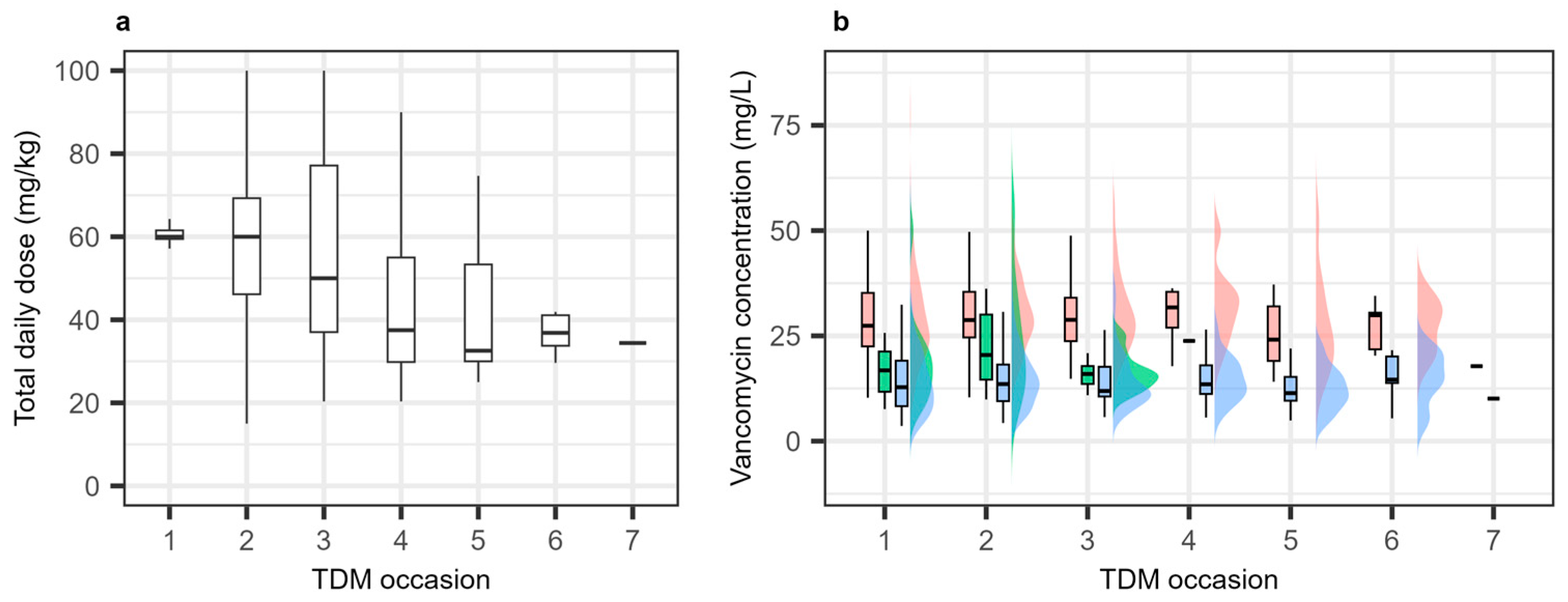
3.2. Vancomycin Dosing and Concentrations
3.3. Performance of Different Forecasting Methods
4. Discussion
5. Conclusions
Supplementary Materials
Author Contributions
Funding
Institutional Review Board Statement
Informed Consent Statement
Data Availability Statement
Acknowledgments
Conflicts of Interest
Abbreviations
| PK | Pharmacokinetics |
| TDM | Therapeutic Drug Monitoring |
| rBias | Relative Bias |
| RMSE | Relative Root Mean Squared Error |
| MRSA | Methicillin-Resistant Staphylococcus aureus |
| AKI | Acute Kidney Injury |
| popPK | Population Pharmacokinetics |
| AUC | Area Under the Curve |
| PEX | Plasma Exchange |
| ECMO | Extracorporeal Membrane Oxygenation |
| eGFR | Estimated Glomerular Filtration Rate |
| ICU | Intensive Care Unit |
| MAP | Maximum A Posteriori |
| IIV | Individual Variabilities |
| MPID | Model-Informed Precision Dosing |
References
- Liu, C.; Bayer, A.; Cosgrove, S.E.; Daum, R.S.; Fridkin, S.K.; Gorwitz, R.J.; Kaplan, S.L.; Karchmer, A.W.; Levine, D.P.; Murray, B.E.; et al. Clinical practice guidelines by the infectious diseases society of america for the treatment of methicillin-resistant Staphylococcus aureus infections in adults and children. Clin. Infect. Dis. 2011, 52, e18–e55. [Google Scholar] [CrossRef]
- Anderson, B.J.; Holford, N.H. Tips and traps analyzing pediatric PK data. Paediatr. Anaesth. 2011, 21, 222–237. [Google Scholar] [CrossRef]
- Cella, M.; Knibbe, C.; Danhof, M.; Della Pasqua, O. What is the right dose for children? Br. J. Clin. Pharmacol. 2010, 70, 597–603. [Google Scholar] [CrossRef]
- Rybak, M.J.; Le, J.; Lodise, T.P.; Levine, D.P.; Bradley, J.S.; Liu, C.; Mueller, B.A.; Pai, M.P.; Wong-Beringer, A.; Rotschafer, J.C.; et al. Therapeutic monitoring of vancomycin for serious methicillin-resistant Staphylococcus aureus infections: A revised consensus guideline and review by the American Society of Health-System Pharmacists, the Infectious Diseases Society of America, the Pediatric Infectious Diseases Society, and the Society of Infectious Diseases Pharmacists. Am. J. Health Syst. Pharm. 2020, 77, 835–864. [Google Scholar] [CrossRef] [PubMed]
- Rybak, M.J.; Lomaestro, B.M.; Rotschafer, J.C.; Moellering, R.C., Jr.; Craig, W.A.; Billeter, M.; Dalovisio, J.R.; Levine, D.P. Therapeutic monitoring of vancomycin in adults summary of consensus recommendations from the American Society of Health-System Pharmacists, the Infectious Diseases Society of America, and the Society of Infectious Diseases Pharmacists. Pharmacotherapy 2009, 29, 1275–1279. [Google Scholar] [CrossRef]
- Ye, Z.K.; Tang, H.L.; Zhai, S.D. Benefits of therapeutic drug monitoring of vancomycin: A systematic review and meta-analysis. PLoS ONE 2013, 8, e77169. [Google Scholar] [CrossRef]
- Pai, M.P.; Neely, M.; Rodvold, K.A.; Lodise, T.P. Innovative approaches to optimizing the delivery of vancomycin in individual patients. Adv. Drug Deliv. Rev. 2014, 77, 50–57. [Google Scholar] [CrossRef] [PubMed]
- Patel, N.; Pai, M.P.; Rodvold, K.A.; Lomaestro, B.; Drusano, G.L.; Lodise, T.P. Vancomycin: We can’t get there from here. Clin. Infect. Dis. 2011, 52, 969–974. [Google Scholar] [CrossRef] [PubMed]
- He, N.; Su, S.; Ye, Z.; Du, G.; He, B.; Li, D.; Liu, Y.; Yang, K.; Zhang, X.; Zhang, Y.; et al. Evidence-based Guideline for Therapeutic Drug Monitoring of Vancomycin: 2020 Update by the Division of Therapeutic Drug Monitoring, Chinese Pharmacological Society. Clin. Infect. Dis. 2020, 71, S363–S371. [Google Scholar] [CrossRef]
- Matsumoto, K.; Oda, K.; Shoji, K.; Hanai, Y.; Takahashi, Y.; Fujii, S.; Hamada, Y.; Kimura, T.; Mayumi, T.; Ueda, T.; et al. Clinical Practice Guidelines for Therapeutic Drug Monitoring of Vancomycin in the Framework of Model-Informed Precision Dosing: A Consensus Review by the Japanese Society of Chemotherapy and the Japanese Society of Therapeutic Drug Monitoring. Pharmaceutics 2022, 14, 489. [Google Scholar] [CrossRef]
- Bayard, D.S.; Jelliffe, R.W. A Bayesian approach to tracking patients having changing pharmacokinetic parameters. J. Pharmacokinet. Pharmacodyn. 2004, 31, 75–107. [Google Scholar] [CrossRef]
- Fuchs, A.; Csajka, C.; Thoma, Y.; Buclin, T.; Widmer, N. Benchmarking therapeutic drug monitoring software: A review of available computer tools. Clin. Pharmacokinet. 2013, 52, 9–22. [Google Scholar] [CrossRef]
- Pai, M.P.; Rodvold, K.A. Aminoglycoside dosing in patients by kidney function and area under the curve: The Sawchuk-Zaske dosing method revisited in the era of obesity. Diagn. Microbiol. Infect. Dis. 2014, 78, 178–187. [Google Scholar] [CrossRef]
- Brocks, D.R.; Hamdy, D.A. Bayesian estimation of pharmacokinetic parameters: An important component to include in the teaching of clinical pharmacokinetics and therapeutic drug monitoring. Res. Pharm. Sci. 2020, 15, 503–514. [Google Scholar] [CrossRef] [PubMed]
- Sheiner, L.B.; Beal, S.; Rosenberg, B.; Marathe, V.V. Forecasting individual pharmacokinetics. Clin. Pharmacol. Ther. 1979, 26, 294–305. [Google Scholar] [CrossRef]
- Sheiner, L.B.; Beal, S.L. Bayesian individualization of pharmacokinetics: Simple implementation and comparison with non-Bayesian methods. J. Pharm. Sci. 1982, 71, 1344–1348. [Google Scholar] [CrossRef] [PubMed]
- Hughes, J.H.; Keizer, R.J. A hybrid machine learning/pharmacokinetic approach outperforms maximum a posteriori Bayesian estimation by selectively flattening model priors. CPT Pharmacomet. Syst. Pharmacol. 2021, 10, 1150–1160. [Google Scholar] [CrossRef]
- Wicha, S.G.; Martson, A.G.; Nielsen, E.I.; Koch, B.C.P.; Friberg, L.E.; Alffenaar, J.W.; Minichmayr, I.K.; the International Society of Anti-Infective Pharmacology (ISAP); the PK/PD study group of the European Society of Clinical Microbiology, Infectious Diseases (EPASG). From Therapeutic Drug Monitoring to Model-Informed Precision Dosing for Antibiotics. Clin. Pharmacol. Ther. 2021, 109, 928–941. [Google Scholar] [CrossRef] [PubMed]
- Schwartz, G.J.; Haycock, G.B.; Edelmann, C.M., Jr.; Spitzer, A. A simple estimate of glomerular filtration rate in children derived from body length and plasma creatinine. Pediatrics 1976, 58, 259–263. [Google Scholar] [CrossRef]
- Le, J.; Ngu, B.; Bradley, J.S.; Murray, W.; Nguyen, A.; Nguyen, L.; Romanowski, G.L.; Vo, T.; Capparelli, E.V. Vancomycin monitoring in children using bayesian estimation. Ther. Drug Monit. 2014, 36, 510–518. [Google Scholar] [CrossRef]
- Alrahahleh, D.; Thoma, Y.; Van Daele, R.; Nguyen, T.; Halena, S.; Luig, M.; Stocker, S.; Kim, H.Y.; Alffenaar, J.W. Bayesian Vancomycin Model Selection for Therapeutic Drug Monitoring in Neonates. Clin. Pharmacokinet. 2024, 63, 367–380. [Google Scholar] [CrossRef]
- Broeker, A.; Nardecchia, M.; Klinker, K.P.; Derendorf, H.; Day, R.O.; Marriott, D.J.; Carland, J.E.; Stocker, S.L.; Wicha, S.G. Towards precision dosing of vancomycin: A systematic evaluation of pharmacometric models for Bayesian forecasting. Clin. Microbiol. Infect. 2019, 25, 1286.e1–1286.e7. [Google Scholar] [CrossRef] [PubMed]
- Owen, J.S.; Fiedler-Kelly, J. Applications Using Parameter Estimates from the Individual. In Introduction to Population Pharmacokinetic/Pharmacodynamic Analysis with Nonlinear Mixed Effects Models; Wiley: Hoboken, NJ, USA, 2014; pp. 198–211. [Google Scholar]
- Ngan, V.T.; Phuong, L.Q.; Cuc, N.T.; Huong, D.T.; Duong, L.T.; Anh, N.D.H.; Thuy, N.T., Jr.; Thuy, N.T.; Ngoc, N.T.B.; Luong, D.V.; et al. Analysis of the implementation of an AUC-guided vancomycin dosing protocol in adult patients at the National Lung Hospital. J. 108-Clin. Med. Pharm. 2025, 20, 159–166. Available online: https://tcydls108.benhvien108.vn/index.php/YDLS/article/view/2839 (accessed on 18 December 2025).
- Anh, L.T.H.; Cuc, N.T.; Anh, T.D.; Ha, T.T.T.; Tan, N.D.; Thao, L.P.; Nhat, N.Q.; Thanh, N.H.; Linh, H.H.; Anh, N.H.; et al. Individualized vancomycin dosing with AUC-based therapeutic drug monitoring by the Bayesian approach in adult patients at National Institute of Hematology and Blood Transfusion. Vietnam Med. J. 2024, 538, 185–190. [Google Scholar] [CrossRef]
- Hang, L.T.M.; Anh, N.H., Jr.; Cuc, N.T.; Hao, N.T.H.; Hien, N.T.; Huong, D.M.; Khanh, T.X.; Hoa, V.D.; Anh, N.H.; Thuy, L.Q. Adjusting vancomycin dosage through monitoring drug concentration with AUC target based on Bayesian estimation in surgical intensive care patients, Viet Duc Hospital. Vietnam Med. J. 2023, 525, 176–181. [Google Scholar] [CrossRef]
- Anh, T.T.V.; Thuc, B.T.N.; Anh, N.H., Jr.; Anh, L.T.L.; Nam, N.T.; Minh, N.T.; Hoa, N.Q.; Anh, N.H.; Tuan, Đ.N.; Hoa, V.D. Individualized vancomycin dosing with AUC-based therapeutic drug monitoring by the Bayesian approach at Pediatric Center, Bach Mai Hospital. J. Pharm. Res. Drug Inf. 2022, 13, 8–14. [Google Scholar]
- Tien, N.T.N.; Linh, L.T.T.; Anh, N.H., Jr.; Cuc, N.T.; Thuc, B.T.N.; Gam, D.T.H.; Thu, N.T.; Minh, N.T.; Hoa, N.Q.; Co, D.X.; et al. Validation of Bayesian estimation methods in Model Informed Precision Dosing of vancomycin for adult patients at Bach Mai Hospital. J. Pharm. Res. Drug Inf. 2022, 13, 1–7. [Google Scholar]
- Stockmann, C.; Olson, J.; Rashid, J.; Lubsch, L.; Young, D.C.; Hersh, A.L.; Frymoyer, A.; Ampofo, K.; Liu, X.; Wang, Y.; et al. An Evaluation of Vancomycin Area Under the Curve Estimation Methods for Children Treated for Acute Pulmonary Exacerbations of Cystic Fibrosis Due to Methicillin-Resistant Staphylococcus aureus. J. Clin. Pharmacol. 2019, 59, 198–205. [Google Scholar] [CrossRef]
- Ibe, Y.; Ishigo, T.; Fujii, S.; Fukudo, M. Initial cumulative area under the blood concentration-time curve of vancomycin is associated with the incidence of acute kidney injury. J. Chemother. 2025, 1–11. [Google Scholar] [CrossRef]
- Reuter, S.E.; Stocker, S.L.; Alffenaar, J.C.; Baldelli, S.; Cattaneo, D.; Jones, G.; Koch, B.C.P.; Kocic, D.; Mathew, S.K.; Molinaro, M.; et al. Optimal Practice for Vancomycin Therapeutic Drug Monitoring: Position Statement From the Anti-infectives Committee of the International Association of Therapeutic Drug Monitoring and Clinical Toxicology. Ther. Drug Monit. 2022, 44, 121–132. [Google Scholar] [CrossRef]
- Yoon, S.; Baek, S.; Chung, J.Y.; Lee, K.; Lee, J.H.; Lee, S.; Seo, J.; Cho, Y.M.; Kim, J.H.; Lee, H. Analysis of Pharmacokinetics and Comparison Between One-point versus Two-point Sampling for Therapeutic Drug Monitoring of Vancomycin in Children. Pediatr. Infect. Dis. J. 2025, 45, 159–164. [Google Scholar] [CrossRef] [PubMed]
- De Cock, P.A.; Desmet, S.; De Jaeger, A.; Biarent, D.; Dhont, E.; Herck, I.; Vens, D.; Colman, S.; Stove, V.; Commeyne, S.; et al. Impact of vancomycin protein binding on target attainment in critically ill children: Back to the drawing board? J. Antimicrob. Chemother. 2017, 72, 801–804. [Google Scholar] [CrossRef] [PubMed]
- Sridharan, K.; Al Daylami, A.; Ajjawi, R.; Al-Ajooz, H.; Veeramuthu, S. Clinical Pharmacokinetics of Vancomycin in Critically Ill Children. Eur. J. Drug Metab. Pharmacokinet. 2019, 44, 807–816. [Google Scholar] [CrossRef] [PubMed]
- Akunne, O.O.; Mugabo, P.; Argent, A.C. Pharmacokinetics of Vancomycin in Critically Ill Children: A Systematic Review. Eur. J. Drug Metab. Pharmacokinet. 2022, 47, 31–48. [Google Scholar] [CrossRef]


| Characteristics | Value (N = 110) |
|---|---|
| Patient characteristics | |
| Age (year), median (IQR) | 2.0 (0.6–4.7) |
| <1, no. (%) | 41 (37.3) |
| 1 to <2, no. (%) | 14 (12.7) |
| 2 to <12, no. (%) | 49 (44.5) |
| ≥9, no. (%) | 6 (5.5) |
| Male gender, no. (%) | 58 (53.6) |
| Total body weight (kg), median (IQR) | 10.0 (7.0–15.0) |
| Baseline serum creatinine (mg/dL), median (IQR) | 0.34 (0.22–0.49) |
| eGFR (mL/min), median (IQR) | 113.0 (82.7–178.0) |
| Mechanical ventilation support, no. (%) | 96 (87.3) |
| Septic shock, no. (%) | 44 (41.1) |
| Infectious disease, no. (%) | |
| Nosocomial pneumonia | 73 (66.1) |
| Bloodstream infection/bacteremia | 49 (44.6) |
| Meningitis | 10 (8.9) |
| Others | 5 (4.5) |
| Concurrent use of agents, no. (%) | |
| Furosemide | 93 (84.5) |
| Vasopressor drugs | 82 (75.5) |
| Other nephrotoxic agents | 45 (40.9) |
| Vancomycin administration | |
| Empirical total daily dose (mg/kg), median (IQR) | 60.0 (59.6–61.9) |
| Initial dosing interval, no. (%) | |
| Every 6 h | 91 (82.7) |
| Every 8 h | 17 (15.5) |
| Other (12 h, 24 h) | 2 (1.8) |
| Total concentrations, no. (%) | 568 (100.0) |
| The first TDM | 220 (38.7) |
| The subsequent TDM occasion | 348 (61.3) |
| Time after dose to vancomycin concentration (h), median (IQR) | |
| Peak concentration | 2.0 (1.93–2.10) |
| Mid concentration | 4.72 (3.59–5.40) |
| Trough concentration | 5.5 (5.48–5.82) |
| Length of vancomycin therapy (days), median (IQR) | 13.0 (8.0–18.8) |
| Length of ICU stay (days), median (IQR) | 13.0 (8.0–24.5) |
| Variables | Unadjusted | Adjusted | ||||
|---|---|---|---|---|---|---|
| Estimate | 95% CI | p | Estimate | 95% CI | p | |
| Age (month) | −0.100 | −0.209 to 0.009 | 0.074 | - | - | - |
| Body weight (kg) | −0.273 | −0.672 to 0.125 | 0.182 | - | - | - |
| Serum creatinine (µmol/L) | 0.035 | −0.062 to 0.132 | 0.475 | - | - | - |
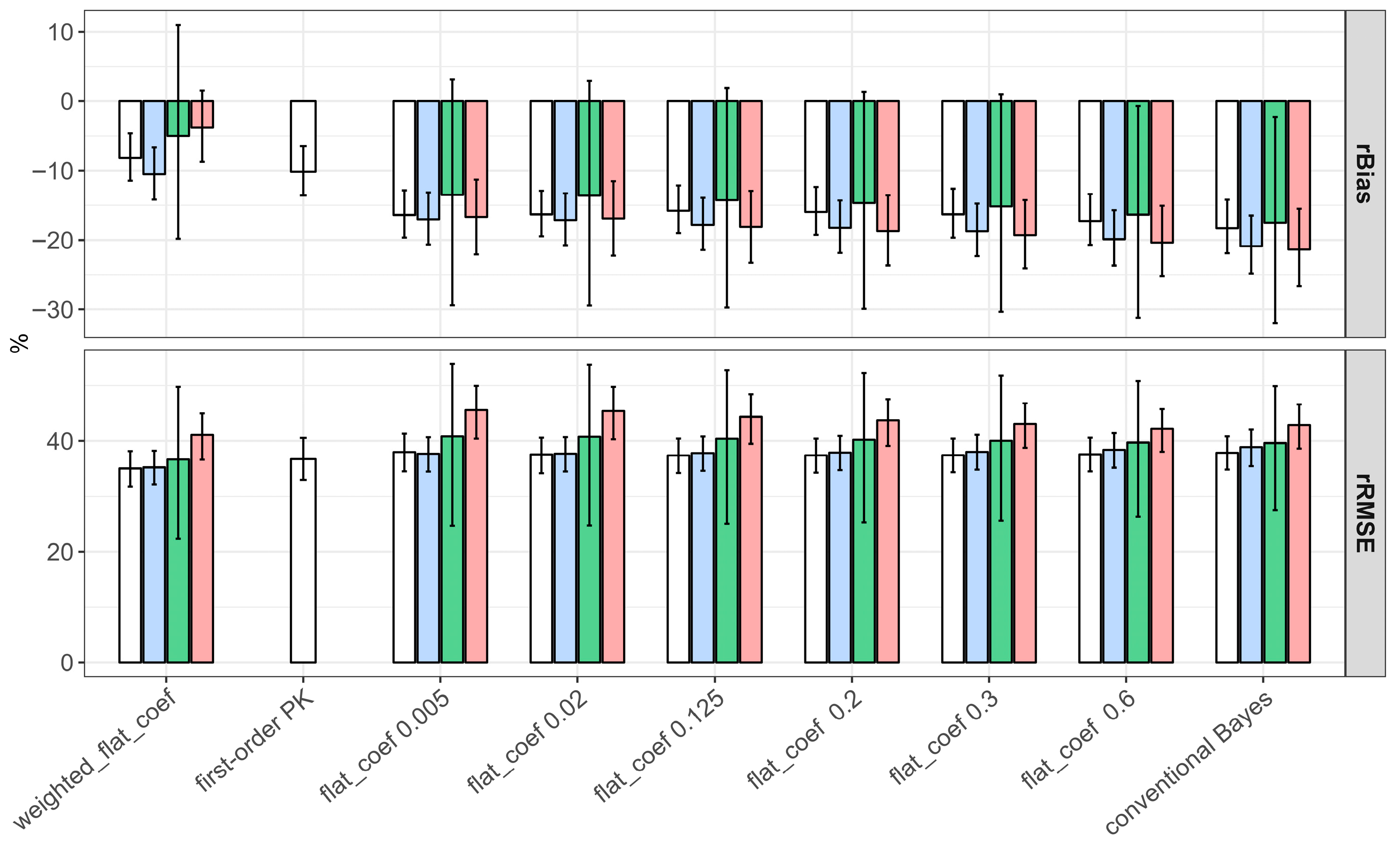
| The forecast lead time (day) | −3.333 | −3.928 to −2.738 | <0.001 | −3.311 | −3.902 to −2.720 | <0.001 |
| Vancomycin concentration | ||||||
| Two concentrations | Reference | |||||
| Mid concentration | 1.343 | −2.544 to 5.229 | 0.498 | 0.618 | −3.235 to 4.470 | 0.753 |
| Peak concentration | −1.961 | −3.510 to −0.411 | 0.013 | −1.298 | −2.868 to 0.272 | 0.105 |
| Trough concentration | −2.537 | −4.101 to −0.974 | 0.001 | −1.847 | −3.429 to −0.264 | 0.022 |
| Estimation methods | ||||||
| Conventional Bayesian method | Reference | |||||
| Flattened coefficient 0.005 | 3.472 | 0.921 to 6.023 | 0.008 | 3.472 | 0.941 to 6.003 | 0.007 |
| Flattened coefficient 0.02 | 3.395 | 0.845 to 5.946 | 0.009 | 3.395 | 0.864 to 5.927 | 0.009 |
| Flattened coefficient 0.125 | 2.945 | 0.394 to 5.496 | 0.024 | 2.945 | 0.414 to 5.476 | 0.023 |
| Flattened coefficient 0.2 | 2.546 | −0.004 to 5.097 | 0.051 | 2.546 | 0.015 to 5.078 | 0.049 |
| Flattened coefficient 0.3 | 2.078 | −0.473 to 4.629 | 0.110 | 2.078 | −0.453 to 4.610 | 0.108 |
| Flattened coefficient 0.6 | 1.022 | −1.529 to 3.572 | 0.433 | 1.022 | −1.510 to 3.553 | 0.429 |
| Weighted-flattened Bayesian method | 12.662 | 10.111 to 15.213 | <0.001 | 12.660 | 10.131 to 15.194 | <0.001 |
| First-order PK | 9.900 | 6.293 to 13.508 | <0.001 | 8.932 | 5.242 to 12.623 | <0.001 |
| Variables | Unadjusted | Adjusted | ||||
|---|---|---|---|---|---|---|
| Estimate | 95% CI | p | Estimate | 95% CI | p | |
| Age (month) | 0.087 | 0.023 to 0.151 | 0.009 | 0.123 | 0.049 to 0.199 | 0.002 |
| Body weight (kg) | 0.187 | −0.052 to 0.425 | 0.128 | - | - | - |
| Serum creatinine (µmol/L) | −0.210 | −0.282 to −0.139 | <0.001 | −0.252 | −0.325 to −0.181 | <0.001 |
| The forecast lead time (day) | 3.187 | 2.792 to 3.582 | <0.001 | 3.227 | 2.834 to 3.621 | <0.001 |
| Vancomycin concentration | ||||||
| Two concentrations | Reference | |||||
| Mid concentration | 1.804 | −0.789 to 4.397 | 0.173 | 3.523 | 0.960 to 6.086 | 0.007 |
| Peak concentration | 5.501 | 4.467 to 6.536 | <0.001 | 5.402 | 4.360 to 6.443 | <0.001 |
| Trough concentration | −0.012 | −1.054 to 1.033 | 0.984 | −0.204 | −1.255 to 0.847 | 0.703 |
| Estimation methods | ||||||
| Conventional Bayesian method | Reference | |||||
| Flattened coefficient 0.005 | 0.537 | −1.191 to 2.265 | 0.543 | 0.537 | −1.143 to 2.218 | 0.531 |
| Flattened coefficient 0.02 | 0.378 | −1.350 to 2.106 | 0.668 | 0.378 | −1.302 to 2.059 | 0.659 |
| Flattened coefficient 0.125 | 0.049 | −1.679 to 1.777 | 0.956 | 0.049 | −1.632 to 1.729 | 0.954 |
| Flattened coefficient 0.2 | −0.103 | −1.830 to 1.625 | 0.907 | −0.103 | −1.783 to 1.578 | 0.905 |
| Flattened coefficient 0.3 | −0.254 | −1.981 to 1.474 | 0.774 | −0.254 | −1.934 to 1.427 | 0.767 |
| Flattened coefficient 0.6 | −0.370 | −2.098 to 1.358 | 0.675 | −0.370 | −2.051 to 1.310 | 0.666 |
| Weighted-flattened Bayesian method | −2.099 | −3.826 to −0.371 | 0.017 | −2.099 | −3.779 to −0.418 | 0.014 |
| First-order PK | −2.440 | −4.883 to 0.003 | 0.050 | −0.653 | −3.103 to 1.797 | 0.601 |
Disclaimer/Publisher’s Note: The statements, opinions and data contained in all publications are solely those of the individual author(s) and contributor(s) and not of MDPI and/or the editor(s). MDPI and/or the editor(s) disclaim responsibility for any injury to people or property resulting from any ideas, methods, instructions or products referred to in the content. |
© 2026 by the authors. Licensee MDPI, Basel, Switzerland. This article is an open access article distributed under the terms and conditions of the Creative Commons Attribution (CC BY) license.
Share and Cite
Pham, H.T.; Nguyen, C.T.; Nguyen, T.T.N.; Hoang, L.H.; Tran, M.N.; Nguyen, T.P.; Do, T.N.; Nguyen, H.T.H.; Nguyen, A.H.; Phan, P.H.; et al. Predictive Performance of Bayesian Methods to Forecast Vancomycin Concentration for Therapeutic Drug Monitoring in Critically Ill Pediatric Patients. Pharmaceutics 2026, 18, 160. https://doi.org/10.3390/pharmaceutics18020160
Pham HT, Nguyen CT, Nguyen TTN, Hoang LH, Tran MN, Nguyen TP, Do TN, Nguyen HTH, Nguyen AH, Phan PH, et al. Predictive Performance of Bayesian Methods to Forecast Vancomycin Concentration for Therapeutic Drug Monitoring in Critically Ill Pediatric Patients. Pharmaceutics. 2026; 18(2):160. https://doi.org/10.3390/pharmaceutics18020160
Chicago/Turabian StylePham, Ha T., Cuc T. Nguyen, Tien T. N. Nguyen, Linh H. Hoang, Minh N. Tran, Thao P. Nguyen, Tuan N. Do, Ha T. H. Nguyen, Anh H. Nguyen, Phuc H. Phan, and et al. 2026. "Predictive Performance of Bayesian Methods to Forecast Vancomycin Concentration for Therapeutic Drug Monitoring in Critically Ill Pediatric Patients" Pharmaceutics 18, no. 2: 160. https://doi.org/10.3390/pharmaceutics18020160
APA StylePham, H. T., Nguyen, C. T., Nguyen, T. T. N., Hoang, L. H., Tran, M. N., Nguyen, T. P., Do, T. N., Nguyen, H. T. H., Nguyen, A. H., Phan, P. H., Tran, D. M., & Vu, H. D. (2026). Predictive Performance of Bayesian Methods to Forecast Vancomycin Concentration for Therapeutic Drug Monitoring in Critically Ill Pediatric Patients. Pharmaceutics, 18(2), 160. https://doi.org/10.3390/pharmaceutics18020160