Skip Content
You are currently on the new version of our website. Access the old version .

Nanomaterials

Nanomaterials is an international, interdisciplinary, peer-reviewed, open access journal published semimonthly online by MDPI, and that publishes reviews, regular research papers, communications, and short notes that are relevant to any field of study that involves nanomaterials with respect to their science and applications.
The Spanish Carbon Group (GEC) and The Chinese Society of Micro-Nano Technology (CSMNT) are affiliated with Nanomaterials and their members receive discounts on the article processing charges.
Indexed in PubMed | Quartile Ranking JCR - Q2 (Physics, Applied | Chemistry, Multidisciplinary | Materials Science, Multidisciplinary | Nanoscience and Nanotechnology)

All Articles (21,736)

The current state and prospects of microreactor synthesis of functional materials in single- and two-phase flows with a liquid continuous phase are analyzed. Microreactors allow fine control over the size, composition, structure, and properties of synthesized particles in co-precipitation processes. The results obtained by various teams provide grounds to expect fairly extensive capabilities for controlling the processes of nucleation and particle growth in microreactors—by controlling the pH, reagent concentrations, micromixing quality, and residence time in each of the reactor zones—in the nucleation growth zones. The advantages of microreactor synthesis have been demonstrated with a high quality of micromixing in a volume of 0.2–0.5 mL, which ensures the production of nanoparticles without impurities, a stoichiometric ratio of atoms in the product, and limitation of agglomerate growth due to a short residence time (in the order of several milliseconds). The transition to an industrial scale is very easy due to the fairly high productivity of a single microreactor (up to 10 m3/day for suspension, up to 200–300 kg/day for solid phase). Intensive mixing in microreactors with a diameter of 2–4 mm or less, due to Taylor vortices, contributed to the use of two-phase microreactors for the synthesis of both organic and inorganic substances.

11 February 2026
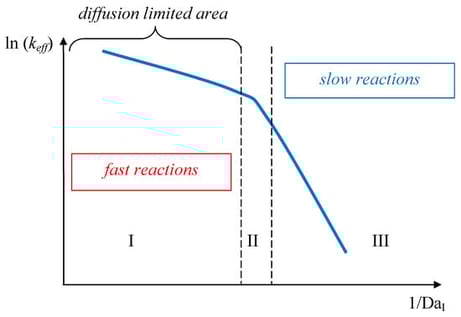
Typical dependence of the effective constant of reaction on the inverse Damköhler number: I—diffusion-limited area; II—transient area; III—reaction kinetic-limited area.

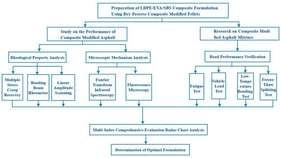
This study employed a dry-process method to prepare SBS/recycled LDPE/EVA composite-modified particles (CMP) for asphalt mixture modification. Conventional performance tests, including penetration tests, determined the optimal CMP dosage to be 8% by mass of asphalt. The rheological properties and microstructure of base asphalt, SBS-modified asphalt, and composite-modified asphalt were systematically compared, and the road performance of the corresponding mixtures was evaluated. The results demonstrated that the composite modifier forms a uniform elastic network within the asphalt, significantly enhancing both high- and low-temperature performance and fatigue life while also improving thermal stability and deformation resistance. The modification mechanism is predominantly based on physical blending, and the system exhibits good thermal stability. The outstanding performance of the mixture, including a 284.4% increase in dynamic stability and a 60.1% extension in fatigue life, is attributed to the formation of a “skeleton–asphalt–particle” multiphase structure. Comprehensive performance analysis indicated that optimal performance is achieved with an SBS/LDPE/EVA ratio of 1:1:1, highlighting the considerable practical engineering potential of this dry-process composite modification technology.

11 February 2026

Research framework.

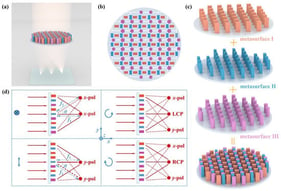
Metalenses capable of controlling more than two types of polarized light have drawn broad interest recently, as they can bring great flexibility and possibilities to the design of highly integrated polarization imaging devices that are not limited by theoretical efficiency. However, current metalenses for practical applications can only perform imaging with dual-polarization states simultaneously through a single aperture. Herein, a polarization-multiplexed multifunctional metalens enabled with three kinds of phase manipulation is proposed. Specifically, by encoding three groups of specific meta-atoms within a single aperture through spatial multiplexing, a “three-in-one” meta-device acting as a composite metalens can be constructed. Theoretical analysis and calculation simulations validate the performance of the metalens. Under circularly polarized light, the metalens exhibits three nearly diffraction-limited coplanar focal spots with horizontal, vertical, and circular polarization properties, respectively, and has a total focusing efficiency of 60%. This device can be used for triple-polarization imaging in real time, with promising prospects in highly integrated polarization imaging systems.

11 February 2026

Design and polarization-modulated property illustration of the metalens. (a) Schematic diagram of the multifunctional metalens. (b) Top view of the designed metalens. The colors are used only to make the different meta-atoms easier to distinguish and do not carry any material information. (c) The construction scheme of the metalens. (d) Focusing diagrams of the metalens on differently polarized light. The arrows indicate the polarization direction of the incident light, representing horizontally polarized, vertically polarized, LCP, and RCP, respectively.

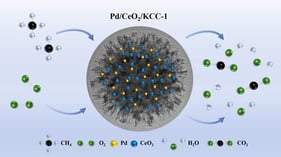
In the present work, 1.92 wt% Pd/9.68 wt% CeO2/spherical mesoporous silica (denoted as 1.92Pd/9.68CeO2/KCC-1) and 1.96 wt% Pd/KCC-1 (denoted as 1.96Pd/KCC-1) catalysts were prepared. It was found that the 1.92Pd/9.68CeO2/KCC-1 sample exhibited an excellent catalytic activity for methane combustion, which was much better than that of the 1.96Pd/KCC-1 sample. In addition, the 1.92Pd/9.68CeO2/KCC-1 sample possessed good high-temperature stability and water resistance. The enhanced methane combustion performance of 1.92Pd/9.68CeO2/KCC-1 was mainly attributed to the good dispersion of Pd species and the stabilization of the active Pd2+ species and generation of more reactive oxygen species by CeO2 modification. This work offers new insights into developing methane combustion catalysts with low-temperature catalytic performance and high-temperature stability.

11 February 2026

SEM images of (A) KCC-1, (B) 1.96Pd/KCC-1 and (C,D) 1.92Pd/9.68CeO2/KCC-1, and (E) TEM image of 1.96Pd/KCC-1, and (F–H) TEM images and (I) EDX elemental mappings of 1.92Pd/9.68CeO2/KCC-1.

News & Conferences

Issues

Open for Submission

Editor's Choice

Reprints of Collections

Advances in Nanostructured Electrode Materials
Reprint

Advances in Nanostructured Electrode Materials

Design and Applications
Editors: Maria Grazia Musolino

Get Alerted

Add your email address to receive forthcoming issues of this journal.

XFacebookLinkedIn
Nanomaterials - ISSN 2079-4991