Photocatalytic Degradation of Antibiotics Using Nanomaterials: Mechanisms, Applications, and Future Perspectives

 , ,
, , 
Abstract
1. Introduction
2. Antibiotics in Aquatic Systems: Physicochemical Characteristics, Transformation, and Ecological Risks
2.1. Chemical Structure and Physicochemical Properties of Antibiotics
2.2. Transformation Products, Detoxification, and Environmental Risk
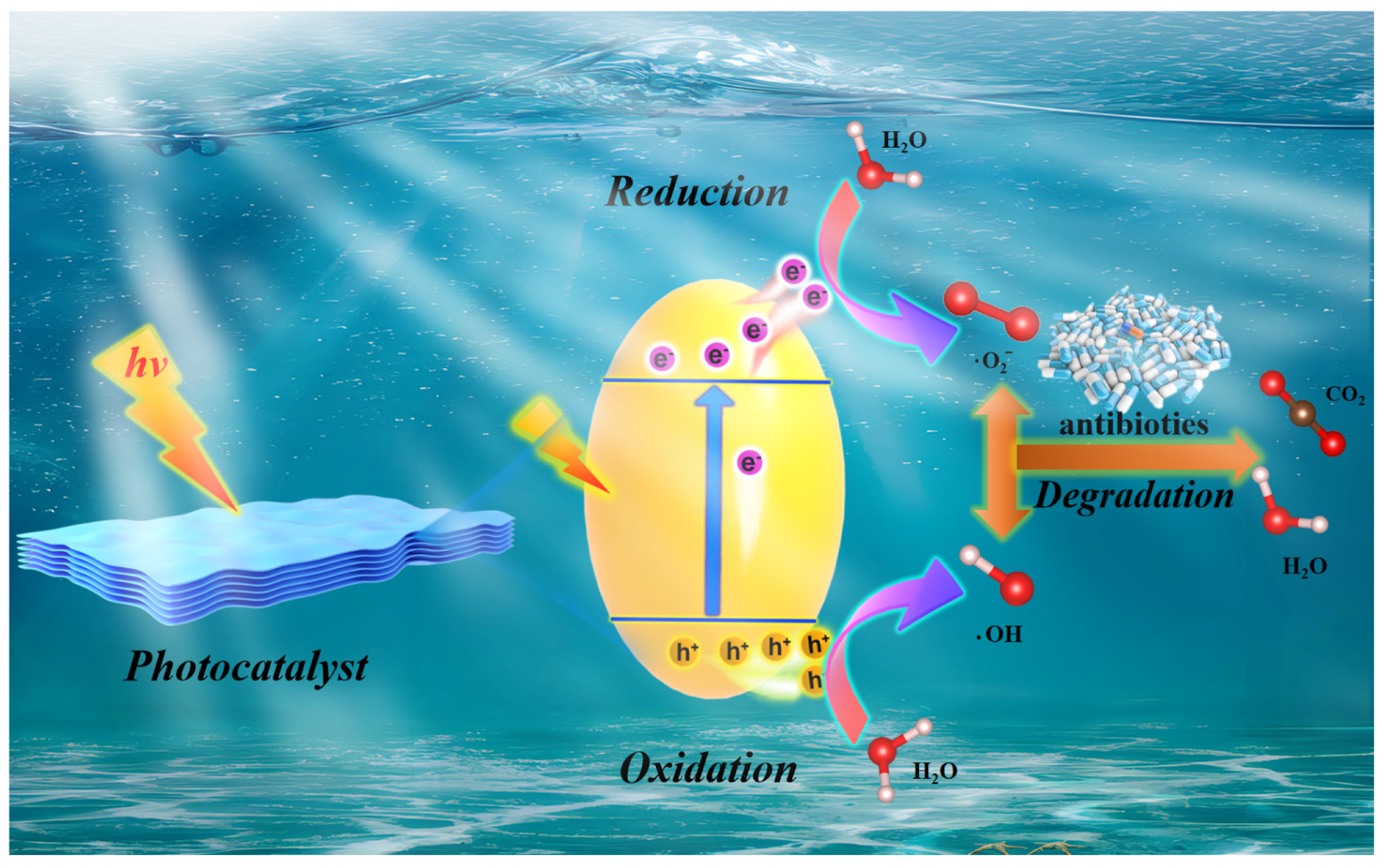
3. Principle and Fundamental Mechanism of Photocatalytic Degradation of Antibiotics
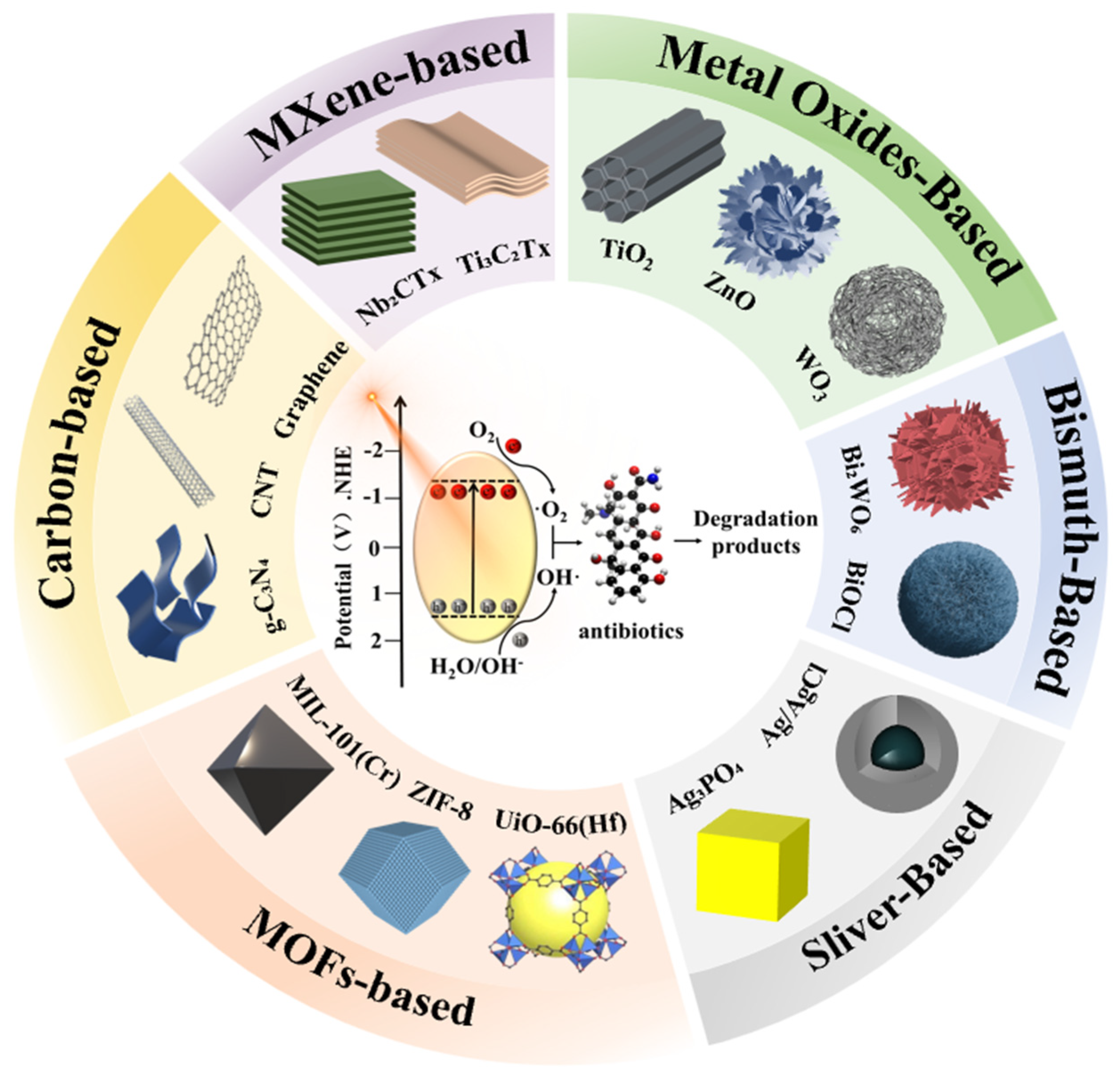
4. Key Photocatalytic Nanomaterials Used in Antibiotic Degradation
4.1. Metal Oxide-Based Photocatalysts
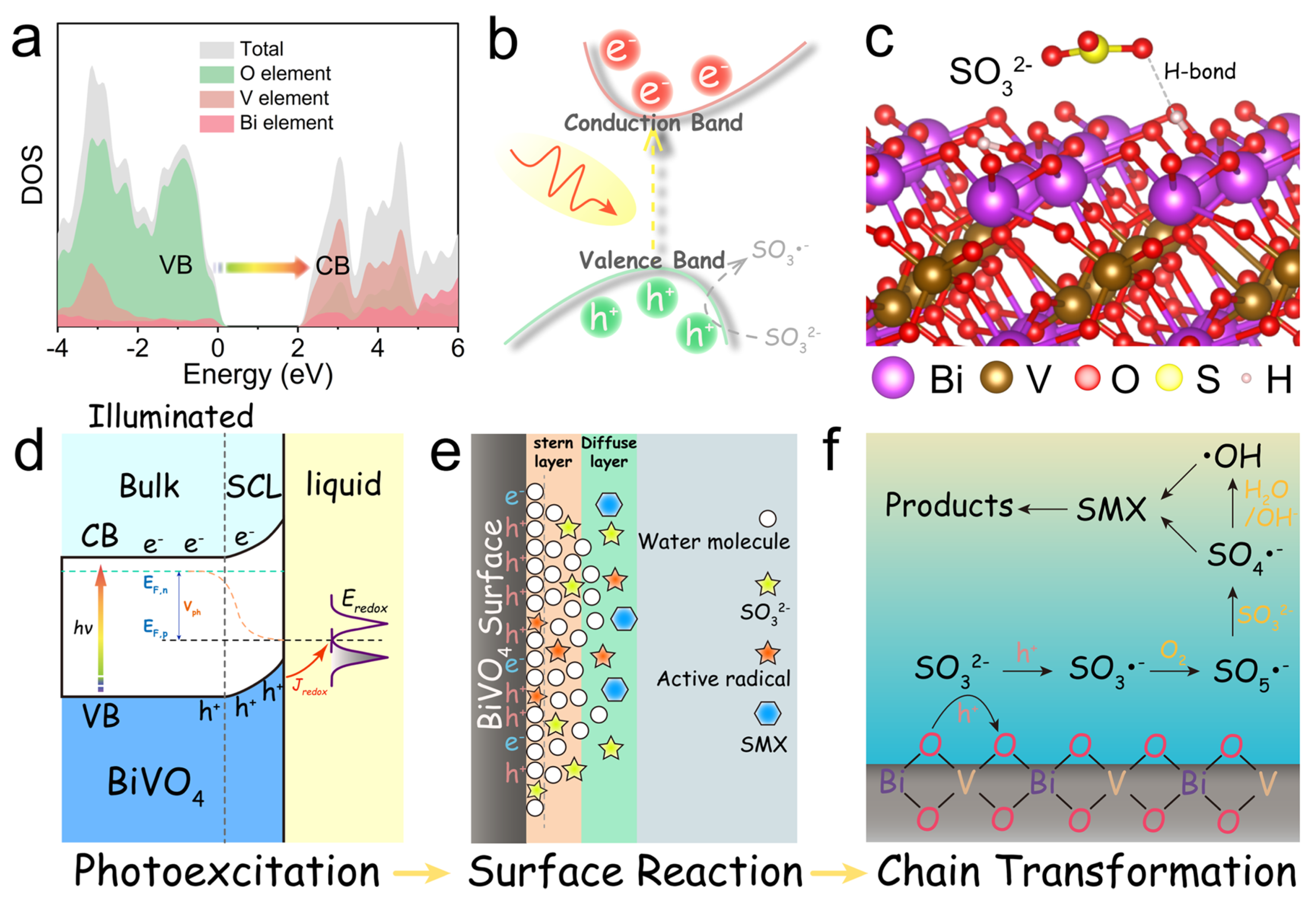
4.2. Bismuth-Based Photocatalysts
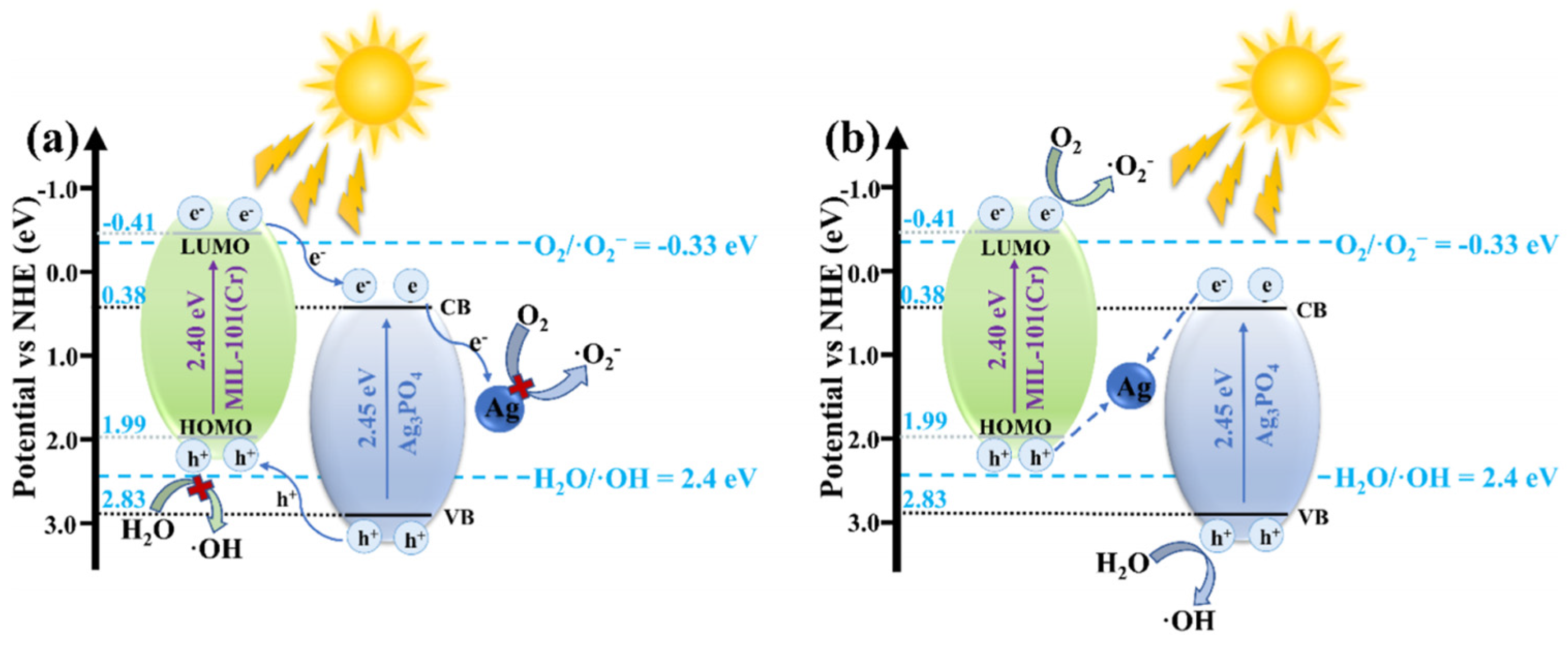
4.3. Silver-Based Photocatalysts
4.4. MOFs-Based Photocatalysts
4.5. Carbon-Based Photocatalyst
4.6. MXene-Based Photocatalysts
4.7. Other Photocatalysts
5. Bridging Lab to Field: Sunlight, Real Wastewater, Immobilization and Scalable Systems
5.1. Sunlight-Driven Operation and Realistic Photonic Reporting
5.2. Real Wastewater Matrices: Matrix Effects, Deactivation, and Comparability
5.3. Immobilization and Retrievability: From Powders to Membranes, Fibers, and 3D Supports
5.4. Device-Integrated Photocatalysis: From Materials to Deployable Water-Treatment Units
6. AI-Driven Design and Optimization of Photocatalysts for Enhanced Antibiotic Degradation
6.1. AI Methods for Photocatalyst Design and Mechanistic Insights
6.2. AI Applications in Photocatalytic Materials and Reactor Systems
7. Challenges
8. Conclusions and Perspectives
Author Contributions
Funding
Data Availability Statement
Conflicts of Interest
References
- Lu, Y.; Zhou, X.; Zheng, Y.; Yang, H.; Cao, W. How far do we still need to go with antibiotics in aquatic environments? Antibiotic occurrence, chemical-free or chemical-limited strategies, key challenges, and future perspectives. Water Res. 2025, 275, 123179. [Google Scholar] [CrossRef]
- Yang, J.; Tian, S.; Song, Z.; Hao, Y.; Lu, M. Recent advances in absorption-based photocatalytic materials for the d egradation of antibiotics. Coord. Chem. Rev. 2025, 523, 216257. [Google Scholar] [CrossRef]
- Javed, M.S.; Nazir, M.A.; Shafiq, Z.; Ullah, S.; Najar, T.; Iqbal, R.; Ismail, M.A.; Tamang, T.L.; Shah, S.S.A. Advanced materials for photocatalytic removal of antibiotics from west water. J. Alloys Compd. 2025, 1010, 177926. [Google Scholar] [CrossRef]
- Vanlalhmingmawia, C.; Tiwari, D.; Kim, D.-J. Novel nanocomposite thin film in the efficient removal of antibiotics using visible light: Insights of photocatalytic reactions and stability of thin film in real water implications. Environ. Res. 2023, 218, 115007. [Google Scholar] [CrossRef]
- Shan, J.Y.; Wu, X.L.; Li, C.F.; Hu, J.W.; Zhang, Z.M.; Liu, H.J.; Xia, P.H.; Huang, X.F. Photocatalytic degradation of tetracycline hydrochloride by a Fe3O4/g-C3N4/rGO magnetic nanocomposite mechanism: Modeling and optimization. Environ. Sci. Pollut. Res. 2023, 30, 8098–8109. [Google Scholar] [CrossRef] [PubMed]
- Dong, C.; Zheng, Z.; Badsha, M.A.H.; He, J.; Lo, I.M.C. Visible-light-driven peroxymonosulfate activation in photo-electrocatalytic system using hollow-structured Pt@CeO2@MoS2 photoanode for the degradation of pharmaceuticals and personal care products. Environ. Int. 2021, 154, 106572. [Google Scholar] [CrossRef]
- Liu, S.; Hu, Q.; Qiu, J.; Wang, F.; Lin, W.; Zhu, F.; Wei, C.; Zhou, N.; Ouyang, G. Enhanced Photocatalytic Degradation of Environmental Pollutants under Visible Irradiation by a Composite Coating. Environ. Sci. Technol. 2017, 51, 5137–5145. [Google Scholar] [CrossRef] [PubMed]
- Valdivia, M.-T.; Taggart, M.A.; Pap, S.; Kean, A.; Pfleger, S.; Megson, I.L. Photocatalytic metallic nanomaterials immobilised onto porous structures: Future perspectives for at-source pharmaceutical removal from hospital wastewater and potential benefits over existing technologies. J. Water Process. Eng. 2023, 52, 103553. [Google Scholar] [CrossRef]
- Yu, M.L.; Wang, J.J.; Tang, L.; Feng, C.Y.; Liu, H.Y.; Zhang, H.; Peng, B.; Chen, Z.M.; Xie, Q.Q. Intimate coupling of photocatalysis and biodegradation for wastewater treatment: Mechanisms, recent advances and environmental applications. Water Res. 2020, 175, 115673. [Google Scholar] [CrossRef]
- Jiang, H.; Wang, Q.; Chen, P.; Zheng, H.; Shi, J.; Shu, H.; Liu, Y. Photocatalytic degradation of tetracycline by using a regenerable (Bi)BiOBr/rGO composite. J.Clean. Prod. 2022, 339, 130771. [Google Scholar] [CrossRef]
- Tan, J.-X.; Chen, Z.-Y.; Chen, C.H.; Hsieh, M.-F.; Lin, A.Y.-C.; Chen, S.S.; Wu, K.C.W. Efficient adsorption and photocatalytic degradation of water emerging contaminants through nanoarchitectonics of pore sizes and optical properties of zirconium-based MOFs. J. Hazard. Mater. 2023, 451, 131113. [Google Scholar] [CrossRef]
- Andronic, L.; Ghica, D.; Stefan, M.; Mihalcea, C.G.; Vlaicu, A.-M.; Karazhanov, S. Visible-Light-Active Black TiO2 Nanoparticles with Efficient Photocata lytic Performance for Degradation of Pharmaceuticals. Nanomaterials 2022, 12, 2563. [Google Scholar] [CrossRef]
- Xu, L.Y.; Zhang, H.; Xiong, P.; Zhu, Q.Q.; Liao, C.Y.; Jiang, G.B. Occurrence, fate, and risk assessment of typical tetracycline antibiotics in the aquatic environment: A review. Sci. Total Environ. 2021, 753, 141975. [Google Scholar] [CrossRef] [PubMed]
- Li, X.; Guo, X.; Niu, J.; Lin, J.; Cheng, J.; Hu, Y.; Chen, Y.; Wen, W. Constructing self-assembled microtubular structured Zn–In–S and modulation mechanism towards efficient photocatalytic degradation of tetracycline. J. Clean. Prod. 2023, 385, 135685. [Google Scholar] [CrossRef]
- Zhou, Q.; Wang, H.; Zhu, K.; Yao, C.; Peng, J.; Chen, Y.; Zhou, S.; Zhu, L. Evaluation of Hydroxyapatite as Adsorbent in the Analysis of Trace Tetracyclines in Complex Matrices. Food Anal. Methods 2021, 14, 28–35. [Google Scholar] [CrossRef]
- Dao, X.; Hao, H.; Bi, J.; Sun, S.; Huang, X. Surface Complexation Enhanced Adsorption of Tetracycline by ALK-MXene. Ind. Eng. Chem. Res. 2022, 61, 6028–6036. [Google Scholar] [CrossRef]
- Ma, Y.; Li, P.; Yang, L.; Wu, L.; He, L.; Gao, F.; Qi, X.; Zhang, Z. Iron/zinc and phosphoric acid modified sludge biochar as an efficient adsorbent for fluoroquinolones antibiotics removal. Ecotoxicol. Environ. Saf. 2020, 196, 110550. [Google Scholar] [CrossRef]
- Labidi, A.; Ren, H.; Liang, X.; Dong, Q.; Li, X.; Tian, Q.; Sial, A.; Cui, Y.; Kang, H.; Liang, J.; et al. Visible–light–driven photocatalytic degradation of ciprofloxacin antibiotic by novel heterostructured coal fly ash waste: Mechanism insight, toxicity pathway and DFT calculation. Mater. Today Chem. 2024, 42, 102388. [Google Scholar] [CrossRef]
- Harrower, J.; McNaughtan, M.; Hunter, C.; Hough, R.; Zhang, Z.; Helwig, K. Chemical Fate and Partitioning Behavior of Antibiotics in the Aquatic Environment–A Review. Environ. Toxicol. Chem. 2021, 40, 3275–3298. [Google Scholar] [CrossRef]
- Deng, J.; Zhang, W.; Zhang, L.; Qin, C.; Wang, H.; Ling, W. Micro-interfacial behavior of antibiotic-resistant bacteria and antibiotic resistance genes in the soil environment: A review. Environ. Int. 2024, 191, 108972. [Google Scholar] [CrossRef]
- Zhi, D.; Yang, D.; Zheng, Y.; Yang, Y.; He, Y.; Luo, L.; Zhou, Y. Current progress in the adsorption, transport and biodegradation of antibiotics in soil. J. Environ. Manag. 2019, 251, 109598. [Google Scholar] [CrossRef]
- Guo, C.; Gao, S.; Lv, J.; Hou, S.; Zhang, Y.; Xu, J. Assessing the photocatalytic transformation of norfloxacin by BiOBr/iron oxides hybrid photocatalyst: Kinetics, intermediates, and influencing factors. Appl. Catal. B Environ. 2017, 205, 68–77. [Google Scholar] [CrossRef]
- Abellán, M.N.; Giménez, J.; Esplugas, S. Photocatalytic degradation of antibiotics: The case of sulfamethoxazole and trimethoprim. Catal. Today 2009, 144, 131–136. [Google Scholar] [CrossRef]
- Chang, C.-T.; Wang, J.-J.; Ouyang, T.; Zhang, Q.; Jing, Y.-H. Photocatalytic degradation of acetaminophen in aqueous solutions by TiO2/ZSM-5 zeolite with low energy irradiation. Mat. Sci. Eng. B Adv. 2015, 196, 53–60. [Google Scholar] [CrossRef]
- Mu, R.; Ao, Y.; Wu, T.; Wang, C.; Wang, P. Synthesis of novel ternary heterogeneous anatase-TiO2 (B) biphase nanowires/Bi4O5I2 composite photocatalysts for the highly efficient degradation of acetaminophen under visible light irradiation. J. Hazard. Mater. 2020, 382, 121083. [Google Scholar] [CrossRef] [PubMed]
- Abdel-Wahab, A.-M.; Al-Shirbini, A.-S.; Mohamed, O.; Nasr, O. Photocatalytic degradation of paracetamol over magnetic flower-like TiO2/Fe2O3 core-shell nanostructures. J. Photochem. Photobiol. A Chem. 2017, 347, 186–198. [Google Scholar] [CrossRef]
- Moctezuma, E.; Leyva, E.; Aguilar, C.A.; Luna, R.A.; Montalvo, C. Photocatalytic degradation of paracetamol: Intermediates and total reaction mechanism. J. Hazard. Mater. 2012, 243, 130–138. [Google Scholar] [CrossRef]
- Wagner, S.; Bloh, J.; Kasper, C.; Bahnemann, D. Toxicological Issues of Nanoparticles Employed in Photocatalysis. Green 2011, 1, 171–188. [Google Scholar] [CrossRef][Green Version]
- Fanourakis, S.K.; Peña-Bahamonde, J.; Bandara, P.C.; Rodrigues, D.F. Nano-based adsorbent and photocatalyst use for pharmaceutical contaminant removal during indirect potable water reuse. npj Clean Water 2020, 3, 1. [Google Scholar] [CrossRef]
- Brillas, E. A review on the photoelectro-Fenton process as efficient electrochemical advanced oxidation for wastewater remediation. Treatment with UV light, sunlight, and coupling with conventional and other photo-assisted advanced technologies. Chemosphere 2020, 250, 126198. [Google Scholar] [CrossRef]
- Wu, Q.S.; Siddique, M.S.; Wang, H.J.; Cui, L.Q.; Wang, H.; Pan, M.; Yan, J.L. Visible-light-driven iron-based heterogeneous photo-Fenton catalysts for wastewater decontamination: A review of recent advances. Chemosphere 2023, 313, 137509. [Google Scholar] [CrossRef] [PubMed]
- Velempini, T.; Prabakaran, E.; Pillay, K. Recent developments in the use of metal oxides for photocatalytic degradation of pharmaceutical pollutants in water–A review. Mater. Today Chem. 2021, 19, 100380. [Google Scholar] [CrossRef]
- Qin, K.N.; Zhao, Q.L.; Yu, H.; Xia, X.H.; Li, J.J.; He, S.F.; Wei, L.L.; An, T.C. A review of bismuth-based photocatalysts for antibiotic degradation: Insight into the photocatalytic degradation performance, pathways and relevant mechanisms. Environ. Res. 2021, 199, 111360. [Google Scholar] [CrossRef]
- Li, Y.J.; Fu, Y.Z.; Zhu, M.S. Green synthesis of 3D tripyramid TiO2 architectures with assistance of aloe extracts for highly efficient photocatalytic degradation of antibiotic ciprofloxacin. Appl. Catal. B Environ. 2020, 260, 118149. [Google Scholar] [CrossRef]
- Kumari, M.; Sharma, A.; Kumar, N.; Sharma, R.K.; Makgwane, P.R.; Makgato, S.; Tahir, M.; Grover, S. SnS2 interfaced Li-Doped g-C3N4 heterojunctions with enhanced photocatalytic performances for organic pollutant decontamination: Performance and mechanistic analysis. J. Mol. Struct. 2025, 1334, 141848. [Google Scholar] [CrossRef]
- Greco, E.; De Spirt, A.; Miani, A.; Piscitelli, P.; Trombin, R.; Barbieri, P.; Marin, E. Nanomaterials in Photocatalysis: An In-Depth Analysis of Their Role in Enhancing Indoor Air Quality. Appl. Sci. 2025, 15, 1629. [Google Scholar] [CrossRef]
- Ebrahimi, M.; Akhavan, O. Nanomaterials for Photocatalytic Degradations of Analgesic, Mucolytic and Anti-Biotic/Viral/Inflammatory Drugs Widely Used in Controlling SA. Catalysts 2022, 12, 667. [Google Scholar] [CrossRef]
- Danish, M.S.S.; Estrella, L.L.; Alemaida, I.M.A.; Lisin, A.; Moiseev, N.; Ahmadi, M.; Nazari, M.; Wali, M.; Zaheb, H.; Senjyu, T. Photocatalytic Applications of Metal Oxides for Sustainable Environmental Remediation. Metals 2021, 11, 80. [Google Scholar] [CrossRef]
- Sharma, M.; Sajwan, D.; Gouda, A.; Sharma, A.; Krishnan, V. Recent progress in defect-engineered metal oxides for photocatalytic e environmental remediation. Photochem. Photobiol. 2024, 100, 830–896. [Google Scholar] [CrossRef]
- Ding, R.-R.; Li, W.-Q.; He, C.-S.; Wang, Y.-R.; Liu, X.-C.; Zhou, G.-N.; Mu, Y. Oxygen vacancy on hollow sphere CuFe2O4 as an efficient Fenton-like catalysis for organic pollutant degradation over a wide pH range. Appl. Catal. B Environ. 2021, 291, 120069. [Google Scholar] [CrossRef]
- Xu, X.; Meng, L.; Dai, Y.; Zhang, M.; Sun, C.; Yang, S.; He, H.; Wang, S.; Li, H. Bi spheres SPR-coupled Cu2O/Bi2MoO6 with hollow spheres forming Z-scheme Cu2O/Bi/Bi2MoO6 heterostructure for simultaneous photocatalytic decontamination of sulfadiazine and Ni(II). J. Hazard. Mater. 2020, 381, 120953. [Google Scholar] [CrossRef] [PubMed]
- Zhang, S.; Yi, J.; Chen, J.; Yin, Z.; Tang, T.; Wei, W.; Cao, S.; Xu, H. Spatially confined Fe2O3 in hierarchical SiO2@TiO2 hollow sphere exhibiting superior photocatalytic efficiency for degrading antibiotics. Chem. Eng. J. 2020, 380, 122583. [Google Scholar] [CrossRef]
- Abdullah, M.; Iqbal, J.; Ur Rehman, M.S.; Khalid, U.; Mateen, F.; Arshad, S.N.; Al-Sehemi, A.G.; Algarni, H.; Al-Hartomy, O.A.; Fazal, T. Removal of ceftriaxone sodium antibiotic from pharmaceutical wastewater using an activated carbon based TiO2 composite: Adsorption and photocatalytic degradation evaluation. Chemosphere 2023, 317, 137834. [Google Scholar] [CrossRef]
- Wang, C.; Zhan, Z.; Liu, H.; Li, Y.; Wu, J.; Sun, P.; Shen, G. Single-atom iron cocatalyst for highly enhancing TiO2 photocatalytic degradation of antibiotics and antibiotic-resistant genes. Chem. Eng. J. 2024, 482, 148906. [Google Scholar] [CrossRef]
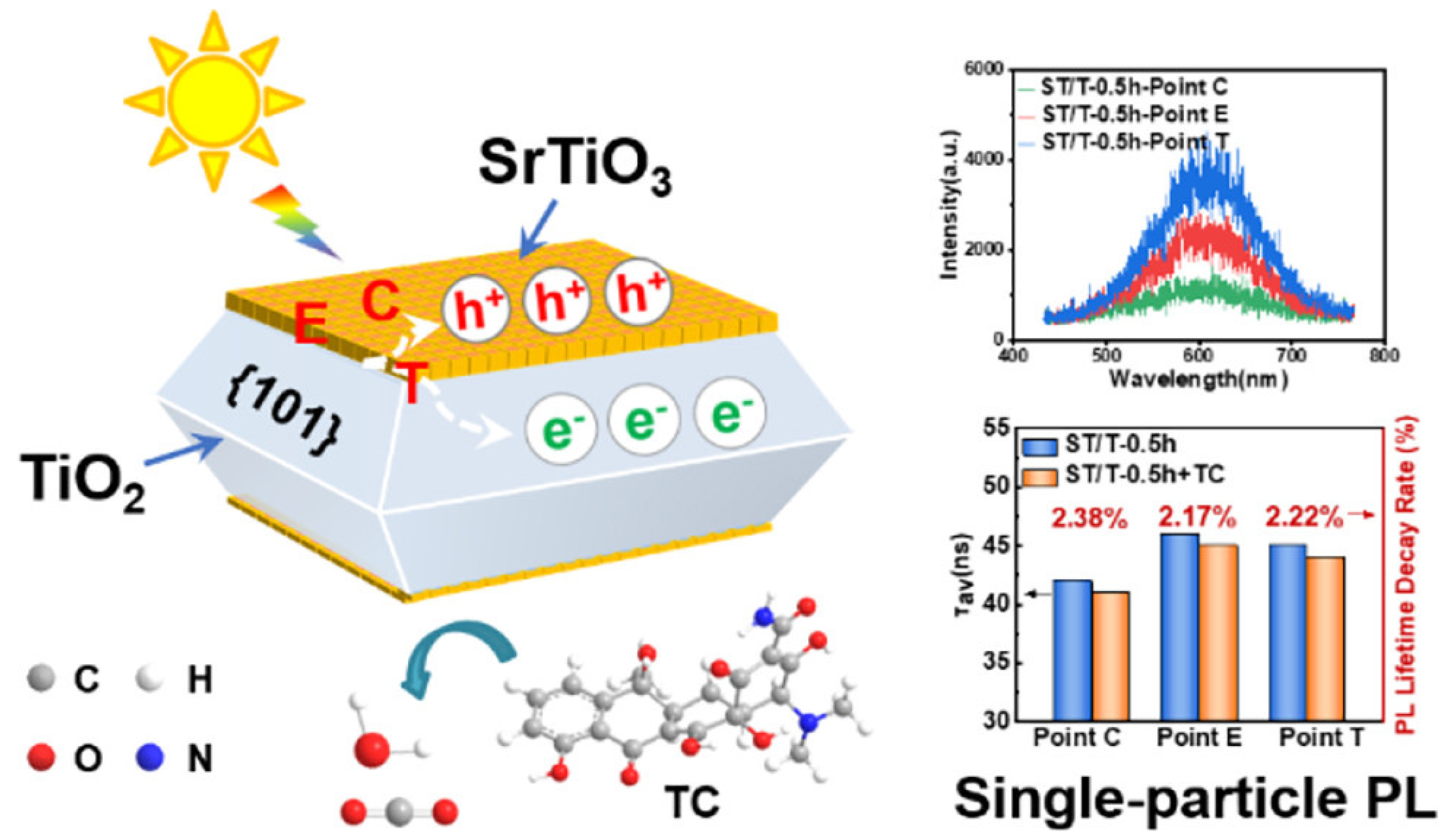
- Li, B.; Tong, F.; Lv, M.; Wang, Z.; Liu, Y.; Wang, P.; Cheng, H.; Dai, Y.; Zheng, Z.; Huang, B. In Situ Monitoring Charge Transfer on Topotactic Epitaxial Heterointerface for Tetracycline Degradation at the Single-Particle Level. ACS Catal. 2022, 12, 9114–9124. [Google Scholar] [CrossRef]
- Yilmaz, E.; Salem, S.; Sarp, G.; Aydin, S.; Sahin, K.; Korkmaz, I.; Yuvali, D. TiO2 nanoparticles and C-Nanofibers modified magnetic Fe3O4 nanospheres (TiO2@Fe3O4@C–NF): A multifunctional hybrid material for magnetic solid-phase extraction of ibuprofen and photocatalytic degradation of drug molecules and azo dye. Talanta 2020, 213, 120813. [Google Scholar] [CrossRef] [PubMed]
- Lu, M.; Liu, M.; Wei, Y.; Xie, H.; Fan, W.; Huang, J.; Hu, J.; Wei, P.; Zhang, W.; Xie, Y.; et al. Photocatalytic activity and mechanism of cerium dioxide with different morphologies for tetracycline degradation. J. Alloys Compd. 2023, 936, 168273. [Google Scholar] [CrossRef]
- Roy, N.; Kannabiran, K.; Mukherjee, A. Integrated adsorption and photocatalytic degradation based removal of ciprofloxacin and sulfamethoxazole antibiotics using Fc@rGO-ZnO nanocomposite in aqueous systems. Chemosphere 2023, 333, 138912. [Google Scholar] [CrossRef] [PubMed]
- Wang, A.; Ni, J.; Wang, W.; Wang, X.; Liu, D.; Zhu, Q. MOF-derived N-doped ZnO carbon skeleton@hierarchical Bi2MoO6 S-scheme heterojunction for photodegradation of SMX: Mechanism, pathways and DFT calculation. J. Hazard. Mater. 2022, 426, 128106. [Google Scholar] [CrossRef]
- Wang, S.; Wang, L.; Huang, W. Bismuth-based photocatalysts for solar energy conversion. J. Mater. Chem. A 2020, 8, 24307–24352. [Google Scholar] [CrossRef]
- Kusuma, K.B.; Manju, M.; Ravikumar, C.R.; Dileepkumar, V.G.; Kumar, A.N.; Santosh, M.S.; Murthy, H.C.A.; Gurushantha, K. Probe Sonicated Synthesis of Bismuth Oxide (Bi2O3): Photocatalytic App lication and Electrochemical Sensing of Ascorbic Acid and Lead. J. Nanomater. 2022, 2022, 3256611. [Google Scholar] [CrossRef]
- Cai, M.; Wang, C.; Liu, Y.; Yan, R.; Li, S. Boosted photocatalytic antibiotic degradation performance of Cd0.5Zn0.5S/carbon dots/Bi2WO6 S-scheme heterojunction with carbon dots as the electron bridge. Sep. Purif. Technol. 2022, 300, 121892. [Google Scholar] [CrossRef]
- Jin, K.; Qin, M.; Li, X.; Wang, R.; Zhao, Y.; Wang, H. Z-scheme Au@TiO2/Bi2WO6 heterojunction as efficient visible-light photocatalyst for degradation of antibiotics. J. Mol. Liq. 2022, 364, 120017. [Google Scholar] [CrossRef]
- Li, S.; Cai, M.; Liu, Y.; Wang, C.; Lv, K.; Chen, X. S-Scheme photocatalyst TaON/Bi2WO6 nanofibers with oxygen vacancies for efficient abatement of antibiotics and Cr(VI): Intermediate eco-toxicity analysis and mechanistic insights. Chin. J. Catal. 2022, 43, 2652–2664. [Google Scholar] [CrossRef]
- Gao, X.; Wang, P.; Che, H.; Liu, W.; Ao, Y. Breaking interfacial charge transfer barrier by sulfite for efficient pollutants degradation: A case of BiVO4. npj Clean Water 2023, 6, 42. [Google Scholar] [CrossRef]
- Gao, W.; Li, G.; Wang, Q.; Zhang, L.; Wang, K.; Pang, S.; Zhang, G.; Lv, L.; Liu, X.; Gao, W.; et al. Ultrathin porous Bi2WO6 with rich oxygen vacancies for promoted adsorption-photocatalytic tetracycline degradation. Chem. Eng. J. 2023, 464, 142694. [Google Scholar] [CrossRef]
- Sun, C.; Wu, L.; Hu, J.; Hussain, S.A.; Yang, J.; Jiao, F. A novel dual S-scheme heterojunction photocatalyst β-Bi2O3/NiAl-LDH/α-Bi2O3 induced by phase-transformed bismuth oxide for efficient degradation of antibiotics in full-spectrum: Degradation pathway, DFT calculation and mechanism insight. Chem. Eng. J. 2023, 474, 145616. [Google Scholar] [CrossRef]
- Su, R.; He, M.; Li, N.; Ma, D.; Zhou, W.; Gao, B.; Yue, Q.; Li, Q. Visible-Light Photocatalytic Chlorite Activation Mediated by Oxygen Vacancy Abundant Nd-Doped BiVO4 for Efficient Chlorine Dioxide Generation and Pollutant Degradation. ACS Appl. Mater. Interfaces 2022, 14, 31920–31932. [Google Scholar] [CrossRef] [PubMed]
- Xu, M.; Wang, Y.; Ha, E.; Zhang, H.; Li, C. Reduced graphene oxide/Bi4O5Br2 nanocomposite with synergetic effects on improving adsorption and photocatalytic activity for the degradation of antibiotics. Chemosphere 2021, 265, 129013. [Google Scholar] [CrossRef] [PubMed]
- Bao, L.; Tian, Z.; Hu, X.; Li, M.; Ji, Y.; Cui, M.; Wang, X.; Li, C. Synergistic roles of oxygen vacancies and interfacial chemical bonds in Z-scheme BiVO4/O-g-C3N4 heterojunctions for enhanced photocatalytic tetracycline degradation. J. Water Process. Eng. 2024, 65, 105830. [Google Scholar] [CrossRef]
- Hasanvandian, F.; Moradi, M.; Aghaebrahimi Samani, S.; Kakavandi, B.; Rahman Setayesh, S.; Noorisepehr, M. Effective promotion of g–C3N4 photocatalytic performance via surface oxygen vacancy and coupling with bismuth-based semiconductors towards antibiotics degradation. Chemosphere 2022, 287, 132273. [Google Scholar] [CrossRef]
- Zhou, Q.; Huang, W.; Xu, C.; Liu, X.; Yang, K.; Li, D.; Hou, Y.; Dionysiou, D.D. Novel hierarchical carbon quantum dots-decorated BiOCl nanosheet/carbonized eggshell membrane composites for improved removal of organic contaminants from water via synergistic adsorption and photocatalysis. Chem. Eng. J. 2021, 420, 129582. [Google Scholar] [CrossRef]
- Gao, B.; Tao, K.; Xi, Z.; El-Sayed, M.M.H.; Shoeib, T.; Yang, H. Fabrication of 3D lignosulfonate composited sponges impregnated by BiVO4/polyaniline/Ag ternary photocatalyst for synergistic adsorption-photodegradation of fluoroquinolones in water. Chem. Eng. J. 2022, 446, 137282. [Google Scholar] [CrossRef]
- Heidari, S.; Haghighi, M.; Shabani, M. Ultrasound assisted dispersion of Bi2Sn2O7-C3N4 nanophotocatalyst over various amount of zeolite Y for enhanced solar-light photocatalytic degradation of tetracycline in aqueous solution. Ultrason. Sonochem. 2018, 43, 61–72. [Google Scholar] [CrossRef] [PubMed]
- Li, T.; Liu, J.; Shi, F.; Song, X.; Zhang, H.; Zhang, H.; Ma, C.; Zhu, K.; Liu, J. Construction of a novel highly porous BiOBr/CsxWO3@SiO2 composite aerogel: Adsorption/self-heating photocatalytic synergistic degradation of antibiotics and mechanism study. J. Environ. Chem. Eng. 2022, 10, 107785. [Google Scholar] [CrossRef]
- Boxi, S.S.; Paria, S. Effect of silver doping on TiO2, CdS, and ZnS nanoparticles for the ph otocatalytic degradation of metronidazole under visible light. RSC Adv. 2014, 4, 37752. [Google Scholar] [CrossRef]
- Zhang, C.; He, D.H.; Fu, S.S.; Zeng, G.M.; Liang, Q.H.; Yang, Y.; Huang, D.L.; Wang, W.J.; Zhou, Y. Silver iodide decorated ZnSn(OH)6 hollow cube: Room-temperature preparation and application for highly efficient photocatalytic oxytetracycline degradation. Chem. Eng. J. 2021, 421, 129810. [Google Scholar] [CrossRef]
- Cai, T.; Zeng, W.; Liu, Y.; Wang, L.; Dong, W.; Chen, H.; Xia, X. A promising inorganic-organic Z-scheme photocatalyst Ag3PO4/PDI supermolecule with enhanced photoactivity and photostability for environmental remediation. Appl. Catal. B Environ. 2020, 263, 118327. [Google Scholar] [CrossRef]
- Fan, T.; Yang, Y.; Li, P.; Hu, C.; Yin, H.; Liu, X. 0D/2D Ag3PO4/Nickel-Aluminum layered double hydroxide Z-scheme photocatalyst for efficient antibiotic degradation. Colloids Surf. A Physicochem. Eng. Asp. 2021, 628, 127251. [Google Scholar] [CrossRef]
- Ma, C.; Shi, F.; Liu, J.; Li, T.; Zhu, K.; Liu, J.; Cui, G.; Yang, D.; Xiao, J. Construction of a novel Ag/AgBr/AgI@SiO2 composite aerogel with controlled pore structure: Efficient removal of tetracycline by adsorption/photocatalysis synergism under visible light irradiation. J. Environ. Chem. Eng. 2023, 11, 110157. [Google Scholar] [CrossRef]
- Liu, X.; Xu, J.; Zhang, T.; Zhang, J.; Xia, D.; Du, Y.; Jiang, Y.; Lin, K. Construction of Ag nanocluster-modified Ag3PO4 containing silver vacancies via in-situ reduction: With enhancing the photocatalytic degradation activity of sulfamethoxazole. J. Colloid Interface Sci. 2023, 629, 989–1002. [Google Scholar] [CrossRef]
- Wang, Y.; Han, D.; Wang, Z.; Gu, F. Efficient Photocatalytic Degradation of Tetracycline under Visible Light by an All-Solid-State Z-Scheme Ag3PO4/MIL-101(Cr) Heterostructure with Metallic Ag as a Charge Transmission Bridge. ACS Appl. Mater. Interfaces 2023, 15, 22085–22100. [Google Scholar] [CrossRef]
- Liu, X.; Li, Y.; Wang, H.; Liu, J.; Fu, J.; Liu, J.; Li, S. In situ construction of N-rich carbon nitride (C3N5)/silver phosphate (Ag3PO4) S-scheme heterojunctions for the efficient photocatalytic removal of levofloxacin antibiotic and RhB. Carbon Lett. 2024, 34, 1995–2011. [Google Scholar] [CrossRef]
- Liao, W.; Zheng, L.; Hao, J.; Huang, L.; Wang, Q.; Yin, Z.; Qi, T.; Jia, L.; Liu, K. Eco-friendly fabrication of multifunctional magnetic plasmonic photocatalyst for adsorption, SERS monitoring and photodegradation of residual fluoroquinolone antibiotics in water. Chemosphere 2023, 331, 138842. [Google Scholar] [CrossRef]
- Jin, J.; Liu, M.; Feng, L.; Wang, H.; Wang, Y.; Nguyen, T.A.H.; Wang, Y.; Lu, J.; Li, Y.; Bao, M. 3D Bombax-structured carbon nanotube sponge coupling with Ag3PO4 for tetracycline degradation under ultrasound and visible light irradiation. Sci. Total Environ. 2019, 695, 133694. [Google Scholar] [CrossRef]
- Negoescu, D.; Atkinson, I.; Gherendi, M.; Culita, D.C.; Baran, A.; Petrescu, S.; Trica, B.; Pelinescu, D.; Ionescu, R.; Bratan, V.; et al. Brij 58–activated carbon assisted synthesis of Ag/Ag2O/TiO2-AC photocatalysts for efficient organic pollutants degradation. J. Alloys Compd. 2023, 931, 167528. [Google Scholar] [CrossRef]
- Cao, P.; Zhang, Y.; Gao, D.; Chen, H.; Zhou, M.; He, Y.; Song, P.; Wang, R. Constructing nano-heterojunction of MOFs with crystal regrowth for efficient degradation of tetracycline under visible light. J. Alloys Compd. 2022, 904, 164061. [Google Scholar] [CrossRef]
- Du, C.; Zhang, Z.; Yu, G.; Wu, H.; Chen, H.; Zhou, L.; Zhang, Y.; Su, Y.; Tan, S.; Yang, L.; et al. A review of metal organic framework (MOFs)-based materials for antibiotics removal via adsorption and photocatalysis. Chemosphere 2021, 272, 129501. [Google Scholar] [CrossRef] [PubMed]
- Dey, B.; Ahmad, M.W.; Al-Shannaq, R.; Al-Humaidi, J.Y.; Hossain, S.K.S.; Patra, C.N.; Althomali, R.H.; Rahman, M.M.; Choudhury, A. Non-Enzymatic Electrochemical Sensing of Bisphenol A in Drinking Water and Milk Using Bimetallic Nickel-Copper Metal–Organic Framework. J. Anal. Test. 2024, 8, 451–465. [Google Scholar] [CrossRef]
- Li, S.; Wang, C.; Liu, Y.; Liu, Y.; Cai, M.; Zhao, W.; Duan, X. S-scheme MIL-101(Fe) octahedrons modified Bi2WO6 microspheres for photocatalytic decontamination of Cr(VI) and tetracycline hydrochloride: Synergistic insights, reaction pathways, and toxicity analysis. Chem. Eng. J. 2023, 455, 140943. [Google Scholar] [CrossRef]
- Su, Q.; Li, J.; Wang, B.; Li, Y.; Hou, L.a. Direct Z-scheme Bi2MoO6/UiO-66-NH2 heterojunctions for enhanced photocatalytic degradation of ofloxacin and ciprofloxacin under visible light. Appl. Catal. B Environ. 2022, 318, 121820. [Google Scholar] [CrossRef]
- Liu, S.; Jiang, X.; Waterhouse, G.I.N.; Zhang, Z.-M.; Yu, L.-m. A novel Z-scheme NH2-MIL-125(Ti)/Ti3C2 QDs/ZnIn2S4 photocatalyst with fast interfacial electron transfer properties for visible light-driven antibiotic degradation and hydrogen evolution. Sep. Purif. Technol. 2022, 294, 121094. [Google Scholar] [CrossRef]
- Yin, L.; Wang, D.; Li, X.; He, Y.; Liu, X.; Xu, Y.; Chen, H. One-pot synthesis of oxygen-vacancy-rich Cu-doped UiO-66 for collaborative adsorption and photocatalytic degradation of ciprofloxacin. Sci. Total Environ. 2022, 815, 151962. [Google Scholar] [CrossRef]
- Du, X.; Du, H.; Tang, B.; Lai, C. Elaboration of a green and highly dispersible Co-MOFs induced Co-doped C3N5 photocatalyst: Applications and mechanistic insights into activated perxymonosulfate degradation of antibiotics. J. Environ. Chem. Eng. 2024, 12, 112186. [Google Scholar] [CrossRef]
- Liu, S.; Jiang, X.; Waterhouse, G.I.N.; Zhang, Z.-M.; Yu, L.-m. Construction of Z-scheme Titanium-MOF/plasmonic silver nanoparticle/NiFe layered double hydroxide photocatalysts with enhanced dye and antibiotic degradation activity under visible light. Sep. Purif. Technol. 2021, 278, 119525. [Google Scholar] [CrossRef]
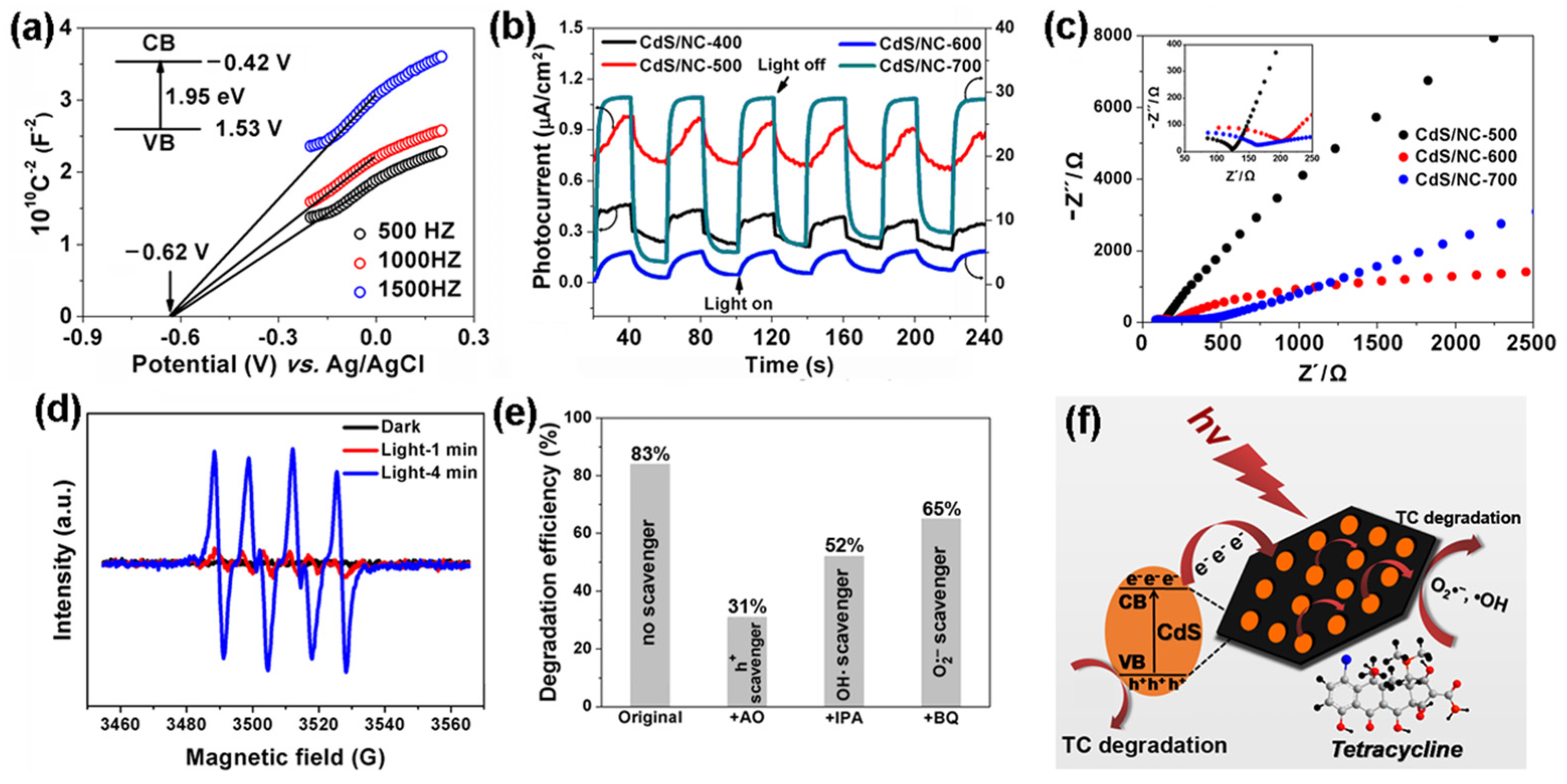
- Cao, H.-L.; Cai, F.-Y.; Yu, K.; Zhang, Y.-Q.; Lü, J.; Cao, R. Photocatalytic Degradation of Tetracycline Antibiotics over CdS/Nitrogen-Doped–Carbon Composites Derived from in Situ Carbonization of Metal–Organic Frameworks. ACS Sustain. Chem. Eng. 2019, 7, 10847–10854. [Google Scholar] [CrossRef]
- Yu, W.; Zhang, J.; Xiong, Y.; Wan, Z.; Zhu, J.; Zhang, Y. Construction of UiO-66-NH2/BiOBr heterojunctions on carbon fiber cloth as macroscale photocatalyst for purifying antibiotics. J. Clean. Prod. 2023, 415, 137603. [Google Scholar] [CrossRef]
- Zhang, X.M.; Wang, H.; Gao, M.M.; Zhao, P.F.; Xia, W.L.; Yang, R.L.; Huang, Y.C.; Wang, L.; Liu, M.X.; Wei, T.; et al. Template-directed synthesis of pomegranate-shaped zinc oxide@zeolitic imidazolate framework for visible light photocatalytic degradation of tetracycline. Chemosphere 2022, 294, 133782. [Google Scholar] [CrossRef]
- Fang, Y.; Zhu, S.-R.; Wu, M.-K.; Zhao, W.-N.; Han, L. MOF-derived In2S3 nanorods for photocatalytic removal of dye and antibiotics. J. Solid State Chem. 2018, 266, 205–209. [Google Scholar] [CrossRef]
- Huong, V.T.; Van Duc, B.; An, N.T.; Anh, T.T.P.; Aminabhavi, T.M.; Vasseghian, Y.; Joo, S.W. 3D-Printed WO3-UiO-66@reduced graphene oxide nanocomposites for photocatalytic degradation of sulfamethoxazole. Chem. Eng. J. 2024, 483, 149277. [Google Scholar] [CrossRef]
- Zhang, X.; Lin, B.; Li, X.; Wang, X.; Huang, K.; Chen, Z. MOF-derived magnetically recoverable Z-scheme ZnFe2O4/Fe2O3 perforated nanotube for efficient photocatalytic ciprofloxacin removal. Chem. Eng. J. 2022, 430, 132728. [Google Scholar] [CrossRef]
- Suo, S.; Ma, W.; Zhang, S.; Han, Z.; Wang, Y.; Li, Y.; Xiong, Y.; Liu, Y.; He, C.; Fang, P. MOF-Derived Spindle-Shaped Z-Scheme ZnO/ZnFe2O4 Heterojunction: A Magnetic Recovery Catalyst for Efficient Photothermal Degradation of Tetracycline Hydrochloride. Materials 2023, 16, 6639. [Google Scholar] [CrossRef]
- Budiarso, I.J.; Dabur, V.A.; Rachmantyo, R.; Judawisastra, H.; Hu, C.; Wibowo, A. Carbon nitride- and graphene-based materials for the photocatalytic de gradation of emerging water pollutants. Mater. Adv. 2024, 5, 2668–2688. [Google Scholar] [CrossRef]
- Wang, Z.; Ding, G.; Zhang, J.; Wang, P.; Lv, Q.; Ni, Y.; Liao, G. Porous Graphitic Carbon Nitride-Based Photocatalysts for Antibiotic De gradation. Energy Environ. Sci. 2024, 1, 3. [Google Scholar] [CrossRef]
- Asl, M.M.; Shirkhanloo, H.; Mansouri, N.; Mirzahosseini, S.A.R.H.S.; Atabi, F. Functionalized Graphene Oxide with Bismuth and Titanium Oxide Nanoparticles for Efficiently Removing Formaldehyde from the Air by Photocatalytic Degradation–Adsorption Process. J. Anal. Test 2023, 7, 444–458. [Google Scholar] [CrossRef]
- Shen, H.Q.; Wang, M.; Zhang, X.Z.; Li, D.; Liu, G.W.; Shi, W.D. 2D/2D/3D architecture Z-scheme system for simultaneous H2 generation and antibiotic degradation. Fuel 2020, 280, 118618. [Google Scholar] [CrossRef]
- Mahalingam, S.; Neelan, Y.D.; Bakthavatchalam, S.; Al-Humaid, L.A.; Al-Dahmash, N.D.; Santhanam, H.; Yang, T.Y.; Hossain, N.; Park, S.H.; Kim, J. Effective Visible-Light-Driven Photocatalytic Degradation of Harmful Antibiotics Using Reduced Graphene Oxide-Zinc Sulfide-Copper Sulfide Nanocomposites as a Catalyst. ACS OMEGA 2023, 8, 32817–32827. [Google Scholar] [CrossRef]
- Wang, H.J.; Wan, Y.; Li, B.R.; Ye, J.; Gan, J.H.; Liu, J.J.; Liu, X.; Song, X.H.; Zhou, W.Q.; Li, X.; et al. Rational design of Ce-doped CdS/N-rGO photocatalyst enhanced interfacial charges transfer for high effective degradation of tetracycline. J. Mater. Sci. Technol. 2024, 173, 137–148. [Google Scholar] [CrossRef]
- Zhang, Y.Y.; Chen, K.D.; Zhang, J.C.; Huang, K.Z.; Liang, Y.H.; Hu, H.W.; Xu, X.J.; Chen, D.C.; Chang, M.L.; Wang, Y.Z. Dense and uniform growth of TiO2 nanoparticles on the pomelo-peel-derived biochar surface for efficient photocatalytic antibiotic degradation. J. Environ. Chem. Eng. 2023, 11, 109358. [Google Scholar] [CrossRef]
- Li, S.Q.; Yan, S.; Tong, Z.Y.; Yong, X.Y.; Zhang, X.Y.; Zhou, J. Assessment of photocatalytic activities of layered double hydroxide@petrochemical sludge biochar for sulfamethoxazole degradation. Sep. Purif. Technol. 2025, 355, 129732. [Google Scholar] [CrossRef]
- Saikia, P.; Borah, D.; Gogoi, D.; Rout, J.; Ghosh, N.N.; Choudhury, S.; Bhattacharjee, C.R. Sustainable synthesis of biochar-rGO supported AgNPs nanohybrid as high performance photocatalyst for Cr(VI) ion reduction and antibiotic degradation. Mater. Today Sustain. 2024, 28, 100970. [Google Scholar] [CrossRef]
- Khlifi, M.A.; Hassan, W.H.; Kadhum, A.A.H.; Boujelbene, M.; Almehizia, A.A.; Diab, M.A.; El-Sabban, H.A.; Atamurotov, F.; Abduvokhidov, A. Construction of a novel S-scheme CaIn2S4-ZnO/pine cone-derived biochar for enhanced visible-light-induced photocatalytic H2O2 production and antibiotic degradation. J. Water Process. Eng. 2025, 71, 107111. [Google Scholar] [CrossRef]
- Li, Y.Y.; Zhang, A.R.; Liu, Z.M.; Yao, S.Q.; Zhou, R.C.; Fu, Y.Z.; Zhou, Q.X. A study on the role of high-energy holes and reactive oxygen species in photocatalytic degradation using oxygen-doped/biochar-modified 2D carbon nitride. J. Water Process. Eng. 2024, 65, 105808. [Google Scholar] [CrossRef]
- Zhou, Y.; Zhai, Y.B.; Zhang, C.; Qin, D.Y.; Wang, W.J.; Liu, X.M.; Liu, X.P.; Wang, Z.X.; Huang, C.; Luo, H.Z.; et al. Biochar-derived flower-like Co-Mo2C spheres/g-C3N4 photocatalyst: Engineering morphology configuration and electronic structure tuning. Sep. Purif. Technol. 2023, 316, 123808. [Google Scholar] [CrossRef]
- Zhang, C.; Qin, D.; Zhou, Y.; Qin, F.; Wang, H.; Wang, W.; Yang, Y.; Zeng, G. Dual optimization approach to Mo single atom dispersed g-C3N4 photocatalyst: Morphology and defect evolution. Appl. Catal. B Environ. 2022, 303, 120904. [Google Scholar] [CrossRef]
- Ma, Y.; He, D.; Liu, Q.; Le, S.; Wang, X. A S-type 2D/2D heterojunction via intercalating ultrathin g-C3N4 into NH4V4O10 nanosheets and the boosted removal of ciprofloxacin. Appl. Catal. B Environ. 2024, 344, 123642. [Google Scholar] [CrossRef]
- Zhang, M.J.; Zhang, Y.; Zhu, Y.; Wang, J.J.; Qiao, L.; Zhao, Y.; Tao, Y.N.; Xiao, Y.; Tang, L. Insights into adsorption and high photocatalytic oxidation of ciprofloxacin under visible light by intra-molecular Donor-Acceptor like p-n isotype heterojunction: Performance and mechanism. Chem. Eng. J. 2023, 464, 142533. [Google Scholar] [CrossRef]
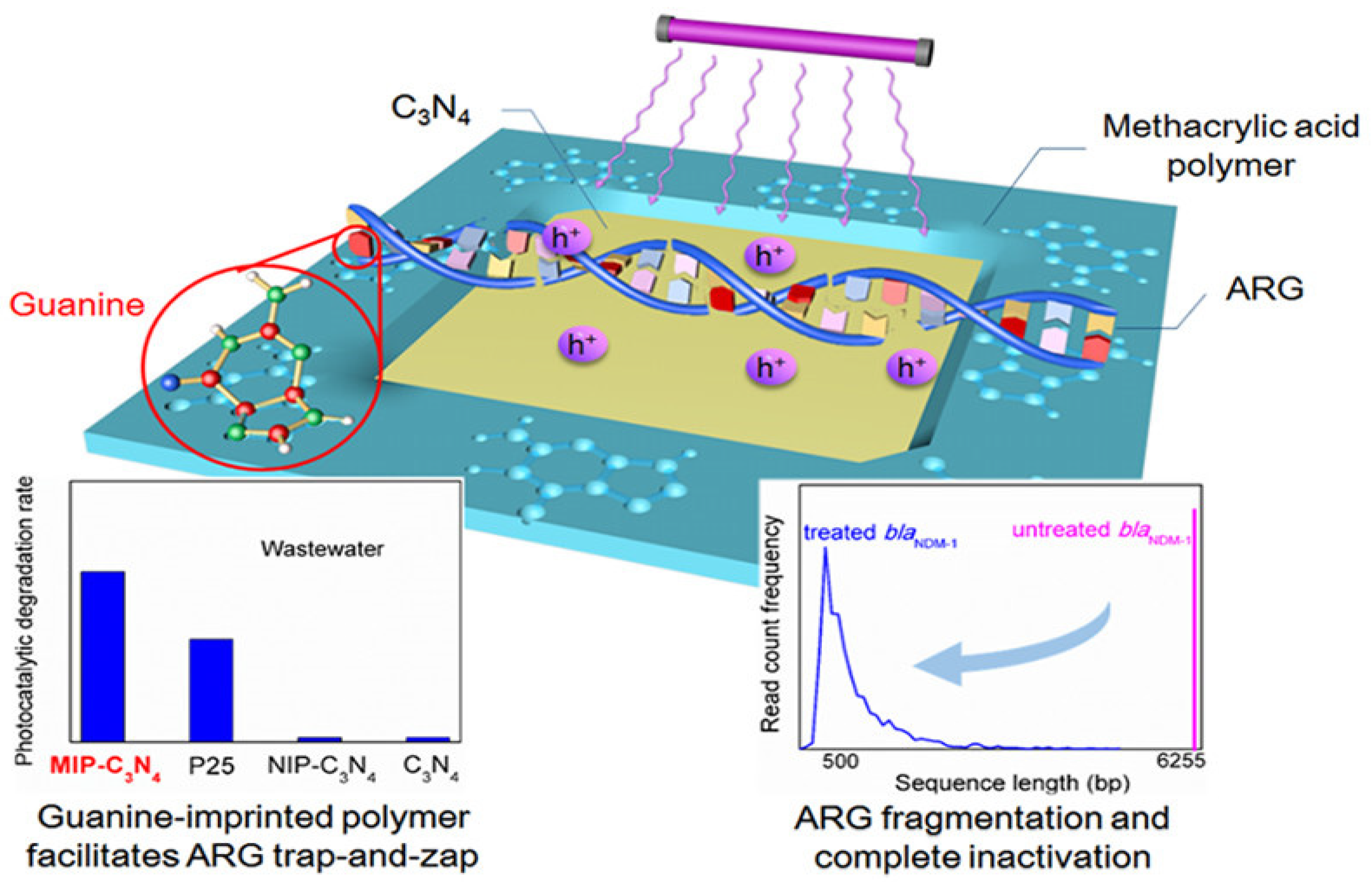
- Yuan, Q.; Zhang, D.; Yu, P.; Sun, R.; Javed, H.; Wu, G.; Alvarez, P.J.J. Selective Adsorption and Photocatalytic Degradation of Extracellular Antibiotic Resistance Genes by Molecularly-Imprinted Graphitic Carbon Nitride. Environ. Sci. Technol. 2020, 54, 4621–4630. [Google Scholar] [CrossRef] [PubMed]
- Kumar, A.; Majithia, P.; Choudhary, P.; Mabbett, I.; Kuehnel, M.F.; Pitchaimuthu, S.; Krishnan, V. MXene coupled graphitic carbon nitride nanosheets based plasmonic photocatalysts for removal of pharmaceutical pollutant. Chemosphere 2022, 308, 136297. [Google Scholar] [CrossRef]
- Park, S.; Kim, S.; Yea, Y.; Saravanakumar, K.; Lee, E.; Yoon, Y.; Park, C.M. Adsorptive and photocatalytic performance of cobalt-doped ZnTiO3/Ti3C2Tx MXene nanohybrids towards tetracycline: Kinetics and mechanistic insight. J. Hazard. Mater. 2023, 443, 130165. [Google Scholar] [CrossRef]
- Lin, C.; Song, X.; Ye, W.; Liu, T.; Rong, M.; Niu, L. Recent Progress in Optical Sensors Based on MXenes Quantum Dots and MXenes Nanosheets. J. Anal. Test. 2024, 8, 95–113. [Google Scholar] [CrossRef]
- Qi, N.; Yi, Y.X.; Tang, Y.C.; Liu, X.Y.; Yuan, Y.T.; He, Z.P.; Shi, X.T.; Fang, Y.Y.; He, Y.Z.; Wei, S.P. Constructing a novel Bi2MoO6/TiO2/Ti3C2 composite with efficient carrier separation for excellent photocatalytic purification of TC. J. Alloys Compd. 2025, 1010, 177575. [Google Scholar] [CrossRef]
- Lee, D.E.; Moru, S.; Jo, W.K.; Tonda, S. Dual-cocatalyst-promoted photocatalytic treatment of persistent waterborne pollutants via in situ MXene-derived TiO2/Ti3C2 hybrids with plasmonic Ag nanoparticles. Sep. Purif. Technol. 2025, 352, 128261. [Google Scholar] [CrossRef]
- Liu, C.; Yu, H.; Xiao, W.; Gu, C.X.; Yu, J.W.; Li, J.M.; Song, J.; Song, Y.X.; Sun, T.; Zou, Z.G.; et al. Tuning interfacial charge transfer for efficient photodegradation of tetracycline hydrochloride over Ti3C2/Bi12O17Cl2 Schottky heterojunction and theoretical calculations. Appl. Surf. Sci. 2025, 682, 161717. [Google Scholar] [CrossRef]
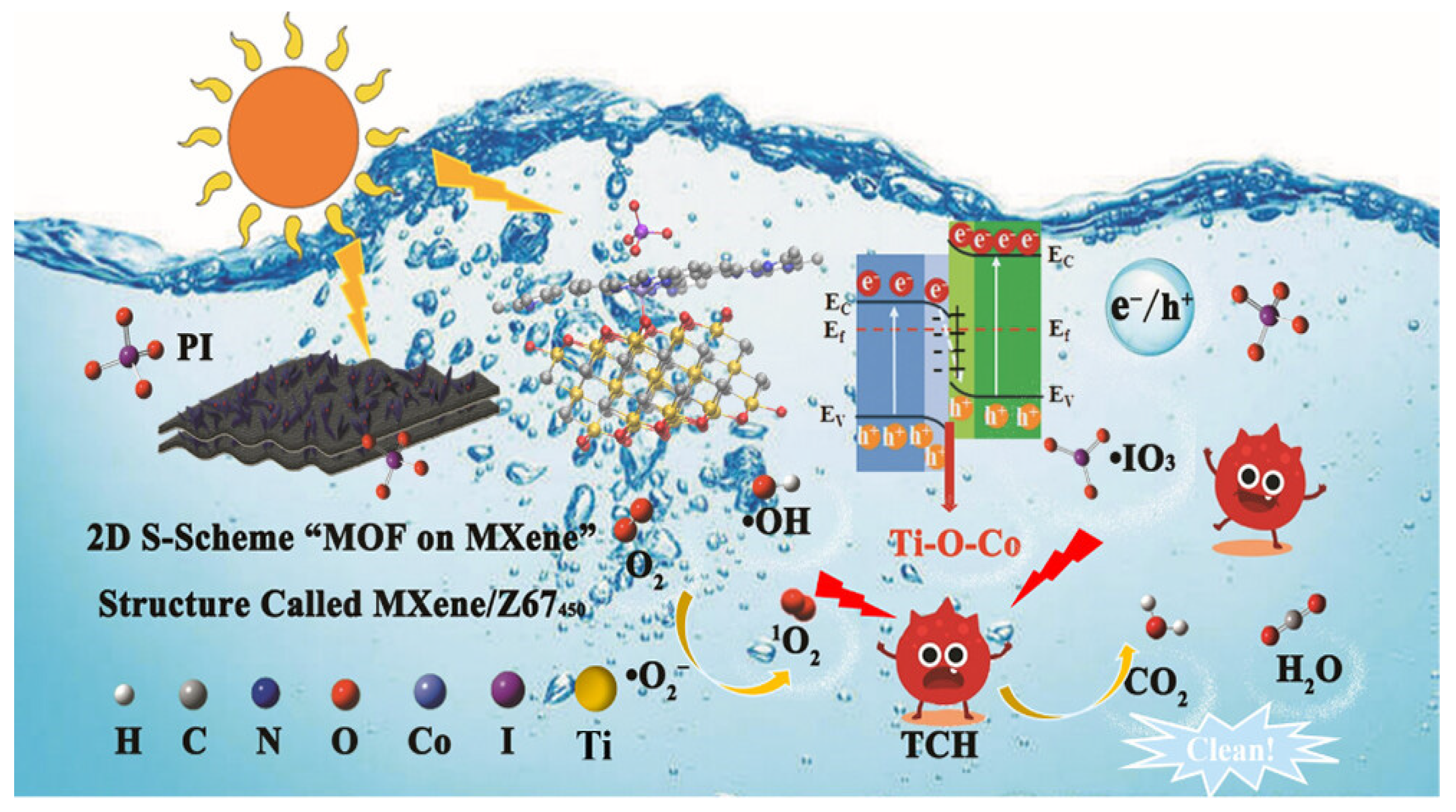
- Chen, Y.; Qiu, Y.; Chen, T.; Wang, H. An S-Scheme MOF-on-MXene Heterostructure for Enhanced Photocatalytic Periodate Activation. ACS Nano 2025, 19, 6588–6600. [Google Scholar] [CrossRef] [PubMed]
- Zhang, J.; Shao, C.; Lei, Z.; Li, Y.C.; Bai, H.N.; Zhang, L.H.; Ren, G.Q.; Wang, X.Y. Treatment of antibiotics in water by SO3 H-modified Ti3C2 Mxene photocatalytic collaboration with g-C3N4. J. Mater. Sci. Technol. 2024, 194, 124–137. [Google Scholar] [CrossRef]
- Hosseini, S.F.; Dorraji, M.S.S.; Mohajer, S.; Saeedi, S.N.; Kianfar, M.; Koshelev, A.V.; Arkharova, N.A.; Karimov, D.N. Synergistic photothermal conversion and visible-light photodegradation of antibiotic in S-type TiO2 derived Ti3C2-MXene loaded on NaYF4: Tm3+, Er3+, Yb3+ @BiOI. J. Sci-Adv. Mater. Dev. 2025, 10, 100851. [Google Scholar] [CrossRef]
- Wu, Y.; Li, X.M.; Yang, Q.; Wang, D.B.; Yao, F.B.; Cao, J.; Chen, Z.; Huang, X.D.; Yang, Y.; Li, X.P. Mxene-modulated dual-heterojunction generation on a metal-organic framework (MOF) via surface constitution reconstruction for enhanced photocatalytic activity. Chem. Eng. J. 2020, 390, 124519. [Google Scholar] [CrossRef]
- Wu, K.; Song, S.J.; Wu, H.D.; Guo, J.; Zhang, L.F. Facile synthesis of Bi2WO6/C3N4/Ti3C2 composite as Z-scheme photocatalyst for efficient ciprofloxacin degradation and H2 production. Appl. Catal. A Gen. 2020, 608, 117869. [Google Scholar] [CrossRef]
- Fang, Y.; Cao, Y.; Chen, Q.L. Synthesis of an Ag2WO4/Ti3C2 Schottky composite by electrostatic traction and its photocatalytic activity. Ceram. Int. 2019, 45, 22298–22307. [Google Scholar] [CrossRef]
- Alshaikh, H.; El-Hout, S.I. CuMn2O4-BaTiO3 nanocomposites: Efficient photocatalysts for visible-light-driven degradation of tetracycline. Mater. Res. Bull. 2025, 185, 113316. [Google Scholar] [CrossRef]
- Ghandour, R.; Ali, A.B.M.; Kadhum, A.A.H.; Diab, M.A.; El-Sabban, H.A.; Shah, M.M.; Nagar, H. Novel extruded palm tree wood-derived activated carbon-based SrTiO3 for wastewater treatment in continuous system: Evaluation of synthesis condition, LHSV, and pH. Inorg. Chem. Commun. 2025, 173, 113898. [Google Scholar] [CrossRef]
- Liu, J.; Lin, H.; He, Y.; Dong, Y.; Gueret Yadiberet Menzembere, E.R. Novel CoS2/MoS2@Zeolite with excellent adsorption and photocatalytic performance for tetracycline removal in simulated wastewater. J. Clean. Prod. 2020, 260, 121047. [Google Scholar] [CrossRef]
- Li, Z.J.; Chen, S.; Li, Z.H.; Sun, J.L.; Yang, J.H.; Wei, J.W.; Wang, S.F.; Song, H.N.; Hou, Y.P. Visible light driven antibiotics degradation using S-scheme Bi2WO6/CoIn2S4 heterojunction: Mechanism, degradation pathways and toxicity assessment. Chemosphere 2022, 303, 135113. [Google Scholar] [CrossRef]
- Cao, S.H.; Zhang, Y.; He, N.N.; Wang, J.; Chen, H.; Jiang, F. Metal-free 2D/2D heterojunction of covalent triazine-based frameworks/graphitic carbon nitride with enhanced interfacial charge separation for highly efficient photocatalytic elimination of antibiotic pollutants. J. Hazard. Mater. 2020, 391, 122204. [Google Scholar] [CrossRef]
- Dong, Y.Y.; Hu, Y.R.; Chen, J.H. Au-modified In2O3 nanoparticles for photocatalytic degradation of diverse antibiotics. J. Photochem. Photobiol. A Chem. 2025, 466, 116366. [Google Scholar] [CrossRef]
- Wang, L.Y.; Shi, Q.Q.; Sun, Y.X.; Xiong, Q.; Ping, G.C. Plasmonic induced Biochar@WO3/Cu composites for boosted photocatalytic antibiotic removal. Sustain. Mater. Technol. 2025, 44, e01376. [Google Scholar] [CrossRef]
- Chin, J.Y.; Ahmad, A.L.; Low, S.C. Evolution of photocatalytic membrane for antibiotics degradation: Perspectives and insights for sustainable environmental remediation. J. Water Process. Eng. 2023, 51, 103342. [Google Scholar] [CrossRef]
- da Silva, E.S.; Starling, M.C.V.M.; Amorim, C.C. LED-irradiated photo-Fenton process on pollutant removal: Outcomes, trends, and limitations. Environ. Sci. Pollut. R 2025, 32, 10569–10591. [Google Scholar] [CrossRef]
- Kar, S.; Pal, T.; Ghosh, S. Reduced Graphene Oxide–SnSe Nanocomposite Photocatalyst with High Apparent Quantum Yield for the Photodegradation of Norfloxacin. ACS Appl. Nano Mater. 2024, 7, 6516–6524. [Google Scholar] [CrossRef]
- Almansba, A.; Kane, A.; Nasrallah, N.; Wilson, J.M.; Maachi, R.; Lamaa, L.; Peruchon, L.; Brochier, C.; Amrane, A.; Assadi, A.A. An engineering approach towards the design of an innovative compact photo-reactor for antibiotic removal in the frame of laboratory and pilot-plant scale. J. Photochem. Photobiol. A Chem. 2021, 418, 113445. [Google Scholar] [CrossRef]
- Franzen Ramos, L.; da Silva, S.W.; Schneider, D.E.; Rodrigues, M.A.S.; Bernardes, A.M. Mineralization of erythromycin by UV-based and electro-oxidation processes. J. Water Process. Eng. 2020, 33, 101039. [Google Scholar] [CrossRef]
- Liu, H.; Zhang, H.; Dong, X.; Wu, C.; Lichtfouse, E. Removal of antibiotics from black water by a membrane filtration-visible light photocatalytic system. J. Water Process. Eng. 2023, 53, 103605. [Google Scholar] [CrossRef]
- Krishnan, S.A.G.; Abinaya, S.; Arthanareeswaran, G.; Govindaraju, S.; Yun, K. Surface-constructing of visible-light Bi2WO6/CeO2 nanophotocatalyst grafted PVDF membrane for degradation of tetracycline and humic acid. J. Hazard. Mater. 2022, 421, 126747. [Google Scholar] [CrossRef] [PubMed]
- Zeng, G.; He, Z.; Wan, T.; Wang, T.; Yang, Z.; Liu, Y.; Lin, Q.; Wang, Y.; Sengupta, A.; Pu, S. A self-cleaning photocatalytic composite membrane based on g-C3N4@MXene nanosheets for the removal of dyes and antibiotics from wastewater. Sep. Purif. Technol. 2022, 292, 121037. [Google Scholar] [CrossRef]
- Sun, S.; Yao, H.; Fu, W.; Xue, S.; Zhang, W. Enhanced degradation of antibiotics by photo-fenton reactive membrane filtration. J. Hazard. Mater. 2020, 386, 121955. [Google Scholar] [CrossRef] [PubMed]
- Galloni, M.G.; Falletta, E.; Mahdi, M.; Cerrato, G.; Giordana, A.; Boffito, D.C.; Bianchi, C.L. An Innovative Sunlight-Driven Device for Photocatalytic Drugs Degradation: From laboratory- to real-Scale Application. A First Step Toward Vulnerable Communities. Adv. Sustain. Syst. 2024, 8, 2300565. [Google Scholar] [CrossRef]
- Han, J.; He, S.; Lichtfouse, E. Waves of pharmaceutical waste. Environ. Chem. Lett. 2023, 21, 1251–1255. [Google Scholar] [CrossRef]
- Liu, K.H.; Ni, W.H.; Zhang, Q.Y.; Huang, X.; Luo, T.; Huang, J.; Zhang, H.; Zhang, Y.; Peng, F.M. Based on TEST toxicity prediction and machine learning to forecast toxicity dynamics in the photocatalytic degradation of tetracycline. Phys. Chem. Chem. Phys. 2024, 26, 28266–28273. [Google Scholar] [CrossRef]
- Sethi, S.; Dhir, A.; Arora, V. Intervention of artificial intelligence to predict the degradation and mineralization of amoxicillin through photocatalytic route using nickel phosphide-titanium dioxide catalyst. React. Kinet. Mech. Cat. 2023, 136, 549–565. [Google Scholar] [CrossRef]
- Wang, L.; Yang, T.; Wei, M.; Guan, R.; Wei, W.; Jiang, J. Machine learning and DFT dual-guidance of carbon dots implanted SrTiO3 hollow nanosphere for efficient all-pH-value photocatalysis. J. Mater. Sci. Technol. 2025, 217, 169–181. [Google Scholar] [CrossRef]
- Xue, L.; Jing, R.Y.; Zhong, N.Y.; Nie, X.Y.; Du, Y.T.; Luo, J.S.; Huang, K.M. Machine learning to guide the use of plasma technology for antibiotic degradation. J. Hazard. Mater. 2024, 480, 135787. [Google Scholar] [CrossRef] [PubMed]
- Jiang, S.; Xu, W.; Xia, Q.; Yi, M.; Zhou, Y.; Shang, J.; Cheng, X. Application of machine learning in the study of cobalt-based oxide catalysts for antibiotic degradation: An innovative reverse synthesis strategy. J. Hazard. Mater. 2024, 471, 134309. [Google Scholar] [CrossRef] [PubMed]
- Xu, K.; Wang, L.; Song, J.; Guo, H.; Zhang, Q. Photocatalyst performance of Bi4O5I2/BCNQDs hydrogel in floating photocatalysis device: Influence of external environmental conditions. J. Water Process. Eng. 2024, 68, 106429. [Google Scholar] [CrossRef]
- Zhang, X.; Wei, B.; Cheng, Y.; Xu, Y.; Song, M.; Tang, L.; Jin, J.; Liu, X.; Lu, Z. Machine Learning Assisted Imprinted Ag@PANI/CoFe2O4/C Heterojunction with Simultaneous Improvement of Selectivity and Activity for Antibiotic Photodegradation. Water Air Soil Poll. 2024, 235, 707. [Google Scholar] [CrossRef]
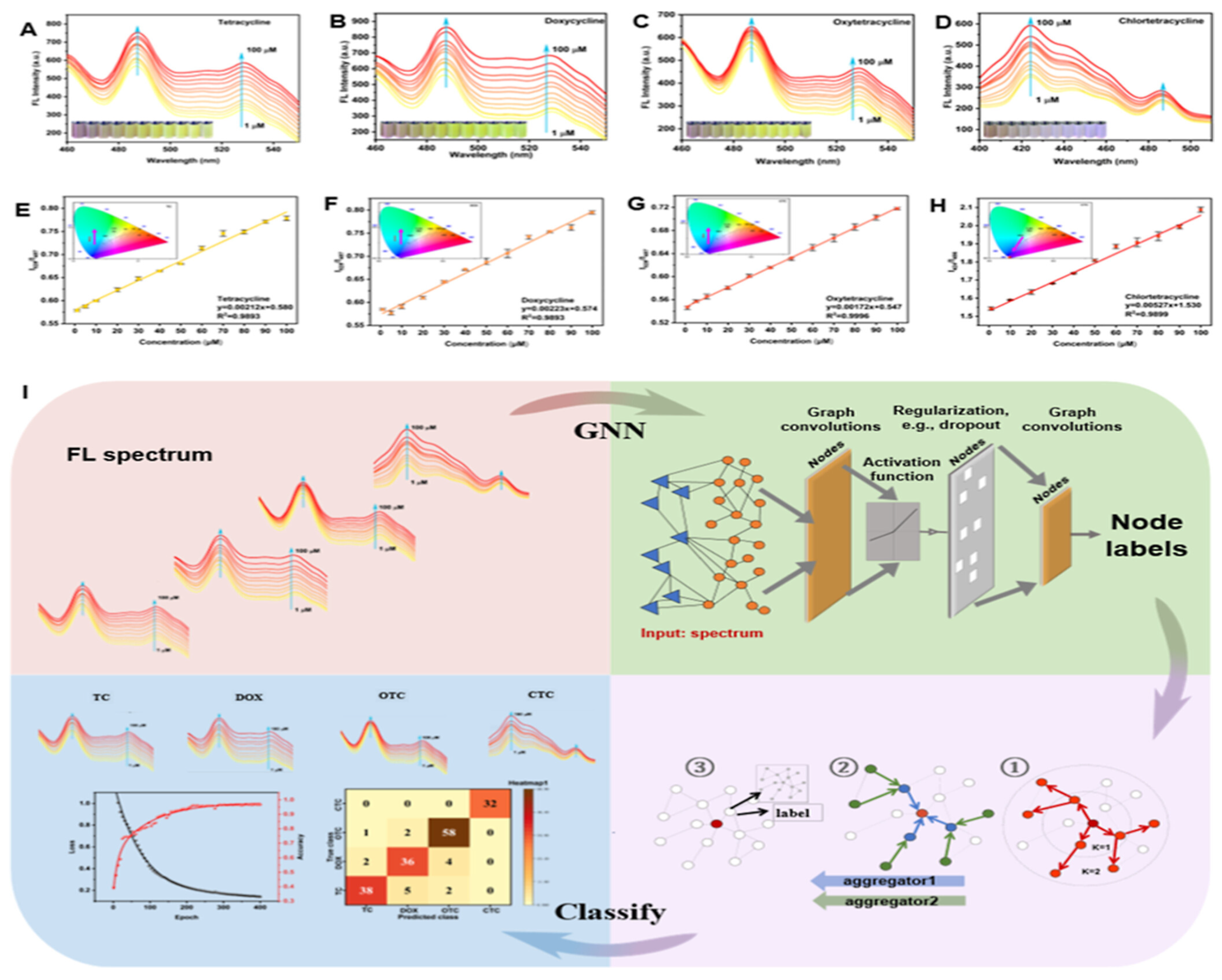
- Zhuo, Y.; Chen, X.; Luo, J.; Huang, Z.; Han, F.; Liu, F.; Zheng, F.; Li, S. A Closed-Loop Environmental Health Management Platform: A Multifunctional MgFe2O4 Nanoparticle Enabling AI-Enhanced Detection, Bioimaging, and Degradation of Tetracycline Antibiotics. Anal. Chem. 2025, 97, 13432–13441. [Google Scholar] [CrossRef]
- Gao, Y.; Saedi, Z.; Shi, H.; Zeng, B.; Zhang, B.; Zhang, X. Machine Learning-Assisted Optimization of Microbubble-Enhanced Cold Plasma Activation for Water Treatment. ACS EST Water 2024, 4, 735–750. [Google Scholar] [CrossRef]





| Type | Compounds | Molecular Formula | Molecular Mass (g/mol) | Structure | Melting Point (°C) | pKa Values | Log Kow |
|---|---|---|---|---|---|---|---|
| Tetracyclines (TCs) | Tetracycline (TC) | C22H24N2O8 | 444.43 | 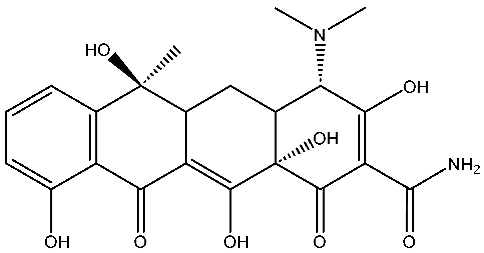 | 5–170 | 3.27; 6; 9.612 | −1.3 |
| Oxytetracycline (OTC) | C22H24N2O9 | 460.43 | 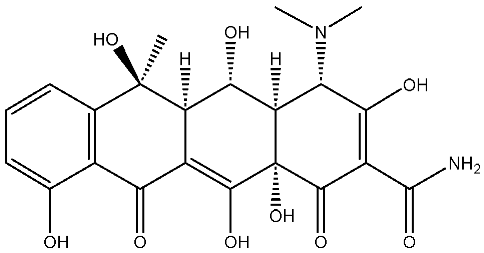 | 184–185 | 3.53; 7.25; 9.58 | −0.9 | |
| Doxycycline (DOX) | C21H24N2O8 | 1025.89 |  | 201 | 30.2; 7.97; 9.15 | −0.002 | |
| Chlortetracycline (CTC) | C22H23ClNO28 | 478.11 |  | 210–215 | 7.44 | −0.62 | |
| Sulfonamides (SAs) | Sulfamethoxazole (SMX) | C10H11N3O3S | 253.28 |  | 167 | 1.4; 5.8 | 0.89 |
| Sulfamerazine (SMX) | C11H12N4O2S | 264.30 |  | 236 | 2.24; 6.92 | 1.41 | |
| Sulfadiazine (SDZ) | C10H10N4O2S | 250.28 |  | 255.5 | 6.36 | −0.0314 | |
| Quinolones (FQs) | Ciprofloxacin (CIP) | C17H18FN3O3 | 331.34 |  | 225–257 | 6.09; 8.74 | 0.28 |
| Norfloxacin (NOR) | C16H18FN3O3 | 319.33 | 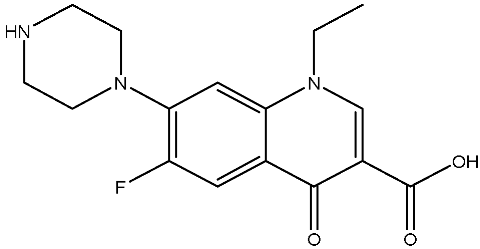 | 227–228 | 6.26; 8.85 | −1.03 | |
| Enrofloxacin (ENR) | C21H24FN3O4 | 359.39 |  | 219–221 | 2.7–3.9 | - | |
| Ofloxacin (OFLX) | C18H20FN3O4 | 361.37 | 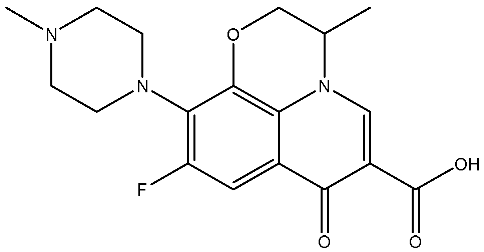 | 254 | 5.77; 8.44 | −0.39 | |
| Levofloxacin (LEV) | C18H20FN3O4 | 361.37 |  | 225–227 | 6.02; 8.05 | −0.39 | |
| β-lactams | Penicillin G (PEN) | C16H18N2O4S | 334.39 |  | 82–83 | 2.74 | - |
| Amoxicillin (AMX) | C16H19N3O5S | 365.40 |  | 140 | 3.37; 8.96 | 0.87 |
| Catalyst | Targets | Antibiotic Dosage | Catalyst Dosage | Degradation Efficiency | Light Source | Mian Active Species | Recycle | Ref. |
|---|---|---|---|---|---|---|---|---|
| ACT-4 | CEF | 100 mg/L | 1 g/L | 99.6% within 240 min | vis | •OH, | 5 | Abdullah et al. [43] |
| HS-CuFe2O4-σ | CIP | 10 mg/L | 0.5 g/L | ~100% within 30 min | vis | •OH, HO2•/ | 5 | Ding et al. [40] |
| Cu2O/Bi/Bi2MoO6 | SDZ | 10 mg/L | N.P. | 98.6% SDZ within 100 min | vis | h+, •OH, , e− | 5 | Xu et al. [41] |
| SiO2@Fe2O3@TiO2 | TC, ENR | 10 mg/L (TC), 5 mg/L (ENR) | 0.2 g/L | 100% TC within 140 min, 100% ENR within 80 min | Natural Sunlight | h+, | 5 | Zhang et al. [42] |
| SA-Fe@ TiO2 | SMX | 10 mg/L | 0.3 g/L | 94.59% within 30 min | Simulated solar | h+, •OH, | 4 | Wang et al. [44] |
| TiO2@Fe3O4@C–NF | TMP, SGU | 5 mg/L | 0.67 g/L | 80–100% within 8–125 min | UV | h+, •OH | 7 | Yilmaz et al. [46] |
| CeO2NRs | TC | 20 mg/L | 0.4 g/L | 89.35% within 90 min | vis | h+, | 1 | Lu et al. [47] |
| Fc@rGO-ZnO | SMX, CIP | 20 mg/L | 0.075 g/L | 92.55%SMX/95.01% CIP within 180 min | UV | •OH, | 3 | Roy et al. [48] |
| N-ZnO/C@Bi2MoO6 | SMX | 10 mg/L | 1.25 g/L | 97.3% within 60 min | Vis | h+, •OH, | 4 | Wang et al. [49] |
| Catalyst | Targets | Antibiotic Dosage | Catalyst Dosage | Degradation Efficiency | Light Source | Mian Active Species | Recycle | Ref. |
|---|---|---|---|---|---|---|---|---|
| CZS/CDs/BWO | TC, LEV, NOR, OTC, ENR | 20 mg/L | 10 g/60 L | TC: 85.2% (40 min); others: 38.9–81.6% | vis | h+, •OH, | 5 | Cai et al. [52] |
| Au@TiO2/Bi2WO6 | SMX, TC | 15 mg/L | 0.5 g/L | 96.9% SMX/ 95.0% TC within 75 min | vis | h+, •OH, | 4 | Jin et al. [53] |
| TaON/Bi2WO6 | TC, LEV | 20 mg/L | 0.2 g/L | 93.2% TC/ ~100% LEV within 50–60 min | vis | h+, •OH, | 5 | Li et al. [54] |
| VO-rich BWO | TC | 20 mg/L | 0.3 g/L | 95.12% within 100 min | vis | 5 | Gao et al. [56] | |
| αβ-Bi2O3/NiAl-LDH | TC, NOR, CIP | 15 mg/L (TC); 10 mg/L (CIP, NOR) | 1 g/L | 96.17% (TC, 120 min); 94.81% (NOR, 180 min); 48.48% (CIP, 180 min) | vis | h+, •OH, | 5 | Sun et al. [57] |
| Nd0.1Bi0.9VO4-δ | CPX | 10 mg/L | 0.3 g/L | 94.3% within 60 min | vis | h+, •OH, , ClO2 | 5 | Su et al. [58] |
| rGO/Bi4O5Br2 | CIP, NOR, TC | 20 mg/L NOR/TC; 10 mg/L CIP | 0.5 g/L | 80.7% NOR/ 92.5% CIP/ 95.2% TC within 60 min | vis | h+, | 4 | Xu et al. [59] |
| BiVO4/O-g-C3N4 | TC | 0.3 g/L | 0.1 g/L | 99.8% within 60 min | vis | 1O2, h+, •OH, | 4 | Bao et al. [60] |
| (Bi)BiOBr/rGO | TC | 20 mg/L | 1 g/L | >98% within 20 min | vis | h+, •OH | 5 | Jiang et al. [10] |
| VO-Bi2CrO6/g–C3N4 | LVFX | 15 mg/L | 0.9 g/L | 92.5% within 120 min | LED | h+, •OH, | 5 | Hasanvandian et al. [61] |
| CQDs/BiOCl/CEM | TC | 10 mg/L | 0.5 g/L | ~98% total removal (30 min dark adsorption + 30 min vis degradation) | vis | h+, •OH, | 4 | Zhou et al. [62] |
| PLS-BiVO4/PANI/Ag | FQs | 0.025 mmol/L | 0.67 g/L | 92% FLE/, 95% NOR/95% ENR/, 96% OFL/98% CIP within 120 min | vis | h+ | 5 | Gao et al. [63] |
| Bi2Sn2O7-C3N4/Y | TC | 20 mg/L | 1 g/L | 80.41% within 90 min | Solar light | h+, •OH, | 4 | Heidari, et al. [64] |
| BiOBr/CsxWO3@SiO2 | TC | 20 mg/L | 0.5 g/L | 93.8% within 60 min | vis | h+, •OH, | 4 | Li et al. [65] |
| Catalyst | Targets | Antibiotic Dosage | Catalyst Dosage | Degradation Efficiency | Light Source | Mian Active Species | Recycle | Ref. |
|---|---|---|---|---|---|---|---|---|
| Ag3PO4/PDIsm | TCH | 20 mg/L | 0.4 g/L | 100% within 60 min | vis | h+, | 4 | Cai et al. [68] |
| Ag3PO4/NiAl-LDH | TCH | 20 mg/L | 1 g/L | 92.8% TCH within 60 min | vis | h+, •OH, | 4 | Fan et al. [69] |
| Ag/AgBr/AgI@SiO2 | TC | 20 mg/L | 0.3 g/L | 79.5% within 30 min | vis | 5 | Ma et al. [70] | |
| Ag Ag3PO4-VAg | SMX | 20 mg/L | 10 mg | 100% within 15 min | vis | •OH, | 4 | Liu et al. [71] |
| C3N5/Ag3PO4 | LEV | 11.1 mg/L | 0.2 g/L | 83% LEV within 10–20 min | vis | h+, | 3 | Liu et al. [73] |
| Fe3O4@mTiO2@Ag@GO | FQs | 10 g/L | 1 g/L | 91% NOR within 180 min | UV | •OH, | 5 | Liao et al. [74] |
| Ag3PO4/CNT sponge | TC | 10 mg/L | 1 g/L | 90% within 60 min | vis | •OH, | 5 | Jin et al. [75] |
| (Clay/TiO2/Ag0(NPs) | TC, SMX | 10.0 mg/L | N.P. | 72.4% TC/58.3% SMX within 60 min | vis, UV | •OH | 6 | Vanlalhmingmawia et al. [4] |
| Ag/Ag2O/C/P/TiO2 | CIP | 10 mg/L | 0.15 g/L | 89.10% within 120 min | UV | •OH, | N.P. | Negoescu et al. [76] |
| Catalyst | Targets | Antibiotic Dosage | Catalyst Dosage | Degradation Efficiency | Light Source | Mian Active Species | Recycle | Ref. |
|---|---|---|---|---|---|---|---|---|
| Bi2MoO6/UiO66-NH2 | OFL, CIP | 10 mg/L | 0.2 g/L | 100.0% OFL/96.0% CLP within 90 min | vis | h+, , •OH | 4 | Su et al. [81] |
| NH2-MIL-125(Ti)/Ti3C2 QDs/ZnIn2S4 | TC, SMX | 20 mg/L TC; 30 mg/L SMX | 0.3 g/L | 96% TC within 50 min; 98% SMX within 40 min | vis | 3 | Liu et al. [82] | |
| 0.8CuUiO-66 | CIP | 30 mg/L | 0.3 g/L | 93% within 60 min | vis | h+, | 5 | Yin et al. [83] |
| SnS2@UiO-66 | TC | 20 mg/L | 0.4 g/L | 90.0% within 75 min | vis | h+, | 3 | Cao et al. [77] |
| MIL-101(Fe)/Bi2WO6 | TC | 20 mg/L | 0.2 g/L | 82.8% within 60 min | vis | h+, , •OH | 5 | Li et al. [80] |
| Co-ZIF-C3N5 (10%) | CTC | 30 mg/L | 0.6 g/L | 100% within 6 min | vis | •OH, SO4−, , 1O2, h+ | 5 | Du et al. [84] |
| CFC/UiO-66-NH2/BiOBr | LVFX, CIP | 10 mg/L | 0.16 g | 92.2% LVFX within 120 min; 86.4% CIP within 120 min | vis | h+, | 4 | Yu et al. [87] |
| ZnO@ZIF-8 | TC | 20 mg/L | 0.5 g/L | 91% within 50 min | vis | h+, , H2O2 | 5 | Zhang et al. [88] |
| 3D-WO3-UiO-66@rGO | SMX | 20 mg/L | N.P. | 90.39% within 60 min | UV | h+, | 10 | Huong et al. [90] |
| ZnFe2O4/Fe2O3 | CIP | 10 mg/L | 0.5 g/L | 96.5% within 60 min | vis | , •OH | 5 | Zhang et al. [91] |
| ZnO/ZnFe2O4 | TCH | 100 mg/L | 0.4 g/L | 86.3% within 75 min | vis | h+, | 5 | Suo et al. [92] |
| ZnS/ZnIn2S4 | TCH, TC, DOXH, OTC, CTCH | 20 mg/L | 0.18 g/L | >90% TCH within 60 min; >95% for other TCs within 120 min | Simulated solar | h+, , •OH | 4 | Li et al. [14] |
| Catalyst | Targets | Antibiotic Dosage | Catalyst Dosage | Degradation Efficiency | Light Source | Mian Active Species | Recycle | Ref. |
|---|---|---|---|---|---|---|---|---|
| Cu2O/RGO/BiVO4 | TC | 100 mg/L | 0.5 g/L | 96% within 180 min | vis | h+, , •OH | 5 | Shen et al. [96] |
| rGO-ZnS-CuS | OFL | 14.4 mg/L | 0.2 g/L | ~100% within 90 min | vis | •OH, | 5+ | Mahalingam et al. [97] |
| Ce5-CdS/N-rGO20 | TC | 20 mg/L | 0.25 g/L | 94.5% within 60 min | vis | h+, , •OH, 1O2 | 4 | Wang et al. [98] |
| BCT30 | TC | 50 mg/L | 0.2 g/L | 95% within 120 min | Simulated solar | h+, •OH | 5 | Zhang et al. [99] |
| CoFe-LDH@PBC800 | SMX | 20–100 μM | 0.05–0.5 g/L | 100% within 100 min | UV | h+, , •OH | 3 | Li et al. [100] |
| Ag@BC-rGO | RIF | 80 mg/L | 1–3 mg | N.P. | Scattered sunlight | •OH, | N.P. | Saikia et al. [101] |
| CaIn2S4-ZnO/Biochar | TCH | 50 mg/L | 1 g/L | >95% within 60 min | vis | •OH, | 6 | Khlifi et al. [102] |
| A-CN | TC | 20 mg/L | 0.05–0.4 g/L | 95% degradation, 88% mineralization within 60 min | vis | h+, | 4+ | Li et al. [103] |
| CMCN2 | TC | 20 mg/L | 0.6 g/L | 98% within 60 min | vis | h+, , •OH, 1O2 | 4 | Zhou et al. [104] |
| Mo/Nv-TCN | TC | 10 mg/L | 1 g/L | 94.45% within 60 min | vis | h+, , •OH, 1O2 | 4 | Zhang et al. [105] |
| CNNS/NH4V4O10 | CIP | 10 mg/L | 0.5 g/L | 92% within 100 min | Simulated sunlight | h+, , •OH, e− | 5 | Ma et al. [106] |
| 3B-PCN | CIP | 10 mg/L | 0.4 g/L | 87.56% within 60 min | vis | h+, •O, •OH | 5 | Zhang et al. [107] |
| Catalyst | Targets | Antibiotic Dosage | Catalyst Dosage | Degradation Efficiency | Light Source | Mian Active Species | Recycle | Ref. |
|---|---|---|---|---|---|---|---|---|
| Bi2MoO6/TiO2/Ti3C2 | TC | 10 mg/L | N.P. | 87.54% within 150 min | vis | 4 | Qi et al. [112] | |
| Ag/TiO2/Ti3C2 | SFM | N.P. | 0.1 g/50 mL | ~99% within 60 min | Simulated solar light | h+, •OH | 5 | Lee et al. [113] |
| Ti3C2/Bi12O17Cl2 | TCH | 20 mg/L | 0.3 g/L | >90% within 60 min | vis | •OH, | 3 | Liu et al. [114] |
| Ti3C2–SO3H/g-C3N4 | TC | 10 mg/L | 0.5 g/L | 75.42% within 120 min | vis | •OH, | 5 | Zhang et al. [116] |
| TiO2@Ti3C2/UCNPs@BiOI | TC | 40 mg/L | 0.25 g/L | 90% within 120 min | Scattered sunlight | h+, | 3 | Hosseini et al. [117] |
| Au/GCN/MXene | CEF | 5 × 10⁻⁵ M (~20 mg/L) | 20 g/50 L | 64.69% within 105 min | vis | h+, , •OH | 3 | Kumar et al. [109] |
| NH2-MIL-125(Ti)/TiO2/Ti3C2 | TC | N.P. | N.P. | 82.80% within 60 min | vis | h+, •OH | 4 | Wu et al. [118] |
| Bi2W6/C3N4/Ti3C2 | CIP | 10 mg/L | 0.15 g/L | 92% within 60 min | vis | h+, | 3 | Wu et al. [119] |
| Ag2WO4/Ti3C2 | TC, SFE | 20 mg/L | 1 g/L | 62.9% (TC)/88.6% (SFE) within 40 min | vis | h+, | 3 | Fang et al. [120] |
Disclaimer/Publisher’s Note: The statements, opinions and data contained in all publications are solely those of the individual author(s) and contributor(s) and not of MDPI and/or the editor(s). MDPI and/or the editor(s) disclaim responsibility for any injury to people or property resulting from any ideas, methods, instructions or products referred to in the content. |
© 2025 by the authors. Licensee MDPI, Basel, Switzerland. This article is an open access article distributed under the terms and conditions of the Creative Commons Attribution (CC BY) license.
Share and Cite
Liu, J.; Ruan, H.; Duan, P.; Shao, P.; Zhou, Y.; Wang, Y.; Chen, Y.; Yan, Z.; Liu, Y. Photocatalytic Degradation of Antibiotics Using Nanomaterials: Mechanisms, Applications, and Future Perspectives. Nanomaterials 2026, 16, 49. https://doi.org/10.3390/nano16010049
Liu J, Ruan H, Duan P, Shao P, Zhou Y, Wang Y, Chen Y, Yan Z, Liu Y. Photocatalytic Degradation of Antibiotics Using Nanomaterials: Mechanisms, Applications, and Future Perspectives. Nanomaterials. 2026; 16(1):49. https://doi.org/10.3390/nano16010049
Chicago/Turabian StyleLiu, Jianwei, Hongwei Ruan, Pengfei Duan, Peng Shao, Yang Zhou, Ying Wang, Yudi Chen, Zhiyong Yan, and Yang Liu. 2026. "Photocatalytic Degradation of Antibiotics Using Nanomaterials: Mechanisms, Applications, and Future Perspectives" Nanomaterials 16, no. 1: 49. https://doi.org/10.3390/nano16010049
APA StyleLiu, J., Ruan, H., Duan, P., Shao, P., Zhou, Y., Wang, Y., Chen, Y., Yan, Z., & Liu, Y. (2026). Photocatalytic Degradation of Antibiotics Using Nanomaterials: Mechanisms, Applications, and Future Perspectives. Nanomaterials, 16(1), 49. https://doi.org/10.3390/nano16010049