Skip Content
You are currently on the new version of our website. Access the old version .

Minerals

Minerals is an international, peer-reviewed, open access journal of natural mineral systems, mineral resources, mining, and mineral processing, and is published monthly online by MDPI.

Quartile Ranking JCR - Q2 (Mining and Mineral Processing | Mineralogy | Geochemistry and Geophysics)

All Articles (10,524)

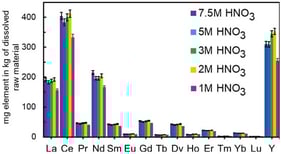
Separation of heavy rare earth elements from calcium and light rare earth elements extracted from Estonian phosphorite ore by acid leaching and subsequent liquid extraction has been conducted and analyzed. For initial leaching, nitric acid, hydrochloric acid, and orthophosphoric acid with different concentrations have been utilized. For the final separation of heavy rare earth elements, a liquid extraction with bis(2-ethylhexyl) phosphate (D2EHPA) or 2-ethylhexyl hydrogen-2-ethylhexyl phosphonate (P507) at different acidic concentrations has been applied. After leaching and extraction, all samples were characterized using the inductively coupled plasma mass spectrometry method (ICP-MS/MS). Optimal conditions for both extracting agents have been established. All rare earth elements + Y have been recovered in acid leaching, and heavy rare earth elements (elements Gd-Lu) have been selectively recovered by D2EHPA with 5 M nitric acid leaching and by P507 with 1 M nitric acid leaching. The presence of Sc has not been detected in Estonian phosphorite ore.

7 February 2026

REE concentrations (mg element in kg of dissolved raw material) of phosphorite ore nitric acid leaching at 95 ± 5 °C, with constant magnetic stirring at 300 rpm for 4 h. Leaching efficiency of Sc remains below the detection limit and is not presented here. Uncertainty of measurement is 2%.

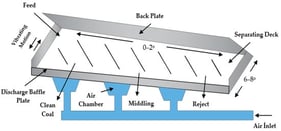
Increasing constraints related to water consumption and operational complexity have intensified interest in dry coal beneficiation as an alternative to conventional wet cleaning, particularly for low-calorific coals used in thermal power plants. In this study, the performance of a gravity-based dry beneficiation process using an air table was experimentally investigated for run-of-mine coals from the Soma Coal Basin, utilized in the Soma A Thermal Power Plant. The coal was crushed to −10 mm and classified into three size fractions, 5–10 mm, 3–5 mm, and 1–3 mm, before beneficiation. A pilot-scale air table with a capacity of 10 t/h was employed, and operating parameters including table inclination, airflow rate, and vibration frequency were optimized for each size fraction. Clean coal yields of 86.8–88.7% were achieved, while the ash content was reduced from 32 to 35% in the feed to 27.8%–29.7% in the clean coal (dry basis), remaining within the acceptable ash limits of the boiler design. The reject fractions exhibited high ash contents of approximately 71%–72%, indicating effective de-stoning and removal of high-density gangue minerals. Low and consistent Ep values (0.05–0.06) together with nearly constant cut-point densities (D50 ≈ 1.82%–1.83 g/cm3) demonstrated sharp and stable density-based separation. The dust fraction remained limited (1.4%–2.1%), confirming mechanically stable operation. The removal of approximately 10% of the feed as high-density reject was found to reduce coal milling energy demand and lower the energy consumption of ash handling and disposal systems. Overall, the results show that air table-based dry beneficiation enables water-free and energy-efficient pre-concentration of low-calorific coals, offering strong potential for application in water-scarce regions.

7 February 2026

Schematic of the FGX air table separator showing the adjustable table inclination in both the oscillation and transverse directions, along with the corresponding product outlets.

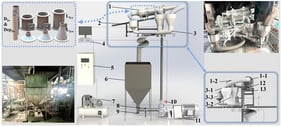
The Three-Product Dense Medium Cyclone (TPDMC) has been widely applied in the coal preparation industry, yet the adaptive optimization of its parameters based on feed characteristics remains under-researched. This study utilizes a semi-industrial experimental platform with a JX300/240 TPDMC to investigate the influence of pump frequency (PF) and four second-stage structural parameters—cylindrical section length (L2cy), overflow pipe insertion depth (Dep2o), overflow pipe diameter (D2o), and conical section length (L2co)—on the separation performance of three feed materials with distinct washability characteristics. Experiments conducted with density tracer particles revealed a distinct hydrodynamic coupling effect: PF and D2o were the only factors modulating inlet pressure (varying from 0.12 to 0.45 bar), which directly altered the clean coal yield. In contrast, L2cy, Dep2o, and L2co primarily influenced the second-stage internal flow field and concentration effect, thereby affecting the yield and ash content of middling coal (gangue). To quantify feed-specific sensitivities, a new index, Near-Gravity-Range Material (NGRM), was proposed. Results demonstrated that Sample-3 exhibited the highest sensitivity to parameter variations, with its middling coal yield variation reaching 41.25% due to its high NGRM of 71%. Furthermore, statistical analyses were conducted to quantify the influence of each parameter on the heavy product partition ratio across different density fractions. Based on these findings, the following targeted optimization strategies are proposed: (1) for feeds rich in the 1.40–1.50 RD range, increasing PF or decreasing D2o is recommended to enhance clean coal yield; (2) for materials dominated by the 1.7 ± 0.10 RD fraction, increasing D2o, PF, or L2cy maximizes middling coal recovery; and (3) for feeds high in the 1.90 ± 0.10 RD fraction, reducing Dep2o, PF, L2cy, or L2co effectively minimizes middling coal contamination by high-density particles.

7 February 2026

3D modeling diagram of the three-product dense medium cyclone (TPDMC) separation system. 1: TPDMC (1-1: First-stage cyclone; 1-2: Second-stage cyclone); 2: Cyclone support frame; 3: Collection tanks (3-1: First-stage overflow collection tank; 3-2: Second-stage overflow collection tank; 3-3: Second-stage underflow collection tank); 4: Industrial computer; 5: PLC control cabinet; 6: Mixing tank; 7: Air compressor; 8: Butterfly valve; 9: Discharge valve; 10: Electromagnetic flowmeter; 11: Slurry pump; 12: Pressure transmitter; and 13: Working suspension density sampling valve.

Shagamite, KFe11O17 (IMA 2020-091) was discovered in the ferrite zone of gehlenite hornfels from the Hatrurim Complex exposed near Mt. Ye’elim, Hatrurim Basin, Israel. The mineral occurs in outer zones of gehlenite rock blocks that were heterogeneously altered by high-temperature (>1200 °C) ferritization. Ferritization was induced by K-bearing fluids or melts, generated as a by-product of late combustion processes. Shagamite crystallized from a thin melt that formed on the rock surface during cooling to approximately 800–900 °C. It is mainly associated with minerals of the magnetoplumbite group like barioferrite, Sr-analog of barioferrite, and gorerite but also with magnetite, maghemite, harmunite, devilliersite and K(Sr,Ca)Fe23O36 hexaferrite. Shagamite is a modular compound with a β-alumina-type structure (P63/mmc, a = 5.9327 (5), c = 23.782 (3) Å, γ = 120°, V = 724.91 (13) Å3, Z = 2), and it is isostructural with diaoyudaoite, NaAl11O17, and kahlenbergite, KAl11O17. Its structure is also closely related, though non-isotypic, to those of the magnetoplumbite-group minerals. Shagamite is dark brown with a semi-metallic luster and forms platy crystals flattened on (001). Its mean empirical formula is: (K1.00Ca0.15Mn2+0.05Na0.04Rb0.01)Σ1.25(Fe10.36Mn2+0.15Al0.14Mg0.12Zn0.10Ni0.07Cu0.03Cr3+0.02Ti4+0.01)Σ11.00O17. The Vickers microhardness VHN25 = 507 kg/mm2 corresponds to a Mohs hardness of ~5. The calculated density, based on the empirical formula and unit-cell parameters, is 4.12 g·cm−3. The main bands in the Raman spectrum of shagamite occur at 685 and 715 cm−1 and are assigned to ν1(FeO4)5− tetrahedral vibrations.

6 February 2026

Ferritization zones (dark) in gehlenite hornfels at the type locality of shagamite near Mt. Ye’elim, Negev Desert, Israel. The white arrows indicate the ferritization zones.

News & Conferences

Issues

Open for Submission

Editor's Choice

Reprints of Collections

Large Igneous Provinces
Reprint

Large Igneous Provinces

Research Frontiers
Editors: Richard E. Ernst, Hafida El Bilali
Industrial Minerals Flotation
Reprint

Industrial Minerals Flotation

Fundamentals and Applications
Editors: Xuming Wang, Jan D. Miller

Get Alerted

Add your email address to receive forthcoming issues of this journal.

XFacebookLinkedIn
Minerals - ISSN 2075-163X