Skip Content
You are currently on the new version of our website. Access the old version .

Micromachines

Micromachines is a peer-reviewed, open access journal on the science and technology of small structures, devices and systems, published monthly online by MDPI.
The Chinese Society of Micro-Nano Technology (CSMNT) and AES Electrophoresis Society are affiliated with Micromachines and their members receive a discount on the article processing charges.
Indexed in PubMed | Quartile Ranking JCR - Q2 (Instruments and Instrumentation | Physics, Applied | Chemistry, Analytical)

All Articles (12,940)

In low-amplitude and low-frequency vibration environments, the energy harvesting efficiency of self-powered wireless sensor nodes is insufficient, limiting their long-term autonomous operation. To address this issue, a micro piezoelectric–electromagnetic hybrid energy harvester is designed, aiming to enhance energy capture efficiency through structural integration and parameter optimization. The study is conducted entirely through numerical simulations. A coaxial integrated architecture is adopted, combining a piezoelectric cantilever beam array with an electromagnetic induction module. The piezoelectric layer uses lead magnesium niobate–lead titanate (PMN-PT) solid solution material with a thickness of 0.2 mm. The electromagnetic module employs copper wire coils with a diameter of 0.08 mm, winding 1500–3000 turns, paired with N52-type neodymium–iron–boron (NdFeB) permanent magnets. To improve energy conversion efficiency, the optimization parameters include the length-to-thickness ratio of the cantilever beam, the mass of the tip mass, the number of coil turns, and the spacing of the permanent magnets. Each parameter is set at four levels for orthogonal experiments. A multi-physics coupling model is established using ANSYS Workbench 2023, covering structural dynamics, piezoelectric effects, and the electromagnetic induction module. The mesh size is set to 0.1 mm. The energy output characteristics are analyzed under vibration frequencies of 0.3–12 Hz and amplitudes of 0.2–1.0 mm. Simulation results show that the optimized hybrid harvester achieves 45% higher energy conversion efficiency than a single piezoelectric structure and 31% higher than a traditional separated hybrid structure within the 0.3–12 Hz low-frequency range. Under a 6 Hz frequency and 0.6 mm amplitude, the output power density reaches 3.5 mW/cm3, the peak open-circuit voltage is 4.1 V, and the peak short-circuit current is 1.3 mA. Under environmental conditions of 20–88% humidity and −15–65 °C temperature, the device maintains over 94% stability in energy output. After 1.2 million vibration cycles, structural integrity remains above 96%, and energy conversion efficiency decreases by no more than 5%. The proposed coaxial hybrid structure and multi-parameter orthogonal optimization method effectively enhance energy harvesting performance in low-amplitude, low-frequency environments. The simulation design parameters and analysis procedures provide a reference for the development of similar micro hybrid energy harvesters and support the performance optimization of self-powered wireless sensor nodes.

9 February 2026
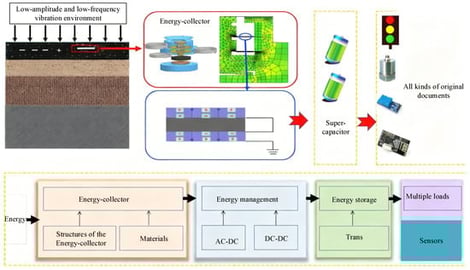
Structure of the energy harvester.

Zn(HQ)2-Phenanthroline/PEDOT:PSS Hybrid Film Engineering as a Promising Active Layer in Organic Photoconductive Devices

  • María Elena Sánchez Vergara,
  • Omar Jimenez Correa and
  • Monserrat Bizarro
  • + 2 authors

Zinc(II) bis(8-hydroxyquinolinate) (Zn(HQ)2) and 1,10-phenanthroline (phen) were combined to fabricate an organic semiconductor in a bulk heterojunction architecture and subsequently embedded in a poly 3,4-ethylene dioxythiophene–polystyrene sulfonate (PEDOT–PSS) matrix. The resulting Zn(HQ)2-phen/PEDOT–PSS was deposited as a film upon tin-oxide-coated glass and graphite-covered Tetra Pak (TP)-recycled substrates for the manufacture of organic photoconductive devices. The topographical and micromechanical characteristics of the hybrid films were assessed by atomic force microscopy, with an average roughness of 5.6 nm, maximum tensile strength of 7.95 MPa, and Knoop microhardness of 14.7. The fundamental energy gap (Eg) was determined employing the Kubelka–Munk function, with Eg of 3.5–3.8 eV. These results were complemented with a computational DFT molecular orbital analysis of the species involved in the hybrid semiconductor. The devices were electrically characterized under UV irradiation conditions, obtaining the current–voltage and power–voltage relationships. The maximum current in the TP–graphite device is 1.8 × 10⁻² A and 1.1 × 10⁻² A in the device on glass–ITO. Zn(HQ)2-phen/PEDOT–PSS film presents its own operating regimes relating to a photoconductor or flexible photoresistor. The power in the device on glass–ITO is 120 mW and 113 mW for shortwave and longwave, respectively, and in the device on TP–graphite, it is 198 mW and 139 mW.

8 February 2026

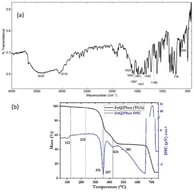
(a) IR spectrum and (b) TGA and DSC curves of the dispersed heterojunction Zn(HQ)2-phen BHJ.

A Field-Driven Growth Model for Uniform Thin-Film Growth

  • Helena Cristina Vasconcelos,
  • Telmo Eleutério and
  • Maria Meirelles

Externally applied electric fields are widely employed during thin-film deposition to improve film uniformity, texture and densification. Despite extensive experimental evidence, the physical mechanisms by which such fields influence nucleation, surface diffusion, island coalescence and interface stability remain theoretically fragmented. Classical thin-film growth models assume a field-free energetic landscape and therefore provide limited predictive guidance for field-assisted manufacturing strategies. In this work, we introduce the Field-Driven Growth Model (FDGM), a unified theoretical framework that incorporates field–matter interactions directly into the free-energy functional governing thin-film growth. By explicitly accounting for effective dipolar coupling arising from field-induced polarization of surface species, predominantly quadratic in the field amplitude and consistent with linear-response polarization, the model consistently modifies the fundamental processes of nucleation, surface diffusion and coalescence. At the continuum scale, the FDGM predicts a field-induced stabilization mechanism that suppresses long-wavelength roughening modes and defines a field-controlled morphological crossover wavelength (field-controlled cutoff). The FDGM demonstrates that field-assisted nucleation bias, anisotropic surface diffusion, field-biased coalescence pathways and morphological stabilization are not independent phenomena, but multiscale manifestations of a single energy-minimization principle acting on a field-modified energy landscape. By providing analytical stability criteria and explicit links between external field parameters and morphological outcomes, the model establishes a predictive foundation for the manufacturing of thin films with improved uniformity in advanced thin-film-based devices. The framework is broadly applicable to deposition techniques such as sputtering, pulsed-laser deposition, chemical vapor deposition and atomic layer deposition.

6 February 2026

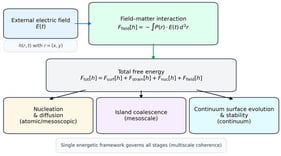
Overview of the Field-Driven Growth Model (FDGM): Schematic representation of the total free-energy functional, 


        F
      
      
        t
        o
        t


, highlighting the explicit incorporation of the electric external field through the field–matter interaction term, 


        F
      
      
        f
        i
        e
        l
        d


. The same energetic framework governs nucleation and diffusion, island coalescence and continuum surface evolution, ensuring multiscale coherence.

This work presents a millimeter-wave half-mode substrate integrated waveguide filter with high selectivity, using through glass via technology. Compared to a traditional printed circuit board, the benefits of high precision and integration afforded by the glass-based process enable the substrate-integrated waveguide to be employed at a higher operating frequency. A novel negative coupling structure is proposed for achieving a quasi-elliptic function response, and its coupling mechanism is investigated to explore the properties of the finite transmission zeros. The proposed coupling slots allow for flexible adjustment of the coupling between the half-mode substrate integrated waveguide cavities from positive to negative by modulating the corresponding geometrical parameters. As a prototype, a glass-based fourth-order bandpass filter is synthesized, simulated, fabricated and measured. Subsequently, good matching is captured, confirming the validity of the topology. The proposed glass-based negative coupling structure is promising for realizing substrate integrated waveguide filters with a quasi-elliptic function response, especially operating at millimeter-wave band.

6 February 2026

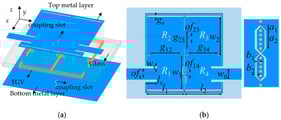
Schematic view of the proposed glass-based filter. (a) Exploded 3D view. (b) Top view.

News & Conferences

Issues

Open for Submission

Editor's Choice

Get Alerted

Add your email address to receive forthcoming issues of this journal.

XFacebookLinkedIn
Micromachines - ISSN 2072-666X