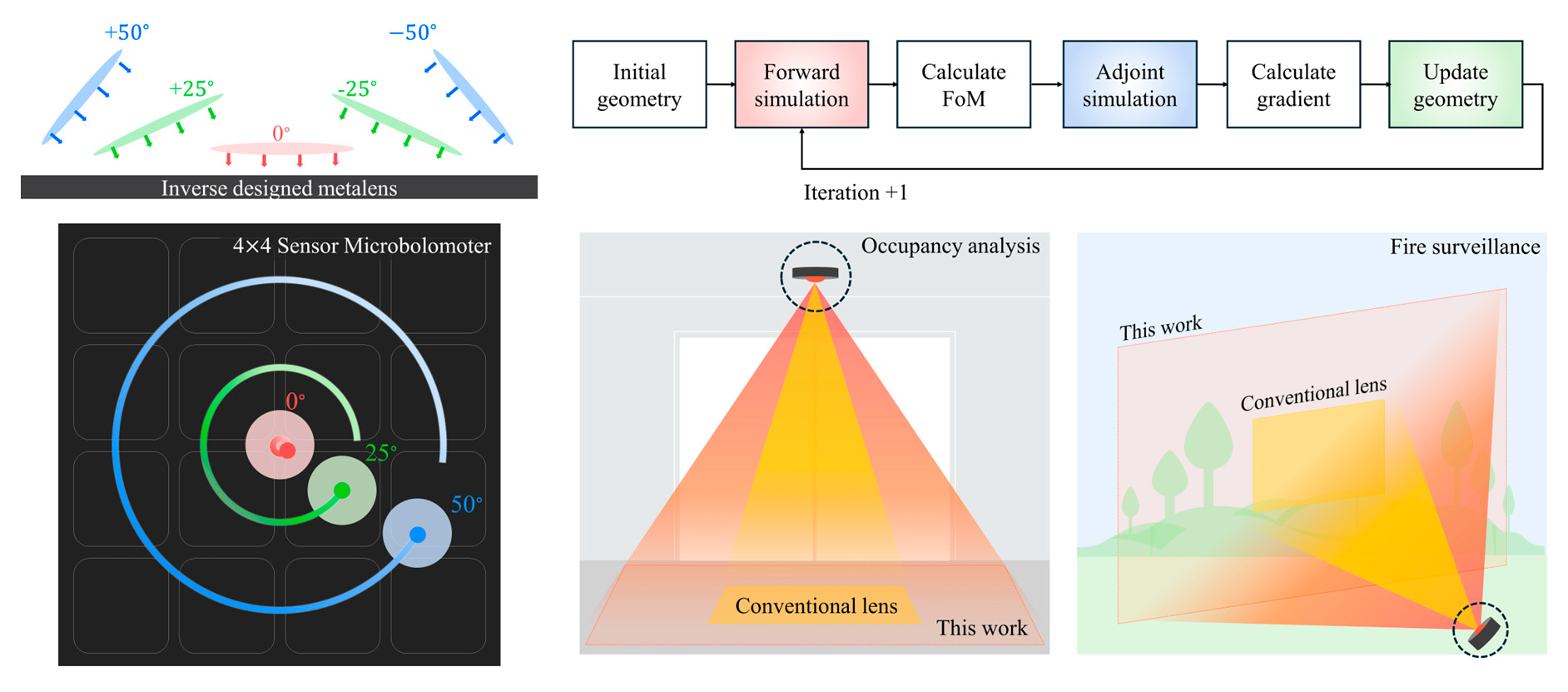
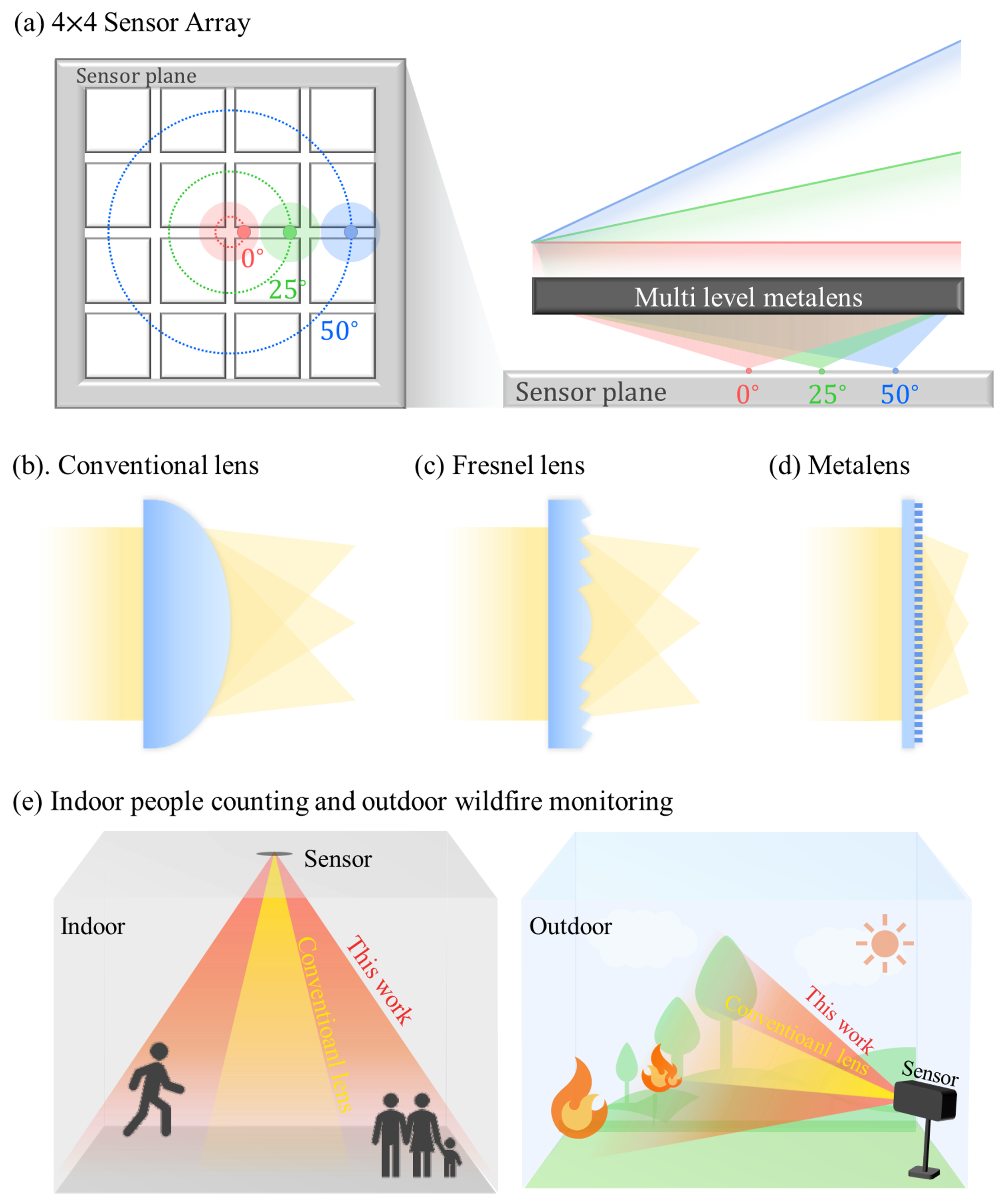
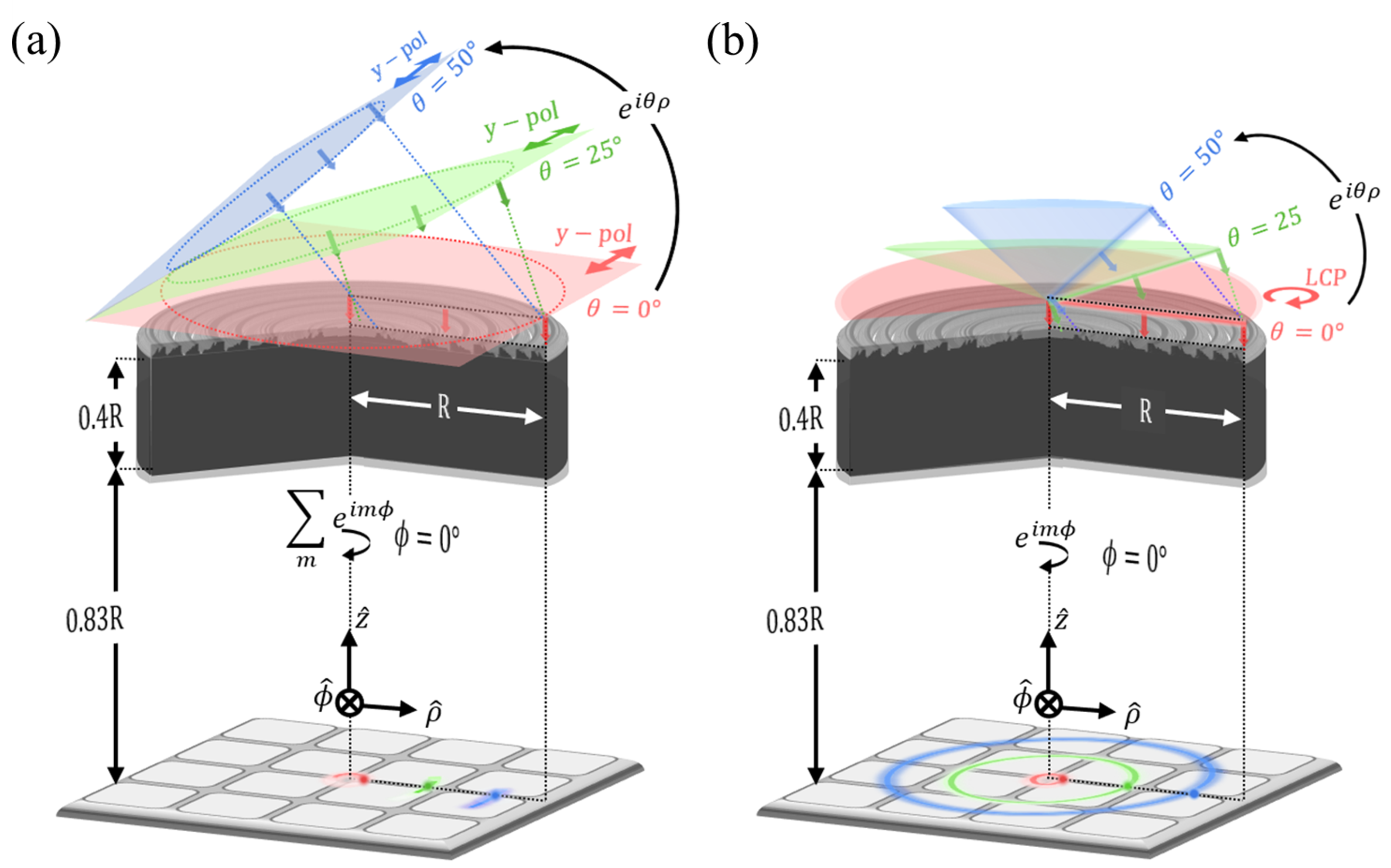
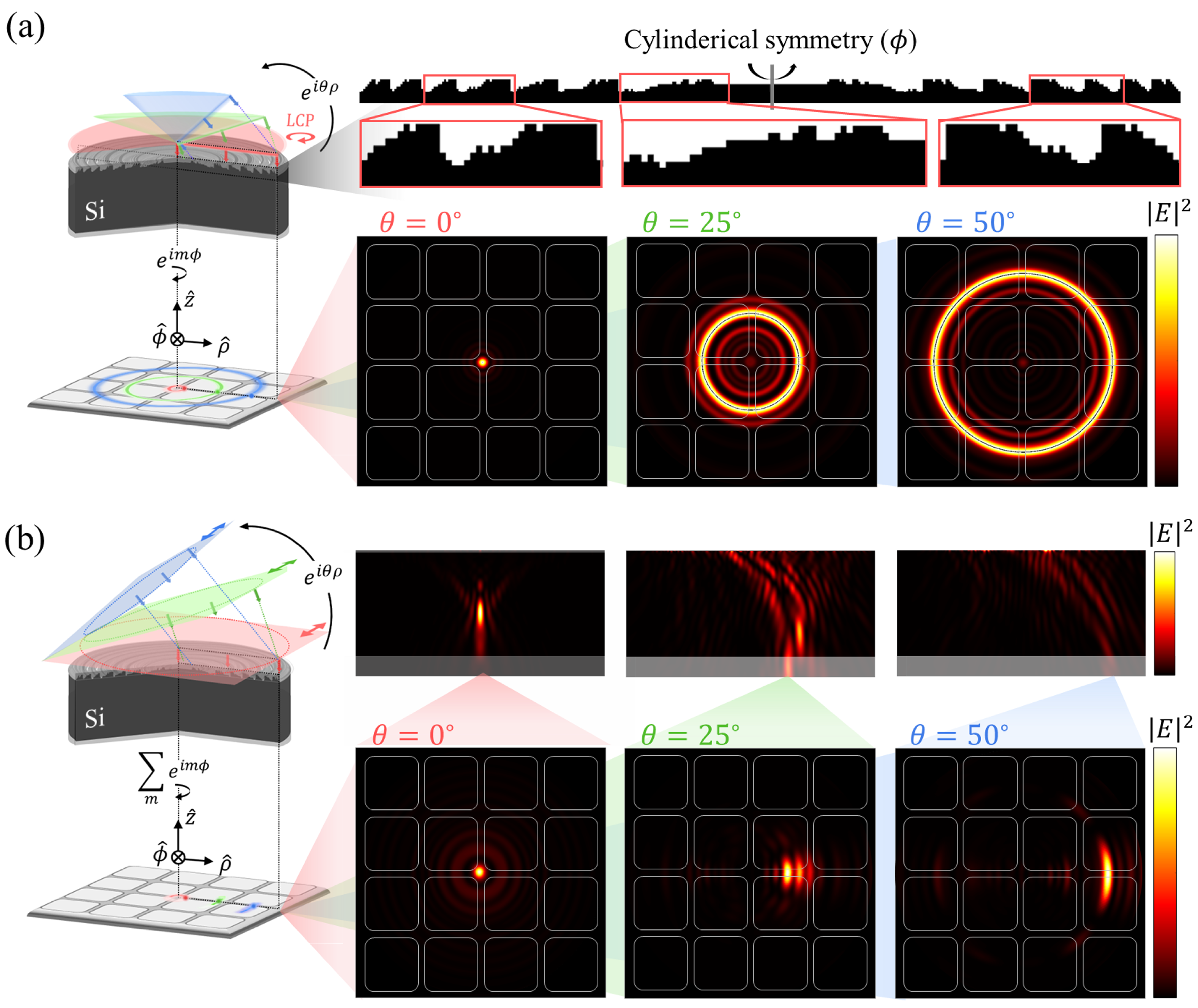
Inverse Design of Thermal Imaging Metalens Achieving 100° Field of View on a 4 × 4 Microbolometer Array


Abstract
1. Introduction
2. Methodology
2.1. Cone-Shaped Source for the Wide-FoV Configuration
2.2. Adjoint Compatible Fabrication-Aware Algorithm
2.3. Demonstrations on Small-Scale Metalens
3. Results
4. Discussion and Conclusions
Author Contributions
Funding
Data Availability Statement
Conflicts of Interest
Correction Statement
Abbreviations
| LWIR | Long-wave infrared |
| FoV | Field of View |
| IoT | Internet of Things |
| NA | Numerical Aperture |
| LCP | Left-handed Circular Polarization |
| RMSE | Root Mean Square Error |
| PSF | Point-Spread Function |
| MTF | Modulation Transfer Function |
| OTF | Optical Transfer Function |
| HVAC | Heating, Ventilation, and Air Conditioning |
References
- Ogawa, S.; Hanaoka, M.; Iwakawa, M.; Fukushima, S.; Shimatani, M. All-Dielectric Metalenses for Long-Wavelength Infrared Imaging Applications: A Review. Sensors 2025, 25, 3781. [Google Scholar] [CrossRef]
- Huang, L.; Han, Z.; Wirth-Singh, A.; Saragadam, V.; Mukherjee, S.; Fröch, J.E.; Tanguy, Q.A.; Rollag, J.; Gibson, R.; Hendrickson, J.R.; et al. Broadband thermal imaging using meta-optics. Nat. Commun. 2024, 15, 1662. [Google Scholar] [CrossRef]
- Meem, M.; Banerji, S.; Majumder, A.; Guevara Vasquez, F.; Sensale-Rodriguez, B.; Menon, R. Broadband lightweight flat lenses for long-wave infrared imaging. Proc. Natl. Acad. Sci. USA 2019, 116, 21375–21380. [Google Scholar] [CrossRef]
- Wang, C.; Jiang, J.; Roth, T.; Nguyen, C.; Liu, Y.; Lee, H. Integrated sensor data processing for occupancy detection in residential buildings. Energy Build. 2021, 237, 110810. [Google Scholar] [CrossRef]
- Wu, L.; Gou, F.; Wu, S.T.; Wang, Y. SLEEPIR: Synchronized Low-Energy Electronically Chopped PIR Sensor for True Presence Detection. IEEE Sens. Lett. 2020, 4, 2500204. [Google Scholar] [CrossRef]
- Lee, J.H.; Choi, J.S.; Jeon, E.S.; Kim, Y.G.; Thanh Le, T.; Shin, K.Y.; Lee, H.C.; Park, K.R. Robust pedestrian detection by combining visible and thermal infrared cameras. Sensors 2015, 15, 10580–10615. [Google Scholar] [CrossRef] [PubMed]
- Banuls, A.; Mandow, A.; Vázquez-Martín, R.; Morales, J.; García-Cerezo, A. Object detection from thermal infrared and visible light cameras in search and rescue scenes. In Proceedings of the 2020 IEEE International Symposium on Safety, Security, and Rescue Robotics (SSRR), Abu Dhabi, United Arab Emirates, 4–6 November 2020; IEEE: New York, NY, USA, 2020; pp. 380–386. [Google Scholar]
- Manara, J.; Zipf, M.; Stark, T.; Arduini, M.; Ebert, H.P.; Tutschke, A.; Hallam, A.; Hanspal, J.; Langley, M.; Hodge, D.; et al. Long wavelength infrared radiation thermometry for non-contact temperature measurements in gas turbines. Infrared Phys. Technol. 2017, 80, 120–130. [Google Scholar] [CrossRef]
- Hsu, P.S.; Rein, K.; Oleksandr, B.; Wu, D.; Cook, T.S.; Adhikari, S.; Emerson, B.; Lieuwen, T.; Gord, J.R.; Roy, S. Fiber-coupled LWIR hyperspectral sensor suite for non-contact component surface temperature measurements. Appl. Opt. 2018, 57, 10418–10425. [Google Scholar] [CrossRef]
- Oppliger, M.; Gutknecht, J.; Gubler, R.; Ludwig, M.; Loeliger, T. Sensor fusion of 3d time-of-flight and thermal infrared camera for presence detection of living beings. In Proceedings of the 2022 IEEE Sensors, Dallas, TX, USA, 30 October–2 November 2022; IEEE: New York, NY, USA, 2022; pp. 1–4. [Google Scholar]
- Leykin, A.; Hammoud, R. Real-time estimation of human attention field in LWIR and color surveillance videos. In Proceedings of the 2008 IEEE Computer Society Conference on Computer Vision and Pattern Recognition Workshops, Anchorage, AK, USA, 23–28 June 2008; IEEE: New York, NY, USA, 2008; pp. 1–6. [Google Scholar]
- Altaf, M.A.; Ahn, J.; Khan, D.; Kim, M.Y. Usage of IR sensors in the HVAC systems, vehicle and manufacturing industries: A review. IEEE Sens. J. 2022, 22, 9164–9176. [Google Scholar] [CrossRef]
- Li, X.; Chen, Q. Development of a novel method to detect clothing level and facial skin temperature for controlling HVAC systems. Energy Build. 2021, 239, 110859. [Google Scholar] [CrossRef]
- Tse, R.; Wang, T.; Im, M.; Pau, G. Privacy aware crowd-counting using thermal cameras. In Proceedings of the Twelfth International Conference on Digital Image Processing (ICDIP 2020), Virtually, 19–22 May 2020; SPIE: Bellingham, WA, USA, 2020; Volume 11519, pp. 323–333. [Google Scholar]
- Abuarafah, A.G.; Khozium, M.O.; AbdRabou, E. Real-time crowd monitoring using infrared thermal video sequences. J. Am. Sci. 2012, 8, 133–140. [Google Scholar]
- Bertozzi, M.; Fedriga, R.I.; Miron, A.; Reverchon, J.L. Pedestrian detection in poor visibility conditions: Would SWIR help? In Proceedings of the International Conference on Image Analysis and Processing, Naples, Italy, 9–13 September 2013; Springer: Berlin/Heidelberg, Germany, 2013; pp. 229–238. [Google Scholar]
- Pinchon, N.; Cassignol, O.; Nicolas, A.; Bernardin, F.; Leduc, P.; Tarel, J.P.; Brémond, R.; Bercier, E.; Brunet, J. All-weather vision for automotive safety: Which spectral band? In Proceedings of the International Forum on Advanced Microsystems for Automotive Applications, Berlin, Germany, 11–12 September 2018; Springer: Berlin/Heidelberg, Germany, 2018; pp. 3–15. [Google Scholar]
- Mares, J.W.; Renshaw, C.K. Performance characterization of infrared imagers for horizon-matching geolocalization methods. In Proceedings of the Infrared Imaging Systems: Design, Analysis, Modeling, and Testing XXXVI, Orlando, FL, USA, 15–17 April 2025; SPIE: Bellingham, WA, USA, 2025; Volume 13468, pp. 27–35. [Google Scholar]
- Ke, Y.; Zhou, C.; Zhou, Y.; Wang, S.; Chan, S.H.; Long, Y. Emerging thermal-responsive materials and integrated techniques targeting the energy-efficient smart window application. Adv. Funct. Mater. 2018, 28, 1800113. [Google Scholar] [CrossRef]
- Ke, Y.; Chen, J.; Lin, G.; Wang, S.; Zhou, Y.; Yin, J.; Lee, P.S.; Long, Y. Smart windows: Electro-, thermo-, mechano-, photochromics, and beyond. Adv. Energy Mater. 2019, 9, 1902066. [Google Scholar] [CrossRef]
- Liu, S.; Chen, G.; Li, J.; Cao, S.J. Smart Skin for Zero Energy Buildings: A Review of Thermoresponsive Spectral-Adaptive Envelopes. Adv. Mater. 2025. [Google Scholar] [CrossRef] [PubMed]
- Patel, C.K.N.; Lyakh, A.; Maulini, R.; Tsekoun, A.; Tadjikov, B. QCL as a game changer in MWIR and LWIR military and homeland security applications. In Proceedings of the Micro-and Nanotechnology Sensors, Systems, and Applications IV, Baltimore, MD, USA, 23–27 April 2012; SPIE: Bellingham, WA, USA, 2012; Volume 8373, pp. 599–607. [Google Scholar]
- Chen, Q.; Huang, X.; Ju, Z.; Lin, H.; Tang, H.; Guo, C.; Fan, F.; Zhao, X.; Ma, Y.; Luo, Y.; et al. A Triband Metasurface Covering Visible, Midwave Infrared, and Long-Wave Infrared for Optical Security. Nano Lett. 2025, 25, 4459–4466. [Google Scholar] [CrossRef]
- Li, Y.; Moreau, J.; Ibanez-Guzman, J. Emergent visual sensors for autonomous vehicles. IEEE Trans. Intell. Transp. Syst. 2023, 24, 4716–4737. [Google Scholar] [CrossRef]
- Moyer, S.; Hixson, J.G.; Edwards, T.C.; Krapels, K. Probability of identification of small hand-held objects for electro-optic forward-looking infrared systems. Opt. Eng. 2006, 45, 063201. [Google Scholar] [CrossRef]
- Nelson, M.P.; Gomer, N.R. Portable Standoff Optical Spectroscopy for Safety and Security. In Portable Spectroscopy and Spectrometry; Wiley Online Library: Hoboken, NJ, USA, 2021; pp. 237–273. [Google Scholar]
- Hickman, D.L. The development of a multi-band handheld fusion camera. In Proceedings of the Electro-Optical and Infrared Systems: Technology and Applications XVI, Strasbourg, France, 11–12 September 2019; SPIE: Bellingham, WA, USA, 2019; Volume 11159, pp. 78–95. [Google Scholar]
- Yang, B.; Luo, J.; Liu, Q. A novel low-cost and small-size human tracking system with pyroelectric infrared sensor mesh network. Infrared Phys. Technol. 2014, 63, 147–156. [Google Scholar] [CrossRef]
- Akin, T. Low-cost LWIR-band CMOS infrared (CIR) microbolometers for high volume applications. In Proceedings of the 2020 IEEE 33rd International Conference on Micro Electro Mechanical Systems (MEMS), Vancouver, BC, Canada, 18–22 January 2020; IEEE: New York, NY, USA, 2020; pp. 147–152. [Google Scholar]
- Kim, B.; Yoon, N.; Lee, H.C.; Kim, C.K. Novel concept of TDI readout circuit for LWIR detector. In Proceedings of the Infrared Detectors and Focal Plane Arrays VI, Orlando, FL, USA, 25–27 April 2000; SPIE: Bellingham, WA, USA, 2000; Volume 4028, pp. 166–172. [Google Scholar]
- Mizuno, G.; Olah, R.; Oduor, P.; Dutta, A.K.; Dhar, N.K. High performance digital read out integrated circuit (DROIC) for infrared imaging. In Proceedings of the Image Sensing Technologies: Materials, Devices, Systems, and Applications III, Baltimore, MD, USA, 17–21 April 2016; SPIE: Bellingham, WA, USA, 2016; Volume 9854, pp. 26–32. [Google Scholar]
- Qiao, J.; Wang, X.; Zhao, Y. Design of high dynamic range and digitalized readout integrated circuit for LWIR FPAs. In Proceedings of the 2019 IEEE 13th International Conference on ASIC (ASICON), Chongqing, China, 29 October–1 November 2019; IEEE: New York, NY, USA, 2019; pp. 1–3. [Google Scholar]
- Berkol, A. Exploring AI-Based Techniques for the Generation of Synthetic Infrared Images and Their Practical Applications. In Proceedings of the 2025 9th International Symposium on Innovative Approaches in Smart Technologies (ISAS), Gaziantep, Turkiye, 27–28 June 2025; IEEE: New York, NY, USA, 2025; pp. 1–5. [Google Scholar]
- Canilang, H.M.O.; Caliwag, A.C.; Camacho, J.R.C.; Lim, W.; Maier, M. Edge TMS: Optimized real-time temperature monitoring systems deployed on edge AI devices. IEEE Internet Things J. 2023, 11, 2490–2506. [Google Scholar] [CrossRef]
- Guo, X.; Zhang, Z.; Ren, Z.; Li, D.; Xu, C.; Wang, L.; Liu, W.; Zhuge, Y.; Zhou, G.; Lee, C. Advances in Intelligent Nano-Micro-Scale Sensors and Actuators: Moving toward Self-Sustained Edge AI Microsystems. Adv. Mater. 2025, 37, e10417. [Google Scholar] [CrossRef] [PubMed]
- Chen, C.; Li, C.; Min, S.; Guo, Q.; Xia, Z.; Liu, D.; Ma, Z.; Xia, F. Ultrafast silicon nanomembrane microbolometer for long-wavelength infrared light detection. Nano Lett. 2021, 21, 8385–8392. [Google Scholar] [CrossRef] [PubMed]
- Takasawa, S. Uncooled LWIR imaging: Applications and market analysis. In Proceedings of the Image Sensing Technologies: Materials, Devices, Systems, and Applications II, Baltimore, MD, USA, 22–23 April 2015; SPIE: Bellingham, WA, USA, 2015; Volume 9481, pp. 87–99. [Google Scholar]
- Mukhtar, S.; Arbabi, A.; Viegas, J. Compact Spectral Imaging: A Review of Miniaturized and Integrated Systems. Laser Photonics Rev. 2025, 19, e01042. [Google Scholar] [CrossRef]
- Yang, F.; Shalaginov, M.Y.; Lin, H.I.; An, S.; Agarwal, A.; Zhang, H.; Rivero-Baleine, C.; Gu, T.; Hu, J. Wide field-of-view metalens: A tutorial. Adv. Photonics 2023, 5, 033001. [Google Scholar] [CrossRef]
- Wirth-Singh, A.; Fröch, J.E.; Han, Z.; Huang, L.; Mukherjee, S.; Zhou, Z.; Coppens, Z.; Böhringer, K.F.; Majumdar, A. Large field-of-view thermal imaging via all-silicon meta-optics. Appl. Opt. 2023, 62, 5467–5474. [Google Scholar] [CrossRef] [PubMed]
- Lin, H.I.; Geldmeier, J.; Baleine, E.; Yang, F.; An, S.; Pan, Y.; Rivero-Baleine, C.; Gu, T.; Hu, J. Wide-field-of-view, large-area long-wave infrared silicon metalenses. ACS Photonics 2024, 11, 1943–1949. [Google Scholar] [CrossRef]
- Lalanne, P.; Chavel, P. Metalenses at visible wavelengths: Past, present, perspectives. Laser Photonics Rev. 2017, 11, 1600295. [Google Scholar] [CrossRef]
- Vaidyanathan, M.; Joshi, A.; Xue, S.; Hanyaloglu, B.; Thomas, M.; Zandian, M.; Edwall, D.; Williams, G.; Blackwell, J.; Tennant, W.; et al. High performance ladar focal plane arrays for 3D range imaging. In Proceedings of the 2004 IEEE Aerospace Conference Proceedings (IEEE Cat. No. 04TH8720), Big Sky, MT, USA, 6–13 March 2004; IEEE: New York, NY, USA, 2004; Volume 3. [Google Scholar]
- Chiu, P.T.; Lin, Y.C.; Chen, Y.S.; Wang, Y.C.F. Low-Resolution Thermal Sensor-Guided Image Synthesis. In Proceedings of the WACV Workshops, Waikoloa, HI, USA, 2–7 January 2023. [Google Scholar]
- Maaspuro, M. Low-Resolution IR-Array as a Doorway Occupancy Counter. Int. J. Online Biomed. Eng. (Ijoe) 2020, 16, 4–18. [Google Scholar]
- Fukuhara, T.; Kouyama, T.; Kato, S.; Nakamura, R.; Takahashi, Y.; Akiyama, H. Detection of Small Wildfire by Thermal Infrared Camera With the Uncooled Microbolometer Array for 50-kg Class Satellite. IEEE Trans. Geosci. Remote Sens. 2017, 55, 4314–4324. [Google Scholar] [CrossRef]
- Posch, C.; Matolin, D.; Wohlgenannt, R.; Maier, T.; Litzenberger, M. A microbolometer asynchronous dynamic vision sensor for LWIR. IEEE Sens. J. 2009, 9, 654–664. [Google Scholar] [CrossRef]
- Eminoglu, S.; Tezcan, D.; Tanrikulu, M.; Akin, T. Low-cost uncooled infrared detectors in CMOS process. Sens. Actuators A Phys. 2003, 109, 102–113. [Google Scholar] [CrossRef]
- Mukhtar, S.; Viegas, J. Design and performance analysis of all-dielectric reflective, metalens for LWIR applications. Sci. Rep. 2025, 15, 23985. [Google Scholar] [CrossRef]
- Ogawa, S.; Iwakawa, M.; Fukushima, S.; Shimatani, M. Graphene-metagrating hybrid nanostructures for advanced functional infrared sensors. In Proceedings of the Infrared Technology and Applications LI, Orlando, FL, USA, 14–17 April 2025; SPIE: Bellingham, WA, USA, 2025; Volume 13469, pp. 473–477. [Google Scholar]
- Bae, E.J.; Kang, S.W.; Choi, G.S.; Jang, E.B.; Baek, D.H.; Ju, B.K.; Park, Y.W. Enhanced light extraction from organic light-emitting diodes with micro-nano hybrid structure. Nanomaterials 2022, 12, 1266. [Google Scholar] [CrossRef]
- Rozman, N.; Peng, R.; Padilla, W.J. Deep inverse design of an infrared metasurface diffuser. Adv. Opt. Mater. 2024, 12, 2401462. [Google Scholar] [CrossRef]
- Choi, G.S.; Kang, S.W.; Bae, E.J.; Jang, E.B.; Baek, D.H.; Ju, B.K.; Park, Y.W. A simple method for fabricating an external light extraction composite layer with rns to improve the optical properties of oleds. Nanomaterials 2022, 12, 1430. [Google Scholar] [CrossRef]
- Mukhtar, S.; Viegas, J. Reflective Metalens Architecture for Broadband Achromatic Performance in the LWIR Range. IEEE Photonics Technol. Lett. 2025, 38, 69–72. [Google Scholar] [CrossRef]
- He, G.; Ge, H.; Li, Q.; Xu, T.; Wei, H.; Ding, X. A Cross-Type Multi-Focus Phase Compensation Method Enables Metalens Antenna Wide-Angle Beam Steering. IEEE Trans. Antennas Propag. 2025, 73, 6062–6067. [Google Scholar] [CrossRef]
- Barulin, A.; Barulina, E.; Oh, D.K.; Jo, Y.; Park, H.; Park, S.; Kye, H.; Kim, J.; Yoo, J.; Kim, J.; et al. Axially multifocal metalens for 3D volumetric photoacoustic imaging of neuromelanin in live brain organoid. Sci. Adv. 2025, 11, eadr0654. [Google Scholar] [CrossRef]
- Jung, D.E.; Einck, V.J.; Dawicki, A.; Malgras, V.; Verrastro, L.D.; Grosso, D.; Arbabi, A.; Watkins, J.J. Full Wafer Scale Manufacturing of Directly Printed TiO2 Metalenses at Visible Wavelengths with Outstanding Focusing Efficiencies. Adv. Mater. 2025, 37, 2500327. [Google Scholar] [CrossRef]
- Chung, H.; Miller, O.D. High-NA achromatic metalenses by inverse design. Opt. Express 2020, 28, 6945–6965. [Google Scholar] [CrossRef] [PubMed]
- Pan, M.; Fu, Y.; Zheng, M.; Chen, H.; Zang, Y.; Duan, H.; Li, Q.; Qiu, M.; Hu, Y. Dielectric metalens for miniaturized imaging systems. Light. Sci. Appl. 2022, 11, 84. [Google Scholar] [CrossRef] [PubMed]
- Hanaoka, M.; Fukushima, S.; Shimatani, M.; Ogawa, S. Multifoci all-dielectric metalens for long-wavelength infrared. In Proceedings of the Infrared Technology and Applications LI, Orlando, FL, USA, 14–17 April 2025; SPIE: Bellingham, WA, USA, 2025; Volume 13469, pp. 478–482. [Google Scholar]
- Wirth-Singh, A.; Fröch, J.E.; Yang, F.; Martin, L.; Zheng, H.; Zhang, H.; Tanguy, Q.T.; Zhou, Z.; Huang, L.; John, D.D.; et al. Wide field of view large aperture meta-doublet eyepiece. Light. Sci. Appl. 2025, 14, 17. [Google Scholar] [CrossRef] [PubMed]
- Miller, O. Photonic Design: From Fundamental Solar Cell Physics to Computational Inverse Design. Ph.D. Thesis, EECS Department, University of California, Berkeley, CA, USA, 2012. [Google Scholar]
- Kang, C.; Park, C.; Lee, M.; Kang, J.; Jang, M.S.; Chung, H. Large-scale photonic inverse design: Computational challenges and breakthroughs. Nanophotonics 2024, 13, 3765–3792. [Google Scholar] [CrossRef]
- Elsawy, M.M.; Lanteri, S.; Duvigneau, R.; Fan, J.A.; Genevet, P. Numerical optimization methods for metasurfaces. Laser Photonics Rev. 2020, 14, 1900445. [Google Scholar] [CrossRef]
- Mansouree, M.; Kwon, H.; Arbabi, E.; McClung, A.; Faraon, A.; Arbabi, A. Multifunctional 2.5 D metastructures enabled by adjoint optimization. Optica 2020, 7, 77–84. [Google Scholar] [CrossRef]
- Bae, M.; Jo, J.; Lee, M.; Kang, J.; Boriskina, S.V.; Chung, H. Inverse design and optical vortex manipulation for thin-film absorption enhancement. Nanophotonics 2023, 12, 4239–4254. [Google Scholar] [CrossRef]
- Fan, J.A. Freeform metasurface design based on topology optimization. Mrs Bull. 2020, 45, 196–201. [Google Scholar] [CrossRef]
- Mansouree, M.; McClung, A.; Samudrala, S.; Arbabi, A. Large-scale parametrized metasurface design using adjoint optimization. ACS Photonics 2021, 8, 455–463. [Google Scholar] [CrossRef]
- Jang, E.; Cho, J.; Kang, C.; Chung, H. Inverse design of ultrathin metamaterial absorber. Nanomaterials 2025, 15, 1024. [Google Scholar] [CrossRef]
- Hooten, S.; Sun, P.; Gantz, L.; Fiorentino, M.; Beausoleil, R.; Van Vaerenbergh, T. Automatic Differentiation Accelerated Shape Optimization Approaches to Photonic Inverse Design in FDFD/FDTD. Laser Photonics Rev. 2025, 19, 2301199. [Google Scholar] [CrossRef]
- Grushina, A. Direct-write grayscale lithography. Adv. Opt. Technol. 2019, 8, 163–169. [Google Scholar] [CrossRef]
- Oskooi, A.F.; Roundy, D.; Ibanescu, M.; Bermel, P.; Joannopoulos, J.D.; Johnson, S.G. MEEP: A flexible free-software package for electromagnetic simulations by the FDTD method. Comput. Phys. Commun. 2010, 181, 687–702. [Google Scholar] [CrossRef]
- Lin, Z.; Roques-Carmes, C.; Christiansen, R.E.; Soljačić, M.; Johnson, S.G. Computational inverse design for ultra-compact single-piece metalenses free of chromatic and angular aberration. Appl. Phys. Lett. 2021, 118. [Google Scholar] [CrossRef]
- Verslegers, L.; Catrysse, P.B.; Yu, Z.; Shin, W.; Ruan, Z.; Fan, S. Phase front design with metallic pillar arrays. Opt. Lett. 2010, 35, 844–846. [Google Scholar] [CrossRef] [PubMed]
- Park, J.S.; Lim, S.W.D.; Amirzhan, A.; Kang, H.; Karrfalt, K.; Kim, D.; Leger, J.; Urbas, A.; Ossiander, M.; Li, Z.; et al. All-glass 100 mm diameter visible metalens for imaging the cosmos. ACS Nano 2024, 18, 3187–3198. [Google Scholar] [CrossRef]
- Qin, C.; Fan, W.; Wu, Q.; Jiang, X. Polarization insensitive achromatic terahertz metalens based on all-dielectric metasurfaces. Opt. Commun. 2022, 512, 128061. [Google Scholar] [CrossRef]
- Niklaus, F.; Decharat, A.; Jansson, C.; Stemme, G. Performance model for uncooled infrared bolometer arrays and performance predictions of bolometers operating at atmospheric pressure. Infrared Phys. Technol. 2008, 51, 168–177. [Google Scholar] [CrossRef]
- Engelberg, J.; Levy, U. Optimizing the spectral range of diffractive metalenses for polychromatic imaging applications. Opt. Express 2017, 25, 21637–21651. [Google Scholar] [CrossRef]
- Bouchouri, A.; Akram, M.N.; Øhlckers, P.A.; Chen, X. Optimization of Grayscale Lithography for the Fabrication of Flat Diffractive Infrared Lenses on Silicon Wafers. Micromachines 2024, 15, 866. [Google Scholar] [CrossRef] [PubMed]





Disclaimer/Publisher’s Note: The statements, opinions and data contained in all publications are solely those of the individual author(s) and contributor(s) and not of MDPI and/or the editor(s). MDPI and/or the editor(s) disclaim responsibility for any injury to people or property resulting from any ideas, methods, instructions or products referred to in the content. |
© 2025 by the authors. Licensee MDPI, Basel, Switzerland. This article is an open access article distributed under the terms and conditions of the Creative Commons Attribution (CC BY) license.
Share and Cite
Bae, M.; Jang, E.; Kang, C.; Chung, H. Inverse Design of Thermal Imaging Metalens Achieving 100° Field of View on a 4 × 4 Microbolometer Array. Micromachines 2026, 17, 65. https://doi.org/10.3390/mi17010065
Bae M, Jang E, Kang C, Chung H. Inverse Design of Thermal Imaging Metalens Achieving 100° Field of View on a 4 × 4 Microbolometer Array. Micromachines. 2026; 17(1):65. https://doi.org/10.3390/mi17010065
Chicago/Turabian StyleBae, Munseong, Eunbi Jang, Chanik Kang, and Haejun Chung. 2026. "Inverse Design of Thermal Imaging Metalens Achieving 100° Field of View on a 4 × 4 Microbolometer Array" Micromachines 17, no. 1: 65. https://doi.org/10.3390/mi17010065
APA StyleBae, M., Jang, E., Kang, C., & Chung, H. (2026). Inverse Design of Thermal Imaging Metalens Achieving 100° Field of View on a 4 × 4 Microbolometer Array. Micromachines, 17(1), 65. https://doi.org/10.3390/mi17010065