




materials-logo

Journal Browser

Journal Browser

Materials Containing Silicon, Its Inorganic Derivatives, Functional Silanes, and/or Organosilicon Polymers—2nd Edition

A special issue of Materials (ISSN 1996-1944). This special issue belongs to the section "Polymeric Materials".

Deadline for manuscript submissions: 30 December 2026 | Viewed by 2628
Editors


E-Mail Website
Guest Editor
1. Łukasiewicz Research Network, Lodz Institute of Technology (ŁIT), 19/27 Marii Skłodowskiej-Curie Str., 90-570 Łódź, Poland
2. Circular Economy Center (BCG), Environmental Protection Engineering Research Group, Łukasiewicz Research Network, Lodz Institute of Technology (ŁIT), Brzezińska 5/15, 92-103 Łódź, Poland
Interests: science and technology of polymers and plastics, with focus on chemistry and technology of organosilicon, organo-metallic and inorganic polymers (silicones, etc.); silane coupling agents (SCA); synthesis of functional silanes, polymers and their characterization; modification of inorganic polymers with functional silanes, silicates and silicones; modification of polymers and polymeric materials by chemical and physical methods; epoxy resins; polyurethane foams; fire resistant polymers and composites; nanocomposites; chemical and antimicrobial (antibacterial and antifungal) modifications of properties of textile materials, barrier protection of textiles and garments against UV radiation, preparation of polymeric membranes for water desalination and purification
Special Issues, Collections and Topics in MDPI journals

E-Mail Website
Guest Editor
Centre of Molecular and Macromolecular Studies, Polish Academy of Sciences, Lodz, Poland
Interests: hybrid materials; silsesquioxanes; supramolecular chemistry; bioactive organosilicon compounds
Special Issues, Collections and Topics in MDPI journals

Special Issue Information

Dear Colleagues,

After our successful first edition of the Special Issue “Materials Containing Silicon, Its Inorganic Derivatives, Functional Silanes, and/or Organosilicon Polymers”, we have decided to create a 2nd edition to collect and publish state-of-the-art research in this field.

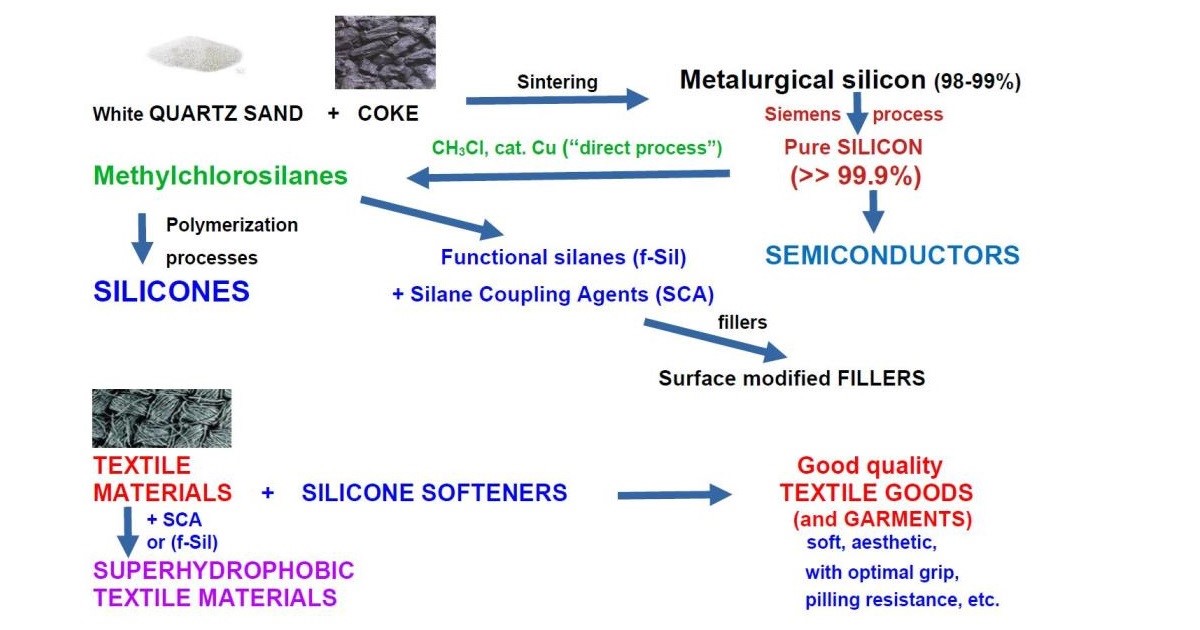
A semiconductive pure silicon is used as a basic electronic material for production of computer chips and other electronic devices. Many functional silanes of different chemical structures containing reactive groups, mostly bound to silicon atom, but also quite often attached to carbon atom are applied for modification of surface properties of different polymeric and inorganic materials, e.g., fillers.

Silicones (polysiloxanes), containing silicon and oxygen atoms in their main chains and organic substituents bound to silicon, are a large and most important group of various inorganic-organic (hybrid) compounds and materials. Mainly poly(dimethylsiloxanes) (PDMS) are used. Silicones are applied as oils, rubbers, and resins. They have many unusual features - they exhibit excellent chemical, physical, and electrical properties. Even an addition of  a very small amount of silicones  
leads to a crucial improvement of properties of modified materials. Silicones increase hydrophobicity and improve water resistance and thermal stability of many materials.

Other organosilicon polymers, and especially, polysilanes, polycarbosilanes, and polysilazanes, are raw materials for fabrication of polymer-derived high-tech ceramic materials. Silicon-based polymers and polymeric materials as well as reactive silane coupling agents (SCA) are used in many fields – from industry, through everyday life commodity goods and cosmetics, to medicine. Their universal properties decide that they are very useful and attractive materials and components in a very wide range of products.

A continuously growing interest in applications of reactive silanes, all kinds of silicones, chemically modified nanosilica, different composites, silicon photovoltaic cells, and silicon nanowires has been still observed in many different fields of science, the chemical technology, and especially in materials science.

Original contributions and reviews are welcome.

Dr. Jerzy J. Chruściel
Prof. Dr. Anna Kowalewska
Guest Editors

Manuscript Submission Information

Manuscripts should be submitted online at www.mdpi.com by registering and logging in to this website. Once you are registered, click here to go to the submission form. Manuscripts can be submitted until the deadline. All submissions that pass pre-check are peer-reviewed. Accepted papers will be published continuously in the journal (as soon as accepted) and will be listed together on the special issue website. Research articles, review articles as well as short communications are invited. For planned papers, a title and short abstract (about 250 words) can be sent to the Editorial Office for assessment.

Submitted manuscripts should not have been published previously, nor be under consideration for publication elsewhere (except conference proceedings papers). All manuscripts are thoroughly refereed through a single-anonymized peer-review process. A guide for authors and other relevant information for submission of manuscripts is available on the Instructions for Authors page. Materials is an international peer-reviewed open access semimonthly journal published by MDPI.

Please visit the Instructions for Authors page before submitting a manuscript. The Article Processing Charge (APC) for publication in this open access journal is 2600 CHF (Swiss Francs). Submitted papers should be well formatted and use good English. Authors may use MDPI's English editing service prior to publication or during author revisions.

Keywords

  • silica annd silicates—applications in materials science
  • silicon containing polymers and materials
  • chemistry, technology and applications of silicones
  • applications of silane coupling agents (SCA)
  • polysilsesquioxanes (POSS)
  • modification of polymeric materials with silanes, silicates and silicones
  • nanomaterials, composites and nanocomposites
  • superhydrofobic materials
  • medical applications of silicones

Benefits of Publishing in a Special Issue

  • Ease of navigation: Grouping papers by topic helps scholars navigate broad scope journals more efficiently.
  • Greater discoverability: Special Issues support the reach and impact of scientific research. Articles in Special Issues are more discoverable and cited more frequently.
  • Expansion of research network: Special Issues facilitate connections among authors, fostering scientific collaborations.
  • External promotion: Articles in Special Issues are often promoted through the journal's social media, increasing their visibility.
  • Reprint: MDPI Books provides the opportunity to republish successful Special Issues in book format, both online and in print.

Further information on MDPI's Special Issue policies can be found here.

Related Special Issue

Published Papers (3 papers)

Order results
Result details
Select all
Export citation of selected articles as:

Research

17 pages, 3065 KB  
Article
Yolk–Shell Silicon–Carbon Anodes with Interconnected N-Doped Carbon Networks for Stable Lithium-Ion Storage
by Yi Zhou, Yi Zhang, Zhanhong Zhao, Yansen Qu, Jiajun Wu, Xueqin Ma and Xinghua Chang
Materials 2026, 19(11), 2286; https://doi.org/10.3390/ma19112286 - 28 May 2026
Viewed by 484
Abstract
Silicon-based anodes are considered promising alternatives to graphite anodes owing to their high theoretical lithium-storage capacity and abundant reserves. However, silicon nanoparticle anodes are severely limited by large volume expansion, unstable interfacial chemistry, and poor electrical connectivity during repeated lithiation/delithiation. Herein, we develop [...] Read more.
Silicon-based anodes are considered promising alternatives to graphite anodes owing to their high theoretical lithium-storage capacity and abundant reserves. However, silicon nanoparticle anodes are severely limited by large volume expansion, unstable interfacial chemistry, and poor electrical connectivity during repeated lithiation/delithiation. Herein, we develop a yolk–shell N-doped carbon network (NCN) strategy to construct Si@void@NCN composites. The optimized Si@void@NCN-1 achieves a balanced architecture between void buffering and carbon network integrity, delivering a high initial discharge capacity of 1245.5 mAh g−1 and an initial charge capacity of 735.8 mAh g−1. It also demonstrates stable long-term cycling performance, retaining a reversible capacity of 402.5 mAh g−1 after 500 cycles at 0.5 A g−1 with a capacity retention of 68.66%, and shows improved rate reversibility and electrode structural stability, with an electrode thickness increase of only 80.4% after rate cycling, much lower than that of densely carbon-coated Si@C. Kinetic analysis, post-cycling structural characterization, and in situ EIS further reveal that the yolk–shell void-buffering structure and the N-doped three-dimensional conductive network act synergistically to mitigate Si volume expansion, enhance structural stability, and facilitate electron/ion transport. This study emphasizes the importance of integrating buffering structures with Si/C composites, providing guidance for the rational design of advanced silicon-based electrode materials. Full article
Show Figures

Graphical abstract

24 pages, 6834 KB  
Article
Flame-Retardant and Hydrophobic Cotton via Alkoxysilyl-Functionalized Polysiloxanes, Cyclosiloxanes, and POSS with Surface Thiol-Ene Dithiophosphate Grafting
by Marcin Przybylak, Anna Szymańska, Weronika Gieparda, Mariusz Szołyga, Agnieszka Dutkiewicz and Hieronim Maciejewski
Materials 2026, 19(2), 265; https://doi.org/10.3390/ma19020265 - 8 Jan 2026
Cited by 4 | Viewed by 1032
Abstract
In this work, a multifunctional surface engineering strategy was developed to impart both flame-retardant and hydrophobic properties to cotton fabrics. In the first stage, cellulose fibers were modified with poly(methylvinyl)siloxane containing trimethoxysilyl groups, 2,4,6,8-tetramethyl-divinyl-bis(trimethoxysilylpropyltioethyl)cyclotetrasiloxane, or tetrakis(vinyldimethylsiloxy)tetrakis(trimethoxysilylpropyltioethyl)octasilsesquioxane (POSS). All modifiers contained alkoxysilyl groups capable [...] Read more.
In this work, a multifunctional surface engineering strategy was developed to impart both flame-retardant and hydrophobic properties to cotton fabrics. In the first stage, cellulose fibers were modified with poly(methylvinyl)siloxane containing trimethoxysilyl groups, 2,4,6,8-tetramethyl-divinyl-bis(trimethoxysilylpropyltioethyl)cyclotetrasiloxane, or tetrakis(vinyldimethylsiloxy)tetrakis(trimethoxysilylpropyltioethyl)octasilsesquioxane (POSS). All modifiers contained alkoxysilyl groups capable of forming covalent bonds with cellulose hydroxyl groups. The modification was performed using a dip-coating process followed by thermal curing. This procedure enabled the formation of Si-O-C linkages and the generation of a reactive organosilicon layer on the cotton surface. In the second step, O,O′-diethyl dithiophosphate was grafted directly onto the vinyl-functionalized fabrics via a thiol-ene click reaction. This process resulted in the formation of a phosphorus- and sulfur-containing protective layer anchored within the siloxane-based network. The obtained hybrid coatings were characterized using Fourier-transform infrared spectroscopy (FT-IR), scanning electron microscopy (SEM), and SEM-EDS. These analyses confirmed the presence and uniform distribution of the modifiers on the fiber surface. Microscale combustion calorimetry demonstrated a substantial reduction in the heat release rate. Thermogravimetric analysis (TG/DTG) revealed increased char formation and altered thermal degradation pathways. The limiting oxygen index (LOI) increased for all modified fabrics, confirming enhanced flame resistance. Water contact angle measurements showed values above 130°, indicating effective hydrophobicity. As a result, multifunctional textile surfaces were obtained. In addition, the modified fabrics exhibited partial durability toward laundering and retained measurable flame-retardant and hydrophobic performance after repeated washing cycles. Full article
Show Figures

Graphical abstract

12 pages, 2931 KB  
Article
Influence of the Si-Layer Thickness on the Structural, Compositional and Resistive Switching Properties of SiO2/Si/SiO2 Stack Layers for Resistive Switching Memories
by Alfredo Morales-Sánchez, Karla E. González-Flores, Jesús M. Germán-Martínez, Braulio Palacios-Márquez, Juan F. Ramírez-Rios, Javier Flores-Méndez, Alfredo Benítez-Lara, Juan R. Ramos-Serrano, Luis Hernández-Martínez and Mario Moreno-Moreno
Materials 2025, 18(24), 5539; https://doi.org/10.3390/ma18245539 - 10 Dec 2025
Viewed by 597
Abstract
This work focuses on developing resistive switching (RS) devices using thermally annealed (TA) SiO2/Si multilayers (ML). Three SiO2/Si bilayers were deposited with an additional 10 nm SiO2 layer as a dielectric barrier layer on top of the ML. [...] Read more.
This work focuses on developing resistive switching (RS) devices using thermally annealed (TA) SiO2/Si multilayers (ML). Three SiO2/Si bilayers were deposited with an additional 10 nm SiO2 layer as a dielectric barrier layer on top of the ML. The SiO2 layers were 6 nm thick, while the thickness of the Si layers varied from 2, 4, and 6 nm, and were labeled as ML-62, ML-64, and ML-66, respectively. X-ray photoelectron spectroscopy analysis revealed well-defined ML structures before TA. However, after TA, samples ML-64 and ML-62 showed discontinuities due to diffusion between neighboring Si layers, increasing the dimensions of the Si-rich regions. In fact, the concentration of elemental Si (Si0) within the intermediate Si layer increases as the Si layer becomes thinner. Consequently, the size of Si-nanocrystals, created after TA, increases from 6 to 8.5 nm for ML-66 to ML-62, as confirmed by Raman and transmission electron microscopy analysis. The composition discontinuities and loss of the ML structure resulted in erratic electrical behavior, with an electroforming (EF) voltage as high as −14 V in sample ML-62. For the ML-66, which retained the ML structure, the EF voltage was reduced to −4 V, showing SET/RESET values of around ±3 V and stable electrical behavior, with an ON/OFF ratio of up to seven orders of magnitude. This demonstrates the importance of the ML design in the operation of RS devices. Full article
Show Figures

Figure 1

Back to TopTop