


You are currently viewing a new version of our website. To view the old version click .

Logistics

Logistics is an international, scientific, peer-reviewed, open access journal of logistics and supply chain management published quarterly online by MDPI.
The first issue has been released in December 2017.
Quartile Ranking JCR - Q2 (Operations Research and Management Science | Management)

All Articles (682)

Background: nowadays, traditional delivery options are challenging to the urban last-mile logistics and sustainability goals. The purpose of this study is to investigate the practical factors that drive frequent e-shoppers to actively switch their intention from conventional delivery options to utilizing smart lockers. Methods: the hypothetical framework tested integrating constructs from the Technology Acceptance Model (TAM) and the Theory of Planned Behavior (TPB), and supplementary constructs such as privacy and convenience. Data were collected via a structured online questionnaire from 513 respondents in major Egyptian cities, including Alexandria and Cairo. The framework was tested using Structural Equation Modeling (SEM) via SmartPLS 4.0 software to assess the relationship between constructs and switching intention. Results: the analysis confirms that switching intention to use smart lockers is positively driven by Perceived Usefulness, Perceived Ease of Use, Convenience, Privacy, and Perceived Behavioral Control. Notably, a positive attitude towards smart lockers was found to have a non-significant effect on the intention to switch in the Egyptian context. Conclusions: this research contributes to addressing the gap in the extant literature by focusing on analyzing the unique contextual determinants in the emerging last-mile logistics within a developing market context.

11 December 2025
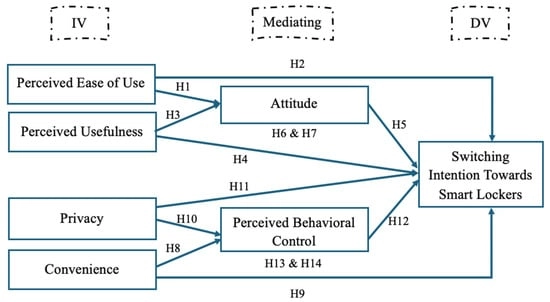
The Proposed Framework.

Background: This study examines how Green Knowledge Integration Capability (GKIC) influences supplier performance within sustainable supply chains by balancing exploration (acquiring new knowledge) and exploitation (refining existing knowledge) strategies. Methods: Based on Social Exchange Theory, Relationship Motivation Theory, and Absorptive Capacity Theory, a conceptual model was developed and tested using cross-sectional survey data collected from 398 managers representing 240 multinational corporations (MNCs) operating in Pakistan. Structural Equation Modelling (SEM) was employed to analyse the relationships among exploration and exploitation focus, Green Management Innovation (GMI), GKIC, Green Absorptive Capacity (GAC), and supplier performance. Results: The findings indicate that exploration and exploitation strategies significantly enhance supplier performance, with GKIC acting as a mediating mechanism linking strategic focus and innovation to performance outcomes. Moreover, GAC strengthens the impact of the exploration and exploitation focus on performance but exhibits limited moderating effects for GMI and GKIC pathways. Conclusions: The results highlight GKIC’s critical role in translating strategic and innovation initiatives into supplier performance gains. This study contributes to the sustainable supply chain literature and provides actionable insights for managers and policymakers to enhance sustainability outcomes through knowledge integration and absorptive capacity development.

10 December 2025

Theoretical framework.

Background: This study aims to examine the barriers hindering the implementation of sustainable procurement in Indonesian small and medium-sized enterprises (SMEs) and to identify their hierarchical relationships. Methods: A mixed-method approach was adopted, employing Interpretive Structural Modeling (ISM) to map the causal structure of barriers and Fuzzy MICMAC analysis to classify them according to their influence and dependence. Data were collected through expert evaluations and secondary sources, providing both empirical depth and contextual validity. Results: The results reveal that financial constraints, particularly funding limitations, are the most critical and independent barrier driving the entire system of obstacles. The analysis further shows that systemic linkage barriers, such as minimal government incentives, limited availability of eco-friendly raw materials, and high import dependency, create a self-reinforcing cycle that amplifies cost challenges for SMEs. Dependent barriers, including regulatory inadequacies and weak supplier collaboration, are identified as outcomes of these structural constraints, while autonomous barriers like limited consumer awareness remain less influential but still significant. Conclusions: These findings demonstrate that sustainable procurement barriers are not isolated but interconnected, with financial viability acting as the foundational challenge. The study contributes to the literature by providing a relational perspective on sustainable procurement barriers, offering managerial insights for policy.

1 December 2025

Research design for sustainable procurement in SMEs: Integration of ISM and Fuzzy MICMAC.

Prioritization Model for the Location of Temporary Points of Distribution for Disaster Response

  • María Fernanda Carnero Quispe,
  • Miguel Antonio Daza Moscoso and
  • Jose Manuel Cardenas Medina
  • + 3 authors

Background: Disasters generate abrupt surges in humanitarian demand, requiring response strategies that balance operational performance with vulnerability considerations. This study examines how temporary Points of Distribution (PODs) can be planned and activated to support timely and equitable resource distribution after a high-magnitude earthquake. Methods: A two-stage framework is proposed. First, a modular p-median model identifies POD locations and allocates modular capacity to minimize population-weighted distance under capacity constraints; travel-distance percentiles guide the selection of p. Second, a SMART-based multi-criteria model ranks facilities using operational metrics and vulnerability indicators, including seismic and economic conditions and the presence of at-risk groups. Results: Evaluation of p values from 3 to 30 shows substantial reductions in travel distances as PODs increase, with an elbow at p=12, where 50% of the residents are within 500 m, 75% within 675 m, and 95% within 1200 m. The SMART analysis forms three priority clusters: facilities 24 and 9 as highest priority; 23, 4, 12, and 22 as medium priority; and the remaining sites as lower priority. Sensitivity analysis shows that rankings are responsive to vulnerability weights, although clusters remain stable. Conclusions: The framework integrates optimization and multi-criteria decision analysis without increasing model complexity, enabling meaningful decision-maker involvement throughout the modeling process.

29 November 2025

Maps of Alto Selva Alegre, Arequipa, Peru, showing (a) Population [46], (b) Seismic Vulnerability [44], and (c) Economic Vulnerability [45].

News & Conferences

Issues

Open for Submission

Editor's Choice

Reprints of Collections

New Technological Solutions, Research Methods, Simulation and Analytical Models That Support the Development of Modern Transport Systems
Reprint

New Technological Solutions, Research Methods, Simulation and Analytical Models That Support the Development of Modern Transport Systems

Editors: Tomasz Nowakowski, Artur Kierzkowski, Agnieszka A. Tubis, Franciszek Restel, Tomasz Kisiel, Anna Jodejko-Pietruczuk, Mateusz Zaja̧c

Get Alerted

Add your email address to receive forthcoming issues of this journal.

XFacebookLinkedIn
Logistics - ISSN 2305-6290