


You are currently viewing a new version of our website. To view the old version click .

Laboratories

Laboratories is an international, peer-reviewed, open access journal on laboratory management published quarterly online by MDPI.

All Articles (35)

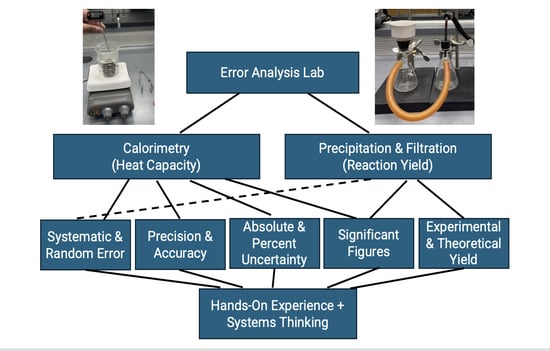
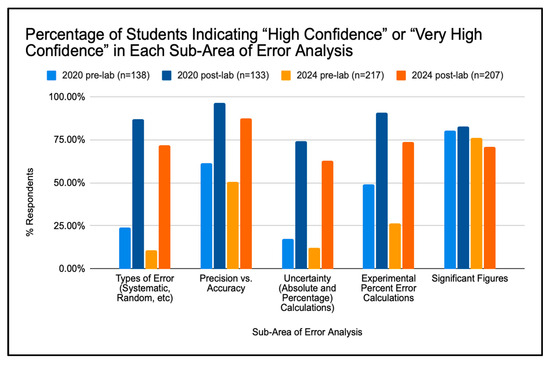
Designing laboratory experiences that support both skill development and conceptual understanding is a persistent challenge in introductory chemistry education—especially within accelerated or compressed course formats. To address this need, we developed and implemented a systems-thinking-based laboratory module on error analysis for a large introductory chemistry course at Brown University, composed primarily of first-year students (approximately 150–200 students in the spring semesters). Unlike traditional labs that isolate single techniques or concepts, this module integrates calorimetry, precipitation reactions, vacuum filtration, and quantitative uncertainty analysis into a unified experiment. Students explore how procedural variables interact to affect experimental outcomes, promoting a holistic understanding of accuracy, precision, and uncertainty. The module is supported by multimedia pre-lab materials, including faculty-recorded lectures and interactive videos developed through Brown’s Undergraduate Teaching and Research Awards (UTRA) program. These resources prepare students for hands-on work while reinforcing key theoretical concepts. A mixed-methods assessment across four semesters (n > 600) demonstrated significant learning gains, particularly in students’ ability to analyze uncertainty and distinguish between accuracy and precision. Although confidence in applying significant figures slightly declined post-lab, this may reflect increased awareness of complexity rather than decreased understanding. This study highlights the educational value of integrating systems thinking into early-semester laboratory instruction. The module is accessible, cost-effective, and adaptable for a variety of institutional settings. Its design advances chemistry education by aligning foundational skill development with interdisciplinary thinking and real-world application.
11 December 2025

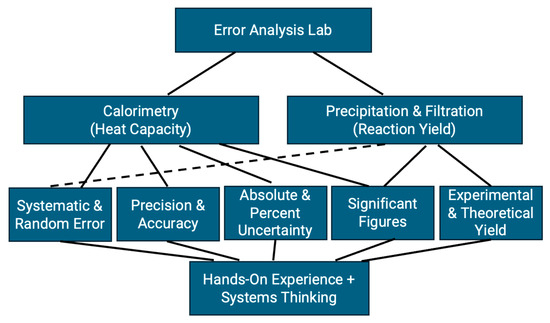
Schematic drawing depicting how multiple sub-concepts of error analysis are integrated into a single hands-on lab module, incorporating systems thinking.

The escalating frequency and complexity of cyber threats have made cybersecurity education a national priority, yet a practical gap persists between theoretical instruction and workforce readiness. This study presents a comprehensive, modular framework for designing and implementing cybersecurity laboratories in academic institutions, environments that foster hands-on learning, skill mastery, and curricular innovation. Using a mixed-methods, multi-stage case study approach, the research combined qualitative analysis of institutional practices and instructional methods with quantitative evaluation of learning outcomes to comprehensively examine technical and pedagogical considerations impacting lab development. Data sources included literature analysis, direct observation, document review, and semi-structured interviews. The study synthesized best practices across these domains into a scalable lab design model grounded in experiential learning theory. Results demonstrate that the framework supports enhanced student performance, instructional adaptability, and simulation fidelity. Case study data revealed measurable gains in participant competency, with all participants achieving at least a 20% improvement in post-training test scores, high engagement levels demonstrated through consistent session attendance and active participation in hands-on exercises, and successful adaptation to logistical and technological barriers, including facility relocations and system downtime incidents. The lab’s modularity enabled curricular alignment, resource efficiency, and expansion to serve workforce training initiatives beyond the classroom. By integrating pedagogical (structured, teacher-guided instructional approaches) and andragogical (adult learning) design with technological scalability, this research contributes an actionable roadmap for institutions seeking to modernize cybersecurity education and respond effectively to evolving digital threats. The findings offer broad implications for future curriculum development, facilitator training, and sustainable program implementation.

23 October 2025

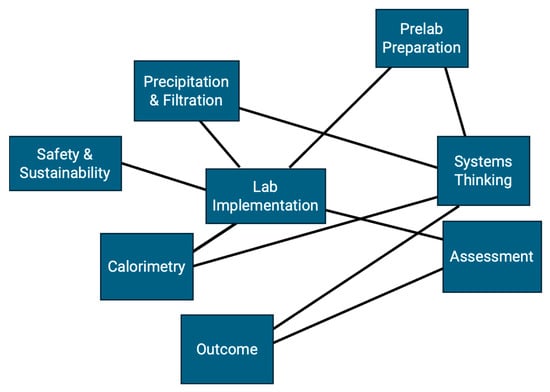
The Modular Adaptive Cybersecurity Laboratory Framework (MACLF) by Dr. S. L. Burton (2025). Modular, adaptive framework for academic cybersecurity laboratory design, highlighting core components and dynamic feedback integration. Created by Dr. Sharon L. Burton.
  • Technical Note
  • Open Access

The VISIR Remote Laboratory: Analysis of Limitations and Proposals for Improvement

  • Frederico Lázaro Jacob,
  • Maria Arcelina Marques and
  • Gustavo R. Alves
  • + 3 authors

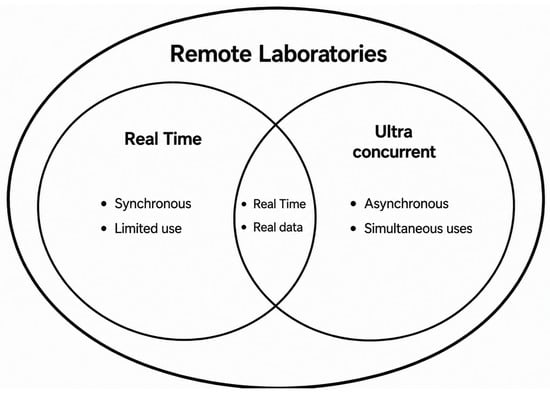
Engineering education depends on hands-on experimentation, but laboratory access is often limited by time, availability, and resources. Remote laboratories mitigate these barriers by enabling online access to real experiments, with the Virtual Instrument Systems in Reality (VISIR) standing out as a long-established system for teaching electronics and electrical circuits. Based on an extensive literature review and on substantial experience, this study qualitatively analyzes VISIR and identifies limitations related to scalability, interoperability, and integration with emerging technologies. From these insights, the paper proposes a set of improvements and technologies to enhance or replace key components while preserving its core infrastructure. The conclusions contribute to practical recommendations for those developing remote laboratories for electrical circuits and analog electronics education, thus offering achievable design suggestions and outlining directions for future research and development.

18 October 2025

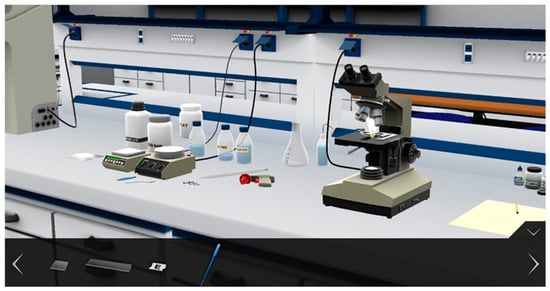
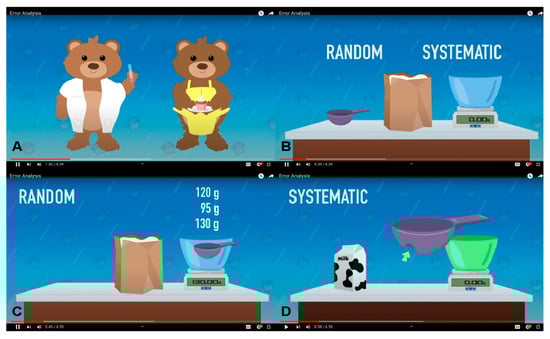
Virtual breadboard interface.

Occupational asthma (OA) and rhinitis are health problems occurring in facilities employing animals for medical and scientific reasons. We have compared the UK trends (2006–2023) in these outcomes reported to the SWORD scheme with changes in routine and personal air monitoring for the major mouse (Mus m 1) and rat (Rat n 1) allergens. The exposure data contained 1540 and 688 mouse and rat results, respectively, expressed in ng.m−3. The median, 75th and 90th percentiles were used as exposure characteristics, and annually incrementing three-yearly rolling data slices compared exposure and health outcomes by linear regression. The median, P75 and P90 for Mus m 1 all showed annual declines of around 5–6% (p < 0.001), suggesting general improvements in controlling mouse allergen exposure, but without evidence of a decline in rat allergen levels (p > 0.05), although control measures for both species are largely identical. An annual mean decline in OA of 2.9% (p = 0.021) was identified, but without a significant decline in rhinitis (−1.4%; p = 0.21). Over 16 years, reductions in exposure to the predominant rodent species were accompanied by a concomitant but smaller reduction in OA. These data confirm the immediate value of controlling relevant allergen exposure in reducing the incidence of IgE-E mediated OA.

29 September 2025

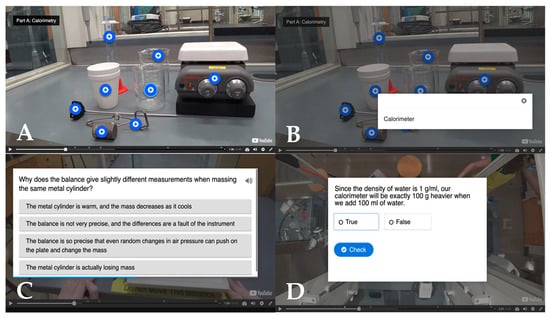
Annual total number of procedures for mice and rats conducted in Great Britain from 2005 to 2022.

News & Conferences

Issues

Open for Submission

Editor's Choice

Get Alerted

Add your email address to receive forthcoming issues of this journal.

XFacebookLinkedIn
Laboratories - ISSN 2813-8856