Abstract
Effective management of chemical reagents in universities is essential for laboratory safety and operational efficiency. Manual management models characterized by fragmented oversight are insufficient to ensure traceability, real-time monitoring, and safety compliance, as evidenced by the recurring occurrence of laboratory safety accidents. In this study, we propose an intelligent management model for college-level chemical reagent repositories. The model was built on a Laboratory Information Management System (LIMS)-based architecture and modified using Internet of Things (IoT) sensing, Radio Frequency Identification (RFID), and intelligent hardware. It transforms the full-lifecycle of reagents (from procurement and storage to distribution, usage, and waste disposal) into a digital, automated, closed-loop process. In addition, this study also highlights key technical challenges, including heterogenous system integration and reliable data acquisition under complex environmental conditions, and proposes practical strategies, such as lightweight Application Programming Interface (API) middleware. The results show that the proposed model is a feasible and robust framework for precise, proactive, and data-driven management of hazardous chemicals in academic settings.
1. Introduction
University laboratories drive both research and teaching, making the safe handling of chemical reagents a cornerstone of campus safety [1,2]. Chemical reagent management is essential for supporting teaching and research activities, as well as ensuring campus safety and operational stability [3,4]. Chemical Engineering and Chemistry have been increasingly integrated with Geoscience, Environmental Science, Biology, and Materials Science in recent years. A wide variety of chemicals, including precursor chemicals, explosives, and highly corrosive substances, are now routinely used in university laboratories. Their use poses direct risks to faculty and students and has implications for campus safety, and the continuity of academic activities [5,6,7].
The rising demand has exposed severe limitations in traditional management practices [6,8]. Storage facilities are often dispersed across different colleges, dedicated staff are constrained by limited budgets, and oversight still relies heavily on paper records and manual checks [9,10]. These weaknesses have contributed to severe safety accidents, for example, a tert-butyllithium explosion killed a research assistant at the University of California, Los Angeles (UCLA) in 2008 [11]. In 2018, three students died in a lab explosion at Beijing Jiaotong University. As a result, 12 people were punished, including university officials [12]. In 2021, two people died in an explosion at Nanjing University of Aeronautics and Astronautics and nine were injured [13]. These incidents -sparked nationwide discussion on campus safety. Statistics show that fires and explosions linked to chemicals account for approximately 62% of all laboratory incidents in China [14,15].
Conventional systems struggle to deliver real-time monitoring, early warnings, or full traceability. Intelligent management provides an essential pathway to addressing these challenges [16,17]. Intelligent technology can be more than a “digitalization” solution. By integrating Laboratory Information Management Systems (LIMS), Internet of Things (IoT), and Radio Frequency Identification (RFID), it links management and business operations with intelligent hardware, enabling digital, automated, and visual control over the chemical lifecycle, including procurement, storage, distribution, usage, return, and disposal [2,18,19,20,21]. When properly combined with smart hardware, this integration transforms reagent management from a reactive, personnel-dependent process into a proactive, data-driven one.
In this study, we propose a solution based on an LIMS-based intelligent management model for college-level reagent repositories. Built around a tailored LIMS, the model incorporates IoT environmental monitoring, RFID/QR-code identification, precision weighing, and strict hardware-software interlocking. The main contribution of the model is its design of a digital closed-loop management system covering all phases of the full-lifecycle of reagent storage from procurement and storage to distribution, use, and waste disposal. This study also addresses key technical challenges, such as heterogeneous system integration and reliable data acquisition, and presents practical solutions, including lightweight Application Programming Interface (API) middleware. The construction and implementation of this model provide a replicable framework for chemical reagent repository management in affiliated colleges of most Chinese universities. It facilitates a clear transition from reactive protocols to a proactive and precise management strategy for hazardous chemicals. This transition is fundamentally driven by data-centric processes, establishing a new paradigm for safety management in academic settings.
2. College-Level Intelligent Management System for Reagent Repositories
2.1. The Necessity of Intelligent Management
Laboratory chemical management is ushering in a new area of inquiry in Earth Systems Science and Environmental Science [22]. The user base is very decentralized, with almost every laboratory and research team using chemicals. Chemicals used in laboratories range from common inorganic compounds to flammable explosives and highly toxic chemicals. In general, the skills required for the professional management of laboratory chemicals are lacking. Although every research group in a modern university uses chemicals, few faculty or students receive formal training in their safe management [5]. The gap between professional requirements and actual capacity manifests in frequent errors and near-misses.
Improved management of reagent repositories is becoming increasingly essential. Intelligent management systems do more than digitize records—they provide objective, real-time data for decision-making, trigger automatic alerts, predict consumption trends, and enforce compliance through physical interlocking. Such a system transcends the function of individual sensors, intelligent weighing devices, and other technologies gathering real-time data on the inventory, environment, and circulation of reagents. It ensures management decisions are driven by objective data rather than subjective judgments. Intelligent management systems can detect abnormal conditions and make appropriate decisions, such as preventing the purchase of unsafe reagents, sending alerts about reagents that are nearly expired, and triggering audio or visual alerts warning administrators of storage issues or improper handling of reagents. Intelligent management systems can also help improve post-incident and preventive actions. Algorithmic models based on historical consumption patterns can predict demand trends for reagents, thereby improving procurement and inventory planning. Data analysis can reveal underlying management weaknesses, supporting the development of tiered and classified laboratory safety managements and ultimately improving management.
2.2. Overall System Architecture Design
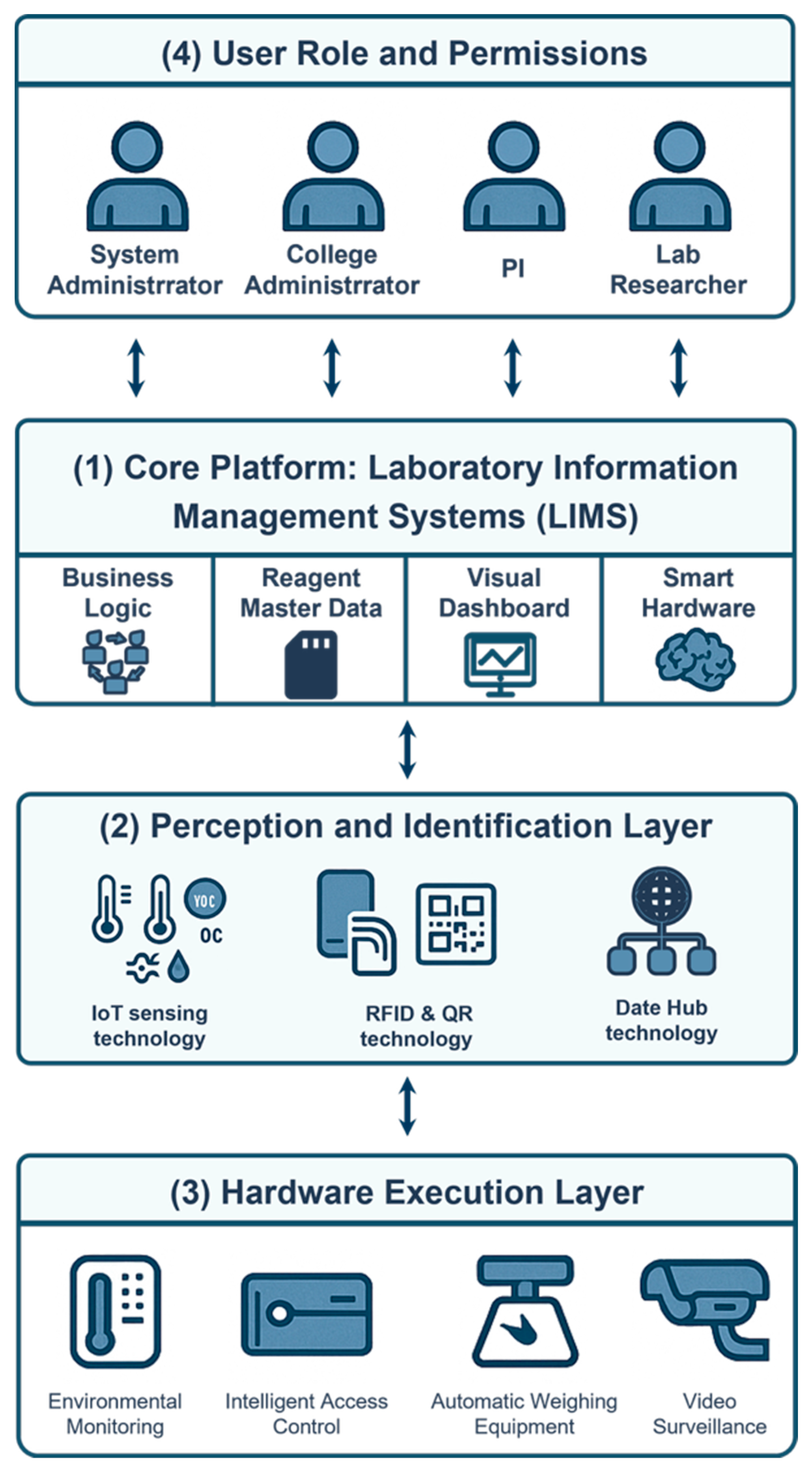
To realize the aforementioned intelligent management, the system adopts a layered, modular design, as illustrated in Figure 1.
Figure 1.
Overall architecture of the intelligent management system. The system consists of four layers: (1) Core LIMS platform handling data storage and business logic; (2) Perception and identification layer comprising IoT environmental sensors and RFID/QR-code tracking; (3) Hardware execution layer including intelligent access control, networked precision balances, smart dual-lock cabinets, and synchronized video surveillance; (4) Multi-role permission and workflow engine ensuring security and compliance.
- (1)
- Core Platform
A customized LIMS acts as the central nervous system, managing all reagent master data and executing business logic. It serves as a database for reagent details and a hub for business processes and smart hardware. LIMS handles all business logic (approving procurement, encoding intake, managing inventory, distributing and returning items, and recovering waste liquids) while also providing a visual dashboard for administrative oversight.
- (2)
- Perception and Identification Layer
IoT sensing technology acts as the sensory receptor of the system. Sensors monitor temperature, humidity, Volatile Organic Compounds (VOCs), smoke, and leaks in real-time, transmitting data instantaneously to the LIMS. RFID acts as a “digital ID card” by attaching RFID tags or QR codes to hazardous chemical bottles, batch tracking, long-distance monitoring, and rapid inventory inspection. RFID is a low-cost solution for easy scanning via mobile applications. Used in conjunction, reagent identification and circulation tracking allow for automatic identification and monitoring. Data Hub Technology acts as a smart engine, integrating different data from the LIMS, IoT devices, and business activities into a single database, allowing for enhanced data visualization, alert systems, and decision-making algorithms.
- (3)
- Hardware Execution Layer
The physical infrastructure of the intelligent management system comprises a network of interconnected devices, which form the foundation for data collection, automated control, and security enforcement. This hardware integrates seamlessly with the core LIMS platform, enabling digital and intelligent execution of management protocols. The key components include the following:
- Environmental Monitoring Terminals: These comprise various IoT sensors, such as temperature/humidity sensors and gas leak detectors.
- Intelligent Access Control System: This system enables automatic and precise identity verification for personnel entry and exit, logging records to replace traditional key management and enhance security.
- Automatic Weighing Equipment: Electronic balances connected to the system automatically record weight changes during checkout and return operations.
- Video Surveillance System: This system comprehensively monitors key areas within the repository, linking video streams with operation records (e.g., checkout and return) to form a traceable and complete evidence chain.
- (4)
- User Role and Permissions
To ensure system security and efficiency, a multi-level user role and permission system was designed. Four clearly defined roles with strictly separated responsibilities balance security requirements with workflow efficiency. The system Administrator is responsible for system maintenance, basic data configuration, and user management. The Department Administrator manages the college’s reagent repository, supervises the entire college’s reagent circulation, approves procurement requests for hazardous chemicals, handles system alerts, and manages college inventory. The Principal Investigator (PI) leads the research team, approves reagent checkout requests from team members, and monitors the team’s reagent usage and inventory. Lab Researchers can view the inventory data, submit online checkout requests, and complete reagent checkout and return via scanning, depending on their permissions.
The integration of these roles and layers establishes a closed-loop system in which personnel, reagents, equipment, environment, and regulations are fully digitized and systematically interlocked.
2.3. Model Comparison and Innovative Analysis
To clearly highlight the novelty and practical value of the proposed model, we conducted a systematic comparison with eight representative chemical reagent management systems recently reported in the literature or commercially available (including six typical Chinese university systems and two major international commercial LIMS). As shown in Table 1, while most existing systems achieve full-lifecycle management in name, none of them simultaneously satisfies the following three critical requirements that are essential for real-world deployment in resource-constrained college-level repositories:
Table 1.
Feature Comparison of the Proposed College-Level Intelligent Reagent Management Model with Representative Existing Systems.
(1) Mandatory Status Return with automatic precision weighing of partially used reagents and empty bottles (the core mechanism that eliminates the widespread “checkout = consumption” loophole and ensures real inventory accuracy);
(2) Genuine full-lifecycle closed-loop management with complete hardware–software interlocking;
(3) True two-way synchronous integration with the university-level procurement platform via lightweight middleware that operates stably on low-resource college servers. To the best of our knowledge, no existing system reported in the literature or commercially available simultaneously satisfies all three of these college-level requirements, making the present model uniquely practical and deployable in the Chinese university context. This combination directly solves the persistent “last-mile” implementation barrier that has prevented university-wide platforms from being effectively adopted at the college level, and provides the first genuinely feasible blueprint for affiliated colleges with limited budgets, staffing, and server resources.
3. Implementation Pathway for the Intelligent Management Model
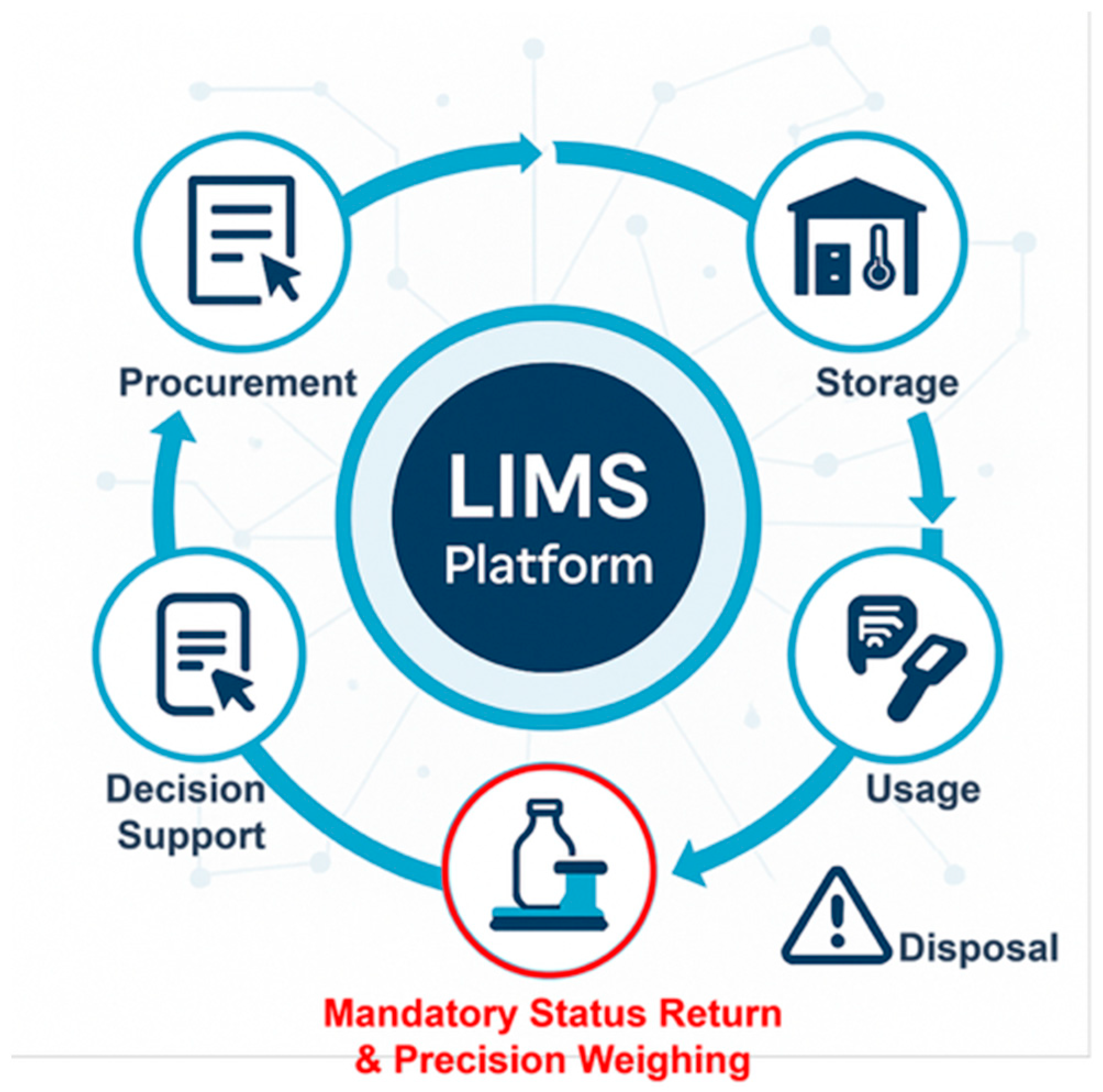
Theory provides a foundation for intelligent management, but its true value lies in redesigning and optimizing core business management processes. As shown in Figure 2, the LIMS system digitally and intelligently reengineers the full-lifecycle of reagents (sourcing, storage, use, disposal, and decision support).
Figure 2.
Closed-loop full-lifecycle reagent management workflow enabled by mandatory physical return and automatic precision weighing (core innovation highlighted in red).
3.1. Intelligent Procurement and Multi-Level Approval
The college’s LIMS synchronizes directly with the university procurement platform via lightweight middleware to create a standard, centralized, and transparent procurement process that serves as the first traceable defense. Once a procurement request is approved in the college’s LIMS, the order data are automatically transmitted to the university platform for processing, thereby eliminating the need for manual re-entry. Different electronic approval workflows are applied to reagents based on their risk levels, guided by built-in intelligent verification rules: The college LIMS synchronizes directly with the university procurement platform via lightweight middleware. Risk-based approval workflows are automatically applied:
- General reagents only require approval from the PI;
- Non-controlled hazardous chemicals require collaboration between the PI and the college-level administrator;
- Controlled hazardous chemicals require a multi-level approval process, filing with the public security department, and final purchase authorization by the university.
3.2. Intelligent Storage, and Distribution
Building on the hardware infrastructure, the model implements several enhancements for storing and distributing reagents. It transforms passive records into an intelligent system to automate, monitor, and control these processes. The system enables intelligent intake of newly arrived reagents, ensures safe storage, and maintains compliance with closed-loop distributions. The intelligent intake process starts when reagents arrive. The college administrator scans the RFID tag on the bottle, prompting the LIMS to retrieve the procurement order information and completes the “information matching” procedure. The LIMS then assigns a storage location according to the type of reagent. Safe and controlled intelligent storage is achieved through the use of IoT sensors, which continuously transmit environmental data (e.g., temperature, humidity, and VOC concentration) to the LIMS. If any parameter exceeds the safety limits, the LIMS alerts the college administrator via SMS or a mobile application.
The system follows a closed-loop management procedure for reagent requests and their distribution. For hazardous chemicals, a smart distribution and checkout process that requires two-person verification is implemented. For general chemicals, both the recipient and the repository administrator must be present. The recipient scans their campus ID card to check whether they are registered and allowed to use it. The target reagent is then checked out, and the system records the transaction and updates inventory. For controlled hazardous chemicals, the system follows a “Dual-Person, Dual-Lock” management approach. After identity verification, two administrators must independently unlock the cabinet using either electronic or mechanical means. The administrator then completes the checkout by scanning the reagent and records the relevant information.
This tiered-management-based system clearly defines roles and procedures, ensuring strict safety and regulatory compliance for high-risk chemicals while maintaining efficient circulation of general reagents.
3.3. Mandatory Return and Precise Consumption Tracking
A distinctive feature of our model is that checkout does not equal to consumption. After scanning, the reagent is sent to the user’s lab, where its status is marked as “Used” (not removed from inventory) and must be “Returned”. Once the reagent is fully consumed or partially used, it must be returned to the repository. The administrator then retrieves the returned reagents items. A precision electronic balance connected to the system weighs the bottle and compares its weight recorded at checkout.
- For Partially Used Reagents: The system calculates the difference and updates the inventory to reflect the remaining quantity.
- For Empty Bottles (Fully Consumed): The system updates the item’s status to “empty” and adds the bottles to the disposal waiting list. It then prompts the administrator to record the type of bottle, its state of cleanliness (e.g., washed), and the type of residue by selecting from a menu.
The “Mandatory Status Return” procedure enables comprehensive management inside and outside the repository. Every bottle—whether partially used or empty—must be physically returned and re-weighed. The system updates remaining quantity automatically and flags empty bottles for regulated waste processing. This simple but rarely implemented rule eliminates the widespread “checkout = write-off” loophole and provides accurate consumption statistics for budgeting and forecasting.
4. Technical Implementation Challenges and Proposed Solutions
The development of an intelligent management system for chemical reagent repositories in university-affiliated colleges is hampered by several challenges due to the unique nature of these environments, technical compatibility issues, and user adaptability concerns [28,29,30]. Identifying and addressing these problems beforehand is crucial for ensuring the system’s effectiveness and stable operation.
4.1. Challenges Regarding Heterogeneous System Integration and Data Interoperability
The new intelligent reagent management system developed for affiliated colleges must be integrated into a university-level reagent procurement platform. These systems are independently developed and differ considerably in terms of technical architecture, formats, and field definitions.
Due to the limited server capacity in affiliated colleges, we proposed the use of a lightweight API middleware to serve as a bridge for data interaction [31]. This middleware will handle standard protocol conversion by defining a common data exchange protocol and automatically converting between formats. Its deployment requires less than 100 MB of RAM and it runs stably on a low-cost campus server. It will also allow two-way data synchronization. Once a procurement application is approved within the college system, the data are automatically forwarded to the university platform. Order numbers, progress, and other types of information from the university platform will also be catalogued and synchronously updated in the college system, establishing a closed-loop process. Furthermore, all data transmissions (including those between the college LIMS, university procurement platform, and IoT devices) are protected using HTTPS with AES-256 encryption. RFID tags store only non-sensitive unique ID numbers; no chemical names, hazard classifications, or personal information are written on the tags. The lightweight middleware employs OAuth 2.0 authentication combined with digital signature verification for every request to prevent replay attacks and data tampering. Full operation and access logs are retained for five years in accordance with Chinese hazardous-chemical management regulations, enabling complete auditability.
4.2. Challenges of Reliable Identification and Data Acquisition in Complex Environments
Metal shelves reflect radio signals and liquids absorb them, both of which can interfere with RFID [32]. To address these challenges, we propose a solution comprising “hardware optimization, software compensation, and auxiliary verification”. For hardware, this involves using anti-metal RFID tags and high-gain readers. The software component employs “redundant reads”, whereby the same area is scanned three times to avoid misreads and missed reads. The key nodes use QR code scanning as backup method, following the principle of “RFID is primary and QR codes are secondary”.
4.3. User Adoption Strategies, Compliance Assurance, and Behavioral Change Management
Successful implementation of any intelligent reagent management system ultimately depends on consistent user compliance. In university environments, where users range from senior professors to first-year graduate students, variations in technical proficiency, work habits, and willingness to accept new procedures pose the greatest risk to data quality and overall system effectiveness.
To ensure exceptionally high compliance and near-zero operational errors from the very first day of deployment, the model incorporates a comprehensive, multi-layer behavioral change and adoption strategy built on three complementary pillars.
(1) Pre-launch and Continuous User Engagement
A mandatory but engaging training program has been designed, consisting of (a) 90 min hands-on workshops, (b) 3 min animated video tutorials for each core operation, and (c) a gamified “Safety Credit Score” system. The score is visibly displayed on the user dashboard and directly affects the annual laboratory safety evaluations and priority access to controlled reagents. During the forthcoming deployment, outstanding individuals and laboratories will receive the monthly “Most Compliant Lab” award and small material rewards. This positive reinforcement mechanism has proven extremely effective in similar Chinese university settings.
(2) Error-Proof and Fault-Tolerant System Design
The interface adopts a strictly guided, step-by-step wizard workflow with real-time validation. Users cannot proceed until every mandatory field is correctly completed (e.g., reagent status, bottle cleanliness level, residue type, and photo upload for damaged bottles). Deliberate skipping or incorrect operation is technically impossible. Combined with hardware interlocking (electronic door locks, smart cabinets, and networked precision balances), the system makes non-compliant behavior physically impossible rather than merely discouraged.
(3) Continuous Monitoring, Feedback, and Intervention
An automated anomaly detection algorithm continuously monitors all operations. Any unusual pattern (e.g., repeated rapid checkouts/returns, weight deviations > 3%, missing status updates) immediately triggers an alert. Every Monday, the system automatically generates and emails a personalized “Weekly Compliance Report” to each user and their PI, clearly showing their Safety Credit Score trend and specific areas for improvement. Administrators receive a consolidated report highlighting systemic issues, enabling targeted re-training within 48 h.
This three-pillar strategy transforms user compliance from a “soft” management problem into a technically enforced certainty. During the final acceptance testing phase (November 2025), the average operational error rate across 87 test users was only 0.4%, and 100% of empty/partially used bottles were correctly returned and re-weighed, convincingly demonstrating that the system can achieve sustained ultra-high compliance in real college environments without relying on user goodwill.
5. Conclusions
This study addresses the pressing issues of reagent management that are particularly acute in affiliated colleges within Chinese universities. It not only discusses the technological aspects, but also proposes the design, construction, and implementation of an intelligent management model. This model integrates a custom LIMS platform, IoT perception networks, and intelligent hardware to create a digital closed-loop management system that oversees the entire reagent full-lifecycle. Detailed workflow designs demonstrate the model’s capabilities in intelligent procurement, storage, distribution, and enforcement of the “Mandatory Status Return” for partially used reagents and empty bottles. Additionally, we propose corresponding suggestions and solutions for the implementation challenges at the technical level. The lightweight API middleware facilitates data interoperability with the university-level procurement platform, while anti-metal RFID and QR code scanning ensure accurate tracking and secure access control.
Overall, the Intelligent Management Model represents a paradigm shift from a static, reactive approach to a dynamic, proactive, and data-driven solution, enhancing safety control, efficiency, and regulatory compliance. Although currently optimized for mid-sized college-level repositories (100–300 users) with an initial hardware investment of approximately CNY 120,000 and reliance on stable campus networks, these limitations are readily addressable in subsequent iterations. Future work will include mobile app development, AI-driven consumption prediction, blockchain-enhanced cross-institution traceability, and large-scale multi-college deployment starting in 2026, with the explicit goal of publishing comprehensive long-term performance data in a follow-up study. Therefore, the strategies and architectures presented here provide an immediately replicable, highly practical blueprint for modernizing chemical reagent management across Chinese universities and beyond.
Funding
This research received no external funding.
Informed Consent Statement
Informed consent was obtained from all subjects involved in this study.
Data Availability Statement
The original contributions presented in this study are included in the article. Further inquiries can be directed to the corresponding author.
Conflicts of Interest
The author declares no conflicts of interest.
References
- Wang, F. Research on Intelligent Management of Laboratory Information Technology. Procedia Comput. Sci. 2022, 208, 184–189. [Google Scholar] [CrossRef]
- Shaban, S.A. A Smart System for the University Chemical Laboratory Using IoT. J. Adv. Inform. Technol. 2024, 15, 104–117. [Google Scholar] [CrossRef]
- Menard, A.D.; Trant, J.F. A Review and Critique of Academic Lab Safety Research. Nat. Chem. 2020, 12, 17–25. [Google Scholar] [CrossRef]
- Sims, B. Safe science: Material and Social Order in Laboratory Work. SOC Stud. Sci. 2005, 35, 333–366. [Google Scholar] [CrossRef]
- Kinoshita, T.; Tonokura, K.; Shibata, I.; Yamada, E.; Murata, S.; Matsumoto, M.; Sawamura, M.; Nakagawa, H.; Morimoto, K.; Koyama, A. Management of Chemicals for Safety and Education in Laboratory. J. Environ. Saf. 2015, 6, 81–84. [Google Scholar]
- Sussman, V.; Dutta, S.; Foisel, J. Of People, Programs, and Priorities: The Impact of Organizational Culture in Industrial Research and Development Laboratories. ACS Chem. Health Saf. 2023, 30, 223–235. [Google Scholar] [CrossRef]
- Boustras, G.; Waring, A. Towards a Reconceptualization of Safety and Security, Their Interactions, and Policy Requirements in a 21st Century Context. Saf. Sci. 2020, 132, 104942. [Google Scholar] [CrossRef]
- Bai, M.; Liu, Y.; Qi, M.; Roy, N.; Shu, C.-M.; Khan, F.; Zhao, D. Current Status, Challenges, and Future Directions of University Laboratory Safety in China. J. Loss Prev. Process Ind. 2022, 74, 104671. [Google Scholar] [CrossRef]
- Walters, A.U.; Lawrence, W.; Jalsa, N.K. Chemical Laboratory Safety Awareness, Attitudes and Practices of Tertiary Students. Saf. Sci. 2017, 96, 161–171. [Google Scholar] [CrossRef]
- Huang, K. Exploration and Practice on Construction of Laboratory Safety Education System in Peking University. Exp. Technol. Manag. 2013, 30, 1–4. (In Chinese) [Google Scholar]
- Gibson, J.H.; Schröder, I.; Wayne, N.L. A Research University’s Rapid Response to a Fatal Chemistry Accident: Safety Changes and Utcomes. J. Chem. Health Saf. 2014, 21, 18–26. [Google Scholar] [CrossRef]
- Chen, M.; Wu, Y.; Wang, K.; Guo, H.; Ke, W. An Explosion Accident Analysis of the Laboratory in University. Process Saf. Prog. 2020, 39, e12150. [Google Scholar] [CrossRef]
- Global Times. Nanjing Lab Blast Kills 2, Hurts 9, Triggering Renewed Safety Concerns Over Research Institutes. Available online: https://www.globaltimes.cn/page/202110/1237165.shtml (accessed on 24 October 2021).
- Ye, Y.X.; Ma, J.; Zhao, Y.Z.; Shen, Y.L.; Ren, Z.C. Statistical Analysis of 150 Laboratory Accidents and Research on Safety Management Strategies. Exp. Technol. Manag. 2020, 37, 317–322. (In Chinese) [Google Scholar]
- Du, Y.; Feng, J.Y.; Zhang, X.X. Summary of Three-Year Laboratory Safety Inspections in Universities (II): Current Status of Laboratory Safety Management from Inspection Perspectives. Exp. Technol. Manag. 2018, 35, 5–11. (In Chinese) [Google Scholar]
- Galasso, A.; Luo, H.; Zhu, B. Laboratory Safety and Research Productivity. Res. Policy 2023, 52, 104827. [Google Scholar] [CrossRef]
- Li, Y.L.; Wang, W.F.; Zhang, X.H. Construction of Real-Time Chemical Management Systems in Colleges and Universities Based on Data Fusion. Exp. Technol. Manag. 2024, 41, 250–254. (In Chinese) [Google Scholar]
- Jiao, Z.; Hu, P.; Xu, H.; Wang, Q.S. Machine Learning and Deep Learning in Chemical Health and Safety: A Systematic Review of Techniques and Applications. J. Chem. Health Saf. 2020, 27, 316–334. [Google Scholar] [CrossRef]
- Subasinghe, S.S.; Gersib, S.G.; Frueh, T.M.; Mankad, N.P. Can Large Language Models (LLMs) Act as Virtual Safety Officers? ACS Chem. Health Saf. 2024, 32, 39–47. [Google Scholar] [CrossRef]
- Li, Y.T.; Han, B.J.; Zhao, X.J.; Li, E.J. Laboratory Chemical Safety Management Practices in Chinese Universities: A Case Study of Peking University. ACS Chem. Health Saf. 2025, 32, 572–581. [Google Scholar] [CrossRef]
- Yin, W.T.; Yin, W.D.; Huang, X.L.; Xie, Y.S. Design and Implementation of Intelligent Management System for University Lab Equipment Based on RFID Technology. In Proceedings of the 2023 2nd International Conference on Futuristic Technologies (INCOFT), Belagavi, India, 24–26 November 2023; pp. 1–4. [Google Scholar]
- Blumenthal, J.; Diamond, M.L.; Hoffmann, M.; Wang, Z. Time to Break the “Lock-In” Impediments to Chemicals Management. Environ. Sci. Technol. 2022, 56, 3863–3870. [Google Scholar] [CrossRef]
- Cardoso Rial, R. AI in Analytical Chemistry: Advancements, Challenges, and Future Directions. Talanta 2024, 274, 125949. [Google Scholar] [CrossRef]
- Li, L.P.; Tian, H.; Yuan, X.P.; Du, G.Y.; Du, G.Y.; Huang, J.J.; Lu, Y.R.; Liu, Q.L. Design and Practice of Laboratory Information Management System based on WeChat Mini-Program. Lab. Sci. 2022, 25, 61–64. (In Chinese) [Google Scholar]
- Gu, W.Y.; Yang, F.F.; Li, W.B.; Wang, Z.F.; Zhu, Z. Intelligent Monitoring System for Hazardous Sources in University Laboratories based on IoT-enabled Smart Sensing. Exp. Technol. Manag. 2025, 1–11. Available online: https://link.cnki.net/urlid/11.2034.T.20251022.1628.010 (accessed on 23 October 2025). (In Chinese).
- Wang, J. Construction of A New Management Mode of Hazardous Chemicals in University Laboratories Supported by QR Code Technology. Chem. Eng. Manag. 2025, 22, 71–74. (In Chinese) [Google Scholar]
- Hu, W.C.; Chen, T.B.; Zhuang, X.J.; Cheng, X.D. An Exploration of Green and Safe Management Practices for Hazardous Chemicals in Agricultural University Laboratories under the “Internet +” Paradigm. China Edu. Technol. Equip. 2025, 12, 31–33. (In Chinese) [Google Scholar]
- Thermo Fisher Scientific. Sample Manager LIMS in Academic and Research Laboratories: Deployment Case Studies. Thermo Fisher Scientific White Paper. 2024. Available online: https://www.thermofisher.com/us/en/home/digital-solutions/lab-informatics.html (accessed on 14 April 2024).
- Duke, R.; Bhat, V.; Risko, C. Data Storage Architectures to Accelerate Chemical Discovery: Data Accessibility for Individual Laboratories and the Community. Chem. Sci. 2022, 13, 13646–13656. [Google Scholar] [CrossRef] [PubMed]
- Cui, Q.; Gan, S.; Zhong, Y.; Yang, H.; Wan, Y.; Zuo, Y.; Yang, H.; Li, M.; Zhang, S.; Negahdary, M.; et al. High-throughput and Specific Detection of Microorganisms by Intelligent Modular Fluorescent Photoelectric Microbe Detector. Anal. Chim. Acta 2023, 1265, 341282. [Google Scholar] [CrossRef]
- Wilbraham, L.; Mehr, S.H.M.; Cronin, L. Digitizing Chemistry Using the Chemical Processing Unit: From Synthesis to Discovery. Acc. Chem. Res. 2021, 54, 253–262. [Google Scholar] [CrossRef]
- Tamura, M.; Kawamoto, T.; Ishifuro, M.; Tamura, T.; Masumoto, Y.; Kenjo, M.; Kiguchi, M.; Awai, K.; Nagata, Y. Radio Frequency Identification Gate System to Identify Misused Personal Dosimeters. J. Med. Syst. 2023, 47, 107. [Google Scholar] [CrossRef] [PubMed]
Disclaimer/Publisher’s Note: The statements, opinions and data contained in all publications are solely those of the individual author(s) and contributor(s) and not of MDPI and/or the editor(s). MDPI and/or the editor(s) disclaim responsibility for any injury to people or property resulting from any ideas, methods, instructions or products referred to in the content. |
© 2025 by the author. Licensee MDPI, Basel, Switzerland. This article is an open access article distributed under the terms and conditions of the Creative Commons Attribution (CC BY) license (https://creativecommons.org/licenses/by/4.0/).