

You are currently viewing a new version of our website. To view the old version click .

Journal of Aesthetic Medicine

Journal of Aesthetic Medicine is an international, peer-reviewed, open access journal on dermatology, plastic surgery, and cosmetic procedures published quarterly online by MDPI.

All Articles (11)

Background: Large-volume ptotic breasts are associated with incision complication rates in single-stage direct-to-implant pre-pectoral breast reconstruction. The aim is to propose an updated surgical approach for this patient population. Methods: A small retrospective case series of patients who underwent direct-to-implant breast reconstruction without a wise-pattern incision from 2019 to 2024 at a single academic institution. Results: Eight breasts from five patients fulfilled the inclusion criteria. One patient had minimal superior nipple–areolar complex ischemia with no additional postoperative complications identified. Conclusions: Refinement to a popular direct-to-implant breast reconstruction technique has the potential to decrease complication rates and improve aesthetic outcomes in large-volume ptotic breasts.

5 December 2025
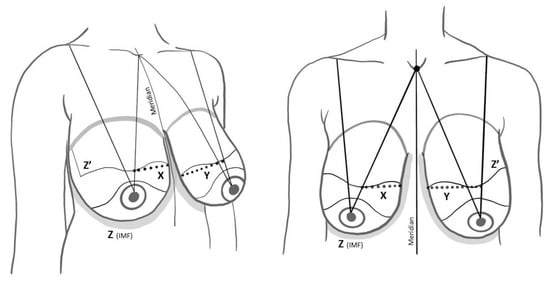
Z is the inframammary fold. Z’ is the new breast pocket. X is from the meridian to the medial triangle. Y is the meridian to the lateral triangle.

Cellulite, or edematous-fibro-sclerotic panniculopathy (EFSP), is a multifactorial condition affecting most postpubertal women, characterized by surface irregularities with significant psychosocial impact. Its pathogenesis involves adipocyte metabolism, fibrous septa, microvascular dysfunction, extracellular matrix (ECM) remodeling, oxidative stress, and low-grade inflammation. Topical therapies remain among the most accessible approaches, acting on specific biological pathways. Osmotic and vSSasomodulatory formulations reduce edema and improve microcirculation, while methylxanthines such as caffeine and aminophylline promote lipolysis and enhance cutaneous blood flow. Retinoids mainly target the ECM, stimulating neocollagenesis and dermal thickening, with greater efficacy in early EFSP. Botanicals, including Centella asiatica, Rosmarinus officinalis, and Ginkgo biloba, provide antioxidant, anti-inflammatory, and venotonic effects. Randomized controlled trials consistently report modest but reproducible benefits: localized circumference reductions and improved elasticity, echogenicity, and orange-peel scores, all with excellent tolerability. Recent innovations, such as lipid nanoparticles, ultradeformable vesicles, and microneedle-assisted delivery, aim to enhance penetration, stability, and sustained bioactivity of established actives. Nonetheless, most studies are small, short-term, and heterogeneous, with limited ability to isolate the role of individual components or control for massage-related effects. Artificial intelligence offers opportunities to standardize outcome measures, optimize formulations, and personalize protocols. Overall, topical therapies are best positioned as safe, biologically active adjuncts within multimodal cellulite management.

1 December 2025

This narrative literature review is an evaluation of the cosmetic, perioperative, and clinical outcomes of alternative approaches to submandibular gland excision, including conventional and robotic transoral excision, as well as endoscopic and robotic retroauricular excision, in comparison with the traditional transcervical approach. We intend to compare the cosmetic impact of each procedure based on the type of scar and location. PubMed and Google Scholar identified studies published between January 2000 and May 2025 which reported the outcomes of submandibular gland excisions performed using a transcervical, transoral, or retroauricular technique. Our analysis showed that the transcervical approach provides reliable access but carries risks of marginal mandibular nerve injury (18.7%) and visible cervical scarring. Conventional transoral excision avoids external scars and reduces the risk to the marginal mandibular branch and hypoglossal nerves but increases the risk of lingual nerve neuropraxia, with transient sensory deficits reported in 25–43% of patients. Robotic transoral excision preserves the sublingual gland and may improve completeness of resection, but operative times remain prolonged (<190 min). Endoscopic and robotic retroauricular excision can hide scars in the hairline and provide improved cosmetic satisfaction scores, with limitations including longer operative times and learning curves. Alternative approaches to submandibular gland excision provide improved cosmetic outcomes with comparable safety profiles to the transcervical approach.

27 November 2025

Facial aesthetic surgery has evolved from early reconstructive efforts to highly refined, technology-driven practice. This educational review explores the historical development of key procedures, including rhinoplasty, blepharoplasty, and facelifts, and connects these milestones to modern innovations including artificial intelligence, virtual reality, and three-dimensional planning. By linking past techniques to current approaches, this work highlights how foundational surgical principles continue to guide safe, precise, and patient-centered aesthetic care.

21 November 2025

News & Conferences

Issues

Open for Submission

Editor's Choice

Get Alerted

Add your email address to receive forthcoming issues of this journal.

XFacebookLinkedIn
J. Aesthetic Med. - ISSN 3042-6774