Environmental and Agronomic Factors Shaping Phenolic Composition in Horticulture

A special issue of Horticulturae (ISSN 2311-7524). This special issue belongs to the section "Medicinals, Herbs, and Specialty Crops".

Deadline for manuscript submissions: 10 August 2026 | Viewed by 1654

Special Issue Editors


E-Mail Website
Guest Editor
Faculty of Pharmacy and Biochemistry, University of Zagreb, A Kovačića 1, 10000 Zagreb, Croatia
Interests: analytical chemistry; history of pharmacy; medicinal plant; phenolic compounds; antioxidant

E-Mail Website
Guest Editor
Faculty of Agriculture, University of Zagreb, Svetošimunska Cesta 25, 10000 Zagreb, Croatia
Interests: medicinal plants; essential oil; biological activity; micromorphology; ornamental plants
Special Issues, Collections and Topics in MDPI journals

Special Issue Information

Dear Colleagues,

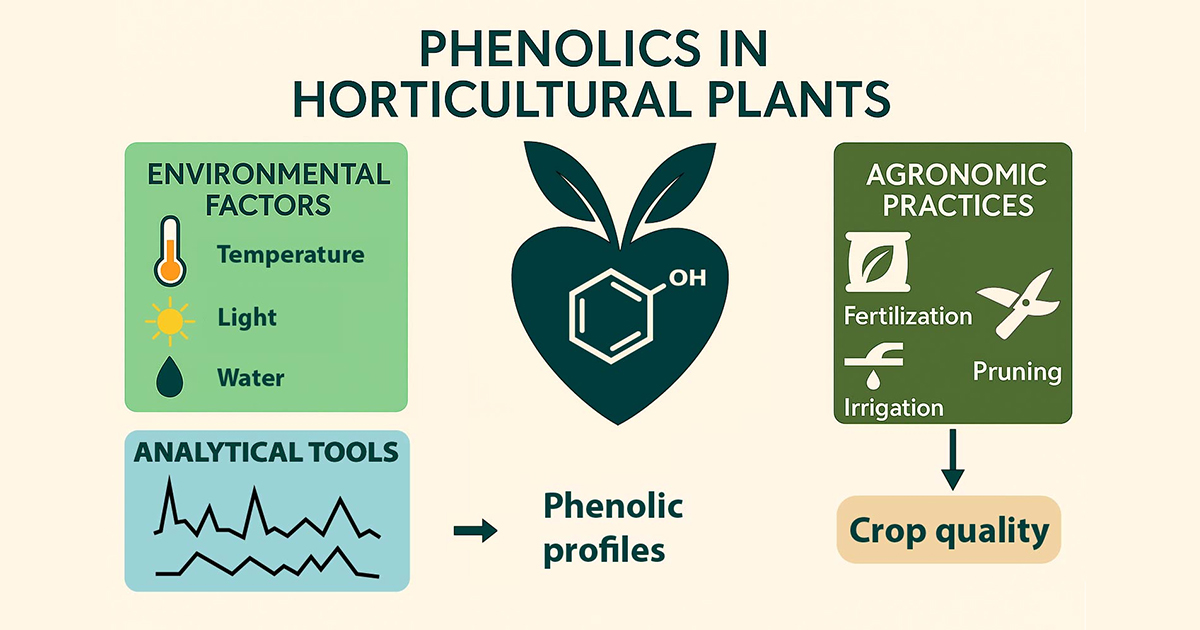
Phenolic compounds are fundamental to plant physiology, stress adaptation, nutritional quality and the health-promoting properties of horticultural products. Their composition and concentration are highly dynamic and depend on growing conditions. They are shaped by complex interactions between environmental factors (temperature, light intensity, water availability and soil characteristics) and agronomic practices such as fertilization, irrigation, pruning and sustainable production strategies. This Special Issue highlights recent findings on how these factors influence phenolic biosynthesis and variability across horticultural species, as well as the potential of advanced analytical tools and modern agricultural approaches to optimize phenolic profiles and improve crop quality. By integrating new insights from plant science, agronomy and food technology, this approach provides a comprehensive understanding of phenolic composition in horticultural plants.

Dr. Suzana Inić
Dr. Dario Kremer
Guest Editors

Manuscript Submission Information

Manuscripts should be submitted online at www.mdpi.com by registering and logging in to this website. Once you are registered, click here to go to the submission form. Manuscripts can be submitted until the deadline. All submissions that pass pre-check are peer-reviewed. Accepted papers will be published continuously in the journal (as soon as accepted) and will be listed together on the special issue website. Research articles, review articles as well as short communications are invited. For planned papers, a title and short abstract (about 250 words) can be sent to the Editorial Office for assessment.

Submitted manuscripts should not have been published previously, nor be under consideration for publication elsewhere (except conference proceedings papers). All manuscripts are thoroughly refereed through a single-blind peer-review process. A guide for authors and other relevant information for submission of manuscripts is available on the Instructions for Authors page. Horticulturae is an international peer-reviewed open access monthly journal published by MDPI.

Please visit the Instructions for Authors page before submitting a manuscript. The Article Processing Charge (APC) for publication in this open access journal is 2200 CHF (Swiss Francs). Submitted papers should be well formatted and use good English. Authors may use MDPI's English editing service prior to publication or during author revisions.

Keywords

  • phenolic compounds
  • horticulture
  • environmental factors
  • agronomic practices
  • quality
  • sustainable agriculture
  • analytical tools

Benefits of Publishing in a Special Issue

  • Ease of navigation: Grouping papers by topic helps scholars navigate broad scope journals more efficiently.
  • Greater discoverability: Special Issues support the reach and impact of scientific research. Articles in Special Issues are more discoverable and cited more frequently.
  • Expansion of research network: Special Issues facilitate connections among authors, fostering scientific collaborations.
  • External promotion: Articles in Special Issues are often promoted through the journal's social media, increasing their visibility.
  • Reprint: MDPI Books provides the opportunity to republish successful Special Issues in book format, both online and in print.

Further information on MDPI's Special Issue policies can be found here.

Published Papers (2 papers)

Order results
Result details
Select all
Export citation of selected articles as:

Research

23 pages, 3239 KB  
Article
Chemotypic Diversity and Integrated Metabolic Profiling of Myrtle (Myrtus communis L.) from Mediterranean Turkey
by Deniz Hazar, Esra Gölcü, Aydın Mızrak, Doğan Ergün, Luca Mazzoni, Ebru Kafkas, Esra Alim and Sevinç Ateş
Horticulturae 2026, 12(5), 633; https://doi.org/10.3390/horticulturae12050633 - 20 May 2026
Viewed by 260
Abstract
Myrtus communis L. (common myrtle) is an economically valuable Mediterranean shrub with diverse applications in food, pharmaceutical, and ornamental sectors. However, the biochemical diversity of myrtle genotypes from Mediterranean environments remains insufficiently characterized, particularly regarding the relationship between primary and secondary metabolism and [...] Read more.
Myrtus communis L. (common myrtle) is an economically valuable Mediterranean shrub with diverse applications in food, pharmaceutical, and ornamental sectors. However, the biochemical diversity of myrtle genotypes from Mediterranean environments remains insufficiently characterized, particularly regarding the relationship between primary and secondary metabolism and stress adaptation. This study investigated the biochemical and aroma profiles of six myrtle genotypes selected from natural populations in Antalya, Turkey, to identify chemotypic diversity and elucidate metabolic diversity observed in Mediterranean genotypes. Volatile compounds were analyzed using HS-SPME/GC-MS, while sugars and organic acids were quantified by HPLC. Multivariate statistical analyses (PCA, hierarchical clustering) were employed to evaluate metabolic relationships and genotype classification. Descriptive analysis suggested three potential chemotypic patterns: (i) 1,8-cineole-type (G34, G36) with G29 showing a transitional profile, (ii) α-Pinene-type (G15, G37), and (iii) Ester-aldehyde type (G9). These groupings are based on single volatile measurements and should be considered preliminary patterns pending validation through replicate analyses. Significant genotypic variation was observed for primary metabolites (sugars and organic acids) (p < 0.001, η2 > 0.90), as evaluated by ANOVA with triplicate biological replicates. Volatile compound differences were evaluated as descriptive exploratory patterns only. Hierarchical clustering revealed three metabolic strategies: balanced metabolism integrating diverse volatile and primary metabolite profiles (Cluster 1: G9, G15, G37), terpene-rich volatile defense with enhanced organic acid metabolism (Cluster 2: G29, G36), and specialized 1,8-cineole-dominant biosynthesis (Cluster 3: G34). These findings highlight substantial metabolic diversity and provide a basis for germplasm evaluation and selection and potential applications. Full article
Show Figures

Figure 1

29 pages, 1100 KB  
Article
Preharvest Salicylic Acid Application Enhances Pigments, Antioxidants, and Secondary Metabolites in Cannabis sativa L.
by Nattaya Montri, Chachpon Tebdoie, Papitchaya Kongchinda, Pornjarus Singhavorachai, Borworn Tontiworachai, Anusorn Cherdthong, Chalermpon Yuangklang, Rujira Deewatthanawong and Sineenart Polyorach
Horticulturae 2026, 12(3), 276; https://doi.org/10.3390/horticulturae12030276 - 26 Feb 2026
Viewed by 1062
Abstract
Salicylic acid (SA) is a key signaling molecule regulating secondary metabolism and stress responses in plants, but its preharvest role as a low-cost elicitor in cannabis remains underexplored. This study evaluated the effects of preharvest foliar SA application at different concentrations and application [...] Read more.
Salicylic acid (SA) is a key signaling molecule regulating secondary metabolism and stress responses in plants, but its preharvest role as a low-cost elicitor in cannabis remains underexplored. This study evaluated the effects of preharvest foliar SA application at different concentrations and application intervals on pigments, antioxidants, and cannabinoids in Cannabis sativa L. leaves and inflorescences. In leaves, moderate SA (0.1 M) significantly enhanced total phenolic content, total flavonoid content, and antioxidant activity (%DPPH inhibition), while higher concentrations suppressed these responses, reflecting a regulated metabolic trade-off rather than irreversible tissue damage. A significant interaction between SA concentration and preharvest time was observed for chlorophyll a (p < 0.01), whereas chlorophyll b and total chlorophyll were not significantly influenced by the interaction. In inflorescences, short-term application of 0.1 M SA (1 h preharvest) maximized phenolics, flavonoids, antioxidant capacity, and pigment accumulation, whereas the untreated controls showed the lowest levels. Cannabinoids exhibited distinct responses: Δ9-tetrahydrocannabinol (Δ9-THC), total tetrahydrocannabinol (Total THC), and tetrahydrocannabinolic acid (THCA) peaked at 0.1 M SA applied 1 h preharvest, while cannabidiol (CBD) was less concentration-dependent, with maximum accumulation observed at 1.0 M SA applied 24 h preharvest. Preharvest SA elicitation strongly modulated cannabis secondary metabolism. Short-term application of moderate SA promoted total phenolic, total flavonoid, antioxidant, pigment, and THC-group cannabinoid accumulation, while CBD displayed broader tolerance to concentration and application timing. These findings highlighted the potential of SA as a preharvest elicitor to improve cannabis phytochemical quality. Full article
Show Figures

Figure 1

Back to TopTop