





Genes 2024, 15(6), 816; https://doi.org/10.3390/genes15060816 - 20 Jun 2024
Cited by 3 | Viewed by 1879
Abstract
►
Show Figures
The identification of new biomarkers of ocular diseases is nowadays of outmost importance both for early diagnosis and treatment. Epigenetics is a rapidly growing emerging area of research and its involvement in the pathophysiology of ocular disease and regulatory mechanisms is of undisputable
[...] Read more.
The identification of new biomarkers of ocular diseases is nowadays of outmost importance both for early diagnosis and treatment. Epigenetics is a rapidly growing emerging area of research and its involvement in the pathophysiology of ocular disease and regulatory mechanisms is of undisputable importance for diagnostic purposes. Environmental changes may impact the ocular surface, and the knowledge of induced epigenetic changes might help to elucidate the mechanisms of ocular surface disorders. In this pilot study, we investigated the impact of extensive contact lens (CL) wearing on human corneal epithelium epigenetics. We performed ex vivo analysis of the expression of the miR-320 and miR-423-5p involved in the processes of cellular apoptosis and chronic inflammation. The human corneal epithelium was harvested from healthy patients before the photorefractive keratectomy (PRK). The patients were divided into two age- and sex-matched groups accordingly to CL wearing history with no CL wearers used as a control. The epithelium was stored frozen in dry ice at −80 °C and forwarded for miRNA extraction; afterwards, miRNA levels were detected using real-time PCR. Both miRNAs were highly expressed in CL wearers (p < 0.001), suggesting epigenetic modifications occurring in chronic ocular surface stress. These preliminary results show the relationships between selected miRNA expression and the chronic ocular surface stress associated with extensive CL use. MicroRNAs might be considered as biomarkers for the diagnosis of ocular surface conditions and the impact of environmental factors on ocular surface epigenetic. Furthermore, they might be considered as new therapeutic targets in ocular surface diseases.
Full article
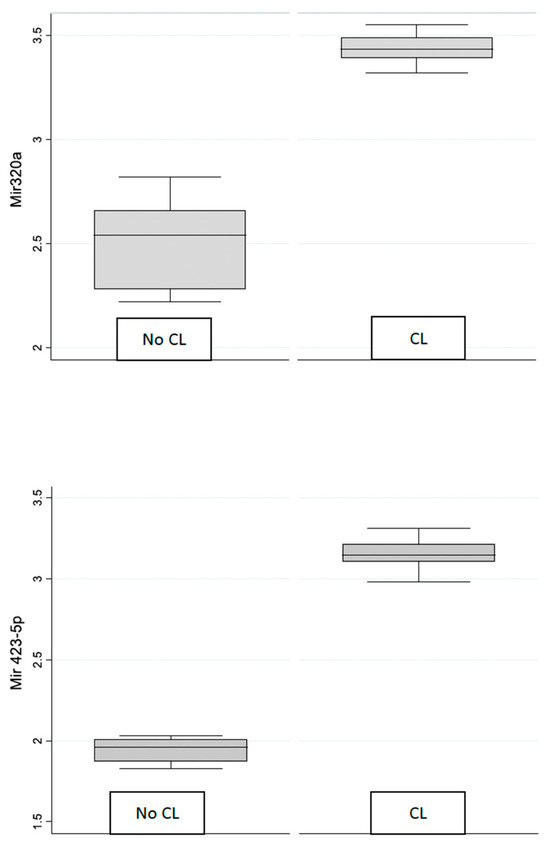
Figure 1