
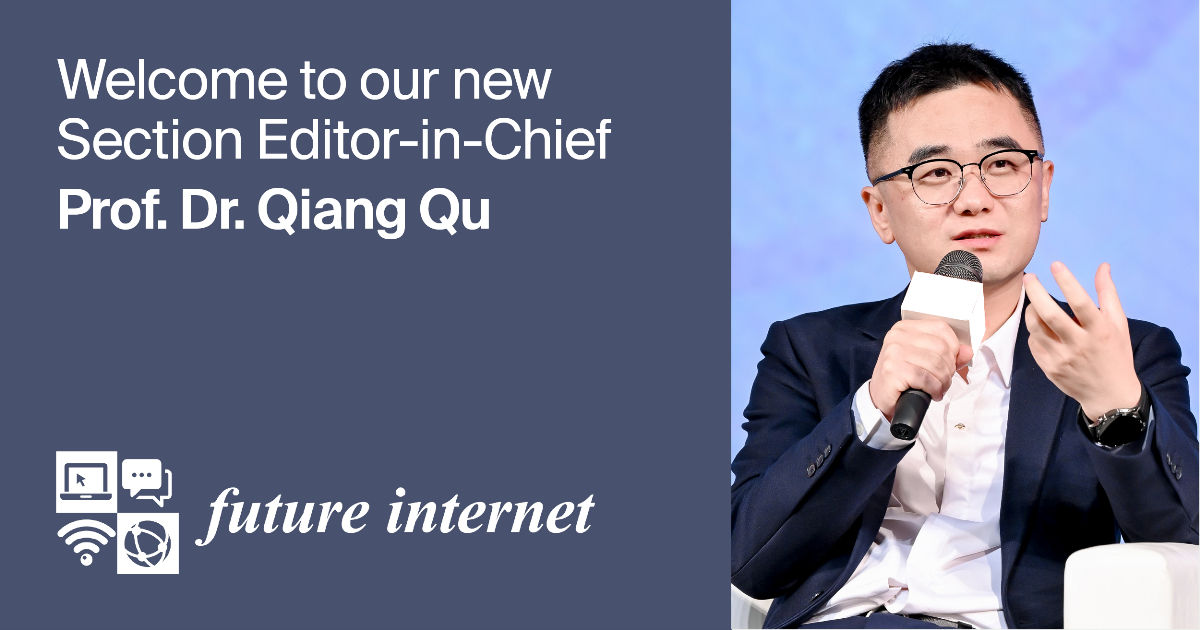
Prof. Dr. Qiang Qu Appointed Section Editor-in-Chief of Section “Big Data and Augmented Intelligence” in Future Internet
We are pleased to announce that Prof. Dr. Qiang Qu has been appointed Editor-in-Chief of the Section “Big Data and Augmented Intelligence”. We look forward to his contributions to Future Internet (ISSN 1999-5903).
Prof. Dr. Qiang Qu is a full professor at Shenzhen Institutes of Advanced Technology, Chinese Academy of Sciences. He is currently the director of Guangdong Provincial Blockchain and Distributed IOT Security Engineering Research Center, and the deputy director of Shenzhen Key Laboratory on High-performance Data Mining. He is a senior member of the China Computer Federation. Qiang received his PhD from Aarhus University, supervised by Obel Professor Christian S. Jensen in 2014. He has work experience from Innopolis University, Carnegie Mellon University, ETH Zurich and Singapore Management University. His research endeavors focus on blockchain/Web3 technologies, databases, data mining, and advanced data intelligence systems. He joined the Chinese Academy of Sciences at the end of 2016, and he was promoted to a full professor in 2020. He has been a principle investigator (PI) for a number of projects, and he is now the chief scientist for a project supported by the National key research and development Program of China.
The following is a short Q&A with Prof. Qiang Qu, who shared his vision for the journal with us, as well as his views of the research area and open access publishing:
1. Could you briefly introduce your main research areas and achievements?
My research focuses on trustworthy data intelligence, integrating blockchain and AI. I was among the first to systematically propose the Blockchain+AI paradigm and also proposed the concept of spatial–temporal blockchain to anchor data in real-world contexts. I published a pioneering book on this paradigm in 2019, and have since led national key R&D projects, authored 180+ papers, and deployed solutions at Huawei Cloud. I believe this paradigm is the core technology for the future intelligent society and the emerging agent economy.
2. What appealed to you about the journal that made you want to take the role as its Section Editor-in-Chief?
Future Internet’s Section “Big Data and Augmented Intelligence” sits at the perfect intersection of my work. The journal’s forward-looking, open access spirit aligns with my belief that data is the foundation and moat of AI. I see this role as a platform to shape rigorous, impactful discourse on how decentralized intelligence and big data co-evolve.
3. What are your expectations and suggestions for the future development of our Section and the journal?
I expect the section to become a hub for cross-disciplinary research on trustworthy, decentralized data systems. My suggestion is to actively encourage submissions on blockchain–AI integration, multi-agent systems, and data sovereignty, areas that are often siloed. We should also foster industry–academic dialogues to ground research in real-world agent economy needs.
4. What is your vision for the journal?
My vision is to position Future Internet as the leading venue for actionable intelligence on future data ecosystems, where big data meets augmented intelligence via verifiable, decentralized infrastructure. I want the journal to bridge theoretical advances (e.g., Web4, agent economies) with practical engineering, emphasizing data as both the foundation and the competitive moat for AI systems.
5. What does the future of this field of research look like?
The future lies in agent economies powered by trustworthy data intelligence. We will see massive multi-agent collaboration underpinned by blockchain for trust and AI for decision-making. Data will not only fuel AI but also serve as a strategic asset, the moat. Research will shift from isolated models to verifiable, interoperable, and human-centric intelligent systems.
6. What do you think of the development of open access in the publishing field?
Open access is essential for democratizing knowledge, especially in fast-moving fields like blockchain and AI. It accelerates the translation of research into real-world impact, enabling startups, policymakers, and global researchers to access cutting-edge insights. However, we must ensure quality and sustainability with rigorous peer review are the way forward.
We wish Prof. Dr. Qiang Qu every success in his new position, and we look forward to his contributions to the journal.