
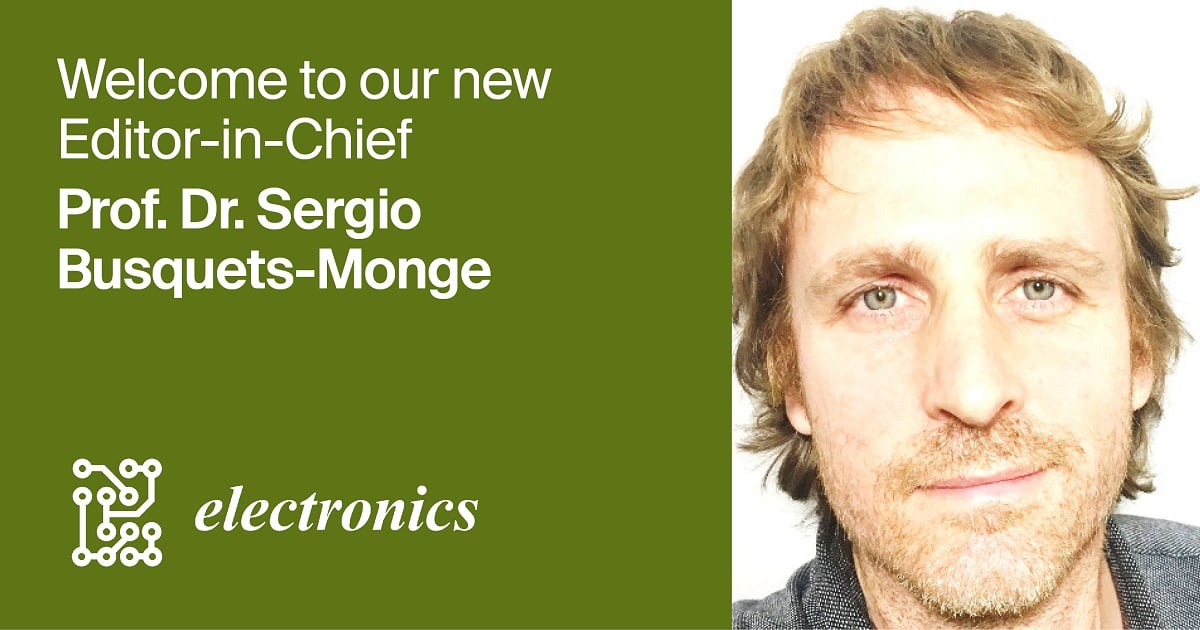
Prof. Dr. Sergio Busquets-Monge Appointed Editor-in-Chief of Electronics
Electronics (ISSN 2079-9292) is pleased to welcome Prof. Dr. Sergio Busquets-Monge as its new Editor-in-Chief. A Full Professor in the Electronic Engineering Department at the Universitat Politècnica de Catalunya (UPC), Barcelona, Spain, Prof. Dr. Busquets-Monge has more than 25 years of experience in power electronics research, academic publishing, and editorial work. His research focuses on multilevel power conversion, with applications in renewable energy systems and electric vehicles.
With his extensive experience in both research and scholarly publishing, Prof. Dr. Busquets-Monge brings a broad perspective to his new role and a strong commitment to fostering scientific communication and collaboration. As Electronics continues to evolve alongside rapid advances in electronics technology, he looks forward to contributing to the journal’s development and supporting its global research community.
In the following interview, Prof. Dr. Busquets-Monge looks back on his academic journey, reflects on the development and strengths of Electronics, and shares his vision for the journal’s future. He also discusses emerging research directions, the opportunities and challenges facing the electronics community, and the importance of effective scientific communication.
1. Could you briefly introduce yourself and share a little about your academic journey and research background?
I am currently a Full Professor at the Electronic Engineering Department of Universitat Politècnica de Catalunya in Barcelona, Spain. I graduated from the same university in 1999, obtaining a degree equivalent to a BS plus an MS covering all areas of engineering, with special focus on electrical engineering. Then, I moved to the USA, where I joined the Center for Power Electronics Systems to further my incipient research journey in power electronics, and in 2001, I obtained an MS in electrical engineering from the Virginia Polytechnic Institute and State University. Finally, for personal reasons, I decided to move back to Spain, where I obtained a PhD degree in electronic engineering from my current university, and I was subsequently awarded an Assistant Professor position.
I have always researched in the area of power electronics, particularly in multilevel power conversion, with applications in renewable energy systems and electric vehicles. My current research interests include modular and scalable power converter design based on multilevel neutral-point-clamped topologies and electric vehicles.
2. You have recently taken on the role of Editor-in-Chief of Electronics. What attracted you to this role, and what does this appointment mean to you?
After more than 25 years in the publication arena, both as an author, reviewer and Academic Editor, I have deeply reflected on the role of scientific publications. I am convinced that the advances in science and technology are achieved thanks to the contributions of the community as a whole, and scientific publications play an important role in establishing communication channels to make this collaboration a reality. Given this relevance, it is an honor for me to take the role of Editor-in-Chief of Electronics. From this position, I would like to contribute to reinforce the role of scientific publications, and open the debate to adapt the publication process to the new times, so that they better serve their mission.
3. What are your impressions of Electronics and its development so far? What do you think are the journal’s greatest strengths?
Electronics is already a consolidated journal with fifteen years of history that encompasses all areas within the electronics technology. Thus, it offers a global overview of the development of this technology. The journal is improving year after year. In my opinion, one of the main strengths of the journal is a revision process that is satisfactory for the authors, where in a short timeframe they either receive a grounded rejection decision or are requested to introduce necessary changes to clarify the work and/or strengthen the contribution. Generally, this is achieved without becoming bogged down in excessively long revision processes focused on non-critical issues—processes that can frustrate the authors and prevent them from focusing on the core of the research. This efficient review process is possible thanks to robust in-house editorial support and the journal’s commitment to continuous improvement.
4. Are there any emerging research areas or interdisciplinary topics that you would particularly like to see more of in Electronics?
Among the many interesting emerging and interdisciplinary research areas, I could mention here quantum computing, advanced implementation of artificial intelligence, power conversion solutions for data centers, and green electronics.
5. What do you think will be the most important challenges and opportunities for the electronics research community over the next 5–10 years?
As electronics technology is at the heart of many of the most prominent technological challenges of our society, there are many topics that will shine in the coming years. I would like to highlight here the overcoming of the limits of traditional silicon scaling, developing advanced systems for the effective and efficient implementation of artificial intelligence, including the power conversion systems that feed them, reaching a truly sustainable energy system, and developing sustainable electronics systems on the grounds of eco-design and circularity.
6. What advice would you give to researchers who are considering submitting their work to Electronics?
I would encourage them to submit their manuscript after rigorous research work, very carefully and clearly written, and enjoy the process of publishing with us. Comments from reviewers, with a different perspective than the authors, will likely be an opportunity to improve their work. To maximize chances of having your paper accepted, it is essential to explain very clearly the research undertaken and the results obtained. Effective communication is as important as the technical work. In practice, this makes sense, as undertaking an excellent research that is not properly communicated would have an equivalent effect on the community as doing no research at all. Or even worse, it could be misleading!
7. Finally, if you could give one message to the electronics community as you begin your term as Editor-in-Chief, what would you like to say?
Electronics technology is enabling the current technological revolution. Those of us who research in this area are very lucky to be involved in such exciting times and we have an exceptional responsibility. For the benefit of nature and humanity, we must therefore do our best. Advances will only be possible in cooperation, and open access scientific publications are a solid and universal means to establish this cooperation. Let us build together the technology of tomorrow!