
Skip to Content

Coatings

Coatings is an international, peer-reviewed, open access journal on coatings and surface engineering, published monthly online by MDPI.
The Korean Tribology Society (KTS) and Chinese Society of Micro-Nano Technology (CSMNT) are affiliated with Coatings and their members receive discounts on the article processing charges.
Quartile Ranking JCR - Q2 (Physics, Applied | Materials Science, Coatings and Films)

Get Alerted

Add your email address to receive forthcoming issues of this journal.

All Articles (12,215)

Ti3C2Tx/Al6061 composites were fabricated via vacuum induction melting, with systematic analysis conducted on their microstructure, mechanical properties, and wear behavior. Findings indicate that Ti3C2Tx addition significantly refined the composite grain size. Uniformly dispersed Ti3C2Tx particles promoted heterogeneous nucleation, reducing the average grain size by 44.7% compared to the matrix at the optimal 2 wt.% addition. Strong interfacial bonding ensured efficient load transfer, resulting in a 48.4% increase in tensile strength for the 2 wt.% Ti3C2Tx/Al6061 composites compared to the matrix alloy, while elongation decreased by 11.7%. Tribological analysis revealed that the wear rate of 2 wt.% Ti3C2Tx/Al6061 composites increases with applied load but remained substantially lower than Al6061 under all tested conditions. This excellent wear resistance is attributed to the synergistic effect of the protective mechanically mixed-layers formation and the inherent self-lubrication property of Ti3C2Tx during sliding contact. With increasing load, the friction coefficient and tendency for microcracking on the worn surface of the composite increased, and the dominant wear mechanisms transitioned from abrasive and adhesive wear to delamination wear.
15 March 2026

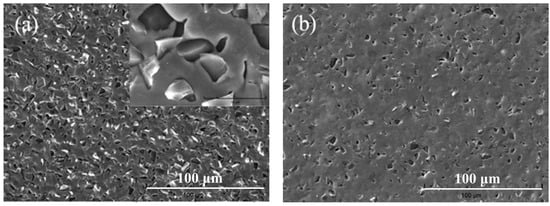
SEM morphology of (a) Al powders and (b) Ti3C2Tx particles.

To address the challenges of excessive local thinning, poor surface quality, and low production efficiency in traditional multi-pass deep-drawn aluminum alloy fairings, this study investigates the effects of process parameters—including liquid chamber pressure, holding force, and differentiated lubrication schemes—on the liquid-filled forming performance and wall thickness distribution of a 460 × 280 × 1.5 mm thin-walled 2A12 aluminum alloy fairing. Employing an integrated liquid-filled forming technique combining a flexible punch with a rigid die, the research combines numerical simulation with experimental validation. The study demonstrates good consistency between experimental results and numerical simulations. The optimal forming process parameters are liquid chamber pressure of 10 MPa, holding force of 1100 kN, and a lubrication scheme (friction coefficients of 0.01 for the flange and forming zones and 0.06 for the transition radius zone). Under these parameters, part wrinkling and cracking are effectively suppressed, achieving optimal wall thickness uniformity in the formed parts, with a maximum thinning rate of only 6.6%. The proposed liquid-assisted forming process and differentiated lubrication scheme provide a new technical pathway for high-precision manufacturing of thin-walled complex curved components made of 2A12 aluminum alloy. Compared to traditional multi-stage drawing processes, both forming efficiency and quality are significantly improved.

15 March 2026

Formed part of the fairing.

Laser powder bed fusion (LPBF) of AA7075 is severely constrained by a narrow process window and susceptibility to defect formation (hot cracking and porosity), which often dominates performance. In this study, 5 wt.% AlCoCrFeNi2.1 high-entropy alloy (HEA) particles, volumetric energy density (VED = 74–222 J·mm−3), and subsequent T6 heat treatment were systematically investigated to reveal their combined effects on defect structure, crystallographic texture/substructure, and tensile behaviour. Quantitative EBSD shows a measurable grain refinement in the as-built state (average grain size 13.44 → 11.80 µm, ~12%) accompanied by a pronounced weakening of the <001> fibre texture (maximum MRD 4.94 → 2.38), indicating disrupted epitaxial growth and a more dispersed orientation distribution. After T6, the reinforced alloy retains a higher low-angle boundary fraction (31.62% vs. 24.17% in unreinforced AA7075) and a higher kernel average misorientation (0.80° vs. 0.60°), consistent with particle-stabilised substructure retention and retarded recovery. Across all VEDs, AA7075-HEA exhibits higher microhardness (compared with AA7075, the addition of HEA increases the hardness by roughly 20–50 HV) and tensile strength, with the intermediate VED (140.74 J·mm−3, T6 states) yielding the best performance. While macroscopic cracking is not fully eliminated, the results clarify that HEA-enabled texture/substructure modifications can contribute to enhanced defect tolerance and are more effectively translated into tensile performance when the as-built defect severity is controlled. These findings provide quantitative insights into defect–microstructure–property coupling in LPBF AA7075-HEA composites from as-built to T6 states.

15 March 2026

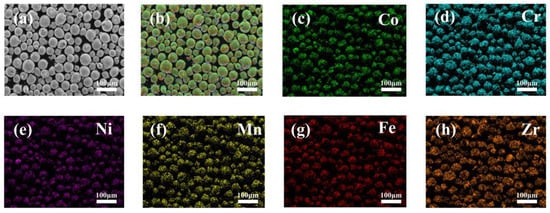
SEM image and corresponding EDS elemental maps of the mixed AA7075–5 wt.% AlCoCrFeNi2.1 composite feedstock powder. The Al, Mg, Zn and Cu maps identify the AA7075 matrix particles, while Ni, Co, Cr and Fe highlight the HEA particles, which are homogeneously dispersed between the aluminium alloy powders (scale bar 250 μm).A similar powder morphology of the same material system was reported previously in Ref. [31].

The incorporation of reclaimed asphalt pavement (RAP) in asphalt mixtures improves sustainability but significantly reduces the intrinsic self-healing capacity due to binder aging. This study aimed to quantify whether epoxy-coated rejuvenator microcapsules could restore and enhance the self-healing performance of RAP-containing recycled asphalt mixtures. Four mixture types (AC-10C, AC-13C, AC-16C, and SMA-13C) containing 20% RAP were evaluated using a fracture–healing–refracture bending test (Repair index, RC) and a splitting healing strength ratio (SHSR) test to determine the effects of healing time, temperature, and microcapsule dosage. RC increased rapidly during the first 8 h of healing and then approached stabilization, with the growth rate falling below 2%, indicating 8 h as the practical optimum healing duration. RC increased from 0 °C to 45 °C due to enhanced binder mobility and diffusion, and slightly decreased at 60 °C because temperature-induced softening reduced peak bending strength. The highest self-healing capacity was obtained at a microcapsule dosage of 4% (by RAP mass). Under the optimum healing condition (8 h and 45 °C), RC increased by 10.38%–13.50% and SHSR increased by 14.35%–25.27% compared with mixtures without microcapsules. Among the mixtures, SMA-13C exhibited the highest self-healing capacity, followed by AC-13C, AC-10C, and AC-16C. The contribution of this study lies in quantifying the healing enhancement in RAP-containing mixtures, identifying practical optimum healing conditions based on a growth-rate criterion, and demonstrating consistent trends between two healing indices across different mixture structures.

14 March 2026

Schematic illustration of the synthesis process of RA-5/Epoxy Resin (ERM) microcapsule-type rejuvenator.

News & Conferences

Volumes

Issues

Open for Submission

Editor's Choice

XFacebookLinkedIn
Coatings - ISSN 2079-6412