


You are currently viewing a new version of our website. To view the old version click .

Children

Children is an international, peer-reviewed, open access journal on children’s health, published monthly online by MDPI.

Indexed in PubMed | Quartile Ranking JCR - Q2 (Pediatrics)

All Articles (9,238)

Background/Objectives: Perinatal infections caused by Gram-negative bacteria pose a significant risk to neonatal health, especially in low-resource settings. These infections often lead to severe complications due to diagnostic and therapeutic challenges. This study aimed to clinical characterize, early outcomes, and risk factors associated with Gram-negative infections in neonates admitted to the tertiary neonatal intensive care unit (NICU) at “Louis Turcanu” Children’s Hospital, Timisoara. Methods: A retrospective, case–control study was conducted at a tertiary neonatal care unit in Timișoara, Romania, including neonates with microbiologically confirmed Gram-negative infections (n = 44) and a matched control group without infection (n = 47). Clinical, laboratory, and microbiological data were analyzed. Statistical comparisons and logistic regression analyses were used to evaluate risk factors and outcomes. Results: Male sex (79.5% in infected vs. 57.4% in controls; p = 0.0418) and vaginal delivery (43.2% vs. 17.0%; p = 0.00001) were significantly associated with infection. Respiratory distress (72.7%) and digestive symptoms (75.0%) were common in infected neonates. C-reactive protein and procalcitonin levels were markedly elevated in infected infants. Escherichia coli was the most common pathogen, with multidrug-resistant strains observed in bloodstream infections. Mechanical ventilation was required in 75% of infected neonates compared with 16.2% in controls (p < 0.0001). Mortality was higher among infected neonates (25% vs. 4.3% in the control group), although not statistically significant. Conclusions: Gram-negative perinatal infections are associated with considerable morbidity, particularly in male neonates and those delivered vaginally. Early identification, antimicrobial stewardship, and intensive respiratory support are essential to improving outcomes in this vulnerable population.

13 December 2025
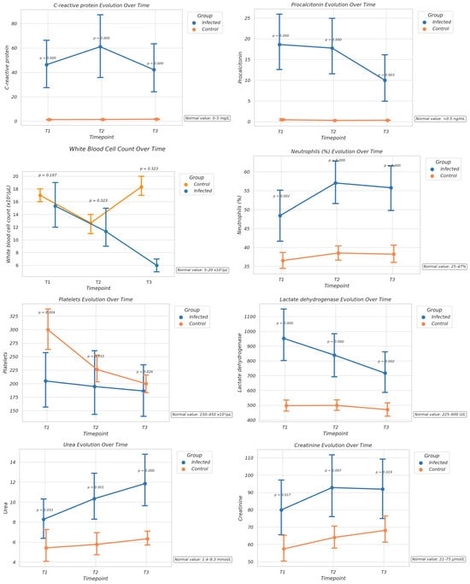
Comparative laboratory markers in infected and control groups.

Background: Oral health-related quality of life (OHRQoL) in children is an issue of growing interest in the scientific literature, with various studies focused on the adolescent population published in recent years. Nevertheless, few studies have evaluated the possible influence of the OHRQoL of mothers on that of their adolescent children. The aim of this study was to analyse the correlation between the OHRQoL of mothers and that of their adolescent children at their first oral examination. Methods: This retrospective pilot study was performed at the Dental Clinic of the University of Salamanca (Spain) between 2023 and 2025. The OHRQoL of 130 adolescent patients (from 11 to 14 years old) who visited the dentist for the first time was analysed. The mothers of these children were also interviewed to evaluate their OHRQoL; the adolescent patients completed the Spanish version of the Child Perceptions Questionnaire (CPQ-Esp11–14) before their first dental consultation, and their mothers completed the Oral Health Impact Profile-14 (OHIP-14). Results: The study population consisted of 130 mothers (mean age: 43.0 ± 2.66 years) and their respective adolescent children (mean age: 12.5 ± 1.3 years) (65 boys and 65 girls). Among the adolescent patients, the highest score was obtained for the social well-being dimension of the CPQ-Esp11–14 (25.01 ± 4.10), whereas the lowest was obtained for the oral symptoms dimension (10.88 ± 3.78). A higher score on the physical pain dimension of the OHRQoL for the mothers was related (p < 0.01) to higher scores on the emotional and social well-being dimensions of the CPQ-Esp11–14 for their children. Conclusions: Considering the limitations of this study, it can be concluded that the OHRQoL of mothers has some effect on that of their adolescent children when visiting a dentist for the first time.

13 December 2025

Introduction: Primary Cytomegalovirus (CMV) infection occurs in 0.7–4.1% of all pregnancies. Our study aims to analyze the incidence rate of ultrasound anomalies, as well as CMV PCR analysis of the amniotic fluid sample obtained from amniocentesis in CMV-infected pregnancies, as well as the outcome of the pregnancies and neonatal follow-up. Methods: We analyzed cases of recent maternal CMV infections confirmed by serological testing at the Department of Obstetrics and Gynecology, Semmelweis University, between 2001 and 2023. In cases of primary CMV infection confirmed by serological testing during pregnancy, we offered amniocentesis at the genetic counseling, which was performed at the 20–21 weeks stage of the pregnancy. Results: In 130 cases of recent maternal CMV infection confirmed by serological testing, amniocentesis was performed, and a total of 11 cases (8.46%) were found to have CMV DNA in the amniotic fluid. Based on the neonatological follow-up examinations in 116 deliveries, 18 newborns had complications (15.52%); however, some cases were associated with multiple complications, resulting in a total of 33 types of complications being identified (28.45%). Among the 11 neurological complications (9.48%), we found 1 case each (0.86%) of severe inoperable intracranial space occupation, hydrocephalus, balance disorder, sleep disorder–sleep apnea, and speech development disorder. Two cases (1.72%) were found to have rigid muscles, epilepsy, and hypotonic muscles. Ophthalmological complications occurred in five cases (4.31%), such as enophthalmos, cataract, and retinopathy of prematurity (ROP), one case each, and two cases of strabism. Other complications were detected in 17 cases (14.66%). Conclusions: Because of the high incidence rate of recent CMV infection, serological testing is recommended following fetal abnormality detected by ultrasound. If a serologically confirmed new infection is diagnosed, the affected couple should be offered amniocentesis.

12 December 2025

The refugee population is increasing worldwide, and in South Korea, the refugee population, including children and adolescents, is also rapidly increasing. This study aimed to compare the psychological problems of North Korean refugee adolescents with those of South Korean adolescents and to evaluate their mental health characteristics. Methods: This cross-sectional comparative study assessed psychological problems using the Korean version of the Youth Self-Report Scale (K-YSR) among 206 South Korean adolescents and 130 North Korean refugee adolescents enrolled in middle and high schools in Gyeonggi Province. The inclusion criteria included adolescents aged 13–18 years at middle or high school and residing in South Korea for at least 6 months (for North Korean refugees). Data were collected in October 2025. Results: North Korean refugee adolescents showed significantly higher scores of anxiety/depression (F = 11.304, p < 0.001, η2 = 0.033), somatic symptoms (F = 20.997, p < 0.001, η2 = 0.060), social immaturity (F = 11.083, p < 0.001, η2 = 0.032), rule-breaking behavior (F = 12.851, p < 0.001, η2 = 0.037), and aggressive behavior (F = 50.386, p < 0.001, η2 = 0.132). Notably, the largest effect size (η2 = 0.132) was observed in the aggressive behavior domain, while the somatic symptoms also showed a moderate effect size (η2 = 0.060). In the ANCOVA analysis, controlling for gender and age as covariates, female students scored higher in the anxiety/depression and somatic symptoms domains, while male students scored higher in the rule-breaking behavior and aggressive behavior domains. Conclusions: North Korean refugee adolescents experience various psychological difficulties during their adaptation to South Korean society. These results can be used as basic data to detect mental health problems in North Korean adolescent refugees early and develop customized support plans.

12 December 2025

News & Conferences

Issues

Open for Submission

Editor's Choice

Reprints of Collections

10th Anniversary of <em>Children</em>
Reprint

10th Anniversary of Children

Feature Papers in Neonatology
Editors: Karel Allegaert
Personality, Health and Well-Being among Different Age Groups
Reprint

Personality, Health and Well-Being among Different Age Groups

Editors: Hajime Iwasa, Yuko Yoshida

Get Alerted

Add your email address to receive forthcoming issues of this journal.

XFacebookLinkedIn
Children - ISSN 2227-9067