

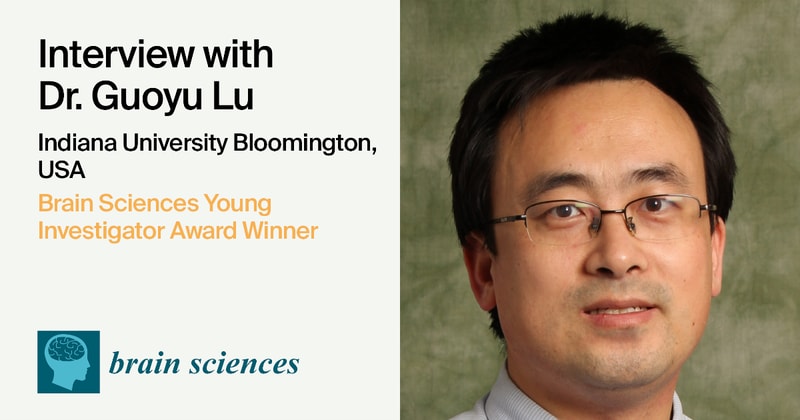
Interview with Dr. Guoyu Lu—Winner of the Brain Sciences Young Investigator Award
1. Congratulations on winning the Brain Sciences Young Investigator Award. Could you briefly introduce yourself and your main research interests?
Thank you very much. I am honored to receive the Brain Sciences Young Investigator Award.
I am a faculty member in computer science and artificial intelligence, with research interests in computer vision, machine learning, robotics perception, multimodal sensing, and AI for science. My work focuses on developing computational methods that allow machines to perceive, reconstruct, and interpret complex biological, physical, and human-centered systems.
A growing part of my research is connected to brain sciences and biomedical AI, including brain and neural image processing, neuroimaging-related analysis, the understanding of medical images, interpretable biomedical AI, gaze and behavioral analysis, and multimodal sensing. I am especially interested in how AI can help extract meaningful information from complex imaging, behavioral, genomic, and biomedical data. In this sense, I see AI not only as a prediction tool, but also as a way to organize evidence, reveal hidden patterns, and support scientific discovery in brain- and health-related research.
2. How did you hear about this award, and what impact do you think such awards can have on a researcher’s career?
I learned about the Brain Sciences Young Investigator Award through the journal’s award announcements and through colleagues who encouraged me to consider opportunities that recognize interdisciplinary contributions to brain-related research.
Awards like this can have a meaningful impact, especially for young researchers working across disciplinary boundaries. It often takes time for interdisciplinary work to be fully understood because it may not fit neatly into one traditional field. Recognition from a journal such as Brain Sciences helps validate the importance of connecting AI, biomedical imaging, neurotechnology, cognitive analysis, and computational biology. It can also encourage young researchers to continue pursuing ambitious directions, build new collaborations, and communicate their work to a broader scientific community.
3. Do you have any advice for aspiring young researchers looking to make a meaningful impact in their respective fields?
My main advice is to build a strong technical foundation, but not to stop there. A meaningful research career requires both depth and curiosity. It is important to develop expertise in a core area, but also to understand real scientific problems deeply enough that your methods can make a difference.
For young researchers in AI and computational fields, I would encourage them to spend time talking with domain scientists, clinicians, experimentalists, and engineers. Many important research questions are hidden in the details of data acquisition, measurement noise, biological variability, or the clinical workflow. If we only focus on benchmark performance, we may miss the most meaningful problems.
I would also encourage young researchers to be patient. Some ideas take several years to mature. Early failures are common, especially when working across fields. But if the problem is important and the direction is scientifically sound, persistence often leads to deeper and more original contributions.
4. Do you have any thoughts about how Brain Sciences can further support young researchers and the academic community?
I think Brain Sciences can continue to play an important role by supporting interdisciplinary research at the intersection of neuroscience, medicine, engineering, and computation. Many young researchers today are working in areas such as AI for neuroimaging, brain-inspired intelligence, neurotechnology, computational psychiatry, neurodevelopment, and multimodal biomedical data analysis. These areas need venues that welcome both methodological innovation and domain relevance.
The journal could further support young researchers by organizing Special Issues, early career forums, invited perspectives, and mentorship-oriented editorial initiatives. It may also be valuable to highlight successful interdisciplinary studies and provide guidance on how authors can communicate computational or engineering contributions to a broader brain science audience. This would help young researchers present their work in a way that is both technically rigorous and meaningful to the neuroscience community.
5. Have you encountered any difficulties in your research, and how did you overcome them? What is your ‘secret’ to a happy scientific life?
Research always comes with difficulties. One challenge I have often encountered is working across disciplines. When computer scientists, neuroscientists, biomedical researchers, and clinicians talk about the same problem, they may use different language, value different types of evidence, and have different expectations. This can make collaboration challenging at the beginning.
I try to overcome this by listening carefully and by respecting the scientific logic of each field. In interdisciplinary research, the goal is not simply to bring an AI model to another domain. The goal is to understand what the real question is, what the data actually mean, and what kind of computational result would be useful to domain experts.
As for a happy scientific life, I do not think there is a single secret. For me, it is important to remain curious and to work on problems that feel meaningful. I also try to enjoy the process, not only the final outcome. Papers, grants, and awards are important, but the most enjoyable moments often come from seeing a student grow, discovering an unexpected pattern in data, or realizing that an idea from one field can help solve a problem in another field.
6. Is there anyone you would especially like to thank as the winner of this award?
I would like to sincerely thank the Brain Sciences award committee and editorial team for this recognition. I am also deeply grateful to my mentors, students, colleagues, and collaborators who have supported my research journey.
I especially want to thank my collaborators across neuroscience, biomedical engineering, medicine, biology, computer science, robotics, and related fields. Many of my projects started because a collaborator showed me a difficult dataset or a scientific question that did not fit a standard AI or computer vision benchmark. Those conversations changed how I think about AI. Much of my work has been possible because collaborators were willing to cross disciplinary boundaries, share their domain knowledge, and work together on problems that could not be solved by one field alone. Their perspectives have helped me understand what kinds of AI methods are truly useful for scientific and biomedical research.
I am also very grateful to my students. Interdisciplinary research often requires patience: the data can be messy, the problem definition may change, and the first version of a method may not work. My students’ persistence and creativity have been essential in turning early ideas into real research outcomes.
Receiving this award is a great encouragement. I see it not only as recognition of past work, but also as motivation to continue developing AI methods that can contribute to brain sciences, biomedical discovery, and the broader understanding of complex biological and human systems.