Skip to Content

Breast Cancer Research and Care

Breast Cancer Research and Care is an international, peer-reviewed, open access journal on disseminating cutting-edge research and innovative clinical advancements in the field of breast cancer published quarterly online by MDPI.
  • Open Access— free for readers, with article processing charges (APC) paid by authors or their institutions.
  • Rapid Publication: first decisions in 18 days; acceptance to publication in 7 days (median values for MDPI journals in the first half of 2026).
  • Recognition of Reviewers: Reviewers whose reports are timely and of high quality receive an APC discount voucher for a future publication in an MDPI journal. Become a reviewer.

Get Alerted

Add your email address to receive forthcoming issues of this journal.

All Articles (4)

  • Review
  • Open Access

Triple-negative breast cancer (TNBC) is a receptor-defined diagnosis encompassing genomic, transcriptional, epigenetic, proteomic, metabolic, cellular and spatial heterogeneity. Although transcriptomic classifications established biologically interpretable TNBC subtypes, multi-omic, single-cell and spatial studies show that tumour states may coexist within the same lesion and evolve under treatment pressure. The central translational question is therefore not simply how to generate higher-resolution molecular maps, but which biological layer should be measured, at what clinical time point, and whether that information can change patient-level decisions. This narrative review proposes a time-aware resolution-to-decision framework for TNBC precision oncology. We examine how genomics defines molecular potential; transcriptomics and epigenomics capture active and plastic cellular programmes; proteomics and metabolomics provide functional pathway readouts; and single-cell and spatial approaches resolve cellular and anatomical context. We then evaluate circulating tumour DNA as a longitudinal biomarker for molecular residual disease and tumour evolution, distinguishing strong prognostic evidence from still-unproven treatment-intervention utility. Using the ESMO Scale for Clinical Actionability of Molecular Targets (ESCAT) as a reference for genomic actionability, we distinguish established biomarkers from context-dependent markers and investigational multi-omic signatures, while noting that several recent therapeutic advances required little or no molecular selection. Molecular profiling should be judged by biological resolution, disease time point and evidence maturity rather than by technological complexity alone.

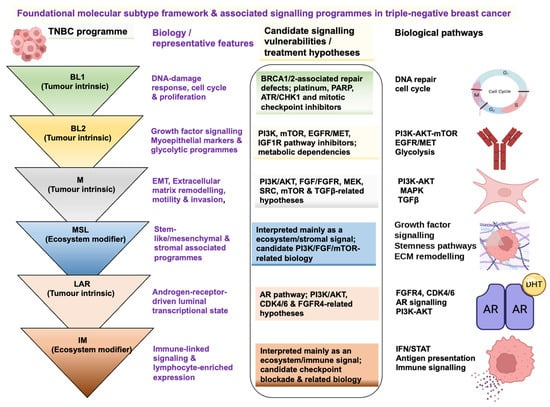
Foundational TNBC molecular subtype framework and candidate signalling pathways. The figure retains six transcriptomic programme labels (BL1, BL2, M, MSL, LAR and IM), their representative biology and proposed pathway vulnerabilities. BL1, BL2, M and LAR denote primarily tumour-intrinsic programmes, whereas IM and MSL include prominent immune and stromal expression signals. The AR/DHT illustration is retained beside LAR. Associations with DNA repair, growth-factor signalling, EMT, androgen signalling and immunity are hypothesis-generating; none establishes subtype-specific treatment eligibility without indication-specific evidence [7,8,9,10,11,12,13,24]. Abbreviations: TNBC, triple-negative breast cancer; BL1/BL2, basal-like 1/2; M, mesenchymal; MSL, mesenchymal stem-like; LAR, luminal androgen receptor; IM, immunomodulatory; AR, androgen receptor; DHT, dihydrotestosterone; EMT, epithelial–mesenchymal transition. Original artwork prepared by the authors.
  • Perspective
  • Open Access

Breast reconstruction is an integral component of comprehensive breast cancer care rather than a merely aesthetic adjunct. For many women, reconstruction is associated with meaningful improvements in body image, psychosocial well-being, and quality of life after mastectomy. Nevertheless, it is not a mandatory part of treatment and represents a preference-sensitive decision. This article presents a clinical perspective, informed by selected literature, clinical guidelines, and institutional practice, on why patients with non-metastatic breast cancer in whom mastectomy is a realistic possibility should be offered reconstructive consultation before surgery. At that stage, reconstructive options remain open, patients have time to reflect, and expectations can be discussed realistically. Counseling should present all legitimate pathways, including implant-based and autologous reconstruction, immediate and delayed timing, the implications of postmastectomy radiotherapy, and no reconstruction with an appropriately planned primary closure. The final plan should be individualized according to oncologic safety, anticipated adjuvant treatment, anatomy, comorbidities, and the surgical burden acceptable to the patient, while also incorporating the patient’s expectations and priorities. Reconstructive consultation should therefore support shared decision-making rather than promote reconstruction, with the final informed choice remaining the patient’s own. Psychological and quality-of-life benefits vary among individuals. The success of early reconstructive involvement should not be measured by reconstruction rates, but by whether patients are able to make informed, realistic, and preference-concordant decisions. We propose a consultation framework addressing oncologic context, reconstructive feasibility, patient priorities, expectation management, treatment decisions, and alternative planning, explicitly including no reconstruction with appropriately planned primary closure when preferred. The framework has not yet undergone formal evaluation.

  • Review
  • Open Access

Background/Objectives: Exercise is increasingly recognized as an effective supportive intervention in breast cancer (BC), with substantial evidence demonstrating benefits on cancer-related fatigue, physical function, and quality of life. However, despite this strong scientific basis, its implementation in routine clinical practice remains inconsistent. Existing exercise oncology frameworks have primarily focused on screening, risk stratification, and referral, with limited availability of practical tools to guide individualized exercise prescription across the BC continuum. Accordingly, this narrative review aimed to synthesize current evidence to develop a clinically applicable, stepwise algorithm for individualized exercise prescription in women with BC. Methods: Current evidence from randomized controlled trials, systematic reviews, meta-analyses, and international clinical guidelines on exercise interventions in women with BC was synthesized narratively, with emphasis on exercise modality, intensity, progression, safety considerations, treatment phase, and patient-specific factors. Results: Aerobic and resistance exercise are safe and effective across different phases of BC care, including active treatment, survivorship, and advanced disease, with consistent improvements in fatigue, physical function, cardiorespiratory fitness, and health-related quality of life. However, heterogeneity in interventions, patient populations, and clinical contexts limits direct translation into clinical practice. To address this implementation gap, the available evidence was translated into a structured clinical algorithm based on the FITT principle (frequency, intensity, time, and type), treatment phase, risk stratification, patient-specific characteristics, treatment-related toxicities, and safety considerations, allowing individualized adaptation to different clinical scenarios. Conclusions: Exercise should be considered a core component of BC care rather than a general lifestyle recommendation. Bridging the evidence-to-implementation gap requires structured, individualized, and clinically applicable approaches to exercise prescription. The proposed algorithm translates current evidence into a structured clinical decision-support framework that may facilitate the routine implementation of individualized exercise prescription across the BC continuum.

  • Editorial
  • Open Access

It gives me great pleasure to launch the new journal Breast Cancer Research and Care (ISSN 3043-100X) [...]

News & Conferences

Latest Issues

Open for Submission

Journal Sections

XFacebookLinkedIn
Breast Cancer Res. Care - ISSN 3043-100X