Animals 2024, 14(9), 1255; https://doi.org/10.3390/ani14091255 - 23 Apr 2024
Cited by 6 | Viewed by 3182
Abstract
►
Show Figures
Dirofilaria immitis and D. repens are the two most widespread and important species of mosquito-borne nematodes, posing a significant threat to veterinary health and particularly affecting canines and felines. While D. immitis causes cardiopulmonary dirofilariasis, D. repens causes subcutaneous infections in dogs and
[...] Read more.
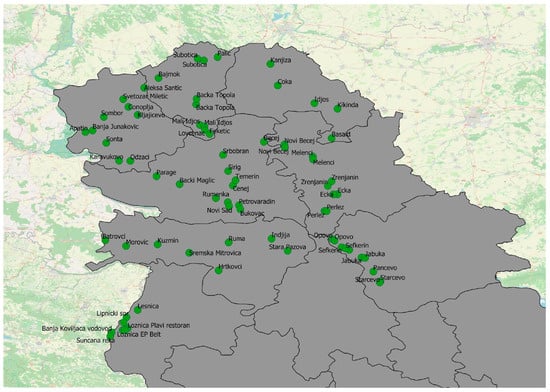
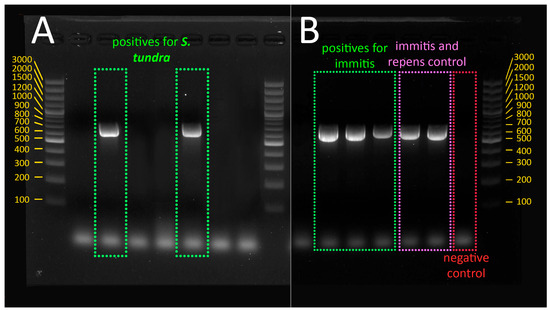
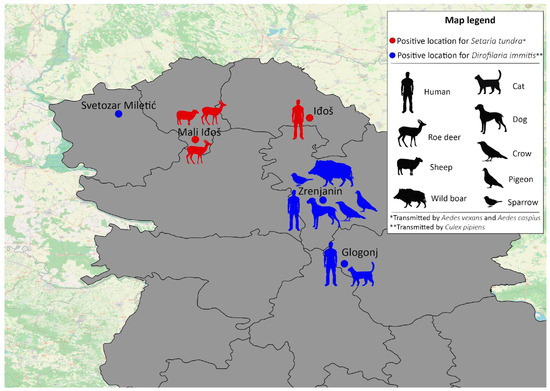
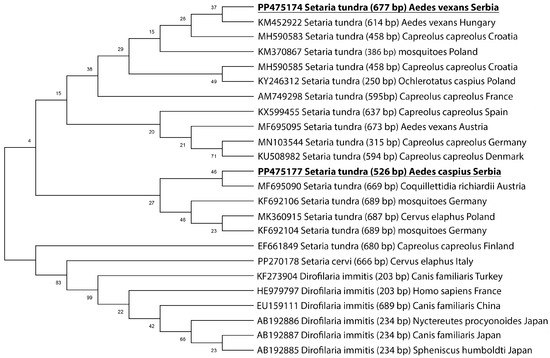
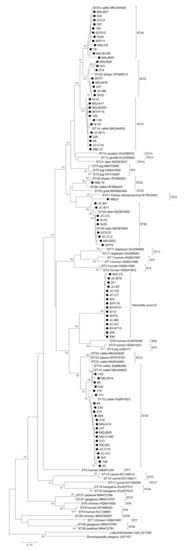
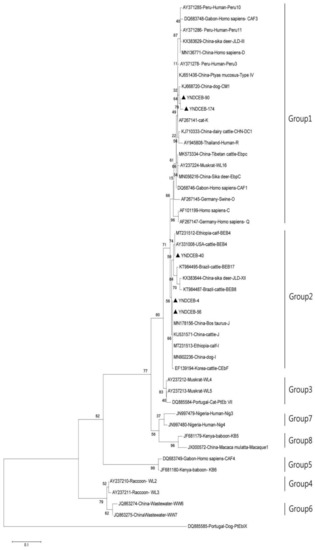
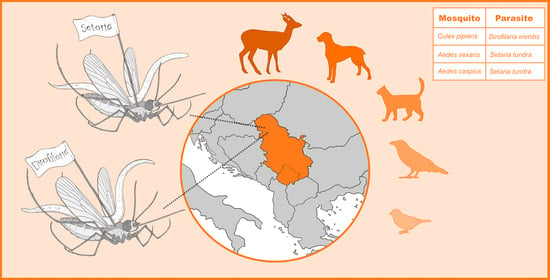
Dirofilaria immitis and D. repens are the two most widespread and important species of mosquito-borne nematodes, posing a significant threat to veterinary health and particularly affecting canines and felines. While D. immitis causes cardiopulmonary dirofilariasis, D. repens causes subcutaneous infections in dogs and other carnivores. Despite the extensive knowledge on these parasites, little is known about their natural vectors in Serbia. The parasite Setaria tundra, known to infect deer, has not yet been detected in Serbia but has been documented in neighboring countries. Thus, the aim of this study was to (i) further map out Dirofilaria sp. hotspots in the Vojvodina Province and detect S. tundra for the first time, (ii) detect positive mosquito species that can provide insights into how the nematodes spread in Serbia, and (iii) analyze the blood-fed female mosquitoes of species found to be infected, in order to identify the potential source of parasite infection. A total of 2902 female mosquitoes were collected across 73 locations during 2021 and 2022. Molecular biology methods, based on conventional PCR, were used to analyze non-blood-fed (2521 specimens) and blood-fed (381 specimens) female mosquitos, in order to detect filarial nematode presence and identify blood-meal sources, respectively. When the parasite genome was detected, the amplicon (cox1 gene, 650 bp fragment) was sent for Sanger sequencing, further confirming the presence of nematodes and species assignation. D. immitis was detected in three Culex pipiens mosquitoes collected in Zrenjanin (August 2021) and Glogonj and Svetozar Miletić (both in July 2021). Additionally, Setaria tundra was detected in Aedes vexans collected in Iđoš (mid-August 2021) and Aedes caspius, which was collected in Mali Iđoš (end of July 2021). This work identifies two new locations where D. immitis occurs in Vojvodina, and is the first report of S. tundra in Serbian territory. Blood-meal analysis provided insights into the preferences of mosquitoes that were positive for Dirofilaria sp. and S. tundra.
Full article
Graphical abstract