
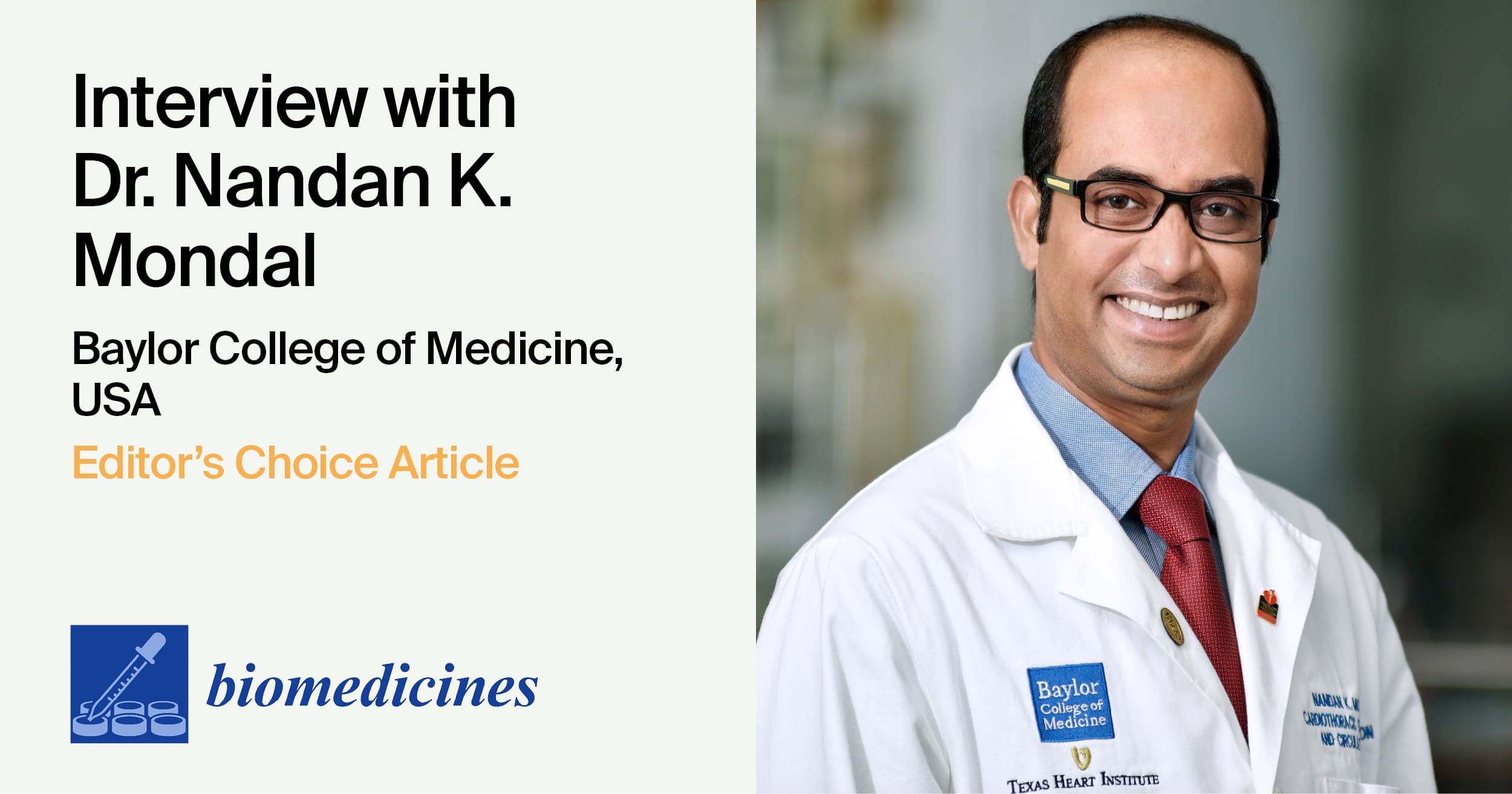
Biomedicines | Interview with Editor’s Choice Article Author—Dr. Nandan Kumar Mondal
Dr. Nandan Kumar Mondal is one of the authors of the Editor’s Choice Article entitled “Urinary Vitamin D Binding Protein and Kidney Injury Molecule-1 as Biomarkers for Predicting Acute Kidney Injury in Patients with Left Ventricular Assist Devices” published in Biomedicines (ISSN 2227-9059).
Dr. Mondal is an Assistant Professor of Surgery in the Michael E. DeBakey Department of Surgery, Division of Cardiothoracic Transplantation and Circulatory Support, at Baylor College of Medicine, Houston, Texas, United States. His research is translational and precision-medicine-oriented, focusing on biomarker discovery in heart failure, heart transplantation, and mechanical circulatory support, with a particular interest in non-invasive markers of kidney injury and organ dysfunction in LVAD patients. His lab uses longitudinally collected human blood, urine, and tissue biospecimens and maintains a substantial biorepository within the division, allowing the team to connect molecular findings with clinical outcomes. He works in an interdisciplinary environment involving clinicians, engineers, and computational scientists, and his broader goal is to develop practical biomarkers and mechanistic insights that improve risk stratification and individualized care for advanced heart failure and circulatory support patients.
The following is an interview with Dr. Nandan Kumar Mondal:
1. Congratulations on your publication! Could you please briefly introduce the main research content of your paper?
Thank you. Our paper focused on predicting acute kidney injury, or AKI, within 90 days after leaving ventricular assist device, or LVAD, implantation. AKI is a common and serious complication in this population, but serum creatinine rises relatively late, so there is a real need for earlier, non-invasive markers. We prospectively enrolled 29 advanced heart failure patients undergoing LVAD implantation and measured urinary vitamin D binding protein, VDBP, and kidney injury molecule-1, KIM-1, normalized to urinary creatinine, before surgery and one week after surgery. Thirteen patients developed AKI. We found that both urinary VDBP and KIM-1 were significantly elevated in patients who developed AKI, and both showed strong predictive performance. Predictive accuracy improved further when we combined the biomarkers with pre-LVAD kidney function and hemodynamic stability. Overall, the study supports urinary VDBP and KIM-1 as promising non-invasive biomarkers for early AKI risk stratification in LVAD patients.
2. Can you tell us a little bit about yourself and your current research?
My training has been interdisciplinary. I completed my BSc, MSc, and MPhil at the University of Burdwan in India, followed by a PhD at the Chittaranjan National Cancer Institute, Jadavpur University, where my work centered on molecular epidemiology and genotoxicity. I then transitioned to cardiovascular research through postdoctoral fellowships at the University of Maryland and the University of Louisville, focusing on heart failure and complications of mechanical circulatory support devices. I joined Baylor College of Medicine in 2018 and established the Lab in 2019.
Our lab is a human-subject basic science and translational research laboratory. We house one of the largest biorepository cores within the Division of Cardiothoracic Transplantation and Circulatory Support, with thousands of longitudinally collected biospecimens from patients and cadavers. This infrastructure enables clinically anchored, longitudinal biomarker work that would be difficult to replicate otherwise. Our team is diverse, including postdoctoral associates, research coordinators, clinical residents, and undergraduate, graduate, postgraduate, PhD, and medical students, and we collaborate closely with physicians, biomedical engineers, computer scientists, and machine learning specialists.
Current research spans several directions. One major program investigates molecular mechanisms in heart transplantation, particularly strategies to extend the warm ischemic limit for donor hearts through pharmacological reconditioning of brain-death and circulatory-death donors. Another involves machine learning-assisted stroke prediction in patients with mechanical circulatory support. We also continue our biomarker work in LVAD and cardiac surgery populations, including the urinary VDBP and KIM-1 study we are discussing today.
I have been fortunate to serve as principal investigator on multiple grants. I received several awards for my outstanding contributions to teaching and research. These accolades include the prestigious O.H. Frazier, M.D. Innovation and Leadership Award, Norton Rose Fulbright Faculty Excellence Award, American Heart Association Innovation Research Award, Nancy Chang Research Excellence Award, SOAR Research Mentor Champion Award, Professional Educator Appreciation and Recognition (PEAR) Awards, and Power of Professionalism (POP) Awards. I also received numerous travel and presentation awards, as well as many International Invited Lecture Awards. What drives the lab is the goal of moving discoveries from bench to bedside, using our biorepository, interdisciplinary collaborations, and clinical partnerships to develop biomarkers and mechanistic insights that can realistically inform patient care in advanced heart failure and circulatory support.
3. Would you mind sharing what inspired your research?
The inspiration came from a very practical clinical problem. AKI after LVAD implantation is frequent and is associated with worse outcomes, but current tools, especially serum creatinine, often detect kidney injury only after substantial damage has occurred. We wanted to know whether urinary markers reflecting proximal tubular injury or impaired tubular reabsorption could identify high-risk patients earlier. VDBP and KIM-1 were particularly interesting because they are biologically linked to proximal tubular dysfunction and injury, and urine is an ideal non-invasive matrix for kidney biomarkers. Previous work had suggested roles for VDBP in acute decompensated heart failure and cardiac surgery, and for KIM-1 in tubular injury, but their value in LVAD patients was not well understood. That gap motivated our study.
4. What was the biggest challenge you faced while writing this paper, and how did you overcome it?
The biggest challenge was the combination of a relatively small, single-center cohort and the clinical heterogeneity of advanced heart failure patients undergoing LVAD implantation. We had 29 patients and 13 AKI events, so we needed to be careful not to overinterpret the findings. We addressed this by using a prospective, standardized sampling approach, normalizing urinary biomarkers to urinary creatinine, stratifying patients by pre-LVAD kidney function and hemodynamic status, and presenting both unadjusted and adjusted models. We also tried to be very transparent about the exploratory nature of the study and its limitations. Working closely with our nephrologist collaborator, Dr. Carl Walther, and cardiothoracic Surgeon Dr. Kenneth Liao, the clinical team helped us present the results rigorously while keeping the clinical message clear.
5. How did feedback during your research influence your direction?
Feedback from coauthors, clinical collaborators, and the peer-review process was very valuable. It pushed us to go beyond reporting isolated biomarker associations and to ask how these markers perform in the context of established clinical risk factors. That led us to incorporate pre-LVAD kidney dysfunction and hemodynamic instability into adjusted models, which substantially improved the predictive performance. Reviewers also encouraged us to be clearer about the limitations, including sample size and the limited number of sampling time points. Overall, the feedback strengthened the paper by making it more clinically relevant and more appropriately cautious in its conclusions.
6. What role did you play in your research team, and how did teamwork affect the paper’s outcome?
As corresponding author, I was involved in conceptualization, methodology, supervision, project administration, funding acquisition, writing, review, and editing. The study was highly collaborative. Coauthors contributed to patient enrollment, sample and data curation, validation, formal analysis, statistical support, visualization, and critical revision of the manuscript. Teamwork was essential because this project bridged cardiothoracic surgery, heart failure, nephrology, and laboratory biomarker research. The multidisciplinary input helped us design the clinical stratification, interpret the biomarker results in context, and present a balanced conclusion. The final paper reflects that combined clinical and laboratory perspective.
7. Why did you choose Biomedicines as a platform for publishing your work, and how was your experience?
We chose Biomedicines because it reaches a broad biomedical and translational audience and publishes work at the interface of clinical medicine, biomarkers, and disease mechanisms. Our study is translational and clinically oriented, so the journal was a good fit. The review process was rigorous and constructive, and the feedback helped us improve the clarity and rigor of the manuscript. We were also honored that the paper was selected as an editor’s choice article. Overall, our experience with the journal was very positive.
8. What impact do you hope your research will have, and what key innovation do you see in your paper?
I hope this work contributes to earlier and more individualized kidney risk assessment in LVAD patients. If validated, urinary VDBP and KIM-1 could help identify high-risk patients before serum creatinine rises, allowing clinicians to consider closer monitoring and nephroprotective strategies earlier. The key innovation is that, to our knowledge, this is the first study to evaluate urinary VDBP for predicting postoperative AKI in LVAD patients, and we also used urinary KIM-1 normalized to creatinine rather than plasma KIM-1. Importantly, we showed that combining these biomarkers with pre-LVAD kidney function and hemodynamic stability substantially improved predictive performance. We view the findings as promising and exploratory, but they support a practical, non-invasive approach to risk stratification.
The next step is clearly validation in larger, multicenter cohorts. We also need serial measurements across the perioperative period to capture dynamic changes in VDBP and KIM-1 rather than only pre- and one-week post-LVAD levels. It will be important to compare these markers head-to-head with other AKI biomarkers such as NGAL, TIMP-2, and IGFBP7, and to evaluate whether they add value to existing clinical risk scores. Mechanistic studies linking urinary VDBP and KIM-1 to tubular injury and repair pathways would also be valuable. Ultimately, I would like to see these biomarkers integrated into a practical clinical risk-stratification tool that can guide perioperative kidney protection and individualized management in LVAD recipients.