
Coatings | Interview with Dr. Emerson Coy—Event Chair of the 5th Coatings and Interfaces Online Conference (CIC 2027)
1. To begin, could you please introduce yourself, including your name, current position, and institutional affiliation?
I am an associate professor at the NanoBioMedical Center at Adam Mickiewicz University in Poznan, Poland, where I lead the Hybrid Nanomaterials and Interfaces group. I am an engineer by training, and I hold a PhD in nanosciences from the University of Barcelona, Spain, and a DSc in materials engineering from AGH University, Poland.
2. What first sparked your interest in coating and interface technologies, and what key experiences have shaped your research journey?During my PhD, I worked in thin-film technology, from target sintering and thin-film growth to functional applications in spintronics and electronic devices. This experience already made me fall in love with thin-film technology, but it wasn’t until I moved to Poland that I gradually shifted to mechanical characterization of nanomaterials. Among several reasons, the one that I recall the most, and I think the one that got me passionate about coatings, was realizing that many of the carbide and nitride compounds at the heart of many of the DLC coatings were also incredibly important for catalysis and energy production, and many of the challenges in these fields were also addressed or highly relevant in coating technology. Coating technology is also a versatile field, spanning biomedical and energy applications, as well as the conservation and restoration of cultural heritage; it is a live and vibrant area. Additionally, many novel materials never leave the lab environment unless they are mechanically and tribologically stable for their application, making this field a crucial bridge between materials science, engineering, and industrial application.
3. What inspired you to take the role of Chair for CIC2027, and what are your main goals and expectations for this conference?The conference is a unique opportunity for the coatings community. It brings people together from all over the world and provides a platform to discuss current challenges and showcase unique solutions. The main goals are to bring together community members working on similar topics around the world, not only to discuss their research but also to share the local challenges in their fields. As we know, industrial demands and immediate challenges differ at the global, continental, national, and regional levels. I hope for a vibrant conference that provides perspective and depth on many current topics in coating technology and strong participation from the young researcher community.
4. Coating and interface technologies are rapidly evolving with advances in materials science. What emerging trends, key challenges, and research directions do you believe will shape the future development of this field? How will CIC2027 provide a platform to promote discussion and collaboration on these topics?Coatings and interface technologies have been moving toward multifunctional, eco-conscious, and dynamically adaptive materials. Key trends shaping the future include the design of self-healing and stimuli-responsive coatings, the elimination of hazardous compounds in favor of bio-based polymers and solvent-free deposition, and the development of extreme-environment interfaces (such as doped DLC and high-temperature ceramic barriers). Major challenges persist around interfacial adhesion failure, scalable synthesis on complex 3D components, and maintaining durability in sustainable chemistries without sacrificing performance. Research is increasingly targeting multiscale hybrid interfaces, operando characterization, and AI-accelerated formulation screening. In this landscape, CIC2027 serves as an essential venue and link for academic and industrial exchange. Through its specialized sessions covering thin-film deposition, plasma/laser surface processing, tribology/corrosion, functional polymers, and biomedical applications, the conference addresses the entire pipeline from fundamental interface physics to application. Furthermore, its open virtual format allows for as wide participation as possible, while its direct integration with the MDPI Coatings journal ensures collaborative findings and emerging paradigms translate quickly into peer-reviewed, globally accessible research.
5. As an online conference, CIC2027 provides opportunities for researchers worldwide to connect beyond geographical boundaries. What new features or initiatives will the conference introduce to enhance scientific exchange and participant engagement? Additionally, what message would you like to share with researchers and readers of Coatings regarding the importance of collaboration and innovation in advancing coating and interface technologies?To make the online experience as dynamic and interactive as possible, CIC2027 combines several features designed to overcome the traditional passive feel of virtual symposiums. We are placing a strong emphasis on interactive digital formats, including a dedicated, permanently hosted digital poster and submission gallery where participants can browse research, leave questions, and engage directly with authors beyond the live session hours. We are also actively encouraging early-career participation through our Best Oral Presentation and Best Poster Awards, which recognize outstanding contributions and incentivize engaging presentations.
My message to the researchers and readers of Coatings is that coatings and interfaces are, by definition, the point where different materials and disciplines meet. Real breakthroughs rarely occur within isolated labs or narrow sub-disciplines; they happen when tribologists talk to polymer chemists, or when thin-film physicists collaborate with biomedical engineers and corrosion experts. Because surface and interface stability determines whether an advanced material ever leaves the laboratory or survives in industrial practice, our community holds the key to making next-generation technologies viable. I encourage everyone to share not only your successes but also the open challenges and failures you have encountered. By encouraging open, borderless collaboration and embracing interdisciplinary thinking, we can accelerate the transition from fundamental materials discovery to real-world impact. We warmly invite you to join us at CIC2027 to shape that future together.
Introduction of CIC 2027:
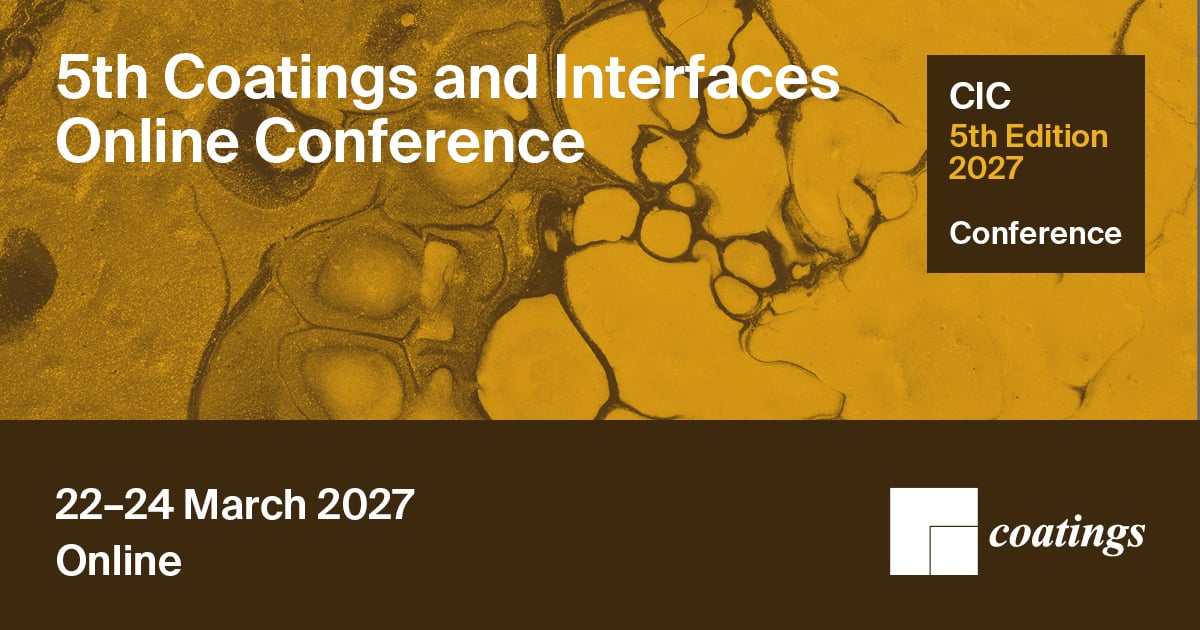
Conference date: 22–24 March 2027
Deadline for abstract submission: 30 November 2026
Deadline for registration: 16 March 2027
Conference chair: Dr. Emerson Coy (Adam Mickiewicz University in Poznań, Poznań, Poland)
For more details, please visit https://sciforum.net/event/CIC2027.
For any inquiries regarding the event, please contact cic2027@mdpi.com.