


Abstract
COVID-19, What to do now? This issue has had devastating effects in all domains of society worldwide. Lockdowns, the lack of freedom and social distancing meant the closure of a country’s entire activity. Having effects at all levels, beside incalculable ones in health, it is argued that scientific activity in education, business, economics and management suffered some of the most drastic impacts of this pandemic. This study aims to map the scientific literature in these areas in the context of COVID-19 and analyze its content through bibliometrics, which made it possible to highlight the scarcity of studies on the topic, namely empirical studies on the effects of this pandemic on scientific research and teaching/education. The results show there is a lack of peer-reviewed publications on this topic, with the studies covered (93) via the threads used revealing only 28 articles coming within the proposed objective. The bibliometrics corroborates that shortage. Finally, the contributions and implications for theory and practice are presented, followed by the limitations and suggestions for future research.
1. Introduction
The coronavirus, or COVID-19, was first detected in December 2019 in Wuhan, China, but only on 11 March 2020 did the World Health Organisation (WHO) declare that this had rapidly become a world pandemic, the first time a disease caused by a coronavirus had been considered as such [1]. In this scenario, COVID-19 had a major impact on public health, leading to an exponential growth of research in the field of medicine. For example, Di Gennaro et al. [2] developed a narrative review of COVID-19 and Asadi et al. [3] studied its transmission. Haleem et al. [4] identified 18 areas of research standing out in the context of the COVID-19 pandemic, where the field of economics is group 5, the topics addressed being the supply chain, travel and tourism, market closure, loss of income, economic recovery, poverty and hunger. However, a study to be published shortly by Myers et al. [5] shows that researchers report a relevant decline in the time spent on research, despite the number of hours spent on research being heterogeneous depending on the field of study (and depending on whether the field requires research in laboratories) and on gender. This has suggested that there is an atypical dimension with an impact on the hours spent on childcare by gender, which means that the pandemic has affected scientific human capital and could mold the scientific responses to the effects of the pandemic on science [5]. Also in terms of education, Kamal [6] studied teaching and COVID-19 in Brazil, arguing that distance education has reached students during the pandemic, thanks to the evolution of technologies and their multidimensional ways of being used. However, Carmo and Franco [7] show that in this teaching typology that teachers must accompany, guide, motivate and assess their students in a virtual learning environment. This means that teachers’ competences must go beyond everyday ones to include digital competences, the management of non face-to-face contact, flexibility and a mastery of online teaching, where digital interactivity has become the main way to create and transfer knowledge [8].
In addition to an exponential adaptation to a new reality that is widespread for all teachers and the rest of the scientific community, the total lack of knowledge about the coronavirus in all scientific areas triggered signs of chaos and an unprecedented global crisis. However, crises are understood as opportunities for the generation of new scientific knowledge, so it is argued that chaos theory [9] theoretically fits the study presented here. This means that chaos allows us to establish a standardization oriented towards an apparent disorder, as a consequence of several uncertainties (e.g., economic, social, health or information uncertainties) [10]. Consequently, the current pandemic crisis is characterized by the butterfly effect postulated by chaos theory, since an infinite change in an initial state can produce unexpected results [11]. In the same line of thought, Murphy [12] argued that chaos theory is a suitable framework for crisis situations, given that these are a sequence of events that over time assume increasing volumes and complexities, with dynamics similar to a chaotic and disorderly system.
For society in general and the academic community in particular, this pandemic is a new and completely unknown subject, where the frontiers upstream and downstream are hazy, which does not detract value from a mapping of the topic in the above-mentioned areas of research. This line of thought provides the intrinsic motivation to embark on a conceptual study on this topic and to bridge the existence of the limited number of studies in these areas, given the exponentiality of studies in the health field. This motivation is further supported by the importance that scientific research and education plays in showing how to deal with this pandemic crisis and the post-COVID-19 era, since advancing knowledge on this topic will allow for constructive learning with a disruptive experience and better adaptation to the abnormal future, which is the main added value of this study. Consequently, and from a management perspective, it is important to identify academics’ scientific production on education, management of business and similar areas, and how teaching institutions have adapted to the abnormal situation of lockdown in society as a whole. Therefore, the aim of this study is to map and make a bibliometric analysis of publications in the above-mentioned areas of investigation associated with scientific research and education. In other words, it is intended to systematize the scientific literature produced in 2020 on the topic of education and academic research in a pandemic environment COVID-19, through a systematic review of the literature. The operationalization of this review resides in the definition of search strings, of eligibility criteria, whose final basis will be subject to a descriptive analysis and to a bibliometric analysis by the RStudio software. It is crucial to fulfil this objective in order to bring critical aggregate value to a completely unknown topic and allow scientific knowledge to evolve rather than stagnate [13,14,15,16,17,18,19] and to understand its scope [20]. In addition, content analysis of all the documents included in this study will be presented.
The main contribution of this article lies in identifying the topics most studied in 2020 in the context of the COVID-19 pandemic from a management perspective. Studies here are scarce, with Myers et al. (2020) stating that the areas of education, business and management have been covered to some degree, and others have been excluded.
Then, the methodology (Section 3) is presented, which includes the definition of the strings for data collection, the eligibility criteria and the methodological procedures. The results include a descriptive analysis of the 93 selected documents and the respective content analysis, which allowed the identification of two main lines of research and their ramifications (Section 4). After this qualitative mapping, the bibliometric review (Section 5) is shown, which determined the existence of 3 clusters through factorial analysis and which confirms the lines of research identified in Section 4. Finally, the conclusions are presented, the main contributions, recommendations, limitations and future leads.
2. Synopsis of Literature
COVID-19 occurred at a time of hyper-connectivity, reinforcing the importance of communication at various levels [21], for example, in the closing of schools [22] which led to face-to-face teaching changing to distance learning [23], and the cancellation of international research conferences [24], which are so important for academics and researchers to present their recent work on a given topic. In addition, besides the dramatic changes to their income, researchers had very limited use of traditional workplaces during this time, as most institutions suspended face-to-face activities [5].
This means that the suspension of face-to-face classes and the closure of Higher Education Institutions (HEIs) [25] was seen as a means to mitigate the spread of infectious diseases and avoid chains of transmission [26,27,28], as was the abrupt switching to online classes [29]. On the other hand, this caused abnormal changes in people’s daily lives [30], including for higher education teachers, researchers and students [31]. This abnormality in the way of teaching and researching in a COVID-19 environment led to a process of relearning by all interested parties, which should be understood as a positive opportunity for change [32], supported for resilience, institutional and technological support by Strielkowski [33]. In addition, Myers et al. [5] stated that researchers have devoted less hours to research activities, which vary according to research areas and gender. However, the little research on teaching and research in the context of COVID-19, showed that resilience is a necessary condition to face this virus, namely for academics [34,35], and that this virus causes anxiety, stress [36], pessimism [37] and severe effects on research [38,39]. This pandemic reflects a challenge for researchers who have had to adapt to restrictions on access to their workplaces [31,40], performing their research duties while at home with the family [40]. The educational policies of the HEIs have also been involved in strategies that guarantee the continuity of the education system and which are characterized by several vectors, such as the availability of virtual platforms, digital content and the eventual training of teachers, especially in developing countries. In view of the imposed blockade and inherent confinement [23], requiring the definition of contingency plans [34], which must include equality and continuity of access to the resources necessary for the pursuit of the mission of teaching and research [23], without neglecting the significant educational, psychological, social and economic impacts on everyone’s life, did not end with the provision of continuity of learning, which represents yet another challenge for these institutions [41]. This brief synopsis showed that the existing studies do not include any systematic review, and most of these existing studies are descriptive. Therefore, in the following sections, this gap is closed.
3. Methodology
Carrying out a systematic literature review (SLR) means adopting stages that can be replicated, and the procedures must be transparent in all of them [42], so that the final result can be understood as critical added value [19]. Specifically, this critical aggregation should produce a descriptive summary of the literature on the topic analyzed and identify gaps and emerging directions for future research [19]. In particular, this method is based on transparency in data collection and definition of the criteria for selecting documents [43]. However, in order to achieve the required transparency, it is essential to follow the steps defined by Tranfield, Denyer and Smart [27] and by Xiao and Watso [28], which are: definition of the objective, protocols to be followed, research in the databases of literature, definitions of inclusion and quality eligibility criteria, data extraction, synthesis of the extracted data and its analysis and discussion.
Scientific mapping of the topic of analysis was performed through the bibliometric review [13,14,15,16,17,18,44], this bibliometric analysis being a statistical method allowing assessment of the qualitative and quantitative coverage of a given area of interest [20]. This analysis was carried out using Bibliometrix software [45], which joins a set of tools for exclusive processing of all the data about the publications selected for analysis. This process produces different matrices (e.g., about authors, number of publications, networks, couplings) [46], which are preceded by the normalization of similarity of publications [45]. Aria and Cuccurullo (p. 963) underlined that “the existence of substantial, effective statistical algorithms, access to high-quality numerical routines, and integrated data visualization tools are perhaps the strongest qualities to prefer R to other languages for scientific computation.” Bibliometrix is a package for bibliometric analysis written in R. R is an ecosystem software meaning it operates in an integrated environment consisting of open-libraries, the open-algorithm, and open-graphical software.”
3.1. Data Collection and Eligibility Criteria
It is therefore fundamental to define the criteria and key-words to be used in the process of searching for and specifying documents [47] to ensure an appropriate connection between the main topic and sub-topics and the inherent descriptive analysis [48].
It is also important to mention that this study used two online databases—Web of Science (WoS) and Scopus—widely recognized by the scientific community [49], but only the search of Web of Science (WOS) returned results. It should also be noted that WOS includes thousands of academic publications and bibliographic information about authors, affiliations and citations, with high scientific recognition in the academic world.
From the above, Table 1 shows the stages followed in this study, according to Tranfield, Denyer and Smart [50] and Xiao and Watso [51].
Table 1.
Stages of the systematic literature review (SLR).
3.2. Methodological Procedures
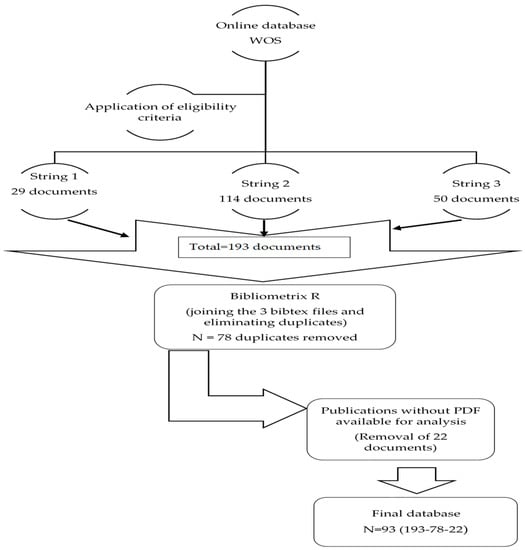
The operationalization of stages 1 to 5, i.e., the methodological procedures, are presented in Figure 1.
Figure 1.
Methodological procedures.
The requirement followed in the data collection and the application of the eligibility criteria led to the elaboration of Figure 1, which shows the careful way in which the final database was obtained (n = 93). The procedures shown here are in accordance with those followed in several studies of systematic and bibliometric nature [32]. Based on Figure 1, the following sections show stages 5 and 6 as described in Table 1.
4. Mapping and Qualitative Analysis
The mapping of the documents included in the final database was summarized by Bibliometrix R with the information considered relevant, as shown in Table 2.
Table 2.
Main information (n = 93).
A reading of this table reveals that various articles have been published recently (during 2019/2020) with citations (0.1067) and that the collaboration index rate between authors is 3.19. In addition, this search covered 48 scientific journals with 202 authors using 2813 bibliographic references. Among the articles contributing to the average citations per document (0.1067), the main ones standing out are those by Ivanov [52], analyzing the possible impacts of COVID-19 on supply chains through the simulation of a case with the limitations of this pandemic (citations in 2020 = 15), that of Dwyer and Walsh [53] exploring distance learning and the importance of critical thought; Herodotou et al. [54] notably studied the benefits of adopting Predictive Learning Analysis in online higher education. Only the article by Ivanov [52] was found to come within the COVID-19 context.
As for the country of origin of the 202 authors, it is important to compare that with the respective numbers of COVID-19 in that country (Data obtained from WHO on 27/5/2020 (https://covid19.who.int/). The USA (40 authors) stands out, having 1,63410 confirmed cases; Ukraine (32 authors) has 21,584 confirmed cases; Brazil (17 authors) has 374,898 cases. Strangely, China, with 84,544 confirmed cases, only accounts for 11 authors. Analysis of these data reveals the interest of academics in these countries in contributing scientific evidence to understanding and addressing the effects of the global lockdown caused by the pandemic; even if research at large now focuses mainly on medicine and related areas, education, business, economics and management researchers are still active in their research, whether it is related to COVID-19 or not. In the case of China, the country where the pandemic began, few authors appear in the final database analyzed, perhaps because researchers’ concerns have been mostly directed towards medicine.
Finalizing this descriptive analysis, the journal with most publications was Information Technologies and Learning Tools (n = 8), which has no impact factor (SJR) and is from Ukraine, which is logical given the number of authors originating in this country (32).
5. Content Analysis
Next, and also crucial in mapping the literature on a topic is content analysis of the 93 documents in the final database. This analysis aimed to identify the sub-topics studied, the objectives and the documents that are indeed related to COVID-19 in the areas of research referred to. This mapping implied integral reading of the 93 documents, in order to summarize their objective, determine the study typology, identify the sub-topic and finally identify the general conclusions. These studies were found to be of various typologies, namely: conceptual, empirical, exploratory and descriptive. Furthermore, quantitative and qualitative methodologies were used in different contexts, and sometimes jointly. However, the qualitative methodology was especially relevant, since this is a phenomenon with particular aspects, with this type of method allowing: (1) the direct source of data to be the natural environment and the researcher as the main agent involved in data collection; (2) the data gathered to be essentially of a descriptive nature; (3) researchers more interested in the process itself than in the results; (4) data analysis being performed inductively, and (5) the researcher being interested mainly in trying to understand the meaning participants attribute to their experiences [55,56]. This emphasis on qualitative research demonstrates that COVID-19 is an unknown phenomenon without precedents, where only quasi-experimentation can produce positive initial results, even if they have to be supported subsequently by quantitative research.
Finally, this content analysis identified two main sub-topics, namely: (1) Online education and (2) COVID-19’s relation with the research areas of Education, Business, Economics and Management. Consequently, Appendix A presents the table with the content information of Group 1, as this is not related to COVID-19 but to distance learning in general, which is not the primary aim of this study but may suggest future research options related to this aim. Summarizing, this group of documents deals mainly with the competences of students and teachers, particularly regarding the technology [57] required in distance learning, the importance of involvement [58], communication [59] and interaction [60] between students and teachers, the use of technology [61], course completion rates [62] and the importance of feedback [63].
Concerning Group 2, related to COVID-19, this is analyzed in the following paragraphs. A significant number of documents related to Canada is noted, through the emergence of a special edition about agriculture, food and supply chains, among others [64,65]. However, these articles do not allow generalization of the results, as they are specific to the Canadian context. No less importantly, the majority of studies are exploratory and descriptive, which is understandable due to the scarcity of primary and secondary data.
As mentioned, Canada stands out in terms of (exploratory and descriptive) publications on the effects of this pandemic on management of the lockdown imposed. The effect of COVID-19 was studied in various domains and can be summarized as follows: (a) this virus altered consumer behavior in the food sector, with around 30% of the amount normally spent on eating out transferred to the retail sector [64]; (b) current agricultural policy can help farmers to manage new risks related to COVID-19 [65]; (c) pandemics are a particular risk case for the supply chain, causing a long-term interruption and a time of uncertainty, and so it was important to simulate those new impacts on the supply chain’s performance following total lockdown [52]; (d) the enforced economic paralyzation reduced production [66,67], which renewed pressure on the value of agricultural land based on the duration of the recession and interest rates [67]; (e) the impact of COVID-19 on the financial wheat market has been major, causing a great volatility of prices given the uncertainty [68]; (f) food availability will be stable in the near future in the pandemic context, but there may be temporary deficits in supply and increased prices of certain food [69]; (g) this pandemic crisis requires the resilience of international supply chains, which will be neglected by consumers opting for online purchases and local chains [70,71]; (h) consumers’ demand for food was changed by the pandemic (e.g., through changes in preferences, income and prices) [72], and also by the suppression of the transport system [73].
Concerning education, scientific production and academics, research related to COVID-19 is currently scarce (5 publications). Briefly, and in the area of education, Jackson et al. [74] concluded that in times of a pandemic, Twitter does not provide information in addition to other methods already used for complementary data about closed schools. This dictated the urgency to take up the challenge of setting up a new teaching method, requiring major adaptation by all involved, with the aim of using this experience of COVID-19 for future pandemics or other health emergencies [75]. The lockdown caused by the pandemic had devastating effects on Muslim women’s education [76]. Concerning scientific production and academics, Wooliscroft [24] mentioned that the Conference of the Macro Marketing Society Inc. received a record amount of scientific production research, but for the first time in its history, the conference will not be held in 2020 due to COVID-19. Fernandez and Shaw [77] concluded that in times of a pandemic, good practices include a connection with people, mutual trust and clear, frequent communication between all those involved.
From a management perspective, studies are also scarce, with Grint [78] arguing that COVID-19 exposed the limits of a market-based economy and the fragilities of health systems, revealing that individuals look for charismatic or authoritarian leaders who supposedly have the management competences to defeat COVID-19 only through being positive or simply by denying evidence. The labor market also registered a major collapse. In Canada and the USA, around 50% of workers lost income due to the pandemic, with this figure being around 25% in the UK and around 45% in China [79]. A search on this topic returned two articles on the environment, namely about the global warming caused by COVID-19 [80,81]. Another study addresses the change in consumer behavior in moving to online purchases, this being linked to the effects of fear and causing swings in purchasing trends [82]. Other relevant research includes a study about the health system’s financial adaptation to COVID-19 [83], another about the economic and social measures taken to reduce transmission of the virus [84], one about price speculation in medical supplies during COVID-19 [85], while Stavins [86] describes Americans’ emerging expenditure due to the pandemic in terms of credit card use.
Finally, the last articles published (4) do not relate directly to these areas and studied: perceptions of the risk of COVID-19 in Vietnam [87]; the need for health professionals to have training on how to manage ventilators [88]; the importance of continuing to be physically active during times of a pandemic [89]; and a reflection on the film The POST during the COVID-19 period [90]. Note that all these studies are published in journals in the area of business, economics and management.
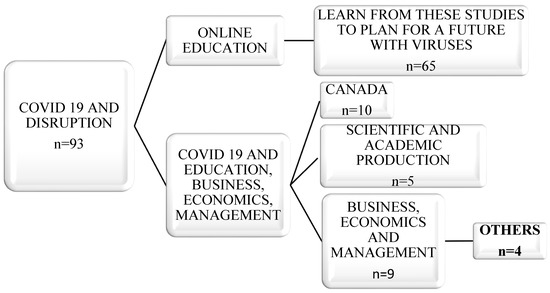
This descriptive analysis allowed mapping of the topics studied, as shown in Figure 2.
Figure 2.
Mapping of the topic analyzed (n = 93).
This theoretical mapping shown in Figure 2 is a consequence of the 93 articles under analysis, which suggests that research on COVID-19 and the disruption it has caused in education and scientific research is still scarce, while the existing research did not go beyond the means used to bridge the absence of face-to-face classes, the importance of communication and the connection between academia. This may indicate that the lack of empirical data on this disruption interrupted the production of scientific knowledge, highlighting the weaknesses to which researchers and teachers are exposed. In short, the advancement of science is fundamental, so this mapping and content analysis has made explicit the importance of supporting the network of researchers and creating conditions so that the butterfly effect caused by chaos is not limiting research’s investigative functions at a time when the abnormality will be the new normality in the future.
The above mapping suggests there are distinct groups of research, and so the following section identifies the clusters according to document titles and key words using Bibliometrix R.
6. Bibliometric Analysis
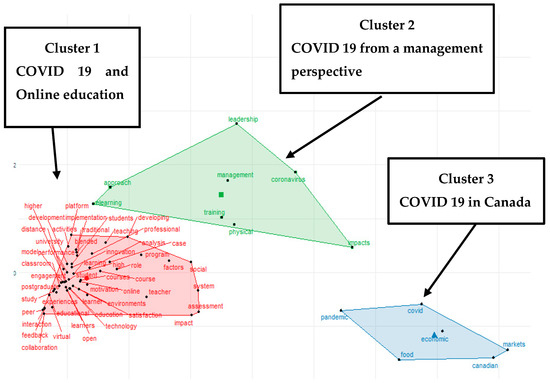
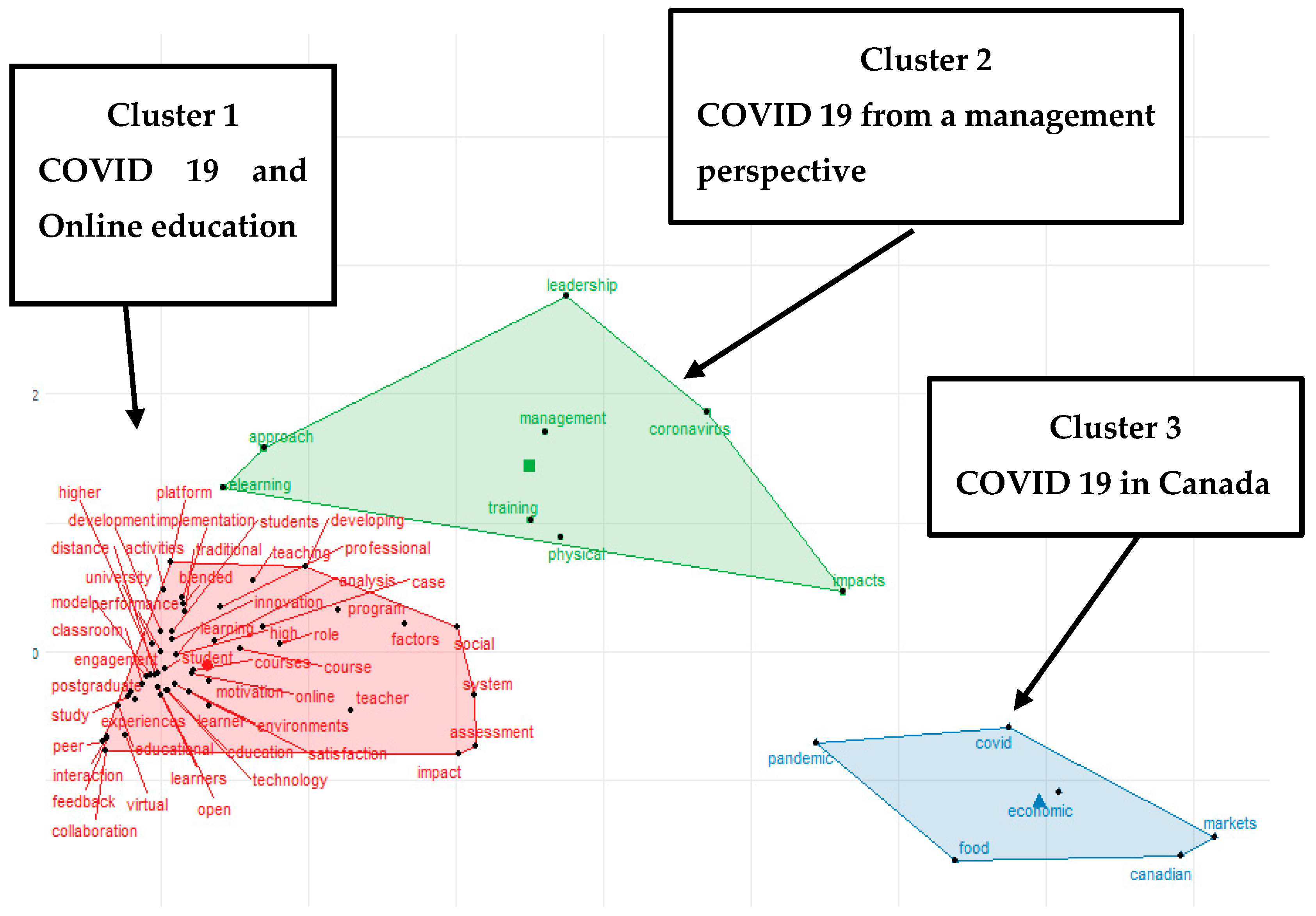
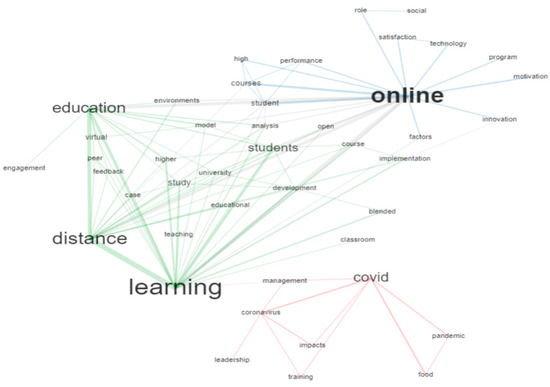
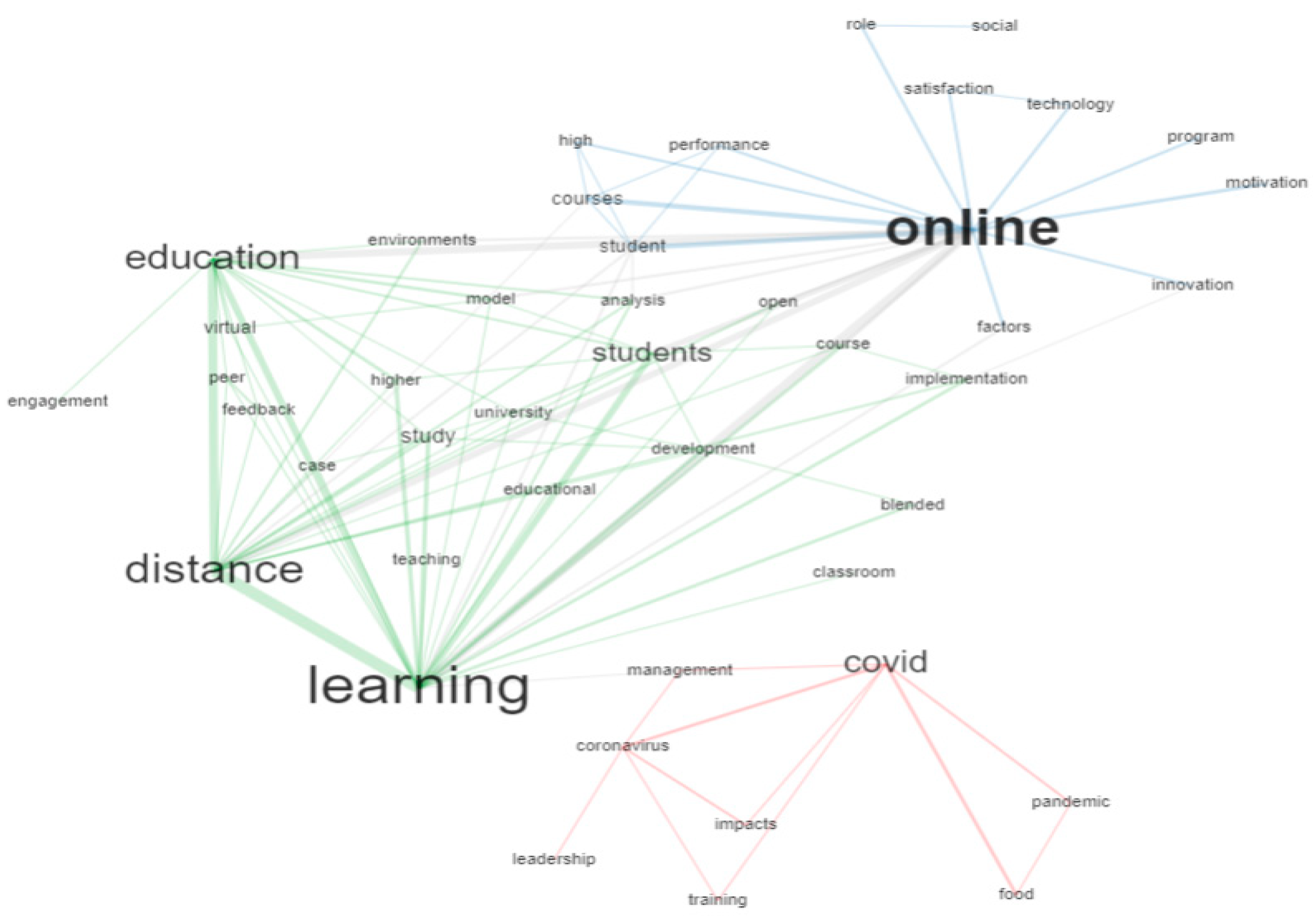
Network analysis has been widely used in bibliometric studies [91]. In this context, Bibliometrix R allows carrying out network analysis through connections between the various attributes of the database, which can be used for additional analysis [45]. These networks are analyzed to capture significant properties of the underlying research topic, and particularly, to determine the influence of bibliometric units, for example key-words and titles [45]. In accordance with the mapping above using Bibliometrix R software, Figure 3 presents the factor analysis of the 93 documents (Correspondence Analysis) in order to obtain the bipartite network of terms extracted from titles [45]. In parallel, the links between the key words of these documents are presented (Figure 4).
Figure 3.
Factorial Analysis by titles (n = 93).
Figure 4.
Network analysis by key words (n = 93).
This figure shows that most articles in Cluster 1 do not include the term COVID-19 or coronavirus (red) in their titles. This confirms the mapping of the previous section, where articles published in the area of education studied questions and concerns related to distance learning in a situation of normality. However, the contributions of these articles reveal the students and teachers’ experiences of this teaching typology and can provide synergies for the possible continuity of online classes or a mixed teaching system (face-to-face and online) in the near future. For example, the literature suggested the importance of getting around the technological anxiety [92] caused by online classes, the feeling of belonging to an academic community [93,94] and feedback [63], which are new vectors for students and teachers, and also for teaching institutions. In addition, it is crucial to recognize students and teachers’ remarkable adaptation to this new form of class, where physical presence was replaced by technology [95,96,97], altering the student/teacher relationship considerably [59,98,99]. Resilience was the key to this teaching typology during the pandemic, irrespective of whether teachers have the competences inherent to online teaching [57,100,101,102]. Cluster 2 (green), which is clearly smaller, shows that publications in management and academics’ research in this area demonstrated a significant negative effect, with academic literature being one of the fields with the most harmful effects, leading to the shortage of studies on COVID-19 and its effects from a management perspective and in written research. This has to do with it being a new phenomenon, with no existing knowledge on the subject, and so management scholars’ first instinct was to launch numerous questionnaires about its effects on social and other networks. It is assumed that the studies involving these questionnaires are still being elaborated on or are in the peer-review process. This means that the titles of this cluster are articles about distance learning and training and the positive and negative impacts [54,94,103,104,105,106,107], about leadership [77,102], about physical questions [89,101,108], about coronavirus [78,81,84,89] and about management [109]. Finally, Cluster 3 (blue) represents the studies about Canada analyzed in the previous section.
Based on another approach, Figure 4 shows the links between the key-words of the 93 articles, where only one association between learning and COVID-19 stands out, the research by Grint [78] connecting this virus with the type of leaders looked for in this pandemic. The disruption in research on COVID-19 from a management perspective is also confirmed.
Summarizing, the bibliometrics shows that the main topic studied was education based on online constructs and distance e-learning, with Canada standing out in studies on COVID-19 and its impacts on the country’s management and economy, with the areas of business, economics and management revealing little research.
7. Conclusions and Contributions
The development of this article was a challenge, and simultaneously an adventure into an unknown public health phenomenon with devastating effects on health, the economy, business and its management. Initially, this research highlighted that publications in the area of health grew exponentially as opposed to those dealing with education, business, economics and management, with the cause-effect relation being dictated by the urgent need to combat the pandemic. This means that in the areas of research analyzed in this article, scholars found themselves facing drastic changes in their daily academic routines associated with a different type of family life, implying major resilience in managing this. Moreover, these changes meant that research tasks diminished drastically due to the time spent on preparing and giving classes online and on assisting students at a distance, where information and communication technology was crucial.
Given this scenario of scientific literature from a management perspective, the main contribution of this conceptual article lies in showing that management and education scholars were faced with paradigmatic situations in relation to academic tasks, with a different schedule for dealing with all of them. In other words, with no freedom of choice, they turned to online teaching and learned how to work with the platforms available in order to continue to transmit programmed content to their students, and neglected research due to a lack of time.
Other contributions concern theoretical and practical implications. In terms of theory, this research produced an original study—SLR—on an unexplored topic in the area of education and management, where mapping revealed that online education and COVID-19 and management are research flows in articles that have been published in WOS up to the present date. The first topic revealed no association with COVID-19, but various studies were conducted on the pros and cons of distance learning and teaching online for all those involved. These studies give insights into the experiences felt and identify strengths and weaknesses so that this type of teaching can be of greater quality in the future. The second group was able to respond to the objective proposed, where the topic was divided into three sub-topics, namely: Canada, scientific and academic production, business, economics and management. Standing out in these sub-topics is Canada’s emphasis on the effects of COVID-19 on supply chains in the food and agriculture sector, which are uncertain and still difficult to quantify. The second sub-topic addressed the closure of schools, good educational practices and the cancellation of international conferences. Finally, the third sub-topic includes a research flow on management constructs, such as the leader profile required during pandemic periods, market questions from the supply and demand perspective and environmental questions. Another theoretical implication concerns the bibliometrics used, i.e., presenting title and key-word networks, as articles from 2020 are so recently published that there was no point in examining co-citations, for example. The clustering carried out showed three clusters closely related to the topics and sub-topics mapped in the descriptive and content analysis, corroborating the shortage of research in the areas of analysis associated with COVID-19. Moreover, in the key-word network, only one study on leadership was linked to COVID-19.
It is also important to note that chaos theory fits as an effective theoretical support, which means that the sooner the initial state of the pandemic changes due to measures to mitigate the spread, the faster the final result changes. Applying this argument to the topic studied here, the timely closure of universities, research centers and businesses generated an apparent disorder through which the rapid way in which institutions and other entities responded in order to find a viable and efficient solution, which did not let the students continue their academic year as before, which in turn led to lost opportunities for research in progress and business survival. In other words, the butterfly worked and avoided total chaos.
Clearly, this pandemic affected domains far beyond health, although with different impacts not involving the loss of life. It must therefore be recognized that the sphere of education in general and scientific research in the areas of business, education, educational research, economics and management also experienced relevant impacts. Specifically, there has been a wide range of questionnaires published on social networks regarding all types of effects of COVID-19, to obtain robust empirical evidence that is open to generalization. However, research made in these areas has not produced any theoretical and conceptual articles on what the academic world has published, corroborating Haleem et al. [4] in the simplistic mapping of research on COVID-19, so this study provides added value in that sense.
Finally, the results of this investigation provided some recommendations for the area of education, in terms of the future. Thus, educational entities should take advantage of the opportunity given by this crisis to further digitize themselves and to offer their teachers training in online education systems, for example on how to keep students connected, communicative, participatory in these classes; teachers must rethink the way they teach their content, where the use of gamification can be an asset. Also the preparation of adequate contingency plans by the relevant entities would be an asset, so that an eventual second wave does not have an impact as severe as the first in the lives of students, teachers and investigators.
Regarding the contributions and implications for practice, there is an opportunity to define a future agenda for empirical research into all the constructs implicit in people, business, scientific research, teaching methods and other areas, which are extremely important for effective assessment of the true socio-economic impact of COVID-19 on society in general, on business management and on families’ lives.
8. Limitations and Future Avenues of Research
Similar to other investigations, this is not without limitations. The first one concerns using only the WOS database, suggesting that future research could extend to other databases, despite this one having the greatest international recognition. For example, replicating this SLR using Google Scholar could be interesting, as a quick search of the same threads revealed a great many non-indexed articles whose content could be important, and these could be classified using Publish or Perish software, which suggests future research opportunities. Another limitation concerns the researchers’ subjectivity in elaborating on the articles given the absence of publications on the topic, which suggests that empirical articles carried out in the future should set out from a new SLR to have internal and external validity.
Finally, unsurprisingly, this is fertile ground for a vast amount of future research. Therefore, some suggestions are made, and others could certainly be indicated, as none of them excludes any of he others. These are as follows: (1) a study addressing the impact of COVID-19 on scientific activities in the academic sphere; (2) research into the socio-economic impact of the pandemic on firms, due to the enforced lockdown of a country’s entire economic activity; (3) investigate the socio-economic effects on families to identify their typology; (4) determine the strengths and weaknesses of online teaching for lecturers and students in higher education; (5) a descriptive and comparative study of the results obtained from the previous suggestions; (6) a case study about a public institution’s social responsibility and citizenship in the social domain in the pandemic context; (7) another case study on how cities, through local governments, managed the pandemic.
Author Contributions
M.R. and R.S. had the initial idea for the manuscript and wrote an original draft, as well as provided the resources for the research and M.F. participated in the formal reviews and supervision. All authors have read and agreed to the published version of the manuscript.
Funding
This research was not funded.
Acknowledgments
The authors are grateful to the anonymous referees of the journal for their extremely useful suggestions to improve the quality of the paper. The authors gratefully acknowledge financial support from National Funds of the FCT–Portuguese Foundation for Science and Technology within the project «UIDB/04007/2020».
Conflicts of Interest
The authors declare no conflict of interest.
Appendix A
Table A1.
Content information about Group 1–Online education.
References
- He, F.; Deng, Y.; Li, W. Coronavirus disease 2019: What we know? J. Med. Virol. 2020, 92, 719–725. [Google Scholar] [CrossRef] [Scilit]
- Di Gennaro, F.; Pizzol, D.; Marotta, C.; Antunes, M.; Racalbuto, V.; Veronese, N.; Smith, L. Coronavirus Diseases (COVID-19) Current Status and Future Perspectives: A Narrative Review. Int. J. Environ. Res. Public Health 2020, 17, 2690. [Google Scholar] [CrossRef] [Scilit]
- Asadi, S.; Bouvier, N.; Wexler, A.S.; Ristenpart, W.D. The coronavirus pandemic and aerosols: Does COVID-19 transmit via expiratory particles? Aerosol Sci. Technol. 2020, 54, 635–638. [Google Scholar] [CrossRef] [Scilit]
- Haleem, A.; Javaid, M.; Vaishya, R.; Deshmukh, S. Areas of academic research with the impact of COVID-19. Am. J. Emerg. Med. 2020, 5–7. [Google Scholar] [CrossRef] [Scilit]
- Myers, K.; Tham, W.Y.; Yin, Y.; Cohodes, N.; Thursby, J.G.; Thursby, M.; Schiffer, P.; Walsh, J.; Lakhani, K.R.; Wang, D. Quantifying the Immediate Effects of the COVID-19 Pandemic on Scientists. SSRN Electron. J. 2020. [Google Scholar] [CrossRef] [Scilit]
- Kamal, Z.N.M. Technologies for Digital, Distance and Open Education: Defining What are Those. SSRN Electron. J. 2020. [Google Scholar] [CrossRef] [Scilit]
- Carmo, R.D.O.S.; Franco, A.P. DA DOCÊNCIA PRESENCIAL À DOCÊNCIA ONLINE: APRENDIZAGENS DE PROFESSORES UNIVERSITÁRIOS NA EDUCAÇÃO A DISTÂNCIA. Educ. Em. Rev. 2019, 35, 35. [Google Scholar] [CrossRef] [Scilit]
- Jafarian, M.; Abdollahi, M.R.; Nathan, G.J. Preliminary evaluation of a novel solar bubble receiver for heating a gas. Sol. Energy 2019, 182, 264–277. [Google Scholar] [CrossRef] [Scilit]
- Lorenz, E. On the Prevalence of Aperiodicity in Simple Systems—Global Analysis; Springer: New York, NY, USA, 1963; pp. 53–75. [Google Scholar]
- Gleick, J.C.-A. C. de uma nova C., 4th ed.; Campus: São Paulo, Brasil, 1991; 310p. [Google Scholar]
- Gatti, F.; Carvalho, A. Administração e Caos: Uma Estreita Relação. Rev. Ciências Gerenc. 2007, 11, 40–44. [Google Scholar]
- Murphy, P. Chaos theory as a model for managing issues and crises. Public Relat. Rev. 1996, 22, 95–113. [Google Scholar] [CrossRef] [Scilit]
- Smith, D.R. Citation Analysis and Impact Factor Trends of 5 Core Journals in Occupational Medicine, 1975–1984. Arch. Environ. Occup. Health 2010, 65, 176–179. [Google Scholar] [CrossRef] [Scilit] [PubMed]
- Garfield, E. Is citation analysis a legitimate evaluation tool? Science 1979, 1, 359–375. [Google Scholar] [CrossRef] [Scilit]
- Powell, W.W.; Koput, K.W.; Smith-Doerr, L. Interorganizational Collaboration and the Locus of Innovation: Networks of Learning in Biotechnology. Adm. Sci. Q. 1996, 41, 116. [Google Scholar] [CrossRef] [Scilit]
- Quinlan, K.M.; Kane, M.; Trochim, W.M.K. Evaluation of large research initiatives: Outcomes, challenges, and methodological considerations. New Dir. Eval. 2008, 2008, 61–72. [Google Scholar] [CrossRef] [Scilit]
- Wolfe, A.W. Social Network Analysis: Methods and Applications. Am. Ethnol. 1997, 24, 219–220. [Google Scholar] [CrossRef] [Scilit]
- White, H.D.; Griffith, B.C. Author cocitation: A literature measure of intellectual structure. J. Am. Soc. Inf. Sci. 1981, 32, 163–171. [Google Scholar] [CrossRef] [Scilit]
- Mentzer, J.T.; Kahn, K.B. A Framework of Logistic Reserarch. J. Bus. Logist. 1995, 16, 231–250. [Google Scholar]
- Geaney, F.; Scutaru, C.; Kelly, C.; Glynn, R.W.; Perry, I.J. Type 2 Diabetes Research Yield, 1951–2012: Bibliometrics Analysis and Density-Equalizing Mapping. PLoS ONE 2015, 10, e0133009. [Google Scholar] [CrossRef] [Scilit]
- Кештов, М.Л.; Куклин, С.А.; Бузин, М.И.; Годовский, Д.Ю.; Хохлов, А.Р. СИНТЕЗ И ФОТОФИЗИЧЕСКИЕ СВОЙСТВА ПОЛУПРОВОДНИКОВЫХ МОЛЕКУЛ Д1–А–Д2–А–Д1-СТРУКТУРЫ НА ОСНОВЕ ПРОИЗВОДНЫХ ХИНОКСАЛИНА И ДИТИЕНОСИЛОЛА ДЛЯ ОРГАНИЧЕСКИХ СОЛНЕЧНЫХ ФОТОЭЛЕМЕНТОВ. Дoклады Академии наук 2016, 469, 319–323. [Google Scholar] [CrossRef] [Scilit]
- Viner, R.M.; Russell, S.J.; Croker, H.; Packer, J.; Ward, J.; Stansfield, C.; Mytton, O.; Bonell, C.; Booy, R. School Closure and Management Practices during Coronavirus Outbreaks Including COVID-19: A Rapid Systematic Review. Lancet Child Adolesc. Heal. 2020, 4, 397–404. [Google Scholar] [CrossRef] [Scilit]
- UNESCO. COVID-19 and Higher Education: Today and Tomorrow IMPACT Analysis, Policy Responses and Recommendations; UNESCO, IESALC: Paris, France, 2020; pp. 1–46. [Google Scholar]
- Wooliscroft, B. Macromarketing the Time is Now. J. Macromark. 2020, 40, 153–155. [Google Scholar] [CrossRef] [Scilit]
- Sahu, P.K. Closure of Universities Due to Coronavirus Disease 2019 (COVID-19): Impact on Education and Mental Health of Students and Academic Staff. Cureus 2020, 12, 4–9. [Google Scholar] [CrossRef] [Scilit] [PubMed]
- Kawano, S.; Kakehashi, M. Substantial Impact of School Closure on the Transmission Dynamics during the Pandemic Flu H1N1-2009 in Oita, Japan. PLoS ONE 2015, 10, e0144839. [Google Scholar] [CrossRef] [Scilit]
- De Luca, G.; Van Kerckhove, K.; Coletti, P.; Poletto, C.; Bossuyt, N.; Hens, N.; Colizza, V. The impact of regular school closure on seasonal influenza epidemics: A data-driven spatial transmission model for Belgium. BMC Infect. Dis. 2018, 18, 29. [Google Scholar] [CrossRef] [Scilit]
- Wheeler, C.C.; Erhart, L.M.; Jehn, M. Effect of School Closure on the Incidence of Influenza Among School-Age Children in Arizona. Public Health Rep. 2010, 125, 851–859. [Google Scholar] [CrossRef] [Scilit]
- Gewin, V. Five tips for moving teaching online as COVID-19 takes hold. Nature 2020, 580, 295–296. [Google Scholar] [CrossRef] [Scilit] [PubMed]
- Baldwin, R.; Weder, B. Economics in the Time of COVID-19; CEPR Press: London, UK, 2020. [Google Scholar]
- Sorokowski, A.P.; Kowal, M.; Sorokowska, A.; Lebuda, I.; Białek, M.; Kowalska, K.; Wojtycka, L.; Karwowski, M. Dread in Academia—How COVID-19 Affects Science and Scientists; Institute of Psychology, University of Wroclaw: Wroclaw, Poland, 2020; pp. 1–5. [Google Scholar]
- Corbera, E.; Anguelovski, I.; Honey-Rosés, J.; Ruiz-Mallén, I. Academia in the Time of COVID-19: Towards an Ethics of Care. Plan. Theory Pract. 2020, 21, 191–199. [Google Scholar] [CrossRef] [Scilit]
- Strielkowski, W. COVID-19 Pandemic and the Digital Revolution in Academia and Higher Education; Prague Business School: Prague, Czech Republic, 2020. [Google Scholar]
- Dohaney, J.; De Roiste, M.; Salmon, R.A.; Sutherland, K. Benefits, barriers, and incentives for improved resilience to disruption in university teaching. Int. J. Disaster Risk Reduct. 2020, 50, 101691. [Google Scholar] [CrossRef] [Scilit]
- Zanon, C.; Dellazzana-Zanon, L.; Weschler, S.; Fabretti, R.; Rocha, K. COVID-19: Implications and Applications of Positive Psychology in Times of Pandemia. Estud. Psicol. 2020, 37, 1–30. [Google Scholar]
- Polizzi, C.; Lynn, S.J.; Perry, A. Perspective Article Stress and Coping in the Time of COVID-19: Pathways to Resilience and Recovery. Clin. Neuropsychiatry 2020, 17, 59–62. [Google Scholar]
- Shukla, A.; Dwivedi, M. Pessimism towards Optimism: Empowering University Students amid COVID-19. Tathapi Ugc. Care J. 2020, 19, 149–159. [Google Scholar]
- Inouye, D.W.; Underwood, N.; Inouye, B.D.; Irwin, R.E. Support early-career field researchers. Science 2020, 368, 724–725. [Google Scholar] [CrossRef] [Scilit]
- Staniscuaski, F.; Reichert, F.; Werneck, F.P.; De Oliveira, L.; Mello-Carpes, P.B.; Soletti, R.C.; Almeida, C.I.; Zandona, E.; Ricachenevsky, F.K.; Neumann, A.; et al. Impact of COVID-19 on academic mothers. Science 2020, 368, 724. [Google Scholar] [CrossRef] [Scilit]
- Omary, M.B.; Eswaraka, J.R.; Kimball, S.D.; Moghe, P.V.; Panettieri, J.R.A.; Scotto, K.W. The COVID-19 pandemic and research shutdown: Staying safe and productive. J. Clin. Investig. 2020, 130, 2745–2748. [Google Scholar] [CrossRef] [Scilit]
- Carver, L.B. Supporting Learners in a Time of Crisis. Adv. Soc. Sci. Res. J. 2020, 7, 129–136. [Google Scholar] [CrossRef] [Scilit]
- Briner, R.B.; Denyer, D. Systematic Review and Evidence Synthesis as a Practice and Scholarship Tool. In Systematic Review and Evidence Synthesis as a Practice and Scholarship Tool; Oxford University Press: Oxford, UK, 2012; pp. 112–129. [Google Scholar]
- Hadengue, M.; De Marcellis-Warin, N.; Warin, T. Reverse innovation: A systematic literature review. Int. J. Emerg. Mark. 2017, 12, 142–182. [Google Scholar] [CrossRef] [Scilit]
- Howard, W.; Katherine, M. Visualizing a Discipline: An Author Co-Citation Analysis of Information Science, 1972–1995. J. Am. Soc. Inf. Sci. 1998, 49, 327–355. [Google Scholar]
- Aria, M.; Cuccurullo, C. bibliometrix: An R-tool for comprehensive science mapping analysis. J. Inf. 2017, 11, 959–975. [Google Scholar] [CrossRef] [Scilit]
- Ekundayo, T.C.; Okoh, A.I. A global bibliometric analysis of Plesiomonas-related research (1990–2017). PLoS ONE 2018, 13, e0207655. [Google Scholar] [CrossRef] [Scilit]
- Bandara, W.; Miskon, S.; Fielt, E. A Systematic, Tool-Supported Method for Conducting Literature Reviews. In ECIS 2011 Proceedings [19th European Conference on Information Systems]; AIS Electronic Library (AISeL)/Association for Information Systems: Atlanta, GA, USA, 2011; pp. 1–13. [Google Scholar]
- Treinta, F.T.; Filho, J.R.D.F.; Sant’Anna, A.P.; Rabelo, L.M. Metodologia de pesquisa bibliográfica com a utilização de método multicritério de apoio à decisão. Production 2013, 24, 508–520. [Google Scholar] [CrossRef] [Scilit]
- Rodrigues, M.; Franco, M. Networks and performance of creative cities: A bibliometric analysis. City Cult. Soc. 2020, 20, 100326. [Google Scholar] [CrossRef] [Scilit]
- Tranfield, D.; Denyer, D.; Smart, P. Towards a Methodology for Developing Evidence-Informed Management Knowledge by Means of Systematic Review. Br. J. Manag. 2003, 14, 207–222. [Google Scholar] [CrossRef] [Scilit]
- Xiao, Y.; Watson, M. Guidance on Conducting a Systematic Literature Review. J. Plan. Educ. Res. 2017, 39, 93–112. [Google Scholar] [CrossRef] [Scilit]
- Ivanov, D. Predicting the impacts of epidemic outbreaks on global supply chains: A simulation-based analysis on the coronavirus outbreak (COVID-19/SARS-CoV-2) case. Transp. Res. Part E Logist. Transp. Rev. 2020, 136, 101922. [Google Scholar] [CrossRef] [Scilit]
- Dwyer, C.P.; Walsh, A. An exploratory quantitative case study of critical thinking development through adult distance learning. Educ. Technol. Res. Dev. 2019, 68, 17–35. [Google Scholar] [CrossRef] [Scilit]
- Herodotou, C.; Rienties, B.; Hlosta, M.; Boroowa, A.; Mangafa, C.; Zdrahal, Z. The scalable implementation of predictive learning analytics at a distance learning university: Insights from a longitudinal case study. Internet High. Educ. 2020, 45, 100725. [Google Scholar] [CrossRef] [Scilit]
- Yin, R. Case Study Research: Design and Methods—Applied Social Research Methods Series, 6th ed.; Sage Publications, Inc.: Thousand Oaks, CA, USA, 2015. [Google Scholar]
- Mills, J.; Birks, M. Qualititave Methodology: A Practical Guide; SAGE Publications: Thousand Oaks, CA, USA, 2014; pp. 2–15. [Google Scholar]
- Harper, D.A.; Muñoz, F.-F.; Vázquez, F.J. Innovation in online higher-education services: Building complex systems. Econ. Innov. New Technol. 2020, 1–20. [Google Scholar] [CrossRef] [Scilit]
- Yilmaz, A.B.; Banyard, P. Engagement in Distance Education Settings: A Trend Analysis. Turk. Online J. Distance Educ. 2020, 101–120. [Google Scholar] [CrossRef] [Scilit]
- Kayser, I.; Merz, T. Lone Wolves in Distance Learning? Int. J. Mob. Blended Learn. 2020, 12, 82–94. [Google Scholar] [CrossRef] [Scilit]
- Zheng, B.; Lin, C.-H.; Kwon, J.B. The impact of learner-, instructor-, and course-level factors on online learning. Comput. Educ. 2020, 150, 103851. [Google Scholar] [CrossRef] [Scilit]
- Rajagopal, K.; Firssova, O.; De Beeck, I.O.; Van Der Stappen, E.; Stoyanov, S.; Henderikx, P.; Buchem, I. Learner skills in open virtual mobility. Res. Learn. Technol. 2020, 28, 1–18. [Google Scholar] [CrossRef] [Scilit]
- Danka, I. Motivation by gamification: Adapting motivational tools of massively multiplayer online role-playing games (MMORPGs) for peer-to-peer assessment in connectivist massive open online courses (cMOOCs). Int. Rev. Educ. 2020, 66, 75–92. [Google Scholar] [CrossRef] [Scilit]
- Schreiber, B.R.; Jansz, M. Reducing distance through online international collaboration. ELT J. 2019, 74, 63–72. [Google Scholar] [CrossRef] [Scilit]
- Goddard, E. The impact of COVID-19 on food retail and food service in Canada: Preliminary assessment. Can. J. Agric. Econ. Can. D’agroeconomie 2020, 68, 157–161. [Google Scholar] [CrossRef] [Scilit]
- Ker, A.P. Risk management in Canada’s agricultural sector in light of COVID-19. Can. J. Agric. Econ. Can. D’agroeconomie 2020, 68, 251–258. [Google Scholar] [CrossRef] [Scilit]
- Hailu, G. Economic thoughts on COVID-19 for Canadian food processors. Can. J. Agric. Econ. Can. D’agroeconomie 2020, 68, 163–169. [Google Scholar] [CrossRef] [Scilit]
- Lawley, C. Potential impacts of COVID-19 on Canadian farmland markets. Can. J. Agric. Econ. Can. D’agroeconomie 2020, 68, 245–250. [Google Scholar] [CrossRef] [Scilit]
- Vercammen, J. Information-rich wheat markets in the early days of COVID-19. Can. J. Agric. Econ. Can. D’agroeconomie 2020, 68, 177–184. [Google Scholar] [CrossRef] [Scilit]
- Deaton, B.J. Food security and Canada’s agricultural system challenged by COVID-19. Can. J. Agric. Econ. Can. D’agroeconomie 2020, 68, 143–149. [Google Scholar] [CrossRef] [Scilit]
- Hobbs, J.E. Food supply chains during the COVID-19 pandemic. Can. J. Agric. Econ. Can. D’agroeconomie 2020, 68, 171–176. [Google Scholar] [CrossRef] [Scilit]
- Weersink, A.; Von Massow, M.; McDougall, B. Economic thoughts on the potential implications of COVID-19 on the Canadian dairy and poultry sectors. Can. J. Agric. Econ. Can. D’agroeconomie 2020, 68, 195–200. [Google Scholar] [CrossRef] [Scilit]
- Cranfield, J.A.L. Framing consumer food demand responses in a viral pandemic. Can. J. Agric. Econ. Can. D’agroeconomie 2020, 1–6. [Google Scholar] [CrossRef] [Scilit]
- Gray, R.S. Agriculture, transportation, and the COVID-19 crisis. Can. J. Agric. Econ. Can. D’agroeconomie 2020, 68, 239–243. [Google Scholar] [CrossRef] [Scilit]
- Jackson, A.M.; A Mullican, L.; Tse, Z.T.H.; Yin, J.; Zhou, X.; Bs, D.K.; Fung, I.C.-H.; Mph, L.A.M. Unplanned Closure of Public Schools in Michigan, 2015–2016: Cross-Sectional Study on Rurality and Digital Data Harvesting. J. Sch. Health 2020, 90, 511–519. [Google Scholar] [CrossRef] [Scilit] [PubMed]
- Moorhouse, B.L. Adaptations to a face-to-face initial teacher education course ‘forced’ online due to the COVID-19 pandemic. J. Educ. Teach. 2020, 1–3. [Google Scholar] [CrossRef] [Scilit]
- Safdar, M.; Yasmin, M.; Alvi, M.Y. COVID-19: A threat to educated Muslim women’s negotiated identity in Pakistan. Gend. Work. Organ. 2020, 1–12. [Google Scholar] [CrossRef] [Scilit]
- Fernandez, A.A.; Shaw, G.P. Academic Leadership in a Time of Crisis: The Coronavirus and COVID-19. J. Lead. Stud. 2020, 14, 39–45. [Google Scholar] [CrossRef] [Scilit]
- Grint, K. Leadership, management and command in the time of the Coronavirus. Leadership 2020, 16, 314–319. [Google Scholar] [CrossRef] [Scilit]
- Bell, D.N.F.; Blanchflower, D.G. US and UK labour markets before and during the COVID-19 CRASH. Natl. Inst. Econ. Rev. 2020, 252, R52–R69. [Google Scholar] [CrossRef] [Scilit]
- Helm, D. The Environmental Impacts of the Coronavirus. Environ. Resour. Econ. 2020, 76, 21–38. [Google Scholar] [CrossRef] [Scilit]
- Selby, D.; Kagawa, F. Climate change and coronavirus: A confluence of two emergencies as learning and teaching challenge. In Policy & Practice: A Development Education Review, 30. Policy & Practice; Centre for Global Education: Belfast, Ireland, 2020. [Google Scholar]
- Addo, P.C.; Jiaming, F.; Kulbo, N.B.; Liangqiang, L. COVID-19: Fear appeal favoring purchase behavior towards personal protective equipment. Serv. Ind. J. 2020, 40, 471–490. [Google Scholar] [CrossRef] [Scilit]
- Jeyabaladevan, P. COVID-19: An FY1 on the frontline. Med. Educ. Online 2020, 25, 1759869. [Google Scholar] [CrossRef] [Scilit]
- Qiu, Y.; Chen, X.; Shi, W. Impacts of social and economic factors on the transmission of coronavirus disease 2019 (COVID-19) in China. J. Popul. Econ. 2020, 33, 1127–1172. [Google Scholar] [CrossRef] [Scilit]
- Evenett, S.J. Sicken Thy Neighbour: The Initial Trade Policy Response to COVID-19. World Econ. 2020, 4, 828–839. [Google Scholar] [CrossRef] [Scilit]
- Stavins, J. Unprepared for financial shocks: Emergency savings and credit card debt. Contemp. Econ. Policy 2020. [Google Scholar] [CrossRef] [Scilit]
- Huynh, T.L. The COVID-19 Risk Perception: A Survey on Socioeconomics and Media Attention. Economics Bulletin. AccessEcon 2020, 401, 758–764. [Google Scholar]
- Naik, N.; Finkelstein, R.A.; Howell, J.; Rajwani, K.; Ching, K. Telesimulation for COVID-19 Ventilator Management Training With Social-Distancing Restrictions During the Coronavirus Pandemic. Simul. Gaming 2020. [Google Scholar] [CrossRef] [Scilit]
- Hammami, A.; Harrabi, B.; Mohr, M.; Krustrup, P. Physical activity and coronavirus disease 2019 (COVID-19): Specific recommendations for home-based physical training. Manag. Sport Leis. 2020, 1–6. [Google Scholar] [CrossRef] [Scilit]
- Cho, Y. The Post: A token woman leader’s transformation. Hum. Resour. Dev. Q. 2020, 1–5. [Google Scholar] [CrossRef] [Scilit]
- Jalal, S.K. Co-Authorship and Co-Occurrences Analysis Using Bibliometrix r-Package: A Case Study of India and Bangladesh. Ann. Libr. Inf. Stud. 2019, 66, 57–64. [Google Scholar]
- Hilliard, J.; Kear, K.; Donelan, H.; Heaney, C.A. Students’ experiences of anxiety in an assessed, online, collaborative project. Comput. Educ. 2020, 143, 103675. [Google Scholar] [CrossRef] [Scilit]
- Peacock, S.; Cowan, J.; Irvine, L.; Williams, J. An Exploration Into the Importance of a Sense of Belonging for Online Learners. Int. Rev. Res. Open Distrib. Learn. 2020, 21, 18–35. [Google Scholar] [CrossRef] [Scilit]
- Skelcher, S.; Yang, D.; Trespalacios, J.; Snelson, C. Connecting online students to their higher learning institution. Distance Educ. 2020, 41, 128–147. [Google Scholar] [CrossRef] [Scilit]
- Kauppi, S.; Muukkonen, H.; Suorsa, T.; Takala, M. I still miss human contact, but this is more flexible—Paradoxes in virtual learning interaction and multidisciplinary collaboration. Br. J. Educ. Technol. 2020, 51, 1101–1116. [Google Scholar] [CrossRef] [Scilit]
- Park, C.; Kim, D. Exploring the Roles of Social Presence and Gender Difference in Online Learning. Decis. Sci. J. Innov. Educ. 2020, 18, 291–312. [Google Scholar] [CrossRef] [Scilit]
- Kuznetcova, I.; Lin, T.-J.; Glassman, M. Teacher Presence in a Different Light: Authority Shift in Multi-user Virtual Environments. Technol. Knowl. Learn. 2020, 1–25. [Google Scholar] [CrossRef] [Scilit]
- Yun, H.; Park, S. Building a structural model of motivational regulation and learning engagement for undergraduate and graduate students in higher education. Stud. High. Educ. 2018, 45, 271–285. [Google Scholar] [CrossRef] [Scilit]
- Lee, H.; Chang, H.; Bryan, L. Doctoral Students’ Learning Success in Online-Based Leadership Programs: Intersection With Technological and Relational Factors. Int. Rev. Res. Open Distrib. Learn. 2020, 21, 61–81. [Google Scholar] [CrossRef] [Scilit]
- Wilhelm-Chapin, M.K.; Koszalka, T.A. Graduate Students’ Use and Perceived Value of Learning Resources in Learning the Content in an Online Course. TechTrends 2020, 64, 361–372. [Google Scholar] [CrossRef] [Scilit]
- Krasnova, L.; Shurygin, V. Blended Learning of Physics in the Context of the Professional Development of Teachers. Int. J. Emerg. Technol. Learn. 2019, 14, 17–32. [Google Scholar] [CrossRef] [Scilit]
- Lee, M.F.; Lim, S.C.J.; Lai, C.S. Assessment of Teaching Practice Competency among In-Service Teacher Degree Program PPG. in Universiti Tun Hussein Onn Malaysia. J. Tech. Educ. Train. 2020, 181–188. [Google Scholar] [CrossRef] [Scilit]
- Lam, T.Y.; Dongol, B. A blockchain-enabled e-learning platform. Interact. Learn. Environ. 2020, 1–23. [Google Scholar] [CrossRef] [Scilit]
- Lengyel, P.S. Can the Game-Based Learning Come? Virtual Classroom in Higher Education of 21st Century. Int. J. Emerg. Technol. Learn. 2020, 15, 112–126. [Google Scholar] [CrossRef] [Scilit]
- Zimmerman, E. Code-switching in conversation-for-learning: Creating opportunities for learning while on study abroad. Foreign Lang. Ann. 2020, 53, 149–175. [Google Scholar] [CrossRef] [Scilit]
- Roman, T.A.; Callison, M.; Myers, R.D.; Berry, A.H. Facilitating Authentic Learning Experiences in Distance Education: Embedding Research-Based Practices into an Online Peer Feedback Tool. TechTrends 2020, 64, 591–605. [Google Scholar] [CrossRef] [Scilit]
- Kilinc, B.K.; Yazici, B.; Gunsoy, B.; Gunsoy, G. Perceptions and Opinions of Graduates about the Effects of Open and Distance Learning in Turkey. Turk. Online J. Distance Educ. 2020, 121–132. [Google Scholar] [CrossRef] [Scilit]
- Mubarak, A.A.; Cao, H.; Zhang, W. Prediction of students’ early dropout based on their interaction logs in online learning environment. Interact. Learn. Environ. 2020, 1–20. [Google Scholar] [CrossRef] [Scilit]
- Fernandes, R.A.M.L.; Lima, J.T.D.O.; Da Silva, B.H.; Sales, M.J.T.; De Orange, F.A. Development, implementation and evaluation of a management specialization course in oncology using blended learning. BMC Med. Educ. 2020, 20, 37. [Google Scholar] [CrossRef] [Scilit]
- Lee, K. Who opens online distance education, to whom, and for what? Distance Educ. 2020, 41, 186–200. [Google Scholar] [CrossRef] [Scilit]
- Ortagus, J.C.; Yang, L.; Voorhees, N.; Riggs, S. Revenue Reconsidered: Exploring the Influence of Changes in Local and State Appropriations on Online Enrollment at Community Colleges. Community Coll. J. Res. Pract. 2020, 1–14. [Google Scholar] [CrossRef] [Scilit]
- Choi, S.-H.; Choi, S.-H. Virtual short-term intercultural exchange as an inclusive educational strategy: Lessons from the collaboration of two classes in South Korea and China. J. Teach. Travel Tour. 2020, 1–18. [Google Scholar] [CrossRef] [Scilit]
- Saltz, J.; Heckman, R. Using Structured Pair Activities in a Distributed Online Breakout Room. Online Learn. 2020, 24, 227–244. [Google Scholar] [CrossRef] [Scilit]
- Ruiperez-Valiente, J.A.; Halawa, S.; Slama, R.; Reich, J. Using multi-platform learning analytics to compare regional and global MOOC learning in the Arab world. Comput. Educ. 2020, 146, 103776. [Google Scholar] [CrossRef] [Scilit]
- Matthews, A.; Kotzee, B. UK university part-time higher education: A corpus-assisted discourse analysis of undergraduate prospectuses. High. Educ. Res. Dev. 2020, 1–16. [Google Scholar] [CrossRef] [Scilit]
- Mapp, S.; Boutté-Queen, N. The role of the US baccalaureate social work program director: A national survey. Soc. Work. Educ. 2020, 1–18. [Google Scholar] [CrossRef] [Scilit]
- Alanazi, A.A.; Frey, B.B.; Niileksela, C.; Lee, S.W.; Nong, A.; Alharbi, F. The Role of Task Value and Technology Satisfaction in Student Performance in Graduate-Level Online Courses. TechTrends 2020, 1–9. [Google Scholar] [CrossRef] [Scilit]
- Shahzad, F.; Xiu, G.; Khan, I.; Shahbaz, M.; Riaz, M.U.; Abbas, A. The moderating role of intrinsic motivation in cloud computing adoption in online education in a developing country: A structural equation model. Asia Pac. Educ. Rev. 2019, 21, 121–141. [Google Scholar] [CrossRef] [Scilit]
- Littenberg-Tobias, J.; Valiente, J.R.; Reich, J. Studying learner behavior in online courses with free-certificate coupons: Results from two case studies. Int. Rev. Res. Open Distance Learn. 2020, 21, 197–200. [Google Scholar] [CrossRef] [Scilit]
- Forde, C.; Gallagher, S. Postgraduate Online Teaching in Healthcare: An Analysis of Student Perspectives. Online Learn. 2020, 24, 118–139. [Google Scholar] [CrossRef] [Scilit]
- Lee, D.; Watson, S.L.; Watson, W.R. The Relationships between Self-Efficacy, Task Value, and Self-Regulated Learning Strategies in Massive Open Online Courses. Int. Rev. Res. Open Distrib. Learn. 2020, 21, 23–39. [Google Scholar] [CrossRef] [Scilit]
- Elizondo-Garcia, J.; Gallardo, K. Peer Feedback in Learner-Learner Interaction Practices. Mixed Methods Study on an XMOOC. Electron. J. E-Learn. 2020, 18, 122–135. [Google Scholar] [CrossRef] [Scilit]
- Williams, L.; Martinasek, M.P.; Carone, K.; Sanders, S. High School Students’ Perceptions of Traditional and Online Health and Physical Education Courses. J. Sch. Health 2020, 90, 234–244. [Google Scholar] [CrossRef] [Scilit] [PubMed]
- Sinacori, B.C. How Nurse Educators Perceive the Transition From the Traditional Classroom to the Online Environment. Nurs. Educ. Perspect. 2020, 41, 16–19. [Google Scholar] [CrossRef] [Scilit] [PubMed]
- Gay, G.H.; Betts, K. From Discussion Forums to eMeetings: Integrating High Touch Strategies to Increase Student Engagement, Academic Performance, and Retention in Large Online Courses. Online Learn. 2020, 24, 92–117. [Google Scholar] [CrossRef] [Scilit]
- Anderson, T.; Cuttler, C. Open to Open? An Exploration of Textbook Preferences and Strategies to Offset Textbook Costs for Online Versus On-Campus Students. Int. Rev. Res. Open Distrib. Learn. 2020, 21, 40–60. [Google Scholar] [CrossRef] [Scilit]
- Ahmed, S.K.; Khan, M.M.; Khan, R.A.; Mujtaba, B.G. The Relationship between Social Capital and Psychological Well-Being: The Mediating Role of Internet Marketing. Mark. Manag. Innov. 2020, 1, 40–53. [Google Scholar] [CrossRef] [Scilit]
- Yavuzalp, N.; Bahçivan, E. The Online Learning Self-Efficacy Scale: Its Adaptation into Turkish and Interpretation According to Various Variables. Turk. Online J. Distance Educ. 2020, 31–44. [Google Scholar] [CrossRef] [Scilit]
- Stuij, S.M.; on behalf of the INSTRUCT Project Group; Drossaert, C.H.C.; Labrie, N.H.M.; Hulsman, R.L.; Kersten, M.J.; Van Dulmen, S.; Smets, E.M.; De Haes, H. Developing a digital training tool to support oncologists in the skill of information-provision: A user centred approach. BMC Med. Educ. 2020, 20, 1–17. [Google Scholar] [CrossRef] [Scilit]
- Sedra, M.; Bennani, S. Competency Based Approach: Modeling and Implementation. Int. J. Emerg. Technol. Learn. 2020, 15, 230–238. [Google Scholar] [CrossRef] [Scilit]
- García-Peñalvo, F.J. Modelo de Referencia Para La Enseñanza No Presencial En Universidades Presenciales Reference Model for Virtual Education at Face-to-Face Universities. Campus Virtuales 2020, 9, 2020. [Google Scholar]
- Shonfeld, M.; Magen-Nagar, N. The Impact of an Online Collaborative Program on Intrinsic Motivation, Satisfaction and Attitudes towards Technology. Technol. Knowl. Learn. 2017, 25, 297–313. [Google Scholar] [CrossRef] [Scilit]
- Martin, I. Pronunciation Development and Instruction in Distance Language Learning. Lang. Learn. Technol. 2020, 24, 86–106. [Google Scholar]
- Vershitskaya, E.R.; Mikhaylova, A.V.; Gilmanshina, S.I.; Dorozhkin, E.M.; Epaneshnikov, V.V. Present-day management of universities in Russia: Prospects and challenges of e-learning. Educ. Inf. Technol. 2019, 25, 611–621. [Google Scholar] [CrossRef] [Scilit]
- Andoh, R.P.K.; Appiah, R.; Agyei, P.M. Postgraduate Distance Education in University of Cape Coast, Ghana: Students’ Perspectives. Int. Rev. Res. Open Distrib. Learn 2020, 21, 118–135. [Google Scholar] [CrossRef] [Scilit]
- Al Said, N. Mobile Application Development for Technology Enhanced Learning: An Applied Study on the Students of the College of Mass Communication at Ajman University. Int. J. Emerg. Technol. Learn. 2020, 15, 57–70. [Google Scholar] [CrossRef] [Scilit]
- Ramlatchan, M.; Watson, G.S. Enhancing instructor credibility and immediacy in online multimedia designs. Educ. Technol. Res. Dev. 2019, 68, 511–528. [Google Scholar] [CrossRef] [Scilit]
- Joiner, K.; Rees, L.; Levett, B.; Sitnikova, E.; Townsend, D. Efficacy of structured peer critiquing in postgraduate coursework. Stud. High. Educ. 2020, 1–17. [Google Scholar] [CrossRef] [Scilit]
- Villalpando, A.J.; Kanagusiko, A.G.; Flores, C.M.; Carrillo, J.M.; Mendoza, J.A.; Contreras, L.C.A.; Quiroz-Rivera, S. Motivación hacia las matemáticas de estudiantes de bachillerato de modalidad mixta y presencial. Rev. Educ. 2019, 23. [Google Scholar] [CrossRef] [Scilit]
- Faisal, P.; Kisman, Z. Information and communication technology utilization effectiveness in distance education systems. Int. J. Eng. Bus. Manag. 2020, 12, 1–9. [Google Scholar] [CrossRef] [Scilit]
- Jones, D.; Lotz, N.; Holden, G. A longitudinal study of virtual design studio (VDS) use in STEM distance design education. Int. J. Technol. Des. Educ. 2020, 1–27. [Google Scholar] [CrossRef] [Scilit]
- Delnoij, L.E.; Dirkx, K.J.; Janssen, J.P.; Martens, R.L.; Laurie, E.D.; Kim, J.D.; Janssen, J.; Rob, L.M. Predicting and resolving non-completion in higher (online) education—A literature review. Educ. Res. Rev. 2020, 29, 100313. [Google Scholar] [CrossRef] [Scilit]
- Prasandy, T.; Nurlaila, I.; Titan, T.; Lena, L. Implementation of “ADAB” to Hearing Impaired Student as Learning Innovation in the Data and Text Mining Course, Information System Distance Learning, Binus Online Learning. Int. J. Emerg. Technol. Learn. 2020, 15, 193–201. [Google Scholar] [CrossRef] [Scilit]
- Corsby, C.L.T.; Bryant, A. “I felt like I was missing out on something”: An evaluation of using remote technology in the classroom. Educ. Inf. Technol. 2020, 1–18. [Google Scholar] [CrossRef] [Scilit]
- Amin, M.R.B.M.; Piaralal, S.K.; Bin Daud, Y.R.; Bin Mohamed, B. An Empirical Study on Service Recovery Satisfaction in an Open and Distance Learning Higher Education Institution in Malaysia. Int. Rev. Res. Open Distrib. Learn. 2020, 21, 36–60. [Google Scholar] [CrossRef] [Scilit]

© 2020 by the authors. Licensee MDPI, Basel, Switzerland. This article is an open access article distributed under the terms and conditions of the Creative Commons Attribution (CC BY) license (http://creativecommons.org/licenses/by/4.0/).