


Abstract
Mining activities can contaminate water resources used in agricultural and food-producing environments through the release of metals, acid mine drainage (AMD), and other pollutants. This systematic review synthesized evidence on mining-related water contamination and it reported links with agricultural exposure, crop productivity, food safety, human health, and food security. Following PRISMA 2020 guidelines, Scopus, Web of Science, ProQuest, and Google Scholar were searched for peer-reviewed studies published between 2015 and 2025. Eighty studies met the eligibility criteria, comprising 35 primary empirical studies; 10 modelling, spatial, or econometric studies; 29 reviews or syntheses; and 6 policy, conceptual or case analyses. Large-scale industrial metal mining was the most frequently identified individual mining source, although 45.0% of studies covered multiple mining types or did not specify a dominant source. Arsenic and lead were each reported in 25.0% of studies, followed by cadmium (22.5%), mercury (21.3%), and copper (18.8%). Water contamination was reported in 51 studies (63.8%), human health risk or exposure in 34 (42.5%), and soil contamination or degradation in 28 (35.0%). Evidence for subsequent agricultural outcomes was less frequent, with 12 studies (15.0%) reporting crop contamination, 10 (12.5%) reporting crop productivity or yield effects, and six (7.5%) reporting household food-security or livelihood outcomes. Only six studies jointly reported water contamination with productivity or food-security endpoints. Overall, the evidence strongly documents mining-related water contamination, while direct evidence connecting contamination to crop productivity and household food-security outcomes remains comparatively limited. Further primary research that would trace the water–soil–crop–food–security pathway is needed to strengthen the evidence base for agricultural and environmental decision-making.
1. Introduction
Mining is a key source of minerals, which plays an important role in a nation’s economic growth. This economic benefit often comes with serious environmental costs, as mining is also a major cause of environmental degradation. Pollution increasingly threatens the land and water resources on which food production and all life are based. Mining operations release acid mine drainage (AMD), heavy metals, and saline effluents, and consume large volumes of water, all of which can degrade the quality of both surface water and groundwater [1,2]. Although mining activities account for a relatively small share of global natural resource use, their impacts are often concentrated in specific areas, where the consequences can be severe. In some areas, water used by mining alone exceeds what is naturally available, pushing ecosystems, including human beings, beyond their limits and intensifying local water stress [2,3]. Research from large-scale studies across China, Central Asia, Africa, and South America shows that water resources affected by mining frequently contain elevated levels of sulfate, iron, manganese, aluminum, and other toxic metals, compromising their suitability for irrigation, drinking, and other uses. These contaminants lead to carcinogenic and non-carcinogenic health risks, particularly for children and other vulnerable groups living near mining areas [4,5,6,7].
Intensifying mining activities due to declining ore grades or the establishment of new mining ventures often increases associated environmental and health pressures. This is because more rock and water are required to process and produce the desired amounts of target minerals. Similarly, increasing mining activities through the development of new projects in water-stressed areas, such as arid regions that also support important agricultural systems, generate similar pressures [2,8,9]. This stems from the fact that mining activities are often located in or near the most productive farming areas, from Africa’s copper-producing regions to gold-producing regions in South America, raising the likelihood of direct impacts on agriculture [10]. In these settings, farmers increasingly depend on surface water and groundwater that are contaminated by acid mine drainage and metal-rich effluents. This degraded water contributes to soil acidification, salinization, and the buildup of heavy metals in agricultural soils [4,11,12]. As farmers use polluted water for irrigation, soil microorganisms are destroyed, disrupting nutrient cycling and reducing nutrient availability in the soil, thereby reducing crop growth. Over time, food quality declines as metals accumulate in edible plant tissues, increasing scarcity and rendering them unsafe for consumption. This ultimately threatens agricultural sustainability and food security in mining communities [12,13,14].
Competition for water further intensifies the impacts of mining in mining regions, forcing difficult policy choices between extractive industries and agriculture. Agriculture generally requires abundant water; however, mining accelerates the depletion of available water sources, increasing competition and, therefore, scarcity. Studies from Chile, northern China, Brazil, and Central Asia suggest that the allocation systems often cannot effectively meet mining, food production and community demands [3,6,8,15]. Declining water quality and loss of productive farmland threaten rural livelihoods and regional food systems. However, research has focused on mining-related water pollution rather than its effects on farmers’ activities. As a result, the impacts of mining on farming activities are often overlooked in planning and policymaking, underscoring the need for policies that explicitly address food security in mining regions [11,16,17]. Mitigating mining-related water pollution in food-producing regions requires an integrated approach that combines technical solutions, systemic planning, and robust governance. Technically, both active and passive treatments, such as microbial bioremediation, sulfate- and iron-reducing microbial consortia, phytoremediation, and sustainable AMD treatment systems can effectively lower acidity and heavy metal concentrations before polluted water is either released into rivers and lakes or, critically, reused to irrigate crops [1,12,18]. Conducting risk assessments is critical for guiding decision-makers at the intersection of mining, agriculture, and water security to identify the regions where farming is most exposed to the expanding reach of mining activities [2,8,19]. From a governance perspective, protecting mining communities and using natural resources responsibly require more than rules alone; they also depend on engaging the people most affected. Effectiveness requires routine monitoring of water and soil quality, early risk identification through assessment and mapping, and consistent enforcement of laws designed to protect water resources [20,21,22].
The successful implementation of the measures does not address the knowledge gap in mining communities regarding the relationships between mining pollutants and the food chain. Mining communities need to understand how mining-related pollutants enter food chains and how multiple environmental stressors interact over time within agroecosystems, as this knowledge is generally limited. Also unknown are the long-term effectiveness of mitigation strategies under climate change and increasing water scarcity scenarios [7,9,21]. Addressing these gaps is critical to developing mining and water management policies that ensure mineral supply while protecting freshwater resources, agricultural productivity, and food safety in mining-affected regions [2]. Overall, this paper attempts to go beyond simply listing pollutants. It examines the entire response chain to pollution, from the moment a contaminant enters a river to its potential effects on a family’s dinner plate and health [23,24]. The specific objective is to provide an in-depth review of the risks posed by mining operations and the potential consequences of insufficient integration of food security considerations into mining planning and regulation. In addition, various interventions and solutions, including the adoption of practical remediation technologies and the empowerment of farming communities through transparency and community-led initiatives, will be examined systematically to assess their potential to enhance the sustainability of the environment and agroecosystems. To achieve this goal, data currently available in the literature were synthesized to answer the research questions listed below:
- Which mining activities and contamination pathways significantly pollute water and impact agricultural productivity in food-producing regions worldwide?
- How does mining-related water pollution affect farming activities, agricultural productivity and the food supply chain?
- What are the short- and long-term effects of mining-related water pollution on food safety and human health?
- Which mitigation strategies effectively reduce mining-related pollution across different ecological and socio-economic contexts?
2. Materials and Methods
2.1. Database
This review was conducted and reported in accordance with the Preferred Reporting Items for Systematic Reviews and Meta-Analyses (PRISMA) 2020 guidelines [25]. Four electronic sources were searched: Scopus, Web of Science, ProQuest, and Google Scholar. Scopus and Web of Science were searched for their broad, multidisciplinary coverage of peer-reviewed environmental, agricultural, and earth-science literature and for their support of structured Boolean searching, which makes the search reproducible [26]. ProQuest was added for its additional coverage of environmental and agricultural journals, and Google Scholar to capture relevant studies not indexed elsewhere, particularly research from mining-affected regions of the Global South.
2.2. Eligibility and Exclusion Criteria
Studies were selected against pre-defined criteria applied at both screening stages (title/abstract and full text) by two reviewers working independently, with disagreements resolved by consensus. To be eligible, a study had to be a peer-reviewed journal article, published in English between 2015 and 2025, with the full text available. Non-peer-reviewed material (institutional reports, theses, preprints, and working papers) and conference abstracts or proceedings were excluded, as were articles whose full text could not be retrieved.
Eligible studies also had to meet two mandatory thematic requirements. First, the study had to establish an explicit link between mining and water pollution by reporting contamination of surface water, groundwater, mine drainage, effluent, or irrigation water resulting from mining activity (including artisanal and small-scale gold mining, large-scale metal mining, coal mining, and legacy and abandoned mines). Studies of soils, sediments, or crops were considered only where mine-affected water was a stated or measured pathway of contamination. Second, the study had to link this pollution to agriculture or food systems by reporting on irrigation water quality, agricultural soils, crops, food safety, household food security, or dietary exposure in farming or food-producing settings. Studies evaluating mitigation or remediation measures were eligible only where they stated relevance to irrigation, farmland, or food production.
Finally, studies had to provide quantitative evidence, such as measured or modelled contaminant concentrations, exposure or risk indices, agronomic or food-security indicators, or treatment performance data. Two categories of evidence were eligible. Primary empirical studies included field surveys, cross-sectional assessments, laboratory or pilot experiments, and empirical modelling studies. Secondary evidence comprising systematic or other literature reviews and policy or conceptual analyses was eligible only where it synthesized quantitative findings not already captured by an included primary study, to avoid double-counting the same underlying data.
2.3. Search Strategy
A combination of keyword brainstorming and Boolean logic refinement was used to construct the search terms applied across the four databases described above. The final search strings combined terms for mining type (“mining” OR “mineral extraction” OR “artisanal mining” OR “coal mining”), pollution (“water pollution” OR “acid mine drainage” OR “heavy metals”), agricultural relevance (“agriculture” OR “farming” OR “food security” OR “irrigation”), and mitigation (“mitigation” OR “remediation” OR “treatment” OR “prevention”). The complete, database-specific Boolean strings, search dates, fields searched (title/abstract vs. full record), and any language or publication-type filters applied are reported in Supplementary Table S1. Because Google Scholar does not support field-restricted Boolean search as other databases do, results were screened using relevance ranking to a fixed cutoff, as documented in the Supplementary Material. The search was run between 06 and 07 August 2026. Pollution terms also included “AMD”.
2.4. Study Selection Process and Data Extraction
A two-stage screening process, guided by PRISMA guidelines, was used to ensure the inclusion of only relevant, high-quality studies. The search of the four previously mentioned databases yielded 1030 records in total. Records were exported as RIS files and imported into Rayyan for automated and manual de-duplication, removing 261 duplicates. The remaining articles were screened in two independent stages by two reviewers, with disagreements resolved by consensus discussion: title/abstract screening (Stage 1) and full-text eligibility assessment (Stage 2). At Stage 1, articles were screened for title and abstract. At stage 2, articles were assessed for full-text eligibility.
A standardized form was used to extract study characteristics, mining context, pollution metrics, agricultural impacts, mitigation strategies, evidence type (primary empirical/systematic review/policy or conceptual analysis), and reported outcomes from each of the 80 included studies.
2.5. Quality Appraisal
Study quality was appraised independently by two reviewers using criteria adapted from the Critical Appraisal Skills Programme (CASP) and Joanna Briggs Institute (JBI) checklists, selected according to study design: JBI checklists for analytical cross-sectional and quasi-experimental studies (primary empirical studies), CASP and JBI criteria for systematic reviews and syntheses, and JBI criteria for text and opinion (policy, conceptual and case analyses). Modelling, spatial, and econometric studies were appraised using the same four domains with modelling-specific indicators. Every study was scored on the same four domains, each from 1 (weak) to 5 (strong): (i) clarity and appropriateness of the research question and design; (ii) adequacy of data sources and methods (sampling and measurement for primary studies; search and selection methods for reviews; evidence base for policy and conceptual analyses); (iii) analytical rigor (appropriate statistical or risk analysis and quality control for primary studies; calibration, validation or sensitivity analysis for models; appraisal and synthesis methods for reviews; coherence of reasoning with the cited evidence for policy and conceptual analyses); and (iv) transparency and completeness of reporting, including stated limitations. The composite score is the mean of the four domain scores. Scores were not assigned based on study type, and any study design could achieve any score. Disagreements were resolved by consensus. Domain-level and composite scores for all 80 studies are provided in Supplementary Table S2.
2.6. Coding and Quantitative Synthesis
The collected data were converted into a coded dataset to enable the evidence to be summarized as proportions of studies. Each study was coded for evidence type (primary empirical, modelling/spatial/econometric, review/synthesis, or policy/conceptual), dominant mining source (artisanal and small-scale mining, ASM or ASGM; large-scale industrial metal mining; coal; or multiple/not specified), the water compartment addressed (surface water/sediment, groundwater, mine drainage, irrigation water), and the pollutants reported. Each study was also coded for whether it reported successive links in the contamination-to-food-security chain: water contamination, soil contamination or degradation, crop contamination, crop productivity effects, food-chain transfer or food safety, human health risk, and household food security or livelihood outcomes. A link was coded only where the extraction record reported, measured, modelled or stated a finding for it. Statements of potential or risk alone were not counted. Guideline exceedance was coded for water quality, food items and human health risk. Mitigation approaches were coded as phytoremediation or soil/sediment amendment, water treatment technologies, governance or planning, or other management. Counts are reported for all 80 studies and separately for the 45 primary empirical and modelling studies and the 35 reviews and policy or conceptual analyses, so that secondary evidence is not treated as equivalent to primary data. The chain-link and pollutant categories are not mutually exclusive, so percentages do not sum to 100%. No effect sizes were pooled, because contaminants, thresholds, analytical methods and outcome metrics differ across studies.
3. Results
3.1. Study Selection
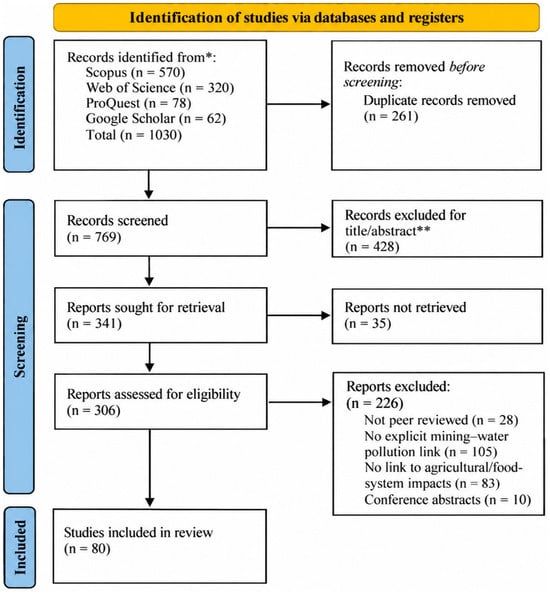
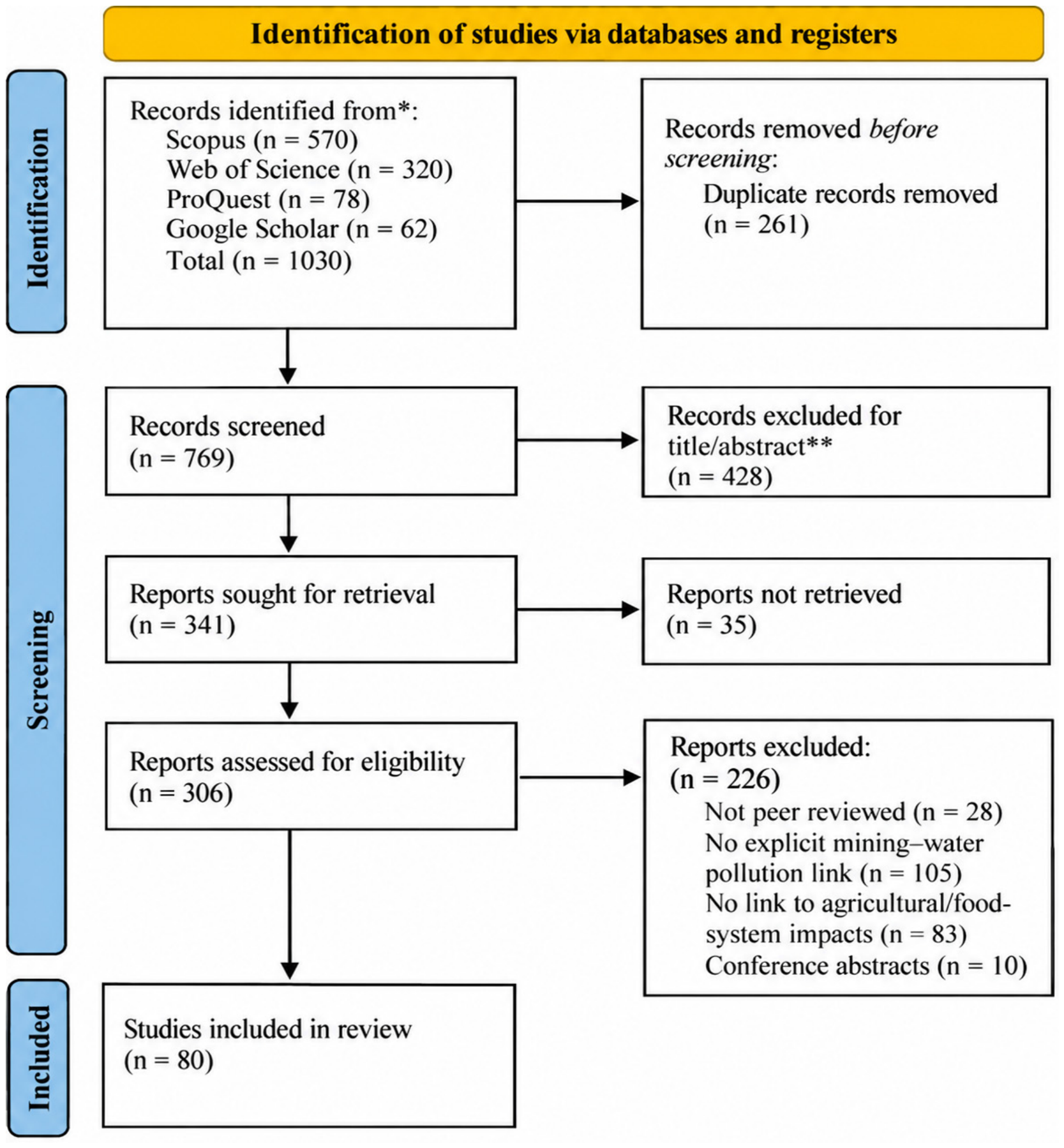
The final database searches in August 2026 resulted in 1030 records: Scopus (n = 570), Web of Science (n = 320), ProQuest (n = 78) and Google Scholar (n = 62). Following the removal of 261 duplicates, 769 articles remained for further review. The remaining 769 unique records were screened for title and abstract. A total of 428 records were then excluded for title and abstract incompatibility. At this stage, the remaining 341 articles were then assessed for full-text availability. Of the 341 articles, 35 were excluded because their full texts could not be retrieved, while 306 advanced to the next stage for full-text assessment. A total of 226 articles were excluded per the criteria in Section 2.2 (not peer-reviewed = 28, no explicit mining–water pollution link = 105, no link to agricultural/food-system impacts = 83, conference abstracts = 10). A final corpus of 80 studies was included in the final review. The full numerical outcome of these stages is presented in the PRISMA 2020 flow diagram (Figure 1).
Figure 1.
PRISMA flow diagram illustrating the study selection process.
3.2. Overview and Yearly Publication of Studies Included
The final evidence base comprised 80 studies published between 2015 and 2025, covering mining-related water contamination, agricultural exposure pathways, food-system risks, and mitigation approaches across different geographical settings. The included studies represented a range of evidence types, including field-based investigations, environmental monitoring studies, risk assessments, modelling studies, experimental studies, and evidence synthesis papers. This variation reflects the multidisciplinary nature of mining-induced contamination, in which impacts are assessed from environmental, agricultural, ecological, and human health perspectives.
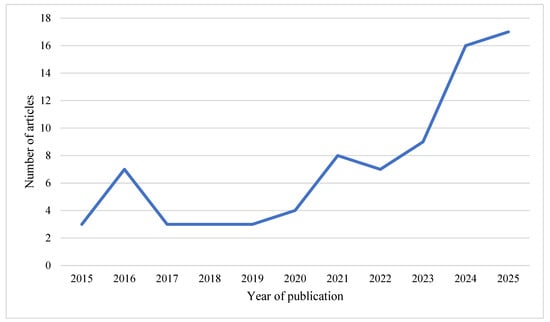
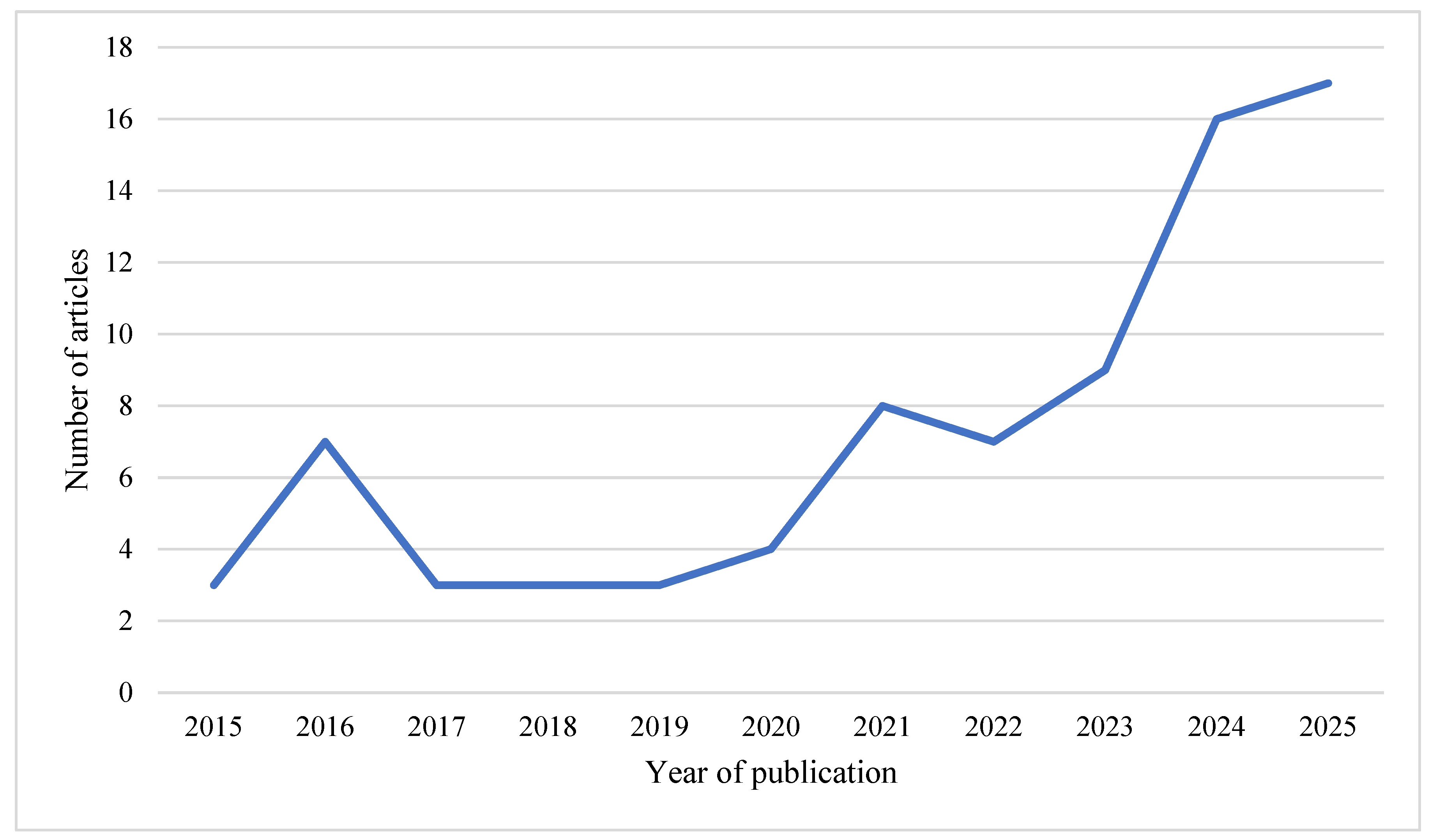
The number of publications increased substantially after 2020, with the highest concentration occurring in the most recent years. Studies published between 2021 and 2025 accounted for 57 of the 80 included studies (71.3%) (Figure 2), indicating that research on the interaction between mining activities, water contamination, agriculture, and food security has expanded considerably in recent years. In comparison, studies published between 2015 and 2020 represented 23 studies (28.7%) of the evidence base.
Figure 2.
Yearly distribution of publications used in this review.
However, the observed publication pattern should be interpreted cautiously. The apparent increase in studies does not necessarily represent a proportional increase in mining impacts globally. Instead, it may reflect improved environmental monitoring capacity, increased availability of analytical techniques, greater policy interest in sustainable resource management, and expanding research attention toward water–food–energy interactions in mining regions.
The included studies also differed considerably in analytical approaches and outcome measurements. Some investigations focused on contaminant concentrations in water, sediments, and soils, whereas others examined biological uptake, food-chain transfer, crop contamination, human exposure risks, or remediation effectiveness. Therefore, the evidence synthesis focuses on recurring contamination pathways and documented impacts rather than estimating a single global effect size. The full data extraction table is supplied in Supplementary Table S2.
3.3. Geographic Distribution of Included Studies
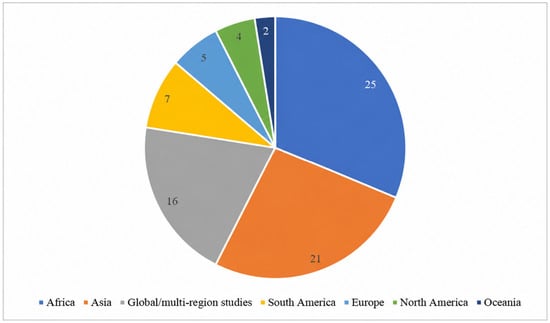
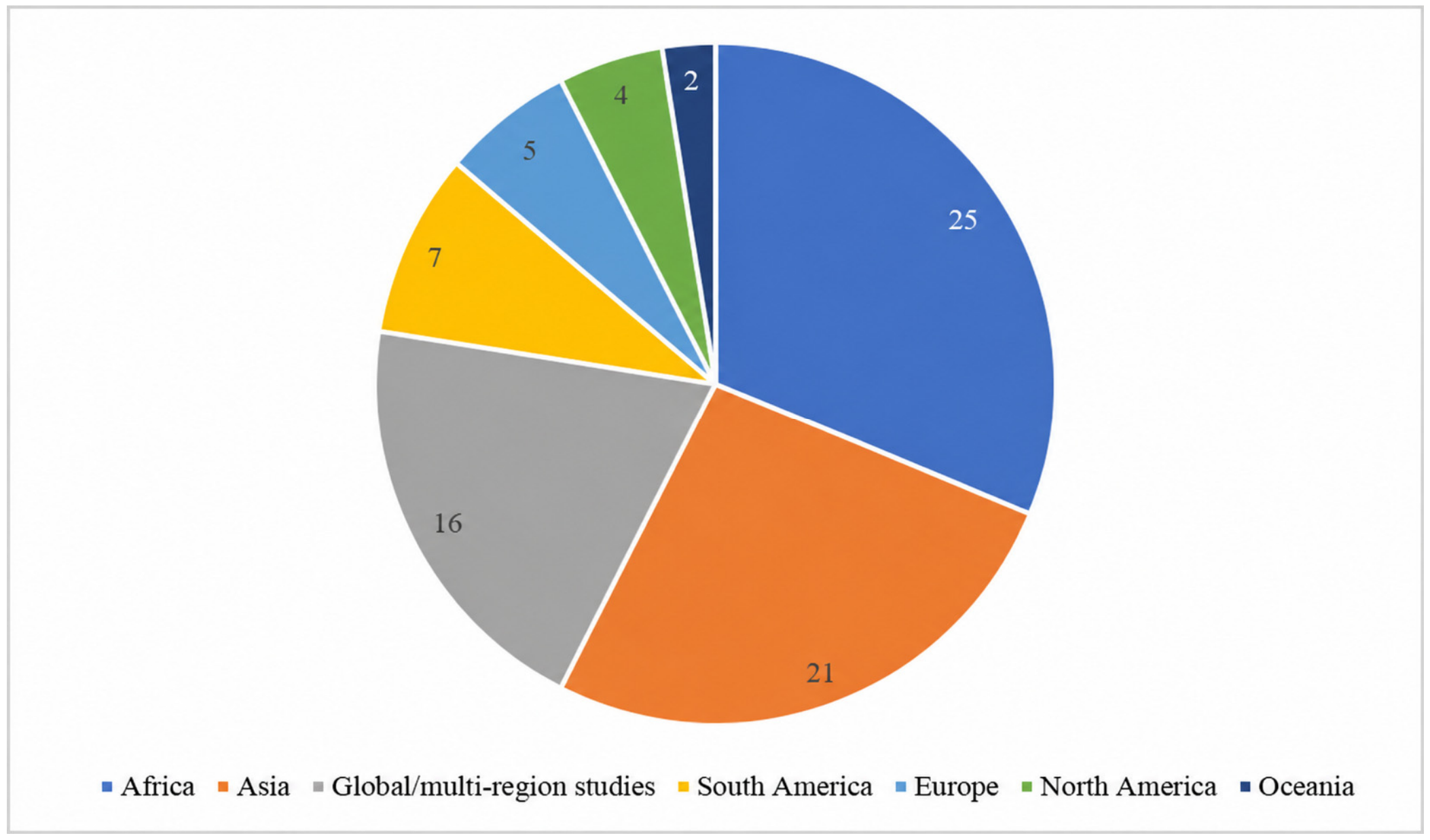
The 80 studies included in this review covered mining-affected environments across different geographical regions, demonstrating the global scope of research examining the relationship between mining activities, water contamination, agriculture, and food-related risks. The largest proportion of studies originated from Africa (25 studies, 31.3%), followed by Asia (21 studies, 26.3%), and global or multi-region assessments (16 studies, 20.0%). Other contributions came from South America (7 studies, 8.8%), Europe (5 studies, 6.3%), North America (4 studies, 5.0%), and Oceania (2 studies, 2.5%) (Figure 3). The relatively higher representation of Sub-Saharan Africa and Asia reflects the availability of published research from mining regions within these areas, particularly studies investigating artisanal and small-scale gold mining (ASGM), large-scale metal mining, acid mine drainage, and heavy-metal contamination pathways.
Figure 3.
Geographic distributions of research on water pollution from mining activities.
The geographical distribution of included studies should be interpreted as a representation of the available scientific literature rather than a direct indication of where mining impacts are greatest. Differences in research capacity, monitoring infrastructure, publication practices, mining history, and availability of environmental data may influence the location and number of published studies. Although some regions are more well-represented in the evidence base, the findings should be understood as reflecting patterns in documented research rather than as a comparative assessment of global mining-related environmental severity.
3.4. Quantitative Synthesis of Evidence-Base from the Studies Reviewed
Coding of the 80 studies enabled description of the evidence base by the proportion of studies addressing each source, pollutant, and endpoint (Table 1, Table 2 and Table 3). Of the 80 included studies, 35 (43.8%) were primary empirical studies; 10 (12.5%) used modelling, spatial, or econometric approaches; 29 (36.3%) were reviews or syntheses; and 6 (7.5%) were policy, conceptual, or case analyses. For synthesis, primary empirical studies and those using modelling, spatial or econometric approaches were grouped together (45 studies). Reviews, synthesis, and policy, conceptual or case analyses formed the second group (35 studies). Surface water or sediment was the most addressed compartment (n = 30; 37.5%), followed by mine drainage (n = 19; 23.8%), irrigation water (n = 17; 21.3%) and groundwater (n = 14; 17.5%). No water compartment was evident in the extraction records of 29 studies (36.3%), most of which were reviews or policy analyses [27,28]. Regarding mining types, 36 studies (45.0%) covered multiple mining types or did not specify a single type, so these proportions reflect only the attributable studies. Among the 45 primary and modelling studies, 21 of the 45 (46.7%) concerned large-scale metal mining and 6 of the 45 (13.3%) concerned ASM/ASGM.
Pollutants: Arsenic and lead were each reported in 20 studies (25.0%), followed by cadmium (18; 22.5%), mercury (17; 21.3%) and copper (15; 18.8%); other named metals, metalloids or radionuclides appeared in 32 studies (40.0%); and 26 studies (32.5%) reported only unspecified or mixed metals. In the primary and modelling subset, arsenic was the most frequently reported pollutant (18 of 45 studies; 40.0%), followed by cadmium (15; 33.3%), lead (12; 26.7%), copper (11; 24.4%) and mercury (9; 20.0%). An exceedance of a guideline or an elevated risk was reported in 15 of 20 (75.0%) of the arsenic studies, 10 of 17 (58.8%) of the mercury studies, 10 of 18 (55.6%) of the cadmium studies, 9 of 20 (45.0%) of the lead studies and 5 of 15 (33.3%) of the copper studies [28,29].
Contamination-to-food-security chain: Evidence was concentrated at the start of the chain and thinned towards its end (Table 2, Panel A). Water contamination was reported in 51 studies (63.8%; 32 primary or modelling), human health risk or exposure in 34 (42.5%), soil contamination or degradation in 28 (35.0%) and food-chain transfer or food safety in 17 (21.3%). Crop contamination was reported in only 12 studies (15.0%; 5 primary or modelling), crop productivity effects in 10 (12.5%; 5 primary or modelling) and household food security or livelihood outcomes in 6 (7.5%; 2 primary or modelling). A guideline exceedance was reported in 13 of 51 (25.5%) of the studies reporting water contamination, an elevated human health risk in 13 of 34 (38.2%) of the studies reporting health risk, and an exceedance in a food item in 3 of 17 (17.6%) of the studies reporting food-chain or food-safety endpoints. Only 11 studies (13.8%) reported water contamination alongside a crop or food-chain endpoint, and only 6 (7.5%) reported it alongside a productivity or food-security endpoint. Consequently, the yield and household food-security estimates in this review rest on a small number of studies and are indicative rather than representative [30,31].
Mitigation: Mitigation was addressed in 23 studies (28.8%), of which 6 were primary or modelling studies and 17 were reviews or policy analyses. These comprised phytoremediation or soil and sediment amendment (n = 7), water treatment technologies (n = 7), governance or planning (n = 4), and other management or restoration measures (n = 5). Because only 6 of the 45 primary and modelling studies evaluated a mitigation measure, the efficiency ranges reported in Section 3.9 should be interpreted with caution [18,32].
Table 1.
Characteristics of the 80 included studies, by evidence group.
Table 2.
Evidence map: proportion of studies addressing each link in the contamination-to-food-security chain, each pollutant and each mitigation approach.
3.5. Reported Environmental Concentrations of Contaminants
Table 3 shows substantial variation in the concentrations and types of contaminants reported across mining-affected locations and environmental media. In surface water from Ghana, Affum et al. [45] reported Hg concentrations of 0.18–0.56 μg/L and As concentrations of 0.69–2.14 μg/L, while Chan et al. [59] reported Mn concentrations of 39.6–1983 μg/L, Zn of 45.2–1363 μg/L, Cu of 4.23–275 μg/L, and Pb of 0.80–27.6 μg/L in mine-affected water in China. In Brazil, Geremias and Masuhara [19] reported Al, Fe, Mn, and Zn concentrations of 6.2, 5.32, 0.61, and 0.10 mg/L, respectively, in acidic coal-mining-affected water. Higher concentrations of several metals were reported in the Abakaliki mining area of Nigeria, where maximum concentrations included 63.45 mg/L Mn, 15.67 mg/L Cd, 14.60 mg/L Cr, 11.42 mg/L Pb, 10.53 mg/L Zn, and 4.13 mg/L As [29]. In borehole water from Ghana, As ranged from below detection to 169.14 μg/L, Pb from below detection to 15.60 μg/L, and Cd from below detection to 6.0 μg/L [28].
Contamination was also documented in soils, sediments, and other mining-associated environmental matrices. AbdelMaksoud et al. [60] reported soil concentrations of 120.26–617.7 mg/kg As, 39.57–90.05 mg/kg Pb, 0.28–1.07 mg/kg Cd, and 7.96–15.96 mg/kg Hg in Egypt, while Fernández-Martínez et al. [39] reported soil Pb concentrations ranging from 61 to 39,000 mg/kg at a former mining site in Spain. In the DRC, Mutombo et al. [27] reported sediment Cu concentrations 35–280 times higher than sediment-quality guideline values and reported exceedances of national limits for As, Cd, and Hg in water. Mercury was also detected across water, soil, and cassava leaves in an ASGM-affected area of Indonesia [30], indicating contamination across multiple environmental compartments. Because Table 3 combines different matrices, units, sampling settings, and regulatory benchmarks, these concentrations are best interpreted as site-specific evidence of contamination rather than directly comparable measures of contamination severity across countries.
Table 3.
Concentrations of contaminants, dominant results and country/region where they occurred.
3.6. Agricultural Impact Pathways
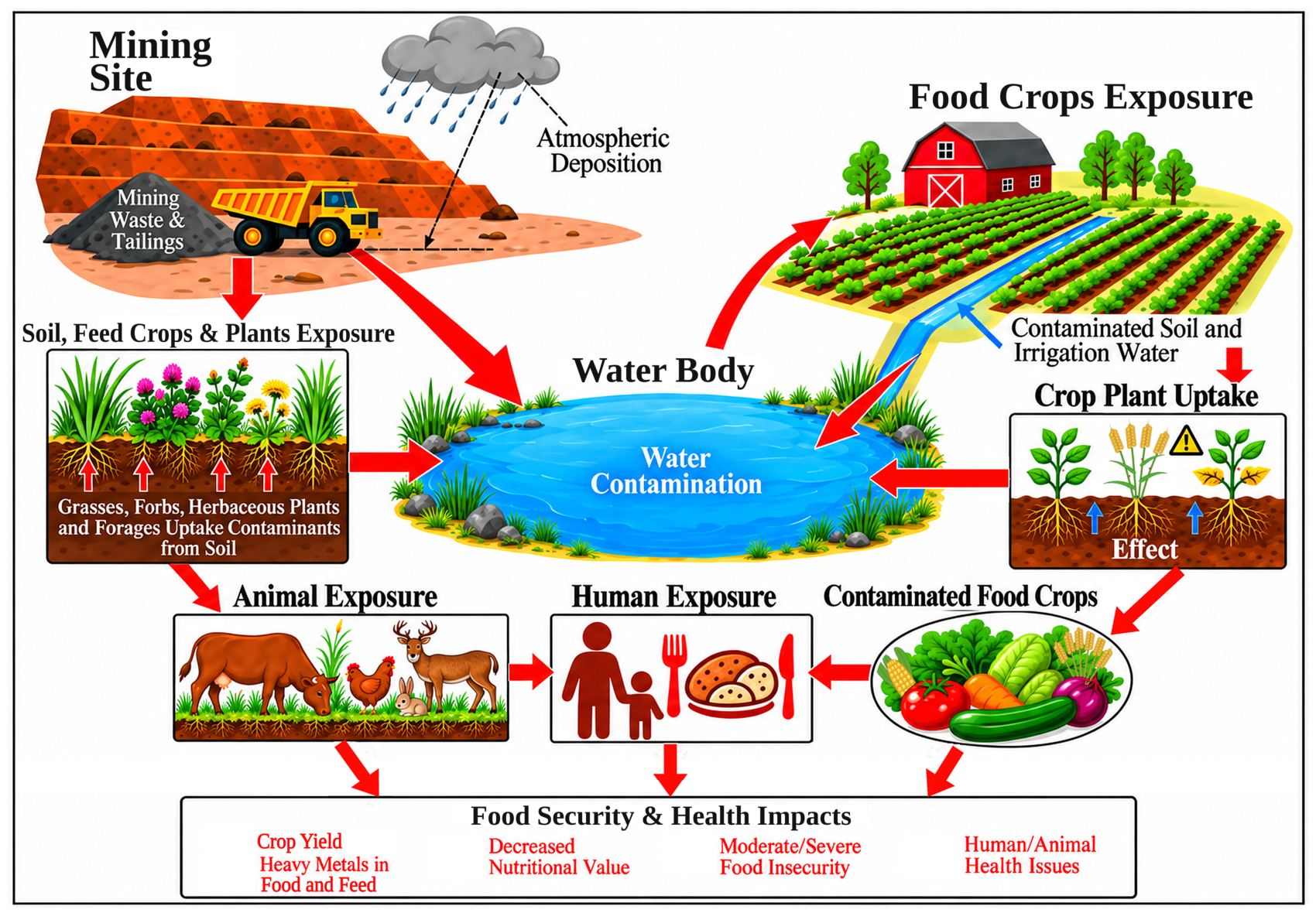
The agricultural effects of mining-related water contamination occur through several connected but distinct stages, and the evidence for one stage does not necessarily demonstrate effects at subsequent stages. Mine drainage, runoff, and contaminated surface water or groundwater can introduce metals and other pollutants into water used in agricultural environments. Where contaminated water reaches farmland, irrigation provides a pathway for contaminants to enter or accumulate in agricultural soils. Evidence of this transition was reported in studies examining mine-affected irrigation water and associated soil contamination. For example, Huang et al. [31] documented acid mine drainage used for irrigation alongside elevated thallium in soil and rice, while Bempah and Ewusi [23] reported contamination across groundwater, soil, and vegetables. Similarly, Agustiani et al. [30] documented mercury across a soil–water–cassava pathway. These studies provide evidence for links between contaminated water, agricultural soil exposure, and contaminant uptake by food plants, although these endpoints should not be treated as equivalent to changes in crop productivity.
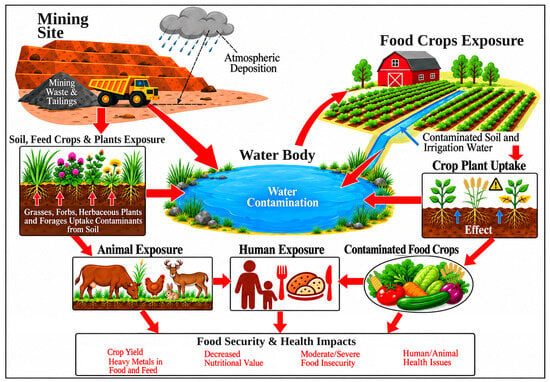
Following soil exposure, contaminants may be taken up by plants and may affect crop physiological processes. Gao et al. [66], for example, reported altered plant physiology under heavy-metal stress in a controlled soil-to-plant experiment, while other studies documented contaminant accumulation in crops or food plants rather than direct effects on growth or yield. The evidence, therefore, becomes less direct as the pathway progresses from environmental contamination to agricultural production. As shown in Table 2 above, crop contamination, crop productivity, and household food-security outcomes were reported much less frequently than water and soil contamination, and only a small subset of studies jointly addressed water contamination and productivity or food-security endpoints. Consequently, evidence of contaminated water, soil, or crops should not be interpreted as evidence of reduced crop yield or household food insecurity. Rather, the reviewed literature supports a pathway whereby water contamination may lead to soil exposure, plant uptake, and physiological effects, with potential consequences for crop productivity, food safety, and, ultimately, food security, although these outcomes were not directly demonstrated in most of the reviewed studies. Figure 4 presents these stages separately to distinguish the environmental contamination pathway from the agricultural and household outcomes, which are measured progressively less frequently.
Figure 4.
Contaminant pathways from mining to agricultural zones. Source: Authors’ Creation.
3.7. Agricultural Vulnerability
Leafy vegetables (e.g., spinach, lettuce) and root crops (e.g., potatoes, carrots) act as sponges for heavy metals (such as cadmium and lead), and accumulate metals such as cadmium and lead in edible tissues, and some studies reported concentrations above food-safety guidelines [67]. The local environment functions as either an amplifier or a buffer. Sandy, acidic soils in high-rainfall areas make metals more mobile, thereby increasing their availability for plant uptake [31]. In contrast, clay-rich, alkaline, organic-matter-rich soils can bind and immobilize certain contaminants [68]. Water shortage may increase reliance on contaminated water for irrigation. Farmers have no option but to irrigate with the very limited water they have in arid areas such as Atacama, Chile, and areas of Africa where water is contaminated by nearby mining. This leads to the accumulation of contaminants in their fields each year.
3.8. Food Safety, Human Health and Food-Security Outcomes
Evidence for the downstream consequences of mining-related water contamination was less frequent and less direct than evidence for contamination itself (Table 2). Food-chain transfer or food-safety endpoints were reported in 17 studies (21.3%), of which three reported a guideline exceedance in a food item; crop productivity or yield effects were reported in 10 studies (12.5%); and household food-security or livelihood outcomes in six (7.5%). Studies of acid mine drainage-polluted soils reported changes in soil microbial community composition [12], and soil microbial diversity is associated with soil fertility, which has been proposed as one route to reduced productivity in heavily affected areas. However, the included studies mostly documented contamination or altered soil properties rather than measured yield loss, so reduced crop yield in mining-affected areas should be regarded as a plausible consequence, not a demonstrated effect.
Evidence on food safety and human health was largely based on exposure and risk assessment. For example, Bempah and Ewusi [23] reported elevated levels of arsenic and mercury in agricultural soils, and of arsenic and nickel in vegetables, around the Obuasi gold mine, and estimated potential human health risks from exposure to metals in water and food crops. These estimates are based on measured concentrations and risk indices, not on observed health outcomes or measured food insecurity. Evidence on household food security came from a small number of studies, including a study in Ghana that reported an association between gold mining and household food security and nutrition [69]. Such findings indicate associations and do not, on their own, show that water contamination caused reduced household food availability. Taken together with Section 3.6, the reviewed literature supports concerns about food safety and health risks, whereas effects on yield and household food security remain poorly evidenced.
3.9. Mitigation and Remediation Approaches
This section addresses the fourth research question, which concerns a range of mitigation strategies. The approaches outlined below vary in effectiveness because the extent of their impact depends heavily on context. It must also be noted that they comprise both active and passive methods.
Localized, Low-Cost Action: This involves using phytoremediation (plants for metal removal) and soil amendments such as biochar or lime [49,57]. They are cheap, but slow to work, suitable for low to moderate contamination and can be deployed within a community.
Landscape-Scale Treatment: This involves constructing wetlands and using them as a nature-based solution that can passively treat acid mine drainage over large areas [14,70]. They are excellent since they help immobilize harmful metals in contaminated water bodies. However, land and good integrated designs are needed to enhance the success of this approach.
High-Risk/Dense Pollution: The intervention uses high-technology solutions, such as reverse osmosis or chemical precipitation [14,70]. Though very effective, they are costly and often energy-consuming. As a result, they are often unaffordable by the communities that need them. Several studies contend that these high-tech solutions remain insufficient, as the effectiveness of advanced treatment technologies can be significantly undermined without adequate governance. Effective mitigation is associated with a well-integrated system of robust rules, transparent data sharing between developed and developing countries or regions, climate conditions across regions, and community-led engagement in monitoring their own water bodies and food production [11]. Another treatment approach for heavy metals, acid mine drainage, and other pollutants originating from mining is a physicochemical method for removing metals and arsenic from water. These methods use ion exchange [50] and membrane filtration (micro-, ultra-, and nanofiltration) [71,72]. Cyanobacteria and algae are also reported to be effective for in situ remediation of pollutants [73].
In recent times, technologies such as nanotechnology-based water treatment and AI-driven predictive models with real-time IoT monitoring have been used to dynamically control pollution. The use of integrated approaches that combine containment remediation methods (e.g., drainage wells, filtration barriers), community engagement, and gender-inclusive governance is being encouraged to improve the effectiveness of remediation plans and efforts. Table 4 summarizes active treatment systems, while Table 5 presents the performance and longevity of passive and biological treatment systems.
Table 4.
Effectiveness of active treatment systems.
Table 5.
Performance and Longevity of Passive and Biological Treatment Systems.
Passive treatment systems offer sustainable and cost-effective approaches for mitigating mining-related water contamination. Biological treatment systems, such as those utilizing sulfate-reducing bacteria, achieve 70–90% sulfate removal, while algal-based systems remove 50–80% of metals, both enhancing natural attenuation processes and contributing to long-term water quality improvement, as shown in Table 5. Prevention strategies in mining operations focus on minimizing pollution at the source through improved waste and water management practices. Key measures include enhanced tailings management, the use of water-diversion systems to limit contact between runoff and reactive materials, waste–rock segregation to reduce acid-generating potential, and recycling of process water to decrease discharge. Overall, they represent a cost-effective, sustainable long-term solution for mitigating the environmental impacts of mining activities, as highlighted in Table 5.
Overall, the reviewed evidence indicates that passive and biological systems achieve moderate to high removal of metals and acidity at low operational input (Table 5), whereas active chemical and physicochemical treatments can achieve higher removal but require continuous chemical input, monitoring and technical capacity (Table 4). Few primary studies directly compared these approaches under the same operating conditions, so their relative performance and cost should be interpreted with caution.
3.10. Quality Appraisal Score
Each study was scored from 1 to 5 on four domains using design-appropriate criteria as highlighted in the methodology. D1, research question and design; D2, methods and data sources; D3, analytical rigor; and D4, transparency and completeness of reporting. Domain-level and composite scores for all 80 studies are presented in Supplementary Table S2. Domain scores ranged from 2 to 5. Mean domain scores were 4.44 for D1, 4.26 for D2, 4.16 for D3 and 4.19 for D4, and median scores were 5.0, 4.5, 5.0 and 4.0, respectively. Analytical rigor (D3) had the lowest mean and was the only domain in which any study scored 2 (nine studies, 11.3%). Composite scores, calculated as the mean of the four domain scores, ranged from 3 to 5: thirty-nine studies (48.8%) scored 5, two (2.5%) scored 4.5, twenty (25.0%) scored 4 and nineteen (23.8%) scored 3; no composite score was below 3. The median composite score was 4.5 and the mean was 4.26, and 61 studies (76.3%) scored 4 or higher. Scores describe methodological and reporting quality against the criteria for each study’s design. They were not used to weight studies or to exclude any study from the synthesis.
4. Discussion
This review reveals a persistent and significant problem. Thus, the water sources that support lives and agricultural activities in mining regions are threatened by unsustainable mining, placing the heaviest burden on those most at risk [55,80]. The findings from the 80 studies extend beyond chemical contamination to include ecosystem degradation, possible effects on agricultural productivity and human health risks [23,64].
The geographic distribution of the included studies shows that the available evidence is unevenly distributed across regions. Africa accounted for most studies, followed by Asia. These proportions describe the distribution of the literature included in this review and should not be interpreted as indicating that mining-related water contamination is necessarily more widespread or severe in Africa and Asia. The greater representation of these regions may reflect several features of the available evidence base, including differences in research intensity and environmental monitoring, publication and database coverage, the prevalence and research visibility of mining activities, such as artisanal and small-scale mining, and the availability of studies that meet the review’s eligibility criteria. The restriction to English-language publications may also have reduced the representation of evidence from regions where relevant research is published in other languages.
Within this uneven evidence base, the included studies nevertheless illustrate that mining-related contamination occurs under different mining and environmental settings. Studies from African countries such as Ghana, Nigeria, the Democratic Republic of Congo, South Africa, and Zambia have documented contamination associated with mining activities, including impacts on water and soil, as well as potential agricultural exposure pathways [23,27,29]. Studies from Asia examined contamination associated with coal and metal mining and their implications for water and agricultural environments [47,81], while studies from North America and Europe documented persistent contamination associated with historical or legacy mining, including arsenic contamination in Canada and Poland [40,41]. These regional examples demonstrate the diversity of mining contexts represented in the literature, but the number of studies from each region does not provide a basis for ranking regions according to environmental burden. In particular, the smaller number of eligible studies from South America, North America, Europe, and Oceania should not be interpreted as evidence of correspondingly lower contamination or agricultural risk in those regions.
With respect to food safety and human health, the reviewed evidence indicates different implications for shorter and longer exposure periods. In the short term, contamination of irrigation or drinking water and subsequent transfer into edible crops can create immediate food-safety and exposure concerns, particularly where contaminant concentrations or hazard indices exceed recommended thresholds. For example, elevated thallium in rice and mercury across pathways involving water, soil, and cassava demonstrate how contaminated agricultural water can contribute to dietary exposure [30,31]. However, most included studies assessed contaminant concentrations and risk indices rather than clinically observed acute health effects. The evidence for longer-term risk was more substantial, particularly where persistent contamination resulted in repeated exposure or bioaccumulation. Several studies have reported elevated chronic non-carcinogenic and carcinogenic risks associated with arsenic, cadmium, mercury, lead, and other metals in mining-affected environments [23,28,29]. Studies of legacy mining environments further indicate that contamination can persist beyond active mining periods, sustaining potential exposure through water, soil and food pathways [40,41]. Nevertheless, because most studies estimated exposure or health risk rather than following populations longitudinally, the evidence supports concern about chronic exposure more strongly than it demonstrates the incidence of specific long-term diseases.
Together, the issues of poor enforcement, water scarcity, technological limitations and limited availability of mining data make the call for integrated governance and adaptive management systems to safeguard agricultural livelihoods in mining-bounded areas relevant. Developed countries have better regulatory environments than developing nations [82], advanced monitoring systems [83], and higher technical capacity for remediation [43]. Nevertheless, one outstanding feature of developed countries is the problem of legacy contamination of old-style mining [11]. This legacy is characterized by persistent problems, including lingering problems of complex, long-term responsibility for contaminated sites [43], costly reparation efforts that usually require public funding [82], and constant balancing of economic needs against the demands for environmental quality across regions, which historically suffered from an over-reliance on such industry [83,84]. Various agricultural, landscape, and engineering/treatment approaches have been used to limit mining-related water pollution, with varying degrees of success. Phytoremediation, soil amendments (organic matter, lime, biochar), and other irrigation practices can curb on-farm contaminant uptake, particularly in low-resource areas or where immediate amelioration is necessary [37,75,85].
Land-based constructed wetlands and passive bioremediation systems (e.g., those based on sulfate-reducing bacteria) are effective for immobilizing metals and managing acid mine drainage when land area is sufficient, appropriate technology is available, and contaminant loads are low [70,75]. Engineering-based treatment technologies, including reverse osmosis, chemical precipitation, adsorption, membrane filtration, and integrated treatment systems, are particularly effective for removing heavy metals and other mining-related contaminants from polluted water sources [52,75,85]. These technologies are most appropriate in situations involving severe contamination, acute environmental risks, or stringent water-quality regulations, where high levels of contaminant removal are required. However, their implementation often involves substantial capital investment, operational costs, energy requirements, and technical expertise, making them more feasible in high-resource settings or large-scale mining operations [77].
The effectiveness and sustainability of the interventions are also site-specific, depending on ecohydrology, contamination profiles, access to land, and associated socio-economic factors such as technical capability, financing, and regulation. Passive systems are suitable for long-term restoration schemes or for minimizing maintenance costs; however, engineering solutions are required when acute risks are high and stringent water quality regulations are expected [75,86]. Addressing mining-related water pollution in food-producing areas requires science-based regulations, economic tools, and local control to precisely protect agricultural water supplies and farmers’ incomes. Mining is a significant industrial user of freshwater in many regions, competing directly with agricultural and domestic demand, though it accounts for a smaller share of global freshwater withdrawals than agriculture [87,88]. Mining impacts water by draining large quantities of water and releasing acid mine drainage, metals, and process chemicals into surface and groundwater, which irrigation and livestock rely on [11]. In critical-mineral and metal belts, mines are increasingly concentrated in already water-stressed basins where farming, households, and ecosystems compete for scarce resources [89,90]. A further problem is the disconnect between what can be implemented and what is executed. A significant portion of this is the so-called “black box” of mining data, whereby communities often find themselves unable to access basic information about what is being released into their environment. This reinforces power inequities and knowledge gaps in the remediation of contaminated water [36], thereby marginalizing farmers.
5. Conclusions
This systematic review reveals that water resources are central to the health and sustainability of agricultural systems and food production, as well as the viability of mining operations. Thus, achieving food security involves much more than just producing food. It must involve tackling pollution that fundamentally jeopardizes the very environment from which food security is derived. Addressing pollution from mining activities must also involve policymakers working with communities to develop relevant, practical policies at all levels. This is because policies developed without community involvement often fail to adequately address the needs of the affected communities.
Overall, the review addresses the four research questions. First, mining-related contamination was documented across different mining activities and water pathways, with metals and metalloids among the most frequently reported pollutants. Second, the evidence demonstrates pathways from contaminated water to agricultural soils and crops, although direct evidence of effects on crop productivity and yield was less frequent. Third, the reviewed studies documented food-chain transfer and human health risks, while evidence of household food-security outcomes remained comparatively limited. Fourth, several mitigation approaches were identified, including phytoremediation, soil amendments, water-treatment technologies, and governance measures, although relatively few primary studies directly evaluated their effectiveness. Together, these findings show that evidence is strongest for environmental contamination and health-related outcomes and becomes more limited for downstream effects on crop productivity and household food security.
6. Policy and Practice Implications
The reviewed evidence supports routine monitoring of mining-affected water, appropriate remediation and treatment measures, improved environmental governance, and greater involvement of affected communities in environmental monitoring and decision-making. However, the quantitative synthesis also shows that evidence on mitigation was derived predominantly from reviews and policy-oriented studies, with relatively few primary or modelling studies directly evaluating mitigation measures. Accordingly, the following implications distinguish between measures directly supported by the reviewed evidence and broader policy proposals developed by the authors from the synthesis.
Evidence-supported implications. The reviewed studies support strengthened monitoring of mining-affected water and agricultural environments, context-specific water treatment and remediation, improved access to environmental information, and community participation in monitoring and resource governance.
Author-proposed policy extensions. Building on these findings, the authors propose that mining projects in agriculturally important areas consider Water-Food Impact Assessments (WFIAs) that explicitly evaluate potential effects on irrigation water, agricultural soils, crops, and food-system outcomes. The authors further propose greater protection of agricultural land and aquifers in land-use planning and wider adoption of transparent water-quality reporting and locally managed monitoring systems. These proposals extend the implications of the reviewed evidence but were not themselves directly evaluated across the included studies.
7. Limitations
This review has several limitations. First, only English-language, peer-reviewed publications were included, which may have excluded relevant studies published in other languages or in less widely indexed sources. Publication and geographical bias may also have influenced the evidence base, as some regions were more strongly represented than others because of differences in research activity, monitoring capacity, database coverage, and publication practices. Therefore, the geographical distribution of the included studies should not be interpreted as representing the global severity of mining-related water contamination.
The included studies also varied considerably in study design, contamination thresholds, analytical methods, crop species, exposure pathways, and outcome measures, which limited direct comparison and prevented estimation of a pooled global effect size. Although primary and secondary evidence were distinguished during synthesis to reduce double counting, some overlap in the underlying evidence cannot be entirely ruled out. Furthermore, relatively few studies directly assessed crop productivity and household food security outcomes, so conclusions about these downstream effects should be interpreted with caution.
Supplementary Materials
The following supporting information can be downloaded at: https://www.mdpi.com/article/10.3390/environments13110609/s1, Table S1: Database search strategy; Table S2: Summary of mining-induced water pollution, agriculture and food vulnerabilities, impact, study duration, and relevant results extracted from the 80 Articles reviewed.
Author Contributions
Conceptualization. A.B.A.K.; methodology, A.B.A.K., P.A.Y.A. and M.A.S.; investigation: A.B.A.K., P.A.Y.A., and M.A.S.; data curation, A.B.A.K. and M.A.S.; writing—original draft, A.B.A.K., P.A.Y.A., M.A.S. and R.A.; writing—review and editing, A.B.A.K., M.A.S., R.A., M.I.M. and P.A.Y.A.; Visualization, A.B.A.K., M.A.S. and M.I.M.; supervision and project administration, P.A.Y.A.; funding, P.A.Y.A. All authors have read and agreed to the published version of the manuscript.
Funding
This publication was supported with USDA-NIFA Evans-Allen Capacity Building Research Funds received by the College of Agriculture, Food and Natural Resources (CAFNR) Research.
Data Availability Statement
The data presented in this systematic review are derived from previously published studies, all of which are cited in the reference list. The database-specific search strategies, search dates and record counts (Supplementary Table S1), and the complete study-level data extraction and quality appraisal scores for all 80 included studies (Supplementary Table S2), are provided as Supplementary Materials.
Conflicts of Interest
The authors declare no conflicts of interest.
References
- Joseph, R. Environmental issues in mining: A comprehensive review of challenges and strategies for mitigation and rehabilitation. Min. Rev./Rev. Min. 2025, 31, 51–71. [Google Scholar] [CrossRef] [Scilit]
- Meißner, S. The impact of metal mining on global water stress and regional carrying capacities—A GIS-based water impact assessment. Resources 2021, 10, 120. [Google Scholar] [CrossRef] [Scilit]
- Aitken, D.; Rivera, D.; Godoy-Faúndez, A.; Holzapfel, E. Water scarcity and the impact of the mining and agricultural sectors in Chile. Sustainability 2016, 8, 128. [Google Scholar] [CrossRef] [Scilit]
- Liu, Y.; Wang, P.; Gojenko, B.; Yu, J.; Wei, L.; Luo, D.; Xiao, T. A review of water pollution arising from agriculture and mining activities in Central Asia: Facts, causes and effects. Environ. Pollut. 2021, 291, 118209. [Google Scholar] [CrossRef] [Scilit]
- Matveeva, V.A.; Alekseenko, A.V.; Karthe, D.; Puzanov, A.V. Manganese pollution in mining-influenced rivers and lakes: Current state and forecast under climate change in the Russian Arctic. Water 2022, 14, 1091. [Google Scholar] [CrossRef] [Scilit]
- Santana, C.S.; Olivares, D.M.M.; Silva, V.H.; Luzardo, F.H.; Velasco, F.G.; de Jesus, R.M. Assessment of water resources pollution associated with mining activity in a semi-arid region. J. Environ. Manag. 2020, 273, 111148. [Google Scholar] [CrossRef] [Scilit]
- Yin, Y.; Li, C.; Ye, Q.; Wei, C.; Li, M. Evaluating regulatory influences on coal mine accidents in China using a fuzzy multi-criteria decision-making approach. Sci. Rep. 2025, 15, 11204. [Google Scholar] [CrossRef] [Scilit]
- Gao, N.; Liang, W.; Gou, F.; Liu, Y.; Fu, B.; Lü, Y. Assessing the impact of agriculture, coal mining, and ecological restoration on water sustainability in the Mu Us Sandyland. Sci. Total Environ. 2024, 929, 172513. [Google Scholar] [CrossRef] [Scilit]
- Luckeneder, S.; Giljum, S.; Schaffartzik, A.; Maus, V.; Tost, M. Surge in global metal mining threatens vulnerable ecosystems. Glob. Environ. Change 2021, 69, 102303. [Google Scholar] [CrossRef] [Scilit]
- Owen, J.; Lebre, É.; Kemp, D. Energy Transition Minerals (ETMs): A Global Dataset of Projects [Data Set]; The University of Queensland: Brisbane, Australia, 2022. [Google Scholar]
- Macklin, M.G.; Thomas, C.J.; Mudbhatkal, A.; Brewer, P.A.; Hudson-Edwards, K.A.; Lewin, J.; Scussolini, P.; Eilander, D.; Lechner, A.; Owen, J.; et al. Impacts of metal mining on river systems: A global assessment. Science 2023, 381, 1345–1350. [Google Scholar] [CrossRef] [Scilit]
- Munyai, R.; Ogola, H.J.O.; Modise, D.M. Microbial community diversity dynamics in acid mine drainage and acid mine drainage-polluted soils: Implication on mining water irrigation agricultural sustainability. Front. Sustain. Food Syst. 2021, 5, 701870. [Google Scholar] [CrossRef] [Scilit]
- Kwarteng, D.A.; Lutuf, H.; Duker, R.Q.; Edusei, G.; Otoo, B.R.; Osei-Owusu, J.; Osabutey, A.F.; Boateng, B.O.; Asante, K.; Nyarko Osei, J.H.; et al. Promoting sustainable mining for health, food security and biodiversity conservation. CABI Rev. 2025, 20, 0036. [Google Scholar] [CrossRef] [Scilit]
- Yuan, J.; Ding, Z.; Bi, Y.; Li, J.; Wen, S.; Bai, S. Resource utilization of acid mine drainage (AMD): A review. Water 2022, 14, 2385. [Google Scholar] [CrossRef] [Scilit]
- Garcia-Zavala, C.; Ordens, C.M.; Pagliero, L.; Lebre, E.; Aitken, D.; Stringer, M. An approach for prioritising environmental, social and governance (ESG) water-related risks for the mining industry: The case of Chile. Extr. Ind. Soc. 2023, 14, 101259. [Google Scholar] [CrossRef] [Scilit]
- Marrufo, T.J.; Capece, B.P.; Silva, M.R.G. Influence of artisanal mining and environmental pollutants on food security in Southern Africa: A systematic review. Food Energy Secur. 2025, 14, e70080. [Google Scholar] [CrossRef] [Scilit]
- Russell, M.; Gunn, J.; Prabhakar, G.; Rickwood, C.J. Drought and liming impacts of mine-impacted wetland sediments. Ecotoxicol. Environ. Saf. 2025, 303, 118964. [Google Scholar] [CrossRef] [Scilit]
- Nazir, M.; Roy, K.; Saha, A.; Das, U.; Saha, D. Sustainable solutions for water scarcity: Rehabilitating abandoned coal mine pit lakes through limnological analysis of freshwater resources in mining-affected regions. Environ. Geochem. Health 2025, 47, 223. [Google Scholar] [CrossRef] [Scilit]
- Geremias, R.; Masuhara, N. Water–Energy–Land–Food Nexus to assess the environmental impacts from coal mining. Land 2025, 14, 1360. [Google Scholar] [CrossRef] [Scilit]
- Igbayiloye, O.B.; Niyi-Gafar, O.L. Water resource protection in Africa’s mining sector: A Nigerian perspective. Turf Law J. 2025. [Google Scholar] [CrossRef] [Scilit]
- Kunz, N.C. Towards a broadened view of water security in mining regions. Water Secur. 2020, 11, 100079. [Google Scholar] [CrossRef] [Scilit]
- Siddique, A.; Tan, Z.; Rashid, W.; Ahmad, H. Sustainable water-related hazards assessment in open pit-to-underground mining transitions: An IDRR and MCDM approach at Sijiaying Iron Mine, China. Water 2025, 17, 1354. [Google Scholar] [CrossRef] [Scilit]
- Bempah, C.K.; Ewusi, A. Heavy metals contamination and human health risk assessment around Obuasi gold mine in Ghana. Environ. Monit. Assess. 2016, 188, 261. [Google Scholar] [CrossRef] [Scilit]
- Liang, G.; Gong, W.; Li, B.; Zuo, J.; Pan, L.; Liu, X. Analysis of heavy metals in foodstuffs and an assessment of the health risks to the general public via consumption in Beijing, China. Int. J. Environ. Res. Public Health 2019, 16, 909. [Google Scholar] [CrossRef] [Scilit]
- Page, M.J.; McKenzie, J.E.; Bossuyt, P.M.; Boutron, I.; Hoffmann, T.C.; Mulrow, C.D.; Shamseer, L.; Tetzlaff, J.M.; Akl, E.A.; Brennan, S.E.; et al. The PRISMA 2020 statement: An updated guideline for reporting systematic reviews. BMJ 2021, 372, n71. [Google Scholar] [CrossRef] [Scilit]
- Adekomaya, V.; Tella, A.; Yusuf-Saba, S.; Salami, I.; Luqman, Z. Macroeconomic Stability in The Era of Climate Change: A Systematic Review of Environmental Risks and Economic Costs. Elicit J. Econ. Manag. Stud. 2025, 1, 74–95. [Google Scholar] [CrossRef] [Scilit]
- Mutombo, A.; Atibu, E.; Mutombo, J.; Kalonda, E.; Bakatula, E.; Kanda, V.; Koy, R.; Mulaji, C.; Carvalho, F.; Poté, J. Contamination by heavy metals from mining activities: An ecological impact assessment of Mura and Kimpulande Rivers, Democratic Republic of the Congo. Watershed Ecol. Environ. 2022, 4, 148–157. [Google Scholar] [CrossRef] [Scilit]
- Owusu, C.; Ofori, A.; Adusei-Mensah, F.; Dodoo, D.; Essumang, D. Water quality, physicochemical, heavy metal content, and health risk assessment of borehole-water from selected mining communities in Ghana. Groundw. Sustain. Dev. 2024, 26, 101230. [Google Scholar] [CrossRef] [Scilit]
- Obasi, P.; Akudinobi, B. Potential health risk and levels of heavy metals in water resources of lead–zinc mining communities of Abakaliki, southeast Nigeria. Appl. Water Sci. 2020, 10, 23. [Google Scholar] [CrossRef] [Scilit]
- Agustiani, T.; Sulistia, S.; Suciati, F.; Sudaryanto, A.; Amandita, F.Y.; Efadeswarni Handika, R.; Poku, P.A.; Boohene, M.; Kobayashi, J.; Ishibashi, Y. Comprehensive assessment of mercury contamination and health risks from artisanal and small-scale gold mining (ASGM) in Sukabumi, Indonesia. Earth 2025, 6, 110. [Google Scholar] [CrossRef] [Scilit]
- Huang, X.; Li, N.; Wu, Q.; Long, J.; Luo, D.; Zhang, P.; Yao, Y.; Huang, X.; Li, D.; Lu, Y.; et al. Risk assessment and vertical distribution of thallium in paddy soils and uptake in rice plants irrigated with acid mine drainage. Environ. Sci. Pollut. Res. 2016, 23, 24912–24921. [Google Scholar] [CrossRef] [Scilit]
- Pocaan, J.P.; Bueno, B.G.; Pagaduan, J.M.; Capingian, J.; Pablo, M.A.N.; Paulo, J.L.R.W.; Beltran, A.B.; Orbecido, A.H.; Tabelin, C.B.; Villacorte-Tabelin, M.; et al. Limestone-based hybrid passive treatment for copper-rich acid mine drainage: From laboratory to field. Minerals 2025, 15, 1043. [Google Scholar] [CrossRef] [Scilit]
- Yin, Z.; Song, J.; Liu, D.; Wu, J.; Yang, Y.; Sun, Y.; Wu, J. Mapping mining-affected water pollution in China: Status, patterns, risks, and implications. Hydrol. Earth Syst. Sci. Discuss. 2024, 29, 3957–3973. [Google Scholar] [CrossRef] [Scilit]
- Haghighizadeh, A.; Rajabi, O.; Nezarat, A.; Hajyani, Z.; Haghmohammadi, M.; Hedayatikhah, S.; Beni, A.A. Comprehensive analysis of heavy metal soil contamination in mining environments: Impacts, monitoring techniques, and remediation strategies. Arab. J. Chem. 2024, 17, 105777. [Google Scholar] [CrossRef] [Scilit]
- Esdaile, L.J.; Chalker, J.M. The mercury problem in artisanal and small-scale gold mining. Chem. Eur. J. 2018, 24, 6905–6916. [Google Scholar] [CrossRef] [Scilit]
- Saenz, C. Keeping up with the flow: Using multiple water strategies to earn social license to operate in the Peruvian mining industry. Resour. Policy 2022, 77, 102687. [Google Scholar] [CrossRef] [Scilit]
- Musvoto, C.; de Lange, W.J. A framework for selecting crops for irrigation using mining contaminated water: An example from the Olifants basin of South Africa. J. Environ. Manag. 2019, 231, 49–58. [Google Scholar] [CrossRef] [Scilit]
- Cacciuttolo, C.; Cano, D. Environmental impact assessment of mine tailings spill considering metallurgical processes of gold and copper mining: Case studies in the Andean countries of Chile and Peru. Water 2022, 14, 3057. [Google Scholar] [CrossRef] [Scilit]
- Fernández-Martínez, R.; Corrochano, N.; Álvarez-Quintana, J.; Ordóñez, A.; Álvarez, R.; Rucandio, I. Assessment of the ecological risk and mobility of arsenic and heavy metals in soils and mine tailings from the Carmina mine site (Asturias, NW Spain). Environ. Geochem. Health 2024, 46, 90. [Google Scholar] [CrossRef] [Scilit]
- Stachnik, L.; Korabiewski, B.; Raczyk, J.; Lopuch, M.; Wieczorek, I. Arsenic pollution in Quaternary sediments and water near a former gold mine. Sci. Rep. 2020, 10, 18458. [Google Scholar] [CrossRef] [Scilit]
- Sprague, D.D.; Vermaire, J.C. Legacy arsenic pollution of lakes near Cobalt, Ontario, Canada: Arsenic in lake water and sediment remains elevated nearly a century after mining activity has ceased. Water Air Soil Pollut. 2018, 229, 87. [Google Scholar] [CrossRef] [Scilit]
- Khamkhash, A.; Srivastava, V.; Ghosh, T.; Akdogan, G.; Ganguli, R.; Aggarwal, S. Mining-related selenium contamination in Alaska, and the state of current knowledge. Minerals 2017, 7, 46. [Google Scholar] [CrossRef] [Scilit]
- McCullough, C.D. Below water table mining, pit lake formation, and management considerations for the Pilbara mining region of Western Australia. Mining 2024, 4, 863–888. [Google Scholar] [CrossRef] [Scilit]
- Banks, E.W.; Hatch, M.; Smith, S.; Underschultz, J.; Lamontagne, S.; Suckow, A.; Mallants, D. Multi-tracer and hydrogeophysical investigation of the hydraulic connectivity between coal seam gas formations, shallow groundwater and stream network in a faulted sedimentary basin. J. Hydrol. 2019, 578, 124132. [Google Scholar] [CrossRef] [Scilit]
- Affum, A.O.; Dede, S.O.; Nyarko, B.J.B.; Acquaah, S.O.; Kwaansa-Ansah, E.E.; Darko, G.; Dickson, A.; Affum, E.A.; Fianko, J.R. Influence of small-scale gold mining and toxic element concentrations in Bonsa River, Ghana: A potential risk to water quality and public health. Environ. Earth Sci. 2016, 75, 178. [Google Scholar] [CrossRef] [Scilit]
- Aluwong, K.; Hashim, M.; Ismail, S.; Shehu, S. Physico-chemical assessment of surface water from mining activities in Maiganga coal mine, Gombe state, Nigeria. Min. Miner. Depos. 2024, 18, 9–17. [Google Scholar] [CrossRef] [Scilit]
- Li, P. Mine water problems and solutions in China. Mine Water Environ. 2018, 37, 217–221. [Google Scholar] [CrossRef] [Scilit]
- Ofori-Sarpong, G.; Amankwah, R. Potential of mine waste rock to generate acid mine drainage—A case study in South-Western Ghana. In New Frontiers in Natural Resources Management in Africa; Ayuk, E., Unuigbe, N., Eds.; Springer: Cham, Switzerland, 2019; Volume 53. [Google Scholar]
- Sharma, J.K.; Kumar, N.; Singh, N.P.; Santal, A.R. Phytoremediation technologies and their mechanism for removal of heavy metal from contaminated soil: An approach for a sustainable environment. Front. Plant Sci. 2023, 14, 1076876. [Google Scholar] [CrossRef] [Scilit]
- Hudson-Edwards, K.A. Geochemistry and mineralogy of wastes from lithium-bearing granite-pegmatite mining: Resource potential and environmental risks. Front. Geochem. 2024, 2, 1378996. [Google Scholar] [CrossRef] [Scilit]
- Mosai, A.K.; Ndlovu, G.; Tutu, H. Improving acid mine drainage treatment by combining treatment technologies: A review. Sci. Total Environ. 2024, 919, 170806. [Google Scholar] [CrossRef] [Scilit]
- Tang, X.; Wu, X.; Xia, P.; Lin, T.; Huang, X.; Zhang, Z.; Zhang, J. Health risk assessment of heavy metals in soils and screening of accumulating plants around the Wanshan mercury mine in Northeast Guizhou Province, China. Environ. Sci. Pollut. Res. 2021, 28, 48837–48850. [Google Scholar] [CrossRef] [Scilit]
- Mensah, A.K.; Mahiri, I.O.; Owusu, O.; Mireku, O.D.; Wireko, I.; Kissi, E.A. Environmental impacts of mining: A study of mining communities in Ghana. Appl. Ecol. Environ. Sci. 2015, 3, 81–94. [Google Scholar]
- Baneh, P.Y.; Ahmadi, B.; Salehzadeh, H.; Mohammadi, H.; Shahmoradi, B.; Ghaderi, B. Assessment of heavy metal contamination in groundwater of rural areas of Kurdistan Province Iran: A comprehensive study. Heliyon 2024, 10, e39833. [Google Scholar] [CrossRef] [Scilit]
- Hilson, G. Farming, small-scale mining and rural livelihoods in Sub-Saharan Africa: A critical overview. Extr. Ind. Soc. 2016, 3, 547–563. [Google Scholar] [CrossRef] [Scilit]
- McLagan, D.S.; Eboigbe, E.O.; Strickman, R.J. Reviews and syntheses: Artisanal and small-scale gold mining (ASGM)-derived mercury contamination in agricultural systems: What we know and need to know. Biogeosciences 2025, 22, 6695–6726. [Google Scholar] [CrossRef] [Scilit]
- Swain, A.A.; Sharma, P.; Keswani, C.; Minkina, T.; Tukkaraja, P.; Gadhamshetty, V.; Kumar, S.; Bauddh, K.; Kumar, N.; Shukla, S.K.; et al. The efficient applications of native flora for phytorestoration of mine tailings: A pan-global survey. Environ. Sci. Pollut. Res. 2024, 31, 27653–27678. [Google Scholar] [CrossRef] [Scilit]
- Moreno-González, R.; Macías, F.; Meyer, A.; Schneider, P.; Nieto, J.M.; Olías, M.; Cánovas, C.R. Life cycle assessment of management/valorisation practices for metal-sludge from treatment of acid mine drainage. Environ. Impact Assess. Rev. 2023, 99, 107038. [Google Scholar] [CrossRef] [Scilit]
- Chan, W.S.; Routh, J.; Luo, C.; Dario, M.; Miao, Y.; Luo, D.; Wei, L. Metal accumulations in aquatic organisms and health risks in an acid mine-affected site in South China. Environ. Geochem. Health 2021, 43, 4415–4440. [Google Scholar] [CrossRef] [Scilit]
- AbdelMaksoud, K.M.; Al-Metwaly, W.M.; Hathout, H.M. Tracking metal pollution from illegal gold mining: A health risk assessment in Edfu, Egypt. Sci. Rep. 2025, 15, 3974. [Google Scholar] [CrossRef] [Scilit]
- Abraham, M.; Susan, T. Water contamination with heavy metals and trace elements from Kilembe copper mine and tailing sites in Western Uganda; implications for domestic water quality. Chemosphere 2017, 169, 281–287. [Google Scholar] [CrossRef] [Scilit]
- Antoniadis, V.; Shaheen, S.M.; Stärk, H.J.; Wennrich, R.; Levizou, E.; Merbach, I.; Rinklebe, J. Phytoremediation potential of twelve wild plant species for toxic elements in a contaminated soil. Environ. Int. 2021, 146, 106233. [Google Scholar] [CrossRef] [Scilit]
- Belle, G.; Schoeman, Y.; Oberholster, P. Potential toxic-element pollution in surface water and its implications for aquatic and human health: Source–pathway–receptor model. Water 2023, 15, 3100. [Google Scholar] [CrossRef] [Scilit]
- Phaenark, C.; Phankamolsil, Y.; Sawangproh, W. Ecological and health implications of heavy metal bioaccumulation in Thai fauna: A systematic review. Ecotoxicol. Environ. Saf. 2024, 285, 117086. [Google Scholar] [CrossRef] [Scilit]
- Teku, D. Geo-environmental and socio-economic impacts of artisanal and small-scale mining in Ethiopia: Challenges, opportunities, and sustainable solutions. Front. Environ. Sci. 2025, 13, 1505202. [Google Scholar] [CrossRef] [Scilit]
- Gao, T.; Wang, H.; Li, C.; Zuo, M.; Wang, X.; Liu, Y.; Yang, Y.; Xu, D.; Liu, Y.; Fang, X. Effects of heavy metal stress on physiology, hydraulics, and anatomy of three desert plants in the Jinchang mining area, China. Int. J. Environ. Res. Public Health 2022, 19, 15873. [Google Scholar] [CrossRef] [Scilit]
- Liu, T.; Chen, Z.; Rong, L.; Duan, X. Land-use driven changes in soil microbial community composition and soil fertility in the dry-hot valley region of southwestern China. Microorganisms 2022, 10, 956. [Google Scholar] [CrossRef] [Scilit]
- Anjolaiya, O. Sorption of Metal Contaminants in Clay Minerals, Soils and Matrices: Understanding the Influence of Organic Matter, pH, Ionic Strength and Mineralogy. Doctoral Dissertation, Loughborough University, Loughborough, UK, 2015. [Google Scholar]
- Armah, F.A.; Luginaah, I.; Obiri, S. The impact of gold mining on food security and nutrition in the Birim North District of Ghana. J. Rural Stud. 2016, 44, 1–11. [Google Scholar]
- Liu, J.; Yao, J.; Zhou, D.; Liu, B.; Liu, H.; Li, M.; Zhao, C.; Sunahara, G.; Duran, R. Mining-related multi-resistance genes in sulfate-reducing bacteria treatment of typical karst nonferrous metal(loid) mine tailings in China. Environ. Sci. Pollut. Res. 2023, 30, 104753–104766. [Google Scholar] [CrossRef] [Scilit]
- Kříbek, B.; Nyambe, I.; Sracek, O.; Kamona, F.; Mapani, B.; Bagai, Z.; Simasiku, S.; Ettler, V. Impact of mining and ore processing on soil, drainage, and vegetation in the Zambian Copperbelt mining districts: A review. Minerals 2023, 13, 384. [Google Scholar] [CrossRef] [Scilit]
- Shamshad, J.; Rehman, R.U. Innovative approaches to sustainable wastewater treatment: A comprehensive exploration of conventional and emerging technologies. Environ. Sci. Adv. 2025, 4, 189–222. [Google Scholar] [CrossRef] [Scilit]
- Lin, H.H.H.; Lin, A.Y.C. Solar photo-Fenton oxidation of cytostatic drugs via Fe(III)-EDDS at circumneutral pH in an aqueous environment. J. Water Process Eng. 2021, 41, 102066. [Google Scholar] [CrossRef] [Scilit]
- RoyChowdhury, A.; Sarkar, D.; Datta, R. Remediation of acid mine drainage-impacted water. Curr. Pollut. Rep. 2015, 1, 131–141. [Google Scholar] [CrossRef] [Scilit]
- Matebese, F.; Mosai, A.K.; Tutu, H.; Tshentu, Z.R. Mining wastewater treatment technologies and resource recovery techniques: A review. Heliyon 2024, 10, e24730. [Google Scholar] [CrossRef] [Scilit]
- Gul, I.; Manzoor, M.; Hashim, N.; Shah, G.M.; Waani, S.P.T.; Shahid, M.; Antoniadis, V.; Rinklebe, J.; Arshad, M. Challenges in microbially and chelate-assisted phytoextraction of cadmium and lead—A review. Environ. Pollut. 2021, 287, 117667. [Google Scholar] [CrossRef] [Scilit]
- de Lima, J.P.M.; Amaral, M.C.S.; de Lima, S.C.R.B. Sustainable water management in the mining industry: Paving the way for the future. J. Water Process Eng. 2025, 71, 107239. [Google Scholar] [CrossRef] [Scilit]
- Habe, H.; Sato, Y.; Aoyagi, T.; Inaba, T.; Hori, T.; Hamai, T.; Hayashi, K.; Kobayashi, M.; Sakata, T.; Sato, N. Design, application, and microbiome of sulfate-reducing bioreactors for treatment of mining-influenced water. Appl. Microbiol. Biotechnol. 2020, 104, 6893–6903. [Google Scholar] [CrossRef] [Scilit]
- Masindi, V.; Foteinis, S.; Renforth, P.; Ndiritu, J.; Maree, J.P.; Tekere, M.; Chatzisymeon, E. Challenges and avenues for acid mine drainage treatment, beneficiation, and valorisation in circular economy: A review. Ecol. Eng. 2022, 183, 106740. [Google Scholar] [CrossRef] [Scilit]
- Blanco-Velázquez, F.J.; Anaya-Romero, M. Review of digital solutions for soil contamination management by mining activities. In Soil Remediation Science and Technology; Ortega-Calvo, J.J., Coulon, F., Eds.; Springer: Cham, Switzerland, 2024; Volume 130, pp. 133–159. [Google Scholar]
- Xia, J.; Gao, L.; Yang, J. Analysis of heavy metal sources in Xutuan mining area based on APCS-MLR and PMF model. Appl. Sci. 2025, 15, 4249. [Google Scholar] [CrossRef] [Scilit]
- Organization for Economic Co-operation and Development. Mining and Green Growth in the EECCA Region; OECD Publishing: Paris, France, 2019.
- Howard, A.J.; Kincey, M.; Carey, C. Preserving the legacy of historic metal-mining industries in light of the Water Framework Directive and future environmental change in Mainland Britain: Challenges for the heritage community. Hist. Environ. Policy Pract. 2015, 6, 3–15. [Google Scholar] [CrossRef] [Scilit]
- World Economic Forum. The Global Risks Report 2023, 18th ed.; World Economic Forum: Davos, Switzerland, 2023; Available online: https://www.weforum.org/reports/global-risks-report-2023 (accessed on 10 May 2026).
- Banerjee, I.; Burrell, B.; Reed, C.; West, A.C.; Banta, S. Metals and minerals as a biotechnology feedstock: Engineering biomining microbiology for bioenergy applications. Curr. Opin. Biotechnol. 2017, 45, 144–155. [Google Scholar] [CrossRef] [Scilit]
- Fito, J.; Van Hulle, S.W.H. Wastewater reclamation and reuse potentials in agriculture: Towards environmental sustainability. Environ. Dev. Sustain. 2021, 23, 2949–2972. [Google Scholar] [CrossRef] [Scilit]
- Salem, H.S.; Pudza, M.Y.; Yihdego, Y. Water strategies and water–food nexus: Challenges and opportunities towards sustainable development in various regions of the world. Sustain. Water Resour. Manag. 2022, 8, 114. [Google Scholar] [CrossRef] [Scilit]
- UN-Water. The United Nations World Water Development Report 2021: Valuing Water; UNESCO: Paris, France, 2021. Available online: https://www.unwater.org/publications/un-world-water-development-report-2021/ (accessed on 5 May 2026).
- International Council on Mining and Metals. Water Stewardship Framework; ICMM: London, UK, 2014. [Google Scholar]
- United Nations Environment Programme. Mineral Resource Governance in the 21st Century: Gearing Extractive Industries towards Sustainable Development; UNEP: Nairobi, Kenya, 2020. Available online: https://www.unep.org/resources/report/mineral-resource-governance-21st-century (accessed on 30 March 2026).

Disclaimer/Publisher’s Note: The statements, opinions and data contained in all publications are solely those of the individual author(s) and contributor(s) and not of MDPI and/or the editor(s). MDPI and/or the editor(s) disclaim responsibility for any injury to people or property resulting from any ideas, methods, instructions or products referred to in the content. |
© 2026 by the authors. Licensee MDPI, Basel, Switzerland. This article is an open access article distributed under the terms and conditions of the Creative Commons Attribution (CC BY) license.