


Abstract
A wavelength-selectable passively Q-switched erbium-doped fiber laser (EDFL) is experimentally demonstrated as a pulsed laser source for addressing selected acetylene P-branch absorption lines near 1.53 μm. The cavity combines interchangeable fiber Bragg gratings (FBGs) for coarse wavelength selection with temperature control of the selected FBG for fine wavelength positioning. Target absorption transitions were identified from the HITRAN database; their line positions were converted to the wavelength convention used in the experimental plots, giving P(7), P(9) and P(11) reference wavelengths of 1528.76 nm, 1529.94 nm, and 1531.17 nm, respectively. The laser output was amplified and launched into an acetylene-filled hollow-core fiber (HCF), and the transmitted spectra were monitored during gas filling and FBG thermal tuning. The source exhibited passively Q-switched operation from approximately 7 to 30 kHz over the investigated pump-power range, with pulse widths decreasing from about 12.3 μs to 3.5–4.0 μs. Short-term spectral measurements showed no resolvable central-wavelength drift within the 0.05 nm resolution of the optical spectrum analyzer (OSA) over 30 min. Thermal tuning produced relative transmission minima near the selected P-branch spectral positions, consistent with increased laser–line spectral overlap; these minima are used as wavelength-positioning indicators rather than quantitative absorption measurements. The results establish a compact wavelength-selectable pulsed source architecture for acetylene-filled HCF experiments and related gas–fiber photonic systems.
1. Introduction
Molecular spectroscopy in the near-infrared region provides important tools for gas detection, optical sensing, and controlled light–matter interaction. In particular, well-resolved molecular absorption transitions can be used as spectral references for wavelength-selectable optical sources and molecular sensing [1,2]. Accurate positioning of a laser source relative to these molecular transitions is important for controlled spectroscopic interrogation and for efficient coupling of optical radiation into gas-filled hollow-core fibers [3,4,5].
Hollow-core fibers (HCFs) filled with molecular gases provide long interaction lengths and strong optical confinement, making them attractive platforms for light–matter interaction and gas-based photonic systems [6,7,8,9,10,11,12,13,14,15,16,17,18,19]. In particular, acetylene-filled HCFs have been investigated for nonlinear frequency conversion and mid-infrared (mid-IR) generation near 3 μm, where the molecular gas can provide the active medium [6,7,8,9,10,11,12,13,14,16,17,18]. In the present work, however, the HCF is used to investigate the interaction of the wavelength-selectable 1.53 μm laser source with acetylene absorption features.
Acetylene (C2H2) is extensively studied in laser spectroscopy because of its well-defined absorption spectrum and relevance to molecular physics, metrology, and gas sensing. Strong absorption lines of the ν1 + ν3 band near 1.53 μm are tabulated in the HITRAN spectroscopic database [1,2]. In this work, the P(7), P(9), and P(11) transitions are considered because they lie within the operating range of the developed EDFL and can be addressed using the available fiber Bragg gratings (FBGs).
Previous acetylene-filled HCF systems have already demonstrated tunable mid-IR generation by precisely adjusting narrowband diode or fiber-laser pump sources to different P-branch absorption lines [3,4,5]. These studies establish that multi-line acetylene pumping itself is not new. Likewise, passively Q-switched EDFLs and FBG-based wavelength selection are well-established approaches. The specific contribution of the present work is the experimental implementation of a coarse-to-fine wavelength-positioning strategy for selected acetylene P-branch transitions near 1.53 μm. In the proposed configuration, interchangeable FBGs provide discrete coarse wavelength selection, while temperature control of the selected grating provides fine wavelength positioning near individual acetylene transitions. This approach allows multiple acetylene transitions to be addressed using the same basic laser cavity while retaining a compact, fiber-integrated configuration.
EDFLs operating in the 1.5 μm telecommunications band are attractive optical sources because of their beam quality, compact configuration, efficiency, and compatibility with fiber-based architectures [20]. Among the available operating regimes, passively Q-switched EDFLs [21,22] can provide pulsed emission with increased instantaneous power while retaining relatively simple cavity configurations and low implementation complexity. Various saturable-absorber materials and structures have also been investigated for the generation of pulsed fiber lasers in the near-infrared region, including two-dimensional and layered materials such as ZrGeTe4 and tellurium [23,24,25]. Such pulsed operation may be advantageous for applications requiring wavelength-selectable pulsed optical excitation, although the present work does not perform a direct efficiency comparison with continuous-wave pumping.
Q-switched fiber lasers can operate using either active or passive mechanisms for modulating the intracavity losses. In active Q-switching, an externally controlled optical modulator, such as an acousto-optic or electro-optic device, periodically changes the cavity losses [26]. In passive Q-switching, the modulation is produced by a saturable absorber whose transmission increases as the intracavity optical intensity rises, enabling the periodic buildup and release of stored energy [21]. Thus, Q-switching describes the pulsed operating regime, whereas active and passive refer to the mechanism used to modulate the cavity losses. In the present work, passive Q-switching is achieved using a thulium–holmium (Tm/Ho) co-doped fiber as a saturable absorber, avoiding the need for an externally driven intracavity modulator.
Among the wavelength-selective components employed in fiber lasers, FBGs [27,28,29,30] are widely used in both active and passive fiber laser configurations because of their narrow reflection bands, wavelength stability, low insertion loss, compact size, and straightforward integration into fiber architectures. Their capability to define the laser emission wavelength has enabled their use in wavelength-switchable, tunable, and multiwavelength fiber laser systems [31,32]. In particular, FBG-based wavelength selection has been demonstrated in passively Q-switched erbium-doped fiber lasers [31] and in cascaded fiber-laser architectures [32], highlighting the versatility of these devices for controlling the spectral characteristics of laser emission. In addition, the Bragg wavelength can be adjusted by changing the grating temperature [33,34], providing a simple mechanism for fine wavelength control without introducing an additional intracavity tunable filter.
For acetylene-based gas systems, the relevant requirement is not only wavelength-selectable laser operation but also controlled positioning of the laser spectrum relative to the selected molecular transition. The combination of interchangeable FBGs and thermal control is therefore evaluated here as an alternative wavelength-selectable pulsed-source strategy for addressing several acetylene P-branch transitions with the same basic laser cavity.
In this work, we present a wavelength-selectable passively Q-switched EDFL for addressing selected acetylene P-branch absorption lines near 1.53 μm. The P(7), P(9), and P(11) transitions were selected as spectral references from HITRAN. The source is characterized in the spectral and temporal domains and subsequently coupled to an acetylene-filled HCF to evaluate the transmitted spectrum during gas filling and thermal wavelength scans.
2. Experimental Setup
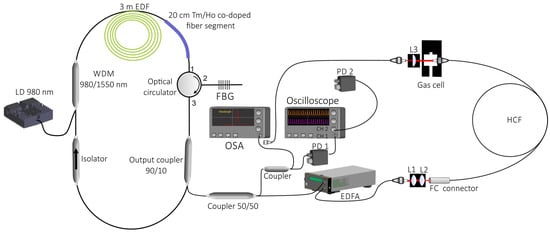
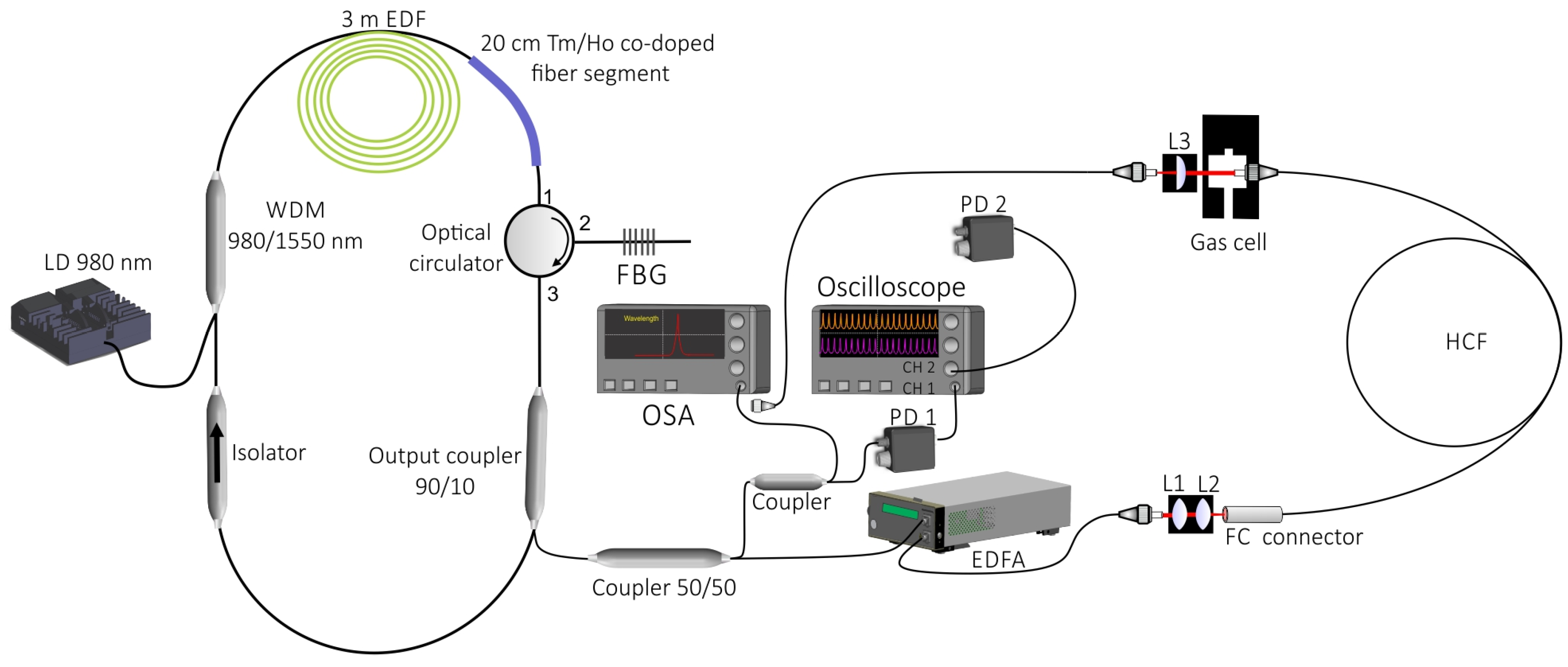
Figure 1 illustrates the experimental setup of the proposed wavelength-selectable passively Q-switched EDFL and the experimental arrangement used to monitor the transmission of the laser signal through the acetylene-filled hollow-core fiber. The latter arrangement comprises the optical coupling system, the gas-tight HCF gas cell, the acetylene-filled HCF, and the optical spectrum analyzer (OSA) used to monitor the transmitted spectrum during gas filling and thermal wavelength tuning. This arrangement is external to the laser cavity and is used only to characterize the transmitted optical signal; it does not participate in the generation of the Q-switched laser emission.
Figure 1.
Schematic diagram of the wavelength-selectable passively Q-switched EDFL for addressing the acetylene P-branch absorption band. Numbers 1–3 identify the optical circulator ports. Colors are used only to distinguish functional components and optical paths in the schematic and do not represent wavelength.
The laser cavity was constructed in a ring configuration using 3 m of LIEKKI Er16-8/125 erbium-doped fiber (EDF, LIEKKI, Lohja, Finland) as the gain medium, with an 8 μm core diameter, a 125 ± 2 μm cladding diameter, a nominal numerical aperture of 0.13, and a mode-field diameter of 9.5 ± 0.8 μm at 1550 nm. The fiber is non-polarization-maintaining (non-PM) and was pumped by a 980 nm laser diode (QPhotonics, QFBGLD-980-500, Ann Arbor, MI, USA) through a 980/1550 nm wavelength-division multiplexer (WDM, Thorlabs, WD202A, Newton, NJ, USA). The EDF length was selected based on an initial laboratory characterization, in which the residual fluorescence was observed after interrupting the 980 nm pump, together with previous experimental experience using the same fiber and cavity length [21]. An optical isolator (Thorlabs, IO-H-1550, Newton, NJ, USA) was incorporated into the cavity to ensure unidirectional propagation. The isolator was polarization-independent, and no polarization controller or polarization adjustment was required to initiate laser operation. Under the same pump-power conditions, the laser consistently started without polarization control.
Passive Q-switching was achieved by inserting a 20-cm-long single-clad thulium–holmium co-doped fiber segment (CorActive, TH512, Québec, QC, Canada), acting as a saturable absorber, into the resonator. The Tm/Ho co-doped fiber was not used as a gain medium; instead, it was inserted as a passive intracavity saturable absorber to provide intensity-dependent loss and enable Q-switched pulse generation. The relevant condition for the use of the Tm/Ho co-doped fiber is not the overlap between its emission band and that of the EDF, but sufficient saturable absorption at the laser wavelength. Around 1.53 μm, the Tm/Ho fiber provides intracavity absorption that decreases as the optical intensity increases, thereby modulating the cavity losses and enabling passive Q-switching.
The choice of the Tm/Ho co-doped fiber as the saturable absorber was motivated by previous demonstrations of passive Q-switching in Er-doped fiber lasers using rare-earth-doped fiber saturable absorbers. Tsai et al. demonstrated passive Q-switching using Tm-doped fiber as a saturable absorber [22]. More specifically, Tao et al. demonstrated passive Q-switching using a 20 cm section of Tm/Ho co-doped TH512 fiber with stable operation over a wavelength range from 1534.6 to 1572.8 nm and a derived absorption cross-section of 1.57 × 10⁻²⁰ cm2 at 1535 nm [35]. In addition, Anzueto-Sánchez et al. demonstrated Q-switched Er-doped fiber laser operation using a Tm/Ho co-doped fiber as a saturable absorber at wavelengths of 1529.69, 1531.74, and 1533.48 nm [36]. These previous results support the use of the Tm/Ho co-doped fiber as a passive saturable absorber for Q-switched operation around 1.53 μm in the present work; no comparative advantage over a Tm-only saturable absorber is claimed. The absorption cross-section of the TH512 fiber was not independently determined in this study. The passive Q-switching operation was self-starting: once the pump power was increased above the lasing threshold, the Q-switched pulse train was generated spontaneously, without external modulation or an additional triggering procedure.
To provide wavelength-selectable operation, three interchangeable FBGs were used. Each FBG (OE Land Inc., model OEFBG-100, LaSalle, QC, Canada) was fabricated by UV inscription using a phase-mask technique [30] and employed as the wavelength-selective element of the laser cavity. The gratings exhibited nominal Bragg wavelengths close to the selected acetylene absorption transitions, reflectivities of approximately 99.8%, and full widths at half maximum (FWHM) of approximately 0.11 nm, providing coarse wavelength selection. Each FBG was mounted on the same temperature-controlled stage and inserted into the laser cavity one at a time, allowing independent evaluation of each spectral region while maintaining the remaining cavity configuration. Fine wavelength positioning was achieved with a Peltier-based temperature controller by heating or cooling the selected FBG. The temperature of the selected FBG was controlled using a TE Technology TC-720 thermoelectric temperature controller (TE Technology, TC-720, Traverse City, MI, USA), which provides a temperature resolution of 0.01 °C and a specified best-case–control stability of ±0.01 °C. Temperature feedback was provided by the thermistor integrated into the Peltier stage. The temperature range was selected independently for each FBG according to the required wavelength shift, as detailed in Section 3.5.
The laser output was extracted through a 90/10 output coupler and the external branch was further divided using a 50/50 optical coupler. Both couplers were standard 1550 nm single-mode fiber components (Thorlabs, Newton, NJ, USA). The resulting branches provided a monitoring/reference path and a path toward the erbium-doped fiber amplifier (EDFA), as indicated in Figure 1. Spectral measurements were performed with an OSA (Yokogawa, AQ6370B, Tokyo, Japan).
The Q-switched signal sent through the amplification branch was amplified by the EDFA before being launched into the acetylene system. The amplified signal was coupled into a 5-m-long hollow-core photonic crystal fiber (HCPCF; GLOphotonics, T18-180902, Limoges, France) with an inner-core diameter of 85 ± 2 µm and an outer diameter of 390 ± 3 µm through an FC connector and a free-space coupling arrangement composed of lenses L1 and L2. The same single 5-m fiber segment was used throughout the gas-filling and thermal wavelength-tuning measurements. The HCF was mounted in a gas-tight hollow-fiber gas-cell block (Guiding Photonics, Torrance, CA, USA) equipped with 1/8-inch Swagelok gas fittings. Lenses L3 and L4 were used in the output coupling path. Two InGaAs photodetectors, together with an oscilloscope (Tektronix, DPO7054, Beaverton, OR, USA), were used to monitor the temporal signals at the reference and transmitted paths shown in Figure 1.
2.1. Acetylene Gas Filling
To provide controlled gas-filling conditions, a two-stage pressure regulator was installed between the acetylene cylinder and the gas cell. The regulator outlet reading was set to approximately 0.9 psi before acetylene was introduced into the system; this value refers to the regulator reading and not to a direct measurement of the absolute pressure inside the HCF. The gas was then allowed to diffuse into the 5-m-long HCF while the transmitted optical spectrum was monitored. A progressively smaller change in the transmitted spectrum was used as the practical criterion for proceeding to the subsequent measurements. Because the present study focuses on wavelength positioning rather than quantitative acetylene spectroscopy, the exact intra-fiber pressure was not determined. The observed transmission minima were used only as qualitative indicators of increased spectral overlap between the laser emission and the selected acetylene transitions. Consequently, no quantitative interpretation of the absorption strength, linewidth, or pressure-dependent spectral profile is made in this work. Gas transport in HCFs depends on the inlet conditions, fiber length, and molecular properties, as discussed by Parmar and Bhatnagar [37].
2.2. Experimental Methodology
The molecular line positions were identified from HITRAN [1,2]. Because HITRAN tabulates line positions as vacuum wavenumbers, the corresponding wavelengths were converted to air wavelengths to match the AIR wavelength reference used in the OSA. Accordingly, the P(7), P(9), and P(11) reference wavelengths used throughout this work are 1528.76 nm, 1529.94 nm, and 1531.17 nm, respectively. The HITRAN-derived trace is used as a spectral-position reference rather than as a quantitative prediction of absolute absorption under the experimental HCF gas-filling conditions. During the experiment, the selected FBG was thermally tuned while the transmitted spectrum was monitored with the OSA.
3. Results and Discussion
This section presents the experimental validation of the wavelength-selectable passively Q-switched fiber laser. First, the relationship between the interchangeable FBG operating wavelengths and the HITRAN-derived acetylene spectral reference is established. The spectral and temporal characteristics of the laser are then evaluated, followed by the gas-filling response and thermal wavelength scans around the P(7), P(9) and P(11) transitions.
3.1. HITRAN Spectral Reference
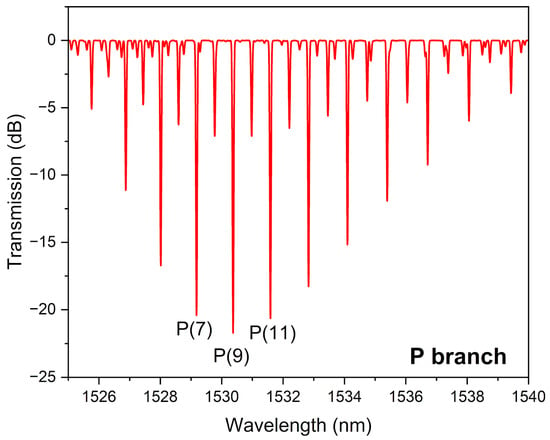
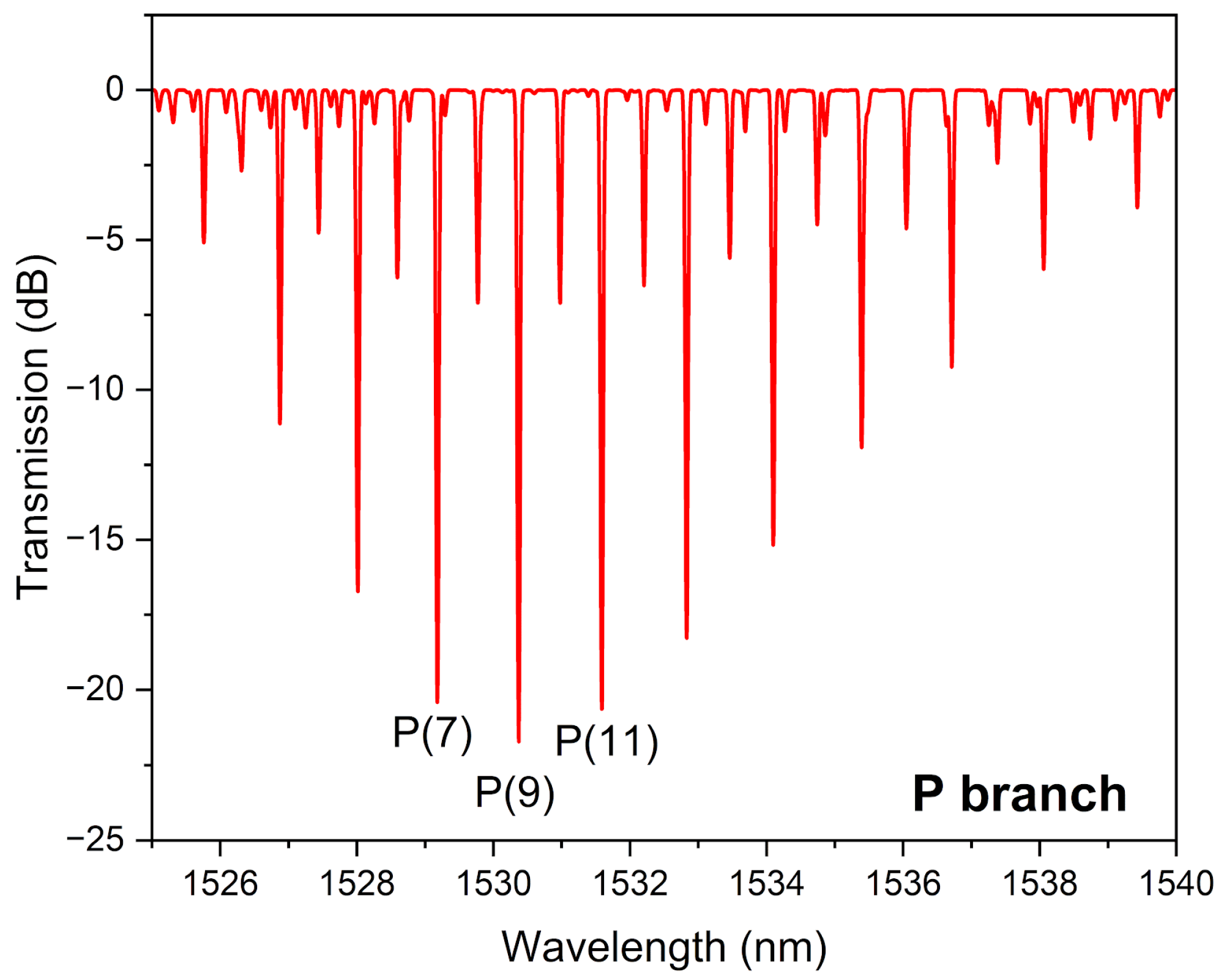
Figure 2 shows the HITRAN-derived acetylene P-branch spectral reference around 1.53 μm [1,2]. Several rovibrational transitions with different strengths are present in this spectral range. The P(7), P(9) and P(11) transitions used in the experimental analysis are located at 1528.76 nm, 1529.94 nm, and 1531.17 nm, respectively. The trace is used only to identify the spectral positions and relative structure of the selected molecular transitions; its plotted depth is not interpreted as the absolute transmission or absorption coefficient of the experimental HCF.
Figure 2.
HITRAN-derived spectral reference for acetylene in the P-branch around 1.53 µm. The P(7), P(9) and P(11) transitions were selected for wavelength positioning and experimental investigation.
3.2. Spectral and Temporal Characterization of the Q-Switched Fiber Laser
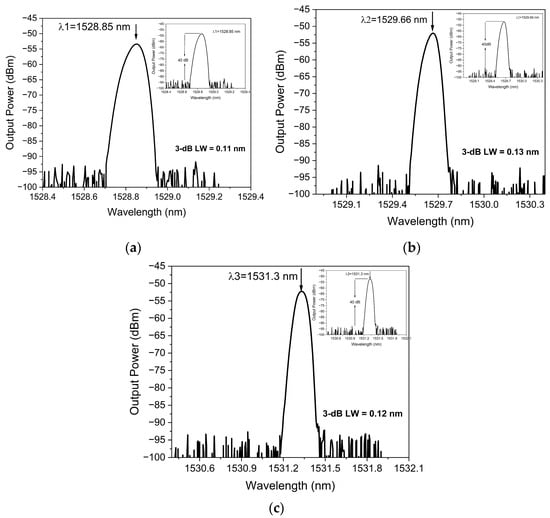
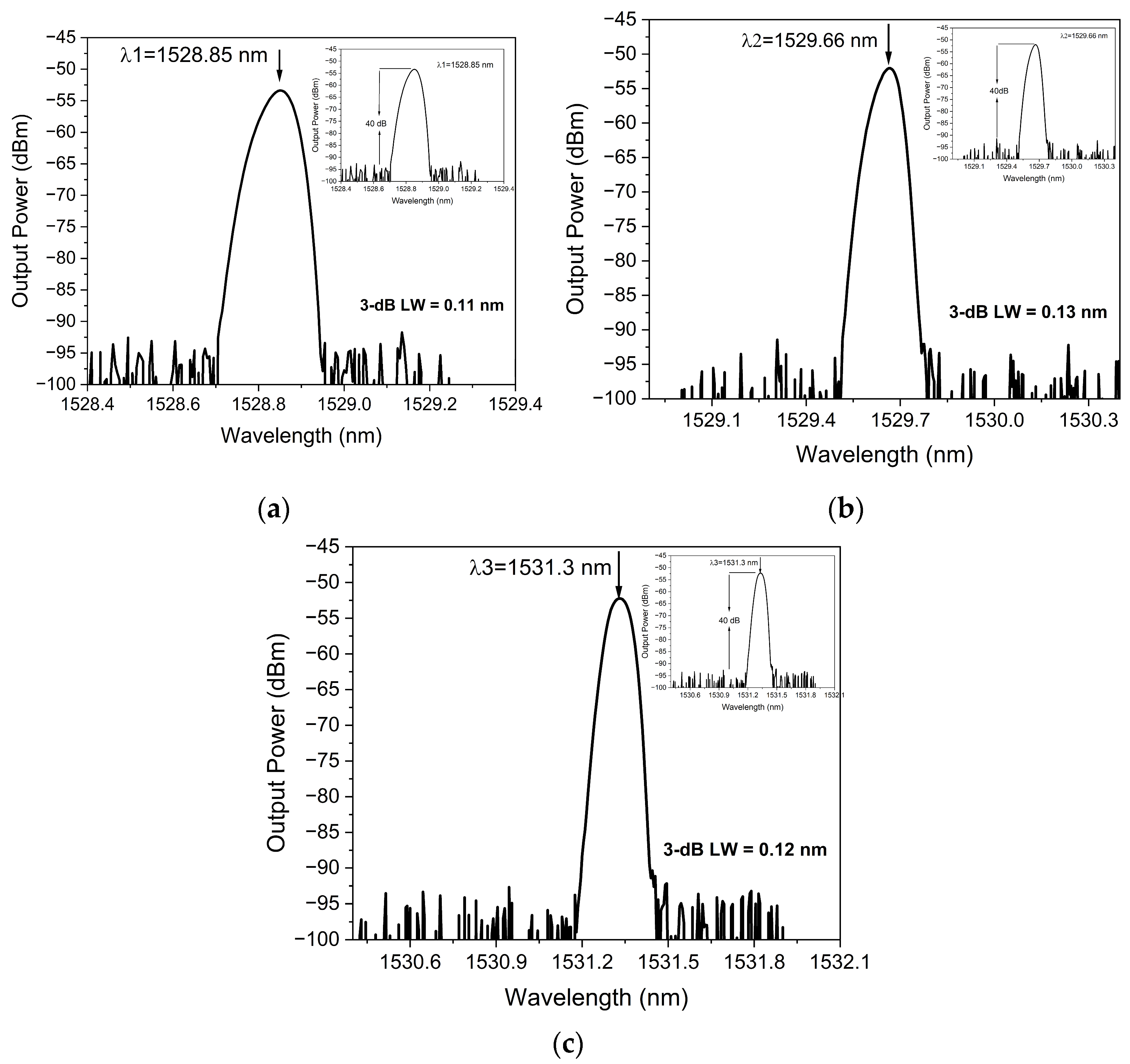
Figure 3 presents the output spectra of the Q-switched EDFL obtained with the three FBGs. The dominant spectral peaks were centered at 1528.85 nm, 1529.66 nm, and 1531.30 nm, placing them near the P(7), P(9) and P(11) spectral regions, respectively. The OSA-measured 3-dB spectral widths were 0.11 nm, 0.13 nm, and 0.12 nm, respectively. The SMSR was measured independently from the optical spectrum obtained for each FBG configuration, yielding approximately 40 dB for FBG1, FBG2, and FBG3 (Table 1). Because these widths are instrument-resolved spectral envelopes rather than an independent high-resolution linewidth measurement, they are not interpreted here as the intrinsic laser linewidth. The results demonstrate a single dominant spectral peak at the OSA resolution and confirm the use of the FBGs for coarse wavelength selection. The corresponding FFT-derived electrical spectra are shown in Figure 4.
Figure 3.
Output spectra of the Q-switched fiber laser obtained using (a) FBG1, (b) FBG2, and (c) FBG3 as the wavelength-selective elements of the laser cavity.
Table 1.
Spectral characteristics of the Q-switched fiber laser operating with the three interchangeable FBGs.
Figure 4.
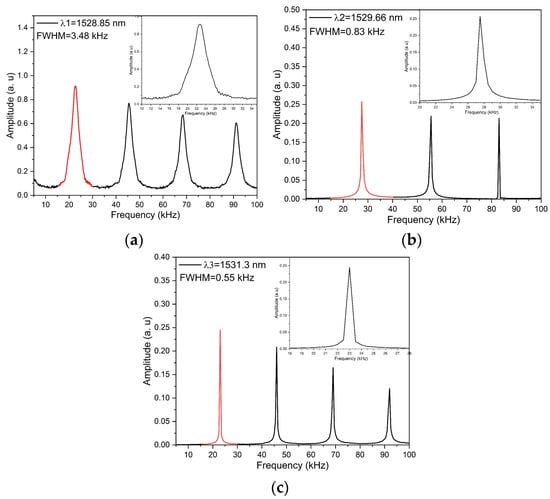
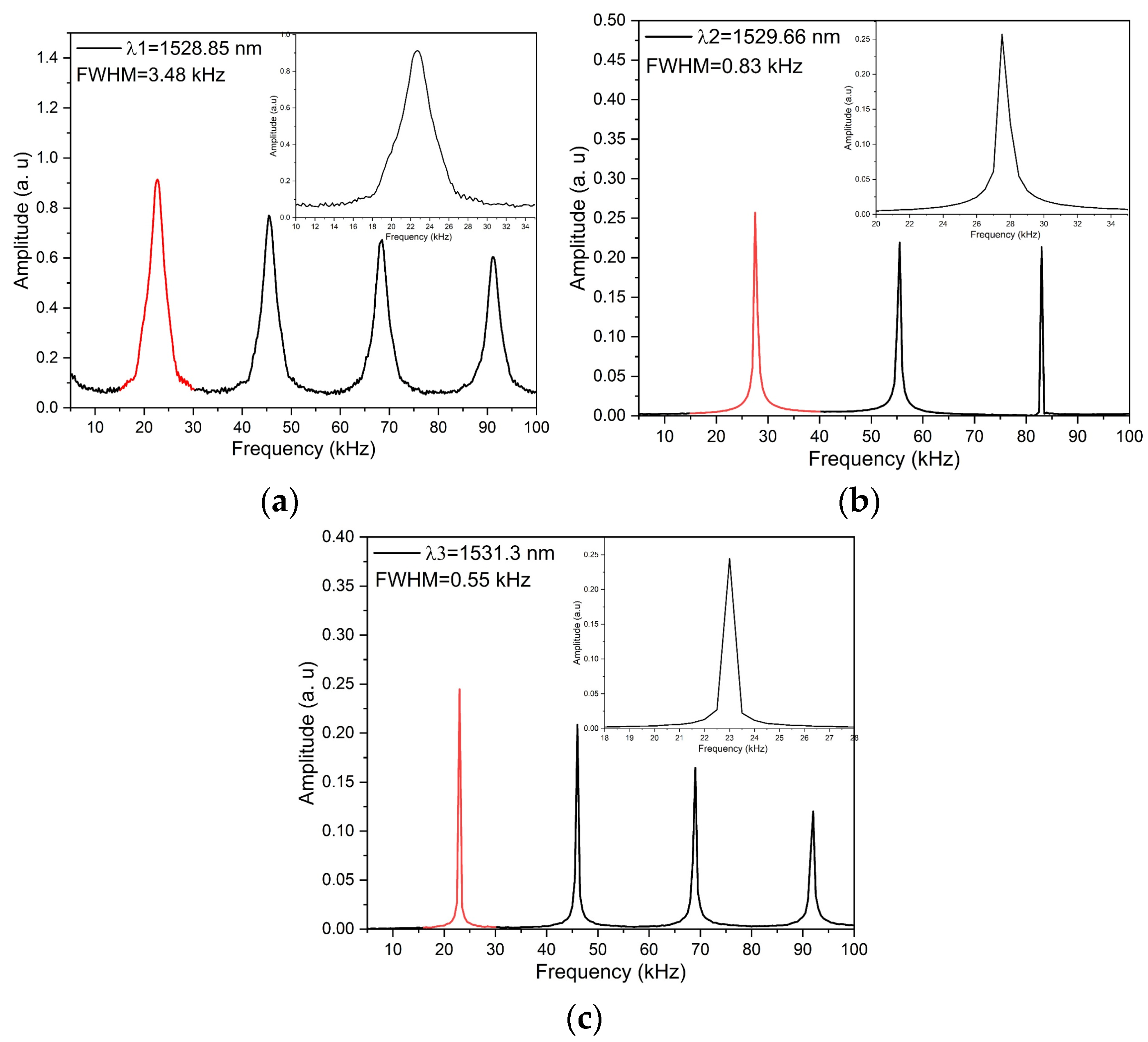
Fast Fourier transform (FFT)-derived electrical spectra of the Q-switched pulse trains at (a) 1528.85 nm, (b) 1529.66 nm, and (c) 1531.30 nm. The insets show the fundamental repetition-frequency component used to determine the corresponding FWHM. The red trace identifies the fundamental repetition-frequency component used for the FWHM determination; higher-order harmonics are shown in black.
The electrical spectra exhibit a well-defined fundamental repetition-frequency component together with its higher-order harmonics, consistent with periodic Q-switched pulse generation. The FFT-derived FWHM of the fundamental component was approximately 3.48 kHz, 0.83 kHz, and 0.55 kHz for the laser operating at 1528.85 nm, 1529.66 nm, and 1531.30 nm, respectively. These values correspond to the linewidth obtained from the FFT of the measured finite-duration oscilloscope traces and are therefore reported as FFT-derived electrical linewidths.
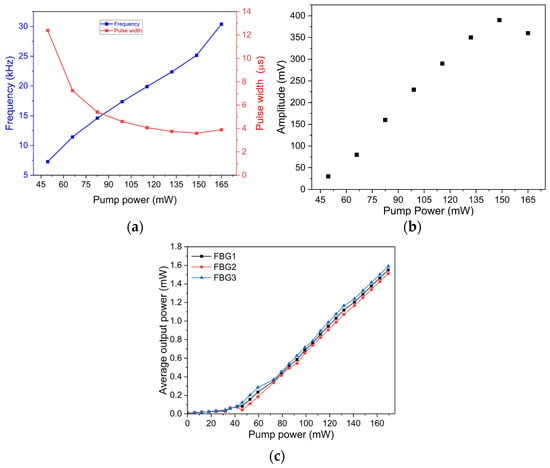
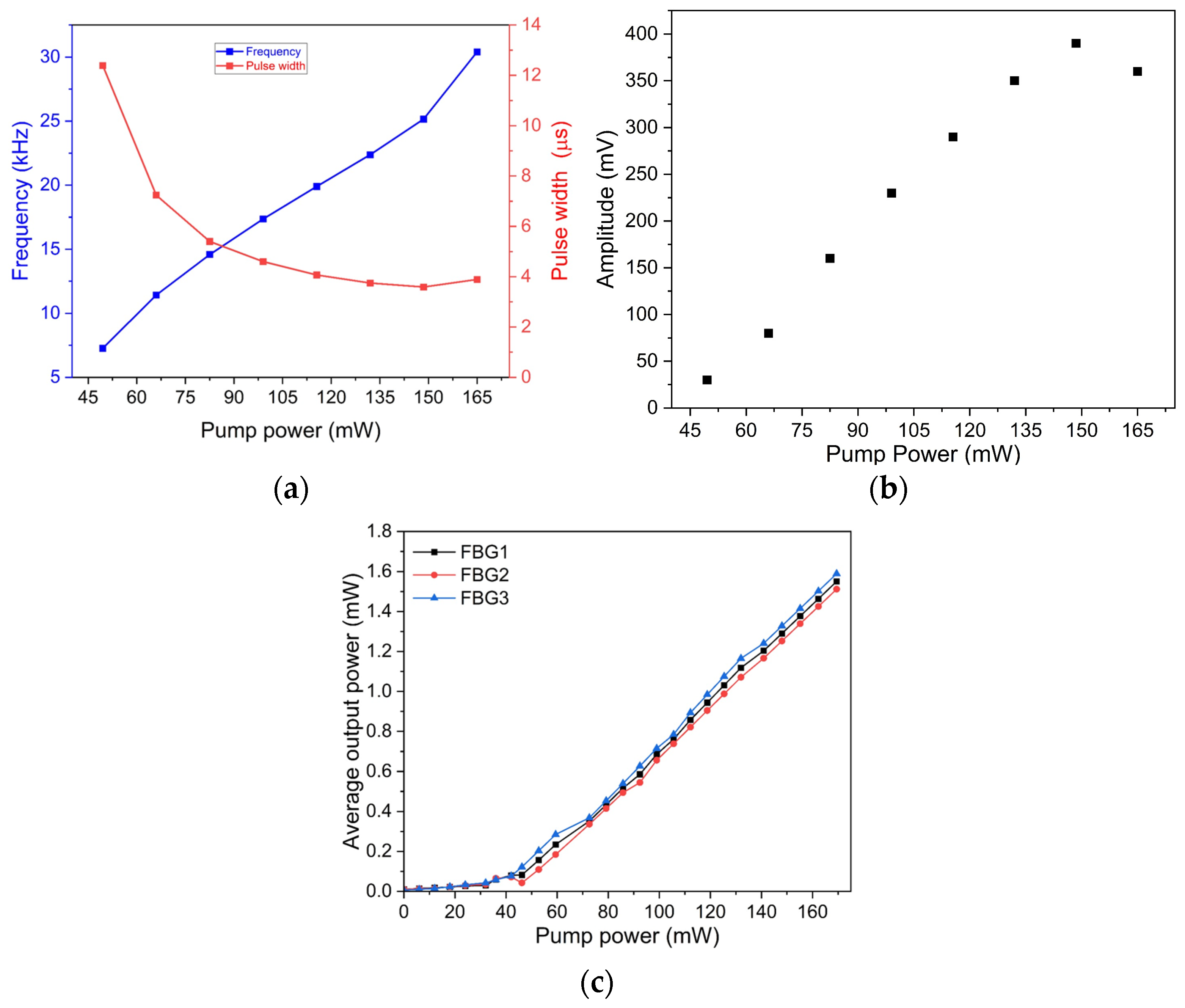
Figure 5a shows the dependence of the repetition frequency and pulse width on pump power. Over the measured range from approximately 50 to 165 mW, the repetition frequency increases from about 7 to 30 kHz, whereas the pulse width decreases from approximately 12.3 μs to about 3.5–4.0 μs. At the highest pump level, the pulse width shows a slight increase while the repetition frequency continues to increase. This inverse evolution of repetition frequency and pulse duration is consistent with the expected pump-dependent behavior of a passively Q-switched fiber laser.
Figure 5.
Pump-power dependence of the passively Q-switched fiber laser characteristics: (a) repetition frequency and pulse width; (b) detected pulse amplitude; (c) average output power for the three FBG configurations.
Figure 5b shows the corresponding photodetector pulse-amplitude response. The detected amplitude increases with pump power and reaches a maximum of approximately 390 mV near 150 mW, followed by a decrease to approximately 360 mV at 165 mW. Because the vertical axis represents photodetector voltage, these data are reported as detected pulse amplitude and are not converted into pulse energy or peak optical power.
Figure 5c shows the measured average output power as a function of pump power for the three FBG configurations. The reported average output power corresponds to the total output power of the laser. For all three cases, the average output power increases with pump power over the investigated range. The three configurations exhibit a similar overall dependence, with FBG3 providing slightly higher output power than FBG1 and FBG2 at the upper pump levels.
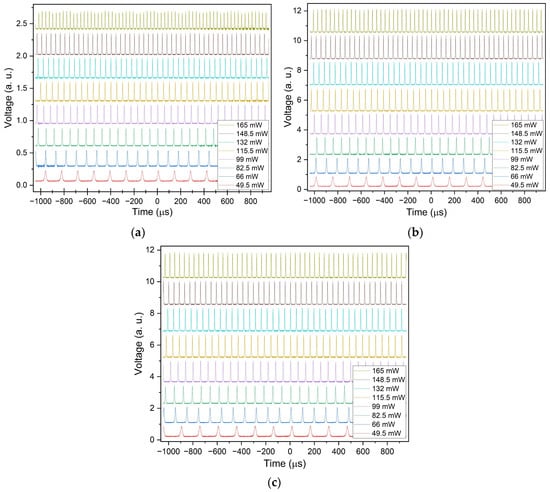
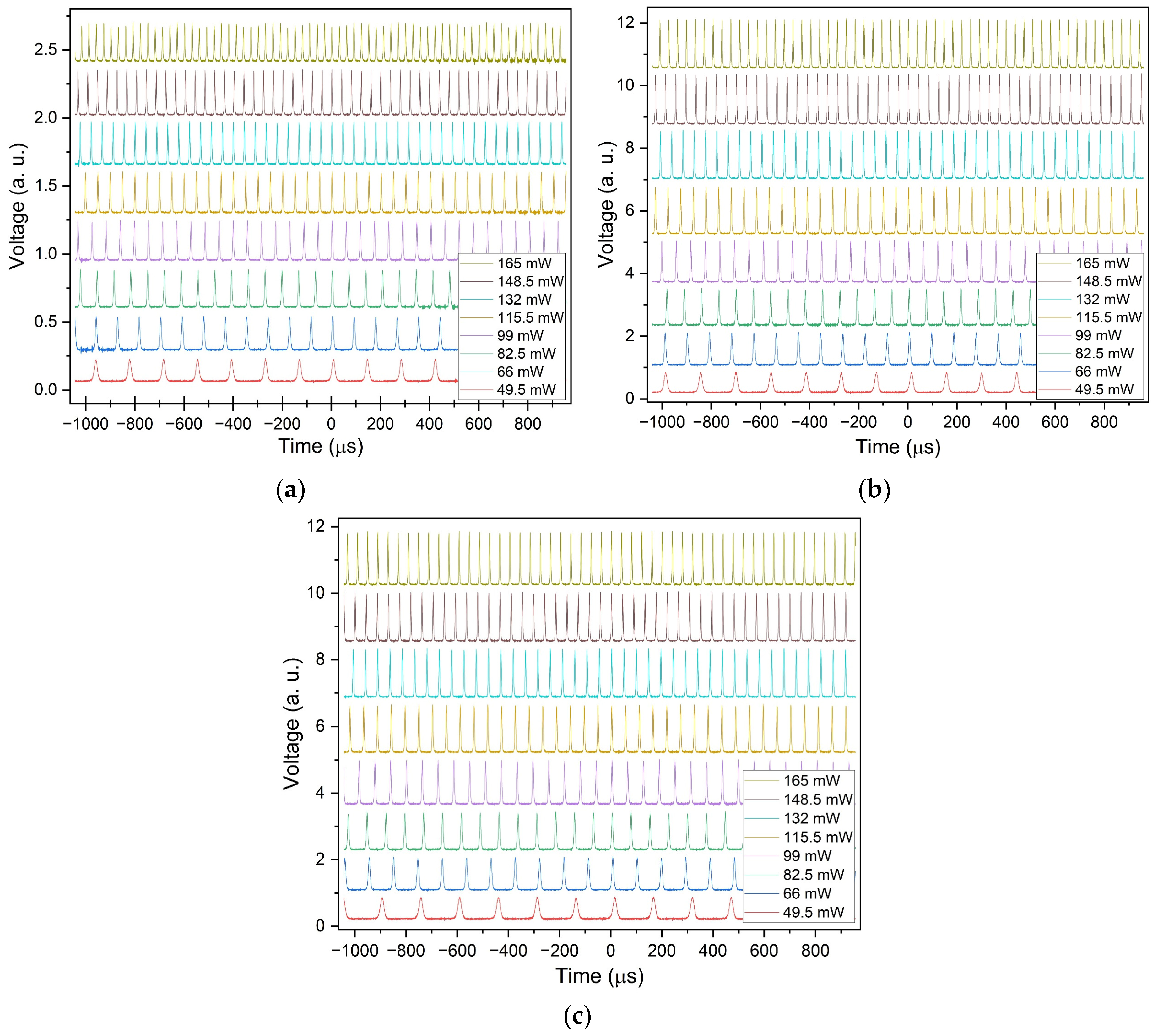
To complement the pump-power dependence summarized in Figure 5, the corresponding time-domain pulse trains measured with the oscilloscope are shown in Figure 6 for the three FBG-selected operating wavelengths. For each wavelength, the traces are presented over the investigated pump-power range from 49.5 to 165 mW. As the pump power increases, the temporal spacing between consecutive pulses decreases, consistent with the increase in repetition frequency shown in Figure 5a, while Q-switched pulse-train operation is maintained over the investigated range.
Figure 6.
Time-domain pulse trains of the Q-switched laser measured at different pump powers for (a) 1528.85 nm, (b) 1529.66 nm, and (c) 1531.30 nm.
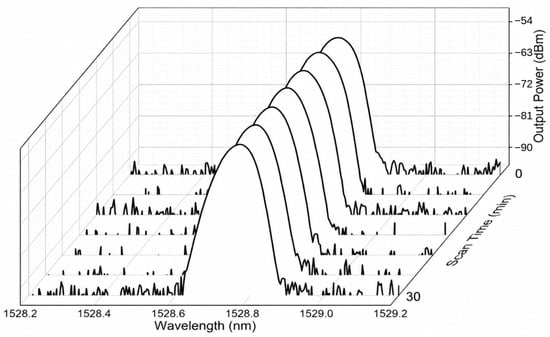
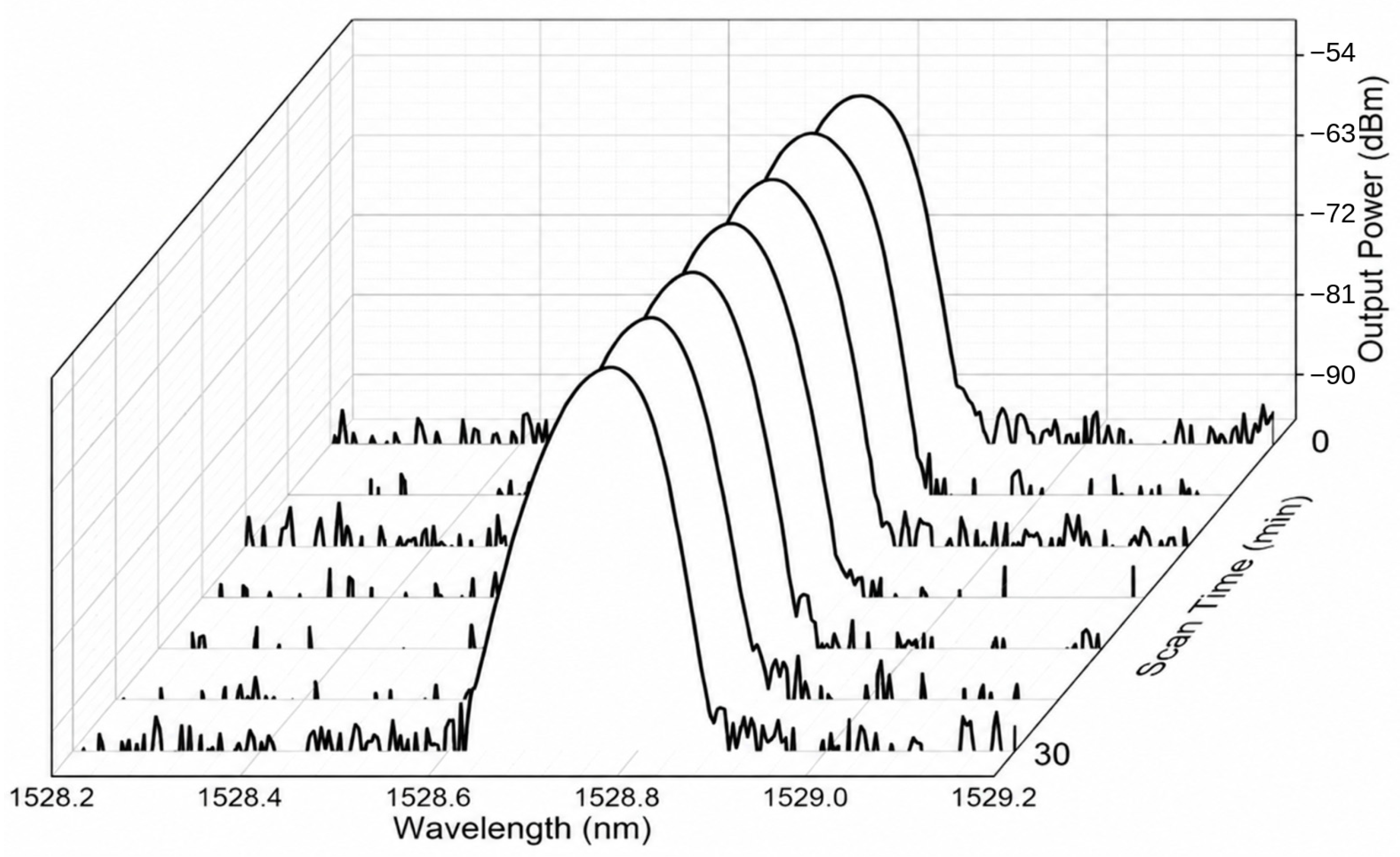
After the temporal characterization, the short-term spectral stability of the laser was evaluated under constant operating conditions at room temperature and without acetylene gas. Figure 7 shows spectra recorded at 5-min intervals over 30 min using the OSA with a wavelength resolution of 0.05 nm. No central-wavelength drift was resolvable within this OSA resolution over the measurement interval, and the measured spectral peak power fluctuated by no more than approximately 0.3 dB. These data support good short-term spectral stability under the selected laboratory conditions.
Figure 7.
Short-term spectral stability of the proposed passively Q-switched laser. The output spectrum was recorded every 5 min over a 30 min period at room temperature in the absence of acetylene gas.
3.3. Coarse Wavelength Selection Using Interchangeable FBGs
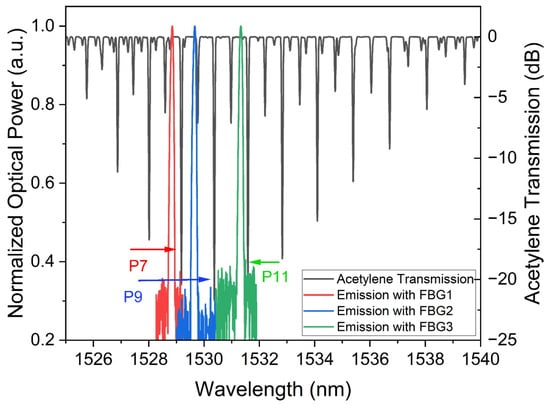
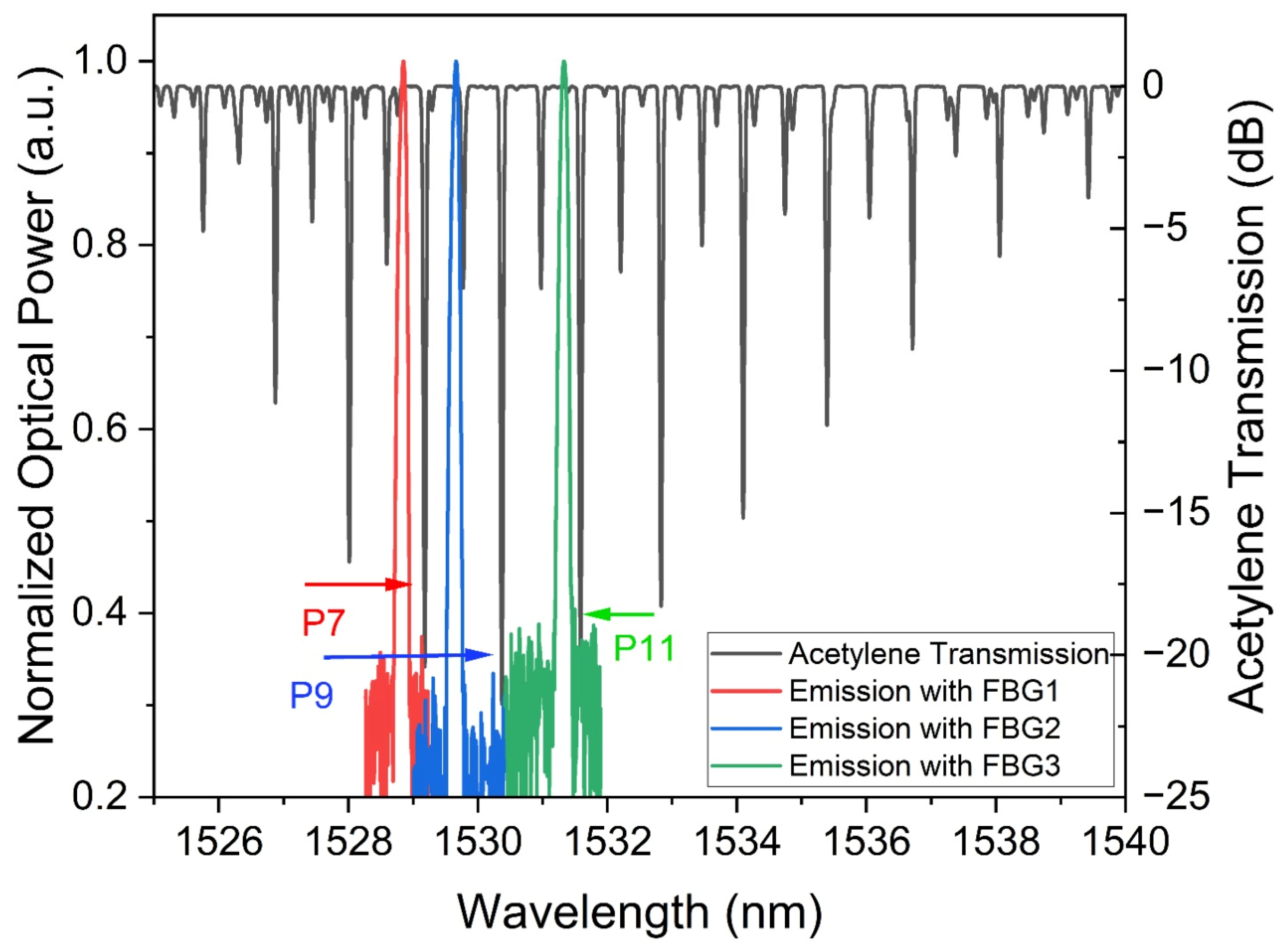
Figure 8 compares the HITRAN-derived acetylene spectral reference with the laser emission spectra obtained using FBG1–FBG3 before fine thermal adjustment. The three FBGs have nominal Bragg wavelengths of 1528.85 nm, 1529.66 nm, and 1531.30 nm, respectively, placing the corresponding laser emission in the vicinity of the P(7), P(9), and P(11) transitions. FBG1 and FBG3 are nominally centered at longer wavelengths than P(7) and P(11), whereas FBG2 is nominally centered at a shorter wavelength than P(9). Consequently, FBG1 and FBG3 require cooling to shift the laser toward shorter wavelengths, while FBG2 requires heating to shift toward longer wavelengths. The interchangeable FBGs thus provide coarse wavelength selection [27,28,29], followed by thermal fine adjustment.
Figure 8.
HITRAN-derived acetylene spectral reference and measured laser emission spectra obtained using three interchangeable FBGs (FBG1–FBG3) in the vicinity of the P(7), P(9) and P(11) acetylene absorption transitions.
3.4. Temporal Evolution of Optical Transmission
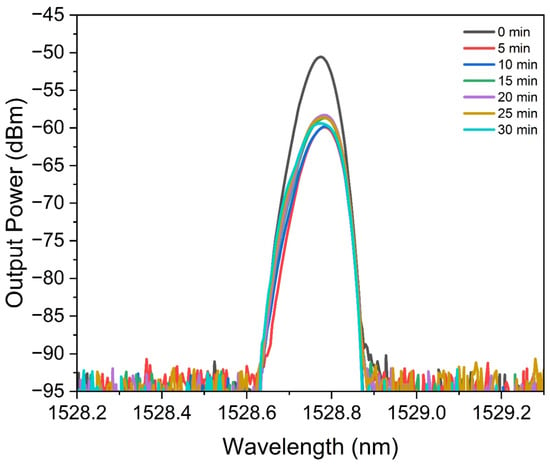
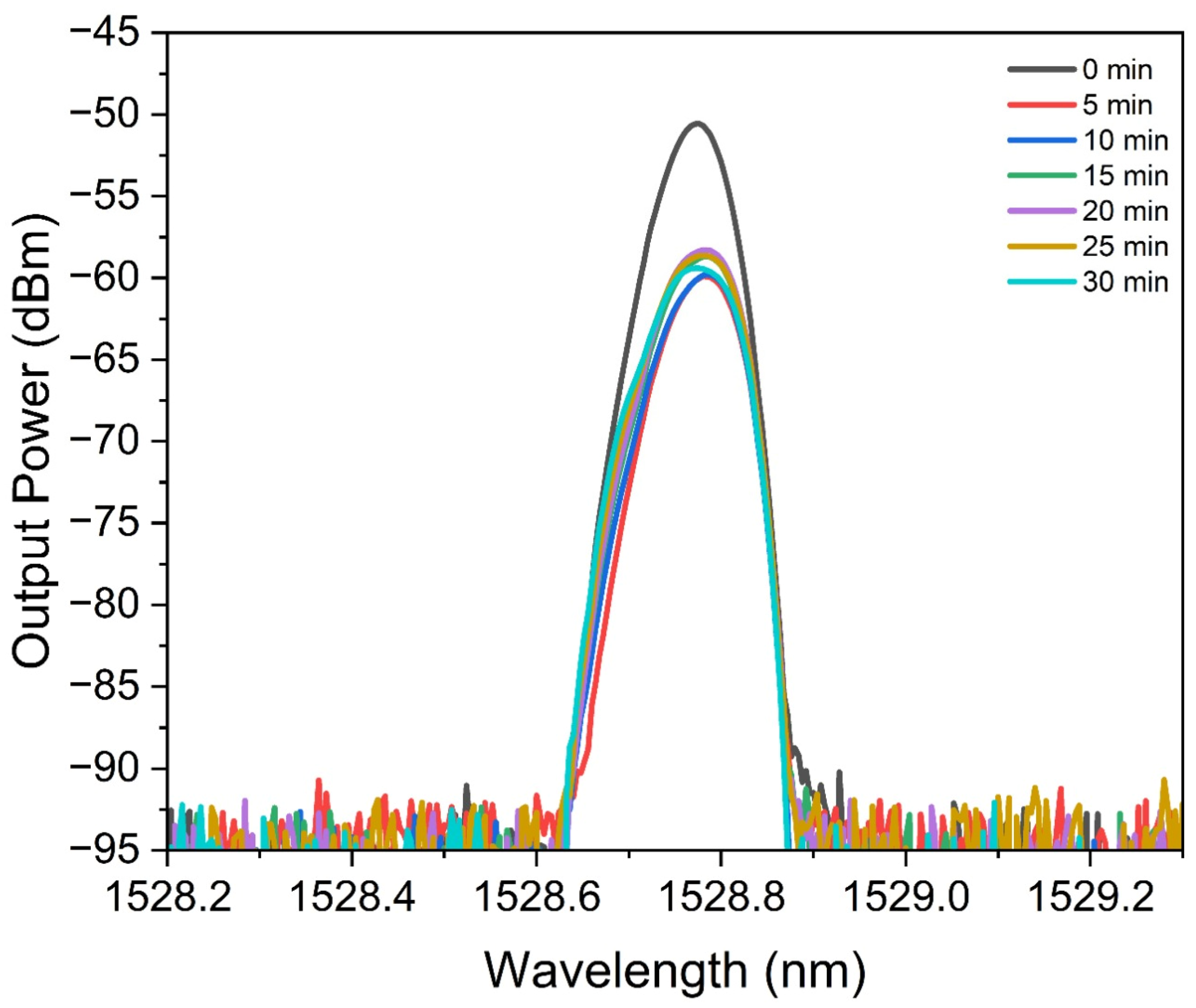
Figure 9 shows the optical spectrum measured in the transmitted path during the acetylene gas-filling process. Spectra were recorded at 5-min intervals after introducing acetylene into the gas cell. At t = 0 min, the transmitted signal was highest. As acetylene entered the HCF, the transmitted spectral peak near 1528.85 nm decreased while its central wavelength remained essentially unchanged. The changes became smaller toward the end of the monitored interval. This evolution is consistent with increasing attenuation during gas filling and was used only as a qualitative operational indication that the transmission was approaching a steady condition.
Figure 9.
Evolution of the transmitted optical spectrum during acetylene filling.
3.5. Thermal Wavelength Tuning Using FBGs
After the gas-filling stage, the three FBGs were thermally tuned toward the selected P(7), P(9), and P(11) spectral positions. The nominal Bragg wavelengths of FBG1, FBG2, and FBG3 were 1528.85 nm, 1529.66 nm, and 1531.30 nm, respectively. These nominal values are used to describe the coarse wavelength selection and should not be interpreted as the measured wavelength at the starting temperature of each thermal scan. The thermal scans were initiated at 20 °C for FBG1, 50 °C for FBG2, and 15 °C for FBG3. Depending on the nominal wavelength offset, the grating was cooled to induce a blue shift or heated to induce a red shift. The transmitted spectra recorded during these scans are used to locate relative transmission minima as the laser spectrum crosses the selected molecular spectral region. Because the spectra are not converted to reference-normalized absorbance, only the positions of these minima are interpreted; their absolute depths are not used as quantitative measurements of absorption strength.
3.5.1. Wavelength Tuning Toward the P(7) Acetylene Absorption Line
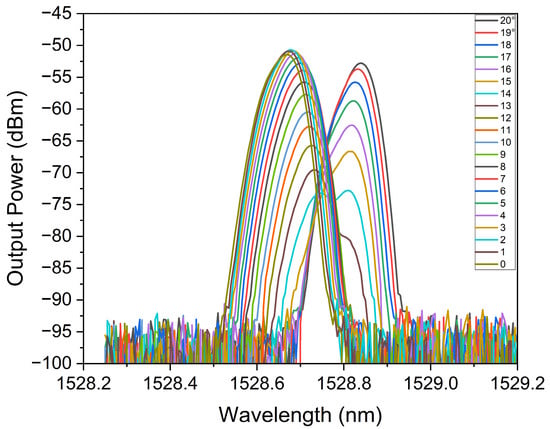
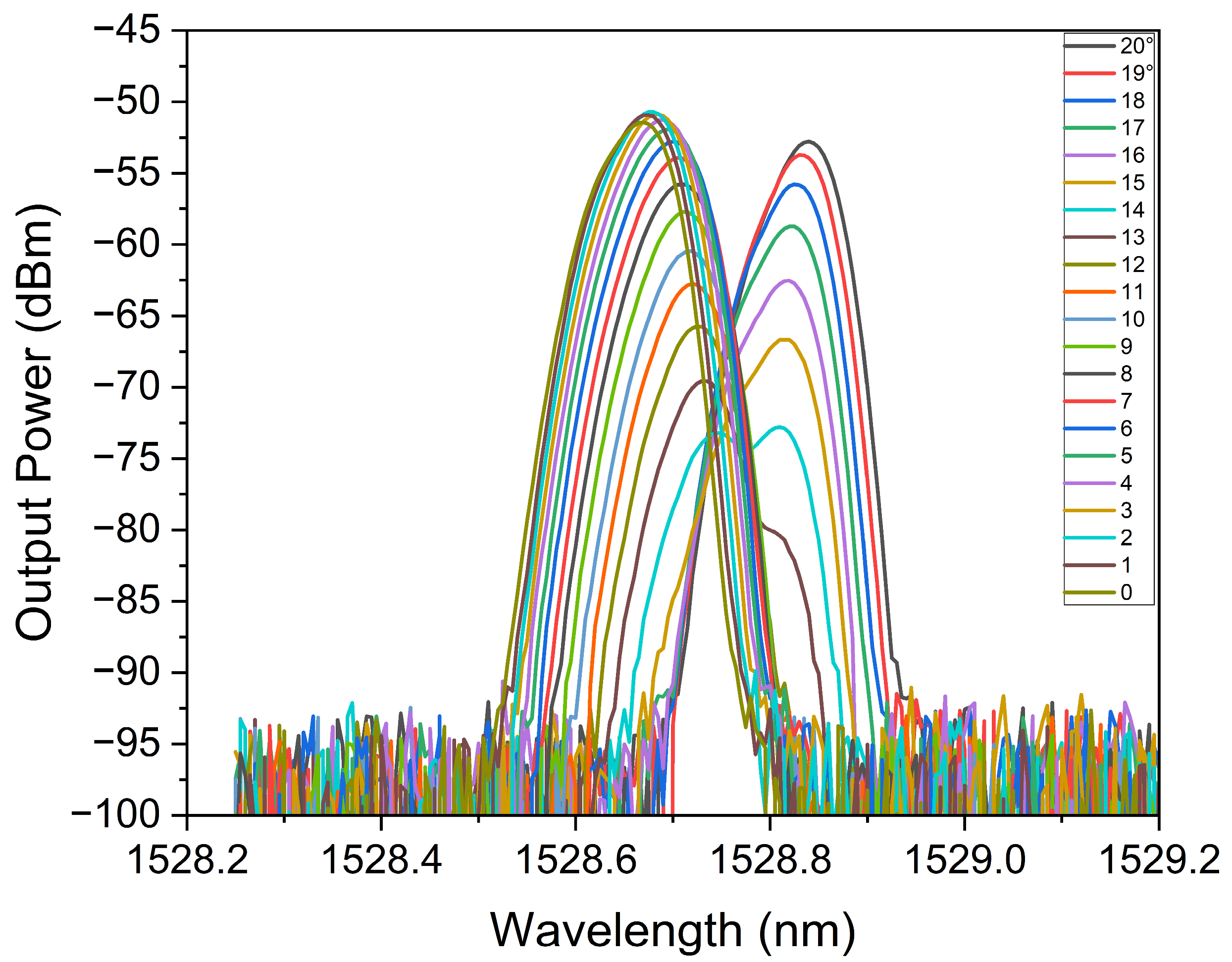
Figure 10 shows the transmitted spectra measured during thermal tuning of FBG1 toward the P(7) reference position at approximately 1528.76 nm. Cooling the grating from 20 °C to 0 °C produced the expected blue shift through the thermo-optic response and thermal contraction of the FBG [33,34]. As the laser spectrum moved across the P(7) spectral region, the transmitted power decreased and reached a relative minimum near 15 °C. Further cooling shifted the laser spectrum beyond this condition and the transmitted power increased again. The observed wavelength-dependent trend is consistent with increased laser–line spectral overlap near the selected acetylene line position [1,2].
Figure 10.
Transmitted optical spectra measured at the output of the acetylene-filled hollow-core fiber during thermal tuning of FBG1 from 20 °C to 0 °C.
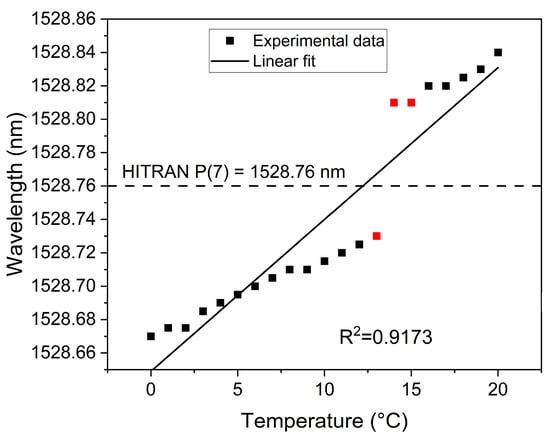
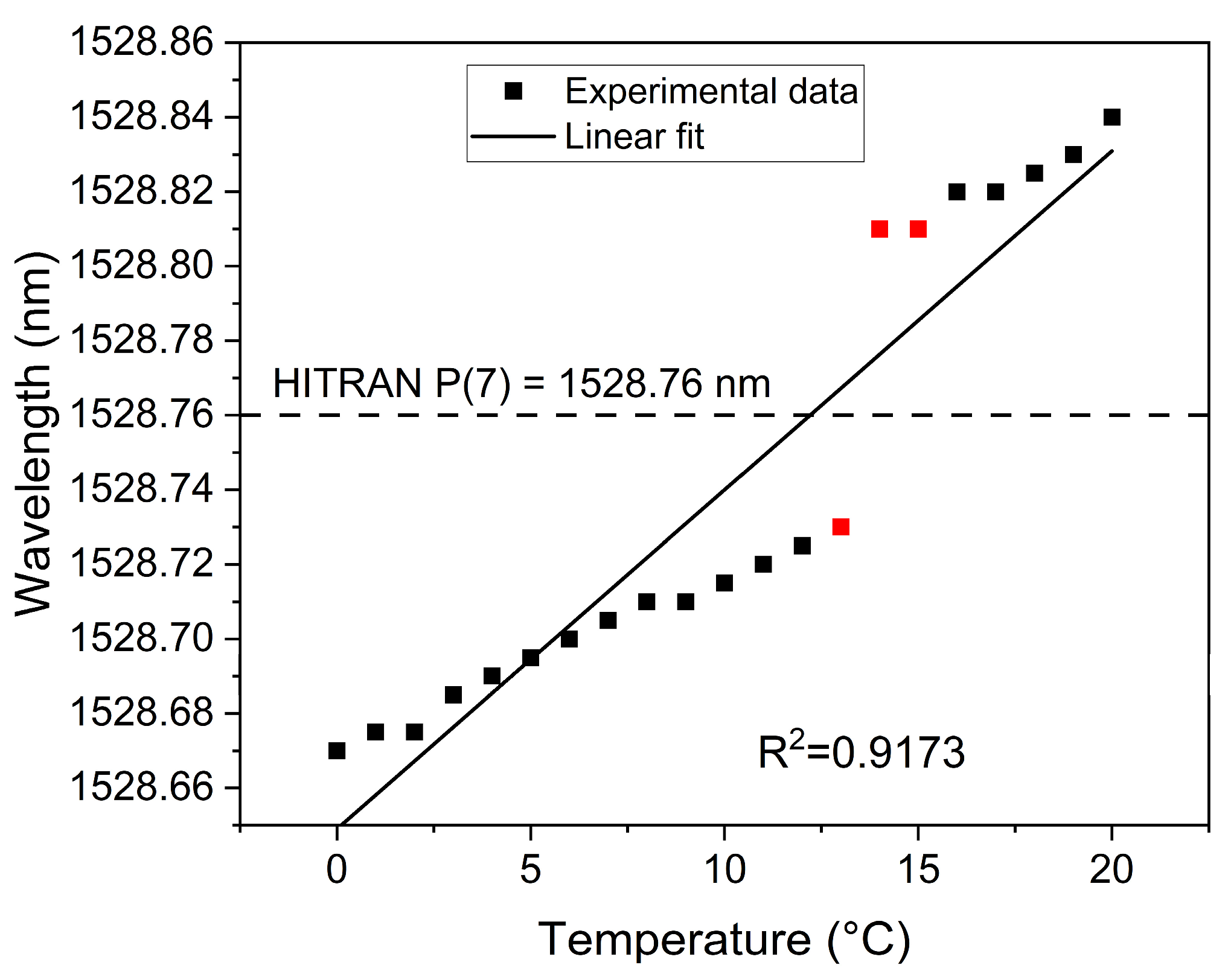
The recovery of transmitted power on either side of the relative minimum demonstrates that thermal control provides a controlled fine wavelength-adjustment mechanism around the FBG1 operating point. The direction of the observed wavelength shift is consistent with the established thermo-optic response of silica fiber Bragg gratings [33,34]. To quantitatively evaluate the thermal wavelength response, a linear regression was performed between the measured spectral peak wavelength and the FBG temperature. The data points surrounding the transmission minimum were excluded because the measured spectral peak is affected by the acetylene absorption feature. The resulting thermal wavelength sensitivity was 9.096 pm/°C, with R2 = 0.9173. The corresponding wavelength-versus-temperature data and linear regression are shown in Figure 11.
Figure 11.
Thermal wavelength response and linear regression of FBG1. The dashed line indicates the HITRAN P(7) wavelength. Red data points correspond to measurements around the transmission-minimum region and were excluded from the linear regression because the measured spectral peak is affected by acetylene absorption.
3.5.2. Wavelength Tuning Toward the P(9) Acetylene Absorption Line
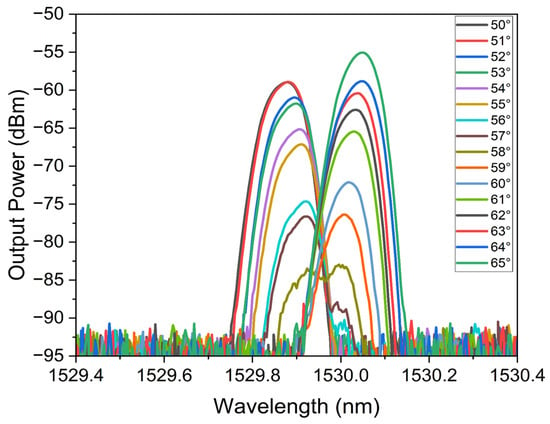
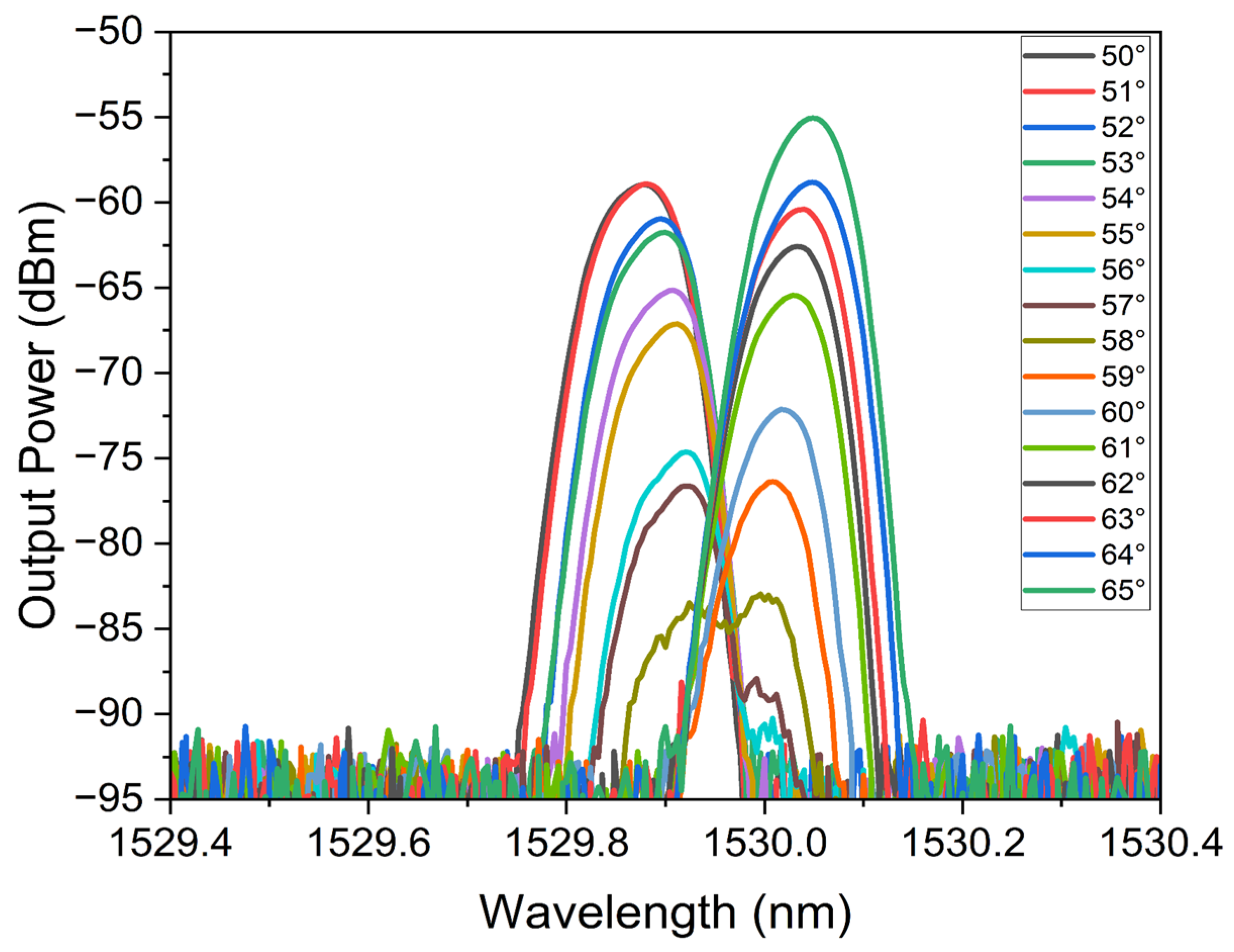
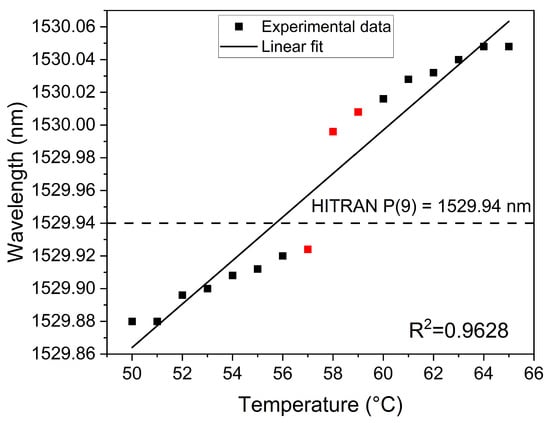
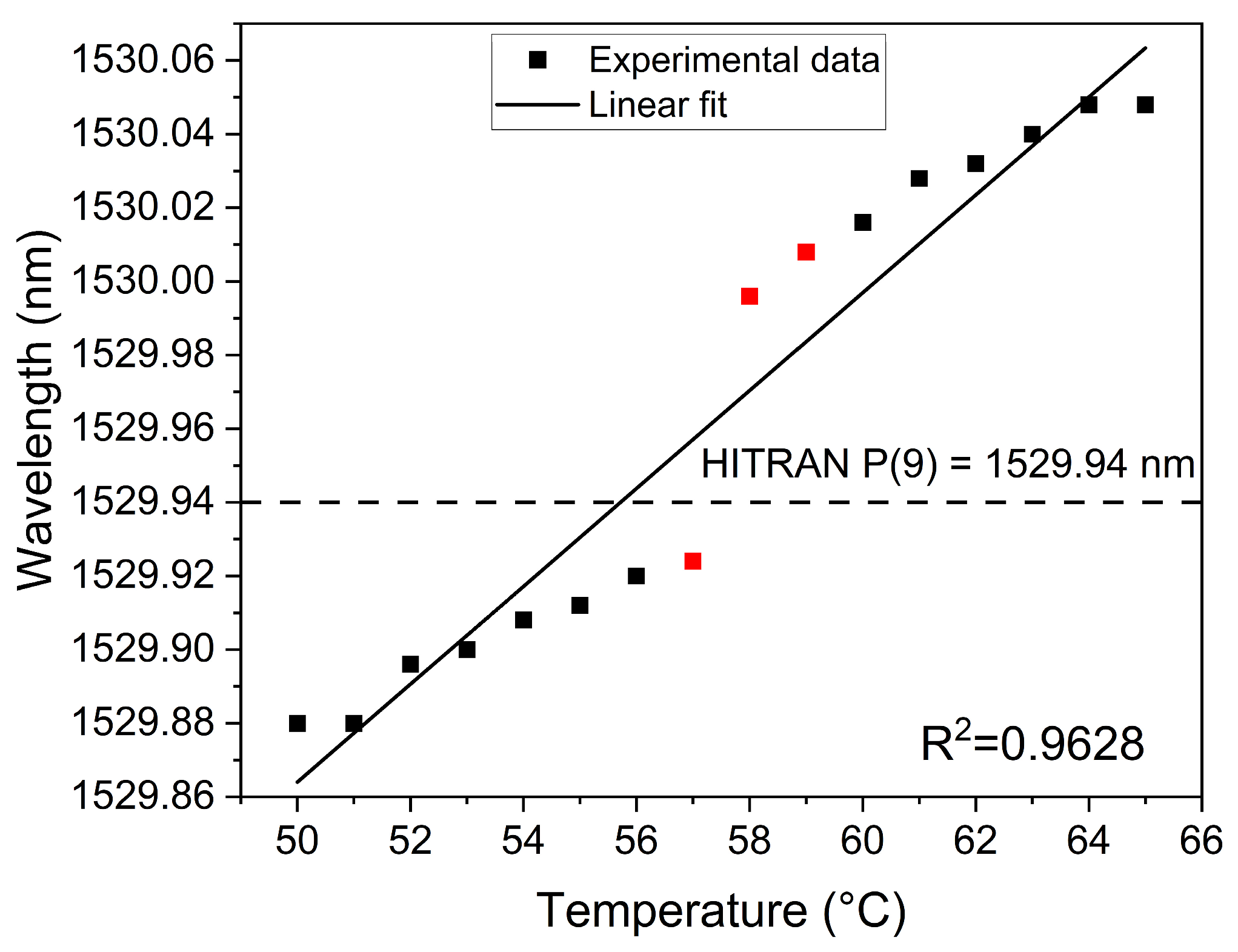
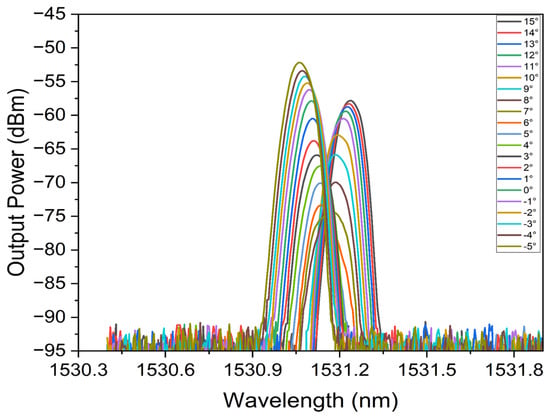
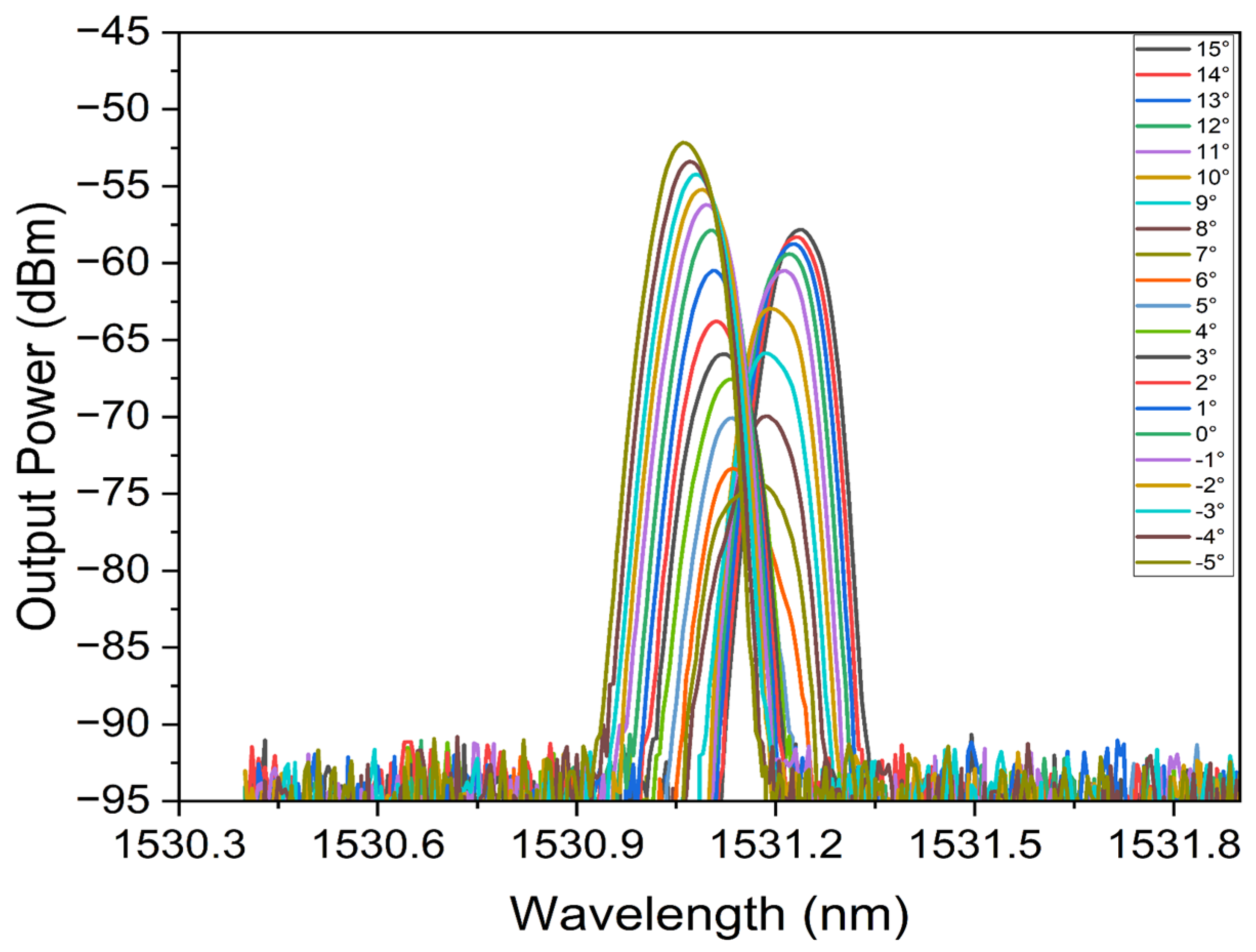
The same procedure was repeated with FBG2 for the P(9) transition centered at 1529.94 nm. Because the nominal FBG2 wavelength was shorter than this reference, heating from 50 °C to 65 °C produced the required red shift. The transmitted power decreased as the laser spectrum approached the selected spectral region and reached a relative minimum near 58 °C (Figure 12). Further heating shifted the emission beyond the minimum and the transmitted power recovered. To quantitatively evaluate the thermal wavelength response, a linear regression was performed between the measured spectral peak wavelength and the FBG temperature. The data points surrounding the transmission minimum were excluded because the measured spectral peak is affected by the acetylene absorption feature. The resulting thermal wavelength sensitivity was 13.294 pm/°C, with R2 = 0.9628. The corresponding wavelength-versus-temperature data and linear regression are shown in Figure 13.
Figure 12.
Transmitted optical spectra measured at the output of the acetylene-filled hollow-core fiber during thermal tuning of FBG2 from 50 °C to 65 °C.
Figure 13.
Thermal wavelength response and linear regression of FBG2. The dashed line indicates the HITRAN P(9) wavelength. Red data points correspond to measurements around the transmission-minimum region and were excluded from the linear regression because the measured spectral peak is affected by acetylene absorption.
3.5.3. Wavelength Tuning Toward the P(11) Acetylene Absorption Line
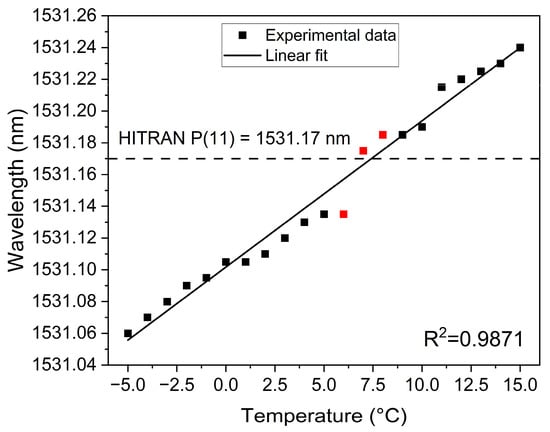
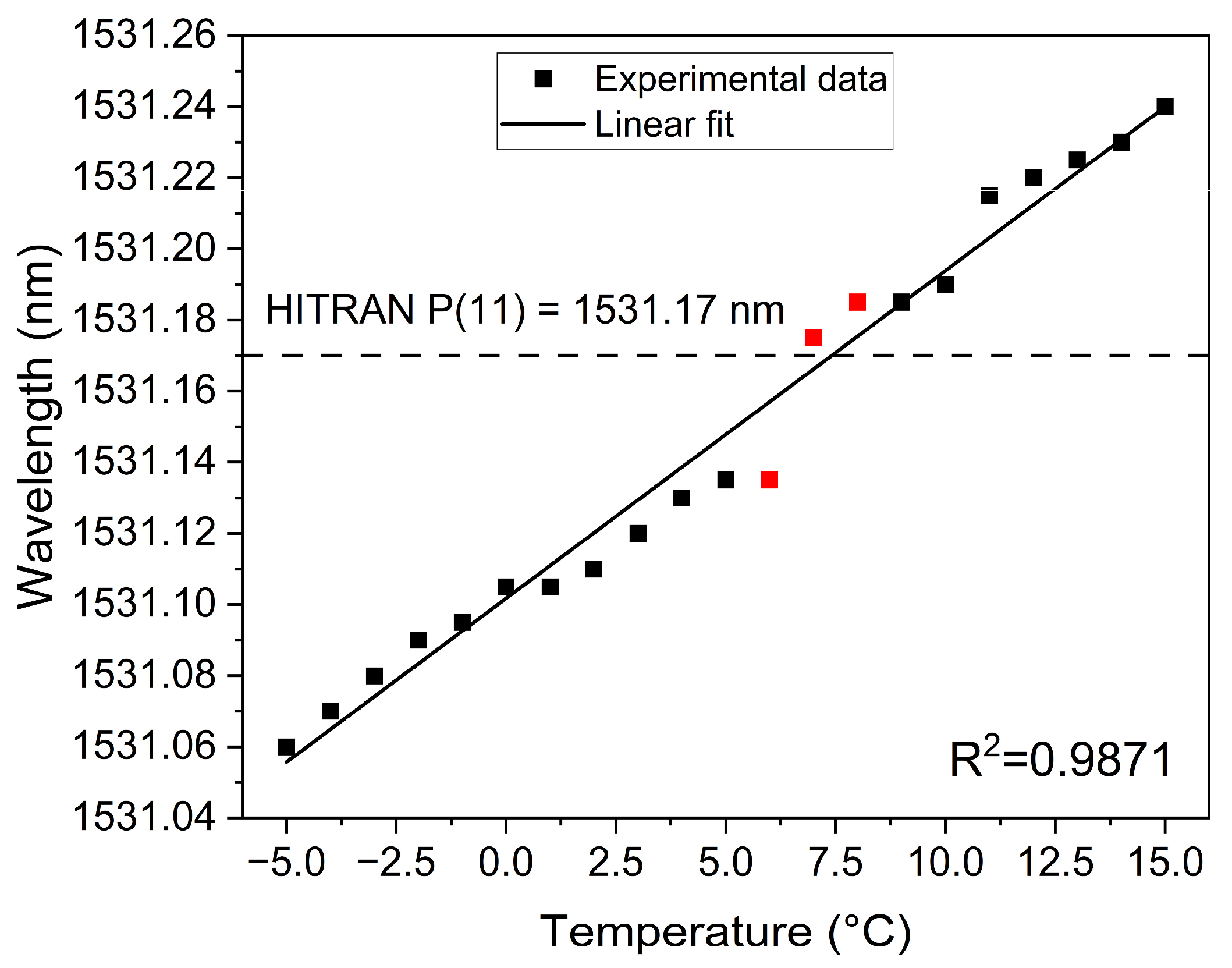
FBG3 was used to address the P(11) transition centered at approximately 1531.17 nm. Its nominal Bragg wavelength was approximately 1531.30 nm. The thermal scan was initiated at 15 °C and the grating was cooled to −5 °C to induce a blue shift. Figure 14 shows that the transmitted power decreased as the laser spectrum approached the selected P(11) region and reached a relative minimum near 6 °C. Further cooling shifted the laser spectrum past this condition and the transmitted power recovered. The result follows the same wavelength-positioning principle observed for P(7) and P(9). To quantitatively evaluate the thermal wavelength response, a linear regression was performed between the measured spectral peak wavelength and the FBG temperature. The data points surrounding the transmission minimum were excluded because the measured spectral peak is affected by the acetylene absorption feature. The resulting thermal wavelength sensitivity was 9.209 pm/°C, with R2 = 0.9871. The corresponding wavelength-versus-temperature data and linear regression are shown in Figure 15.
Figure 14.
Transmitted optical spectra measured at the output of the acetylene-filled hollow-core fiber during thermal tuning of FBG3 from 15 °C to −5 °C.
Figure 15.
Thermal wavelength response and linear regression of FBG3. The dashed line indicates the HITRAN P(11) wavelength. Red data points correspond to measurements around the transmission-minimum region and were excluded from the linear regression because the measured spectral peak is affected by acetylene absorption.
To directly relate the observed transmission minima to the wavelength-positioning measurements, the minima identified from the thermal scans shown in Figure 10, Figure 12 and Figure 14 occurred at approximately 15 °C for P(7), 58 °C for P(9), and 6 °C for P(11), respectively. Figure 11, Figure 13 and Figure 15 show the corresponding measured laser wavelength as a function of FBG temperature, together with the HITRAN reference wavelength indicated by the horizontal dashed line. The red data points correspond to measurements around the transmission-minimum regions and were excluded from the linear regressions because the measured spectral peak is affected by acetylene absorption.
To quantitatively evaluate the thermal wavelength response of the interchangeable FBGs, a linear regression was performed between the measured spectral peak wavelength and the corresponding FBG temperature. Therefore, the data points immediately surrounding the transmission minima were excluded from the linear regression. The resulting experimental thermal wavelength sensitivities were 9.096 pm/°C for FBG1, 13.294 pm/°C for FBG2, and 9.209 pm/°C for FBG3, with coefficients of determination of R2 = 0.9173, 0.9628, and 0.9871, respectively. FBG1 and FBG3 exhibited very similar thermal wavelength sensitivities, whereas FBG2 showed a higher sensitivity. These results indicate that the three interchangeable FBGs do not exhibit an identical thermal wavelength response; therefore, an individual thermal sensitivity was used for each grating. The corresponding nominal FBG wavelengths, tuning directions, transmission-minimum temperatures, and wavelengths estimated from the linear fits are summarized in Table 2. The nominal FBG wavelengths listed in Table 2 are not used as anchor points for the thermal regressions; the values of λ at Tmin are obtained directly from the linear fits to the measured wavelength-versus-temperature data.
Table 2.
Summary of wavelength positioning for the selected acetylene P-branch transitions.
The differences between the wavelengths estimated at the transmission minima and the corresponding HITRAN reference wavelengths are approximately 0.025 nm for P(7), 0.030 nm for P(9), and 0.013 nm for P(11). These differences are smaller than the 0.05 nm wavelength resolution used in the OSA measurements; therefore, within the experimental spectral resolution, the thermally tuned laser positions are consistent with the selected acetylene transitions. The wavelengths reported at the transmission minima were obtained directly from the linear fits to the measured wavelength-versus-temperature data. The nominal FBG wavelengths listed in Table 2 were not used as anchor points for these regressions.
The different temperatures required to reach the transmission minima arise primarily from the different nominal Bragg wavelengths of the interchangeable FBGs, together with their individual thermal wavelength responses. The nominal Bragg wavelengths were 1528.85 nm, 1529.66 nm, and 1531.30 nm for FBG1, FBG2, and FBG3, respectively, whereas the corresponding HITRAN reference wavelengths were 1528.76 nm, 1529.94 nm, and 1531.17 nm. Therefore, FBG1 and FBG3 required cooling because their nominal wavelengths were longer than the corresponding reference wavelengths, whereas FBG2 required heating because its nominal wavelength was shorter than the P(9) reference. The experimentally determined thermal wavelength sensitivities were 9.096 pm/°C for FBG1, 13.294 pm/°C for FBG2, and 9.209 pm/°C for FBG3. Thus, the interchangeable FBGs provide the primary coarse wavelength selection, while thermal tuning provides fine wavelength positioning around each selected acetylene transition. The different thermal sensitivities further contribute to the different temperatures required to reach the transmission minima. Consequently, the three FBGs should not be considered to have an identical thermal response or a common operating temperature range.
4. Conclusions
This work demonstrated a wavelength-selectable passively Q-switched erbium-doped fiber laser for addressing several acetylene P-branch spectral regions. Interchangeable FBGs provided coarse wavelength selection near P(7), P(9), and P(11), while thermal control provided fine wavelength positioning. The relative transmitted-power minima observed during the thermal scans were consistent with increased spectral overlap between the laser emission and the selected HITRAN-derived acetylene line positions; they are not interpreted here as quantitative absorption measurements.
The laser exhibited Q-switched operation over the investigated pump-power range and good short-term spectral stability under the selected laboratory conditions. Heating or cooling the selected FBG produced the expected red or blue wavelength shift and enabled controlled positioning of the laser spectrum around the three targeted acetylene transitions.
Multi-line acetylene pumping with precisely tunable narrowband sources has been demonstrated previously [3,4,5]. Therefore, the specific contribution of the present work is the experimental implementation of a coarse-to-fine wavelength-positioning strategy using interchangeable FBGs for discrete wavelength selection and thermal fine adjustment. This configuration provides a simple wavelength-selectable pulsed laser source that can be integrated with acetylene-filled HCF experiments.
The demonstrated wavelength-selection strategy provides a platform for investigating wavelength-dependent light–gas interactions under pulsed excitation conditions. It may also be considered as a potential source for future acetylene-filled HCF laser experiments and spectroscopic systems requiring wavelength-selective molecular excitation. The same approach could be adapted to other gases by selecting FBGs and thermal tuning ranges appropriate to the corresponding molecular absorption transitions.
The average output power of the Q-switched source was experimentally characterized as a function of pump power for the three FBG configurations, reaching approximately 1.5–1.6 mW at the highest investigated pump levels. These measurements provide a quantitative characterization of the laser output. However, the optical power launched into the acetylene-filled HCF, as well as the corresponding pulse energy and peak power at the HCF input, were not directly determined. Therefore, a complete quantitative evaluation of the source as a pump for an acetylene-filled HCF laser will require additional measurements at the HCF input.
Author Contributions
Conceptualization, G.A.-S. and J.A.M.-V.; methodology, J.A.M.-V., G.A.-S., A.M.-R., L.E.G.-R., A.I.O.-A., R.E.N.-G., J.L.C.-A., M.C.J.-M. and L.A.R.-M.; software, J.A.M.-V., G.A.-S., A.M.-R., L.E.G.-R., A.I.O.-A., R.E.N.-G., J.L.C.-A., M.C.J.-M. and L.A.R.-M.; validation, G.A.-S. and A.M.-R.; formal analysis, J.A.M.-V., G.A.-S., A.M.-R., L.E.G.-R., A.I.O.-A., R.E.N.-G., J.L.C.-A., M.C.J.-M. and L.A.R.-M.; investigation, J.A.M.-V., G.A.-S., A.M.-R., L.E.G.-R., A.I.O.-A., R.E.N.-G., J.L.C.-A., M.C.J.-M. and L.A.R.-M.; resources, G.A.-S.; data curation, J.A.M.-V., G.A.-S., A.M.-R., L.E.G.-R., A.I.O.-A., R.E.N.-G., J.L.C.-A., M.C.J.-M. and L.A.R.-M.; writing—original draft preparation, J.A.M.-V., G.A.-S., A.M.-R., L.E.G.-R., A.I.O.-A., R.E.N.-G., J.L.C.-A., M.C.J.-M. and L.A.R.-M.; writing—review and editing, J.A.M.-V., G.A.-S., A.M.-R., L.E.G.-R., A.I.O.-A., R.E.N.-G., J.L.C.-A., M.C.J.-M. and L.A.R.-M.; visualization, J.A.M.-V., G.A.-S., A.M.-R., L.E.G.-R., A.I.O.-A., R.E.N.-G., J.L.C.-A., M.C.J.-M. and L.A.R.-M.; supervision, G.A.-S. and J.A.M.-V.; project administration, G.A.-S.; funding acquisition, G.A.-S. All authors have read and agreed to the published version of the manuscript.
Funding
This research was funded by the Secretaría de Ciencia, Humanidades, Tecnología e Innovación (SECIHTI), grant number CF-2023-I-753.
Institutional Review Board Statement
Not applicable.
Informed Consent Statement
Not applicable.
Data Availability Statement
The data supporting the findings of this study are available from the corresponding author upon reasonable request.
Acknowledgments
This work was fully supported by SECIHTI project CF-2023-I-753. Ana Ortega-Agredo gratefully acknowledges the financial support provided by Centro de Investigaciones en Óptica (CIO).
Conflicts of Interest
The authors declare no conflicts of interest. The funder had no role in the design of the study; in the collection, analyses, or interpretation of data; in the writing of the manuscript; or in the decision to publish the results.
Abbreviations
The following abbreviations are used in this manuscript:
| HCF | Hollow-core fiber |
| OSA | Optical spectrum analyzer |
| FBG | Fiber Bragg grating |
| EDFL | Erbium-doped fiber laser |
| Mid-IR | Mid-infrared |
| FFT | Fast Fourier transform |
| EDF | Erbium-doped fiber |
| WDM | Wavelength-division multiplexer |
| EDFA | Erbium-doped fiber amplifier |
| HCPCF | Hollow-core photonic crystal fiber |
| FWHM | Full width at half maximum |
| SMSR | Side-mode suppression ratio |
References
- Gordon, I.E.; Rothman, L.S.; Hargreaves, R.J.; Gomez, F.M.; Bertin, T.; Hill, C.; Kochanov, R.V.; Tan, Y.; Wcisło, P.; Makhnev, V.Y.; et al. The HITRAN2024 molecular spectroscopic database. J. Quant. Spectrosc. Radiat. Transf. 2026, 353, 109807. [Google Scholar] [CrossRef] [Scilit]
- HITRAN Online. Available online: https://hitran.org/ (accessed on 19 August 2026).
- Zhou, Z.; Tang, N.; Li, Z.; Huang, W.; Wang, Z.; Wu, W.; Hua, W. High-power tunable mid-infrared fiber gas laser source by acetylene-filled hollow-core fibers. Opt. Express 2018, 26, 19144–19153. [Google Scholar] [CrossRef] [Scilit] [PubMed]
- Lv, G.; Pei, W.; Sun, G.; Shi, J.; Chen, Q.; Lei, L.; Li, T.; Wang, S.; Liu, P.; Zhou, Z.; et al. All-fiber structure tunable mid-infrared light source based on acetylene-filled hollow-core fibers. Opt. Express 2025, 33, 49353–49361. [Google Scholar] [CrossRef] [Scilit] [PubMed]
- Lv, G.-R.; Li, X.-X.; Pei, W.-X.; Chen, Q.; Li, T.-Y.; Shi, J.; Lei, L.-H.; Sun, G.-R.; Zhou, Z.-Y.; Wang, Z.-F. High-power tunable mid-infrared light source based on acetylene-filled hollow-core fibers. Opt. Commun. 2026, 598, 132637. [Google Scholar] [CrossRef] [Scilit]
- Huang, W.; Zhou, Z.; Cui, Y.; Li, H.; Pei, W.; Wang, M.; Wang, Z.; Chen, J. 4.5 W mid-infrared light source based on acetylene-filled hollow-core fibers. Opt. Laser Technol. 2022, 151, 108090. [Google Scholar] [CrossRef] [Scilit]
- Huang, W.; Wang, Z.; Zhou, Z.; Cui, Y.; Li, H.; Pei, W.; Wang, M.; Chen, J. Fiber laser source of 8 W at 3.1 µm based on acetylene-filled hollow-core silica fibers. Opt. Lett. 2022, 47, 2354–2357. [Google Scholar] [CrossRef] [Scilit] [PubMed]
- Abu Hassan, M.R.; Yu, F.; Wadsworth, W.J.; Knight, J.C. Cavity-based mid-IR fiber gas laser pumped by a diode laser. Optica 2016, 3, 218–221. [Google Scholar] [CrossRef] [Scilit]
- Jones, A.M.; Fourcade-Dutin, C.; Mao, C.; Baumgart, B.; Nampoothiri, A.V.V.; Campbell, N.; Wang, Y.; Benabid, F.; Rudolph, W.; Washburn, B.R.; et al. Characterization of mid-infrared emissions from C2H2-, CO-, CO2-, and HCN-filled hollow fiber lasers. Proc. SPIE 2012, 8237, 82373Y. [Google Scholar] [CrossRef] [Scilit]
- Dadashzadeh, N.; Thirugnanasambandam, M.P.; Weerasinghe, H.W.K.; Debord, B.; Chafer, M.; Gerome, F.; Benabid, F.; Washburn, B.R.; Corwin, K.L. Near diffraction-limited performance of an OPA pumped acetylene-filled hollow-core fiber laser in the mid-IR. Opt. Express 2017, 25, 13351–13358. [Google Scholar] [CrossRef] [Scilit] [PubMed]
- Jones, A.M.; Nampoothiri, A.V.V.; Ratanavis, A.; Fiedler, T.; Wheeler, N.V.; Couny, F.; Kadel, R.; Benabid, F.; Washburn, B.R.; Corwin, K.L.; et al. Mid-infrared gas-filled photonic crystal fiber laser based on population inversion. Opt. Express 2011, 19, 2309–2316. [Google Scholar] [CrossRef] [Scilit] [PubMed]
- Huang, W.; Zhou, Z.; Cui, Y.; Wang, Z.; Chen, J. Mid-infrared fiber gas amplifier in acetylene-filled hollow-core fiber. Opt. Lett. 2022, 47, 4676–4679. [Google Scholar] [CrossRef] [Scilit] [PubMed]
- Wang, Z.; Belardi, W.; Yu, F.; Wadsworth, W.J.; Knight, J.C. Efficient diode-pumped mid-infrared emission from acetylene-filled hollow-core fiber. Opt. Express 2014, 22, 21872–21878. [Google Scholar] [CrossRef] [Scilit] [PubMed]
- Nampoothiri, A.V.V.; Ratanavis, A.; Campbell, N.; Rudolph, W. Molecular C2H2 and HCN lasers pumped by an optical parametric oscillator in the 1.5-µm band. Opt. Express 2010, 18, 1946–1951. [Google Scholar] [CrossRef] [Scilit] [PubMed]
- Benabid, F.; Knight, J.C.; Antonopoulos, G.; Russell, P.S.J. Stimulated Raman scattering in hydrogen-filled hollow-core photonic crystal fiber. Science 2002, 298, 399–402. [Google Scholar] [CrossRef] [Scilit] [PubMed]
- Song, W.; Zhang, Q.; Zhang, X.; Hou, Y.; Wang, P. High-power nanosecond pulse amplified spontaneous emission source at 3.1 μm based on C2H2-filled nested hollow core anti-resonant fiber. Opt. Laser Technol. 2025, 181, 111915. [Google Scholar] [CrossRef] [Scilit]
- Song, W.; Zhang, X.; Zhang, Q.; Hou, Y.; Wang, P. 21.8 W acetylene-filled hollow-core anti-resonant fiber amplified spontaneous emission source at 3.1 µm. Opt. Lett. 2024, 49, 3636–3639. [Google Scholar] [CrossRef] [Scilit] [PubMed]
- Song, W.; Zhang, Q.; Zhang, X.; Hou, Y.; Wang, P. High-power hollow-core fiber gas laser at 3.1 µm with a linear-cavity structure. Opt. Lett. 2024, 49, 4922–4925. [Google Scholar] [CrossRef] [Scilit] [PubMed]
- Huang, W.; Cui, Y.; Li, X.; Zhou, Z.; Li, Z.; Wang, M.; Xi, X.; Chen, Z.; Wang, Z. Low-loss coupling from single-mode solid-core fibers to anti-resonant hollow-core fibers by fiber tapering technique. Opt. Express 2019, 27, 37111–37121. [Google Scholar] [CrossRef] [Scilit] [PubMed]
- Richardson, D.J.; Nilsson, J.; Clarkson, W.A. High power fiber lasers: Current status and future perspectives. J. Opt. Soc. Am. B 2010, 27, B63–B92. [Google Scholar] [CrossRef] [Scilit]
- Megchum-Ruedas, C.A.; Anzueto-Sánchez, G.; Martínez-Ríos, A.; Kir’yanov, A.; Jiménez-Mares, M.C.; Camas-Anzueto, J.L.; Nunez-Gomez, R.E.; Martín-Vela, J.A. Simultaneous multi-wavelength pulsing of passively Q-switched erbium-doped fiber laser assisted by intracavity long-period fiber grating. Laser Phys. 2025, 35, 055105. [Google Scholar] [CrossRef] [Scilit]
- Tsai, T.Y.; Fang, Y.C.; Hung, S.H. Passively Q-switched erbium all-fiber lasers by use of thulium-doped saturable-absorber fibers. Opt. Express 2010, 18, 10049–10054. [Google Scholar] [CrossRef] [Scilit] [PubMed]
- Shang, X.; Xu, N.; Zong, M.; Yu, W.; Guo, L.; Gao, G.; Zhang, Z.; Zhang, H.; Su, L. ZrGeTe4 Nanoparticles as a Saturable Absorber for Mode-Locked Operations at 1 and 1.55 μm. Photonics 2026, 13, 305. [Google Scholar] [CrossRef] [Scilit]
- Shang, X.; Xu, N.; Zong, M.; Su, L.; Yu, W.; Guo, L.; Gao, G.; Zhang, Z.; Wang, Z.; Zhang, H. Nonlinear optical properties of ZrGeTe4 at 1.5 μm for the passively Q-switched fiber laser. J. Nonlinear Opt. Phys. Mater. 2026, 35, 2650043. [Google Scholar] [CrossRef] [Scilit]
- Xu, N.; Zong, M.; Su, L.; Wang, Z.; Yu, W.; Fan, W.; Guo, L.; Fu, S.; Shang, X.; Zhang, H. Nonlinear Optical Properties of Tellurene Nanosheets for Harmonic Soliton Operations in an Er-Doped Fiber Laser. Photonics 2026, 13, 584. [Google Scholar] [CrossRef] [Scilit]
- Delgado-Pinar, M.; Zalvidea, D.; Díez, A.; Pérez-Millán, P.; Andrés, M.V. Q-switching of an all-fiber laser by acousto-optic modulation of a fiber Bragg grating. Opt. Express 2006, 14, 1106–1112. [Google Scholar] [CrossRef] [Scilit] [PubMed]
- He, W.; Zhao, J.; Dong, M.; Meng, F.; Zhu, L. Wavelength-switchable erbium-doped fiber laser incorporating fiber Bragg grating array fabricated by infrared femtosecond laser inscription. Opt. Laser Technol. 2020, 127, 106026. [Google Scholar] [CrossRef] [Scilit]
- He, X.; Wang, D.N.; Liao, C.R. Tunable and switchable dual-wavelength single-longitudinal-mode erbium-doped fiber lasers. J. Light. Technol. 2011, 29, 842–849. [Google Scholar] [CrossRef] [Scilit]
- Feng, X.; Sun, L.; Xiong, L.; Liu, Y.; Yuan, S.; Kai, G.; Dong, X. Switchable and tunable dual-wavelength erbium-doped fiber laser based on one fiber Bragg grating. Opt. Fiber Technol. 2004, 10, 275–282. [Google Scholar] [CrossRef] [Scilit]
- Hill, K.O.; Meltz, G. Fiber Bragg grating technology fundamentals and overview. J. Light. Technol. 1997, 15, 1263–1276. [Google Scholar] [CrossRef] [Scilit]
- Zhang, M.; Jiang, X.; Xu, Y.; Cui, C.; Hong, Z.; Zhang, R.; Liu, X.; Yan, P. A passively Q-switched multi-wavelength erbium-doped fiber laser modulated by 12° tilted fiber Bragg grating. Infrared Phys. Technol. 2023, 133, 104806. [Google Scholar] [CrossRef] [Scilit]
- Kanwal, B.; Atieh, A.; Ghafoor, S.; Sajid, M.; Mirza, J. Pumping scheme for Holmium-doped fiber amplifiers using traditional 1480 nm pumps exploiting cascaded lasers implemented using fiber Bragg gratings. Microw. Opt. Technol. Lett. 2024, 66, e33899. [Google Scholar] [CrossRef] [Scilit]
- Flockhart, G.M.H.; Maier, R.R.J.; Barton, J.S.; MacPherson, W.N.; Jones, J.D.C.; Chisholm, K.E.; Zhang, L.; Bennion, I.; Read, I.; Foote, P.D. Quadratic behavior of fiber Bragg grating temperature coefficients. Appl. Opt. 2004, 43, 2744–2751. [Google Scholar] [CrossRef] [Scilit] [PubMed]
- Ecke, W.; Schröder, K.; Andreev, A.; Willsch, R. Thermally stable optical fibre Bragg grating wavelength reference. Opt. Commun. 2011, 284, 1557–1560. [Google Scholar] [CrossRef] [Scilit]
- Tao, M.; Ye, X.; Wang, P.; Yu, T.; Wang, Z.; Yang, P.; Feng, G. A Tm–Ho codoped fiber based 38 nm wideband wavelength tunable passively Q-switched Er-doped fiber laser. Laser Phys. 2013, 23, 105104. [Google Scholar] [CrossRef] [Scilit]
- Anzueto-Sánchez, G.; Nuñez-Gomez, R.E.; Martínez-Rios, A.; Camas-Anzueto, J.; Castrellon-Uribe, J.; Basurto-Pensado, M. Highly Stable, Tapered Fiber Filter-Assisted, Multiwavelength Q-Switched Er-Doped Fiber Laser Based on Tm-Ho Fiber as a Saturable Absorber. IEEE Photonics J. 2017, 9, 1400408. [Google Scholar] [CrossRef] [Scilit]
- Parmar, V.; Bhatnagar, R. Analysis of gas flow dynamics in hollow core photonic crystal fibre based gas cell. Optik 2014, 125, 3204–3208. [Google Scholar] [CrossRef] [Scilit]

Disclaimer/Publisher’s Note: The statements, opinions and data contained in all publications are solely those of the individual author(s) and contributor(s) and not of MDPI and/or the editor(s). MDPI and/or the editor(s) disclaim responsibility for any injury to people or property resulting from any ideas, methods, instructions or products referred to in the content. |
© 2026 by the authors. Licensee MDPI, Basel, Switzerland. This article is an open access article distributed under the terms and conditions of the Creative Commons Attribution (CC BY) license.