


Abstract
This paper investigates timelike developable ruled surfaces generated by the Bishop frame along unit-speed timelike curves in Minkowski 3-space . The Bishop frame formulation remains well defined at curvature-zero points where the Serret–Frenet frame may fail to be defined. The singular sets of the resulting developable surfaces are determined explicitly in terms of the Bishop curvature functions and . The frontality conditions are identified, and necessary and sufficient conditions for cuspidal edge and swallowtail singularities are obtained under the nondegeneracy condition . Using -height functions and versal unfoldings, these singularities are further described through the orders of vanishing of the corresponding height functions and their discriminant sets. A constant normal-offset family is also investigated, and its singular locus along with its cuspidal edge and swallowtail criteria are expressed in terms of both Bishop curvature functions. Cylindrical, conical, and tangential configurations are characterized through the Bishop curvature . Examples illustrate the necessity of the frontality condition, demonstrating cuspidal edge and genuine swallowtail singularities together with cylindrical, conical, and tangential configurations. The results refine and extend earlier Bishop frame treatments of timelike developable surfaces by emphasizing the explicit frontality conditions and the singular geometry of the constant normal-offset family.
MSC:
Primary 53B30; Secondary 53A35, 58K05, 58K40
1. Introduction
A developable ruled surface is locally isometric to a plane at its regular points, and hence can be unfolded without stretching. Equivalently, its Gaussian curvature vanishes identically on the regular locus. Thus, its intrinsic geometry is flat, whereas its embedding may exhibit nontrivial extrinsic and singular behavior. These properties make developable surfaces fundamental in geometric modeling and in the design of objects manufactured from planar sheets, including garments, vehicle bodies, sheet metal structures, and ship hulls [1,2,3]. Their singular sets encode the degeneracy of the ruling construction and reflect focal phenomena, higher-order contact, and transitions between local surface configurations. Singularity theory provides an effective framework for identifying stable local models, particularly cuspidal edges and swallowtails. Developable surfaces also play an important role in geometric design, approximation, and computer-aided construction [4,5,6,7].
Developable ruled surfaces associated with space curves are commonly investigated using adapted moving frames, especially the Serret–Frenet frame. Izumiya et al. [8] studied the rectifying developable associated with a space curve and investigated its geometric and singular properties in terms of the differential invariants of the generating curve. In particular, the generating curve is a geodesic of its rectifying developable. Ishikawa [9] classified the local topological types of singularities occurring on tangent developable surfaces of space curves. Zhao et al. [10] considered one-parameter families of developable surfaces generated by regular curves and showed that cuspidal edges and swallowtails occur among their generic singularities. Related results concerning developable surfaces constructed from Serret–Frenet data and their singularities can be found in [11,12,13].
Despite its effectiveness, the Serret–Frenet frame is not defined at points where the curvature vanishes. Consequently, surface constructions based exclusively on this frame may fail even when the underlying curve remains regular. Bishop removed this restriction by introducing the rotation-minimizing frame, now known as the Bishop frame, which remains well defined along regular curves with possible zero curvature [14]. Its Lorentzian counterpart provides an appropriate frame for investigating timelike and spacelike curves in Minkowski 3-space . The Minkowski Bishop frame and its geometric applications have been developed in several directions; see, for example, [15,16,17,18,19,20,21,22]. In particular, the Bishop curvatures describe the normal-plane behavior without requiring the nonvanishing curvature condition of the Serret–Frenet frame.
Singularities of Bishop developable surfaces in Minkowski 3-space have already been investigated, including timelike and non-lightlike cases, cuspidal edge and swallowtail singularities, and their interpretation by Bishop height functions [23,24]. The singular locus is determined explicitly, and the frontality conditions required for the cuspidal edge and swallowtail models are incorporated into the classification. In particular, the complementary Bishop curvature plays an essential role in these conditions. The singular behavior of a constant normal offset is also investigated, for which both Bishop curvature functions occur simultaneously. Criteria for the cylindrical, conical, and tangential cases are included within the same framework. Although the Bishop frame itself remains well defined when the curvature vanishes, the cuspidal edge and swallowtail classification obtained here requires the nondegeneracy conditions on the Bishop curvatures, as stated in the corresponding results [23,24]. The relation of the present work to the closest previous results requires some clarification: in [23], the generic cuspidal edge and swallowtail classification were established for timelike Bishop developable surfaces under the nonvanishing assumptions on both Bishop curvatures, while in [24] the corresponding non-lightlike setting was treated by means of Bishop height functions, versal unfoldings, and discriminant sets; the latter authors also characterized cylindrical, conical, and tangential developables. Accordingly, Theorem 1 and the results involving -height functions in the present paper are not asserted as new classifications. Their role here is to formulate the timelike case in the language of fronts and -equivalence. In particular, the condition is not a new restriction on the earlier classification; it identifies the complementary Bishop curvature geometrically as the quantity that ensures immersivity of the Legendrian lift.
The principal extension obtained here is the constant normal-offset family
Its singular locus is governed by
so that unlike the original Bishop developable, both Bishop curvature functions enter the singularity condition. Proposition 1 gives the corresponding cuspidal edge and swallowtail criteria. For each fixed , the offset surface is locally a standard Bishop developable after a suitable change of generating curve and reparameterization. Thus, Proposition 1 expresses the existing cuspidal edge and swallowtail classification in terms of the Bishop curvatures of the original generating curve. The explicit offset formulas in terms of the original Bishop curvatures are not stated in [23,24]. The subsequent height function and special class results are retained to place the offset construction within the same Bishop-frame singularity framework and clarify the comparison with the preceding classifications.
2. Preliminaries
Let denote Minkowski 3-space endowed with the Lorentzian metric of signature . For and in , the Lorentzian inner product is defined by [25]
The Lorentzian cross product is given by
According to the causal character induced by the Lorentzian inner product, a vector is called
A smooth regular curve in is spacelike, timelike, or lightlike according to the causal character of its velocity vector . The Lorentzian norm of is
For a point and a constant , the hyperbolic sphere and the Lorentzian sphere centered at are respectively
and
The light cone with vertex is
For and , these sets are denoted by , , and , respectively.
Let be a unit-speed timelike curve in and let and denote its curvature and torsion, respectively. At points where , the associated Serret–Frenet frame satisfies
where
The frame is Lorentz-orthonormal and satisfies
The Bishop frame along consists of the unit timelike tangent and two unit spacelike normal vector fields and that are parallel with respect to the normal connection. Its differential equations are
In particular,
The frame vectors satisfy
With the convention , the Bishop Darboux vector is
where
are the Bishop curvature functions.
The Bishop frame is related to the Serret–Frenet frame by
where is the oriented spacelike angle from to . Consequently,
On an interval where , we choose a smooth local angle function such that
The angle is determined locally modulo , and a continuous branch is chosen on the interval under consideration.
The vanishing of the normal components in and yields . On an interval where the Serret–Frenet frame is defined, the chosen smooth local angle satisfies
3. Singularities of Timelike Developable Ruled Surfaces
Consider the timelike developable ruled surface
The family of constant normal-offset surfaces generated by translating through a constant distance along is
where is the constant normal-offset parameter. Its explicit parameterization is
Using the Bishop equations, we obtain
Consequently,
At every regular point satisfying
a spacelike unit normal is, up to orientation,
Conversely,
Differentiating with respect to v and using gives
Thus, the two surfaces have the same ruling direction and are separated by the constant normal distance . Their singular sets in the parameter domain are respectively determined by
and
Hence, the normal offset modifies the singular locus through the second Bishop curvature .
Proposition 1.
Let
where ρ is constant. Assume that . Then:
- (1)
- The singular locus of is given by
- (2)
- Let be a singular point and definethen, is A-equivalent to a cuspidal edge at if and only ifEquivalently,
- (3)
- The surface is A-equivalent to a swallowtail at if and only ifEquivalently,and
Proof.
For the constant normal-offset surface
the Bishop equations give
where
Hence, is singular if and only if
Since , we have
Thus, the singular set is a regular curve
Along the singular set, ; therefore, the null direction is
Moreover, the unit normal is on the regular set. Since
the assumption implies that the Legendrian lift is immersive at . Hence, is a front near the singular point.
Differentiating
gives
At ,
The tangent vector to the singular curve in the parameter domain is
Thus, the null direction is transverse to the singular curve at if and only if . The signed area density of the front is a nonvanishing smooth multiple of . Since
the singular point under consideration is nondegenerate. By Fact 1.5 of [26], the cuspidal edge and swallowtail criteria can be applied to the singular curve and the null direction. By the standard criterion for nondegenerate singular points of fronts, the surface germ is -equivalent to a cuspidal edge if and only if
For a swallowtail, the null direction is tangent to the singular curve, so ; equivalently,
Differentiating once more and using , we obtain
Consequently, the tangency is of first order precisely when
The standard front criterion then implies that the surface germ is -equivalent to a swallowtail. This proves the assertion. □
Remark 1.
For each fixed ρ, Proposition 1 can also be obtained from Theorem 1 by changing the generating curve. Indeed, at a singular point , choose
and define
The singular-point equation gives . Thus, locally, and Γ is a regular timelike curve. Introducing its arc-length parameter by and setting , we obtain
where the corresponding Bishop curvatures satisfy
At the singular point,
If , then
Hence, the conditions of Proposition 1 follow from Theorem 1 applied to the reparameterized curve. Proposition 1 records these conditions in the Bishop invariants of the original generating curve.
It should be emphasized that is the scalar factor determining the singular set of the offset surface and is not a -height function; consequently, its vanishing order is not identified with an -type of a height-function germ.
Throughout this section, we use right–left equivalence (A-equivalence) for the local classification of the parameterized surface germs. More precisely, two smooth map germs
are said to be A-equivalent if there exist local diffeomorphism germs of the source and of the target such that
We write
Thus, in the classification below, “locally diffeomorphic” means A-equivalent as parameterized surface germs. This notion should be distinguished from equivalence of their Legendrian lifts.
The singularities are determined by the vanishing order of the scalar coefficient multiplying in the derivative with respect to v.
For
we have
Thus, is singular at if and only if
This condition necessarily implies and
Similarly, for
we obtain
Hence, is singular at if and only if
or equivalently,
Lemma 1.
Let
be the developable ruled surface associated with the Bishop frame . At a singular point
the unit normal field on the regular locus is , and the Legendrian lift is given by
The null direction at is , and
Hence, is immersive at if and only if
Similarly, for
the unit normal field is , and at a singular point
one has
Therefore, is immersive at if and only if
Consequently, the standard cuspidal edge and swallowtail classifications for Σ and respectively require
Proof.
For , the Bishop equations give
Since
the singular set is determined by
At a singular point of , we have
Since the Bishop equations give
the differential of the Legendrian lift
satisfies
and
Hence, has rank two if and only if . Therefore, is a front at its singular point precisely when the complementary Bishop curvature does not vanish.
Similarly, at a singular point of ,
whereas
Consequently, is immersive at the singular point if and only if . □
Remark 2.
It is important to distinguish the regularity of the Bishop frame from the nondegeneracy required for the singularity classification. Since
a point at which necessarily satisfies
Hence, such a point does not satisfy the condition
required for the frontality and the cuspidal edge/swallowtail classification in Theorem 1. Therefore, the role of the Bishop frame at curvature-zero points is to provide a well-defined normal frame and ruled-surface construction rather than to assert the presence of a standard front singularity at such points.
The following classification is the timelike Bishop-developable classification obtained previously in [23], stated here in the front formulation needed for the subsequent analysis. The additional emphasis is that the nonvanishing complementary Bishop curvature is precisely the condition ensuring immersivity of the Legendrian lift.
Theorem 1.
Let Σ and be the timelike developable ruled surfaces
Assume that
Then, the following statements hold:
- (1)
- The map germ of Σ at is A-equivalent to the cuspidal-edge map germif and only if
- (2)
- The map germ of Σ at is A-equivalent to the swallowtail map germif and only if
- (3)
- The map germ of at is A-equivalent to the cuspidal-edge map germ if and only if
- (4)
- The map germ of at is A-equivalent to the swallowtail map germ if and only if
Proof.
We first consider
From the Bishop equations,
Hence, the singular set is determined by
and since , it is locally the regular curve
Along the singular set, the null direction is
By Lemma 1, the condition implies that the Legendrian lift
is immersive. Thus, is a front at .
The tangent vector of the singular curve is
Therefore, the null direction is transverse to the singular curve at if and only if
For and , the signed area densities are nonvanishing smooth multiples of and , respectively. Since
the singular points under consideration are nondegenerate. Consequently, Fact 1.5 of [26] applies. By the standard criterion for nondegenerate singular points of fronts, this is equivalent to the surface germ of at being -equivalent to a cuspidal edge.
If
then the null direction is tangent to the singular curve. Moreover,
Hence, the tangency is simple if and only if
The same front criterion then shows that the surface germ is -equivalent to a swallowtail if and only if
For the complementary developable surface
we have
Therefore, its singular set is locally parameterized by
and its null direction is again
By Lemma 1, ensures that is a front.
Since
the null direction is transverse to the singular curve precisely when
Thus, the surface germ is -equivalent to a cuspidal edge if and only if .
If , then
Consequently, the null direction has simple tangency with the singular curve if and only if
Therefore, the front criterion yields the swallowtail classification. This proves both assertions. □
Let be a smooth function and let be a smooth unit-speed timelike curve. The curve and the level set have k-point contact at if satisfies
For a fixed point , we consider the B-height functions
These functions measure the order of vanishing of the displacement vector in the corresponding Bishop normal direction. In what follows, we use the order of vanishing of directly rather than interpreting its zero set as an ambient hypersurface.
Accordingly, the conditions
will be referred to as a zero of order r of the corresponding B-height function at .
The preceding classification can be interpreted in terms of the order of vanishing of the B-height functions. Under the frontality and nondegeneracy conditions
a zero of order three corresponds to a cuspidal edge, whereas a zero of order four corresponds to a swallowtail.
The local models used above are the cuspidal edge
which is parameterized by
the -cusp
and the swallowtail
The corresponding swallowtail map germ is
Figure 1, Figure 2 and Figure 3 illustrate these local models. They distinguish the stable degeneracies of the timelike Bishop developable surfaces at their singular points.
Figure 1.
Cuspidal edge surface , illustrating the local model .
Figure 2.
The -cusp , illustrating the singular locus of the swallowtail model.
Figure 3.
Swallowtail surface , illustrating the local model .
4. Geometric Interpretation Using -Height Functions
Bishop height functions, their versal unfoldings, and the associated discriminant description were employed in [23,24]. The results below are included in the present notation to connect the front formulation of Theorem 1 with that framework; they are not claimed as independent new singularity classifications.
To describe the singular geometry of and , consider the -height functions
For fixed , write
Proposition 2.
Let be a unit-speed timelike curve and assume that at the point under consideration. Then, the following assertions hold.
For the first -height function:
- (1)
- if and only iffor some .
- (2)
- if and only if
- (3)
- if and only if
- (4)
- if and only if
- (5)
- if and only if
For the second -height function:
- (1)
- if and only iffor some .
- (2)
- if and only if
- (3)
- if and only if
- (4)
- if and only if
- (5)
- if and only if
Proof.
We prove the assertions for the first -height function. The proof for the second one is analogous. Since
the condition is equivalent to
Using the Bishop equations gives
Thus, implies because . Therefore,
Differentiating again yields
Since , its vanishing is equivalent to . At this point,
Hence, if and only if . Under this condition,
For the second -height function, the corresponding identities are
and
At , one obtains
If , then
The stated equivalences follow. □
We recall the singularity-theoretic facts required for the local classification. Let
be smooth and set
Then, is an r-parameter unfolding of . In the zero-level setting, the function has an -singularity at if
and
For , consider the -jet
The unfolding is called p-versal if the matrix
has rank k.
The s-th-order discriminant set of is
where all functions in the defining condition are evaluated at . In particular, is the discriminant set.
Theorem 2.
Let be an r-parameter unfolding of and suppose that has an -singularity at . If is p-versal, then:
- (1)
- For , is locally diffeomorphic to and .
- (2)
- For , is locally diffeomorphic to , is locally diffeomorphic to , and .
- (3)
- For , is locally diffeomorphic to , is locally diffeomorphic to , is locally diffeomorphic to , and .
Proposition 3.
Assume that . Then:
- (1)
- If has an -singularity, where , at , then is a p-versal unfolding of .
- (2)
- If has an -singularity, where , at , then is a p-versal unfolding of .
Proof.
We prove the first assertion. Write
Then,
Therefore,
For an -singularity, the relevant coefficient matrix is
Since , the two rows represent the linearly independent vectors and . Hence,
whenever .
For an -singularity, the coefficient matrix is
Moreover,
It follows that
where the sign depends on the chosen orientation. Thus, whenever .
For , one uses
The corresponding determinant is nonzero and proportional to . Therefore, is also p-versal in the and cases. □
Under the corresponding nondegeneracy assumptions, the discriminant sets of the two -height functions coincide locally with the images of the associated Bishop developable surfaces. More precisely, where ,
and where ,
Thus, under these hypotheses, the developable surfaces arise locally as discriminant sets of the associated height function families, while their singular curves correspond to higher-order discriminant strata.
For completeness, we recall the cylindrical, conical, and tangential specializations in the present timelike notation. Analogous Bishop frame characterizations were established in [24]; these results are included for comparison and geometric interpretation of the examples rather than as new classification results.
Corollary 1.
The surface is cylindrical on an interval if and only if
throughout that interval. If , this is equivalent to
Proof.
The surface is cylindrical precisely when its ruling direction is constant. Since
and is nonzero, if and only if . The final equivalence follows from . □
On an interval where the Serret–Frenet frame is defined, if is constant, then
implies . Hence, the base curve is planar on that interval. In the cylindrical case , the corresponding Bishop normal is constant and determines the common ruling direction.
Corollary 2.
The surface is a cone on an interval if and only if
for some constant . Equivalently,
throughout that interval.
Proof.
Suppose that is the vertex of the cone. Then,
for some smooth function . Differentiation gives
The linear independence of and implies
Thus, and are nonzero constants.
Conversely, if , then
satisfies
Hence, every ruling passes through the fixed point and is a cone. □
Corollary 3.
Assume that . Then, is locally a tangential developable with a regular striction curve at if and only if
Equivalently, on an interval where the Serret–Frenet frame is defined,
Proof.
Since , define the striction curve locally by
Differentiation gives
Therefore, is nonzero and parallel to the ruling direction precisely when . Hence, the rulings are tangent to the regular striction curve near , and is locally a tangential developable. □
5. Examples and Geometric Illustrations
The examples in this section illustrate the analytical criteria obtained above for the singularities and for the cylindrical, conical, and tangential configurations. The figures are intended only as geometric illustrations; the local singularity type is determined from the frontality and derivative conditions established in the preceding sections, and is not inferred from the numerical appearance of the plotted surfaces.
Example 1.
Consider the timelike curve
Its velocity satisfies
Hence, γ is a unit-speed timelike curve. Moreover,
so
Thus, the Lorentzian curvature is
Its Serret–Frenet frame is
Direct differentiation also gives
Therefore,
Taking , we obtain
The Bishop frame is determined by
For , its spacelike normal vectors are
and
Write
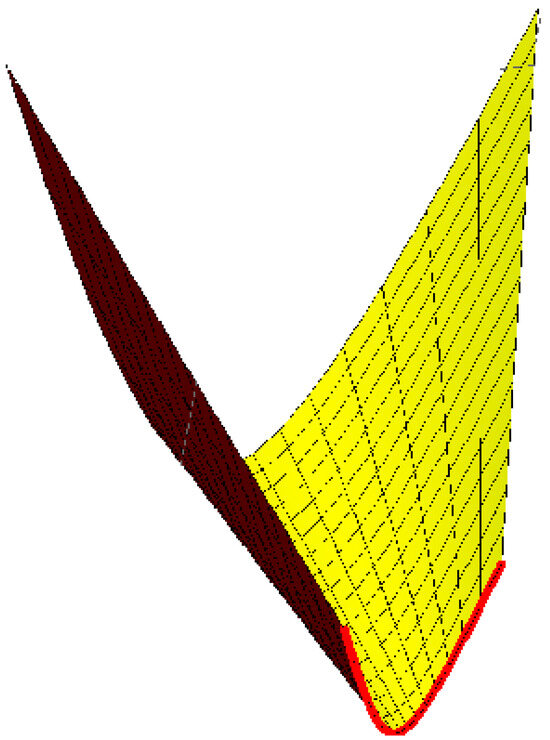
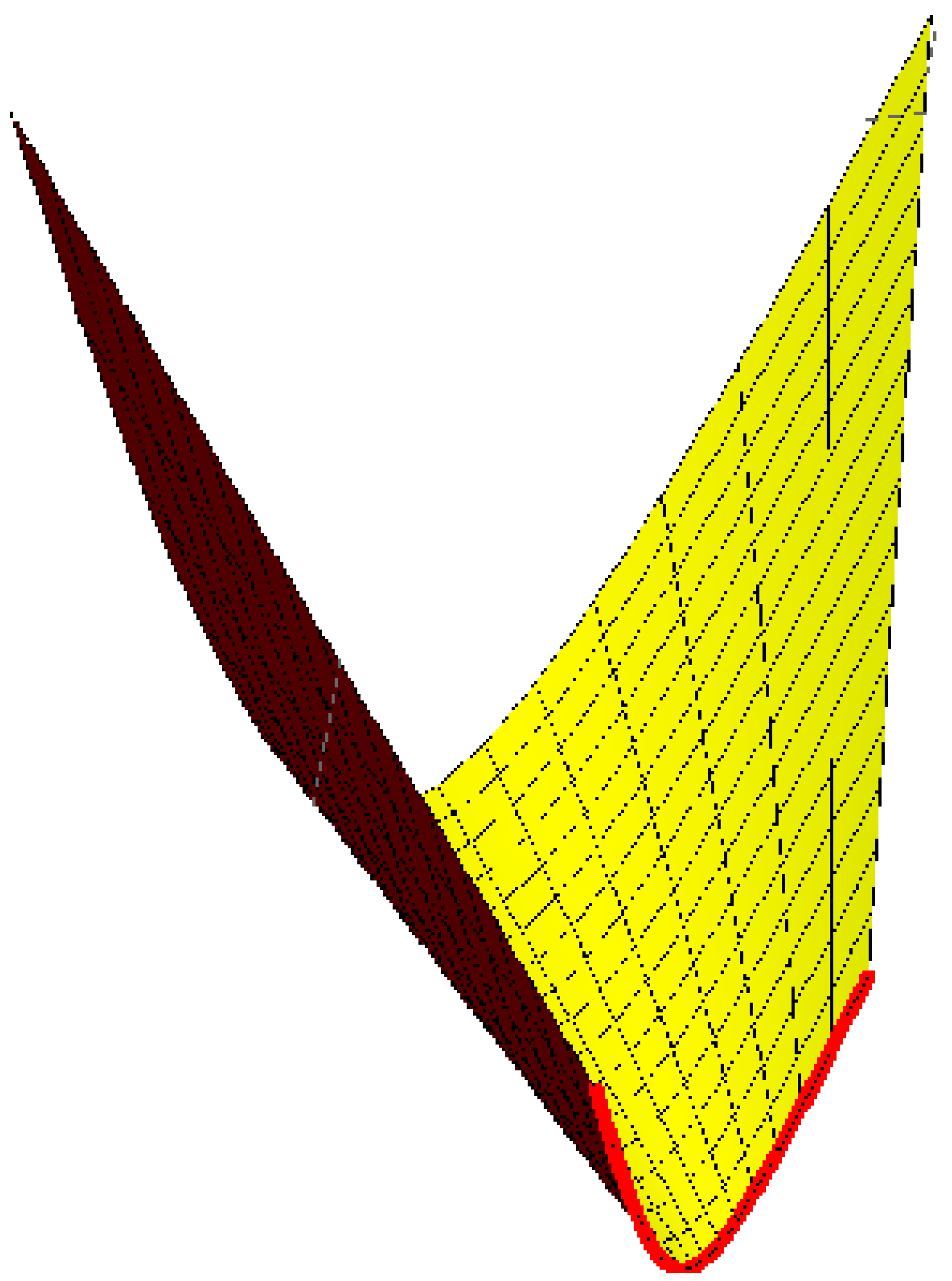
Figure 4.
The timelike developable ruled surface together with the image of its singular locus in Example 1.
Since the singular parameter of Σ is , the image of its singular locus is
where . Similarly, the singular parameter of is ; hence,
where .
For Σ , we have
Therefore, at every singular point satisfying
the frontality condition is satisfied and . Hence, the map germ of Σ is -equivalent to a cuspidal edge. In particular, these conditions hold on
For ,
Thus, at every singular point satisfying
the frontality condition is satisfied and . Hence, the map germ of is -equivalent to a cuspidal edge.
At the points
we have
However,
Therefore, the frontality condition for is not satisfied at these points. Consequently, these singularities are not classified as swallowtails by Theorem 1. This shows the necessity of checking the complementary Bishop curvature in addition to the derivative conditions on .
Example 2.
We next provide a local example for which the frontality and swallowtail conditions are simultaneously satisfied.
Let the Bishop curvature functions be prescribed near by
Let be the Lorentzian Bishop frame determined by
with a fixed orthonormal initial frame, and define γ locally by
Then, γ is a unit-speed timelike curve.
At ,
hence,
Moreover,
Therefore, the singular point of
corresponding to
satisfies all the hypotheses of Theorem 1. Consequently, the map germ of Σ at is -equivalent to a swallowtail.
In particular, the complementary Bishop curvature does not vanish at the singular point. Thus, the Legendrian lift is immersive there and the swallowtail is a genuine front singularity.
Example 3.
Consider the timelike curve
Since
the curve is unit-speed timelike. Its Serret–Frenet frame is
with
It follows that is constant and
The corresponding ruled surface is
If , then
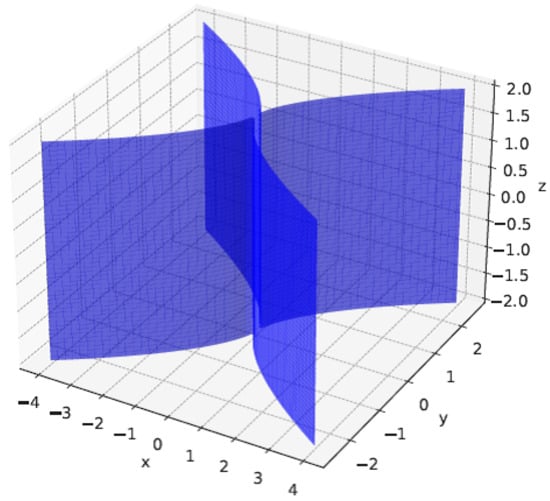
The ruling direction is constant; therefore, Σ is a timelike cylindrical surface, see Figure 5.
Figure 5.
Timelike cylindrical surface corresponding to in Example 3.
If , then
Figure 6.
Timelike conical surface corresponding to in Example 3.
Using
we obtain the constant vertex
This explicitly confirms the conical configuration.
Example 4.
For the curve in Example 1, the Bishop rotation angle is
Consequently,
and
On every subinterval on which
and
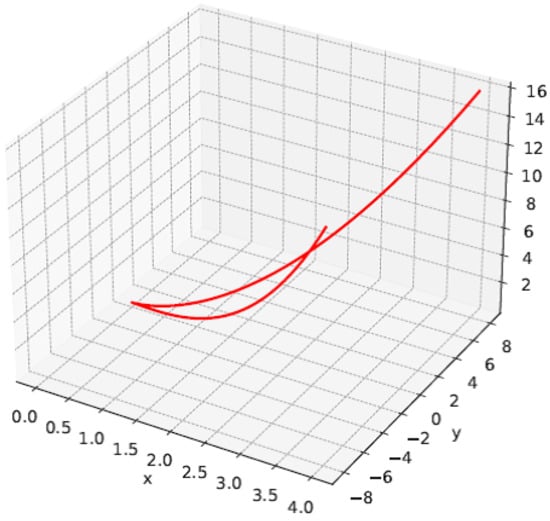
both and are nonzero. Therefore, the corresponding surface is locally a timelike tangential developable with regular striction curve
Its parameterization is
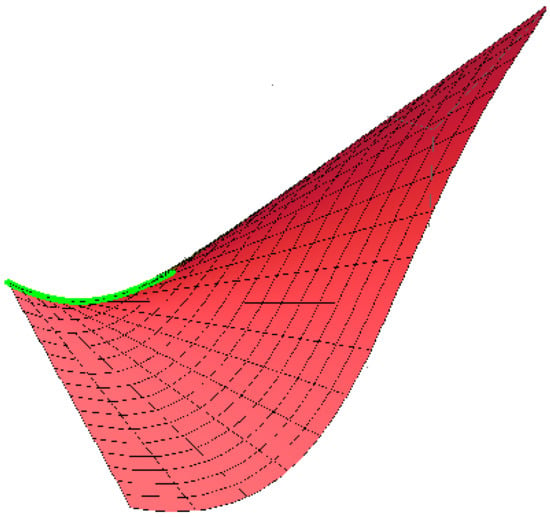
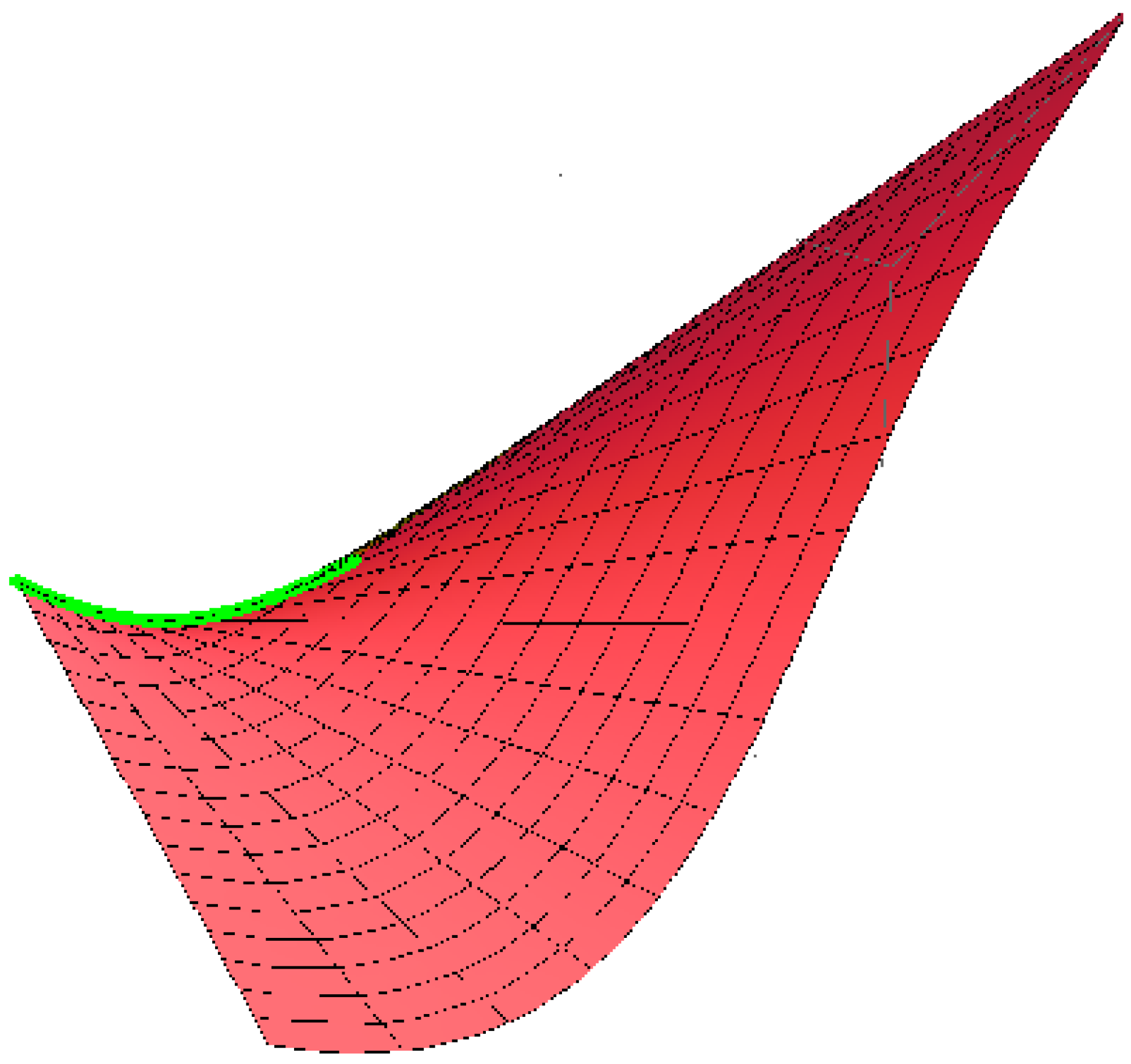
Figure 7.
Timelike tangential developable corresponding to in Example 4.
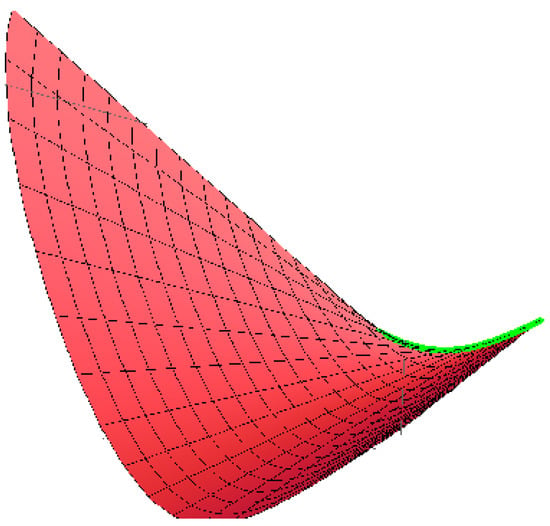
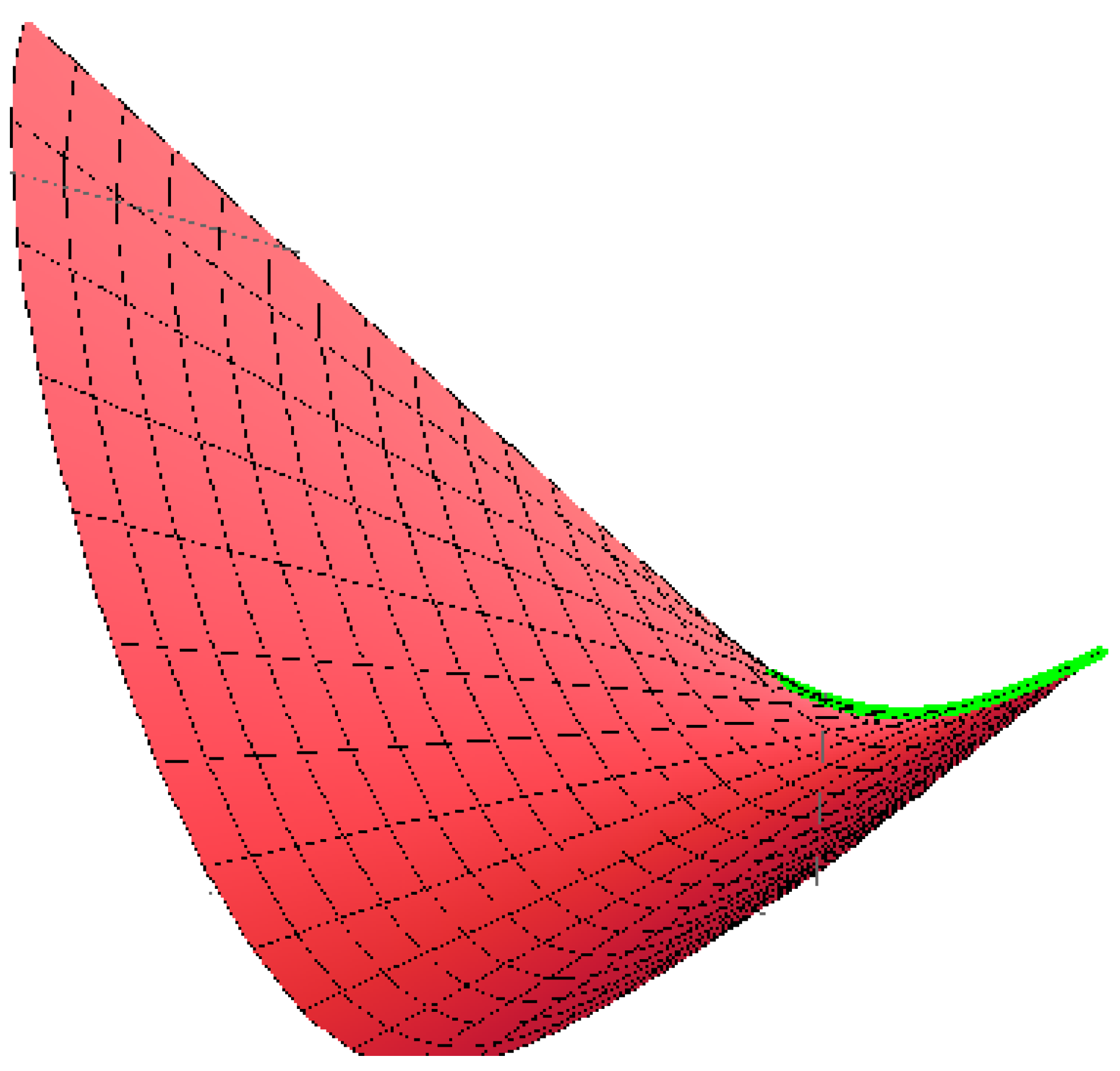
Figure 8.
Timelike tangential developable corresponding to in Example 4.
6. Conclusions
This study has investigated timelike developable ruled surfaces generated by the Bishop frame along unit-speed timelike curves in Minkowski 3-space . The Bishop frame formulation allows the frame and the associated ruled surface construction to remain well defined at curvature-zero points, where the Serret–Frenet frame may fail to be defined. However, the cuspidal edge and swallowtail classification considered here requires the additional nondegeneracy condition
Thus, curvature-zero points are included in the Bishop frame construction, but are not covered by the standard front singularity classification developed in this work.
The singular sets of the two Bishop developable surfaces
and
were explicitly determined. For , the singular set of is given by
whereas for the singular set of is
Under the frontality condition , nonvanishing of the first derivative of the relevant Bishop curvature characterizes a cuspidal edge, whereas its vanishing together with nonvanishing of the second derivative characterizes a swallowtail.
The -height functions provide an equivalent singularity-theoretic description through their orders of vanishing and the associated discriminant sets. In particular, zeros of order three and four at the corresponding singular points are associated with cuspidal edge and swallowtail singularities, respectively, under the required frontality and versality conditions. Under the corresponding nondegeneracy hypotheses, the discriminant sets of the height-function families coincide locally with the images of the associated Bishop developable surfaces.
A further contribution of the present work is the analysis of the constant normal offset
Its singular locus is determined by
showing that both Bishop curvature functions contribute simultaneously to the singular geometry. The corresponding cuspidal edge and swallowtail criteria are obtained in terms of the first and second derivatives of this singular-locus function.
For completeness, the cylindrical, conical, and tangential configurations are also expressed in terms of the Bishop curvature . On an interval, is cylindrical if and only if
Where the Serret–Frenet frame is defined, this is equivalent to . The surface is conical if and only if is a nonzero constant. Moreover, at a point where , the surface is locally tangential with a regular striction curve if and only if
The examples illustrate the singularity criteria together with cylindrical, conical, and tangential configurations. In particular, they show that the derivative conditions alone are insufficient when the complementary Bishop curvature vanishes, and they provide a genuine swallowtail example for which the frontality condition is satisfied.
The cuspidal edge and swallowtail classification for the original Bishop developables, the Bishop height function method, and the special cylindrical, conical, and tangential cases are closely related to the results of [23,24]. The contribution of the present treatment is not a new classification of these previously studied surfaces; its principal extension is a singularity analysis of the constant normal-offset family, the singular locus of which depends simultaneously on and . In addition, the front formulation clarifies the geometric role of the complementary Bishop curvature as the condition ensuring immersivity of the Legendrian lift.
Funding
This research was funded by the Scientific Council of Umm Al-Qura University project (ID 2502006094).
Data Availability Statement
The original contributions presented in this study are included in the article. Further inquiries can be directed to the author.
Acknowledgments
We sincerely thank the referee for the careful reading of our manuscript and for the valuable and constructive comments. The referee’s suggestions have helped us improve the mathematical accuracy, clarity, and presentation of the manuscript. The author would like to thank the Scientific Council of Umm Al-Qura University for the financial support for this research project as an academic sabbatical leave project (ID 2502006094 in 16 July 2025). She also extends her sincere thanks to Umm Al-Qura University.
Conflicts of Interest
The author declares no conflicts of interest.
References
- Li, C.-Y.; Wang, R.-H.; Zhu, C.-G. Design and G1 connection of developable surfaces through Bézier geodesics. Appl. Math. Comput. 2011, 218, 3199–3208. [Google Scholar] [CrossRef] [Scilit]
- Li, C.-Y.; Wang, R.-H.; Zhu, C.-G. Parametric representation of a surface pencil with a common line of curvature. Comput. Aided Des. 2011, 43, 1110–1117. [Google Scholar] [CrossRef] [Scilit]
- Li, C.-Y.; Wang, R.-H.; Zhu, C.-G. An approach for designing a developable surface through a given line of curvature. Comput. Aided Des. 2013, 45, 621–627. [Google Scholar] [CrossRef] [Scilit]
- Pottmann, H.; Farin, G. Developable rational Bézier and B-spline surfaces. Comput. Aided Geom. Des. 1995, 12, 513–531. [Google Scholar] [CrossRef] [Scilit]
- Pottmann, H.; Wallner, J. Approximation algorithms for developable surfaces. Comput. Aided Geom. Des. 1999, 16, 539–556. [Google Scholar] [CrossRef] [Scilit]
- Zhao, H.-Y.; Wang, G.-J. A new method for designing a developable surface utilizing the surface pencil through a given curve. Prog. Nat. Sci. 2008, 18, 105–110. [Google Scholar] [CrossRef] [Scilit]
- Abdel-Baky, R.A. Developable surfaces through sweeping surfaces. Bull. Iran. Math. Soc. 2019, 45, 951–963. [Google Scholar] [CrossRef] [Scilit]
- Izumiya, S.; Katsumi, H.; Yamasaki, T. The rectifying developable and the spherical Darboux image of a space curve. Banach Cent. Publ. 1999, 50, 137–149. [Google Scholar] [CrossRef] [Scilit]
- Ishikawa, G. Topological classification of the tangent developable of space curves. J. Lond. Math. Soc. 2000, 62, 583–598. [Google Scholar] [CrossRef] [Scilit]
- Zhao, Q.; Pei, D.; Wang, Y. Singularities for one-parameter developable surfaces of curves. Symmetry 2019, 11, 108. [Google Scholar] [CrossRef] [Scilit]
- Izumiya, S.; Takeuchi, N. Singularities of ruled surfaces in R3. Math. Proc. Camb. Philos. Soc. 2001, 130, 1–11. [Google Scholar] [CrossRef] [Scilit]
- Hananoi, S.; Izumiya, S. Normal developable surfaces of surfaces along curves. Proc. R. Soc. Edinb. Sect. A Math. 2017, 147, 177–203. [Google Scholar] [CrossRef] [Scilit]
- Cleave, J.P. The form of the tangent-developable at points of zero torsion on space curves. Math. Proc. Camb. Philos. Soc. 1980, 88, 403–407. [Google Scholar] [CrossRef] [Scilit]
- Bishop, R.L. There is more than one way to frame a curve. Am. Math. Mon. 1975, 82, 246–251. [Google Scholar] [CrossRef] [Scilit]
- Bükcü, B.; Karacan, M.K. On the slant helices according to Bishop frame of the timelike curve in Lorentzian space. Tamkang J. Math. 2008, 39, 255–262. [Google Scholar] [CrossRef] [Scilit]
- Liu, H.; Pei, D. Legendrian dualities between spherical indicatrixes of curves and surfaces according to Bishop frame. J. Nonlinear Sci. Appl. 2016, 9, 2875–2887. [Google Scholar] [CrossRef] [Scilit][Green Version]
- Keskin, O.; Yayli, Y. An application of N-Bishop frame to spherical images for direction curves. Int. J. Geom. Methods Mod. Phys. 2017, 14, 1750162. [Google Scholar] [CrossRef] [Scilit]
- Bin-Asfour, M.; Alhamzi, G.; Solouma, E.; Saber, S. A unified rotation-minimizing Darboux framework for curves and relativistic ruled surfaces in Minkowski three-space. Axioms 2026, 15, 207. [Google Scholar] [CrossRef] [Scilit]
- Büyükkütük, S.; Kişi, İ.; Öztürk, G.; Kişi, E. On the focal geometry of translation surfaces: Flatness, minimality, and classification results. Axioms 2025, 14, 919. [Google Scholar] [CrossRef] [Scilit]
- Li, Y.; Alkan, A.; Önder, M.; Xie, Y. Slant helices and Darboux helices in Myller configuration. Axioms 2025, 14, 353. [Google Scholar] [CrossRef] [Scilit]
- Grbović, M.; Nešović, E. On the Bishop frames of pseudo null and null Cartan curves in Minkowski 3-space. J. Math. Anal. Appl. 2018, 461, 219–233. [Google Scholar] [CrossRef] [Scilit]
- Mofarreh, F.; Abdel-Baky, R.A.; Alluhaibi, N. Spacelike sweeping surfaces and singularities in Minkowski 3-space. Math. Probl. Eng. 2021, 2021, 5130941. [Google Scholar] [CrossRef] [Scilit]
- Li, Y.; Chen, Z.; Nazra, S.H.; Abdel-Baky, R.A. Singularities for timelike developable surfaces in Minkowski 3-space. Symmetry 2023, 15, 277. [Google Scholar] [CrossRef] [Scilit]
- Nazra, S.H.; Abdel-Baky, R.A. Singularities of non-lightlike developable surfaces in Minkowski 3-space. Mediterr. J. Math. 2023, 20, 45. [Google Scholar] [CrossRef] [Scilit]
- O’Neill, B. Semi-Riemannian Geometry with Applications to Relativity; Academic Press: New York, NY, USA, 1983. [Google Scholar]
- Saji, K.; Umehara, M.; Yamada, K. The geometry of fronts. Ann. Math. 2009, 169, 491–529. [Google Scholar] [CrossRef] [Scilit]
Disclaimer/Publisher’s Note: The statements, opinions and data contained in all publications are solely those of the individual author(s) and contributor(s) and not of MDPI and/or the editor(s). MDPI and/or the editor(s) disclaim responsibility for any injury to people or property resulting from any ideas, methods, instructions or products referred to in the content. |
© 2026 by the author. Licensee MDPI, Basel, Switzerland. This article is an open access article distributed under the terms and conditions of the Creative Commons Attribution (CC BY) license.