


Abstract
Industrial operations increasingly face high-stakes decisions that involve people, data streams, simulations, and control systems. Urgent sessions often require external expertise, retrieval of documents and live telemetry, running what-if simulations, and verifying safety constraints. These scenarios highlight the need for secure interoperability, explainable decision support, and human-in-the-loop control. This paper presents a proposal of a technology-agnostic reference architecture that builds on Industry 4.0 frameworks by incorporating the human-centric, resilient, and sustainable principles of Industry 5.0. Its intelligent layer enables the new approach to human involvement in the process, facilitating meaningful human–machine collaboration. The proposed research provides a practical and conceptual framework for systems engineers, industrial software architects, and operations managers seeking to transition legacy operational plants into human-aligned ecosystems. Its feasibility is evaluated through a simulation-based underground mining testbed, where heterogeneous data sources and communication protocols are integrated into a common operational environment. The proof of concept shows how telemetry, data storage, machine learning models, and operator feedback can be combined to support auditable, explainable, and human-contestable industrial decisions, demonstrating the classification accuracy, remaining useful life forecasting capabilities, and enhanced recommendation precision enabled by iterative operator feedback loops.
1. Introduction
Since the dawn of humanity, human interaction depended on direct communication and personal judgment for decision-making. Over time, humans have evolved and entered an era in which technology is a fundamental necessity; today, they oversee countless automated processes, minimizing the need for the direct communication that was once indispensable. In particular, in the industry domain, gradually humans turned into passive entities who primarily engage through technology-oriented interactions, ending up being victims of an extensive digitization of industrial sectors. Due to increased automation and artificial decision-making capabilities, their relevance has diminished [1].
A new vision of industry, called Industry 5.0, represents another stage in industrial paradigms, emphasizing not only technology automation/efficiency but also human relevance in all processes [2,3]. The inherent socio-technical transition is heavily based on understanding how human operators perceive and adopt intelligent systems. Recent research in traditional engineering sectors has begun to analyze these behavioral drivers; for example, Cheng et al. [4] utilized a mixed-methods approach to explore the key determinants that shape users’ behavioral intentions when integrating generative artificial intelligence tools into complex operational workflows. Understanding these adoption dynamics is equally critical in high-risk environments such as the mining industry, where advanced digital solutions are difficult to implement.
This human-centric approach explicitly focuses on the human–machine synergy, aiming to achieve sustainability, resilience, and the reintegration of humans as central actors [5] in industrial systems rather than passive or marginal contributors. It advocates for improved human-to-human collaboration supported by the technologies the industry chooses to adopt.
An example of this is the mining industry since it offers a pertinent image of the delicate balance needed between traditional operational methodologies and rapid technological innovation [6]. This industry has evolved into a complex ecosystem characterized by high-risk operations and critical dependence on human expertise. The environment is so demanding that advanced technologies have been introduced to reshape processes. The benefits of this include enabling adaptive workflows, proactive safety measures, and optimized decision-making strategies. This reshape includes Digital Twin systems [7] for real-time operational mirroring, the Industrial Internet of Things (IIoT) for comprehensive data acquisition, edge AI for instantaneous on-site analytics, and artificial intelligence (AI) for predictive modeling/decision support.
A review of the literature reveals significant progress in the adoption of advanced digital solutions in most industries. This includes the generation of large volumes of data through various systems and sensors, as well as the use of intelligent data analytics, remote monitoring, real-time simulation, and predictive maintenance, all of which are facilitated by artificial intelligence [8], resulting in significant improvements in operational efficiency and risk management.
This research seeks to propose a comprehensive reference architecture aligned with Industry 5.0 vision, focused on effective human-centered design, agnostic integration of systems, and sustainability that industries can implement, using the mining industry as a case study. In particular, this study investigates new applications of Digital Twins, IIoT, and AI-driven solutions aimed at achieving effective human-to-human co-decision [9] and human-to-machine collaboration, realizing the objectives of this new concept.
To guide this study, the following sub-research questions (SRQs) are addressed:
- SRQ1: How can Industry 4.0 reference architectures be extended to incorporate Industry 5.0 principles, moving beyond basic machine connectivity to actively support effective human-to-human collaboration?
- SRQ2: In what ways can a multi-layered intelligent framework ensure the effectiveness and auditability of decisions made jointly by distributed human expert teams?
In addressing these questions, the main contributions of this paper are as follow:
- The conceptual design of a technology-agnostic reference architecture focused on enabling effective human-to-human collaborative decision-making within industrial workflows.
- A simulation-based validation within an underground mining scenario, showing how collaborative feedback loops, predictive maintenance telemetry, and expert insights are unified to support effective operations reconfiguration.
The paper is structured in the following way: Background ideas and fundamentals comprise Section 2 with details on reference architectures, terminology, and relevant concepts to IIoT, AI, and Industry 5.0 effectiveness criteria. Follow the specification of the proposed architecture and innovative features in Section 3. The technological development of inherent solutions is described in Section 4. Section 5 describes the testbed scenario for the validation and presentation of the proposed architecture. Finally, Section 6 concludes the paper with an outline of significant findings along with proposed directions for future study.
The authors of this paper consider the terms I4.0 and I5.0 as the terms that denote manufacturing models [10] but not as denominators of industrial revolutions or industrial paradigms. In fact, in the literature, there are both uses of these terms as denominations of industrial revolutions but also as denominations of industrial (manufacturing) models [11]. It means that both terms are of twofold meaning, i.e., both terms are polysemic. The authors refer to I5.0 especially because this model is propagated by the European Commission (EC) [3], whose goal is primarily in the social dimension, e.g., to keep employment in EU. On the other hand, some of the authors of this article defended the role of humans but in the concept of I4.0; see, e.g., [9].
2. Foundations and Related Work
This section highlights and presents the most relevant concepts related to the synergies between Industry 5.0 and artificial intelligence, along with the expected transformations in both the dynamics of information system architectures and human-centered services.
2.1. Core Requirements for Industrial Realization of Industry 5.0
Truly achieving a state in which an industry fully realizes Industry 5.0 is difficult, as enterprise-scale deployment requires the enforcement of certain domains, such as data communication, effectiveness, and safety design. If industry does not respect any of these, it is hard to reach a stage where true human-centricity, sustainability, and resilience are achieved.
2.1.1. Data Communication
In industrial environments, different systems and devices must exchange information using communication patterns that balance immediacy, efficiency, and reliability [12]. In practice, multi-vendor devices, services, and even human operators must coexist within a communication architecture capable of handling synchronous, asynchronous, real-time, and event-driven exchanges [13]. Following established integration models such as those in [13] and as observed in real industrial networks [14], the main categories can be described as follows:
Synchronous: From a system integration perspective, synchronous communication provides an immediate response and is best suited for scenarios that require real-time information and quick execution, typically in milliseconds or seconds. For example, when a customer places an order and expects instant confirmation, the system must check and respond without delay [13]. In industrial networks, synchronous communication often refers to clock-driven data exchange, where connected devices align to a common timing reference. Information is transferred in timed cycles with deterministic characteristics, low latency, and guaranteed coordination—essential for reliable real-time control [13].
Asynchronous: In general integration terms, asynchronous communication does not provide an immediate response. Instead, requests are queued and processed as resources allow. This “fire and forget” model is ideal for batch operations, longer-running tasks, or cases where efficiency is prioritized over immediacy (e.g., synchronizing inventory records overnight) [13,15]. From an industrial perspective, asynchronous communication implies message exchange without a common clock or strict timing coordination. Devices send information independently, often event- or request-based. Although not suitable for hard real-time tasks, it is highly efficient for non-time-critical data transfers [14].
Hard Real-time: Hard real-time communication goes beyond synchronous integration by requiring strict adherence to deadlines. Any violation of timing constraints may result in system failure, making deterministic and bounded low-latency message delivery essential [14,16]. In industrial applications, hard real-time networks guaranty predictable behavior, with protocols ensuring that deadlines are never missed. Such systems are fundamental in safety-critical operations, where timing guaranties directly impact reliability and safety [14].
Event-driven: At the integration level, event-driven communication occurs when messages are triggered only by specific events (e.g., sensor thresholds, system errors). Consumers subscribe to events without being tightly coupled to the publisher, improving scalability and reducing unnecessary traffic [15,17,18]. In industrial environments, event-driven communication transmits information only when relevant changes occur, making it bandwidth-efficient compared to cyclic, time-driven exchanges. This approach reduces overhead and supports loosely coupled system design [15,16].
All these characteristics are present in event-driven publish–subscribe approaches that are increasingly prevalent [15,16,17,18,19], as they enable low latency, efficient edge processing, and clean microservices decoupling. This trend aligns with Industry 4.0 objectives, where scalability, interoperability, and responsiveness are key drivers [14].
2.1.2. Effectiveness
The authors see effectiveness in information systems as the capacity of a system to enable genuine human-centric collaboration. Unlike traditional systems that focus solely on efficiency or technical integration, the effectiveness lies in facilitating active human-to-human collaboration, allowing them to co-create, co-design, and co-decide. The “pragmatics renderer” of [9], a primary innovation within their architecture, achieves this by guaranteeing interoperability among different components by inserting tools that allow the user requirements and tendencies to be achieved.
An architecture that advocates pragmatics-oriented interoperability is needed to allow different stakeholders to participate in co-creative processes. This can be achieved by using real-time multimodal communication tools, such as video conferencing and chat, and shared spaces that reflect the actual behavior of the user, rather than just technological requirements. The architecture should also feature service brokering and dynamic reconfiguration to increase responsiveness and flexibility in complex, distributed settings. Similar industry-oriented experiences in information integration and data migration have shown the relevance of human expert intervention in automated mapping processes, especially when conflicts or scenarios arise that are not fully covered by automated procedures [20]. By accommodating these social, communicative and expert-driven aspects, the system moves beyond a focus on transactional efficiency to enable adaptive and sustainable collaborative processes [21] in cloud and ubiquitous manufacturing systems.
2.1.3. Security and Human Safety
As humans play a key role in intelligent and automated systems, the security of these systems and human safety become equal pillars that reinforce the trust, integrity, and continuity of Industry 5.0 operations. The increased integration of cyber–physical systems (CPSs), edge AI, and the IIoT intensifies the interdependence between cybersecurity and physical safety. Therefore, it is important to approach these topics not as distinct subjects, but as interdependent design requirements.
In an industrial context, cybersecurity refers to the protection of industrial automation and control systems (IACSs) against threats that could cause disruption to operations, compromise safety, or result in physical damage. Unlike traditional IT environments, industrial cybersecurity must address digital risks, such as data breaches and malware, as well as operational consequences, where an attack could directly impact production processes or critical safety equipment [22].
From a cybersecurity perspective, the attack surface of industrial systems is growing. As more systems become networked, they become more vulnerable to malware, supply chain attacks, and malicious manipulation of sensor and actuator information. Standards such as the IEC 62443 series [14] offer guidelines for protecting industrial automation and control systems (IACSs), based on defense-in-depth principles, network segmentation, and role-based access control.
At the same time, the safety of people working in these environments is managed by occupational health and safety standards such as ISO 45001 [23]. An emphasis is placed on identifying risks ahead of time and taking measures to mitigate them. Industry 5.0, on the other hand, is developing a new paradigm based on the coexistence of humans and intelligent machines. To enhance this coexistence, new safety models are required. Such collaborative robots (cobots) [24], self-driving vehicles, and Digital Twins that aim to mimic the true behavior of the system require the implementation of the principles of safety-by-design, integrating risk-aware AI systems that respond to human presence and context. Several initiatives signal this transition towards safety and the socio-technical transition. For example, the European Commission (2021) has placed resilience and human-centricity at the core of Industry 5.0 [3], focusing on the psychological and emotional well-being of human agents operating within or between intelligent systems, rather than on the systems themselves. This creates a demand for user-informed alerting systems and eXplainable AI (XAI) to support unequivocal decision-making. It also requires human-in-the-loop features to allow intervention or overriding in the event of unexpected behavior. Moreover, Zero Trust Architectures (ZTAs) [25] and secure-by-design methodologies have become dominant paradigms. In a ZTA, no service, user, or device is trusted by default, even within the internal system perimeter, significantly restricting internal threat vectors allowing fine-grained access control. In addition, edge computing-based real-time safety monitoring allows hazardous states to be detected and responded to immediately. Meanwhile, AI/ML-driven predictive safety analytics can predict conditions that are likely to contribute to failures or injuries. In order for the human-centric goals of Industry 5.0 to be fully realized, safety and security must not only protect information and assets but also uphold the values of human dignity, autonomy, and cooperation. Future-proofed industrial systems must co-create cybersecurity policies, ergonomic safety measures, and human-adaptive controls to develop an ecosystem in which humans and machines can coexist based on mutual trust [26].
2.2. Reference Architectures and Middleware
Industry 4.0 produced a handful of influential blueprints that organize the technical, organizational, and business layers of a modern production system. They are invaluable for interoperability, but were drafted before Industry 5.0 pillars became a design driver.
The most prominent reference architectures in this domain include the following:
- 1.
- Reference Architecture Model Industry 4.0 (RAMI 4.0): Defines a three-axis “cube” from Platform Industry 4.0, applied to every asset across layers (business → physical), product life-cycles, and the automation hierarchy. It is effective for identifying where a function or standard belongs, but it does not capture how operators or engineers interact beyond interpreting a human–machine interface screen; there is no notion of explainability, cognitive workload, or collaborative decision-making [27].
- 2.
- Industrial Internet Reference Architecture (IIRA): Provides four viewpoints—Business, Usage, Functional, and Implementation—along with detailed guidance on trustworthiness. People are mainly represented as “actors”, triggering use-cases, and the architecture lacks mechanisms for feedback loops that would allow workers to interrogate AI recommendations, override them, or co-design workflows [28].
- 3.
- Big Data Value Association Reference Architecture (BDVA Reference Architecture): Covers the entire data value chain, addressing privacy, governance, and standardization. It is valuable for selecting which analytics components to deploy, but the end-user remains implicit, treated as a consumer of the dashboard rather than a collaborator who shapes what the dashboard displays or how algorithms behave [29].
- 4.
- IBM Industry 4.0 Reference Architecture: Structure the manufacturing stack around the edge, plant, and enterprise functions, combining protocol connectivity and local analytics at the edge with plant- and enterprise-level services in a hybrid-cloud platform. Studies note that it uses service-based integration to connect external applications more easily, which makes it useful for interoperability in heterogeneous industrial environments; however, its emphasis remains on connectivity, analytics, and orchestration rather than explicit support for explainability, worker feedback, or participatory decision-making [30].
- 5.
- Computer-Integrated Manufacturing Open System Architecture (CIMOSA): As a precursor of the Computer-Integrated Manufacturing era, CIMOSA models the life-cycle of the integrated enterprise by separating functional, information, resource and organizational concerns. It is valuable for enterprise integration and process modeling, but it remains oriented toward structured coordination rather than toward native services based on the cloud, AI-enabled adaptation, or human-centric collaboration as explicit design principles [30,31].
These and other models become actionable through middleware (a mechanism that allows heterogeneous system integration), which abstracts heterogeneous devices, enforces security, and offers higher-level services:
Eclipse BaSyx: Implements the Asset Administration Shell and aligns neatly with the RAMI 4.0 layers. Provides microservices for asset registration, sub-model storage, and OPC UA/REST gateways, serving as a practical “RAMI starter kit” [32].
FIWARE: Offers a catalog of open-source generic enablers (e.g., Orion Context Broker, IoT Agents) that realize the context management backbone assumed by both IIRA and BDVA. Being vendor-neutral, it provides a strong foundation for layering people-focused interfaces on top [33].
Eclipse Arrowhead: Defines a local-cloud, service-oriented architecture tailored for low-latency industrial control. Among the middleware examples listed here, it aligns most naturally with the IIRA, especially at the implementation level, because it operationalizes service discovery, orchestration, authorization, and secure system-of-systems interoperability. Recent work on the Arrowhead AI Toolbox extends this foundation to AI-enabled industrial services and safety-oriented use cases [34,35,36].
Eclipse Mosquitto: Implements a lightweight MQTT broker and client toolkit for publish-subscribe messaging. It is better understood as communication middleware that can sit beneath architectures such as the BDVA Reference Architecture to support device and edge data ingestion, rather than as a full reference architecture in its own right. Unlike DDS, Kafka, or Flink, Mosquitto does not cover real-time data-distribution or stream-processing stacks beyond MQTT messaging itself [15,29,37].
Even accepting that by combining these architectures with a middleware platform, a real-world factory can align itself with Industry 4.0 proposals, there will still be a lack of user context models, explainable interfaces, and collaboration security controls to fulfill the effective human-centered promise required in Industry 5.0.
Table 1 shows the existing Industry 4.0 reference architectures that support technical integration, interoperability, cloud services, data management, and to some extent, human–machine integration. However, dynamic reconfiguration, explainable AI, and effective human-to-human collaboration are not considered together as core architectural requirements.
Table 1.
Comparison of reference architectures based on dynamic reconfiguration, human-centricity, and effective human-to-human collaboration.
This gap motivates the research question of this paper: How can a technology-agnostic reference architecture combine an interoperability middleware and an intelligent layer to support dynamic reconfiguration, explainable AI, and effectiveness on human-centered decision-making in Industry 5.0 environments?
2.3. Enabling Technologies
Recent advances in computation, data management, and cognitive systems provide the technical substrate required to operationalize an Industry 5.0 vision that is at once automated, adaptive, and explicitly human-centered. Three technology clusters are particularly salient:
- 1.
- Artificial intelligence and machine learning systems: These systems enable adaptive production scheduling, predictive maintenance, and high-throughput visual inspection. Current practice associates scale-intensive modeling developed within TensorFlow or PyTorch (version 2.12.1.) with low-latency deployment toolchains (e.g., NVIDIA TensorRT [38,39] or Intel OpenVINO) that allow inference on the edge of the network where sub-second response is required. Where legal or commercial limitations preclude the pooling of raw data, federated learning libraries such as Flower or TensorFlow Federated allow the training of multiple sites with preservation of data sovereignty [40,41].
- 2.
- Streaming analytics and the lake-house infrastructure: This infrastructure (data lake and data warehouse combined) converts the torrents of telemetry produced by sensors, video camera feeds, and enterprise-resource-planning (ERP) systems into actionable information. Event brokers that enforce a publish–subscribe model (such as Apache Kafka, MQTT 5.0) [15,17,18,19] feed distributed stream processors such as Apache Flink or Spark Structured Streaming, which calculate key performance indicators and anomaly scores near-real-time. The resulting state is written in the lakes, thus unifying operational and analytical loads and providing a single, uniform truth for downstream decision support services.
- 3.
- Cognitive services and multi-agent systems: Constitute the interface through which human expertise re-enters the loop. Large language model APIs (such as the Azure OpenAI Service, Amazon Bedrock) [42,43] provide conversational access to live process data, while edge-deployed speech and vision-recognition services detect gestures, alarms, and incipient safety breaches. Multi-agent orchestration frameworks—illustratively Eclipse Arrowhead, Java Agent DEvelopment (JADE), or Smart Python Agent Development Environment (SPADE)—permit fleets of robots, software bots, and decision models to negotiate task allocations in real time, exposing explainable recommendations that operators can query, refine, or override [44,45].
When integrated over the event-driven backbone discussed in the preceding subsection, these technology pillars instantiate a closed, socio-technical feedback loop with high-frequency data streams training machine learning models, model inferences propagating through cognitive agents, and human responses captured as events that refine learning cycles. The emergent system is automated, self-adapting, transparent, and collaborative. This enables it to achieve the goals of Industry 5.0 in heterogeneous industrial domains.
3. Proposed Architecture
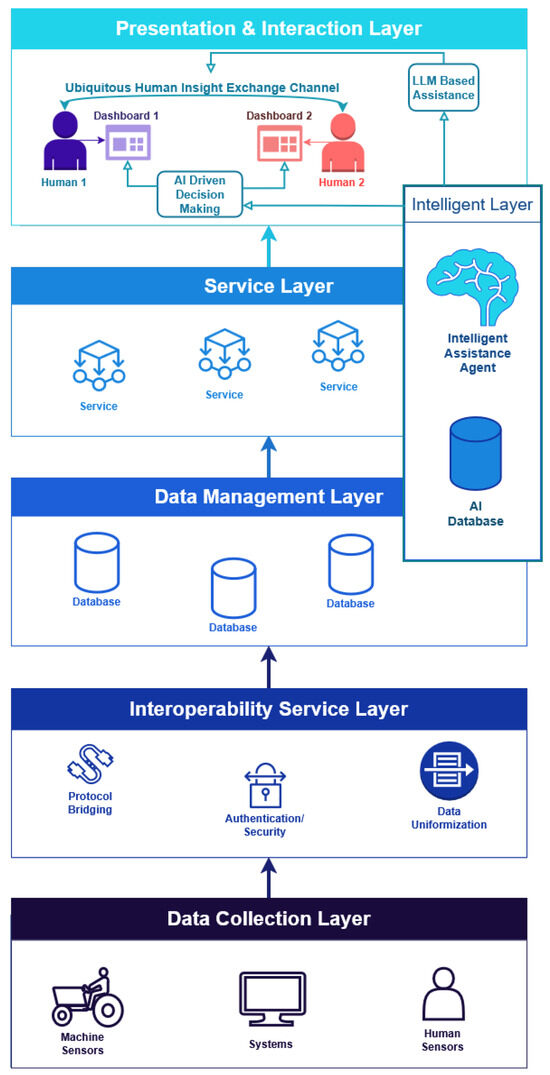
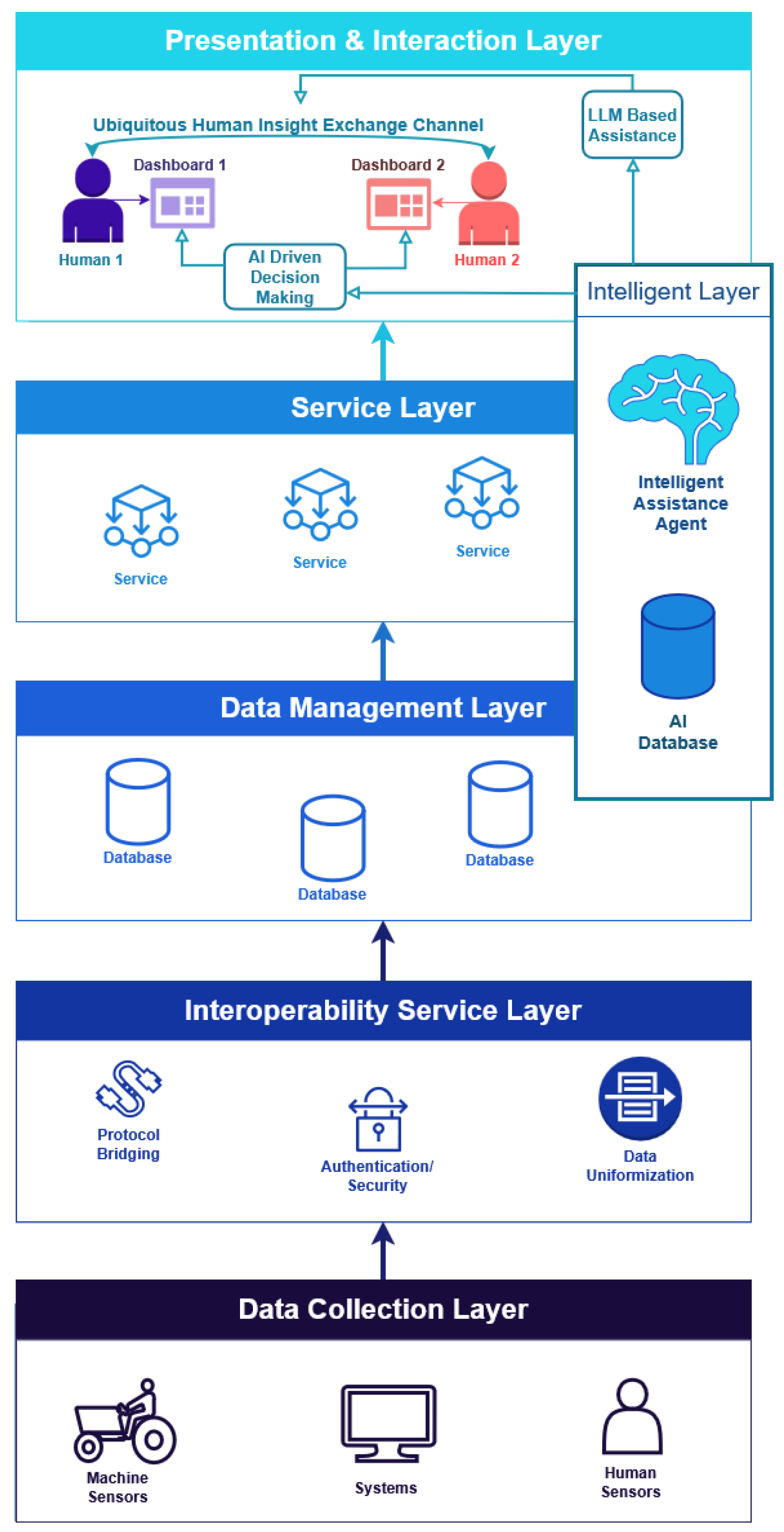
The reference architecture that we propose, the I5.0 human-centered architecture, is structured in layers to achieve effectiveness, scalability, and security (Figure 1). It is divided into six functional layers, two of them consisting of an interoperability middleware and an intelligent layer designed to facilitate human–machine and human–human collaboration. The architecture is conceived for deployment across heterogeneous industrial domains in accordance with Industry 5.0 principles.
Figure 1.
I5.0 proposed effective human-centered architecture.
Architecture design takes its cue from the key Industry 4.0 paradigms presented in Section 2, building on their technological advantages through the addition of a human-centric focus, assuring that humans remain active decision-makers and co-creators instead of mere operators.
3.1. Layered Structure
The layers are described as follows:
- (i)
- Data gathering layer: This base layer consists of the industry’s sensors, machines, and cyber–physical systems (CPSs) that collect raw data on an operation. This level consists of industrial IoT devices, production equipment, wearables, and monitoring equipment. Its key needs are low latency, reliability, and resistance to environmental factors or variability in operation.
- (ii)
- Interoperability layer: This is the middleware that enables heterogeneous devices, services, and vendors to communicate freely. It conceals variations in protocols (e.g., event-driven communication, asynchronous communication, synchronous communication) and standardizes data formats into a unified communication spine. This is where the concepts of security-by-design come into play, e.g., encryption, authentication, and ZTA practices.
- (iii)
- Data management layer: Responsible for storing, organizing, and governing data streams passed through the interoperability layer. This consists of time-series databases, data lakes, and metadata catalogs. Good data-quality enforcement and governance mechanisms ensure that analytics and downstream services run on consistent and reliable information.
- (iv)
- Service layer: Comprise cloud-hosted microservices that run and release data-driven functionality. This consists of real-time analytics engines, predictive maintenance services, Digital Twin platforms, and optimization modules. This service layer delivers APIs to provide interoperability when it comes to integrating with external systems and provides flexibility to scale or modify services when business needs or operational needs shift.
- (v)
- Presentation and interaction layer: The interface where humans interact actively with each other and the system. This layer integrates dashboards, visualization tools, collaborative workspaces, and multimodal interaction channels (e.g., voice, chat, immersive displays). Unlike previous industrial paradigms, this layer is not a passive monitoring interface but a collaborative environment augmented by cognitive assistance.
- (vi)
- Intelligent layer: The intelligent layer acts as a cognitive assistant that enhances human decision-making through explainable AI, predictive insights, and continuous learning from operator feedback.
3.2. Interoperability Middleware
The middleware anchors the architecture, serving as both an integration bus and a trust-enabling layer. By abstracting vendor-specific implementations, it supports plug-and-play interoperability across heterogeneous systems, devices, and services. In the proposed architecture, this role is supported by context management, service discovery, monitoring, and orchestration mechanisms. These mechanisms allow the middleware to identify unavailable or degraded components and, when alternative resources are previously registered and configured, redirect requests to equivalent sensors, services, or processing nodes.
The middleware also contributes to resilience through defense-in-depth mechanisms, such as access control, secure communication and component isolation, reducing the risk that a failure or breach in one component compromises the entire system. In addition, it acts as a broker between industrial systems and advanced services, such as artificial intelligence and machine learning, enabling secure and efficient data exchange between operational technologies and cognitive applications.
3.3. Intelligent Layer
The intelligent layer, represented as “Intelligent Layer” in Figure 1, distinguishes the proposed architecture from purely technical blueprints of Industry 4.0. It is trained on curated datasets aggregated through the middleware and functions as a cognitive assistant, actively supporting human-in-the-loop processes. Its main capabilities include: (i) Providing real-time recommendations and context-aware revelations to operators and managers; (ii) Predicting system failures or unsafe conditions using explainable AI (XAI) models; (iii) Incorporating human feedback to refine models and adapt to situational contexts; (iv) Designed to facilitate collaboration by sharing contextual information between teams in real time.
Instead of replacing human decisions, the intelligent agent keeps humans as key actors empowered with timely, transparent information that is actionable.
3.4. Human–Machine and Human–Human Integration
The innovation of this architecture appears by facilitating both human–machine and human–human integration.
Human–machine interactions are enabled by the intelligent agent and interaction layer such that insights are presented in explainable and context-aware terms. The human is neither the passive recipient of system outputs nor an active consumer but an interactive respondent that is capable of questioning recommendations, overruling decisions, and co-designing the workflow. This blending enables a two way relationship such that machines bring data-driven foresight to the judgment of the human, while the human brings context knowledge, ethical deliberation, and situational awareness which the machines cannot. In this manner, the system behaves less as a substitute and more as an extension of human agency.
Human–human integration arises from the collaborative capabilities built into the architecture. Industrial processes typically include a variety of stakeholders whose roles, responsibilities, and perceptions on the world tend to diverge. The architecture is designed to provide structured spaces where knowledge can be freely shared, decisions can be argued collectively, and decisions can be reached quickly. The spaces provide for both synchronous and asynchronous collaboration to occur such that contributors can communicate synchronously or asynchronously depending on the situation. By synchronizing communication, decisions, and feedback loops on multiple levels of an organization, the architecture reduces fragmentation, mitigates misinterpretation, and increases group resilience.
These two forms of integration function together to bring into being a socio-technical ecosystem where people interact both with intelligent systems and through them to achieve greater depth of coordination, greater flexibility of response, and greater balance among technological processes and human values.
3.5. AI Support
The proposed architecture is guided by clear objectives that ensure that the artificial intelligence components strengthen operational resilience while preserving a human-centered design.
Transparency and trust: Models must be understandable to operators, allowing them to see why a recommendation was made and to retain the ability to intervene or override when necessary.
Adaptability and learning: AI should remain flexible, continuously learning from operator feedback and evolving data, ensuring that the system improves over time and stays relevant to changing industrial conditions.
Prediction and safety: AI should contribute to predictive maintenance and anomaly detection, anticipating failures before they occur, and supporting proactive interventions that reduce risk and downtime.
Effective human insight exchange: AI should facilitate seamless human-to-human communication across platforms, allowing insights, alerts, and decisions to flow without barriers, ensuring that knowledge is shared where and when it matters most.
3.6. Alignment with Industry 5.0 Principles
The architecture incorporates Industry 5.0 guiding principles by embedding human-centricity, sustainability, and resilience across all layers. Human-centricity is achieved through a presentation layer that adapts information to user roles and cognitive load, and through an intelligent layer that mediates interaction and decision support. Sustainability is promoted via efficient data management—by minimizing redundant storage, optimizing data flows, and enabling edge pre-processing that reduces network and energy overhead—combined with energy-aware edge computing and predictive maintenance that extend equipment lifespan.
Resilience arises from the safe and dynamic interoperability mechanisms, which allow components to reconfigure and maintain operation under partial failure or external disruption.
The architecture is developed in a way that constitutes a socio-technical system where humans, machines, and digital services co-evolve, thereby bridging the technological achievements of Industry 4.0 with the human-centered imperatives of Industry 5.0.
4. Simulated Case Study on Underground Mining
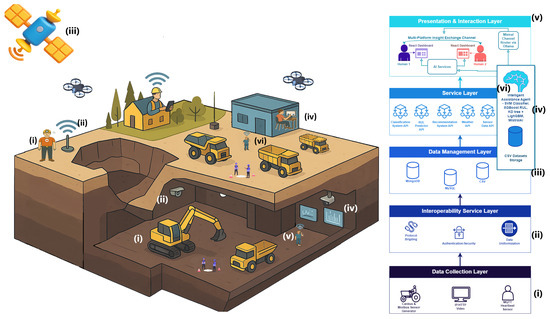
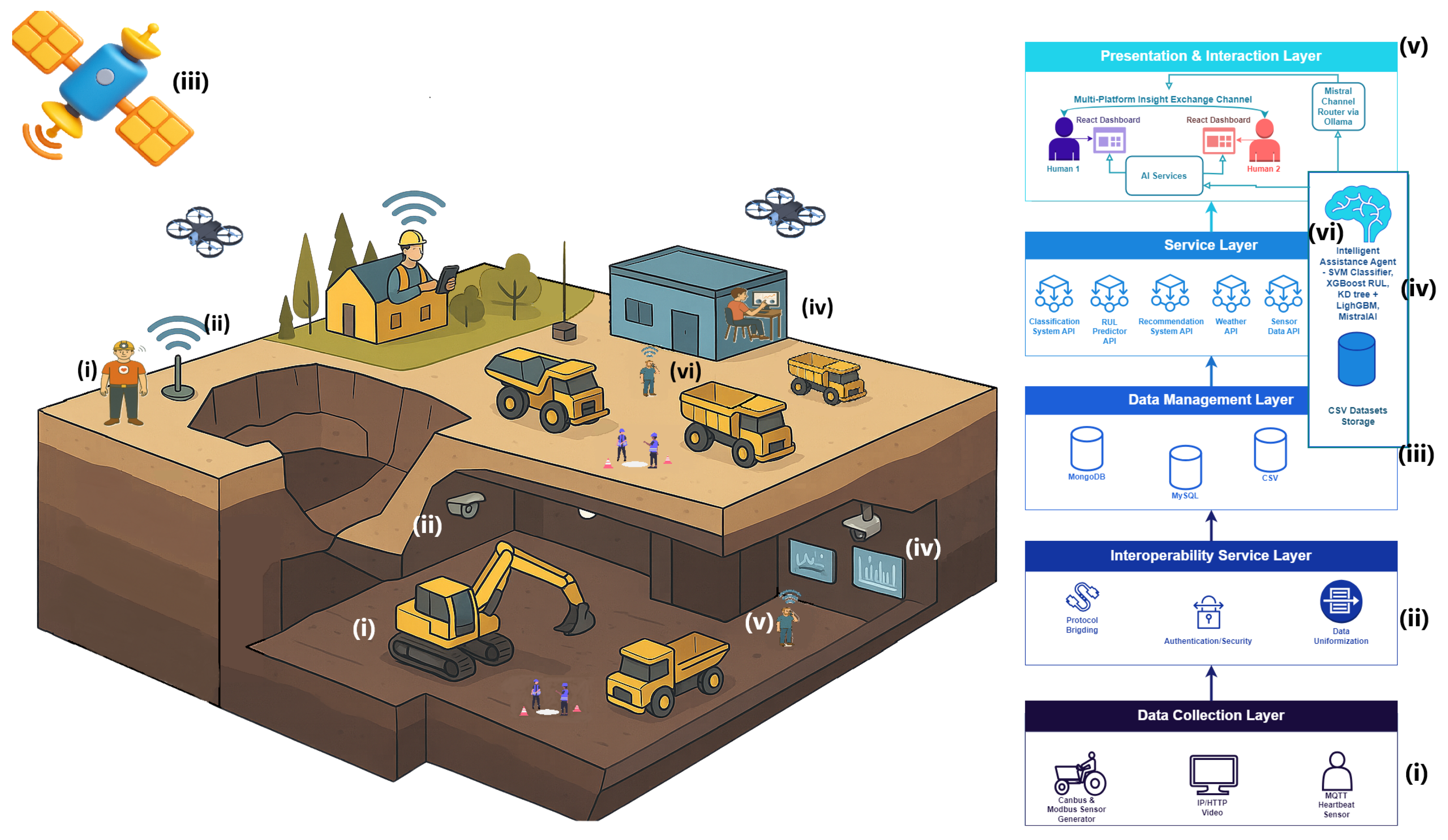
The underground mining industry is an integrated system where specialized equipment, interdependent processes, skilled personnel, and strict safety protocols operate in coordination to enable continuous extraction and material handling. This complex environment provides a suitable context for evaluating the proposed reference architecture. The testbed is a simulation-based proof of concept that validates the architecture under conditions representative of underground mining, Figure 2. This setup explicitly validates human-centric oversight as a first class objective of Industry 5.0. Our goal is not production deployment but to demonstrate that heterogeneous protocols can be unified, data governed with a clean split between operational and training stores, explainable AI can operate with human-in-the-loop controls, and all capabilities can be surfaced securely in a single interaction layer.
Figure 2.
Simulated underground mining case study mapping the operational environment (on the left) to the respective architectural layers (on the right) via corresponding indicators (i)–(vi). Note: The left illustrative scenario was generated by ChatGPT 4.0.
4.1. Design Overview
The data collection layer simulates tractors, heart sensors, and video feeds with controlled degradation to stress multimodal ingest. These streams are unified by a middleware that bridges the protocols CANbus, Modbus, MQTT, and IP/HTTP video into a canonical schema with timestamps, identifiers, coordinates, and quality flags. Data are split by design into two logical databases: opdata serves real-time queries and alerting for operations, while ai_train stores append only raw events, curated feature tables, labels, operator feedback, experiments, and a signed model registry with lineage.
Services include a Support Vector Machine (SVM) classifier for health states, an eXtreme Gradient Boosting (XGBoost) regressor for the remaining useful life, and a K-Dimensional Tree (KD-tree) plus Light Gradient Boosting Machine (LightGBM) ranker for equipment substitution; all provide concise explanations. A dashboard developed in React exposes a fleet map with health overlays, camera tiles, alert banners, collaboration tools, and detailed equipment log info, while an intelligent agent routes human-to-human messages across channels and summarizes recommendations.
These specific machine learning algorithms were selected to balance high inference speed with low computational overhead, which is critical for edge-deployed mining environments. They were chosen over alternative approaches like Random Forests or Convolutional Neural Networks (CNNs) based on three fundamental engineering criteria:
- 1.
- Resource Constraints at the Edge: While CNNs offer high representation capacity, they require significant computational power (GPUs) and large data volumes, making them unsuitable for low-power, localized edge nodes in underground tunnels.
- 2.
- Tabular Efficiency vs. Ensemble Overhead: Compared to standard Random Forests, XGBoost and LightGBM provide faster training times, significantly smaller memory footprints, and better handling of tabular telemetry data through leaf-wise tree growth.
- 3.
- Deterministic Low Latency: SVM and KD-trees guaranty fast, deterministic inference bounds required for sub-second anomaly detection and spatial proximity alerts.
4.2. Data and Middleware
The middleware abstracts protocol heterogeneity by enforcing a uniform data envelope across all sources. Whether input arrives from field busses, MQTT topics, or HTTP services, it is normalized into a message with explicit schema_id, typed payload, and timestamp. Basic validation is performed at ingress and violations are quarantined so that no downstream consumer ingests corrupted or ambiguous data. This guaranties that dashboards, storage layers, and AI pipelines reason over consistent and trusted data contracts.
Operational data flows into two distinct tiers. The first, opdata, is a time-series store optimized for low latency queries, alerts, and dashboards. The second, ai_train, is append only and optimized for reproducibility, storing datasets together with schema identifiers, feature spec versions, and model lineage. This supports auditable retraining and helps guaranty train–serve parity between online and offline pipelines.
To illustrate the integration process, Controller Area Network (CAN) and J1939 messages are decoded in Node-RED and transformed into a canonical JSON envelope before being sent to both opdata and ai_train. Raw frames are first associated with stable machine identities through UUID binding, since native J1939 source addresses may change after restart. Domain-specific decoders then interpret Parameter Group Numbers (PGNs) related to subsystems such as engine, transmission, and hydraulics. Each decoded event is wrapped in a standard JSON structure that contains the tractor identifier, schema reference, timestamp, and payload. This canonical format allows messages to be processed uniformly regardless of origin or signal type.
The same data foundation supports the AI services described in the previous section.
The evaluation dataset comprises a finalized pool of 5000 clean, consecutive simulation records generated under a controlled environment to ensure structural consistency for model verification. Because the data stream was captured directly from a software-based emulation framework, the initial generation phase was deterministic, resulting in zero missing values or corrupted entries requiring removal.
These 5000 baseline samples aggregate continuous telemetry from eight distinct raw parameters tracked natively on the mining tractors, providing a reliable ground truth for the classification layer. The structural breakdown of these metrics, their physical focus, and sampling configuration is detailed in Table 2.
Table 2.
Technical specifications and placement of the eight simulated tractor parameters.
For the prediction of the remaining useful life, synthetic degradation cycles were simulated for 300 machines, with timestamped sensor values and useful life in hours as the target variable. For the replacement recommender, a machine dataset describing equipment characteristics was combined with historical substitution feedback logs, allowing candidate generation, ranking, and retraining from operator decisions. In this way, the middleware not only supports heterogeneous real-time integration, but also provides the structured historical datasets required for predictive and human-in-the-loop AI services.
4.3. AI Services
The platform integrates four complementary AI services, each addressing a distinct layer of the operational pipeline: (i) classification of health state, (ii) prediction of remaining useful life (RUL), (iii) replacement recommendation, and (iv) universal presence and messaging channel. Together, these modules enable proactive monitoring, predictive maintenance, adaptive fleet management, and human-to-human insight exchange across communication platforms.
- (i)
- Classification of the health state: Anticipation of unusual health situations is the key to avoiding costly breakdowns. Support Vector Machines (SVMs) emerged as a promising contender for monitoring industrial conditions, being particularly well suited for small to medium datasets with non-linear feature spaces, as extensively validated in the machinery fault diagnostics literature [46].
- (ii)
- Remaining useful life prediction: Beyond classification, operators require forecasts of how long an equipment will remain functional. Gradient boosting methods, particularly XGBoost, are widely cited in industrial prognostic research for their ability to handle heterogeneous features, irregular time-series, and non-linear degradation trajectories, offering scalable and precise execution in structural health predictions [47,48].
- (iii)
- Replacement recommender: When a machine goes offline, downtime can escalate rapidly if replacements are not chosen promptly. Here, a hybrid search for candidates k-nearest neighbor (kNN) with LightGBM LambdaRank was selected, combining feasibility with operator informed preferences, leveraging established optimization principles in learning-to-rank information systems [49].
- (iv)
- Effective insight exchange channel: This channel is designed not as a chatbot, but as an enabler of effective human-to-human communication. At the heart of this service is a large language model (LLM), which acts as a interpretive router, selecting the delivery platform according to the semantics of the message, tone, presence, interaction history, and recipient preferences. In this initial implementation, the LLM is deployed in a zero-shot configuration, leveraging engineered system prompts to classify and map messages to their respective channels without downstream fine-tuning.
This straight through chain links raw telemetry to human action: detect → forecast → recommend → notify. Regarding explainability, the proposed architecture is designed to leverage the intrinsic properties of the selected models to generate raw explanation data: (i) for the SVM health classifier, distances to the decision hyperplane provide a metric of classification confidence; (ii) for the XGBoost and LightGBM models, global feature importance vectors (such as Cycle Age and Hydraulic Pressure) are available to be computed near-real-time. These mathematical outputs are architected to serve as the structural backbone for the ‘concise explanations’ that will be rendered in the presentation layer.
5. Analysis of Results
This section summarizes the main results obtained for each Ai service implemented, followed by the main validation and presentation outcomes of the testbed. The gray color used in the background of the following table rows is intended to highlight the most critical result.
- (i)
- Classification of the health state: Following preliminary validation runs against standard heuristic and baseline probabilistic models (such as Naive Bayes), the selected Support Vector Machine (SVM) configuration demonstrated strong separation boundaries under the simulated conditions. The model achieved a macro F1-score of 0.983 and an overall accuracy of 0.988. Sensitivity exceeded 0.95 across all classes. Misclassifications were rare, with only 1.4% of Good instances confused with Poor. These results confirm the suitability of SVMs for precise early stage anomaly detection in synthetic industrial telemetry. Table 3 shows an excerpt of the classification output produced by the service, where Tractor 330 (TR-330) is classified as Poor.Table 3. Machine classifications.
- (ii)
- Prediction of the remaining useful life: The deployment of the XGBoost regressor, which outperformed basic linear regression benchmarks in handling non-linear degradation trajectories during initial trials, obtained RMSE equal to 2.00, MAE equal to 1.14, and R2 equal to 74.88%. The MAPE value was inflated, approximately 64%, due to near zero targets. The feature importance analysis classified Cycle Age, Elapsed time, and Hydraulic Pressure as the strongest predictors. These findings align with the industrial literature emphasizing the role of temporal and pressure related features in degradation modeling. Table 4 presents an excerpt of the prediction output, including the predicted health state and the estimated maintenance time. Tractor 204 (TR-204) is marked as Poor Health, which requires immediate maintenance.Table 4. Remaining useful life prediction.
- (iii)
- Replacement recommender: The offline evaluation of the hybrid framework (combining k-NN candidate search with LightGBM LambdaRank optimization) shows that the hybrid approach improves precision at k and NDCG compared to only heuristic baselines. Operator feedback further enhances alignment, demonstrating that substitution recommendations become more accurate over time. Table 5 illustrates the substitute candidates ranked for machine TR-204, including similarity score, distance, capacity variation, health condition, acceptance rate, and the final operator decision. For this case, Tractor 312 (TR-312) is the best replacement machine.Table 5. Replacement recommendation for TR-204.
- (iv)
- Effective channel of insight exchange: By fusing presence signals, historical interaction patterns, and LLM-driven interpretation, the channel transforms fragmented multi-platform messaging into a single coherent layer of human connectivity. Users no longer need to remember where a colleague can be reached; they simply communicate and the system ensures delivery in the most human appropriate channel.
- (v)
- Validation and presentation. To demonstrate the integration capability of all services, including human-to-human collaboration, a dashboard was developed using React 19.1.0. It displays live sensor data and renders geospatial status, live camera tiles, and alert banners that bundle classification, RUL intervals, and ranked substitutes with short rationales and analogous past cases. Users can accept or override recommendations and initiate immediate transversal video calls or cross-platform messages through the agent. Role-based access and audit trails are enforced throughout.Because the testbed is simulation-based, validation focuses on architectural properties: heterogeneity handling, data management, end to end latency, explainability coverage, and human-in-the-loop efficacy. As an example of this validation, a simulated tractor exhibited declining hydraulic pressure while transmission temperature trended upward. The SVM detected a Poor state and the RUL service estimated 3–5 h. The recommender proposed a replacement, but the operator overrode the decision; this feedback was recorded and subsequently used to improve future recommendations, illustrating the intended human-in-the-loop behavior.
6. Discussion
The experimental and architectural outcomes validated in our testbed provide initial evidence of alignment with existing predictive maintenance literature, demonstrating feasibility under controlled simulation conditions. While traditional frameworks often isolate health state classification from decision-making layers [48], our multi-tier AI approach establishes a direct semantic link from raw telemetry to operational recommendations and human-in-the-loop validation. The classification accuracy () and robust RUL trajectory estimation suggest that leveraging specialized, lightweight models (SVM and XGBoost) yields competitive performance compared to resource-intensive deep learning alternatives, which frequently suffer from vanishing gradients in irregular industrial time-series.
Regarding the implementation cost, the proposed architecture follows a modular middleware paradigm designed to minimize computational overhead. By deploying specialized tabular models for classification and prognostics, the continuous operational tracking can be executed locally on edge gateways or low-cost cloud instances without requiring expensive GPU infrastructure. The primary computational cost centers on the integration of the large language model (LLM) for the insight exchange channel; however, by restricting the LLM’s role to semantic intent routing via structured zero-shot prompting rather than continuous fine-tuning, API token consumption and inference latency are strictly bounded, ensuring a highly cost-effective deployment scale for industrial operators.
The proposed architecture is particularly suited to industrial environments where heterogeneous legacy systems must be unified under a common operational layer, where decisions carry safety-critical consequences requiring auditability, and where effective human-to-human collaboration is a first-class operational requirement—such as underground mining, healthcare operations, or critical infrastructure management. In these contexts, existing architectures such as RAMI 4.0 and IIRA, while valuable for technical standardization and protocol connectivity, do not natively support explainable AI, human override mechanisms, or effectiveness as an explicit design principle. Similarly, the IBM Industry 4.0 reference architecture offers strong service orchestration but lacks the collaboration layer and human-in-the-loop controls that the proposed framework treats as core design requirements. Organizations operating in high-stakes, multi-stakeholder environments where human judgment must remain central, contestable, and effective represent the primary adoption context for the proposed architecture.
7. Conclusions and Future Work
This work proposes a technology-agnostic reference architecture that fuses Industry 4.0 building blocks with Industry 5.0 principles of human-centricity, resilience, sustainability, and effectiveness. The main contributions are:
- (i)
- The inclusion of an intelligent layer that provides explainable recommendations, captures operator feedback, and empowers humans as co-designers and co-decision makers, operationalizing effectiveness as an explicit architectural principle that extends the current Industry 5.0 framework.
- (ii)
- An event-driven interoperability middleware that unifies heterogeneous protocols such as CANbus, Modbus, MQTT, and IP/HTTP video within a consistent security posture.
- (iii)
- Dual data stores with clear governance, separating a low-latency operational store from an auditable training store to preserve train–serve parity and model lineage.
- (iv)
- The treatment of security and safety as co-requirements through zero-trust practices, signed model artifacts, and advisory AI with human override.
- (v)
- A collaboration-oriented interaction layer that enables human-to-human and human-to-machine teamwork through dashboards, messaging, and contextual assistance.
A simulation-based underground mining testbed validated feasibility under controlled conditions. It demonstrated protocol unification, separation of operational and training data paths, deployment of explainable AI services including health classification, remaining useful life estimation and substitution ranking, and a unified interface for decision support. The testbed provided a successful validation of the data ingest flows, the coverage of explainability for AI recommendations, and a preliminary verification of the human-in-the-loop pipeline where the recommendation ranking adapted after capturing manual operator overrides. These laboratory results provide an initial indication of the importance of humans in relation to the behaviour of the system. However, to ensure that effective human intervention is essential, validations using real-world cases will be conducted in the future.
It is necessary to point out that the testbed developed was a controlled simulation intended to validate architectural claims rather than demonstrate industrial throughput or human-factor performance. No external operators participated in user studies; external validity (for example, usability in harsh environments and organizational constraints) remains unmeasured. Consequently, a systematic analysis of human override frequencies, failure types, and operational outcomes was not mathematically modeled at this stage.
Practical lessons learned include the importance of adopting event driven publish–subscribe as a strong baseline for heterogeneous and human in the loop plants, designing human override and rationale mechanisms as first class requirements, enforcing parity between training and operational data pipelines while capturing feedback as structured data, and approaching cybersecurity and operational safety as an integrated socio technical discipline. Limitations remain in terms of external validity since the results were derived from a controlled simulation with synthetic data and without field studies in demanding industrial environments. Cost, maintainability, large scale compute and bandwidth constraints, long term model drift, workforce impacts, quantitative sustainability assessments, and compliance processes were also outside the scope of this study.
Future work needs to extend the proposed architecture from simulation to real world industry deployments. The top priority is to develop cybersecurity and safety as a single, unified assurance system wherein threat modeling goes hand in hand with hazard analysis and runtime enforcement of explicit fail safe behavior. Additionally, the design and formal evaluation of the explainable AI (XAI) interfaces constitute a critical next step. Future efforts will focus on factors including engineering to determine how the raw explanation data (such as feature importance and classification confidence) can be best rendered to operators and evaluating formats like contrastive explanations or visual dashboards through user studies to measure cognitive workload, trust calibration, and decision accuracy. Similarly, the LLM-based effective insight exchange channel will undergo empirical evaluation to assess routing accuracy against human benchmarks, message delivery latency, and overall user satisfaction regarding multi-platform communication orchestration. This human-factors evaluation will expand upon the behavioral intention determinants identified by Cheng et al. [4], adapting their socio-technical adoption metrics to the specific safety constraints of underground mining. Another direction is to examine the applicability of zero trust security principles such as strong identity, least privilege, and micro segmentation in operation technology domains where there exist legacy devices and spotty connectivity. Another dimension in need of attention is data and model pipeline resilience wherein signed artifacts, reproducible builds, and detection of drift are necessary for long-term trust in AI-aided decisions. Human-centered telemetry such as video and biometric streams present additional challenges necessitating use of privacy-preserving technologies such as federated learning and differential privacy. Finally, the architecture needs to be tested through field pilot projects with industry partners interspersed with adversarial red teams testing resilience against cyber and physical attacks. These real-world pilots will also serve to empirically evaluate the pillar of sustainability, measuring the actual energy savings derived from edge-computing data reduction and the long-term asset lifespan extension enabled by predictive maintenance. Through such directions, the architecture can develop into a trusted and safe Industry 5.0 framework wherein protection of human agency is possible while still allowing for resilience in high stakes industry scenarios. Future work will focus on expanding the platform’s evaluation by conducting a comprehensive benchmarking of alternative learning-to-rank models for the recommendation layer, alongside a systematic comparative analysis of different open-source large language models (LLMs) to optimize the semantic routing channel.
Author Contributions
Conceptualization, L.F. and G.D.P.; methodology, P.Á. and L.F.; validation, J.P.S. and G.D.P.; writing—original draft preparation, E.G.; writing—review and editing, L.F., G.D.P., P.Á. and J.P.S.; visualization, E.G.; supervision, L.F. and P.Á.; funding acquisition, L.F. and J.P.S. All authors have read and agreed to the published version of the manuscript.
Funding
This paper was funded by national funds and FCT/MCTES (PIDDAC), through the Foundation for Science and Technology, I. P. (FCT) under the scope of the project UID/05549/2025 (https://doi.org/10.54499/UID/05549/2025) and LASI-LA/P/0104/2020 (https://doi.org/10.54499/LA/P/0050/2020).
Institutional Review Board Statement
Not applicable.
Informed Consent Statement
Not applicable.
Data Availability Statement
The synthetic dataset generated and analyzed during the current study is available from the corresponding author upon reasonable request, owing to ongoing institutional framework developments and testbed integration extensions.
Acknowledgments
All content has been reviewed and revised by the authors. The authors assume full responsibility for the accuracy and originality of the work. The authors used ChatGPT 4.0 for the generation of part of the images. To generate the left part of the Figure 2, the main prompt elements used were: (i) isometric technical illustration of a modern open-pit mining; (ii) surface mining operation elements; (iii) collection of underground mining and (iv) digital monitoring elements.
Conflicts of Interest
The authors declare no conflicts of interest.
Abbreviations
| AI | Artificial Intelligence |
| F1 | F1-Score (Harmonic mean of precisionand sensitivity) |
| HydP | Hydraulic Pressure |
| k-NN | k-Nearest Neighbors |
| LLM | Large Language Model |
| MAE | Mean Absolute Error |
| MAPE | Mean Absolute Percentage Error |
| MTP | Maintenance Time Prediction |
| NDCG | Normalized Discounted CumulativeGain |
| RMSE | Root Mean Squared Error |
| RPM | Revolutions Per Minute |
| RUL | Remaining Useful Life |
| SVM | Support Vector Machine |
| TrT | Transmission Temperature |
| TS | Timestamp |
References
- McKinsey & Company. The State of AI in 2023—And a Half Decade in Review, 2023. Sections on Manufacturing Adoption and Impact. Available online: https://www.mckinsey.com/capabilities/quantumblack/our-insights/the-state-of-ai-in-2023-generative-ais-breakout-year (accessed on 24 July 2026).
- Nahavandi, S. Industry 5.0—A Human-Centric Solution. Sustainability 2019, 11, 4371. [Google Scholar] [CrossRef] [Scilit]
- Breque, M.; De Nul, L.; Petridis, A. Industry 5.0: Towards a Sustainable, Human-Centric and Resilient European Industry; Technical Report; European Commission, Directorate-General for Research and Innovation: Luxembourg, 2021. [Google Scholar] [CrossRef] [PubMed]
- Cheng, M.; Chong, H.; Xu, Y.; Wu, H. Exploring the Determinants of Generative Artificial Intelligence Use Intention: A Mixed Methods Study. J. Constr. Eng. Manag. 2026, 152, 04026091. [Google Scholar] [CrossRef] [Scilit]
- Ghobakhloo, M.; Iranmanesh, M.; Grybauskas, A.; Sabahi, S.; Sadeghi, A.; Steenkamp, A. A Roadmap Toward Human-Centric, Sustainable, and Resilient Industry 5.0. Inf. Syst. Front. 2024, 1, 4–5. [Google Scholar] [CrossRef] [Scilit]
- International Council on Mining and Metals (ICMM). ICMM Members Show Progress Towards Zero Fatalities with the Lowest Total Fatality Count on Record in 2023, 2024. Safety Performance Statement. Available online: https://www.icmm.com/en-gb/news/2024/2023-safety-performance (accessed on 24 July 2026).
- Chui, K.; Gupta, B.; Liu, J.; Arya, V.; Nedjah, N.; Almomani, A.; Chaurasia, P. A Survey of Internet of Things and Cyber-Physical Systems. Information 2023, 14, 388. [Google Scholar] [CrossRef] [Scilit]
- Bukowski, L.; Werbinska-Wojciechowska, S. Resilience-Based Maintenance in AI-Driven Sustainable and Smart Industry: Towards Maintenance 5.0. Sensors 2025, 25, 5100. [Google Scholar] [CrossRef] [Scilit] [PubMed]
- Ferreira, L.; Putnik, G.; Cruz-Cunha, M.; Putnik, Z.; Castro, H.; Alves, C.; Shah, V.; Varela, L. A Cloud-Based Architecture with Embedded Pragmatics Renderer for Ubiquitous and Cloud Manufacturing. Int. J. Comput. Integr. Manuf. 2017, 30, 483–500. [Google Scholar] [CrossRef] [Scilit]
- Putnik, G.; Ávila, P. Manufacturing System and Enterprise Management for Industry 4.0. FME Trans. 2021, 49, 769–772. [Google Scholar] [CrossRef] [Scilit]
- Varela, L.; Ávila, P.; Castro, H.; Putnik, G.; Fonseca, L.; Ferreira, L. Manufacturing and Management Paradigms, Methods and Tools for Sustainable Industry 4.0-Oriented Manufacturing Systems. Sustainability 2022, 14, 1574. [Google Scholar] [CrossRef] [Scilit]
- European Commission. Industry 5.0 Community of Practice. Industry 5.0 Communication and Collaboration Patterns, 2024. Knowledge Resource. Available online: https://research-and-innovation.ec.europa.eu/document/download/8aea695d-2b97-4366-812f-971b7ebbfda8_en?filename=cop-5-final-report.pdf (accessed on 24 July 2026).
- Oracle Corporation. About Application Integrations, 2025. Oracle Integration Cloud Documentation. Available online: https://docs.oracle.com/en-us/iaas/application-integration/doc/overview.html (accessed on 24 July 2026).
- International Electrotechnical Commission. IEC 62443 Series—Security for Industrial Automation and Control Systems. Technical report, International Electrotechnical Commission, 2013. Includes IEC 62443-3-3:2013 and Related Parts. Available online: https://webstore.iec.ch/en/publication/7033 (accessed on 24 July 2026).
- OASIS Standards. MQTT Version 5.0, 2019. OASIS Standard. Available online: https://docs.oasis-open.org/mqtt/mqtt/v5.0/mqtt-v5.0.html (accessed on 24 July 2026).
- Object Management Group. Data Distribution Service (DDS) Version 1.4. Technical Report Formal/2015-04-10, Object Management Group. 2015. Available online: https://www.omg.org/spec/DDS/1.4/ (accessed on 24 July 2026).
- Kreps, J.; Narkhede, N.; Rao, J. Kafka: A Distributed Messaging System for Log Processing. In Proceedings of the NetDB Workshop, Athens, Greece, 12 June 2011; Available online: https://www.microsoft.com/en-us/research/wp-content/uploads/2017/09/Kafka.pdf (accessed on 24 July 2026).
- Carbone, P.; Katsifodimos, A.; Ewen, S.; Markl, V.; Haridi, S.; Tzoumas, K. Apache Flink: Stream and Batch Processing in a Single Engine. IEEE Data Eng. Bull. 2015, 38, 28–38. [Google Scholar]
- Armbrust, M.; Das, T.; Torres, J.; Yavuz, B.; Zhu, S.; Xin, R.; Ghodsi, A.; Stoica, I.; Zaharia, M. Structured Streaming: A Declarative API for Real-Time Applications in Apache Spark. In Proceedings of the SIGMOD, New York, NY, USA, 10–15 June 2018; pp. 601–613. [Google Scholar] [CrossRef] [Scilit]
- Silva, J.; Silva, N. Coalesce: Collaboration-Based Information and Recommendation Retrieval Systems. Technical Report PTDC/EIA/74417/2006, Fundação para a Ciência e a Tecnologia, 2007. See Section 2.3, Integração de Esquema (Migração de Dados). Available online: https://www.fct.pt/apoios/projectos/consulta/aavaliar?iep=2829&idconcurso=44 (accessed on 24 July 2026).
- Putnik, G.; Putnik, Z.; Shah, V.; Varela, L.; Ferreira, L.; Castro, H.; Catia, A.; Pinheiro, P. Collaborative Engineering: A Review of Organisational Forms for Implementation and Operation. IOP Conf. Ser. Mater. Sci. Eng. 2021, 1174, 012028. [Google Scholar] [CrossRef] [Scilit]
- NIST. Special Publication 800-82 Rev. 2: Guide to Industrial Control Systems (ICS) Security; Technical Report; National Institute of Standards and Technology (NIST): Gaithersburg, MD, USA, 2015. [CrossRef] [Scilit]
- ISO 45001:2018; Occupational Health and Safety Management Systems—Requirements with Guidance for Use. Technical Report; International Organization for Standardization: Geneva, Switzerland, 2018. Available online: https://www.iso.org/standard/63787.html (accessed on 24 July 2026).
- ISO/TS 15066:2016; Robots and Robotic Devices—Collaborative Robots. Technical Report; International Organization for Standardization: Geneva, Switzerland, 2016. Available online: https://www.iso.org/standard/62996.html (accessed on 24 July 2026).
- NIST. Special Publication 800-207: Zero Trust Architecture; Technical Report; National Institute of Standards and Technology (NIST): Gaithersburg, MD, USA, 2020. [CrossRef] [Scilit]
- de Souza, D.; Sousa, S.; Kristjuhan-Ling, K.; Dunajeva, O.; Roosileht, M.; Pentel, A.; Mõttus, M.; Özdemir, M.; Gratšjova, Z. Trust and Trustworthiness from a Human-Centered Perspective in Human-Robot Interaction: A Systematic Literature Review. arXiv 2025, arXiv:2501.19323. [Google Scholar] [CrossRef] [Scilit]
- DIN SPEC 91345:2016-04; Reference Architecture Model Industrie 4.0 (RAMI 4.0). Technical Report; DIN: Berlin, Germany, 2016. Available online: https://www.beuth.de/en/technical-rule/din-spec-91345/250940128 (accessed on 24 July 2026).
- Industrial Internet Consortium. The Industrial Internet Reference Architecture (IIRA), Version 1.9. Technical Report, Industrial Internet Consortium, 2019. Available online: https://www.iiconsortium.org/IIRA (accessed on 24 July 2026).
- Curry, E.; Metzger, A.; Berre, A.; Monzón, A.; Boggio-Marzet, A. A Reference Model for Big Data Technologies. In The Elements of Big Data Value: Foundations of the Research and Innovation Ecosystem; Springer International Publishing: Cham, Switzerland, 2021; pp. 127–151. [Google Scholar] [CrossRef] [Scilit]
- Kaiser, J.; McFarlane, D.; Hawkridge, G.; André, P.; Leitão, P. A Review of Reference Architectures for Digital Manufacturing: Classification, Applicability and Open Issues. Comput. Ind. 2023, 149, 103923. [Google Scholar] [CrossRef] [Scilit]
- Kosanke, K. CIMOSA—Overview and Status. Comput. Ind. 1995, 27, 101–109. [Google Scholar] [CrossRef] [Scilit]
- Sauer, C.; Eichelberger, H. Performance Evaluation of BaSyx-Based Asset Administration Shells for Industry 4.0 Applications. In Proceedings of the Smart Systems Integration. 2022. Available online: https://fb-swt.gi.de/fileadmin/FB/SWT/Softwaretechnik-Trends/Verzeichnis/Band_43_Heft_1/SSP_22_paper_9621.pdf (accessed on 24 July 2026).
- FIWARE Foundation. Orion Context Broker—NGSI-LD/NGSIv2 Overview. 2024. Available online: https://fiware-orion.readthedocs.io (accessed on 24 July 2026).
- Delsing, J. IoT Automation: Arrowhead Framework; CRC Press: Boca Raton, FL, USA, 2017. [Google Scholar]
- Varga, P.; Blomstedt, F.; Ferreira, L.; Eliasson, J.; Johansson, M.; Delsing, J.; Martínez de Soria, I. Making System of Systems Interoperable—The Core Components of the Arrowhead Framework. J. Netw. Comput. Appl. 2017, 81, 85–95. [Google Scholar] [CrossRef] [Scilit]
- Ficzere, D.; Hollósi, G.; Frankó, A.; Varga, P. AI Toolbox Concept for the Arrowhead Framework. In Proceedings of the 19th International Conference on Network and Service Management (CNSM), Niagara Falls, ON, Canada, 30 October–2 November 2023. [Google Scholar] [CrossRef] [Scilit]
- Light, R. Mosquitto: Server and Client Implementation of the MQTT Protocol. J. Open Source Softw. 2017, 2, 265. [Google Scholar] [CrossRef] [Scilit]
- NVIDIA Corporation. NVIDIA TensorRT Developer Guide. 2024. Available online: https://docs.nvidia.com/deeplearning/tensorrt/developer-guide/index.html (accessed on 24 July 2026).
- Intel Corporation. OpenVINO Toolkit—Documentation. 2024. Available online: https://docs.openvino.ai (accessed on 24 July 2026).
- Beutel, D.; Topal, T.; Mathur, A.; Qiu, X.; Parcollet, T.; Lane, N. Flower: A Friendly Federated Learning Research Framework. arXiv 2020, arXiv:2007.14390. [Google Scholar] [CrossRef] [Scilit]
- Google Research. TensorFlow Federated: Machine Learning on Decentralized Data, 2019. Available online: https://www.tensorflow.org/federated (accessed on 24 July 2026).
- Microsoft Azure. Azure OpenAI Service—Documentation. 2025. Available online: https://learn.microsoft.com/en-us/azure/foundry/ (accessed on 24 July 2026).
- Amazon Web Services. Amazon Bedrock—Developer Guide. 2025. Available online: https://docs.aws.amazon.com/bedrock/latest/userguide/ (accessed on 24 July 2026).
- Moosavi, S.; Farajzadeh-Zanjani, M.; Razavi-Far, R.; Palade, V.; Saif, M. Explainable AI in Manufacturing and Industrial Cyber–Physical Systems: A Survey. Electronics 2024, 13, 3497. [Google Scholar] [CrossRef] [Scilit]
- Senoner, J.; Netland, T.; Feuerriegel, S. Using Explainable Artificial Intelligence to Improve Process Understanding and Control. Manag. Sci. 2022, 68, 8770–8791. [Google Scholar] [CrossRef] [Scilit]
- Widodo, A.; Yang, B. Support Vector Machine in Machine Condition Monitoring and Fault Diagnosis. Mech. Syst. Signal Process. 2007, 21, 2573–2597. [Google Scholar] [CrossRef] [Scilit]
- Chen, T.; Guestrin, C. XGBoost: A Scalable Tree Boosting System. In Proceedings of the 22nd ACM International Conference on Knowledge Discovery and Data Mining, New York, NY, USA, 13–17 August 2016; pp. 785–794. [Google Scholar] [CrossRef] [Scilit]
- Si, X.; Wang, W.; Hu, C.; Zhou, D. Remaining Useful Life Estimation—A Review on the Statistical Data-Driven Approaches. Eur. J. Oper. Res. 2011, 213, 1–14. [Google Scholar] [CrossRef] [Scilit]
- Burges, C. From RankNet to LambdaRank to LambdaMART: An overview. Learning 2010, 11, 81. [Google Scholar]

Disclaimer/Publisher’s Note: The statements, opinions and data contained in all publications are solely those of the individual author(s) and contributor(s) and not of MDPI and/or the editor(s). MDPI and/or the editor(s) disclaim responsibility for any injury to people or property resulting from any ideas, methods, instructions or products referred to in the content. |
© 2026 by the authors. Licensee MDPI, Basel, Switzerland. This article is an open access article distributed under the terms and conditions of the Creative Commons Attribution (CC BY) license.