Article

Hierarchical Encapsulation–Asymmetric Bridging Flocculation for Resolving the Retention–Sizing Trade-Off in Biochar-Filled Straw Fiber-Based Composites

1
School of Marxism, Northeast Agricultural University, Harbin 150030, China
2
School of Resources and Environment, Northeast Agricultural University, Harbin 150030, China
3
College of Agricultural Equipment and Energy Engineering, Northeast Agricultural University, Harbin 150030, China
4
Heilongjiang Provincial Engineering Research Center for Mechanization and Materialization of Major Crops Production, Harbin 150030, China
*
Author to whom correspondence should be addressed.
Sustainability 2026, 18(15), 7914; https://doi.org/10.3390/su18157914
Submission received: 26 June 2026 / Revised: 26 July 2026 / Accepted: 31 July 2026 / Published: 4 August 2026

Abstract

Porous biochar is a functional filler for fiber-based composites. However, its fine particle size, weak affinity toward lignocellulosic fibers, and highly adsorptive pore structure lead to low retention and competitive AKD adsorption, creating a retention–sizing trade-off that limits composite performance. To overcome this challenge, a hierarchical encapsulation–asymmetric bridging flocculation (EABF) strategy integrating cationic starch (CS) and cationic polyacrylamide (CPAM) through sequential interfacial assembly was developed. In this strategy, CS was first adsorbed onto biochar surfaces to form a passivating encapsulation layer that partially shielded porous adsorption sites and regulated interfacial charge characteristics. Subsequently, CPAM served as an asymmetric bridging agent, preferentially linking CS-modified biochar with straw fibers to generate enlarged flocs with enhanced biochar–fiber association. The optimized assembly pathway increased biochar retention and total retention by 84.77% and 25.70%, respectively. Simultaneously, the dry tensile index, sizing degree, and water contact angle improved by 35.14%, 35.02%, and 64.13%, respectively, demonstrating concurrent enhancement of mechanical strength, surface hydrophobicity, and air barrier properties. Mechanistically, surface passivation and asymmetric bridging synergistically suppressed competitive AKD adsorption while strengthening filler–fiber connectivity, thereby coordinating particle-scale interfacial regulation with network-scale structural assembly. This work establishes a scalable interfacial engineering strategy for overcoming performance trade-offs associated with porous fillers and advances the development of sustainable high-performance fiber-based materials.

1. Introduction

Agricultural residues are abundant renewable feedstocks, but their inefficient disposal, open-field burning, and accumulation remain important challenges in agricultural solid-waste management. Straw valorization therefore responds not only to resource-utilization demands but also to policy-driven needs for circular agriculture, carbon reduction, and low-carbon packaging. Compared with conventional wood-derived fibers and petroleum-based packaging materials, straw fibers can broaden the renewable raw-material base and reduce pressure on forest resources [1]. From an industrial perspective, improving the retention, sizing efficiency, and barrier performance of straw fiber composites is also important for reducing filler loss and unnecessary wet-end chemical consumption during papermaking. Therefore, interfacial regulation of biochar-filled straw fiber composites has practical significance for agricultural residue treatment, wood-free low-carbon packaging, and cleaner papermaking processes [2].
Straw fibers have attracted increasing attention as promising feedstocks for bio-based packaging owing to their wide availability, low cost, biodegradability, and compatibility with conventional papermaking processes [3]. However, the practical application of straw fiber-based composites remains constrained by insufficient mechanical strength and inadequate barrier performance [4]. Due to the irregular morphology, heterogeneous composition, and limited conformability of straw fibers, the resulting fiber network typically exhibits low packing density and abundant inter-fiber voids. These structural deficiencies hinder efficient stress transfer while facilitating the transport of air and moisture through the fiber matrix, thereby compromising both mechanical integrity and barrier functionality. Consequently, developing strategies capable of simultaneously reinforcing the fiber network and restricting mass transport is essential for the fabrication of high-performance straw fiber-based packaging materials.
Functional fillers provide an effective means of tailoring the structure and performance of fiber-based composites. Biochar, a porous carbonaceous material, has attracted considerable attention due to its high specific surface area, abundant surface functional groups, and tunable pore structure [5]. Previous studies have shown that biochar can improve stiffness, dimensional stability, thermal behavior, and microstructural characteristics [6]. Nevertheless, its practical utilization remains limited by poor retention. The fine particle size and weak affinity toward lignocellulosic fibers often lead to substantial filler loss during dewatering, where retention is dominated primarily by mechanical entrapment rather than strong filler–fiber interactions [7]. Consequently, the reinforcing potential of biochar cannot be fully realized, highlighting the need for retention strategies that not only improve biochar incorporation but also strengthen filler–fiber interfacial integration within fiber networks.
More critically, the porous and highly adsorptive nature of biochar introduces an additional interfacial challenge in AKD-sized fiber systems. Unlike conventional mineral fillers such as precipitated calcium carbonate (PCC) and ground calcium carbonate (GCC), biochar possesses a high specific surface area and an interconnected pore network that can adsorb and retain hydrophobic sizing agents. Consequently, a portion of AKD may be sequestered within the biochar structure rather than deposited onto cellulose fibers, reducing its effective utilization during sizing [8]. Therefore, increasing biochar loading may improve filler retention while simultaneously impairing sizing efficiency and barrier performance. This retention–sizing trade-off highlights the need for retention strategies that not only enhance biochar incorporation but also regulate biochar–AKD interactions, thereby preserving sizing efficiency while maximizing the reinforcing potential of biochar. In this study, the retention–sizing trade-off was assessed using total retention and biochar retention as retention indicators, and sizing degree and water contact angle as sizing indicators.
Wet-end retention technologies offer a potential route for mitigating the retention–sizing trade-off by simultaneously regulating filler capture and interfacial interactions. Among commonly used retention aids, CS and CPAM influence particle–fiber interactions through fundamentally different but complementary mechanisms. CS adsorbs onto negatively charged particle surfaces, promoting charge neutralization, electrostatic patching, and improved filler–fiber compatibility. More importantly, its adsorption layer can modify porous filler surfaces and partially shield accessible adsorption sites. In contrast, CPAM promotes retention primarily through long-range polymer bridging [9]. As a result, CPAM primarily governs network-scale assembly and structural consolidation rather than direct surface passivation.
To further improve floc stability and retention efficiency, dual-component retention systems have been developed by combining electrostatic neutralization, surface modification, and polymer bridging. In such hierarchical assembly strategies, modified filler particles or compact primary microflocs serve as precursors for subsequent polymer-mediated aggregation, typically generating larger and more shear-resistant flocs than conventional single-component systems. As a result, substantial improvements in filler retention, drainage, and sheet strength have been achieved [10]. Nevertheless, these approaches are primarily designed to enhance filler capture and network formation rather than regulate the adsorption characteristics of porous fillers. For biochar-containing systems, the highly porous filler surface may continue to compete for AKD even when retention is significantly increased. This disconnect between filler retention and sizing efficiency highlights the need for multiscale retention strategies capable of simultaneously regulating filler capture, interfacial adsorption, and network assembly. Unlike conventional dual-component retention systems, EABF separates CS-mediated biochar surface passivation from subsequent CPAM-mediated asymmetric bridging.
The limitations of conventional retention systems are particularly pronounced in biochar-filled composites because improved retention does not necessarily translate into improved sizing performance. CS can partially passivate biochar surfaces by shielding accessible pores and reducing potential AKD adsorption sites, whereas CPAM primarily promotes filler retention through polymer bridging and network consolidation [11]. However, neither mechanism alone can simultaneously address AKD sequestration and filler retention. Consequently, effective utilization of biochar requires coordinated regulation of particle-scale interfacial interactions and network-scale floc architecture.
Asymmetric polymer bridging provides a theoretical framework for coupling particle-scale interfacial regulation with network-scale structural assembly. Van de Ven and Alince demonstrated that heteroflocculation can occur even when a polymer is initially adsorbed onto only one colloidal surface, because chain extension and conformational rearrangement subsequently enable bridging between dissimilar components [12]. Related studies on starch-stabilized AKD systems and CPAM-assisted deposition further demonstrated that CPAM can improve AKD retention and deposition efficiency even when direct adsorption onto all colloidal components is limited. Collectively, these findings indicate that asymmetric polymer bridging can function as a coupling mechanism between surface-level interfacial regulation and network-level structural assembly.
This study develops a hierarchical encapsulation–asymmetric bridging flocculation (EABF) strategy for biochar-filled straw fiber-based composites by coupling CS-induced surface passivation with CPAM-mediated asymmetric bridging. The strategy is intended to mitigate the retention–sizing trade-off by simultaneously improving biochar retention, AKD utilization efficiency, and fiber-network integrity. To verify this mechanism, electrokinetic behavior, floc architecture, retention performance, sizing efficiency, and mechanical properties were systematically evaluated.

2. Materials and Methods

2.1. Materials

Rice straw fibers were prepared using a laboratory-scale extrusion–explosion system (D200) and classified to a length of ≤10 mm, with aspect ratios ranging from 22.8 to 58.3. Commercial unbleached pine kraft pulp (KP, 20% moisture content) was purchased from Andi Chemical Co., Ltd. (Shanghai, China). Coconut-shell biochar pyrolyzed at 500 °C was obtained from Foshan Bors Material Technology Co., Ltd. (Foshan, China). The as-received biochar exhibited an initial particle size of approximately 400 μm and a specific surface area of 160 m2 g−1 and was used as a fixed commercial porous filler in this study. It was subsequently pulverized and sieved to obtain four particle size fractions using 50, 30, 13, and 7 μm meshes, designated as G3 (30–50 μm), G5 (13–30 μm), G10 (7–13 μm), and G18 (<7 μm), respectively.
Alkyl ketene dimer (AKD, 12.5 wt% solids) was obtained from Shanghai Jingyi Chemical Raw Materials Co., Ltd. (Shanghai, China). Cationic starch was supplied by Anhui Ku’er Bioengineering Co., Ltd. (Hefei, China) Cationic polyacrylamide (CPAM, Mw ≈ 1.2 × 10⁷ g mol−1) and anionic polyacrylamide (APAM, Mw ≈ 1.2 × 10⁷ g mol−1) were purchased from Tianjin Zhiyuan Chemical Reagent Co., Ltd. (Tianjin, China). All reagents were used as received without further purification.

2.2. Preparation

2.2.1. Preparation of AKD/RSF

Kraft pulp (KP) and rice straw (RS) were soaked in water for 8 h and refined separately in a Valley beater (PL4-00, Taisite Test Equipment Co., Ltd., Xianyang, China) to a beating degree of 45 ± 5 °SR. The refined pulps were blended at a mass ratio of 30:70 (KP:RS) under continuous stirring to obtain the rice-straw-fiber-based furnish (RSF), in which rice straw fiber was the dominant component and kraft pulp served as a constant reinforcing papermaking fiber. AKD was added at 0.6 wt% based on the dry fiber mass and stirred at 800 rpm for 10 min to facilitate its adsorption onto fiber surfaces. The resulting suspension was designated as AKD/RSF.

2.2.2. Preparation of Biochar-Containing Composite Systems

To elucidate the roles of CS, CPAM, and their sequential assembly in regulating biochar–fiber interactions, a series of control and pre-assembly protocols were designed, as summarized in Table 1. GA and GB were used as preliminary single-additive direct-addition systems to evaluate the dosage-dependent effects of CS and CPAM, respectively, whereas GC–GG were designed as the main assembly-pathway comparison groups based on the same AKD/RSF starting furnish. The biochar dosage was fixed at 20 wt% based on the dry fiber mass for all composite systems. The control groups were designed to compare different interfacial assembly pathways at a fixed biochar dosage. GA and GB served as preliminary dosage-optimization groups to determine the optimum dosages of CS and CPAM under conventional direct-addition conditions. After dosage optimization, GC–GG were established as the principal pathway-comparison groups, in which the AKD/RSF furnish was kept identical, and only the biochar assembly pathway was varied.
For GA, CS, AKD, and biochar were directly added to the RSF furnish without any pre-assembly treatment. The suspension was stirred at 800 rpm for 10 min, yielding the sample designated as RSF + CS + AKD + Biochar (GA). For GB, AKD, CPAM, and biochar were directly added to the RSF furnish without any pre-assembly treatment. The suspension was stirred at 800 rpm for 10 min and designated as RSF + AKD + CPAM + Biochar (GB).
For GC, biochar was dispersed in deionized water to obtain a 2 wt% suspension and then directly blended with the AKD/RSF furnish. The resulting system was designated as AKD/RSF + Biochar (GC).
For GD, a CS stock solution (10.0 g L−1) was added to the biochar suspension at 1.2 wt% based on the dry biochar mass and stirred at 800 rpm for 10 min. CS adsorption generated a surface-passivated biochar structure (Biochar@CS). The resulting suspension was subsequently blended with the AKD/RSF furnish to obtain AKD/RSF + [Biochar@CS] (GD).
For GE, a CPAM stock solution (1.0 g L−1) was introduced into the biochar suspension at 0.12 wt% relative to the dry biochar mass and stirred at 800 rpm for 10 min, allowing CPAM-assisted biochar flocs to form through polymer bridging. The resulting suspension was blended with the AKD/RSF furnish to prepare AKD/RSF + [Biochar–CPAM] (GE).
For GF, a CS stock solution (10.0 g L−1) was first added to the biochar suspension at 1.2 wt% based on the dry biochar mass and stirred at 800 rpm for 10 min to generate a surface-passivated structure (Biochar@CS). Subsequently, a CPAM stock solution (1.0 g L−1) was added at 0.12 wt% relative to the dry biochar mass and stirred for an additional 10 min, forming (Biochar@CS–CPAM). The resulting suspension was blended with the AKD/RSF furnish to obtain AKD/RSF + [Biochar@CS–CPAM] (GF).
For GG, the Biochar@CS structure was first prepared following the same procedure as GD. Subsequently, an APAM stock solution (1.0 g L−1) was added at 0.12 wt% relative to the dry biochar mass and stirred for 10 min to obtain Biochar@CS–APAM. The resulting suspension was blended with the AKD/RSF furnish to prepare AKD/RSF + [Biochar@CS–APAM] (GG).
In this notation, “@” denotes encapsulation of CS on the biochar surface, “–” represents polymer-mediated bridging, and “[ ]” indicates preferential pre-assembly of biochar with additives before introduction into the fiber furnish.
Composite sheets were prepared using a standard sheet former (ZCX-A, Yueming Small Testing Machine Co., Ltd., Changchun, China). The wet sheets were dried on a flat-plate dryer (TD19-A, Tongda Light Equipment Co., Ltd., Xianyang, China) at 105 °C for 5 min.

2.3. Characterization

The concentrations of residual AKD, CS, and CPAM in the white water were determined using a UV–Vis spectrophotometer (LAMBDA 850, PerkinElmer, Waltham, MA, USA). Absorbance measurements were performed at 238 nm for AKD, 575 nm for CS, and 470 nm for CPAM based on their characteristic absorption peaks. Calibration curves were established for each component before analysis. The retention of each additive was calculated according to Equation (1):
R e t e n t i o n ( % ) = m 0 m w m 0 × 100
where m0 is the initial mass of the additive added to the furnish and mw is the mass remaining in the white water.
The zeta potential of biochar suspensions and biochar-containing fiber suspensions prepared under different assembly pathways was measured using a Zetasizer Nano ZS (Malvern Panalytical, Malvern, UK) at 25 ± 1 °C.
The particle size distribution (PSD) and median floc diameter (D50) of biochar suspensions under different assembly pathways were determined using a laser diffraction particle size analyzer (Mastersizer 3000, Malvern Panalytical, UK). Measurements were conducted in wet-dispersion mode using deionized water as the dispersant. The PSD was expressed as a volume-based distribution, and D50 was defined as the particle size corresponding to 50% cumulative volume.

2.4. Mechanical and Barrier Properties

2.4.1. Dry Tensile Index (DTI)

The tensile properties were determined according to GB/T 12914-2018 [13] Specimens (15 mm × 80 mm) were measured using a paper tensile tester (ZL-3006, Jinan Derrick Co., Ltd., Jinan, China) equipped with a 50 N load cell. The gauge length was 50 mm, and the crosshead speed was 20 mm min−1. The tensile strength (TS) was calculated as:
T S = F max w
where TS (kN·m−1) is the tensile strength, Fmax (N) is the maximum tensile force, and w (mm) is the specimen width.
The dry tensile index (DTI) was subsequently calculated as:
D T I = T S B W
where DTI (N m g−1) is the dry tensile index and BW (g m−2) is the basis weight of the sheet.

2.4.2. Tearing Index (TI)

The tearing resistance was measured according to GB/T 455–2002 [14] using a tearing tester (DCP-SLY1000, Sichuan Changjiang Papermaking Instrument Co., Ltd., Yibin, China). The tearing index (TI) was calculated as:
T I = F t B W
where TI (mN·m2·g−1) is the tearing index, Ft (mN) is the tearing force, and BW (g·m−2) is the basis weight.

2.4.3. Retention Analysis

The ash contents of the composite sheets were determined according to ISO 2144:2019 [15], and the total retention (Rt) and biochar retention (Rf) were subsequently calculated using the ash-balance method [16]. Because both rice straw fibers (RSF) and kraft pulp (KP) contain small amounts of inherent inorganic ash, the ash content of the corresponding biochar-free fiber matrix was determined separately and subtracted from the total ash content before calculating the retained biochar. Since biochar is partially oxidized during combustion at 575 °C, only its inorganic mineral residue remains after ashing. Therefore, a correction factor (α), defined as the ash fraction of pure biochar remaining after combustion under identical conditions, was introduced to convert the measured ash residue into the corresponding retained biochar mass. The value of α was determined experimentally by combusting pure biochar under the same ashing conditions. The total retention and biochar retention were calculated as follows:
R t = M s M f + M b × 100
R f = M s ( A c A m ) M b ( α A m ) × 100
where Rt (%) is the total solids retention of the composite sheet, Rf (%) is the biochar retention, Ms (g) is the oven-dry mass of the prepared composite sheet, Mf (g) is the oven-dry mass of fibers (RSF + KP) added to the furnish, Mb (g) is the oven-dry mass of biochar added to the furnish, Ac (%) is the ash content of the composite sheet after combustion at 575 °C, Am (%) is the ash content of the corresponding biochar-free fiber matrix after combustion at 575 °C, and α (%) is the experimentally determined ash fraction of pure biochar remaining after combustion at 575 °C under identical conditions.

2.4.4. Filler Bondability Factor (FBF)

The filler bondability factor (FBF) is an empirical index that reflects the reinforcing efficiency of retained filler within the fiber network rather than the intrinsic interfacial bonding strength between individual filler particles and fibers. Because FBF is calculated from the composite tensile performance, the tensile strength of the biochar-free fiber sheet, and the retained filler content, it provides a comparative measure of how effectively retained biochar contributes to load transfer under identical matrix and processing conditions. FBF is defined as [17]
F B F = X 1 X 2 × F × 100
where X1 (N·m·g−1) is the DTI of the biochar-filled composite and X2 (N·m·g−1) is the DTI of the RSF sheet without biochar. F (%) is the actual biochar content determined from retention analysis.

2.4.5. Sizing Degree (SD)

The sizing degree was determined according to [18] using the standard ink resistance method.

2.4.6. Water Contact Angle (WCA)

Surface wettability was evaluated using a contact angle goniometer (JC2000D1, Zhongchen Digital Technology Equipment Co., Ltd., Shanghai, China). A 5 μL deionized water droplet was deposited on the sample surface, and the contact angle was recorded at 30 s after deposition.

2.4.7. Air Permeability (AP)

Air permeability was measured according to GB/T 458–2008 [19] using a Schopper–Gurley air permeability tester (HK-TQD01, Jinan Drick Instrument Co., Ltd., Jinan, China). The Gurley value was recorded as the time required for a fixed volume of air to pass through the sheet under a constant pressure differential of 1.23 kPa.

2.5. Statistical Analysis

All experiments were performed at least three times independently unless otherwise specified. The data were subjected to analysis of variance (ANOVA) using the F test, which was chosen due to its ability to compare multiple groups simultaneously. The treatment means were compared using the Tukey test (p ≤ 0.05). Statistical significance annotations were generated using OriginPro 2024 (OriginLab Corporation, Northampton, MA, USA). Different lowercase letters indicate statistically significant differences among treatments (p < 0.05), whereas the same or shared letters indicate no significant difference.

3. Results and Discussion

3.1. Effect of Biochar Particle Size on Retention

Biochar particle size exerted a pronounced influence on retention behavior in the composite system in Table 2. As the particle size decreased from 30–50 μm (G3) to <7 μm (G18), biochar retention decreased markedly from 27.94% to 16.45%. This reduction can be primarily attributed to the diminished efficiency of mechanical entrapment within the fiber network. Owing to their high dispersibility, weak inertial effects, and limited physical entrapment, finer biochar particles are more susceptible to loss during sheet formation. Consequently, the finest fraction (<7 μm) represents the most retention-limited condition, in which filler incorporation is governed predominantly by interfacial interactions rather than mechanical entrapment. Therefore, G18 was selected as a challenging model fraction for subsequent experiments because its low retention tendency provides a stringent condition for evaluating the effectiveness of interfacial regulation strategies. Although biochar particles with different size distributions may exhibit distinct retention behaviors, the selected fine fraction enables the respective roles of surface passivation and polymer-mediated bridging to be isolated and systematically investigated.

3.2. Effect of CS Dosage on Retention, Zeta Potential, Sizing Degree, and Mechanical Properties in GA

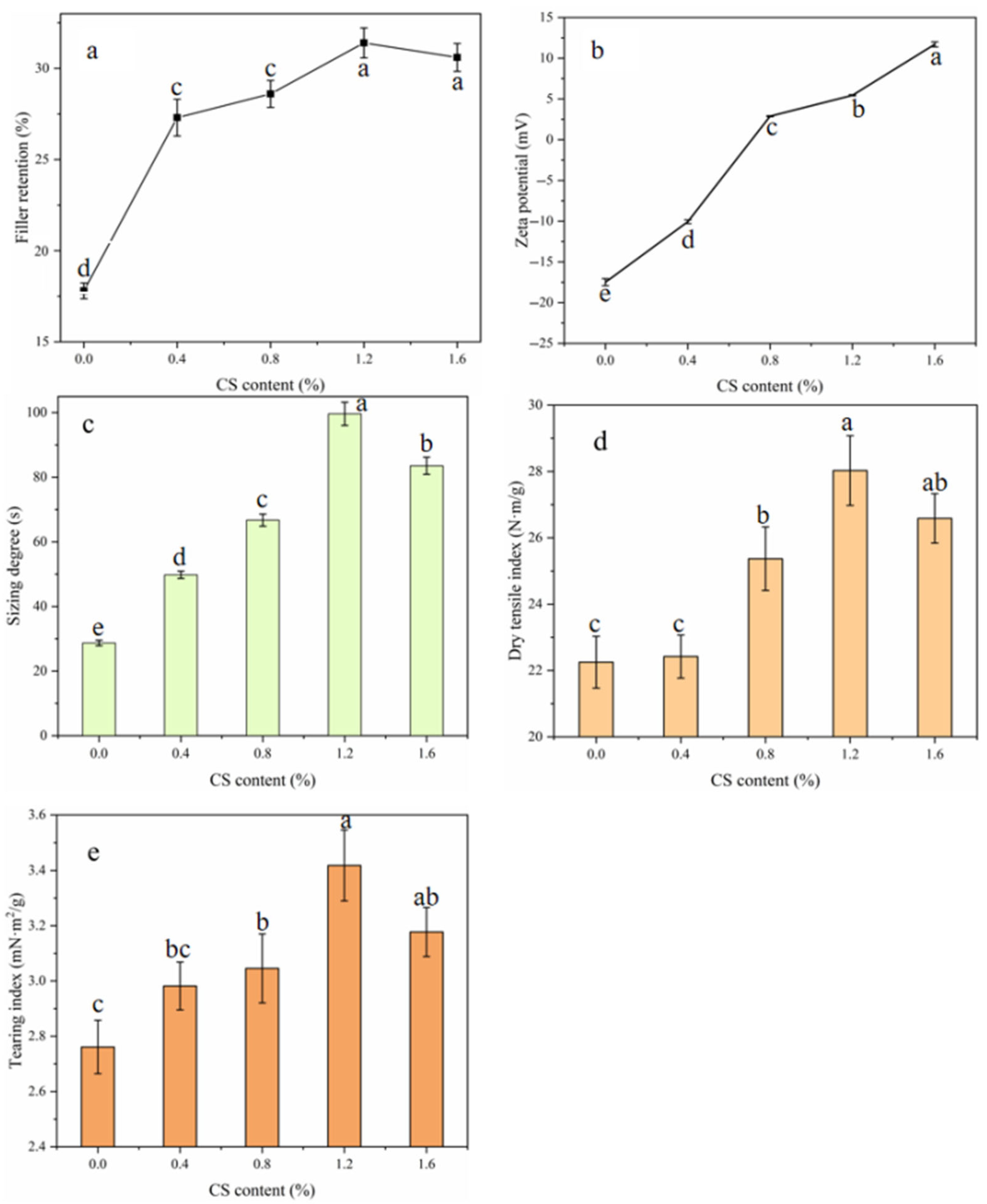
In Figure 1a, biochar retention increased with increasing CS dosage and reached a maximum at 1.2 wt%. This improvement is primarily attributed to the adsorption of CS onto negatively charged biochar and fiber surfaces, which reduces electrostatic repulsion and enhances particle attachment to fibers. The adsorbed CS promotes particle aggregation and improves filler fixation within the fiber network [20]. However, further addition of CS results in surface saturation and excessive charge neutralization, which weakens interfacial attraction and introduces steric hindrance, thereby reducing particle–fiber contact and decreasing retention efficiency.
The evolution of zeta potential (Figure 1b) indicates progressive surface charge modification with increasing CS dosage. The zeta potential gradually shifted toward the isoelectric region, reaching +2.4 mV at 1.2 wt%, suggesting increasing charge neutralization associated with CS adsorption on negatively charged biochar and fiber surfaces. This reduction in surface charge leads to weaker electrostatic repulsion, thereby creating more favorable conditions for particle aggregation. The observed charge regulation further suggests that CS modifies the interfacial environment of biochar, which may influence the accessibility of porous structures and the interaction behavior with wet-end additives during AKD sizing [21].
In Figure 1c, SD increased continuously with increasing CS dosage, reaching 169.37 s at 1.2 wt%, corresponding to a 247.10% improvement. This result demonstrates that CS addition improved sizing performance under the tested conditions. The concurrent increases in biochar retention and sizing degree are consistent with a possible change in AKD partitioning within the system. CS adsorption may modify the accessibility of porous adsorption sites on biochar, potentially leaving a larger fraction of AKD available for effective sizing on fiber surfaces [22,23].
Mechanical properties followed the same increasing trend as retention and sizing performance. In Figure 1d,e, both DTI and TI increased with CS dosage and reached their maximum values at 1.2 wt%, with improvements of 25.95% and 23.79%, respectively [24]. This enhancement is mainly attributed to improved integration between biochar and fibers, which facilitates more efficient load transfer within the fiber network [25]. The retained biochar acts as a microfiller that fills voids within the fiber structure and contributes to network densification, while CS promotes interfacial adhesion through hydrogen bonding and electrostatic patch interactions, thereby reinforcing network integrity [26,27].

3.3. CPAM-Mediated Bridging in the GB System

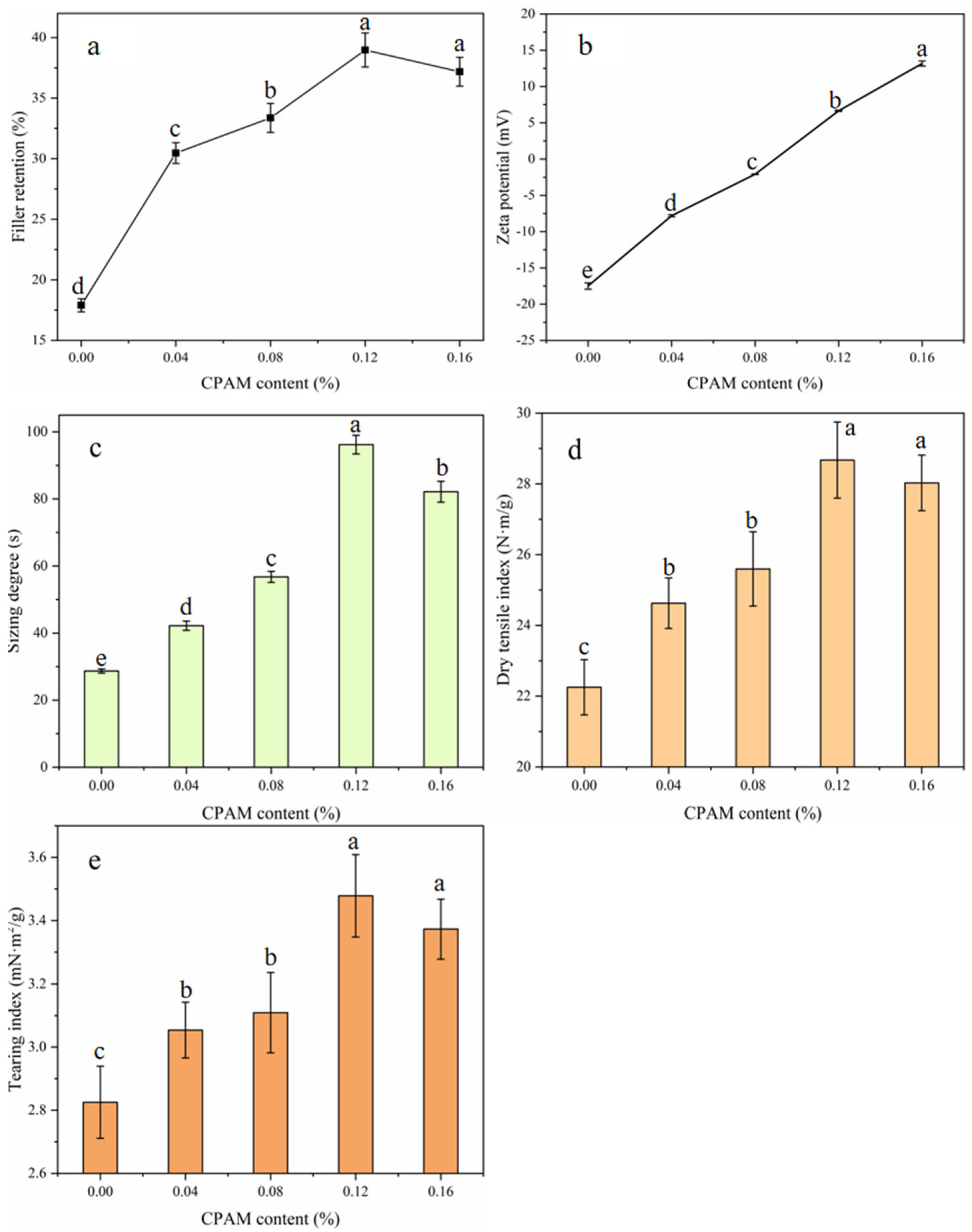
In Figure 2a, biochar retention increased progressively with increasing CPAM dosage and reached a maximum of 38.71% at 0.12 wt%. This improvement is primarily attributed to the bridging flocculation effect of CPAM [28].
The observed increase in biochar retention is consistent with CPAM-mediated bridging flocculation. According to established polymer-bridging theory, CPAM adsorbed on negatively charged regions of biochar and RSF surfaces may promote interparticle association and the formation of larger floc structures. Partially adsorbed polymer chains may extend into the surrounding medium and interact with neighboring particles, although the adsorption amount and chain conformation of CPAM were not directly characterized in this study [29]. The decrease in retention above the optimum CPAM dosage could be associated with increased surface coverage, charge compensation, or steric stabilization.
The zeta potential results shown in Figure 2b further reflect the interfacial charge regulation induced by CPAM adsorption. Biochar and RSF contain abundant oxygen-containing functional groups. As the CPAM dosage increased, the zeta potential gradually shifted toward the isoelectric point and became positive at 0.12 wt%, indicating progressive charge compensation by the permanently positively charged quaternary ammonium groups of CPAM. In addition, the amide groups of CPAM may participate in hydrogen-bonding interactions with the hydroxyl-rich RSF surface, further promoting polymer adsorption and interfacial association [30]. Therefore, the observed positive shift in zeta potential reflects the combined effects of electrostatic adsorption, surface charge compensation, and polymer coverage, which collectively facilitate floc formation and contribute to the improved retention performance.
In Figure 2c, SD increased with increasing CPAM dosage and reached a maximum of 163.54 s at 0.12 wt%, corresponding to a 253.20% improvement. This enhancement is mainly attributed to the formation of a more compact fiber network induced by CPAM bridging flocculation, which promotes the joint retention of biochar, fibers, and AKD-related components within the paper structure [31]. Previous studies involving AKD, CPAM, and pulp fibers demonstrated that CPAM can promote AKD deposition onto fibers through asymmetric bridging rather than uniform adsorption onto all colloidal components [32]. The simultaneous increase in biochar retention and SD indicates that CPAM-mediated flocculation can partially mitigate the retention–sizing trade-off associated with porous biochar. However, due to the remaining available adsorption sites on biochar surfaces, a portion of AKD is still retained by fillers rather than fibers, which limits the overall improvement in sizing efficiency.
The mechanical properties exhibited a similar optimum-dosage trend to retention and sizing performance. In Figure 2d,e, both the DTI and TI increased with CPAM dosage and reached maximum values at 0.12 wt%, corresponding to improvements of 28.85% and 25.97%, respectively. This enhancement is mainly attributed to the formation of a more integrated fiber network induced by CPAM bridging [33]. In addition, the amide groups of CPAM can participate in hydrogen-bonding interactions with hydroxyl groups on fiber surfaces, further strengthening interfacial adhesion.
Overall, CPAM primarily functions as a network-scale bridging agent that promotes fiber–filler aggregation rather than directly modifying the surface chemistry of biochar. Through interparticle bridging, CPAM facilitates the formation of larger and more cohesive flocs, thereby enhancing biochar retention and reinforcing structural integrity. This observation is consistent with filler retention models in which CPAM dosage and adsorption efficiency are key factors governing fiber–filler flocculation behavior [32]. However, CPAM adsorption mainly occurs on external particle surfaces and does not significantly alter the porous structure of biochar. As a result, its ability to suppress competitive AKD adsorption on biochar remains limited.

3.4. Assembly-Pathway Dependence of Biochar Floc Architecture

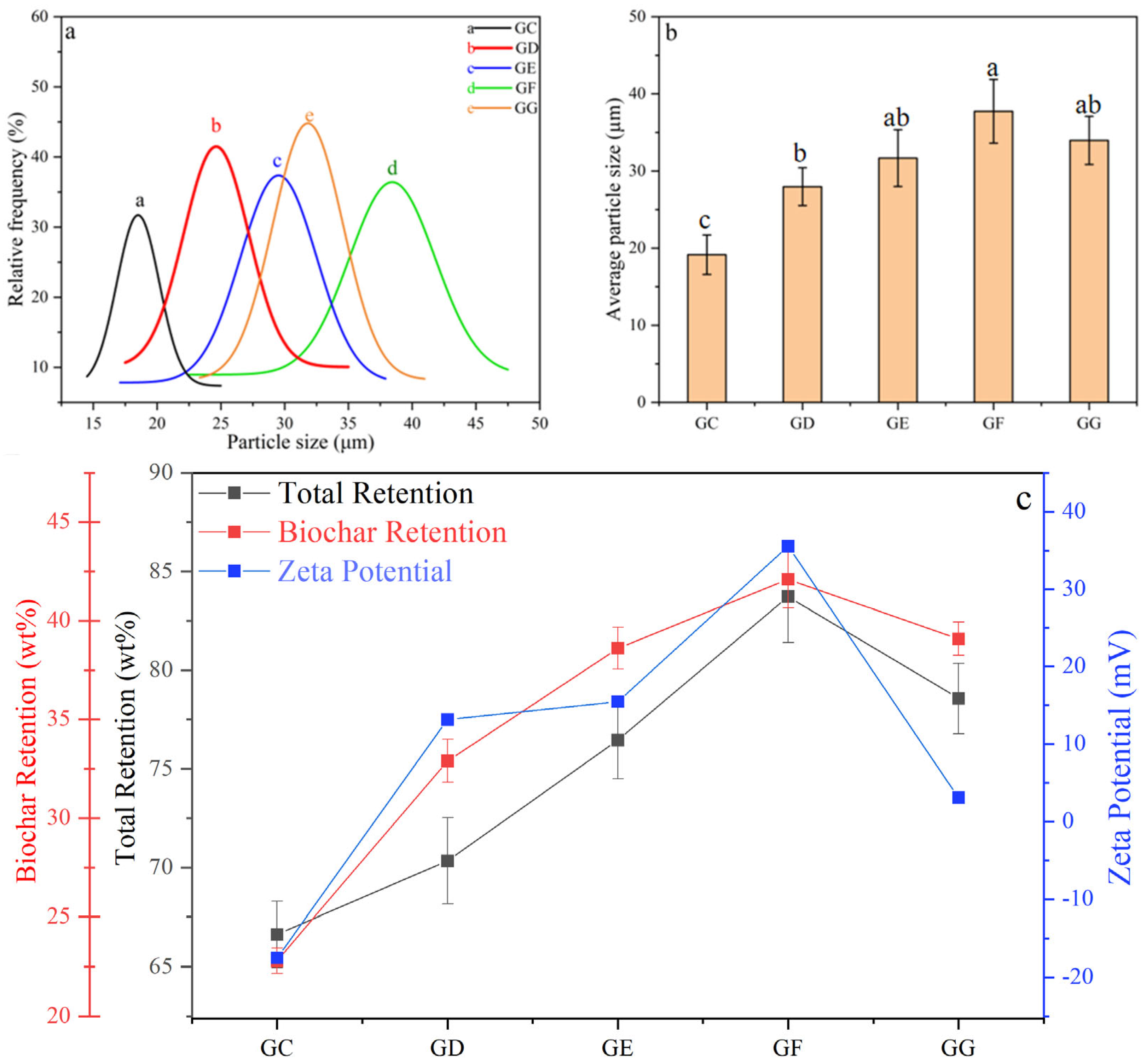
In Figure 3a, the PSD of biochar flocs varied significantly depending on the assembly pathway. GC exhibited a relatively narrow PSD ranging from 13 to 25 μm, indicating limited particle aggregation and weak floc development. The introduction of CS (GD) or CPAM (GE) broadened the PSD and shifted it toward larger particle sizes. Specifically, GD displayed a PSD range of 17–35 μm, whereas GE extended to 17–39 μm, indicating a stronger flocculation effect of CPAM compared to CS. The dual-component treatment (GG) further broadened the PSD to 23–43 μm. Notably, GF exhibited the widest PSD (20–50 μm), indicating the formation of larger and more developed floc structures. These results demonstrate that floc architecture is governed not only by additive type but also by the assembly sequence.
The median floc diameter (D50) shown in Figure 3b further reflects the influence of the assembly pathway on floc growth. Compared with GC, D50 increased by 1.54-fold, 1.32-fold, and 1.11-fold for GD, GE, and GG, respectively, while GF exhibited the largest increase of 1.94-fold. These results indicate that both single- and dual-polymer additions promote floc growth to varying degrees. The significantly larger floc size observed in GF suggests that the sequential assembly strategy enhances interparticle association more effectively than simultaneous dual-polymer addition. Therefore, the assembly sequence plays a critical role in governing floc development and resulting structure.
The electrokinetic behavior further supports the assembly-dependent floc architecture. In Figure 3c, GF exhibited the highest zeta potential (+35.34 mV), significantly exceeding those of GD (+13.17 mV), GE (+15.49 mV), and GG (+3.09 mV). This pronounced positive shift indicates a more strongly cationic surface state of the flocs formed via the GF pathway. More importantly, the higher positive charge suggests that cationic functionalities remained exposed on the floc surface after assembly, which may favor subsequent filler–fiber association during sheet formation [34].
The retention results closely followed the evolution of floc architecture and electrokinetic properties. GF achieved the highest total retention (83.73%) and biochar retention (42.11%). Relative to GC, total retention and biochar retention increased by 25.70% and 84.77%, respectively. This improvement can be attributed to the synergistic effects of electrokinetic regulation and hierarchical floc assembly. GG’s total retention and biochar retention were 6.58% and 7.73% lower than those of GF, respectively. This difference indicates that hierarchical charge regulation by CS and CPAM provides more effective electrokinetic control and floc stabilization than APAM.

3.5. Comprehensive Performance of Different Assembly Pathways

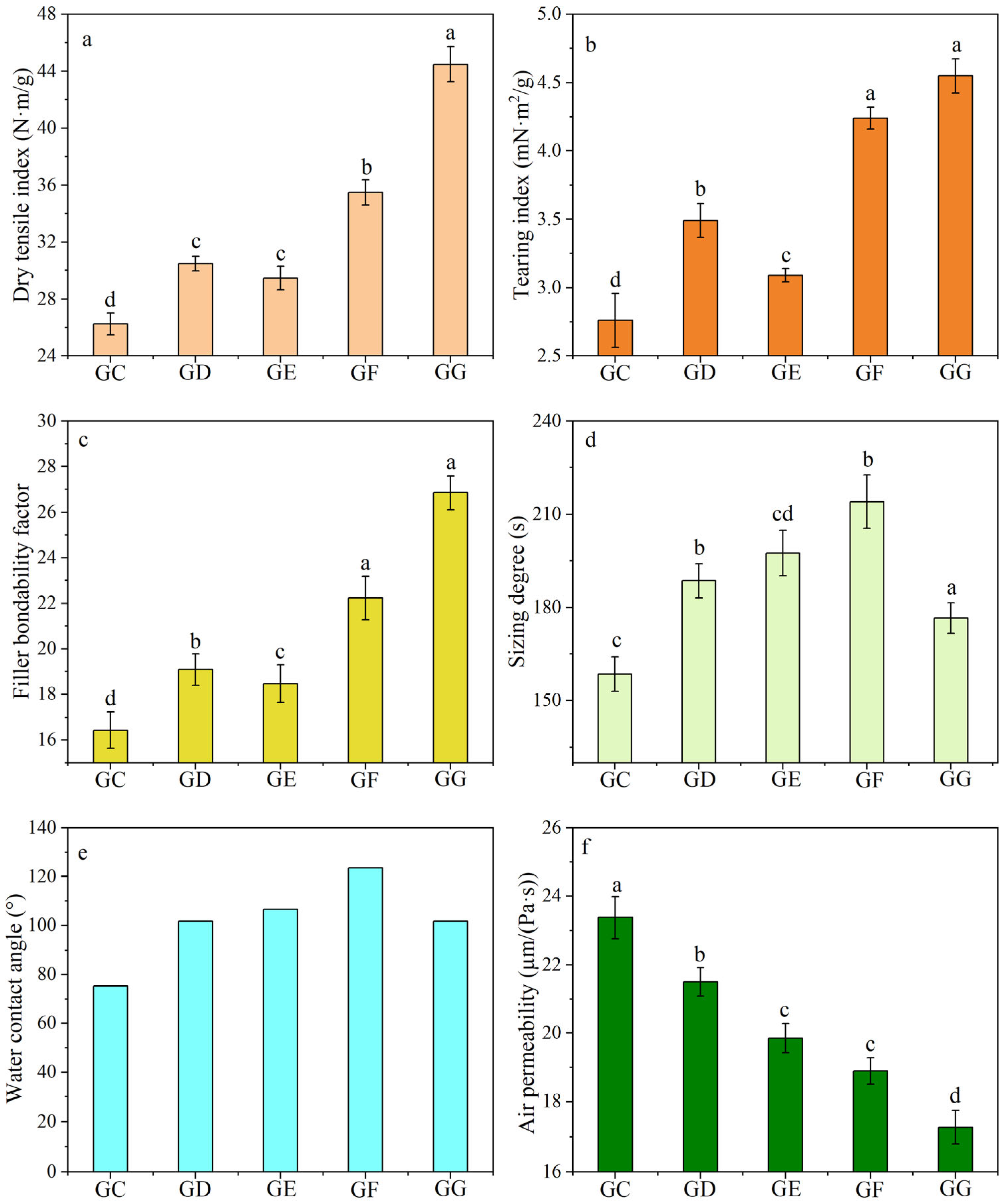
Figure 4 summarizes the comprehensive performance prepared through different biochar assembly pathways. Given that all groups were prepared with the same KP: RS ratio of 30:70, kraft pulp served as a fixed compositional component, allowing the effects of different biochar assembly pathways to be evaluated under an identical fiber-matrix composition. Among all assembly pathways, GF achieved the most balanced improvement in composite performance, especially by simultaneously enhancing filler retention, sizing efficiency, and hydrophobicity. Relative to GC, DTI, TI, FBF, SD, and WCA increased by 35.14%, 53.62%, 35.30%, 35.02%, and 64.13%, respectively, and AP decreased by 19.16%. These results demonstrate that the GF pathway simultaneously enhances mechanical strength, filler utilization efficiency, hydrophobicity, and air permeability and water-resistance-related performance.
The superior performance of GF can be attributed to the cooperative regulation of particle-scale interfaces and network-scale connectivity achieved through the EABF strategy. CS-induced surface passivation likely reduces the accessibility of porous adsorption sites on biochar, thereby mitigating competitive interactions between biochar and AKD. Simultaneously, CPAM-mediated asymmetric bridging promotes the co-retention of passivated biochar, fibers, and sizing-agent domains within the fiber network. As a result, a larger fraction of AKD remains available for effective deposition and orientation on fiber surfaces. This interpretation is consistent with previous studies showing that retention aids, filler preflocculation, and CPAM-assisted bridging can improve AKD retention and sizing efficiency by enhancing additive deposition and retention within the sheet structure [35]. The improvements in mechanical performance are closely associated with enhanced filler utilization. In Figure 4c, GF exhibited the highest FBF, indicating that the retained biochar contributed more effectively to reinforcement of the fiber network. This behavior is consistent with the larger pre-assembled floc size and higher retention achieved by the hierarchical assembly pathway. The enlarged and more shear-resistant flocs are less susceptible to disruption during sheet formation, resulting in more stable filler retention and a more homogeneous distribution of biochar throughout the fiber network. Therefore, the higher FBF reflects not only improved filler retention but also more efficient stress transfer arising from enhanced filler–fiber integration and more effective utilization of the retained biochar.

3.6. Mechanistic Pathway of Hierarchical Encapsulation–Asymmetric Bridging

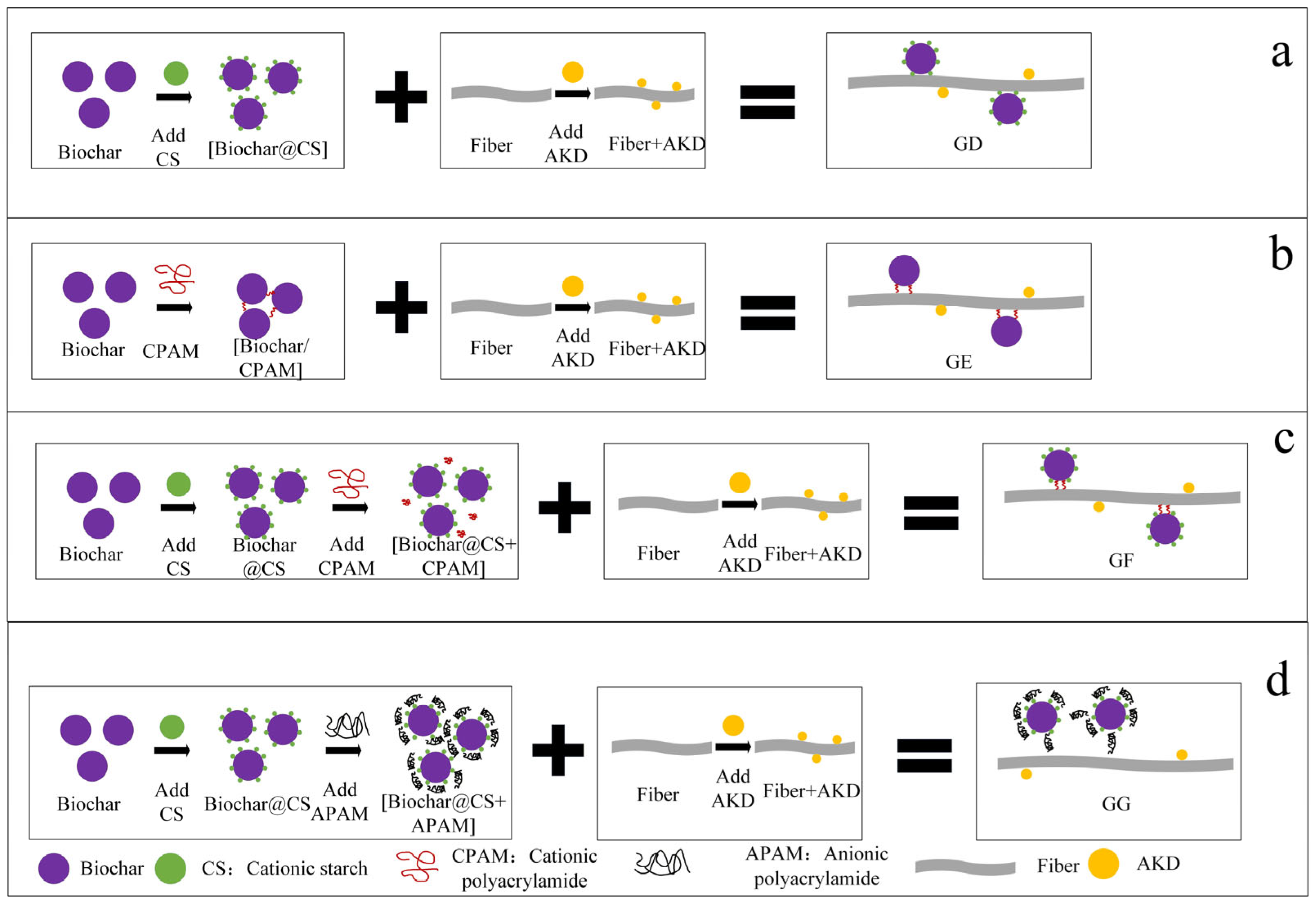
Figure 5 summarizes the proposed assembly mechanisms for the different assembly pathways. The combined evidence from wet-dispersion floc-size evolution, electrokinetic behavior, retention analysis, and mechanical strength, surface hydrophobicity, and air barrier properties supports the hierarchical encapsulation–asymmetric bridging flocculation (EABF) mechanism.
The GD and GE pathways involve only a single mode of regulation. In GD (Figure 5a), CS primarily modifies the biochar interface through surface adsorption and charge neutralization but provides limited long-range bridging capability, resulting in moderate floc growth and retention enhancement. In GE (Figure 5b), CPAM promotes flocculation through polymer bridging. However, the absence of prior biochar passivation leaves the porous biochar surface highly accessible, allowing continued competitive adsorption of wet-end additives within the porous biochar structure [36].
For GF (Figure 5c), the assembly process proceeds through two sequential stages. In the first stage, CS preferentially adsorbs onto negatively charged biochar surfaces through electrostatic attraction, forming a Biochar@CS structure. The resulting passivation layer partially covers accessible adsorption sites and induces a positive surface charge, thereby reducing the availability of biochar surface sites that may otherwise compete for AKD molecules [37]. In the second stage, CPAM functions as an asymmetric bridging agent. Consistent with asymmetric bridging theory, CPAM chains adsorbed onto negatively charged fiber surfaces and subsequently capture CS-modified biochar particles [38].
In the GG pathway (Figure 5d), although dual-component regulation promotes floc growth, replacing CPAM with APAM reduces the efficiency of filler–fiber association. Unlike CPAM, APAM lacks strong cationic adsorption sites and therefore provides limited bridging between negatively charged RSF and biochar particles. Consequently, the resulting flocs exhibit lower electrokinetic stability, retention efficiency, and structural integrity than those formed through the GF pathway.
Overall, the superior performance of GF originates from the coordinated regulation of interfacial interactions across multiple length scales. The encapsulation stage optimizes the biochar interface and improves AKD utilization by reducing the accessibility of porous adsorption sites, whereas the asymmetric bridging stage reinforces filler–fiber connectivity and network integrity [39]. This division of interfacial functions is consistent with previous studies showing that surface encapsulation, filler preflocculation, and polymer-bridging retention systems can improve retention and composite strength when floc size, surface charge, and addition sequence are properly controlled. Through this hierarchical assembly process, improvements in floc architecture are translated into enhanced filler retention, mechanical reinforcement, hydrophobicity, and air barrier properties.

4. Conclusions

A hierarchical encapsulation–asymmetric bridging flocculation (EABF) strategy was proposed and evaluated to alleviate the retention–sizing trade-off (RST) in biochar-filled straw fiber-based composites under the investigated conditions. By integrating CS and CPAM through sequential interfacial assembly, the strategy coupled surface passivation with asymmetric polymer bridging, enabling coordinated regulation of particle-scale interactions and network-scale structural organization.
The individual functions of CS and CPAM were clearly differentiated. CS primarily acted as an interfacial passivator, reducing the accessibility of porous adsorption sites and improving biochar–fiber compatibility. In contrast, CPAM functioned mainly as a bridging flocculant that enhanced filler retention and network consolidation through long-range polymer bridging and floc growth.
GF exhibited the best overall performance. Relative to GC, the median floc diameter increased by 1.94-fold, while total retention and biochar retention increased by 25.70% and 84.77%, respectively. These structural improvements were accompanied by simultaneous enhancements in mechanical strength, filler bondability, hydrophobicity, surface hydrophobicity, and air barrier properties. Mechanistically, the EABF strategy may alleviate the retention–sizing trade-off through the synergistic coupling of surface passivation and asymmetric bridging under the investigated conditions. CS is proposed to form a passivating encapsulation layer on biochar surfaces, which likely reduces the accessibility of porous adsorption sites and thereby may suppress competitive AKD adsorption. CPAM is proposed to preferentially bridge CS-modified biochar with negatively charged straw fibers, consistent with asymmetric polymer-bridging theory. Overall, the EABF strategy provides a potential approach for alleviating performance trade-offs in biochar-filled straw fiber-based composites and offers useful insight into interfacial regulation under the investigated conditions. It also suggests a potential pathway for the high-value utilization of agricultural residues by enabling their conversion into functional materials for sustainable packaging applications.

Author Contributions

Conceptualization, R.L. and M.Q.; methodology, Y.S.; data curation, M.Q.; writing—original draft preparation, R.L.; writing—review and editing, Y.S.; visualization, R.L.; supervision, M.Q.; project administration, R.L.; funding acquisition, R.L. All authors have read and agreed to the published version of the manuscript.

Funding

This work was partially supported by Heilongjiang Provincial Postdoctoral Scientific Research Starting Foundation (LBH-Z19040).

Institutional Review Board Statement

Not applicable.

Informed Consent Statement

Not applicable.

Data Availability Statement

The original data presented in this study are included in the article. Further inquiries can be directed to the corresponding author.

Conflicts of Interest

The authors declare no conflicts of interest.

Abbreviations

The following abbreviations are used in this manuscript:
AKDAlkyl ketene dimer
APAir permeability
APAMAnionic polyacrylamide
CPAMCationic polyacrylamide
CSCationic starch
DTIDry tensile index
EABFEncapsulation–Asymmetric Bridging Flocculation
FBFFiller bondability factor
IEPIsoelectric point
KPKraft pulp
PSDParticle size distribution
RSRice straw fiber
RSFRice straw fiber furnish (70 wt% RS and 30 wt% KP)
SDSizing degree
TITearing index
WCAWater contact angle

References

  1. Singh, Y.; Sharma, S.; Kumar, U.; Sihag, P.; Balyan, P.; Singh, K.P.; Dhankher, O.P. Strategies for economic utilization of rice straw residues into value-added by-products and prevention of environmental pollution. Sci. Total Environ. 2024, 906, 167714. [Google Scholar] [CrossRef] [PubMed]
  2. Darmenbayeva, A.; Rajasekharan, R.; Idrisheva, Z.; Aubakirova, R.; Dautova, Z.; Abylkassova, G.; Zhamanbayeva, M.; Afanasenkova, I.; Massalimova, B. Sustainable Cellulose Production from Agro-Industrial Waste: A Comprehensive Review. Polymers 2026, 18, 153. [Google Scholar] [CrossRef] [PubMed]
  3. Garg, R.; Garg, R.; Anjum, A.; Eddy, N.O.; Watandost, H. Valorization of natural fiber composites for sustainable food packaging materials. Discov. Food 2025, 5, 381. [Google Scholar] [CrossRef]
  4. Yu, Z.; Ji, Y.; Bourg, V.; Bilgen, M.; Meredith, J.C. Chitin- and cellulose-based sustainable barrier materials: A review. Emergent Mater. 2020, 3, 919–936. [Google Scholar] [CrossRef]
  5. Aboughaly, M.; Babaei-Ghazvini, A.; Dhar, P.; Patel, R.; Acharya, B. Enhancing the Potential of Polymer Composites Using Biochar as a Filler: A Review. Polymers 2023, 15, 3981. [Google Scholar] [CrossRef] [PubMed]
  6. Bartoli, M.; Arrigo, R.; Malucelli, G.; Tagliaferro, A.; Duraccio, D. Recent Advances in Biochar Polymer Composites. Polymers 2022, 14, 2506. [Google Scholar] [CrossRef] [PubMed]
  7. Antunes, E.; Garcia, F.; Ferreira, P.; Blanco, A.; Negro, C.; Rasteiro, M. Use of New Branched Cationic Polyacrylamides to Improve Retention and Drainage in Papermaking. Ind. Eng. Chem. Res. 2008, 47, 9370–9375. [Google Scholar] [CrossRef]
  8. Karademir, A.; Chew, Y.S.; Hoyland, R.W.; Xiao, H. Influence of Fillers on Sizing Efficiency and Hydrolysis of Alkyl Ketene Dimer. Can. J. Chem. Eng. 2005, 83, 603–606. [Google Scholar]
  9. Zhang, X.; Huang, Y.; Fu, K.; Yuan, S.; Huang, C.; Li, H. Preparation and performance of cationic flocculant for papermaking based on the graft polymerization of cationic chains from colloidal silica particles. Colloids Surf. A Physicochem. Eng. Asp. 2016, 491, 29–36. [Google Scholar] [CrossRef]
  10. Taheri, A.A.; Rahmaninia, M.; Khosravani, A. Interaction of the electrical conductivity of recycled pulp colloidal suspension with chitosan and bentonite as a papermaking additive system. BioResources 2022, 17, 1805–1817. [Google Scholar] [CrossRef]
  11. Hubbe, M.; Rojas, O. Colloidal stability and aggregation of Lignocellulosic materials in aqueous suspension: A review. BioResources 2008, 3, 1419–1491. [Google Scholar] [CrossRef]
  12. Yekeler, M.; Sönmez, B. Effect of the hydrophobic fraction and particle size in the collectorless column flotation kinetics. Colloids Surf. A Physicochem. Eng. Asp. 1997, 121, 9–13. [Google Scholar] [CrossRef]
  13. GB/T 12914-2018; Paper and Board—Determination of Tensile Properties—Constant Rate of Elongation Method (20 mm/min). Standards Press of China: Beijing, China, 2018.
  14. GB/T 455-2002; Paper and Board—Determination of Tearing Resistance. Standards Press of China: Beijing, China, 2002.
  15. ISO 2144:2019; Paper, Board, Pulps and Cellulose Nanomaterials—Determination of Residue (Ash Content) on Ignition at 900 °C. International Organization for Standardization: Geneva, Switzerland, 2019.
  16. Qian, C.; Li, Q.; Zhang, Z.; Wang, X.; Hu, J.; Cao, W. Prediction of higher heating values of biochar from proximate and ultimate analysis. Fuel 2020, 265, 116925. [Google Scholar] [CrossRef]
  17. Bangar, S.P.; Kajla, P.; Ghosh, T. Valorization of wheat straw in food packaging: A source of cellulose. Int. J. Biol. Macromol. 2023, 227, 762–776. [Google Scholar] [CrossRef] [PubMed]
  18. GB/T 460-2008; Paper—Determination of the Sizing Value. Standards Press of China: Beijing, China, 2008.
  19. GB/T 458-2008; Paper and Board—Determination of Air Permeance. Standards Press of China: Beijing, China, 2008.
  20. Eltaweil, A.S.; Al Harby, N.; El Batouti, M.; Abd El-Monaem, E.M. Engineering a sustainable cadmium sulfide/polyethyleneimine-functionalized biochar/chitosan composite for effective chromium adsorption: Optimization, co-interfering anions, and mechanisms. RSC Adv. 2024, 14, 22266–22279. [Google Scholar] [CrossRef] [PubMed]
  21. Su, X.; Wang, X.; Ge, Z.; Bao, Z.; Lin, L.; Chen, Y.; Dai, W.; Sun, Y.; Yuan, H.; Yang, W.; et al. KOH-activated biochar and chitosan composites for efficient adsorption of industrial dye pollutants. Chem. Eng. J. 2024, 486, 150387. [Google Scholar] [CrossRef]
  22. Nwanji, O.L.; Babalola, J.O.; Arotiba, O.A. Preparation and characterisation of chitosan-Hura crepitans pod biochar and evaluation of its fuel properties and adsorption capacity for methylene blue remediation. Adsorption 2025, 31, 72. [Google Scholar] [CrossRef]
  23. Rodríguez-Fabià, S.; Torstensen, J.; Johansson, L.; Syverud, K. Hydrophobization of lignocellulosic materials part II: Chemical modification. Cellulose 2022, 29, 8957–8995. [Google Scholar] [CrossRef]
  24. Bhardwaj, S.; Bhardwaj, N.K.; Negi, Y.S. Efficacy of Biodegradable Chitosan Polymer for Simultaneous Improvement in Ash and Strength Properties of Paper. J. Nat. Fibers 2023, 20, 2237672. [Google Scholar] [CrossRef]
  25. Palaniappan, M.; Kumar, P.M.; Sivanantham, G.; Gebreyohannes, D.T. Chemical and structural characterization of ramie-based epoxy composites reinforced with macadamia nut shell biochar. Sci. Rep. 2026, 16, 9374. [Google Scholar] [CrossRef] [PubMed]
  26. Shalchian, M.M.; Arabani, M.; Farshi, M.; Ranjbar, P.Z.; Khajeh, A.; Payan, M. Sustainable construction materials: Application of chitosan biopolymer, rice husk biochar, and hemp fibers in geo-structures. Case Stud. Constr. Mater. 2025, 22, e04528. [Google Scholar] [CrossRef]
  27. Nicu, R.; Bobu, E.; Miranda Carreño, R.; Blanco Suárez, M. Flocculation efficiency of chitosan for papermaking applications. Bioresources 2013, 8, 768. [Google Scholar] [CrossRef]
  28. Xie, Y.; Yin, W.; Yao, J.; Xue, F.; Liu, J.; Ban, X. Application and mechanism of an efficient hydrophobic flocculant CPAM in the flocculation reverse flotation of hematite and microfine-grained chlorite. J. Environ. Chem. Eng. 2024, 12, 112608. [Google Scholar] [CrossRef]
  29. Raj, P.; Batchelor, W.; Blanco, A.; de la Fuente, E.; Negro, C.; Garnier, G. Effect of polyelectrolyte morphology and adsorption on the mechanism of nanocellulose flocculation. J. Colloid Interface Sci. 2016, 481, 158–167. [Google Scholar] [CrossRef] [PubMed]
  30. Su, J.; Garvey, C.J.; Holt, S.; Tabor, R.F.; Winther-Jensen, B.; Batchelor, W.; Garnier, G. Adsorption of cationic polyacrylamide at the cellulose-liquid interface: A neutron reflectometry study. J. Colloid Interface Sci. 2015, 448, 88–99. [Google Scholar] [CrossRef] [PubMed]
  31. Sözbir, T.; Çiçekler, M. A study on effect of modified calcite on filler retention and mechanical properties of fluting papers. Bilimsel Madencilik Derg. 2022, 61, 13–18. [Google Scholar] [CrossRef]
  32. Poraj-Kozminski, A.; Hill, R.; van de Ven, T. Asymmetric Polymer Bridging Between Starch-Coated Colloidal Particles and Pulp Fibres by Cationic Polyacrylamide. Can. J. Chem. Eng. 2008, 85, 580–585. [Google Scholar] [CrossRef]
  33. Cho, B.-U.; Garnier, G.; van de Ven, T.G.M.; Perrier, M. A bridging model for the effects of a dual component flocculation system on the strength of fiber contacts in flocs of pulp fibers: Implications for control of paper uniformity. Colloids Surf. A Physicochem. Eng. Asp. 2006, 287, 117–125. [Google Scholar] [CrossRef]
  34. Xu, R.; Zou, W.; Rao, B.; Zhao, W.; Wang, T.; Zhang, Z. In situ kinetics and flocs conformation studies of kaolinite flocculated by Chi-g-CPAM. Int. J. Miner. Metall. Mater. 2023, 30, 813–823. [Google Scholar] [CrossRef]
  35. Peng, Y.; He, B.; Zhao, L.; Zhao, G. Effect of Pre-flocculation of Lime Mud CaCO3 Filler on AKD Sizing Efficiency. BioResources 2014, 9, 5976–5987. [Google Scholar] [CrossRef]
  36. Pettersson, K.; Nordlander, A.; Sasic Kalagasidis, A.; Modin, O.; Maggiolo, D. Dynamics of Contaminant Flow Through Porous Media Containing Random Adsorbers. Transp. Porous Media 2025, 152, 14. [Google Scholar] [CrossRef]
  37. Wu, J.; Wang, T.; Shi, N.; Pan, W.-P. Insight into mass transfer mechanism and equilibrium modeling of heavy metals adsorption on hierarchically porous biochar. Sep. Purif. Technol. 2022, 287, 120558. [Google Scholar] [CrossRef]
  38. Chen, Z.; Fan, G.; He, X.; Xu, L.; Zhang, X.; He, Z.; Zhang, L. Diatomite Modified with an Alkyl Ketene Dimer for Hydrophobicity of Cellulosic Paper. ACS Omega 2022, 7, 20129–20136. [Google Scholar] [CrossRef] [PubMed]
  39. Su, N. Spherical Polyelectrolyte Brushes as Flocculants and Retention Aids in Wet-End Papermaking. Molecules 2023, 28, 7984. [Google Scholar] [CrossRef] [PubMed]
Figure 1. Effect of CS dosage on retention (a), zeta potential (b), SD (c), DTI (d), and TI (e) in GA. Different lowercase letters indicate statistically significant differences among treatments (p < 0.05), whereas the same or shared letters indicate no significant difference.
Sustainability 18 07914 g001
Figure 2. Effect of CPAM dosage on retention (a), zeta potential (b), SD (c), DTI (d), and TI (e) in GB. Different lowercase letters indicate statistically significant differences among treatments (p < 0.05), whereas the same or shared letters indicate no significant difference.
Sustainability 18 07914 g002
Figure 3. Particle size distribution (PSD, (a)), median floc diameter (D50, (b)) of biochar flocs, and zeta potential and retention performance (c) of different assembly pathways at a biochar dosage of 20 wt%. Different lowercase letters indicate statistically significant differences among treatments (p < 0.05), whereas the same or shared letters indicate no significant difference.
Sustainability 18 07914 g003
Figure 4. Effects of different biochar assembly pathways on the DTI (a), TI (b), FBF (c), SD (d), WCA (e), and AP (f). Different lowercase letters indicate statistically significant differences among treatments (p < 0.05), whereas the same or shared letters indicate no significant difference.
Sustainability 18 07914 g004
Figure 5. Schematic illustration of the assembly mechanisms for GD (a), GE (b), GF (c), and GG (d).
Sustainability 18 07914 g005
Table 1. Sample designation.
CodePurpose Addition SequenceFinal Composite System
GAOptimization of CS dosageCS + AKD + Biochar → RSF (direct addition)RSF + CS + AKD + Biochar
GBOptimization of CPAM dosageAKD + CPAM + Biochar → RSF (direct addition)RSF + AKD + CPAM + Biochar
GCControlBiochar → AKD/RSFAKD/RSF + Biochar
GDCS surface passivationBiochar@CS → AKD/RSFAKD/RSF + [Biochar@CS]
GECPAM bridgingBiochar–CPAM → AKD/RSFAKD/RSF + [Biochar-CPAM]
GFEABFBiochar@CS–CPAM → AKD/RSFAKD/RSF + [Biochar@CS-CPAM]
GGdual-component retention systemsBiochar@CS–APAM → AKD/RSFAKD/RSF + [Biochar@CS-APAM]
Table 2. Effects of biochar particle size on retention performance.
GroupParticle Size (μm)Biochar Retention (%)
G330–5027.94 ± 1.02
G513–3026.02 ± 0.77
G107–1321.34 ± 0.54
G18<716.45 ± 0.42
Disclaimer/Publisher’s Note: The statements, opinions and data contained in all publications are solely those of the individual author(s) and contributor(s) and not of MDPI and/or the editor(s). MDPI and/or the editor(s) disclaim responsibility for any injury to people or property resulting from any ideas, methods, instructions or products referred to in the content.