
Pike Use in Megafauna Hunting and Antipredator Defense: Historical Techniques and Paleolithic Research


Abstract
1. Introduction
2. Materials and Methods
3. Results
3.1. Pike Use Context
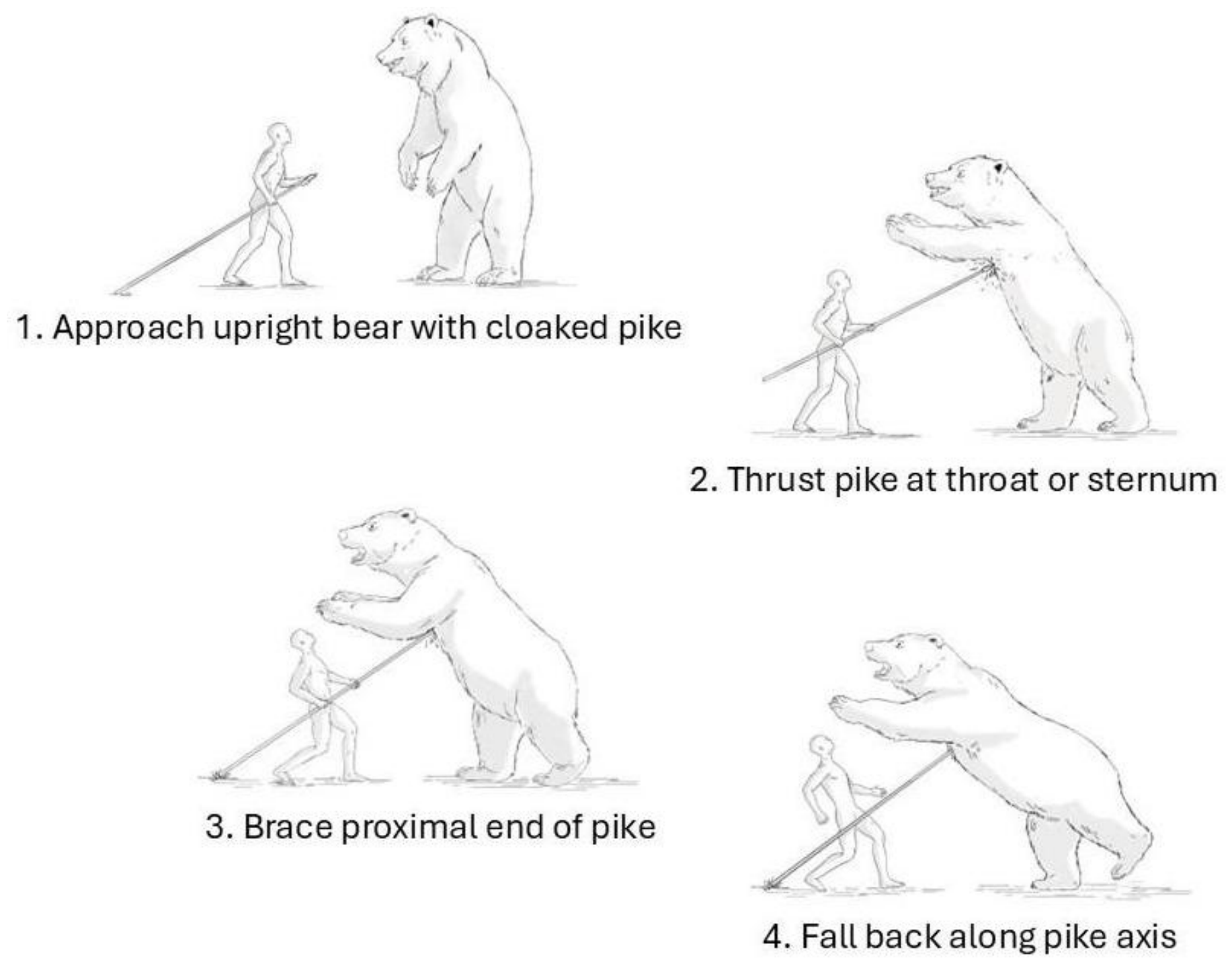
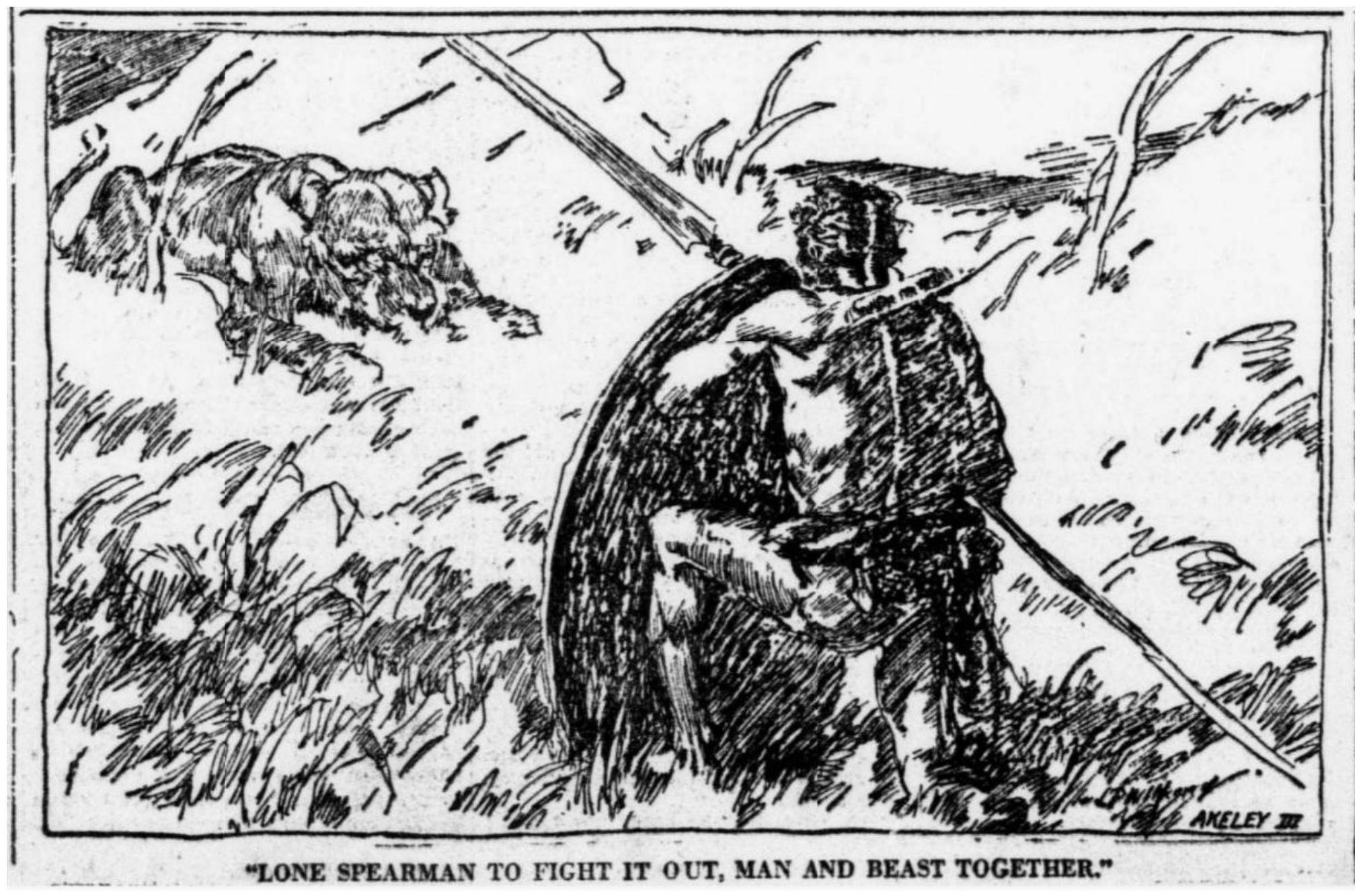
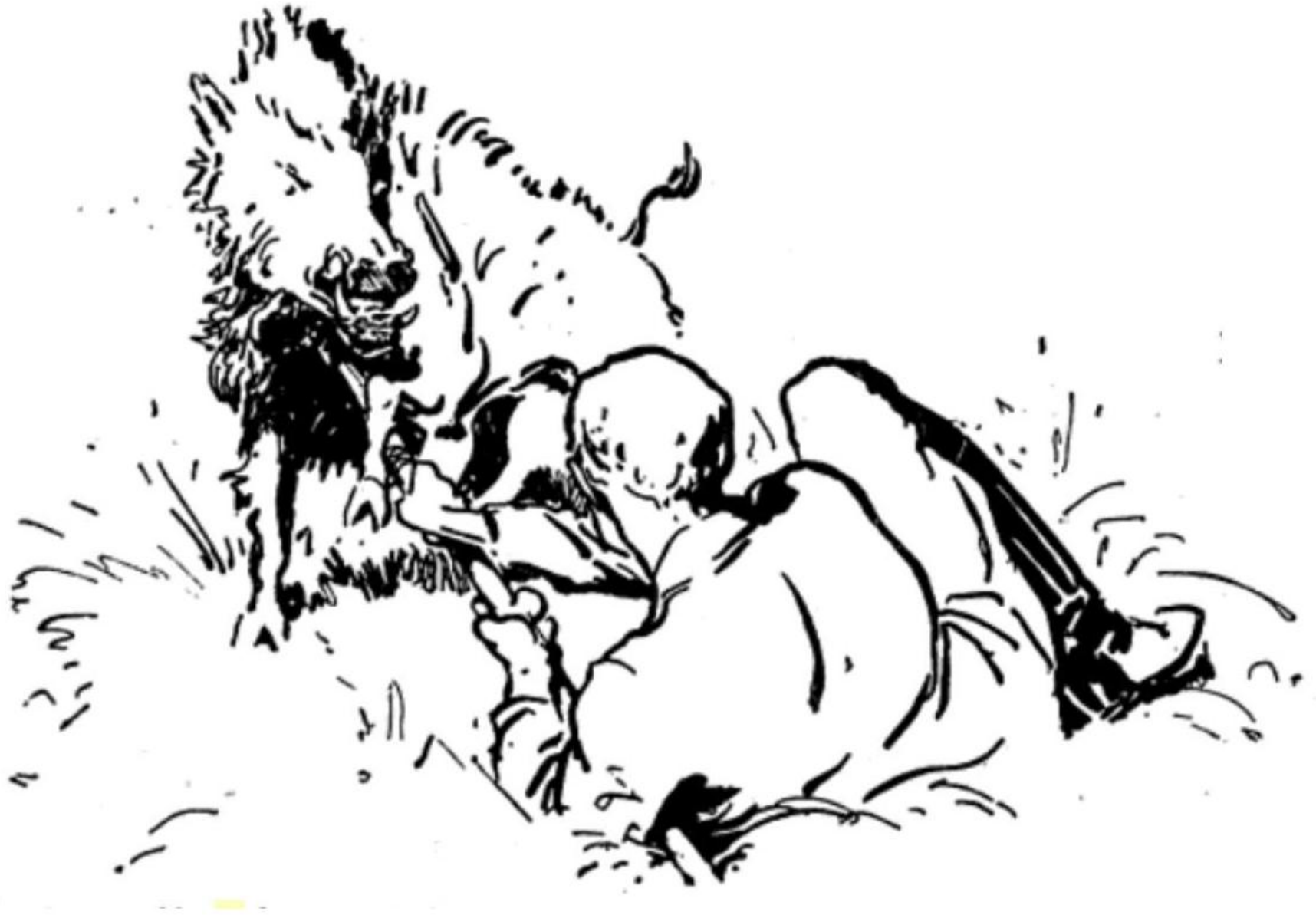
“Shots from muzzle-loaders were usually fired at point-blank range. There was no time to reload in the event of a misfire or being faced by a wounded bear and many hunters carried a long birch spear, tipped with a sharp metal point or knife, as a backup. An injured or provoked bear would instinctively get up on its hind legs and attack. Instead of running, the hunter would get down on his knees and plant the spear in the ground in front of him, with the tip pointing towards the bear. As the bear attacked, the hunter calmly aimed the spear at the bear’s chest and held his ground until it ran onto the spear” (Flatnes [82]).

3.2. Represented Species
“On my return to camp on this occasion, I found that my elephant had gone musth and was running amok among my tents. He ran at me as I stood in the door of the tent, but, as I had a spear in my hand, I placed the butt against my foot and let him run on to the point. He did not appear to like this, for he stopped and then left my camp and went off into the jungles.”
3.3. Pike Deployment Patterns
3.3.1. Megafauna Attack Mode
3.3.2. Associated Actions and Group Composition
3.3.3. Rotation
3.4. Pike Attributes
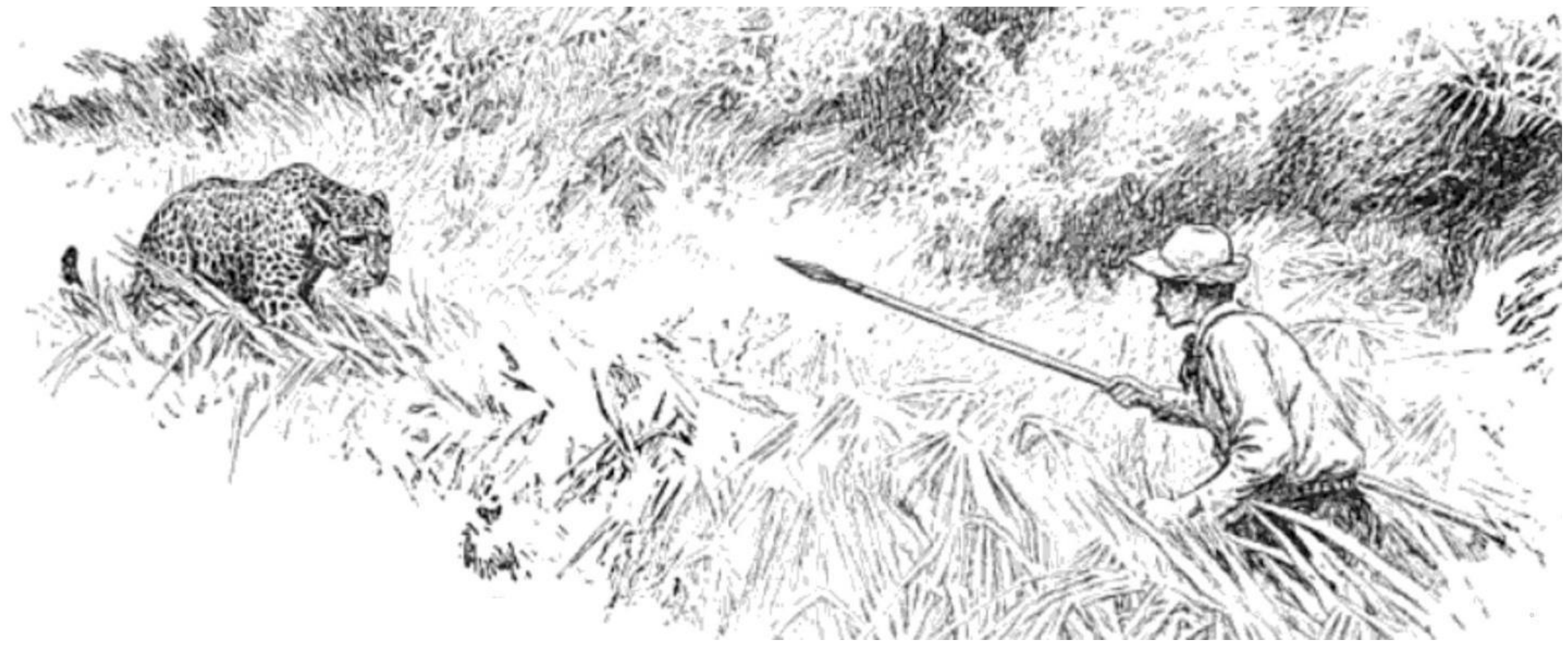
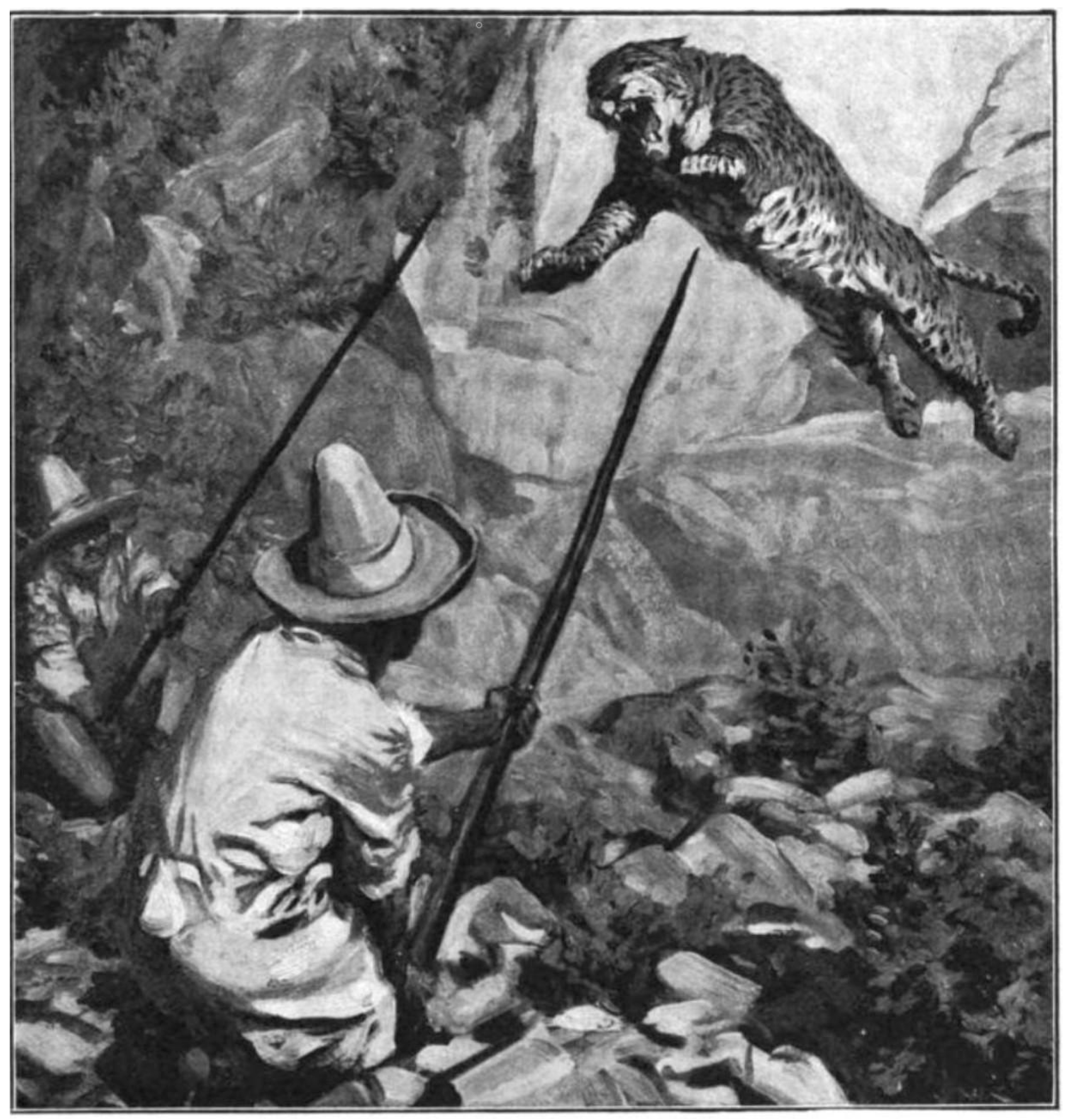
“… the tiger has sprung upon the point of a spear held in rest by a kneeling Malay, and, the spear, passing completely through the beast’s body, the tiger has come down on the man’s back and killed him. The old men say it is because, regardless of the wisdom of their ancestors, fools now face a tiger with spears unguarded, whereas in the olden time it was always the custom to tie a crosspiece of wood where blade joins shaft to prevent the tiger ‘running up the spear’ and killing his opponent.”
4. Discussion
4.1. Pleistocene Faunal Remains
4.2. Paleolithic Artifacts
- (1)
- Shaft diameter range is distinctive. Most replication and experimentation assume projectile or thrusting action and involve spear shafts less than 30 mm diameter, which is much smaller than known ethnographic and historical pikes used in megafauna hunting. In addition to wider main shafts, assessing pike use may require correspondingly wide lithic points, osseous points, and fire-hardened wood shaft tips for experiments.
- (2)
- Mastic is rarely mentioned in ethnohistorical pike hafting accounts, yet it is nearly ubiquitous in hafted lithic point experiments conducted by experimental archaeologists. The widespread use of robust lashing at the haft in documented pikes allows for strength without mastic and expeditious removal and replacement of points. Omitting mastic in replication also provides for a measure of elasticity in the haft, allowing dampening and/or detachment, which could play a role in the adjustment of some weapons to compression and rotation to reduce the likelihood of fracture (see [12]). Unlike human-powered lance and javelin use, pike impalement involves deep weapon penetration despite a thicker shaft and more robust perimeter lashing.
- (3)
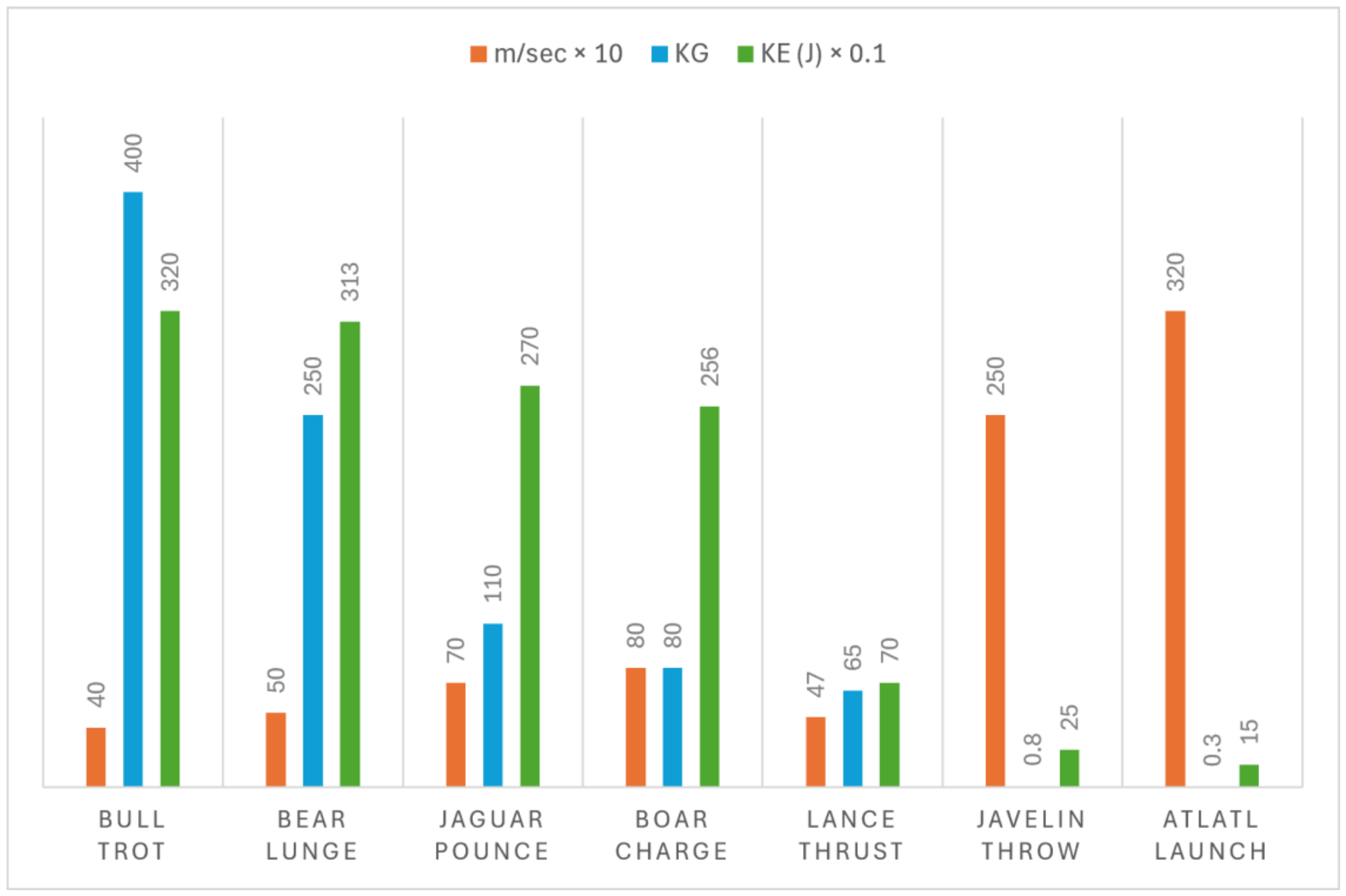
- As we showed in 2024, momentum experiments can involve much greater mass to replicate axial compression produced by fast-moving megafauna against a braced pike. Cross-bar position indicates that impalement well into the chest cavity was common, and several accounts depict ursids, suids and pantherids being completely transfixed when a cross bar was not present or was attached well below the pike tip. Experiments should employ the momentum necessary for a large diameter shaft to penetrate to such depths.
- (4)
- Experiments can involve pike rotation to assess the degree to which different point types and hafts more often convert oblique force to axial force without breakage or collapse under high compression with changing force direction. Among large points, some may be more stable, or hafts may be more flexible to allow for the oblique-to-axial force conversion necessary to initiate and maintain impalement of the forward moving target.
- (5)
- It may be productive to experiment with different wood types and fresh vs. seasoned wood to address variability such as force absorption through bending of longer shafts vs. rotation of shorter shafts. Are expedient shafts able to withstand impalement compression, or is seasoning necessary for a given wood species?
- (6)
- Replication and experimentation with wood and osseous hafted cross bars may lead to the identification of diagnostic wear patterns or materials, sizes and shapes that may be identified in archaeological specimens.
5. Conclusions
Supplementary Materials
Author Contributions
Funding
Data Availability Statement
Acknowledgments
Conflicts of Interest
Appendix A. Ethnohistorical Pike Accounts Dataset
| Region/Group | Period | Rec. Type | Ref # | Asmnt | Attack | Initial | Other | Hntrs | Dogs | Add. Weap. |
| Brown Bear (Ursus arctos) | ||||||||||
| Europe: Saami | 1900s | Image | [65] | E-1 | Lunge | Prov | Rifle | |||
| Europe: Saami | 1900s | Image | [65] | E-1 | Lunge | Prov | Cloaking | |||
| Europe: Saami | 1900s | Ethnographic | [51] | E-1 | Lunge 1 | Prov | ||||
| Europe: Saami | 1900s | Zoologist | [65] | E-1 | Lunge 1 | Cloaking | ||||
| Europe: Saami | 1900s | Ethnographic | [33] | E-1 | Lunge 1 | Cloaking | ||||
| Europe: Saami | 1800s | Ethnographic | [31] | E-1 | Lunge 2 | Prov | ||||
| Europe: Saami | 1800s | Ethnographic | [32] | E-1 | Lunge 1 | Prov | Yes | Spears | ||
| Europe: Saami | 1900s | Ethnographic | [114] | Lunge 1 | Prov | Parry | Yes | Spears | ||
| Europe: Saami | 1700s | Historical | [115] | H-1 | Lunge 1 | Prov | Yes | Muskets | ||
| Europe: Saami | 1800s | Image | [116] | H-3 | Lunge | Prov | 1 | Rifle, knife | ||
| Europe: Finland | 1800s | Historical | [117] | H-1 | Lunge 1 | Prov | Parry | |||
| Europe: Norway | 1900s | Historical | [37] | H-1 | Lunge 1 | Prov | Rotation | Projectiles | ||
| Europe: Norway | 1900s | Naturalist | [118] | Lunge 2 | Prov | |||||
| Europe: Norway | 1900s | Historical | [119] | H-1 | Lunge 1 | Prov | ||||
| Europe: Norway | 1800s | Historical | [82] | P-2 | Lunge 1 | Prov | Rifle/musk. | |||
| Europe: Norway | 1900s | Historical | [120] | H-1 | Lunge 1 | Prov | Cloaking | |||
| N. Europe | 1800s | Historical | [121] | Lunge 1 | ||||||
| W. Europe/medieval | 1500s | Image | [122] | H-2 | Lunge | Prov | 2 | 4 | ||
| W. Europe/medieval | 1500s | Image | [123] | H-2 | Lunge | Prov | 2 | 4 | Pike, sword | |
| Russia/Slavic | 1900s | Image | [124] | H-2 | Lunge 1 | 1 | Rifle | |||
| Russia/Slavic | 1800s | Image | [125] | Ob-2 | Lu or C | 6 | 5 | Axe, rifle | ||
| Russia/Slavic | 1900s | Image | [126] | H-2 | Lunge | 1 | 1 | Rifle | ||
| Russia/Slavic | 1800s | Hunting acct. | [61] | Ob-1 | Lunge 1 | Prov | Rotation | 2 | rifle | |
| Russia/Slavic | 1800s | Hunting acct. | [127] | Ob-3 | Lunge 1 | Pistol | ||||
| Russia/Slavic | 1800s | Hunting acct. | [128] | Ob-1 | Lunge 1 | Prov | Rotation | 2 | Rifle, spear | |
| Russia/Slavic | 1800s | Hunting acct. | [129] | Ob-2 | Lunge 1 | Prov | 1 | Guns, sword | ||
| Russia/Tver | 1900s | Hunting acct. | [130] | Ob-1 | Lunge 1 | Prov | 2 | Axe | ||
| Russia/Slavic | 1900s | Hunting acct. | [131] | H-2 | Lu or C | |||||
| Russia/Slavic | 1800s | Hunting acct. | [71] | Ob-1 | Lu or C | Prov | Yes | Musk., kni. | ||
| Russia/Slavic | 1800s | Hunting acct. | [132] | Ob-3 | Defen | 2 | ||||
| Russia/British | 1800s | Hunting acct. | [133] | Ob-1 | Lunge 1 | Prov | Rotation | Yes | ||
| Russia/St. Petersb. | 1800s | Hunting acct. | [134] | Ob-2 | Charge | Prov | Rotation | Yes | Rifle | |
| Belarus/Naliboki For | 1600s | Naturalist | [135] | H-3 | Lunge 2 | Prov | Yes | Sword | ||
| Siberia/Evenki | 1800s | Ethnographic | [136] | E-1 | Charge | |||||
| Altai/Tatars | 1800s | Hunting acct. | [137] | Ob-2 | Charge | Prov | Rifle | |||
| Ural Mtns/Bashkirs | 1800s | Hunting acct. | [138] | Ob-2 | Lunge 2 | |||||
| NE Asia; Evenk | 1900s | Ethnographic | [53] | E-1 | Lunge 2 | Prov | ||||
| NE Asia: Yakut | 1900s | Journalist | [99] | OT-2 | Prov | 1 | ||||
| NE Asia: Even | 1900s | Zoologist | [139] | E-1 | Lunge 2 | Prov | Yes | |||
| NE Asia/Kamchatka | 1800 | Naturalist | [140] | E-3 | Lunge 2 | Prov | Knife | |||
| NE Asia; Ainu | 1900s | Ethnographic | [141] | E-1 | Lunge 1 | Par/Clo | ||||
| NE Asia; Ainu | 1800s | Ethnographic | [142] | E-2 | Lunge 1 | Prov | 2 | Arro., kni. | ||
| NE Asia; Ainu | 1800s | Ethnographic | [49] | E-1 | Charge | Prov | Yes | Arrows | ||
| NE Asia: Amur R. | 1850s | Ethnographic | [143] | E-1 | Lunge 1 | 2+ | Yes, unspec. | |||
| NE Asia: Gilyak | 1900s | Ethnographic | [45] | E-1 | Lunge 1 | Prov | Par/Clo | Yes | Pikes | |
| Amur R.; Nanai | 1900s | Ethnographic | [39] | E-1 | Charge | Prov | Rotation | |||
| Amur R.; Nanai | 1900s | Ethnographic | [40] | E-1 | Lunge 1 | Prov | Rotation | 2+ | Arr., musk. | |
| Alaska: Kuuvanmiut | 1900s | Ethnographic | [43] | E-1 | Lunge 1 | Prov | Parry | |||
| Alaska: Inupiat | 1900s | Naturalist | [144] | E-2 | Lunge 1 | Prov | Parry | Spear | ||
| Innuit/Kuskokwim | 1900s | Historical | [145] | Charge | Prov | |||||
| Alaska: Innuit | 1800s | Naturalist | [146] | E-2 | Lunge 1 | Prov | ||||
| Alaska: Innuit | 1900s | Naturalist | [147] | Ob-2 | Charge | |||||
| Alaska: Innuit | 1900s | Image | [148] | H-3 | Lunge 1 | |||||
| Alaska:Nunamiut | 1900s | Ethnographic | [38] | E-1 | Lunge 1 | |||||
| Alaska:Nunamiut | 1800s | Ethnographic | [36] | E-1 | Lunge 1 | Prov | 1–2 | Arrows | ||
| Alaska:Nunamiut | 1900s | Ethnographic | [37] | E-1 | Lunge 1 | Prov | Rotation | Arrows | ||
| Alaska: Agulimuit | 1800s | Oral history | [54] | P-2 | Lunge 1 | Prov | ||||
| Alaska: Indigenous | 1900s | Oral history | [149] | OT-2 | Lunge 2 | Prov | Rotation | |||
| Innuit/Athabaskan | 1900s | Naturalist | [68] | E-2 | Charge | Parry | ||||
| Alaska: Koniag | 1900s | Ethnographic | [16] | E-1 | ||||||
| Alaska: Alutiiq | 1800s | Journalist | [150] | Ob-2 | Lu or C | Prov | ||||
| Alaska: Tanana | 1800s | Ethnographic | [151] | E-1 | Charge | |||||
| Alaska: Tanaina | 1900s | Naturalist | [152] | OT-1 | Charge | Prov | ||||
| Alaska: Tanaina | 1800s | Oral tradition | [153] | OT-2 | Charge | Prov | ||||
| Alaska/St. Elias | 1800s | Journalist | [154] | E-2 | Charge | Prov | Musket | |||
| Alaska/St. Elias | 1800s | Ethnographic | [155] | E-1 | Charge | Prov | Arrows | |||
| Alaska/St. Elias | 1800s | Ethnographic | [34] | E-1 | Lu or C | Defen | ||||
| Alaska: Yakutat | 1900s | Ethnographic | [34] | E-1 | Leap | |||||
| Alaska:Tlingit | 1900s | Hunting acct. | [156] | OT-3 | Charge | |||||
| Alaska:Tlingit | 1900s | Ethnographic | [56] | OT-1 | Leap | |||||
| Alaska/Denali NP | 1900s | Naturalist | [157] | E-2 | Charge | Prov | ||||
| Yukon; Kuitchin | 1900s | Journalist | [158] | E-2 | Lu or C | Prov | ||||
| Yukon; Kuitchin | 1800s | Ethnographic | [159] | OT-2 | Leap | |||||
| Yukon; Kuitchin | 1900s | Oral tradition | [160] | OT-2 | Charge | Prov | Arrows | |||
| Yukon: Han | 1800s | Ethnographic | [50] | E-1 | Lunge 2 | Prov | 2 | Other pikes | ||
| Yukon: Koyukon | 1800s | Ethnographic | [48] | E-1 | Lunge 1 | Prov | ||||
| Yukon: Koyukon | 1900s | Oral history | [58] | OT-1 | Lunge 2 | Prov | Rotation | 2 | ||
| Yukon: Koyukon | 1900s | Oral history | [58] | Ob-2 | Charge | Prov | Blunt arrows | |||
| Yukon: Gwich’in | 1800s | Ethnographic | [55] | E-1 | Lunge 2 | Prov | Yes | Arrows | ||
| Tla-o-qui-aht | 1800s | Ethnographic | [46] | E-1 | Leap | Prov | Cloaking | Yes | Arrow | |
| Canada; Indigenous | 1900s | Ethnographic | [19] | E-2 | Charge | Prov | ||||
| Canada: Nakoda | 1800s | Ethnographic | [161] | E-2 | Lunge 1 | Prov | Ax, gun | |||
| Western U.S. | 1800s | Hunting acct. | [162] | Ob-2 | Lunge 2 | Defen | 1 | |||
| Oregon/Modoc | 1800s | Hunting acct. | [163] | Ob-2 | Charge | |||||
| Calif./Nisenan | 1800s | Ethnographic | [44] | E-1 | Charge | |||||
| Polar Bear (Ursus maritimus) | ||||||||||
| Alaska: Innuit | 1800s | Ethnographic | [95] | E-1 | Leap | Defen | ||||
| Alaska: Innuit | 1800s | Ethnographic | [164] | E-2 | Charge | Prov | Arrows | |||
| Nunavuk:Inuit | 1900s | Hunting acct. | [165] | Ob-2 | Charge | Prov | 2 | 3 | Spears | |
| Innuit | 1900s | Geologist | [166] | E-2 | Charge | Prov | 2 | Spear | ||
| Hudson Bay | 1900s | Oral history | [167] | E-2 | Lunge 1 | |||||
| Arctic; whalers | 1800s | Image | [168] | Ob-3 | Lunge | 2 | Pikes, rifles | |||
| Greenland | 1800s | Whaler | [169] | Ob-2 | Charge | Defen | ||||
| Chukchi, Innuit | 1800s | Fur trade | [170] | H-2 | Lunge 2 | Prov | Yes | Yes | Spears/pikes | |
| Alaska; Inupiaq | 1900s | Ethnographic | [171] | E-1 | Lunge 2 | |||||
| Boar (Sus scrofa) | ||||||||||
| Western Europe | 1600s | Image | [172] | H-2 | Charge | Prov | 2 | 5 | Bident spear | |
| Western Europe | 1500s | Image | [173] | H-2 | Prov | Yes | ||||
| Western Europe | 1600s | Image | [174] | H-3 | Charge | Prov | Yes | Yes | Spears | |
| Balkans: Illyrians | 50 CE | Historical | [2] | H-1 | Charge | |||||
| W. Europe: Portugal | 1500s | Historical | [175] | P-2 | ||||||
| India: Musahur | 1800s | Hunting acct. | [97] | Ob-1 | Charge | Defen | Rotation | |||
| India; Colonial | 1900s | Hunting acct. | [176] | Ob-1 | Charge | 2 | ||||
| India: Colonial | 1900s | Hunting acct. | [177] | P-1 | Charge | |||||
| India | 1800s | Hunting acct. | [178] | Ob-1 | Charge | Prov | 3 | Rifles | ||
| India: Colonial | 1800s | Hunting acct. | [92] | P-1 | ||||||
| India: Colonial | 1800s | Hunting acct. | [179] | P-1 | Charge | Prov | 1–2 | |||
| Indian; Colonial | 1900s | Hunting acct. | [180] | P-2 | ||||||
| India; Colonial | 1900s | Hunting acct. | [181] | Ob-1 | Charge | Prov | ||||
| India; Colonial | 1800s | Hunting acct. | [182] | P-2 | ||||||
| Indonesia/Dayak | 2000s | Hunting acct. | [183] | P-1 | Charge | Prov | 1 | Rifle | ||
| Phillipines/Kalinga | 1800s | Ethnographic | [47] | E-1 | Charge | Prov | ||||
| W. Europe | 1800s | Hunting acct. | [184] | H-2 | Charge | Prov | ||||
| W. Europe | 1800s | Literary | [185] | L-2 | Charge | Prov | Sword | |||
| Europe; Roman | 400s | Historical | [186] | H-2 | Charge | Sword | ||||
| Europe: Ardennes | 1800s | Hunting acct. | [187] | Ob-1 | Charge | Prov | Yes | Rifle | ||
| Europe/German | 1900s | [188] | Ob-3 | Charge | Prov | Yes | ||||
| Europe/German | 1900s | Historical | [75] | H-3 | Charge | |||||
| Japan/Kuunan | 1900s | Journalist | [189] | Ob-2 | Charge | Prov | 2+ | Yes | Rifle | |
| African Lion (Panthera leo) | ||||||||||
| E. Africa: Maasai+ | 1900s | Ethnographic | [18] | E-2 | Leap | |||||
| E. Africa: Maasai | 1900s | Oral history | [190] | Ob-1 | Leap | Prov | 2+ | Spears | ||
| E. Africa: Maasai | 1900s | Ethnographic | [17] | E-2 | Leap | |||||
| E. Africa: Maasai | 1900s | Unspecified | [63] | E-2 | Leap | Prov | ||||
| E. Africa: Maasai | 1900s | Hunting acct. | [191] | Ob-2 | Charge | Prov | Spears, rifles | |||
| E. Africa: Maasai | 1900s | Hunting acct. | [192] | Ob-2 | Leap | |||||
| E. Africa: Maasai | 1900s | Hunting acct. | [193] | Ob-1 | Charge | Prov | Yes | Spears | ||
| E. Africa: Maasai | 1900s | Ethnographic | [194] | E-2 | Leap | Prov | Yes | Spears | ||
| E. Africa: Maasai | 1900s | Hunting acct. | [195] | Ob-3 | Leap | |||||
| E. Africa: Maasai | 1800s | Ethnographic | [196] | Ob-2 | Leap | Prov | Cloaking | Yes | Spears | |
| Laikipia: Maasai | 1900s | Hunting acct. | [197] | Ob-3 | Leap | Prov | Yes | |||
| E. Africa; Maasai | 1900s | Hunting acct. | [198] | Ob-1 | Charge | Prov | Yes | Rifle | ||
| Tanganika/Maasai? | 1900s | Unspecified | [199] | H-3 | Defen | |||||
| E. Africa; Zulu | 1900s | Hunting acct. | [200] | Ob-1 | Charge | Prov | ||||
| Somalia; Nandu | 1900s | Colonial | [201] | Ob-1 | Charge | Prov | Parry | Yes | Rifle | |
| Kenya; Nandi | 1900s | Ethnographic | [87] | Ob-1 | ||||||
| Kenya: Kalenjin | 1900s | Hunting acct. | [202] | Ob-2 | Leap | Prov | Yes | Spears | ||
| Kanya; Nandi | 1900s | Zoologist | [203] | E-2 | Charge | Prov | Yes | Spears | ||
| E. Africa | 1800s | Naturalist | [204] | E-2 | Leap | Prov | Cloaking | Yes | Spears | |
| Africa | 1900s | Hunting acct. | [205] | Ob-2 | Leap | Prov | 1 | Rifle | ||
| Ethiopia | 1800s | Hunting acct. | [60] | Ob-2 | Leap | Prov | Rota/Cloak | |||
| Zimbabwe: Ndebele | 1800s | Hunting acct. | [206] | Ob-1 | Leap | Prov | Rifle | |||
| Zimbabwe: Shona | 1900s | Unspecified | [207] | E-2 | Leap | |||||
| Darfur;Zaghawa | 1900s | [208] | Ob-2 | Charge | Prov | Yes | Spears | |||
| Sudan; Arab | 1900s | Hunting acct. | [209] | Ob-2 | Charge | Prov | 1 | Javel., sword | ||
| Angola | 1900s | Hunting acct. | [101] | E-2 | Leap | Defen | ||||
| Sudan; Omdurman | 1900s | Hunting acct. | [96] | H-3 | Charge | Defen | ||||
| C. Africa | 1900s | Biographical | [94] | Ob-1 | Leap | |||||
| C. Africa | 1900s | Conservationist | [67] | E-2 | Lunge | Prov | Yes | |||
| C. Africa | 1900s | Hunting acct. | [86] | Ob-1 | Leap | Defen | ||||
| Africa: Angola | 1900s | Missionary | [101] | Ob-1 | Leap | Defen | Yes | |||
| Roman: England | 400s | Image | [210] | H-2 | Charge | |||||
| Roman | 400s | Historical | [176] | H-1 | ||||||
| England; colonial | 1900s | Journalist | [211] | P-2 | Leap | Prov | ||||
| Jaguar (Panthera onca) | ||||||||||
| Nicaragua/Nahua | 1800s | Milit./mining | [212] | E-2 | Leap | 1–2 | Y | Gun, ar, bla. | ||
| Nicauragua; Carib | 1800s | Hunting acct. | [213] | Ob-2 | Leap | Prov | Yes | |||
| Mato Gros./Guato | 1900s | Ethnographic | [42] | E-1 | Leap | Prov | Arr., | |||
| Brazil/Mato Grosso | 1900s | Image (video) | [214] | P-2 | Leap | Y | Spe., mach. | |||
| Brazil/Mato Grosso | 1900s | Ethnographic | [41] | E-1 | Charge | Prov | ||||
| Mato Gros.; Guato | 1800s | Zoologist | [84] | P-1 | Leap | Prov | 2 | Spears | ||
| Brazil; Indigenous | 1900s | Ethnographic | [215] | E-1 | ||||||
| Brazil | 1900s | Hunting acct. | [216] | Ob-2 | Leap | Prov | Y | Revolver | ||
| Brazil | 1900s | Hunting acct. | [217] | Ob-2 | Charge | Prov | Gun | |||
| Brazil/Mato Grosso | 1900s | Hunting acct. | [218] | Ob-1 | Charge | Prov | ||||
| Brazil/Mato Grosso | 1900s | Journalist/bio | [219] | P-2 | Leap | Prov | Rotation | Y | Rifle, bayo. | |
| Brazil/Guato | 1900s | Hunting acct. | [220] | P-1 | Leap | Prov | 1 | Y | ||
| Brazil; So. Forests | 1900s | Zoology | [221] | Ob-1 | Leap | Rotation | Y | |||
| Matto Grosso | 1900s | Zoology | [222] | E-2 | Leap | Prov | Rotation | Y | ||
| Columbia:Tupi-Gua | 1800s | Zoology | [223] | E-2 | Leap | Prov | ||||
| Venezuela/Guajira | 1800s | Journalist | [70] | Ob-1 | Leap | Y | ||||
| Venezuela/Orinoco | 1800s | Colonial | [224] | P-2 | Charge | Prov | Yes | Musket | ||
| Japura R.: Macusi. | 1900s | Museum | [88] | P-1 | Leap | Prov | Rotation | Yes | Spears | |
| Peru: Amazon | 1800s | Journalist | [100] | Ob-2 | ||||||
| Amazon; Kokama | 1900s | Journalist | [225] | Ob-2 | ||||||
| Amazon | 1969 | Naturalist | [226] | E-2 | Leap | Prov | ||||
| Argentina/Tucuman | 1800s | Naturalist | [64] | E-2 | Leap | Y | ||||
| Argentina/Huarpe | 1700s | Colonial | [227] | H-2 | Charge | Prov | 2 | |||
| Uraguay; | 1800s | Hunting acct. | [228] | Ob-3 | ||||||
| Mexico; indigenous | 1900s | Naturalist | [229] | E-2 | Leap | Prov | ||||
| Mexico; Tlapeneco | 1900s | Journalist | [69] | Ob-1 | ||||||
| Honduras: Indigen. | 1900s | Colonial | [230] | E-2 | Leap | Prov | 1 | Machete | ||
| Nicaragua | 1800s | Ethnographic | [13] | E-1 | Leap | Cloaking | Y | Machete | ||
| Costa Rica/Nicarag | 1800s | Colonial | [90] | Ob-2 | Leap | Prov | 1 | Y | Machete | |
| Costa Rica/Nicarag | 1800s | Journalist | [91] | Ob-2 | Leap | Y | Mach, spear | |||
| S Amer.: Tucuman | 1800s | Zoology | [231] | E-2 | Leap | Rotation | Y | |||
| Amazon/Napo R | 1800s | Literary | [232] | L-2 | Leap | Cloaking | Machete | |||
| S Amer.: Pantanal | 1900s | Naturalist | [66] | E-1 | Lunge | |||||
| Tiger (Panthera tigris) | ||||||||||
| India | 1900s | Ethnographic | [14] | E-1 | Leap | Rotation | ||||
| Korea | 1900s | Hunting acct. | [233] | P-1 | Leap | Prov | Rotation | 0 | ||
| Malaysia/Perak | 1800s | Colonial | [102] | Ob-2 | Leap | Prov | Yes | |||
| Malaysia | 1800s | Colonial | [234] | Ob-2 | Leap | Prov | Yes | Rifl., bayo. | ||
| Indonesia/Javanese | 1800s | Arena acct. | [235] | Ob-2 | Leap | Prov | Yes | |||
| Indonesia/Javanese | 1900s | Arena acct. | [236] | Ob-3 | Leap | Prov | Yes | Spears | ||
| Thailand/Hill Tribes | 1900s | Ethnographic | [52] | E-1 | Leap | Prov | Yes | Spears | ||
| Thailand/Hkaren | 1800s | Missionary | [93] | OT-1 | Leap | Defen | Stake | |||
| Laos; Lahu | 1900s | Ecologist | [237] | P-2 | Leap | Defen | ||||
| China/ Qing | 1700s | Arena acct. | [238] | H-2 | Leap | Prov | Yes | Pikes, stakes | ||
| China/ Qing | 1800s | Hunting acct. | [239] | E-2 | Leap | Cloaking | Spears, rifle | |||
| India/Gujarat | 1800s | Hunting acct. | [62] | Ob-2 | Defen | 9 | ||||
| India/Shikari | 1800s | Hunting acct. | [59] | Ob-2 | Leap | Prov | Rotation | Rifle | ||
| India/Kolhan | 1800s | Oral tradition | [240] | OT-1 | Leap | Defen | Rotation | |||
| Leopard (Panthera pardus) | ||||||||||
| Nigeria/Hill Tribes | 1900s | Colonial ofc. | [241] | L-2 | Leap | Rotation | ||||
| Ghana/Ashanti | 1900s | Oral narrative | [57] | OT-1 | Leap | |||||
| Ghana/Ashanti | 1800s | Hunting acct. | [242] | Ob-1 | ||||||
| Zimbabwe: Shona | 1900s | Unspecified | [207] | E-2 | Leap | |||||
| Africa | 1900s | Hunting acct. | [243] | P-1 | Prov | Yes | Spears | |||
| India/Shikari | 1900s | Hunting acct. | [179] | P-1 | Prov | Arrows | ||||
| India; Colonial | 1900s | Military | [244] | P-1 | ||||||
| India; Colonial | 1800s | Military | [245] | P-2 | Leap | Prov | ||||
| India/Colonial | 1900s | Hunting acct. | [89] | P-1 | Leap | Prov | Y | |||
| India/Colonial | 1800s | Military | [246] | Ob-1 | Charge | Prov | Y | Guns | ||
| India/Colonial | 1900s | Colonial | [247] | Ob-2 | Lunge 2 | Prov | Bayon., rifles | |||
| India/Colonial | 1800s | Colonial | [248] | Ob-1 | Charge | Prov | Bayon. Rifles | |||
| Thailand/Hill Tribes | 1900s | Ethnographic | [249] | E-2 | Leap | Defen | ||||
| Laos; Lahu | 1900s | Ecologist | [237] | P-2 | Leap | |||||
| Bovids | ||||||||||
| Philli.; Kalinga buff. | 1890s | Ethnographic | [47] | E-1 | Charge | |||||
| Lima, Peru, bull | 1800s | Arena acct. | [250] | Ob-1 | Charge | Yes | Swords, spe. | |||
| Ugan./Acholi, buff. | 1900s | Naturalist | [251] | E-2 | Charge | Prov | Yes | Pikes | ||
| Africa; unspecified | 1800s | Hunting acct. | [252] | Ob-1 | Charge | Prov | Yes | Spears | ||
| Thai.Hill Tribes, gaur | 1900s | Ethnographic | [52] | E-1 | Charge | Prov | Yes | |||
| Roman: Cyprus, bull | 400s | Image | [253] | H-2 | Charge | |||||
| Roman Corinth, bull | 200s | Image | [83] | H-1 | Charge | 1 | ||||
| Rome/Borghese, bull | 300s | Image | [26] | H-1 | Charge | |||||
Appendix B. Pike Attributes Table
| Region/Group | Ref # | Length | Diam. | Tip | Cross Bar | Other Description |
| Brown Bear (Ursus arctos) Eurasia | ||||||
| Europe: Saami | [51] | 12 in., metal | Very stout, thickest at distal | |||
| Europe: Saami | [65] | 2 | ||||
| Europe: Saami | [65] | 2 | Antler disguise/cloaking | |||
| Europe: Saami | [65] | 2 | ||||
| Europe: Saami | [116] | 3 | 4 | |||
| W. Europe/Medieval | [122] | 2 | 5.5 | 7–10 cm wide | Yes | |
| W. Europe/Medieval | [123] | 2 | 5.5 | Metal | Yes | Thins to base, branch nubs |
| N. Europe | [121] | Yes | ||||
| Russia/Slavic | [124] | 2.4 | 5 | Metal | Yes | Pointed base |
| Russia/Slavic | [125] | 2 | 5 | Metal | ||
| Russia/Slavic | [126] | 2 | 6 | Metal | Yes | Lashing |
| Russia/Slavic | [61] | 2.4 | 2 ft. iron blade | Yes | ||
| Russia/Slavic | [127] | Metal | Yes | |||
| Russia/Slavic | [128] | Metal | Yes | Seasoned hardwood | ||
| Russia/Tver | [130] | 1.8 | Forked | Forked | Birch pole—rogatina | |
| Russia/Slavic | [131] | Forked | Forked | Rogatina | ||
| Russia/Slavic | [132] | Iron | Yes | Seasoned, sinew lash. | ||
| Russia: British | [133] | Yes | ||||
| Siberia/Evenki | [136] | 1.8 | Iron tip | Yes | Bar lashed on with strap | |
| Belarus/Naliboki For. | [135] | |||||
| Urals/Bashkirs | [138] | Yes | ||||
| Altai/Tatars | [137] | 2.4 | 7.5 | Metal | Yes | Sapling, rawhide lashing |
| NE Asia: Evenk | [53] | 1.8 | Leaf-shaped | Thrust and brace | ||
| NE Asia/Kamchatka | [140] | Thrust and brace | ||||
| NE Asia: Ainu | [141] | Spiked | Lift with cord | |||
| NE Asia: Ainu | [49] | Poison and bracing | ||||
| NE Asia: Amur R. | [143] | Spiked head, lifted w/cord | ||||
| NE Asia: Gilyak | [45] | Yes | Attached by thong | |||
| NE Asia: Nanai | [40] | Spoon-shaped; 45 degrees | ||||
| NE Asia: Sakha Yakut | [99] | 1.8 | ||||
| Brown Bear (Ursus arctos) North America | ||||||
| Alaska: Innuit | [146] | Caribou | ||||
| Alaska: Tlingit | [34] | Barbs, tether | ||||
| Alaska: Inupiat | [144] | Bone-tipped | Stout spear | |||
| Alaska: Nunamiut | [38] | 2.4 | Flint, bear bone | |||
| Alaska: Nunamiut | [37] | Yes | ||||
| Alaska: Agulimuit | [54] | Stout | ||||
| Alaska: Koniag | [16] | Yes | Attached with lashing | |||
| Alaska: Alutiiq | [150] | “Long spear” | ||||
| Alaska: Tanana | [151] | 4 | Steel | Yes | Sinew-wrapped birch | |
| Alaska/St. Elias | [154] | Long, heavy, strongly made | ||||
| Alaska/St. Elias | [155] | Longer spear | ||||
| Alaska/St. Elias | [34] | Blade can free in animal | ||||
| Alaska: Yakutat | [34] | Long knife | ||||
| Yukon: Kuitchin | [158] | 2.1 | ||||
| Yukon: Kuitchin | [159] | Chipped stone | Stout shaft of birch | |||
| Yukon: Han | [50] | 1.8 | Caribou horn | Point lashed to shaft | ||
| Athabaskan | [145] | 1.7 | 8” caribou horn | |||
| Athabaskan | [103] | Y-shaped copper | Dagger used as point | |||
| Yukon: Koyukon | [58] | Bear bone | Yes | Hide lashing no mastic | ||
| Yukon: Koyukon | [58] | 1.6 | 6 | Tapered birch shaft | ||
| Yukon: Gwich’in | [55] | 3 | Antler 6 × 9 cm | Flange | Hide lashing | |
| Yukon: Kutchin | [160] | 1.8 | Steel | Large blade | ||
| Canada: Nakoda | [161] | 2.1 | Length included blade | |||
| Europe: Saami | [32] | Iron | Long spear | |||
| Nootka/Tla-o-qui-aht | [46] | 1.2 | 1 ft. Bone | Birch | ||
| Polar Bear (U. maritimus) | ||||||
| Alaska: Innuit | [95] | Long knife | Pole with fastening | |||
| Alaska: Innuit | [164] | 3.3 | ||||
| Nunavuk: Inuit | [165] | 2.5 ft. | ||||
| Innuit | [166] | 1.8 | Jade or copper | Bear harpoon, 14in. knife | ||
| Greenland | [169] | Whale lance | ||||
| Boar (Sus scrofa) | ||||||
| Western Europe | [172] | 1.8 | 4 | Yes | ||
| Western Europe | [174] | 4.5 | ||||
| Western Europe | [173] | 4.5 | ||||
| Balkans: Illyrians | [2] | Venabulum | ||||
| India: Colonial | [176] | Long spear | ||||
| Indonesia/Dayak | [183] | Metal | ||||
| Phillipines/Kalinga | [47] | Barbed | ||||
| Europe: Ardennes | [187] | Sword braced like pike | ||||
| Euro.: Germany | [188] | Long spear | ||||
| Japan/Kuunan | [189] | Torch pike of bamboo | ||||
| African Lion (P. leo) | ||||||
| E. Africa: Maasai | [63] | Metal | ||||
| E. Africa: Maasai | [193] | Metal, long, flat | Metal ends; also thrown | |||
| Laikipia: Maasai | [197] | 1.8 | 5 | Metal | 2.5 ft. blade | |
| E. Africa | [204] | Ostrich plume for cloaking | ||||
| Zimbabwe: Ndebele | [206] | Blade | Long assegais | |||
| Sudan; Arab | [209] | Shovel-headed | Long spear | |||
| C. Africa | [94] | Elephant spear | ||||
| Sudan: Omdurman | [96] | Huge lion spear | ||||
| Tanganika/Maasai? | [199] | Long spear | ||||
| Jaguar (P. onca) | ||||||
| Nicaragua/Nahua | [212] | 3 | Wood | Hardwood | ||
| Mato Grosso/Guato | [42] | Hollow femur | ||||
| Braz., Mato Grosso | [214] | 2 | 5 | 12 in. steel | From video images 1954/1994 | |
| Braz., Mato Grosso | [41] | Bone w/socket | ||||
| Brazil/Indigenous | [215] | Wood | Bow also used as pike | |||
| Brazil | [216] | Long handled spear | ||||
| S Amer.; Mato Grosso | [219] | 1.8 | 5 | |||
| Matto Grosso/Guato | [220] | 2.1 | 4 | yes | ||
| Venezuela/Guajira | [70] | 2.1 | 5 | Hard, heavy wood | ||
| Mexico: Tlapaneco | [69] | 3.7 | 7 | Wood | Oak, fire-hardened | |
| Nicaragua | [13] | Long, stout lance | ||||
| Costa Rica/Nicaragua | [90] | Long spear | ||||
| Costa Rica/Nicaragua | [91] | 2.1 | 5 | |||
| S Amer.: Tucuman | [231] | Long, strong spear | ||||
| Uraguay | [228] | Metal | Resembles whale lance | |||
| Amazon/Napo R | [232] | Fired wood | Short spear; guaiacum | |||
| Argentina/Huarpe | [227] | 1.7 | Iron | Iron tip | ||
| Honduras: Indig. | [230] | Long spear | ||||
| Mato Grosso: Guato | [84] | 2.7 | ||||
| Tiger (P. tigris) | ||||||
| Malaysia/Perak | [102] | Blade | Wood | Lashed to shaft | ||
| Thailand/Karen | [93] | Wood | Girl kneels by wood stakes | |||
| Leopard (P. pardus) | ||||||
| India/Pradesh | [244] | 3 | “Hog spear” | |||
| Bovids | ||||||
| Phillipines/Kalinga | [47] | Metal | Barbed | |||
| Lima, Peru | [250] | Metal | ||||
| Uganda/Acholi | [251] | 2.7 | Metal tip, base | |||
| Europe/Roman | [26] | 4 | Metal | Yes | Venabulum | |
References
- Sekunda, N. The sarissa. Folia Archaeol. 2001, 23, 13–41. [Google Scholar] [CrossRef]
- Feil, F. A note on the sibyna, an Illyrian weapon similar to the boar spear. Illiria Rev. Arkeol. 2022, 2023, 67–84. [Google Scholar]
- Markle, M.M. The Macedonian sarissa, spear, and related armor. Am. J. Archaeo. 1977, 81, 323–339. [Google Scholar] [CrossRef]
- Matthew, C. An Invincible Beast: Understanding the Hellenistic Pike-Phalanx at War; Penn and Sword Military: Barnsley, UK, 2015. [Google Scholar]
- Milks, A. What’s in a Name? Defining Prehistoric Weaponry, 2018. Available online: https://sticks-and-stones.blog/2018/10/11/whats-in-a-name-defining-prehistoric-weaponry/ (accessed on 28 June 2026).
- Sargeaunt, B.E. Weapons, a Brief Discourse on Hand-Weapons Other Than Fire-Arms; H. Rees: London, UK, 1908. [Google Scholar]
- Binford, L.R. Were there elephant hunters at Torralba? In The Evolution of Human Hunting; Nitecki, M.H., Nitecki, D.V., Eds.; Plenum Press: New York, NY, USA, 1987; pp. 47–105. [Google Scholar]
- Churchill, S.E. Weapon technology, prey size selection, and hunting methods in modern hunter-gatherers: Implications for hunting in the Paleolithic and Mesolithic. Archeol. Pap. Am. Anthropol. Assoc. 1993, 4, 11–24. [Google Scholar] [CrossRef]
- Churchill, S.E. Of assegais and bayonets: Reconstructing prehistoric spear use. Evol. Anthropol. 2002, 11, 185–186. [Google Scholar] [CrossRef]
- Shea, J.J. The origins of lithic projectile point technology: Evidence from Africa, the Levant, and Europe. J. Archaeol. Sci. 2006, 33, 823–846. [Google Scholar] [CrossRef]
- Wilkins, J.; Schoville, B.J.; Brown, K.S. An experimental investigation of the functional hypothesis and evolutionary advantage of stone-tipped spears. PLoS ONE 2014, 9, E104514. [Google Scholar] [CrossRef] [PubMed]
- Byram, R.S.; Lighfoot, K.G.; Sunseri, J.U. Clovis points and foreshafts under braced weapon compression: Modeling Pleistocene megafauna encounters with a lithic pike. PLoS ONE 2024, 19, E0307996. [Google Scholar] [CrossRef] [PubMed]
- Squier, E.G. Nicaragua: Its People, Scenery, Monuments, Resources, Condition, and Proposed Canal; Harper and Brothers: New York, NY, USA, 1860. [Google Scholar]
- Goldenweiser, A. Anthropology: An Introduction to Primitive Culture; F. S. Crofts & Co.: New York, NY, USA, 1937; Available online: https://cir.nii.ac.jp/crid/1970023484901200775 (accessed on 22 May 2026).
- Schmucker, S.C. Man’s Life on Earth; Macmillan: New York, NY, USA, 1925. [Google Scholar]
- Laughlin, W. Acquisition of Anatomical Knowledge by Ancient Man. In The Social Life of Early Man; Washburn, S., Ed.; Wenner-Gren: Chicago, IL, USA, 1961; pp. 150–175. [Google Scholar]
- Heizer, R.F.; Cook, S.F. The Application of Quantitative Methods in Archaeology; Viking Fund Publications in Anthropology, No. 28; Quadrangle Books: Chicago, IL, USA, 1960. [Google Scholar]
- Hoebel, E.A. Anthropology: The Study of Man; McGraw Hill: New York, NY, USA, 1972. [Google Scholar]
- Wenke, R.J. Patterns in Prehistory: Humankind’s First Three Million Years; Oxford University Press: Oxford, UK, 1984. [Google Scholar]
- Bednarik, R.G. Concept-mediated marking in the Lower Palaeolithic. Curr. Anthropol. 1995, 36, 605–634. Available online: https://www.journals.uchicago.edu/doi/abs/10.1086/204406 (accessed on 22 May 2026). [CrossRef] [PubMed]
- McLaren, D.; Wigen, R.; Mackie, Q.; Fedje, D. Bear hunting at the Pleistocene/Holocene transition on the northern Northwest Coast of North America. Can. Zooarchaeol. 2005, 22, 3–29. [Google Scholar]
- Huckell, B.B. The Denver elephant project: A report on experimentation with thrusting spears. Plains Anthr. 1982, 27, 217–224. [Google Scholar] [CrossRef]
- Milks, A.; Parker, D.; Pope, M. External ballistics of Pleistocene hand-thrown spears: Experimental performance data and implications for human evolution. Sci. Rep. 2019, 9, 820. [Google Scholar] [CrossRef] [PubMed]
- Milks, A.; Champion, S.; Cowper, E.; Pope, M.; Carr, D. Early spears as thrusting weapons: Isolating force and impact velocities in human performance trials. J. Archaeol. Sci. Rep. 2016, 10, 191–203. [Google Scholar] [CrossRef]
- Whittaker, J.C.; Pettigrew, D.B.; Grohsmeyer, R.J. Atlatl dart velocity: Accurate measurements and implications for Paleoindian and Archaic archaeology. PaleoAmerica 2017, 3, 161–181. [Google Scholar] [CrossRef]
- Sabatius. Borghese Mosaic; Galleria Borghese: Rome, Italy.
- Oehrl, S. Bear hunting and its ideological context. In Hunting in Northern Europe Until 1500 AD; Grimm, O., Schmölke, U., Eds.; Wachholtz: Neumünster, Germany, 2013; pp. 297–332. [Google Scholar]
- Hallowell, A.I. Bear ceremonialism in the northern hemisphere. Am. Anthropol. 1926, 28, 1–175. [Google Scholar] [CrossRef]
- Fedje, D.; Mackie, Q.; McLaren, D.; Christensen, T. A projectile point sequence for Haida Gwaii. In Projectile Point Sequence in Northwestern North America; Carlson, R., Magne, M., Eds.; Simon Fraser University Press: Burnaby, BC, Canada, 2008; pp. 19–40. [Google Scholar]
- Simon, J.J. Customary and Traditional Use Worksheet, Black Bears, Game Management Units 12, 19, 20, 21 and 24 (Interior Alaska); Special Publication 2008-07; Alaska Department of Fish and Game: Fairbanks, AK, USA, 2008. [Google Scholar]
- Beach, H. A Year in Lapland: Guest of the Reindeer Herders; Smithsonian Institution Press: Washington, DC, USA, 1993. [Google Scholar]
- Bosi, R. The Lapps; Frederick A. Praeger Publishers: New York, NY, USA, 1976. [Google Scholar]
- Turi, J. Das Buch des Lappen; Demant, E., Ed.; Rütten & Loening: Frankfurt am Main, Germany, 1912. (In Germany) [Google Scholar]
- De Laguna, F. Under Mount Saint Elias: The History and Culture of the Yakutat Tlingit; 364 Smithsonian Institution Press: Washington, DC, USA, 1972. [Google Scholar]
- De Laguna, F. Travels Among the Dena: Exploring Alaska’s Yukon Valley; University of Washington Press: Seattle, WA, USA, 2001. [Google Scholar]
- Gubser, N.J. The Nunamiut Eskimos, Hunters of Caribou; Yale University Press: New Haven, CO, USA, 1965; Available online: https://archive.org/details/nunamiuteskimosh0000gubs_t6o7/page/n5/mode/2up (accessed on 26 June 2026).
- Ingstad, H. Nunamiut: Among Alaska’s Inland Eskimos; W.W. Norton: New York, NY, USA, 1954. [Google Scholar]
- Rausch, R.L. Notes on the Nunamiut Eskimo and mammals of the Anaktuvuk Pass region, Brooks Range, Alaska. Arctic 1951, 4, 147–195. Available online: https://digitalcommons.unl.edu/parasitologyfacpubs/502/ (accessed on 26 June 2026). [CrossRef]
- Lattimore, O. Byroads and backwoods of Manchuria: Where violent contrasts of modernism and unaltered ancient tradition clash. Natl. Geogr. 1932, 1, 101–129. [Google Scholar]
- Lattimore, O. The Gold Tribe: “Fishskin Tatars” of the Lower Sungari; Memoirs of the American Anthropological Association 40; Oxford University Press: Oxford, UK, 1933. [Google Scholar]
- Petrullo, V. A Journey to the Matto Grosso; Vincenzo Petrullo Expedition records; University of Pennsylvania Museum: Philadelphia, PA, USA, 1940. [Google Scholar]
- Metraux, A. Native Tribes of Eastern Bolivia and Western Matto Grosso. Smithson. Bur. Ethnol. Bull. 1942, 134, 1–182. [Google Scholar]
- Anderson, D.B.; Anderson, W.W.; Bane, R.; Nelson, R.K.; Sheldon, N.; Towarak. Kuuvanmiut Subsistence: Traditional Eskimo Life in the Latter Twentieth Century; U.S. Government Printing Office: Washington, DC, USA, 1998.
- Beals, R. Ethnology of the Nisenan. In Quantitative Expression of Cultural Relationships; Driver, H.E., Kelly, I.T., Spier, L.S., Beals, R.L., Kroeber, A.L., Eds.; Publications in American Archaeology and Ethnology; University of California: Berkeley, CA, USA, 1930; Volume 31, pp. 335–413. [Google Scholar]
- Hawes, C.H. In the Uttermost East: Being an Account of Investigations among the Natives and Russian Convicts of the Island of Sakhalin; Harper & Brothers: New York, NY, USA, 1904. [Google Scholar]
- Koppert, V.A. Contributions to Clayoquot Ethnology; Anthropological Series; Catholic University of America: Washington, DC, USA, 1930; Volume 1. [Google Scholar]
- Moss, T.E. The Calinga. Am. J. Clin. Med. 1907, 14, 427–435. [Google Scholar]
- Nelson, R.K.; Mautner, K.H.; Bane, G.R. Tracks in the Wildland: A Portrayal of Koyukon and Nunamiut Subsistence; Anthropological and Historic Preservation Section, Cooperative Park Studies Unit, University of Alaska: Fairbanks, AK, USA, 1982. [Google Scholar]
- Olshleger, H.D. Technology, Settlement, and Hunting Ritual. In Ainu: Spirit of a Northern People; Fitzhugh, W.W., Dubreuil, C.O., Eds.; Smithsonian Institution: Washington, DC, USA, 1999; pp. 208–221. [Google Scholar]
- Schmitter, F. Upper-Yukon Native Customs and Folk-Lore. In Smithsonian Miscellaneous Collections; Smithsonian Institution: Washington, DC, USA, 1910; Volume 56. [Google Scholar]
- Vorren, O.M.; McFarlane, E. Lapp Life and Customs: A Survey; Oxford University Press: Oxford, UK, 1962. [Google Scholar]
- Young, G. The Hill Tribes of Northern Thailand: A Socio-Ethonolical [sic] Report; The Siam Society: Bangkok, Thailand, 1966. [Google Scholar]
- Zavadskaya, E.A. Reindeer Trail: History and Culture of the Amur Evenks; Amur State University Publishing: Blagoveshchensk, Russia, 2017. [Google Scholar]
- Holthaus, G.H. Teaching Eskimo Culture (Based on Interview with Chuck Nichols of King Salmon, Alaska); #ED 032-173; U.S. Department of Education: Washington, DC, USA, 1968. [Google Scholar]
- O’Brien, T. Gwich’in Athabaskan Implements: History, Manufacture and Usage According to Reverend David Salmon; University of Alaska Press: Fairbanks, AK, USA, 2011. [Google Scholar]
- Olsen, R.L. Social Structure and Social Life of the Tlingit in Alaska. In Anthropological Records 22–26; University of California Press: Berkeley, CA, USA, 1967. [Google Scholar]
- Rattray, R.S. Akan-Ashanti Folktales; Clarendon Press: Oxford, UK, 1930; p. 15. [Google Scholar]
- Reardon, J.; Huntington, S. Shadows on the Koyukuk; Alaska Northwest Books: Anchorage, AK, USA, 1993. [Google Scholar]
- Baker, S. True Tales for My Grandsons; Macmillan: London, UK, 1883. [Google Scholar]
- Cobb, S. Reporting on Capt. Bushwick in Abyssinia. The Saint Andrews Standard, 20 May 1858; p. 25.
- Drozier, R.R. A Bear Hunt in Russia. Saturday Evening Post, 27 July 1858; p. 11.
- Woodyatt, N. My Sporting Memoirs. Forty Years with Note-Book and Gun; Herbert Jenkins Pub.: London, UK, 1923. [Google Scholar]
- Clarke, J. Man Is the Prey; Stein and Day Publishers: New York, NY, USA, 1969. [Google Scholar]
- Audubon, J.J. The Quadrupeds of North America; Lockwood: New York, NY, USA, 1849. [Google Scholar]
- Ekman, S. Norlands Jakt Och Fiske; Almqvist & Wiksell, Boktrykkeri: Uppsala, Sweden, 1910. (In Swedish) [Google Scholar]
- Guggisberg, C. Wild Cats of the World; Taplinger Publishing Co.: New York, NY, USA, 1975. [Google Scholar]
- Drori, O.; McDannald, D. The Last Great Ape: A Journey through Africa and a Fight for the Heart of a Continent; Pegasus Books: New York, NY, USA, 2012. [Google Scholar]
- Ross, K. Grizzly Bears in Politics. In Pioneering Conservation in Alaska; University Press of Colorado: Denver, CO, USA, 2006. [Google Scholar]
- Dunn, H.H. Hunting jaguars with sticks. Wide World Mag. 1912, 28, 419–423. [Google Scholar]
- Howard, W.W. Hunting the jaguar in Venezuela. Century 1897, 54, 387. [Google Scholar]
- Viardot, L.S. Hunting in Russia, and The Story of Dmitry; Slavic Research Group at the University of Ottawa: Ottawa, ON, Canada, 2008. [Google Scholar]
- Burroughs, E.R. Back to the Stone Age; Edgar Rice Burroughs, Inc.: Tarzana, CA, USA, 1937. [Google Scholar]
- Burroughs, E.R. The Fires of Tohr No. 100 (comic). Atlanta Constitution, 22 June 1939; p. 21.
- Lucianus. The Works of Lucian of Samosata; Fowler, H.W.; Fowler, F.G., Translators; Clarendon Press: Toronto, ON, Canada, 1905. [Google Scholar]
- Dohrenwend, R. Dohrenwend’s Masterwork: On the Spear, Sling, Sai, and Walking Stick; Via Media Publishing: Erie, PA, USA, 2015. [Google Scholar]
- Scullard, E.C. The Elephant in the Greek and Roman World; Cornell University Press: Ithaca, NY, USA, 1974. [Google Scholar]
- Thompson, L. Ancient Weapons in Britain; Pen and Sword Military: Britain, UK, 2005. [Google Scholar]
- Trautmann, T.R. Elephants and Kings: An Environmental History; University of Chicago Press: Chicago, IL, USA, 2015. [Google Scholar]
- Spaulding, T.M. A Manuscript of Sir John Smythe’s ‘Certain Discourses’. In The Papers of the Bibliographical Society of America; University of Chicago Press, Bibliographical Society of America, 1937; Volume 31, pp. 180–184. Available online: https://www.jstor.org/stable/24296540 (accessed on 26 November 2024). [CrossRef]
- Kirpichnikov, A.N. The Ancient Russian Weapons; Nauka: La Peñita de Jaltemba, Mexico, 1971. [Google Scholar]
- Brown, M. Firearms in Colonial America: The Impact on History and Technology, 1492–1792; Smithsonian Institution: Washington, DC, USA, 1980. [Google Scholar]
- Flatnes, O. From Musket to Metallic Cartridge: A Practical History of Black Powder Firearms; The Crowood Press: Wiltshire, UK, 2013. [Google Scholar]
- Shear, T.S. Excavations in the theatre district of Corinth in 1926. Am. J. Archaeol. 1926, 30, 444–463. Available online: https://www.jstor.org/stable/497758 (accessed on 20 March 2026). [CrossRef] [PubMed]
- Smith, H.H. How Bert killed a jaguar. St. Nicholas 1893, 20, 494–499. [Google Scholar]
- Greenspoon, L.; Krieger, E.; Sender, R.; Rosenberg, Y.M.; Bar-On, Y.M.; Moran, U.; Antman, T.; Meiri, S.; Roll, U.; Noor, E.; et al. The Global Biomass of Wild Mammals. Proc. Natl. Acad. Sci. USA 2023, 120, 2204892120. [Google Scholar] [CrossRef] [PubMed]
- Taylor, J. Pondoro: Last of the Ivory Hunters; Simon and Schuster: New York, NY, USA, 1955. [Google Scholar]
- Akeley, C.E. Lions when at bay become courageous and dangerous (Part 5). The Washington Star, 21 October 1923; p. 2.
- Norwood, V. The World of the Jaguar; Perry, R., Ed.; Taplinger Pub.: New York, NY, USA, 1970; pp. 120–121. [Google Scholar]
- Hicks, F.C. Forty Years Among the Wild Animals of India from Mysore to the Himalayas; The Poineer Press: Allahabad, India, 1910. [Google Scholar]
- Boyle, F. On the Borderland; Chapman and Hall: London, UK, 1884. [Google Scholar]
- Inter Ocean (Newspaper), 18 January 1891; p. 23.
- Baden-Powell, R. The King of the Jungle. Pearson’s Mag. 1914, 38, 668–675. [Google Scholar]
- Bunker, A. Sketches from the Karen Hills; Fleming Revell Pub.: New York, NY, USA, 1910. [Google Scholar]
- Crawford, D. Twenty-Two Years Without a Break in the Long Grass of Central Africa; George H.D Doran Company: New York, NY, USA, 1913. [Google Scholar]
- Hall, C.F.; Nourse, J.E. Narrative of the Second Arctic Expedition; United States Naval Observatory—United States Department of the Navy: Washington, DC, USA, 1879. [Google Scholar]
- Mason, M.H. Where the River Runs Dry; Hodder and Stroughton: London, UK, 1934. [Google Scholar]
- Miller, E.D. Musahars and Donghurs, Hunters of Central India. In Fifty Years of Sport; Hurst & Blackett: London, UK, 1901. [Google Scholar]
- Green, F. Interview. Popular Science Monthly, 1 November 1926; p. 14.
- Tayler, J. River of No Reprieve: Descending Siberia’s Waterway of Exile, Death and Destiny; Houghton Mifflin: Boston, MA, USA, 2006. [Google Scholar]
- Reid, M. The Forest Exiles; Fields, Osgood and Co.: Boston, MA, USA, 1880. [Google Scholar]
- Gallagher, D. Along African Trails; United Church of Canada: Toronto, ON, Canada, 1952. [Google Scholar]
- Swettenham, F. About Perak. (Malay Sketches); Straits Times Press: Singapore, 1893. [Google Scholar]
- McClellan, C. My Old People Say; An Ethnographic Survey of Southern Yukon Territory, Part 1; Canadian Museum of Civilization: Hull, QC, Canada, 2001. [Google Scholar]
- Noguchi, H.; Kondo, S. Hunting Tools and Prestige in Northern Athabascan Culture. Polar Sci. 2019, 21, 85–100. [Google Scholar] [CrossRef]
- Ben-Dor, M.; Barkai, R. The evolution of Paleolithic hunting weapons: A response to declining prey size. Quaternary 2023, 6, 46. [Google Scholar] [CrossRef]
- Villa, P.; Lenoir, M. Hunting and Hunting Weapons of the Lower Paleolithic of Europe. In The Evolution of Hominim Diets: Integrating Approaches to the Study of Paleolithic Subsistence; Hublin, J.J., Richards, M.P., Eds.; Springer: New York, NY, USA, 2009; pp. 59–85. [Google Scholar]
- Domínguez-Rodrigo, M.; Baquedano, E.; Organista, E.; Cobo-Sánchez, L.; Mabulla, A.; Maskara, V.; Gidna, A.; Pizarro-Monzo, M.; Aramendi, J.; González-Aguilera, D.; et al. Early Pleistocene faunivorous hominins were not kleptoparasitic, and this impacted the evolution of human anatomy and socio-ecology. Sci. Rep. 2021, 11, 16135. [Google Scholar] [CrossRef] [PubMed]
- Gaudzinski-Windheuser, S. Hunting lesions in Pleistocene and Early Holocene European bone assemblages and their implications for our knowledge on the use and timing of lithic projectile technology. In Multidisciplinary Approaches to the Study of Stone Age Weaponry; Iovita, R., Sano, K., Eds.; Vertebrate Paleobiology and Paleoanthropology; Springer: Dordrecht, The Netherlands, 2016. [Google Scholar] [CrossRef]
- Russo, G.; Milks, A.; Leder, D.; Koddenberg, T.; Starkovich, B.M.; Duval, M.; Zhao, J.-X.; Darga, R.; Rosendahl, W.; Terberger, T. First direct evidence of lion hunting and the early use of a lion pelt by Neanderthals. Sci. Rep. 2023, 13, 16405. [Google Scholar] [CrossRef] [PubMed]
- Boëda, E.; Geneste, J.M.; Griggo, C.; Mercier, N.; Muhesen, S.; Reyss, J.L.; Taha, A.; Valladas, H. A Levallois Point Embedded in the Vertebra of a Wild Ass (Equus africanus): Hafting, projectiles and Mousterian hunting weapons. Antiquity 1999, 73, 394–402. [Google Scholar] [CrossRef]
- Sinitsyn, A.; Stepanova, K.; Petro-va, E. New direct evidence of mammoth hunting from Kostenki. Prehist. Archaeol. J. Interdiscip. Stud. 2019, 1, 149–158. [Google Scholar] [CrossRef]
- Cueto, M.; Camarós, E.; Chauvin, A.; Ontañón, R.; Arias, P. An Upper Paleolithic horse mandible with an embedded lithic projectile: Insights into 16,500 cal BP hunting strategies through a unique case of bone injury from Cantabrian Spain. Int. J. Osteoarchaeol. 2024, 34, e3346. [Google Scholar] [CrossRef]
- Münzel, S.C.; Conrad, N.J. Cave bear hunting in the Hohle Fels, a cave site in the Ach valley, Swabian Jura. Rev. Paléobiol. 2004, 23, 877–885. Available online: https://digitalcommons.usf.edu/kip_articles/640 (accessed on 20 March 2026).
- Collinder, B. The Lapps; Princeton University Press: Princeton, NJ, USA, 1949. [Google Scholar]
- Severin, T. The Horizon Book of Vanishing Primitive Man; American Heritage: Hudson, MA, USA, 1973. [Google Scholar]
- Alamy Archival (1893). Available online: https://www.alamy.com/sami-on-the-bear-hunt-historical-illustration-circa-1893-image231868625.html?imageid=97144EAA-0CA6-4F99-A90C-6E9C58BF1578&pn=1&searchId=bcd57a8bce8e67744e076d7b44830014&searchtype=9 (accessed on 22 May 2026).
- Brusewitz, G. Hunting: Hunters, Game, Weapons and Hunting Methods from the Remote Past to the Present Day; Stein and Day Publishers: New York, NY, USA, 1969. [Google Scholar]
- Hohle, P. Shooting and Fishing in Norway; Dreyers Forlag: Oslo, Norway, 1961. [Google Scholar]
- Skogbruksmuseum, N. The Norwegian Forestry Museum: Forestry, Hunting, Fishing; Norsk Skogbruksmuseum: Elverum, Norway, 1982. [Google Scholar]
- Field. Hunting bear with spears: One of the methods of killing bruin in northern Europe. The Watchman and Southron, 12 March 1910.
- Cooke, H. Expository notes. In The Self-Interpreting Bible, with Commentaries, References, Harmony Of The Gospels; R.S. Peale and J.A. Hill Publishers: New York, NY, USA, 1896. [Google Scholar]
- Solus, V. Available online: https://www.metmuseum.org/art/collection/search/700629 (accessed on 26 November 2024).
- Van Der Straet, J. Bear Hunt with Nets (Print); Blanton Museum: Austin, TX, USA, 1578. [Google Scholar]
- Sokolov, P. Untitled Painting. Available online: http://n2t.net/ark:/86084/b49b7w (accessed on 8 June 2024).
- Graschoff, O. The Tsarevich Alexander Nikolaevich on a Bear Hunt on the Outskirts a Moscow (Painting), 1843. Getty Images, Editorial. Available online: https://www.gettyimages.co.jp/detail/%E3%83%8B%E3%83%A5%E3%83%BC%E3%82%B9%E5%86%99%E7%9C%9F/the-tsarevich-alexander-nikolaevich-on-a-bear-hunt-on-the-%E3%83%8B%E3%83%A5%E3%83%BC%E3%82%B9%E5%86%99%E7%9C%9F/599935163?adppopup=true (accessed on 12 June 2026).
- Tichmenev, E.A. Bear Hunt (Painting), Getty Images Editorial. Available online: https://www.gettyimages.com/detail/news-photo/bear-hunt-private-collection-news-photo/520725707 (accessed on 12 June 2026).
- Cavendish-Bentinck, W. Men, Women, and Things: Memories of the Duke of Portland; Faber and Faber: London, UK, 1938. [Google Scholar]
- Whishaw, F. Among the Russian Bears. Outing 1895, 27, 465. [Google Scholar]
- Carleton, J.W. Petersburgh Pastimes. Sport. Mag. 1867, 50, 1867. [Google Scholar]
- Kamyshansky, B.N. My First Russian Bear. Adventure Mag. 1932, 84, 51. [Google Scholar]
- Roy, S. The Wilds of Russia. In Jews and Strangers: New Russian Writing; Perova, N., Ed.; Glas Publishing: Moscow, Russia, 1993. [Google Scholar]
- Kingsley, H. Tales of Old Travel; MacMillan and Co.: London, UK, 1869. [Google Scholar]
- Ross, C. A Scamper Through Russia, Part I. Illus. Nav. Mil. Mag. 1886, 4, 226–233. [Google Scholar]
- Rumbold, H. Recollections of a Diplomatist; Edward Arnold Co.: London, UK, 1902; Volume 1. [Google Scholar]
- Sidorovich, V. Story of the Brown Bear in Naliboki Forest and the Peculiarity of the On-Going Recolonizing of the Terrain by the Species, 2018. Available online: https://sidorovich.blog/page/2/ (accessed on 12 June 2026).
- Middendorf, A.T. Reise in Den Äussersten Norden Und Osten Sibiriens Während Der Jahre 1843 und 1844 [translation: Journey to the far north and east of Siberia during the years 1843 and 1844]. Imp. Acad. Sci. St. Petersburg. 1867, 4, 1377–1378. [Google Scholar]
- Purington, C.W. Hunting and Fishing in the Altai Mountains, Where Big Game is Plentiful and Unprotected. Outing Wheel. 1901, 39, 577–580. [Google Scholar]
- Anonymous. A Bear Hunt in the Ural Mountains. Frank Leslie’s Pleas. Hours 1875, 17, 196–198. [Google Scholar]
- Pfizenmayer, E.W. Siberian Man and Mammoth; Simpson, M., Translator; Blackie and Son: London, UK, 1939. [Google Scholar]
- Kotzebue, O.V. Voyage Round the World in the Years 1823, 24, 25 and 26; H. Colburn and R. Bently: London, UK, 1830. [Google Scholar]
- Batchelor, J. The Ainu and Their Folk-Lore; Religious Tract Society: London, UK, 1901. [Google Scholar]
- MacRitchie, D. The Ainos; Steiger & Co.: New York, NY, USA, 1892; p. 26. [Google Scholar]
- Ravenstein, E.G. The Russians on the Amur; Trubner and Co.: London, UK, 1861. [Google Scholar]
- Jans, N. “The Last Light Breaking” Living Among Alaska’s Inupiat Eskimos; Alaska Northwest Books: Anchorage, AK, USA, 1993. [Google Scholar]
- Oswalt, W.H. Mission of Change in Alaska: Eskimos and Moravians on the Kuskokwim; Huntington Library: San Marino, CA, USA, 1963. [Google Scholar]
- McPhee, J. Coming Into the Country; Farrar, Straus and Giroux: New York, NY, USA, 1977. [Google Scholar]
- Driggs, J.B. Short Sketches of Old America; George W. Jacobs: Philadelphia, PA, USA, 1905. [Google Scholar]
- Rennicke, J. Bears of Alaska in Life and Legend; Roberts Reinhardt Publishers: Boulder, CO, USA, 1987. [Google Scholar]
- NACLA. Turtle Quarterly; Native American Center for the Living Arts: Niagra Falls, NY, USA, 1993; Volumes 5–6. [Google Scholar]
- An Alaskan Bear Hunt: A Native Brought Down a Grizzly. Los Angeles Times, 27 November 1896; p. 2.
- NPS. Tanana Bear Spear Exhibit. Available online: https://www.nps.gov/articles/ira-museum-facility-protection.htm (accessed on 21 November 2025).
- Kaniut, L. Alaska Bear Tales; Alaska Northwest Publishers: Anchorage, AK, USA, 1983. [Google Scholar]
- Fejes, C. Villagers, Athabaskan Indian Life Along the Yukon River; Random House: New York, NY, USA, 1981. [Google Scholar]
- The Bears of Alaska: A Mode of Hunting that Requires Nerve and Courage to Capture Them. The Yakima Herald, 18 December 1890; p. 4.
- Emmons, G.T. An Ethnography Completed: The Tlingit Indians; De Laguna, F., Ed.; George Thornton Emmons; University of Washington Press: Seattle, WA, USA; American Museum of Natural History: New York, NY, USA, 1991. [Google Scholar]
- Keithahn, E. Bagging a Brownie. Outdoor America, January 1930; p. 16+54.
- Mason, R.; Craver, A.; Devenport, D.; Evanoff, K.; Florey, V.; Moss, M.B.; Okada, M.; Omeliak, J.; Patterson, D. Brown Bears in Alaska’s National Parks Conservation of a Wilderness Icon; Grant, V., Hilderbrand, G.V., Joly, K., Gustine, D.D., Eds.; University of Alaska Press: Fairbanks, AK, USA, 2025; pp. 13–32. [Google Scholar]
- Warner, I. Perimeter of Paradise: Old Crow, Yukon; Whithouse Star: Whitehouse, YT, USA, 1970. [Google Scholar]
- Leechman, D. Indian Summer; Ryerson Press: Toronto, ON, Canada, 1949. [Google Scholar]
- Baleki, A. Vunta Kutchin Social Change: A Study of the People of Old Crow, Yukon Territory; Northern Co-Ordination and Research Centre, Department of Northern Affairs and National Resources: Ottawa, ON, Canada, 1963. [Google Scholar]
- Heming, A. The Living Forest; Doubleday: New York, NY, USA, 1925. [Google Scholar]
- Kingston, W.H. Afar in the Forest. A Tale of Adventure in North America; T. Nelson and Sons: London, UK, 1884. [Google Scholar]
- Dana, M. Greater Love Hath No Man. Wayside Tales 1906, 9–10, 297. [Google Scholar]
- Pope, S. Hunting with the Bow and Arrow; James Barry Co.: San Francisco, CA, USA, 1923. [Google Scholar]
- Delaplante, D. Interview with Kelly Chamandy. Maclean’s 1953, 66, 78–80. [Google Scholar]
- Feazel, C.T. White Bear: Encounters with the Master of the Arctic Ice; H. Holt: New York, NY, USA, 1992. [Google Scholar]
- Davids, R.C. Lords of the Arctic: A Journey Among the Polar Bears; Macmillan: New York, NY, USA, 1982. [Google Scholar]
- Baxter, G. Untitled polar bear and hunters engraving. Le Mag. Pittor. 1833, 1, 372. [Google Scholar]
- Gillies, R.P. Tales of a Voyager to the Arctic Ocean; Henry Colburn: London, UK, 1826; Volume 2. [Google Scholar]
- Madsen, C.; Douglas, J.S. Arctic Trader; Dodd, Mead: New York, NY, USA, 1952. [Google Scholar]
- Burch, E.S. Social Life in Northwest Alaska: The Structure of Iñupiaq Eskimo Nations; University Alaska Press: Fairbanks, AK, USA, 2006. [Google Scholar]
- Snyders, F. The Wild Boar Hunt, 1640. Available online: https://www.wikiart.org/en/frans-snyders/the-wild-boar-hunt (accessed on 12 June 2026).
- Hirschvogel, A. A Bear Hunt, 1569. Available online: https://www.alamy.com/a-bear-hunt-1569-augustin-hirschvogel-german-1503-1553-etching-image240420350.html (accessed on 12 June 2026).
- Rubens, P. The Wild Boar Hunt, 1615. Available online: https://commons.wikimedia.org/wiki/File:Rubens-Wild-Boar_Hunt.jpg (accessed on 22 May 2026).
- Cummins, J.G. The Art of Medieval Hunting: The Hound and the Hawk; Castle Books: Totnes, UK, 2003. [Google Scholar]
- Wardrup, A.E. Modern Pig-Sticking; Macmillan and Co., Ltd.: London, UK, 1914. [Google Scholar]
- Jepson, S. Big Game Encounters; H.F. & G. Witherby, Ltd.: London, UK, 1937. [Google Scholar]
- Hurkeru, A. Shooting on the Saltwater Lakes. Allen’s Indian Mail 1852, 10, 372–373. [Google Scholar]
- Baden-Powell, R.; Robert, S.S. Pigsticking or Hoghunting: A Complete Account for Sportsmen, and Others; Pall Mall: Harrison, MI, USA, 1889. [Google Scholar]
- Anonymous. Some Pigsticking. Blackwood’s Magazine, December 1923; pp. 765–775.
- Western, J.S.E. Reminiscences of an Indian Cavalry Officer; Allen & Unwin: London, UK, 1922. [Google Scholar]
- Wilson, F.H. Truth Better than Fiction; Partridge and Co.: London, UK, 1871. [Google Scholar]
- Rattray, P. Red Deer Hunting: A Complete Guide; Paul Rattray: Nambour, Australia, 2009. [Google Scholar]
- Brooke, H.C. Letter to the editor. Stock Keeper and Fancier’s Chronicle, 12 February 1897; p. 153.
- Gardiner, C.J. De Vavasour, a Tale of the Fourteenth Century; Henry Colburn Pub.: London, UK, 1826; Volume 1. [Google Scholar]
- Cox, N. The Gentleman’s Recreation; Cresset Press, Ltd.: London, UK, 1928; p. 243. [Google Scholar]
- Zu Befehl. Hunting the Wild Tusker in the Ardennes. Outing Mag. 1885, 27, 25. [Google Scholar]
- Hunting the Wild Boar. Times Herald, 4 May 1911; p. 5.
- Full Moon Wild Boar Hunt Festival; Kuunan, Nonogowa River Valley. Available online: https://www.worldanvil.com/w/liminal-chronicles/a/full-moon-wild-boar-hunt (accessed on 17 January 2026).
- Watts, R. The One Who Killed the Lion. In Kenya Adventures in Photography; Howe, P.M., Kraulis, J.A., Scott, G., Watts, R., Eds.; Hurtig Publishers: Edmunton, AB, Canada, 1987; pp. 112–113. [Google Scholar]
- Roosevelt, T.; Loring, J.A. African Adventure Stories; Scribner’s: Hunter, NY, USA, 1914. [Google Scholar]
- Parker, J. Recollections. In Roosevelt as We Knew Him; Wood, F.S., Ed.; Winston and Co.: Philadelphia, PA, USA, 1926; p. 231. [Google Scholar]
- Chilton, J. A Bullet Well Placed: One Hunter’s Adventures Around the World; Safari Press: Long Beach, CA, USA, 2005. [Google Scholar]
- Kirby, C.P. East Africa: Kenya, Uganda and Tanzania; Ernest Benn Publisher: London, UK, 1968. [Google Scholar]
- Barker, R.B. Nyanza Lion Hunters. Tanganyika Notes Rec. 1953, 34, 73–75. [Google Scholar]
- Davis, E.E. The Aborigines of British East Africa, Part V: The Masai. West. Field 1905, 6, 264–272. [Google Scholar]
- Patterson, J.H. Travel and Sport in East Africa. In United Empire: The Royal Colonial Institute Journal 3; Isaac Pitman and Sons: London, UK, 1912. [Google Scholar]
- Percival, A.B. A Game Ranger’s Notebook; George Doran Co.: New York, NY, USA, 1924. [Google Scholar]
- Aiken, D. Magnus; Highway Books: Cobalt, ON, Canada, 1983. [Google Scholar]
- Lake, A. African Adventures; Hunt, Barnard and Co.: London, UK, 1914. [Google Scholar]
- Beech, M.W.H. Untitled. The British North Borneo Herald, 1 February 1910; p. 28.
- Green, F. Martin Johnson Lion Hunter; G. P. Putnam and Sons: New York, NY, USA, 1928. [Google Scholar]
- Fisher, A.H. Lion Spearing in the African Jungle. Travel 1916, 26, 9–10. [Google Scholar]
- Wood, J.G. Natural History of Man: An Account of the Manners and Customs of the Uncivilized Races of Men 1; Routledge: London, UK, 1868. [Google Scholar]
- Green, F. Interview. Pop. Sci. Mon. 1926, 109, 14. [Google Scholar]
- Houghton, W.R. Farmer’s Weekly, 16 April 1924; p. 491.
- Gibson, T.J. Native Life and Mission Work, Southern Rhodesia, South Africa. The Advent Review and Sabbath Herald, 1 April 1915; p. 10.
- Thesiger, W.P. Galloping Lion. Sudan Notes Rec. 1939, 22, 155–157. Available online: https://www.jstor.org/stable/41716322 (accessed on 4 May 2026).
- Bethell, L. ‘Blackwood’ Tales from the Outposts: Jobs of Work; W. Blackwood and Sons, Ltd.: Singapore, 1932; (Blackwood’s Edinburgh Magazine v. 203, January–March 1918, 411). [Google Scholar]
- Johns, C. The Hoxne Late Roman Treasure: Gold Jewellery and Silver Platebooks; British Museum: London, UK, 2010. [Google Scholar]
- Flint, M. Lions Loose in London: A History of What Followed the Burning of a Menagerie. R. Mag. 1905, 15, 507–515. [Google Scholar]
- Byam, G. Wild Life in the Interior of Central America; John W. Parker: London, UK, 1849. [Google Scholar]
- Anonymous. Taupani the Tigrero. Shoot. Fish. 1905, 3, 67. [Google Scholar]
- Fuller, S.; Jarmusch, J. Tigrero! A Film That Was Never Made. Available online: https://www.youtube.com/watch?v=rkxGch53Q4Y (accessed on 20 March 2026).
- Heath, E.G.; Chiara, V. Brazilian Indian Archery: A Preliminary Ethno-Toxological Study of the Archery of the Brazilian Indians; Simon Archery Foundation, Manchester Museum: Manchester, UK, 1977. [Google Scholar]
- Keith, E. Big Game Hunting; Little, Brown and Company: Boston, MA, USA, 1948. [Google Scholar]
- Harding, B. Southern Empire: Brazil; Coward-McCann Books: New York, NY, USA, 1948. [Google Scholar]
- Siemel, S.A. Tigrero; Safari Press: Huntington Beach, CA, USA, 1961. [Google Scholar]
- McNally, T. Chicago Tribune, 9 December 1984; p. 48.
- Siemel, S.A. Capturing the Jungle with Camera & Spear; Folmer Graflex Corp.: Rochester, NY, USA, 1937. [Google Scholar]
- Hastings, H.L. Animal Life in the Wilderness; Cupples and Leon: Brooklyn, NY, USA, 1936. [Google Scholar]
- Miller, A. Mammals from Southern Matto Grosso. J. Mammology 1929, 10, 10–11. [Google Scholar] [CrossRef]
- Smith, H.H. Report on Mammals from the District of Santa Marta, Columbia. In Bulletin of the American Museum of Natural History; Allen, J., Ed.; American Museum of Natural History: New York, NY, USA, 1904; Volume 20, pp. 407–468. [Google Scholar]
- Paterson, S. In the valley of the Orinoco. Geogr. J. 1899, 13, 39–48. [Google Scholar] [CrossRef] [PubMed]
- Price, W. I Cannot Rest from Travel: An Autobiography of Adventure in Seventy Lands; J. Day Co.: New York, NY, USA, 1951. [Google Scholar]
- Tenison, R.H. The Rough and the Smooth: The Story of Two Journeys Across South America; Robert Hale Pub.: London, UK, 1969. [Google Scholar]
- Molina, G.M. The Geographical, Natural, and Civil History of Chili V1; Longman, Hurst, Rees, and Orme: London, UK, 1809. [Google Scholar]
- Anonymous. A Year in Uraguay. The Youth’s Companion, 1 April 1880.
- Deming, E.W.; Deming, T.O. American Animal Life; Frederick A. Stokes Publishers: New York, NY, USA, 1916. [Google Scholar]
- Babson, R.W. A Central American Journey; World Book Co.: Chicago, IL, USA, 1920. [Google Scholar]
- Cooper, W.W. Zoological Notes and Anecdotes; Richard Bentley: London, UK, 1852. [Google Scholar]
- Reid, T.M. Bruin: The Grand Bear Hunt; Project Gutenberg; Routledge, Warne, & Routledge: London, UK, 1861. [Google Scholar]
- Korea Magazine. Blazing the Trail. Korea Mag. 1917, 1, 564–576. [Google Scholar]
- Frost, J. Wild Scenes of a Hunter’s Life; Lee Shepard: Boston, MA, USA, 1871. [Google Scholar]
- Jennison, G. Noah’s Cargo: Some Curious Chapters of Natural History; Macmillan: New York, NY, USA, 1928. [Google Scholar]
- Anonymous. The Javanese Tiger Fight. Youth’s Companion 1914, 88, 496. [Google Scholar]
- Oughton, G. Trends in Shifting Cultivation Policies in Southeast Asia: A Need to Work With, Rather Than Against, Smallholder Farms. Shifting Cultivation Policies: Balancing Environmental and Social Sustainability; Cairns, M., Ed.; CAB International: Boston, MA, 2017; pp. 64–89. [Google Scholar]
- Digby, B. Tigers Gold and Witch-Doctors; Harcourt Brace and Co.: New York, NY, USA, 1928. [Google Scholar]
- Newman, E. Review of Arthur Adams Travels of a Naturalist in Japan and Manchuria. Zoologist 1870, 2, 2309–2321. [Google Scholar]
- Bompas, C.H. Folklore of the Kolhan. J. Asiat. Soc. Bengal 1902, 71–73, 3. [Google Scholar]
- Best, H. Garram The Hunter a Boy of the Hill Tribes; Penguin: New York, NY, USA, 1935. [Google Scholar]
- Marshall, T.B. The Leopard Hunt. Wide World Mag. 1909, 22, 333–336. [Google Scholar]
- Hotchkiss, W.L. The Hotchkiss Luck: An Autobiography, 1901–1928; W.L. Hotchkiss: Toronto, ON, Canada, 1985. [Google Scholar]
- Noronha, R.P. A Tale Told By An Idiot; Vikas Publishing: New Delhi, India, 1976. [Google Scholar]
- Chapman, F. The Paladin and the Panther. Fore’s Sport. Notes Sketches 1899, 16, 110–116. [Google Scholar]
- Anonymous. Times of India Article Synopsis. Every Saturday A J. Choice Read. 1870, 1, 611. [Google Scholar]
- Fraser, W.A. Instinct or Reason: My Experiences in the Jungle. Saturday Evening Post 1923, 197, 34–36. [Google Scholar]
- IACG (Indian Army Corps of Guides). History of the Guides, 1846–1922; Gale and Polden: Chatham, UK, 1938. [Google Scholar]
- Young, G. Tracks of the Intruder; Winchester Press: New York, NY, USA, 1970. [Google Scholar]
- Byam, G. Wanderings in Some of the Western Republics of America. With Remarks Upon the Cutting of the Great Ship Canal Through Central America; J.W. Parker: London, UK, 1850. [Google Scholar]
- Coheleach, G. The African Lion as Man-Eater; Panther Press: Agoura, CA, USA, 2003. [Google Scholar]
- Bell, W.D.M. The Wanderings of an Elephant Hunter; Country Life Ltd.: London, UK, 1923. [Google Scholar]
- Daszewski, W.A.; Michaelides, D. Guide to the Paphos Mosaics; Bank of Cyprus Cultural Foundation: Nicosia, Cyprus, 1988. [Google Scholar]




| Pike | Lance (A) | Lance (B) | Javelin | |
|---|---|---|---|---|
| Deployment Techniques | End braced | Rigid stance held | Hand thrust | Hand thrown |
| Shaft Strength, Mass (Relative) | High | Medium/high | Medium | Low |
| Cross Bar to Limit Penetration | Often present | Often present | Uncommon | Very rare |
| Target Motion | Charge/lunge/leap | Charge/lunge/leap | In motion or at rest | In motion or at rest |
| Target Contact | Ventral | Ventral | Lateral, dorsal or ventral | Lateral, dorsal or ventral |
| Contact Force (Estimated) | 2000 J to >8000 J: target momentum | <2500 J: target momen. to max. stance hold | <700 J: weapon momentum maximum | <200 J: weapon momentum maximum |
| Weapon Force | Inert mass (ground surface, tree, etc.) | Human stance & grip over ground surface | Human motion over ground surface | Human motion & gravitational descent |
| Locus of Force Application | Proximal shaft end | Shaft span (grip) | Shaft span (grip) | Shaft span (grip) |
| Piercing Termination | Weapon stops or diverts target momentum | Weapon stops or diverts target, or stance collapse | Target density stops weapon momentum | Target density stops weapon momentum |
| Rotation & Oblique Force | Massive: base pivot redirects impact force | Moderate: grip leverage expands wound or redirects | Moderate: grip leverage expands wound or redirects | Limited, e.g., anchored shaft wobble |
| Count | Brown Bear Eurasia | Brown Bear N. America | Polar Bear | Boar | Jaguar | Lion | Tiger | Leopard | Bovids | |||||||||
| n = 47 | n = 38 | n = 9 | n = 23 | n = 33 | n = 33 | n = 14 | n = 14 | n = 8 | ||||||||||
| Region | N. Europe | 17 | AK Innuit | 12 | Alaska | 4 | Europe | 11 | Mato Gros. | 11 | E. Africa | 21 | SE Asia | 7 | India | 7 | Roman | 3 |
| Slavic | 14 | AK others | 12 | Canada | 2 | India | 9 | Cent. Am. | 8 | C. Africa | 5 | India | 4 | Africa | 5 | SE Asia | 2 | |
| NE Asia | 12 | Yukon | 8 | Russia | 1 | SE Asia | 2 | Amazon | 5 | N. Africa | 1 | China | 2 | SE Asia | 2 | Africa | 2 | |
| W. Europe | 2 | W. N. Am. | 6 | Greenland | 1 | Japan | 1 | Venezuela | 3 | Africa | 2 | Korea | 1 | Peru | 1 | |||
| Other | 2 | Arctic | 1 | Argentina | 3 | Europe | 3 | |||||||||||
| Braz./Urag. | 3 | |||||||||||||||||
| 2000s | 1 | |||||||||||||||||
| Century | 1900s | 22 | 1900s | 21 | 1900s | 4 | 1900s | 6 | 1900s | 18 | 1900s | 27 | 1900s | 5 | 1900s | 10 | 1900s | 2 |
| 1800s | 21 | 1800s | 18 | 1800s | 5 | 1800s | 9 | 1800s | 14 | 1800s | 4 | 1800s | 8 | 1800s | 4 | 1800s | 3 | |
| 1700s | 1 | 1600s | 2 | 1700s | 1 | 400s | 2 | 1700s | 1 | 2-400s | 3 | |||||||
| 1600s | 1 | 1500s | 2 | |||||||||||||||
| 1500 | 2 | 400s | 1 | |||||||||||||||
| 0-100ce | 1 | |||||||||||||||||
| Source | eth./oral | 14 | eth./oral | 25 | hunting | 3 | hunting | 12 | naturalist | 10 | hunting | 14 | hunting | 4 | colonial | 3 | image | 3 |
| hunting | 12 | naturalist | 8 | eth./oral | 4 | historical | 4 | hunting | 6 | unspec. | 4 | arena | 3 | hunting | 4 | eth./oral | 2 | |
| image | 8 | journalist | 3 | geologist | 1 | image | 3 | Colonial | 5 | colonial | 1 | colonial | 2 | eth./oral | 2 | arena | 1 | |
| naturalist | 5 | hunting | 3 | image | 1 | journalist | 2 | journalist | 7 | eth./oral | 6 | eth./oral | 3 | military | 3 | naturalist | 1 | |
| historical | 7 | historical | 2 | other | 2 | eth./oral | 4 | other | 4 | other | 2 | other | 2 | hunting | 1 | |||
| journalist | 1 | image | 1 | literary | 1 | naturalist | 3 | |||||||||||
| Count | Brown Bear Eurasia | Brown Bear N. America | Polar Bear | Boar | Jaguar | Lion | Tiger | Leopard | Bovid | |||||||||
| n = 47 | n = 38 | n = 9 | n = 23 | n = 33 | n = 33 | n = 14 | n = 14 | n = 8 | ||||||||||
| Attack | Lunge 1 | 24 | Charge | 15 | Charge | 4 | Charge | 18 | Leap | 22 | Leap | 19 | Leap | 13 | Leap | 7 | Charge | 8 |
| Lunge | 6 | Lunge1 | 10 | Lunge1 | 1 | Unspecif. | 5 | Charge | 5 | Charge | 10 | Charge | 2 | |||||
| Lunge 2 | 7 | Lunge2 | 5 | Lunge2 | 2 | Unspec. | 5 | Lunge | 1 | Lunge2 | 1 | |||||||
| Charge | 5 | Lu. or Ch. | 3 | Lunge | 1 | Lunge | 1 | Unspec. | 3 | |||||||||
| Lu. or Chg. | 3 | Leap | 4 | Leap | 1 | |||||||||||||
| Unspec. | 2 | Unspec. | 1 | |||||||||||||||
| Action | Provoc. | 34 | Provoc. | 24 | Provoc. | 4 | Provoc. | 13 | Provoc. | 18 | Provoc. | 20 | Provoc. | 8 | Provoc. | 7 | Provoc. | 3 |
| Defense | 1 | Defense | 2 | Defense | 3 | Defense | 1 | Defense | Defense | 4 | Defense | 4 | Defense | 1 | Defense | |||
| Cloaking | 6 | Cloaking | 1 | Cloaking | Cloaking | Cloaking | 2 | Cloaking | 3 | Cloaking | 1 | Cloaking | Cloaking | |||||
| Rotation | 7 | Rotation | 3 | Rotation | Rotation | 1 | Rotation | 5 | Rotation | 1 | Rotation | 4 | Rotation | 1 | Rotation | |||
| Group | ≥1 hunter | 22 | ≥1 hunter | 6 | ≥1 hunter | 4 | ≥1 hunter | 6 | ≥1 hunter | 9 | ≥1 hunter | 15 | ≥1 hunter | 7 | ≥1 hunter | 2 | ≥1 hunter | 5 |
| dog(s) | 7 | dog(s) | dog(s) | 2 | dog(s) | 7 | dog(s) | 13 | dog(s) | dog(s) | dog(s) | 1 | dog(s) | |||||
| Other Weapon | Firearm | 15 | Arrows | 7 | Spears | 4 | Firearm | 4 | Blade | 7 | Spear | 12 | Spear | 5 | Bayonet | 2 | Spear | 3 |
| Blade | 8 | Spears | 2 | Firearm | 1 | Spears | 2 | Firearm | 5 | Firearm | 3 | Firearm | 3 | Firearm | 2 | Blade | 1 | |
| Spears | 5 | Firearm | 3 | Arrows | 1 | Blade | 2 | Spear | 4 | Blade | 1 | Spear | 1 | |||||
| Arrows | 3 | Blade | 1 | Arrows | 2 | Bayonet | 1 | Arrows | 1 | |||||||||
| Projectile | 2 | Bayonet | 1 | |||||||||||||||
| Shaft Length in Meters (n = 39) | |
| Avg | 2.5 |
| St. Dev. | 0.5 |
| Shaft Diameter in Centimeters (n = 20) | |
| Average | 5.1 |
| St. Dev. | 1.0 |
Disclaimer/Publisher’s Note: The statements, opinions and data contained in all publications are solely those of the individual author(s) and contributor(s) and not of MDPI and/or the editor(s). MDPI and/or the editor(s) disclaim responsibility for any injury to people or property resulting from any ideas, methods, instructions or products referred to in the content. |
© 2026 by the authors. Licensee MDPI, Basel, Switzerland. This article is an open access article distributed under the terms and conditions of the Creative Commons Attribution (CC BY) license.
Share and Cite
Byram, R.S.; Lightfoot, K.G.; Sunseri, J.U. Pike Use in Megafauna Hunting and Antipredator Defense: Historical Techniques and Paleolithic Research. Quaternary 2026, 9, 56. https://doi.org/10.3390/quat9040056
Byram RS, Lightfoot KG, Sunseri JU. Pike Use in Megafauna Hunting and Antipredator Defense: Historical Techniques and Paleolithic Research. Quaternary. 2026; 9(4):56. https://doi.org/10.3390/quat9040056
Chicago/Turabian StyleByram, R. Scott, Kent G. Lightfoot, and Jun U. Sunseri. 2026. "Pike Use in Megafauna Hunting and Antipredator Defense: Historical Techniques and Paleolithic Research" Quaternary 9, no. 4: 56. https://doi.org/10.3390/quat9040056
APA StyleByram, R. S., Lightfoot, K. G., & Sunseri, J. U. (2026). Pike Use in Megafauna Hunting and Antipredator Defense: Historical Techniques and Paleolithic Research. Quaternary, 9(4), 56. https://doi.org/10.3390/quat9040056