


Abstract
Background: Cancer and cardiovascular disease are the two leading causes of death in Canada. Although treatments have improved tremendously across the years, interventions such as radiotherapy and chemotherapies are known to have negative impacts on cardiovascular health and can lead to death if not treated in time. Using a retrospective approach, we determined factors associated with cancer therapy-related cardiac dysfunction (CTRCD). Methods: Patients followed through a dedicated Cardio-Oncology clinic with comprehensive screening for CTRCD were identified. CTRCD was defined as a drop in left ventricular ejection fraction of at least 10% to a value lower than 53%. We performed multivariable logistic regression to determine factors associated with CTRCD. Results: In total, 2460 patients with cancer were identified from clinical records—919 had breast cancer, 758 had hematologic malignancies, and 783 had other cancer types. Patients with breast cancer and hematologic malignancies were more likely to experience CTRCD, with odds ratios (ORs) of 2.10 (p = 0.059) and 1.96 (p = 0.047), respectively. Anthracycline and trastuzumab use were independently associated with CTRCD, with ORs of 1.98 (p = 0.002) and 3.19 (p < 0.001), respectively. In hematologic malignancy patients, hypertension (OR = 2.18, p = 0.047) and diabetes (OR = 2.31, p = 0.036) were also significant predictors of CTRCD. Conclusions: We confirmed the importance of anthracycline, trastuzumab, and radiation in the development of CTRCD. However, among patients with hematologic malignancies, traditional cardiovascular risk factors are also associated with CTRCD. This information could help physicians personalize CTRCD surveillance strategies.
1. Introduction
Cancer and cardiovascular disease are the two leading causes of death in Canada [1,2]. In Canada, about 234,000 people are diagnosed with cancer every year, and approximately 85,000 die [1]. Treatments for cancer such as chemotherapy and radiation can be cardiotoxic, ultimately leading to cardiac dysfunction, clinical heart failure, and even death. Various studies show that the incidence of CTRCD occurs in approximately 7–10% of patients who undergo cancer therapy treatments [3,4]. Cancer therapy-related cardiac dysfunction (CTRCD) is a potential side effect of chemotherapy treatment, happening in about 10% of patients [4]. A decrease in left ventricular ejection fraction (LVEF) of at least 10% from the baseline, with or without symptoms of heart failure, is a standard and widely understood definition of CTRCD [5,6,7]. Fortunately, CTRCD is reversible if detected and treated in a timely manner, which is why it is important to identify the predictors [8].
The dose and combination of such treatments are risk factors for CTRCD and must be monitored [5,6,7,8]. However, cardiac surveillance is time-consuming, for both the administrators and patients, and associated with significant cost for a potentially rare event. Risk factors must be considered to prioritize those who are more susceptible to CTRCD to ensure early identification, without leading to onerous testing schedules for low-risk patients [7]. By learning more about the risk factors and developing a novel risk score assessment, patients could undergo surveillance based on their likelihood of developing CTRCD to allow for better outcomes.
Previous studies have considered risk factors for CTRCD [8,9,10,11,12,13], but these studies did not investigate variation by type of cancer. We evaluated associations with CTRCD, including the type of cancer (breast cancer, hematologic malignancy, or other types) and variation in risk factors by cancer type.
2. Methods
2.1. Patient Population
We included patients followed through the Cardio-Oncology clinic at the University of Calgary, with overall study design in the Visual Abstract. Patients referred for cardiac amyloidosis (related to either transthyretin cardiac amyloidosis or light chain amyloidosis) were excluded. Cancer diagnosis was determined at the time of referral to the Cardio-Oncology clinic and was categorized as breast cancer, hematologic malignancy (including Hodgkin’s lymphoma, non-Hodgkin’s lymphoma, and leukemia), or other cancer types (such as prostate cancer, genitourinary, gastrointestinal, skin, or lung cancers). This study was approved by the research ethics board at the University of Calgary.
2.2. Clinical Characteristics
Medical history was determined at the time of consultation at the Cardio-Oncology clinic. This included cardiovascular risk factors (hypertension, diabetes, dyslipidemia, and smoking status), as well as other pertinent comorbidities, including history of chronic kidney disease, previous coronary artery disease, cerebral vascular disease, and peripheral vascular disease.
2.3. Cancer Therapy-Related Cardiac Dysfunction
Patients in the Cardio-Oncology clinic undergo comprehensive screening with echocardiogram or cardiovascular magnetic resonance imaging every 3 months while on active chemotherapy (including anthracycline or trastuzumab) and annually for up to 5 years after completing chemotherapy. Left ventricular ejection fraction (LVEF) was determined through routine screening as outlined above. CTRCD was defined as a drop in LVEF of at least 10% to a value lower than 53%, regardless of the presence or absence of symptoms [14]. LVEF by echocardiogram was determined using Simpson’s biplanar method when available and visual estimate if not. LVEF for cardiovascular magnetic resonance imaging was determined from short-axis cine slices.
2.4. Statistical Analysis
Continuous variables are summarized as median and interquartile range and compared using the Wilcoxon rank sum test or Kruskal–Wallis test. Categorical variables are summarized as number (frequency) and compared using chi-square tests. Associations with CTRCD were assessed using multivariable logistic regression analysis. We performed prespecified analyses according to cancer diagnosis. All tests were two-sided, and a p-value < 0.05 was considered significant. All calculations were performed using Stata version 14.0 (StataCorp, College Station, TX, USA).
3. Results
3.1. Patient Population
The population included a total of 2460 patients, which were divided into three subgroups based on their cancer diagnosis: 758 hematologic malignancy patients, 919 breast cancer patients, and 783 patients with other cancer diagnoses. Population details are shown in Table 1. The median age was 55.5 years (IQR 45.9, 63.6) for patients with breast cancer and 64.0 years (IQR 49.7, 73.3) for patients with hematologic malignancy (p < 0.001). The prevalence of hypertension was 25.1% in patients with breast cancer and 35.0% in patients with hematologic malignancy (p < 0.001). The use of anthracyclines was 58.3% in patients with breast cancer and 79.8% in patients with hematologic malignancies, compared with 6.4% in patients with other cancer diagnoses (p < 0.001).
Table 1.
Summary of Cardio-Oncology clinic patient characteristics. p-Values reflect differences among the three cancer diagnosis groups, with the chi-square test used for categorical variables and the Kruskal–Wallis test for continuous variables. CAD—coronary artery disease; CTRCD—cancer therapy-related cardiac dysfunction; LVEF—left ventricular ejection fraction; IQR—interquartile range.
3.2. Associations with CTRCD
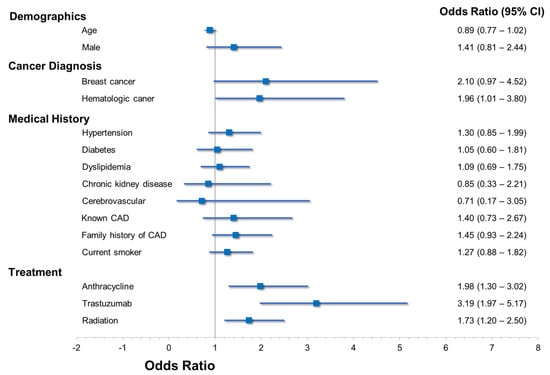
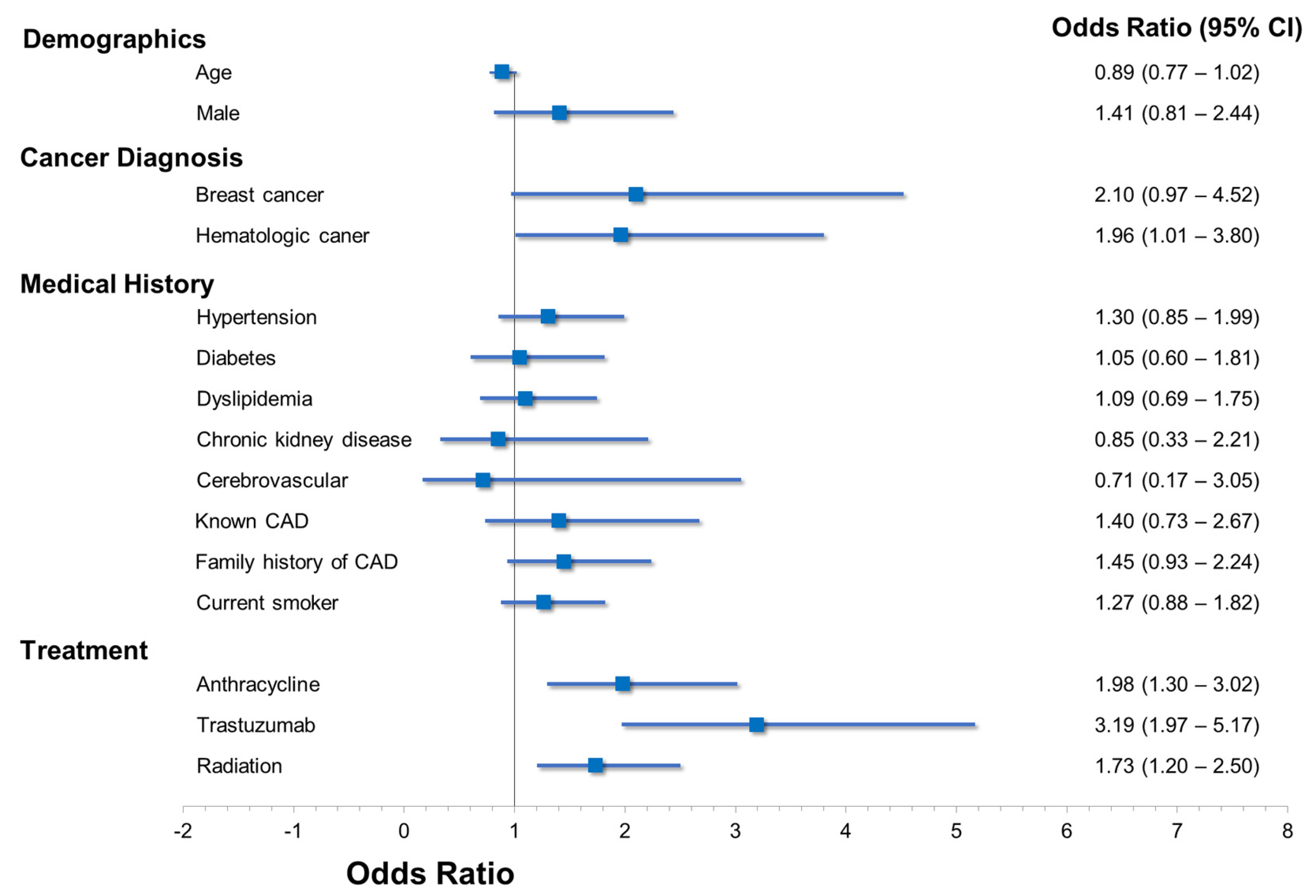
CTRCD occurred in 142 patients (5.8%) at a median interval of 124 days following chemotherapy initiation (IQR 92–220). Among those patients, CTRCD was documented by serial cardiovascular magnetic resonance in 40 patients, serial echocardiogram in 67 patients and a mix of modalities in 35 patients. Breast cancer patients experienced the highest incidence of CTRCD (9.2%), followed by hematologic malignancy patients (5.5%) and other types of cancer (1.9%; p < 0.001). Associations with CTRCD are outlined in Figure 1, with additional details in Table 2. In all patients, the breast cancer diagnosis was associated with a trend towards increased risk of CTRCD (adjusted OR 2.10, 95% CI 0.97–4.52, p = 0.059), while hematologic malignancy diagnosis was associated with increased risk of CTRCD (adjusted OR 1.96, 95% CI 1.01–3.8, p = 0.047). The use of anthracycline (adjusted OR 1.98, 95% CI 1.3–3.02, p = 0.002) and trastuzumab (adjusted OR 3.19, 95% CI 1.97–5.17, p < 0.001) both significantly increased the likelihood of developing CTRCD.
Figure 1.
Associations with cancer therapy-related cardiac dysfunction in the overall cohort. CAD—coronary artery disease; CI—confidence interval. Associations with CTRCD in sub-populations.
Table 2.
Associations with developing cancer therapy-related cardiac dysfunction.
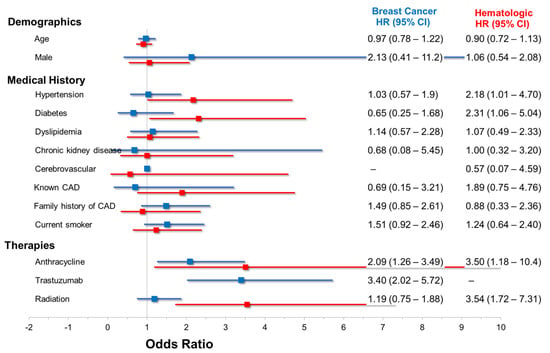
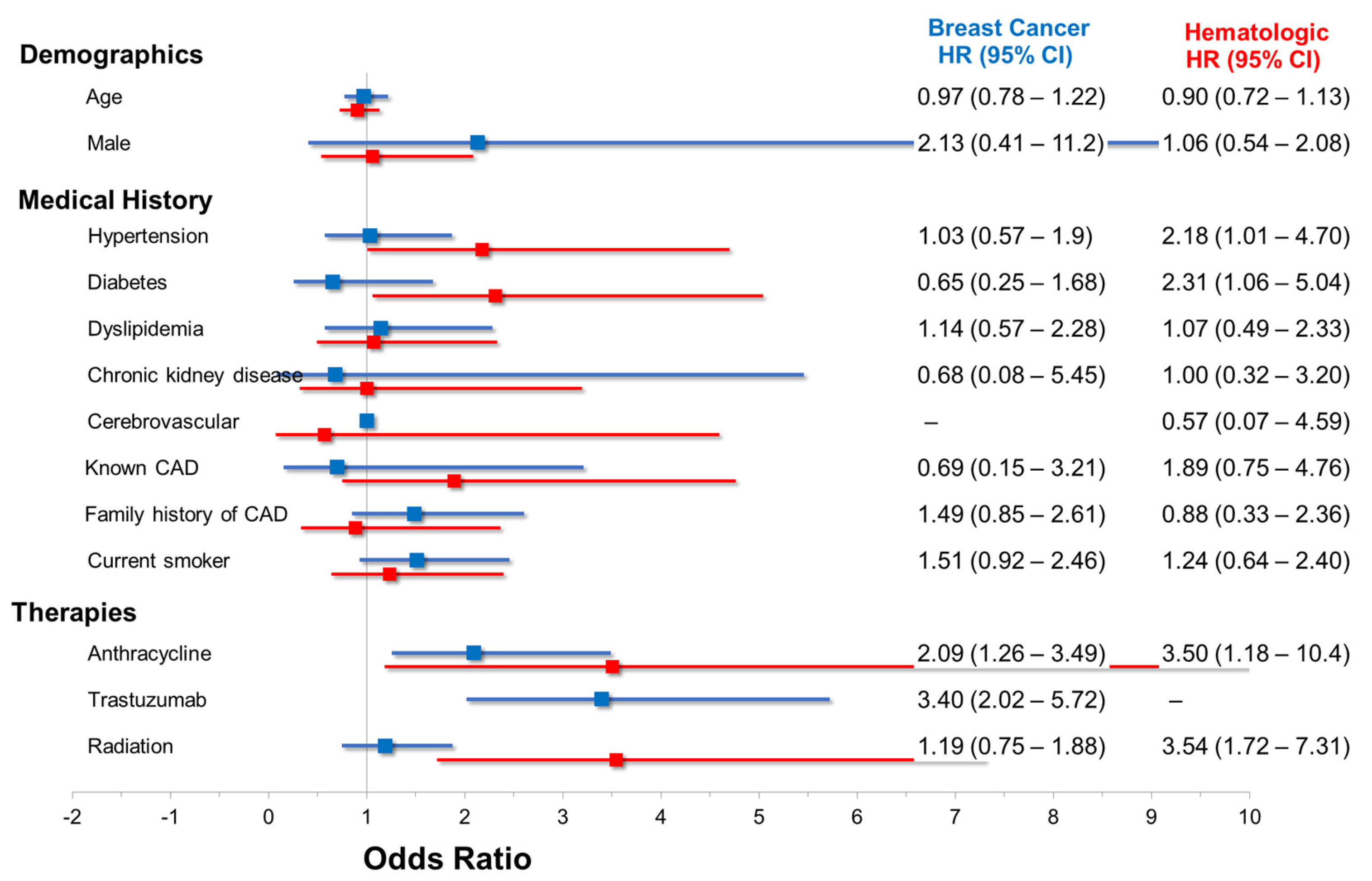
Associations with CTRCD in patients with breast cancer or hematologic malignancy are shown in Figure 2, with additional details in Table 3 and Table 4. In patients with breast cancer, the use of anthracycline (adjusted OR 2.09, 95% CI 1.26–3.49, p = 0.005) and trastuzumab (adjusted OR 3.4, 95% CI 2.02–5.72, p < 0.001) significantly increased the odds of an LVEF drop. However, the use of radiation was not significantly associated with an LVEF drop (adjusted OR 1.19, 95% CI 0.75–1.88, p = 0.468).
Figure 2.
Associations with cancer therapy-related cardiac dysfunction stratified by oncologic diagnosis. CAD—coronary artery disease; CI—confidence interval.
Table 3.
Associations with developing cancer therapy-related cardiac dysfunction in patients with breast cancer. Cerebrovascular disease excluded due to the low number of patients with this comorbidity.
Table 4.
Associations with developing cancer therapy-related cardiac dysfunction in patients with hematologic malignancies.
In patients with hematologic malignancy, hypertension (adjusted OR 2.18, 95% CI 1.01–4.7, p = 0.047) and diabetes (adjusted OR 2.31, 95% CI 1.06–5.04, p = 0.036) were significantly associated with CTRCD. The use of anthracycline (adjusted OR 3.5, 95% CI 1.18–10.4, p = 0.024) and radiation (adjusted OR 3.54, 95% CI 1.72–7.32, p = 0.001) were significantly associated with increased risk of CTRCD.
4. Discussion
We performed a retrospective analysis of a Cardio-Oncology clinic cohort to identify factors associated with CTRCD. As expected, patients with breast cancer and hematologic malignancies were the most likely to develop CTRCD [15,16], which is most likely a reflection of the chemotherapy agents typically used for these cancer types. However, we did notice some variability between patients with different cancer types. More specifically, in patients with hematologic malignancies, cardiovascular risk factors were also significantly associated with CTRCD. Our results suggest that the risk of and risk factors for CTRCD vary by cancer type, which is information that could help physicians individualize surveillance and management strategies.
In our analysis, use of anthracycline and trastuzumab significantly increased the odds of LVEF drop in all patients. Our results align with previous findings regarding the harm of specific treatments, specifically anthracyclines [15,16]. Overall, there was a trend towards breast cancer being associated with CTRCD; however, use of breast cancer-specific medications (trastuzumab) was associated with increased CTRCD risk overall. On the other hand, hematologic malignancies were associated with increased risk of CTRCD independently of other factors. This observation is consistent with other studies demonstrating that CTRCD is common in patients with lymphoma [17,18]. Additionally, patients with lymphoma and a diagnosis of CTRCD may be at higher risk of cardiovascular events [19].
In patients with hematologic malignancies, hypertension and diabetes were significantly associated with increased risk of LVEF drop. In fact, patients with these factors (which were more prevalent in the hematologic malignancy population) had almost double the risk of developing CTRCD. In our analysis, current smoking was not associated with CTRCD risk. However, many patients quit smoking after their initial visit in the Cardio-Oncology clinic, which may have weakened its association with CTRCD in our analysis. Recent analyses have shown that ongoing smoking may be associated with increased CTRCD risk [20]. The finding that cardiovascular risk factors are associated with CTRCD suggests that cardiovascular risk reduction may play a therapeutic role in patients with hematologic malignancies. This is consistent with a recent, large, randomized trial demonstrating a benefit of statin therapy in patients with lymphoma [20], which stands in contrast to previous results [21]. We did not identify similar associations in patients with breast cancer. This may be a reflection of differences in baseline atherosclerotic risk, with patients with breast cancer being younger and having a lower prevalence of prior coronary artery disease. This could also explain the absence of identified benefit of statin therapy in populations with a mix of cancer diagnoses [22]. Given the association with atherosclerotic processes, there may be incremental benefit from assessing other markers of atherosclerotic risk, such as coronary artery calcium, which are associated with increased risk [18]. Importantly, these scores can be derived automatically with deep learning from non-dedicated scans [23], including low-dose scans frequently used for oncology surveillance [24].
The information gathered in this report could potentially help cardio-oncology professionals tailor surveillance programs. For example, patients with hematologic malignancies and cardiovascular risk factors (such as diabetes) may benefit from more aggressive screening protocols compared with patients without cardiovascular risk factors. Similarly, among patients with breast cancer, the risk of cardiotoxicity was substantially higher in patients receiving combination therapy with anthracycline, trastuzumab, and radiation. Current guidelines suggest more frequent screening in these patients [7]. Our results suggest that no additional risk stratification may be possible in this patient group. However, patients with hematologic malignancies and cardiovascular risk factors may benefit from more frequent follow-up imaging than would be considered otherwise. Alternatively, patients at high risk of developing CTRCD may benefit from a transition to chemotherapy agents with lower risk of cardiotoxicity.
Our study has a few important limitations. Firstly, as a retrospective analysis, there are certain bias and limitations inherent in both populations. The Cardio-Oncology clinic cohort is highly selected and certainly impacted by referral bias, leading to a higher-risk cohort. However, this clinic also has comprehensive screening at regular intervals; therefore, we were unlikely to miss CTRCD in this population. Although our analysis included a large number of patients, the rate of CTRCD is quite low; therefore, the power for the analysis of multiple factors is limited. Details of chemotherapy dosing and radiation therapy technique (including site and total dose) were not collected prospectively; therefore, these were considered only as binary factors. However, the results are still reflective of how these therapies are used in current practice. Importantly, we did not have a sufficient number of patients with CTRCD to evaluate cancer groups other than breast and hematologic. Lastly, we did not have information regarding other potentially important factors, such as alcohol intake, and therefore could not consider them in our analysis.
5. Conclusions
We confirmed the importance of anthracycline, trastuzumab, and radiation in the development of CTRCD. However, among patients with hematologic malignancies, traditional cardiovascular risk factors are also associated with CTRCD. This information could help physicians personalize CTRCD surveillance strategies.
Author Contributions
Conceptualization, E.D., A.A., and R.J.H.M.; methodology, E.D., A.A., and R.J.H.M.; formal analysis, E.D., A.A., and R.J.H.M.; data curation, E.D., A.A., D.B., J.C., A.D., J.H., L.K., L.L., S.L., S.N., R.Y.T., and R.J.H.M.; writing—original draft preparation, E.D., and R.J.H.M.; writing—review and editing, E.D., A.A., D.B., J.C., A.D., J.H., L.K., L.L., S.L., S.N., R.Y.T., and R.J.H.M.; visualization, E.D., and R.J.H.M.; supervision, R.J.H.M. All authors have read and agreed to the published version of the manuscript.
Funding
This research received no external funding.
Institutional Review Board Statement
This study was approved by the research ethics board at the University of Calgary (HREBA.CC-21-0170).
Informed Consent Statement
The requirement for patient consent was waived due to the use of previously collected retrospective data.
Data Availability Statement
Data can be made available upon written request, after appropriate data sharing agreements are in place.
Conflicts of Interest
The authors have no relevant conflicts of interest.
References
- Brenner, D.R.; Poirier, A.; Woods, R.R.; Ellison, L.F.; Billette, J.M.; Demers, A.A.; Zhang, S.X.; Yao, C.; Finley, C.; Fitzgerald, N.; et al. Projected estimates of cancer in Canada in 2022. CMAJ 2022, 194, E601–E607. [Google Scholar] [CrossRef] [Scilit] [PubMed]
- Nair, C.; Colburn, H.; McLean, D.; Petrasovits, A. Cardiovascular disease in Canada. Health Rep. 1989, 1, 1–22. [Google Scholar] [PubMed]
- Larsen, C.M.; Garcia Arango, M.; Dasari, H.; Arciniegas Calle, M.; Adjei, E.; Rico Mesa, J.; Scott, C.G.; Thompson, C.A.; Cerhan, J.R.; Haddad, T.C.; et al. Association of Anthracycline With Heart Failure in Patients Treated for Breast Cancer or Lymphoma, 1985–2010. JAMA Netw. Open 2023, 6, e2254669. [Google Scholar] [CrossRef] [Scilit] [PubMed]
- Perez, I.E.; Taveras Alam, S.; Hernandez, G.A.; Sancassani, R. Cancer Therapy-Related Cardiac Dysfunction: An Overview for the Clinician. Clin. Med. Insights Cardiol. 2019, 13, 1179546819866445. [Google Scholar] [CrossRef] [Scilit]
- Oikawa, M.; Ishida, T.; Takeishi, Y. Cancer therapeutics-related cardiovascular dysfunction: Basic mechanisms and clinical manifestation. J. Cardiol. 2023, 81, 253–259. [Google Scholar] [CrossRef] [Scilit]
- Kamphuis, J.A.M.; Linschoten, M.; Cramer, M.J.; Gort, E.H.; van Rhenen, A.; Asselbergs, F.W.; Doevendans, P.A.; Teske, A.J. Cancer Therapy-Related Cardiac Dysfunction of Nonanthracycline Chemotherapeutics: What Is the Evidence? JACC CardioOncol. 2019, 1, 280–290. [Google Scholar] [CrossRef] [Scilit]
- Lyon, A.R.; López-Fernández, T.; Couch, L.S.; Asteggiano, R.; Aznar, M.C.; Bergler-Klein, J.; Boriani, G.; Cardinale, D.; Cordoba, R.; Cosyns, B.; et al. 2022 ESC Guidelines on cardio-oncology developed in collaboration with the European Hematology Association (EHA), the European Society for Therapeutic Radiology and Oncology (ESTRO) and the International Cardio-Oncology Society (IC-OS). Eur. Heart J. 2022, 43, 4229–4361. [Google Scholar] [CrossRef] [Scilit]
- Esteban-Fernández, A.; Carvajal Estupiñan, J.F.; Gavira-Gómez, J.J.; Pernas, S.; Moliner, P.; Garay, A.; Sánchez-González, Á.; Fernández-Rozas, I.; González-Costello, J. Clinical Profile and Prognosis of a Real-World Cohort of Patients With Moderate or Severe Cancer Therapy-Induced Cardiac Dysfunction. Front. Cardiovasc. Med. 2021, 8, 721080. [Google Scholar] [CrossRef] [Scilit]
- Kaboré, E.G.; Guenancia, C.; Vaz-Luis, I.; Di Meglio, A.; Pistilli, B.; Coutant, C.; Cottu, P.; Lesur, A.; Petit, T.; Dalenc, F.; et al. Association of body mass index and cardiotoxicity related to anthracyclines and trastuzumab in early breast cancer: French CANTO cohort study. PLoS Med. 2019, 16, e1002989. [Google Scholar] [CrossRef] [Scilit]
- Al-Sadawi, M.; Hussain, Y.; Copeland-Halperin, R.S.; Tobin, J.N.; Moskowitz, C.S.; Dang, C.T.; Liu, J.E.; Steingart, R.M.; Johnson, M.N.; Yu, A.F. Racial and Socioeconomic Disparities in Cardiotoxicity Among Women With HER2-Positive Breast Cancer. Am. J. Cardiol. 2021, 147, 116–121. [Google Scholar] [CrossRef] [Scilit]
- Bloom, M.W.; Hamo, C.E.; Cardinale, D.; Ky, B.; Nohria, A.; Baer, L.; Skopicki, H.; Lenihan, D.J.; Gheorghiade, M.; Lyon, A.R.; et al. Cancer Therapy-Related Cardiac Dysfunction and Heart Failure: Part 1: Definitions, Pathophysiology, Risk Factors, and Imaging. Circ. Heart Fail. 2016, 9, e002661. [Google Scholar] [CrossRef] [Scilit]
- Dranitsaris, G.; Rayson, D.; Vincent, M.; Chang, J.; Gelmon, K.; Sandor, D.; Reardon, G. The development of a predictive model to estimate cardiotoxic risk for patients with metastatic breast cancer receiving anthracyclines. Breast Cancer Res. Treat. 2008, 107, 443–450. [Google Scholar] [CrossRef] [Scilit]
- Ezaz, G.; Long, J.B.; Gross, C.P.; Chen, J. Risk prediction model for heart failure and cardiomyopathy after adjuvant trastuzumab therapy for breast cancer. J. Am. Heart Assoc. 2014, 3, e000472. [Google Scholar] [CrossRef] [Scilit] [PubMed]
- Plana, J.C.; Galderisi, M.; Barac, A.; Ewer, M.S.; Ky, B.; Scherrer-Crosbie, M.; Ganame, J.; Sebag, I.A.; Agler, D.A.; Badano, L.P.; et al. Expert consensus for multimodality imaging evaluation of adult patients during and after cancer therapy: A report from the American Society of Echocardiography and the European Association of Cardiovascular Imaging. Eur. Heart J. Cardiovasc. Imaging 2014, 15, 1063–1093. [Google Scholar] [CrossRef] [Scilit] [PubMed]
- Daver, N.; Wei, A.H.; Pollyea, D.A.; Fathi, A.T.; Vyas, P.; DiNardo, C.D. New directions for emerging therapies in acute myeloid leukemia: The next chapter. Blood Cancer J. 2020, 10, 107. [Google Scholar] [CrossRef] [Scilit] [PubMed]
- Voß, F.; Nienhaus, F.; Pietrucha, S.; Ruckhäberle, E.; Fehm, T.; Melz, T.; Cramer, M.; Haberkorn, S.M.; Flögel, U.; Westenfeld, R.; et al. Anthracycline therapy induces an early decline of cardiac contractility in low-risk patients with breast cancer. Cardio-Oncology 2024, 10, 43. [Google Scholar] [CrossRef] [Scilit]
- Bjerring, A.W.; Smeland, K.H.B.; Stokke, T.; Haugaa, K.H.; Holte, E.; Rösner, A.; Kiserud, C.E.; Edvardsen, T.; Sarvari, S.I. Long-term cardiac effects of modern treatment for Hodgkin’s lymphoma. Cardio-Oncology 2024, 10, 19. [Google Scholar] [CrossRef] [Scilit]
- Shen, H.; Lian, Y.; Yin, J.; Zhu, M.; Yang, C.; Tu, C.; Peng, Y.; Li, X.; Zhang, J. Cardiovascular Risk Stratification by Automatic Coronary Artery Calcium Scoring on Pretreatment Chest Computed Tomography in Diffuse Large B-Cell Lymphoma Receiving Anthracycline-Based Chemotherapy: A Multicenter Study. Circ. Cardiovasc. Imaging 2023, 16, e014829. [Google Scholar] [CrossRef] [Scilit]
- Khaled, S.; Abdelkhalek, S.; Aljuwaybiri, R.; Almatrafi, J.; AlHarbi, A.; Almarhabi, R.; Alyamani, F.; Soliman, M.; Jubran, E.; Shalaby, G. Cardiac dysfunction and their determinants in patients treated for breast cancer and lymphoma: A cardio-oncology center experience. Curr. Probl. Cardiol. 2024, 49, 102187. [Google Scholar] [CrossRef] [Scilit]
- Ali, A.; Koutroumpakis, E.; Song, J.; Booser, D.; Barcenas, C.H.; Tripathy, D.; Barac, A.; Palaskas, N.L.; Deswal, A. Risk Stratification for Trastuzumab-Induced Cardiac Dysfunction and Potential Implications for Surveillance. JACC CardioOncol. 2025, 7, 203–215. [Google Scholar] [CrossRef] [Scilit]
- Neilan, T.G.; Quinaglia, T.; Onoue, T.; Mahmood, S.S.; Drobni, Z.D.; Gilman, H.K.; Smith, A.; Heemelaar, J.C.; Brahmbhatt, P.; Ho, J.S.; et al. Atorvastatin for Anthracycline-Associated Cardiac Dysfunction: The STOP-CA Randomized Clinical Trial. JAMA 2023, 330, 528–536. [Google Scholar] [CrossRef] [Scilit]
- Hundley, W.G.; D’Agostino, R., Jr.; Crotts, T.; Craver, K.; Hackney, M.H.; Jordan, J.H.; Ky, B.; Wagner, L.I.; Herrington, D.M.; Yeboah, J.; et al. Statins and Left Ventricular Ejection Fraction Following Doxorubicin Treatment. NEJM Evid. 2022, 1, EVIDoa2200097. [Google Scholar] [CrossRef] [Scilit]
- Miller, R.J.H.; Pieszko, K.; Shanbhag, A.; Feher, A.; Lemley, M.; Killekar, A.; Kavanagh, P.B.; Van Kriekinge, S.D.; Liang, J.X.; Huang, C.; et al. Deep Learning Coronary Artery Calcium Scores from SPECT/CT Attenuation Maps Improve Prediction of Major Adverse Cardiac Events. J. Nucl. Med. 2023, 64, 652–658. [Google Scholar] [CrossRef] [Scilit]
- Miller, R.J.H.; Killekar, A.; Shanbhag, A.; Bednarski, B.; Michalowska, A.M.; Ruddy, T.D.; Einstein, A.J.; Newby, D.E.; Lemley, M.; Pieszko, K.; et al. Predicting mortality from AI cardiac volumes mass and coronary calcium on chest computed tomography. Nat. Commun. 2024, 15, 2747. [Google Scholar] [CrossRef] [Scilit]

Disclaimer/Publisher’s Note: The statements, opinions and data contained in all publications are solely those of the individual author(s) and contributor(s) and not of MDPI and/or the editor(s). MDPI and/or the editor(s) disclaim responsibility for any injury to people or property resulting from any ideas, methods, instructions or products referred to in the content. |
© 2026 by the authors. Licensee MDPI, Basel, Switzerland. This article is an open access article distributed under the terms and conditions of the Creative Commons Attribution (CC BY) license.