


Abstract
In this preliminary study, chitosan-based molecularly imprinted polymers crosslinked with glutaraldehyde were synthesized and evaluated for the selective removal of m-cresol, a volatile phenol associated with the sensory defect known as smoke taint in wine. Three formulations of chitosan-based molecularly imprinted polymers (MIP-Gs) were synthesized using glutaraldehyde as a crosslinker and m-cresol as a template. Non-imprinted polymers (NIP-Gs) served as controls. The polymers were characterized by Fourier-transform infrared spectroscopy, thermogravimetric analysis, and scanning electron microscopy, which confirmed successful crosslinking and structural differences between MIPs and NIPs. Adsorption performance was evaluated using solid-phase extraction cartridges packed with the synthesized polymers, employing a Cabernet Sauvignon wine. The MIPs exhibited higher adsorption efficiency and selectivity toward m-cresol compared to NIPs, achieving removal rates of 15% to 40%, depending on polymer formulation and analyte concentration. Molecular dynamics simulations were used to investigate polymer–analyte interactions at the molecular level, providing mechanistic insight into the preferential binding of m-cresol within the imprinted cavities. Physicochemical analyses of red wine showed that m-cresol removal occurred with minimal impact on key phenolic parameters, supporting the functional selectivity of MIPs. These results demonstrate that chitosan-based MIPs constitute a promising class of materials for selective adsorption applications in complex liquid systems.
1. Introduction
Smoke-derived cresols are volatile phenolic compounds that can seriously compromise the sensory quality of red wines [1]. These volatile phenols in wine primarily originate from environmental and technological exposures during grape development and winemaking. When grapevines are exposed to smoke from bushfires or forest fires, volatile phenolic compounds such as guaiacol and cresols are absorbed into berry tissues and subsequently glycosylated, forming nonvolatile glycoconjugates in grapes and the resulting wines, that togheter with free volatile phenols have been identified as the primary contributors to the characteristic smoky, ashy, and medicinal notes of smoke-affected wines, as demonstrated in sensory descriptive analyses correlating volatile phenol concentrations with smoky flavor intensity [2,3].
It is important to note that a smoky character in wine is not necessarily indicative of smoke taint, as certain volatile phenols associated with desirable smoky notes can naturally arise during oak maturation. The smoke taint organoleptic defect appears when some volatile phenols and their glycoconjugates are present in excess due to smoke exposure. Sensory and instrumental studies have reported a sensory threshold of 20 µg.L−1 for m-cresol and have correlated higher total cresol concentrations with stronger perceived smoke taint [1]. These findings underline the importance of quantifying and, where necessary, mitigating m-cresol in grapes and finished wines to preserve varietal character and consumer acceptance.
Some remediation strategies for reducing m-cresol and other smoke-related volatile phenols are based on trapping the undesirable compounds, including reverse osmosis and solid-phase adsorption [4,5], commercial fining agents [6], activated charcoal/carbon [7], activated carbon derivatized with amine groups [8], and yeast-based adsorbents [9]. Unfortunately, none of these alternatives has proven to be selective for the targeted compounds; they may also remove desirable color and aromatic components, affecting the quality of the wine.
A potentially simple, inexpensive, and efficient alternative may be the molecularly imprinted polymers (MIPs). MIPs are synthetic materials with artificially generated recognition sites that selectively extract organic compounds from different matrices [10]. The selectivity recognition of MIPs depends on choosing a suitable functional monomer containing several functional groups that interact with the template and form specific donor-receptor complexes. Most of the literature related to the preparation of MIPs reports the use of synthetic monomers (e.g., methacrylic acid, acrylic acid, acrylamide), which are unsuitable for use in food matrices such as wine [11].
In this study, chitosan is proposed as a functional polymeric backbone for the preparation of molecularly imprinted polymers. Owing to the abundance of amino and hydroxyl groups in its structure, chitosan can establish multiple non-covalent interactions with template molecules, making it an attractive alternative to conventional synthetic functional monomers commonly used in MIP synthesis [12,13,14,15,16,17,18]. Furthermore, its biocompatibility and suitability for food-contact applications support its use in separation and adsorption processes involving complex matrices [19]. Combining the biocompatibility and functional groups of chitosan with the molecular recognition capability of MIPs is an attractive research direction for exploring new alternatives in the removal of volatile phenols in complex liquid matrices. Therefore, the objective of this research was to synthesize and characterize chitosan-based molecularly imprinted polymers crosslinked with glutaraldehyde and evaluate their selective adsorption performance toward m-cresol in a Cabernet Sauvignon wine. By selectively targeting m-cresol while minimizing the co-removal of phenolic and color-related wine compounds, these materials are expected to mitigate smoky sensory defects without adversely affecting wine color or overall sensory quality.
Glutaraldehyde is one of the most commonly used crosslinking agents for chitosan because of its high reactivity toward primary amino groups and its ability to form mechanically stable and chemically resistant polymeric networks [16,17,20,21]. Nevertheless, its potential toxicity has raised concerns for food and beverage-related applications. In chitosan-based materials, glutaraldehyde is intended to act as a covalent crosslinker and not as a free or mobile species in the final polymer [22]. When properly consumed during polymer formation and followed by adequate washing steps, residual glutaraldehyde can be reduced to negligible levels, leading to materials with low toxicity [23]. Recent reviews highlight the use of crosslinking agents such as glutaraldehyde to enhance the cohesion, mechanical integrity, and functional performance of biopolymeric films used in food packaging applications, suggesting that controlled crosslinking with aldehydes can be compatible with food-contact materials when appropriately processed [24].
2. Materials and Methods
2.1. Chemicals and Reagents
Chitosan (deacetylation degree 75–85%, CAS number 9012-76-4), glutaraldehyde (25% aqueous solution, Grade II, CAS number 111-30-8), ethanol (HPLC grade, CAS number 64-17-5), acetic acid (CAS number 64-19-7), m-cresol (99%, CAS number 108-39-4), water (HPLC grade, CAS number 7732-18-5), sodium acetate (CAS number 127-09-3) and acetonitrile (HPLC grade, CAS number 75-05-8) were purchased from Sigma-Aldrich (Santiago, Chile). A Cabernet Sauvignon wine from the Aresti winery, Maule Region, vintage 2014, was purchased in commercial stores in the Curicó Valley.
2.2. Preparation of Chitosan-Based-Imprinted Polymers
Chitosan-based molecularly imprinted polymers (MIP-Gs) for m-cresol removal were synthesized following a modified sol–gel method reported by Mulyasuryani et al. [25]. Briefly, 1 g of chitosan (deacetylation degree 75–85%) was dissolved in 100 mL of 1% (v/v) acetic acid at 60 °C under magnetic stirring for 2 h. Then, 1 µL of m-cresol standard (99%) was added to achieve a final concentration of 0.001% (v/v), and the mixture was stirred for 30 min at room temperature. Glutaraldehyde solution (5, 7, or 9 mL, 25% aqueous solution) was added dropwise as a crosslinking agent under continuous mechanical stirring to obtain three formulations (MIP-G1, MIP-G2, and MIP-G3) [21,22,26]. After 5 h of reaction, the formed gel-like resins were collected, washed several times with 1000 mL of ethanol–acetic acid (80:20, v/v; pH adjusted to 3 with HCl) to remove m-cresol and residual reagents, and the washing was continued until no m-cresol absorbance was detected at 282 nm in a BEL Photonics UV-VIS spectrophotometer Model: UV-M51 (BEL Engineering, Monza, Italy).
The polymers were then rinsed with deionized water, lyophilized to constant weight, and ground to a particle size of <250 µm. Non-imprinted control polymers (NIP-G1, NIP-G2, and NIP-G3) were synthesized under identical conditions without the template molecule.
2.3. Characterization of Polymers
Fourier-transform infrared (FTIR) spectra of the MIP-G resins were recorded on a Nicolet Nexus 470 spectrometer (Thermo Scientific, Waltham, MA, USA) equipped with a Smart Orbit attenuated total reflectance (ATR) accessory. UV–Vis analyses were performed using a BEL Photonics UV-VIS spectrophotometer Model: UV-M51 (BEL Engineering, Monza, Italy) to monitor m-cresol removal and verify template extraction [14]. Thermogravimetric analysis (TGA) was conducted under a nitrogen atmosphere on a TGA Q500 instrument (TA Instruments, New Castle, DE, USA). Samples were heated from 30 to 700 °C at a rate of 10 °C·min−1 under a dynamic nitrogen flow of 50 mL·min−1 [18]. The surface morphology of the MIP-Gs was examined using scanning electron microscopy (SEM) on a JEOL JSM-6300 microscope (JEOL Ltd., Tokyo, Japan) operated at an accelerating voltage of 20 kV. Images were captured at different magnifications to evaluate surface texture and porosity.
2.4. Adsorption Procedure
Adsorption of m-cresol was performed using an experimental design of 2N, considering four experimental variables: m-cresol concentration, MIP-Gs and NIP-Gs mass, wine volume, and crosslinker volume used to obtain MIP-G1, MIP-G2, and MIP-G3. In addition, N + 1 central points were added, completing 21 experiments. The variables were coded between −1 and 1 so that they had the same statistical weight. Table 1 presents the experimental design performed for MIP-Gs and NIP-Gs.

Table 1.
Experimental design for MIPs and NIPs.
To evaluate the adsorption efficiency and practical applicability of the synthesized MIP-Gs in a controlled and reproducible manner, the ability of the materials to remove m-cresol from wine was assessed using solid-phase extraction (SPE)-type cartridges packed with the imprinted polymers. The SPE configuration was chosen because it enables precise control of contact time, flow rate, and sample volume, thereby allowing quantitative comparison among polymer formulations under identical operational conditions.
Each cartridge consisted of a 5 mL polypropylene syringe (Nipro Medical Corp, Santiago, Chile) with an internal diameter of 15 mm, packed with MIP-G resins. A small amount (0.01 g) of commercial cotton was placed at both the bottom and upper ends of the bed to retain the material. The MIP and NIP polymers were accurately weighed and transferred into the cartridges, which were then manually compacted to minimize bed volume. To consolidate the packing, remove trapped air, and condition the cartridges, a low-pressure flow (0.5 mL·min−1) of five bed volumes of model wine solution (12% ethanol, pH 3.5) was passed through each cartridge.
A homogeneous red wine sample was prepared by mixing five commercial bottles of Cabernet Sauvignon wine from the Aresti winery, Maule Region, vintage 2014. The mixture was divided into three equal portions, each of which was spiked with a 99% m-cresol standard to obtain final concentrations of 25, 62.5, or 100 µg·L−1. Wine samples were loaded onto the cartridges following the experimental design parameters summarized in Table 1. Elution was performed at a flow rate of 0.5 mL·min−1, and the effluents were collected in 50 mL polypropylene tubes. All experiments were carried out in triplicate.
2.5. Quantification of m-Cresol by HPLC-UV-FLD Analysis
The concentration of m-cresol in the wine samples was determined using an Agilent 1200 Series HPLC system (Agilent Technologies, Santa Clara, CA, USA) equipped with a LiChrospher RP-18 column (5 µm, 250 × 4 mm), a G1311A quaternary pump, a diode array detector G1315B (DAD), and a fluorescence detector G1321A (FLD), following the method reported by Valente et al. [27] with minor modifications. The mobile phase consisted of (A) acetate buffer (10 mmol·L−1, pH 4.7) and (B) acetonitrile, operated under gradient elution. The acetonitrile content increased linearly from 30% to 33% during the first 15 min, then from 33% to 70% between 15 and 20 min. The system was returned to the initial conditions within 3 min and equilibrated for an additional 2 min prior to the next injection. The flow rate was maintained at 0.7 mL·min−1, and the injection volume was 100 µL. Fluorescence detection was performed at excitation and emission wavelengths of λEx = 260 nm and λEm = 305 nm, respectively. m-Cresol was identified by comparing its retention time and UV spectrum with those of the analytical standard. Quantification was achieved using an external calibration curve constructed with m-cresol standards ranging from 5 to 150 µg·L−1. Results were expressed as µg·L−1.
2.6. Phenolic Compounds and Colorimetric Parameters of Wine
Total phenolics and total anthocyanins in the wine samples were quantified by spectrophotometric analysis using an automatic Y15 analyzer (Biosystems, Barcelona, Spain) and the manufacturer’s reagent kits (COD 12815 and 12831), following the supplier’s instructions. Tannin concentrations were determined spectrophotometrically using the methylcellulose precipitable tannin (MCPT) assay on a SYNERGY HTX multimode reader (BioTek Instruments, Winooski, VT, USA) [28].
The absorbance of each wine sample was recorded at 450, 520, 570, and 630 nm. The CIELAB color coordinates, color intensity, and hue were calculated from the absorption spectra using the MSCV® software [29].
2.7. Molecular Dynamics Simulations
The initial models of chitosan, glutaraldehyde, m-cresol, and ethanol were constructed using Avogadro software, version 1.99. Each polymer structure consisted of two chains, with each chain containing nine chitosan monomers, crosslinked by five glutaraldehyde molecules, as illustrated in Figure S1 (See Supplementary Information). The most energetically favorable conformations of these structures were determined using the MMFF94 force field [30].
To evaluate the capture of m-cresol within the polymer matrix and to analyze the associated interactions, a molecular dynamics simulation was performed. The initial system configuration was prepared using Packmol software version 20.3.5 [31]. This setup included 20 randomly distributed polymer structures confined within a sphere of 25 Å radius, 30 m-cresol molecules placed randomly between spheres of 30 Å and 50 Å radii, and 1200 ethanol molecules distributed randomly within a 100 × 100 × 100 Å3 box. A minimum distance of 3 Å between each structure was maintained. The simulation was then run for 25 ns at a constant temperature of 300 Kelvin in a TIP3P water solvent. It is noteworthy that the ethanol and water molecules were kept at a 13% concentration to simulate the alcohol content found in wine.
The OPLS force field [32] was employed, and the simulations were executed using the academic version 2021-1 of Desmond/Maestro software [33]. The default relaxation protocol implemented in Desmond/Maestro software was applied prior to production runs. This protocol consisted of a series of steps in which the molecular systems were first energy minimized using a steepest descent algorithm, switching on and switching off restraints over heavy atoms. Then, a series of four short NVT [constant number (N), volume (V), and temperature (T)] and NPT [constant number (N), pressure (P), and temperature (T)] molecular dynamics simulations (of 12 and 24 ps) were performed retaining restraints to finally perform an unrestrained simulation. After the relaxation protocol, the final production simulation was run with the following parameters. The NPT ensemble was used, keeping the temperatures defined above through the Nosé–Hoover chain method, with a relaxation time of 1.0 ps. The pressure was kept fixed at 1.0 bar using the Martyna-Tobias-Klein barostat, using an isotropic coupling and a relaxation time of 2.0 ps. The RESPA integrator was used to integrate the equations of motion with a 2.0 fs time step for bonded and near interactions and a 6.0 fs time step for far interactions. A cutoff radius of 9 Å was used for non-bonding interactions, van der Waals (VdW) and electrostatic (Elec) interactions. Structural analyses included calculation of the solvent-accessible surface area (SASA) and radius of gyration (rGyr) of the chitosan-based polymers. Additionally, the number of intermolecular hydrogen bonds between the MIP-G resins and m-cresol molecules was quantified to elucidate the key interactions involved in molecular recognition and binding.
2.8. Statistical Analysis
The experimental data was subjected to analysis of variance (ANOVA) using SPSS statistical software, version 26 (IBM Corp., Armonk, NY, USA). Tukey’s multiple comparison post hoc test (p < 0.05) was applied to determine statistically significant differences among the wine treatments.
3. Results and Discussion
3.1. Formation and Template Removal of MIP-G Resin
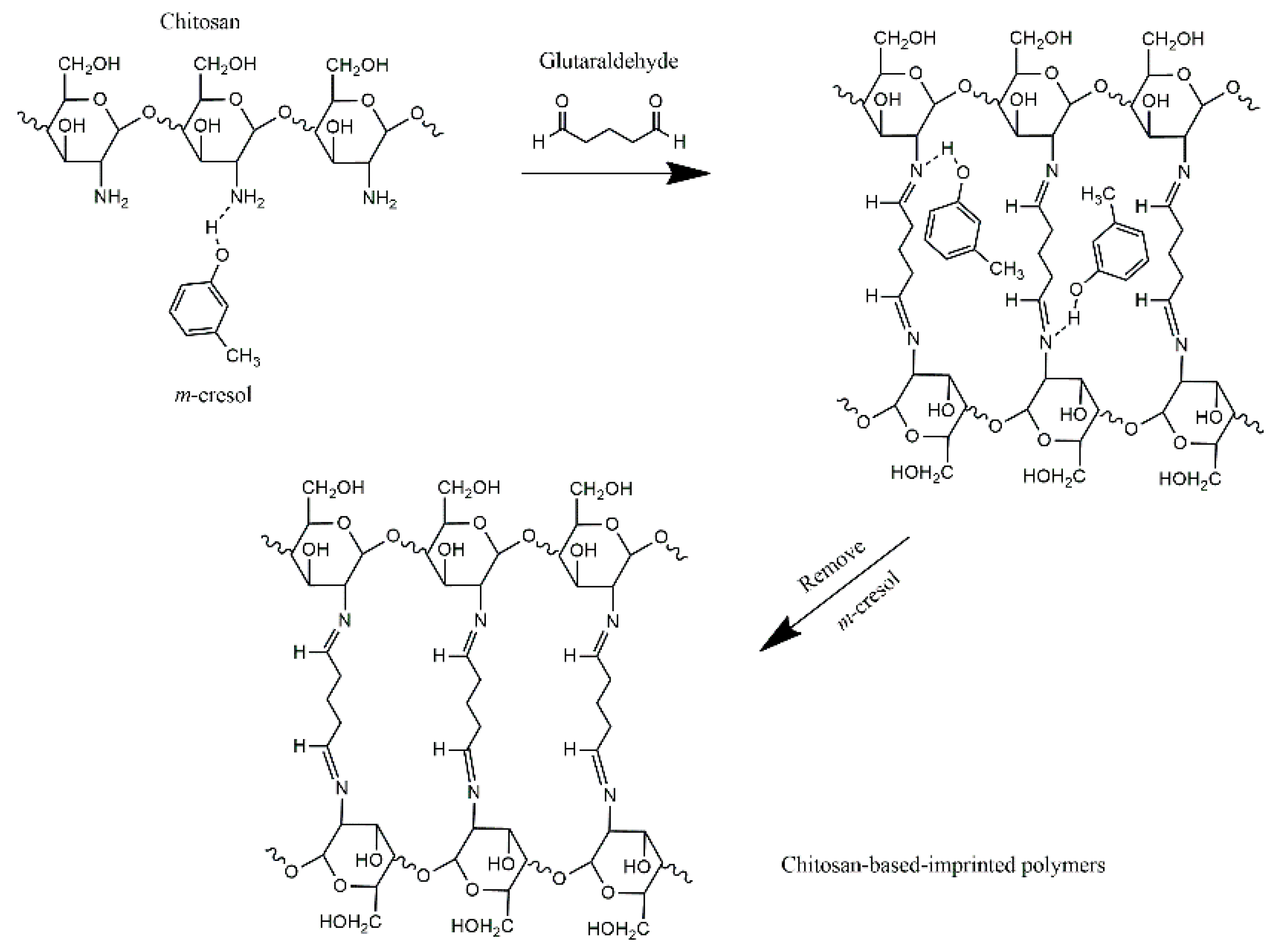
Figure 1 schematically illustrates the preparation process of the MIP-G resins, which comprises three main stages. In the first stage, the self-assembly between chitosan and m-cresol occurred in a 1% acetic acid solution (pH 5.1), resulting in a pale amber mixture. Chitosan, being a polycationic biopolymer with primary amino groups (pKa ≈ 6.3), was positively charged under these conditions, while m-cresol (pKa ≈ 10.09) remained partially deprotonated, carrying a moderate negative charge. Therefore, electrostatic attraction, together with hydrogen bonding between the hydroxyl group of m-cresol and the amino and hydroxyl groups of chitosan, promoted the formation of stable host–guest complexes. These interactions ensured that the chitosan monomers were well organized around the template molecules before the crosslinking reaction.
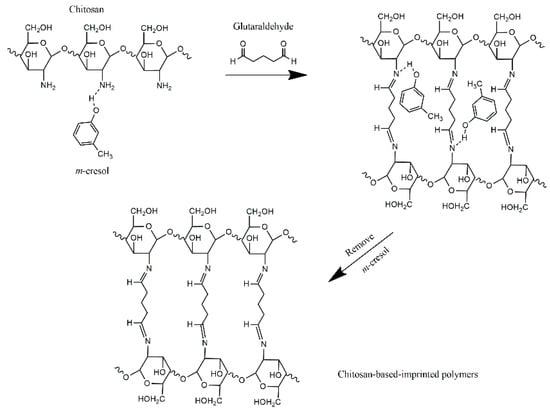
Figure 1.
Schematic illustration of the steps for the synthesis of chitosan-based imprinted polymers.
In the second stage, the chitosan–m-cresol complexes were crosslinked by glutaraldehyde through a Schiff base reaction between the free amino groups of chitosan and the aldehyde groups of the crosslinker. After the addition of glutaraldehyde, the mixture changed from pale amber to a darker orange-brown color, accompanied by gel formation, which is consistent with successful crosslinking. The degree of gelation depended on the relative concentration of glutaraldehyde, being more pronounced for MIP-G3 and less intense for MIP-G1, as previously reported for similar systems [34,35].
In the final stage, the template molecules were removed from the polymeric network using an ethanol:acetic acid (80:20 v/v) washing solution. The efficiency of the washing steps was qualitatively monitored by UV–Vis spectroscopy. A progressive decrease and eventual disappearance of the characteristic absorption band of m-cresol at ~282 nm was observed after successive washing cycles, indicating effective removal of the template from the polymer matrix. This confirmed the removal of the template and the successful formation of well-defined m-cresol-imprinted cavities in the MIP-Gs matrix. These cavities are expected to act as specific recognition sites for selectively rebinding m-cresol molecules in subsequent adsorption experiments.
3.2. Structural and Physicochemical Characteristics of Polymers
3.2.1. ATR-FTIR
The structural and physicochemical characteristics of the synthesized chitosan-based molecularly imprinted polymers (MIP-Gs) and their non-imprinted controls (NIP-Gs) were first evaluated to confirm successful crosslinking, template removal, and polymer stability prior to their application in m-cresol removal from wine. Fourier-transform infrared (FTIR) spectroscopy, thermogravimetric analysis (TGA), and scanning electron microscopy (SEM) were employed to verify the formation of the imprinted networks, assess their thermal behavior, and examine surface morphology, respectively. These analyses provided essential information regarding the chemical interactions between chitosan and glutaraldehyde, as well as the morphological differences induced by molecular imprinting, which are expected to influence adsorption performance.
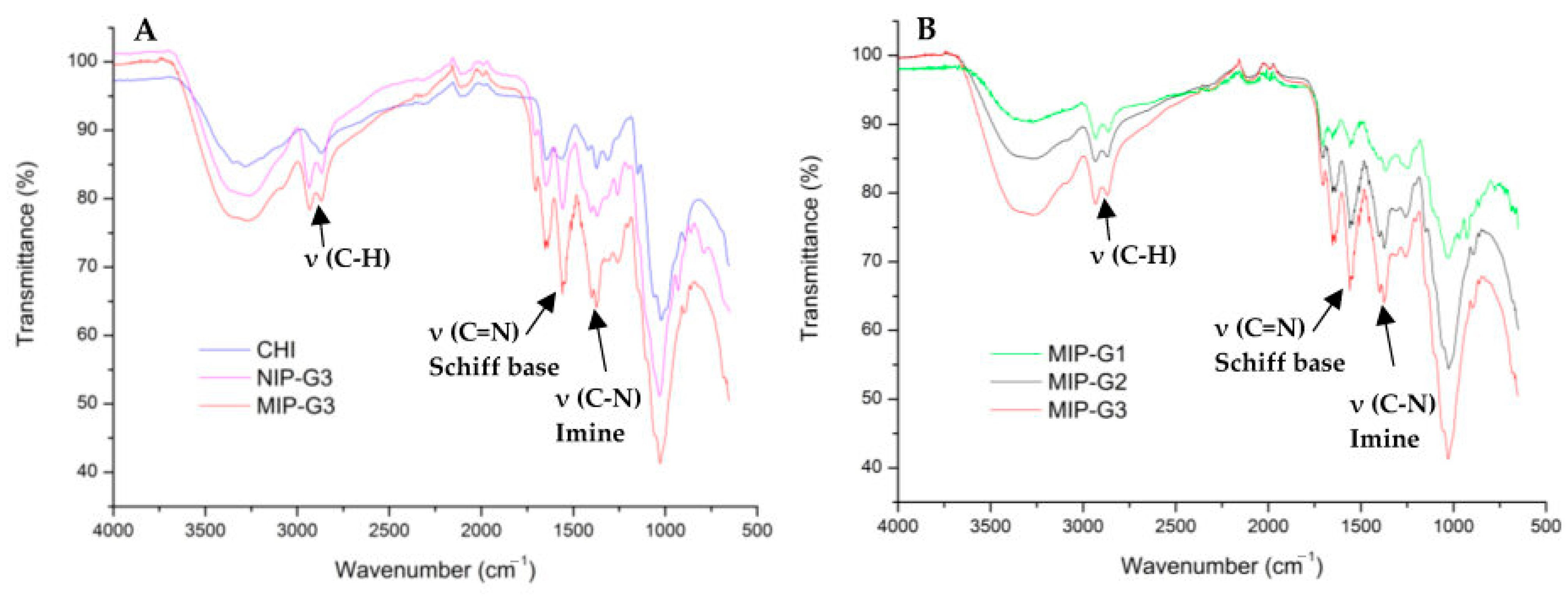
The ATR-FTIR spectra of chitosan, MIP-Gs, and NIP-Gs were recorded to confirm the chemical interactions between chitosan and glutaraldehyde, as well as the successful removal of the m-cresol template (Figure 2).
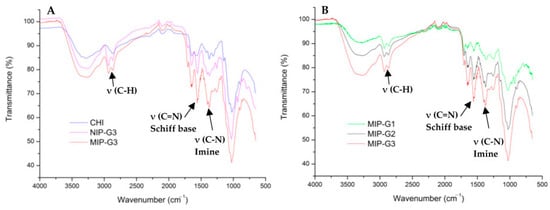
Figure 2.
Comparative ATR-FTIR spectra of the synthesized polymers. (A): ATR-FTIR spectrum of chitosan (CHI), the most crosslinked non-imprinted polymer (NIP-G3), and the most crosslinked molecular imprinted polymer (MIP-G3). (B): ATR-FTIR spectrum of the three synthesized MIP-Gs.
The characteristic absorption bands of chitosan were observed within the typical range reported in the literature for this polysaccharide [18,19].
The main spectral differences between chitosan, NIP-Gs, and MIP-Gs were found in two regions. The first, located between 3000 and 2750 cm−1, corresponds to the stretching vibrations of C–H groups (–CH2 and –CH3) and aldehydic C–H bands from glutaraldehyde. The second region, 1700–1300 cm−1, includes the amide, imine, and amino functional groups. In the spectra of MIP-Gs and NIP-Gs, the attenuation of the –NH2 bending band at approximately 1564 cm−1 and the emergence of a strong band at 1643 cm−1, attributed to the C=N stretching vibration, confirm the formation of Schiff base linkages between the amine groups of chitosan and the aldehyde groups of glutaraldehyde. This indicates that imine formation was the predominant crosslinking mechanism.
Additional confirmation of Schiff base formation is provided by the appearance of a new band near 1398 cm−1, which is commonly associated with the vibration of C–N bonds in the imine structure [20]. Furthermore, the presence of a weak band at 1706 cm−1, corresponding to residual aldehyde C=O stretching, provides further evidence of the crosslinking reaction and suggests incomplete consumption of glutaraldehyde during polymerization. All MIP-G and NIP-G spectra were generally similar, although variations in the intensity of the 1706 cm−1 band suggest differences in the degree of crosslinking among formulations.
Finally, in the MIP-G spectra, the characteristic bands at 1450–1600 cm−1 and 785 cm−1, corresponding to the aromatic C=C stretching and out-of-plane C–H bending vibrations of the m-cresol phenyl ring and its 1,3-substitution pattern, respectively, were absent. The disappearance of these bands confirms the effective removal of the m-cresol template, validating the efficiency of the washing protocol described previously.
3.2.2. Morphological Analysis by Scanning Electron Microscopy
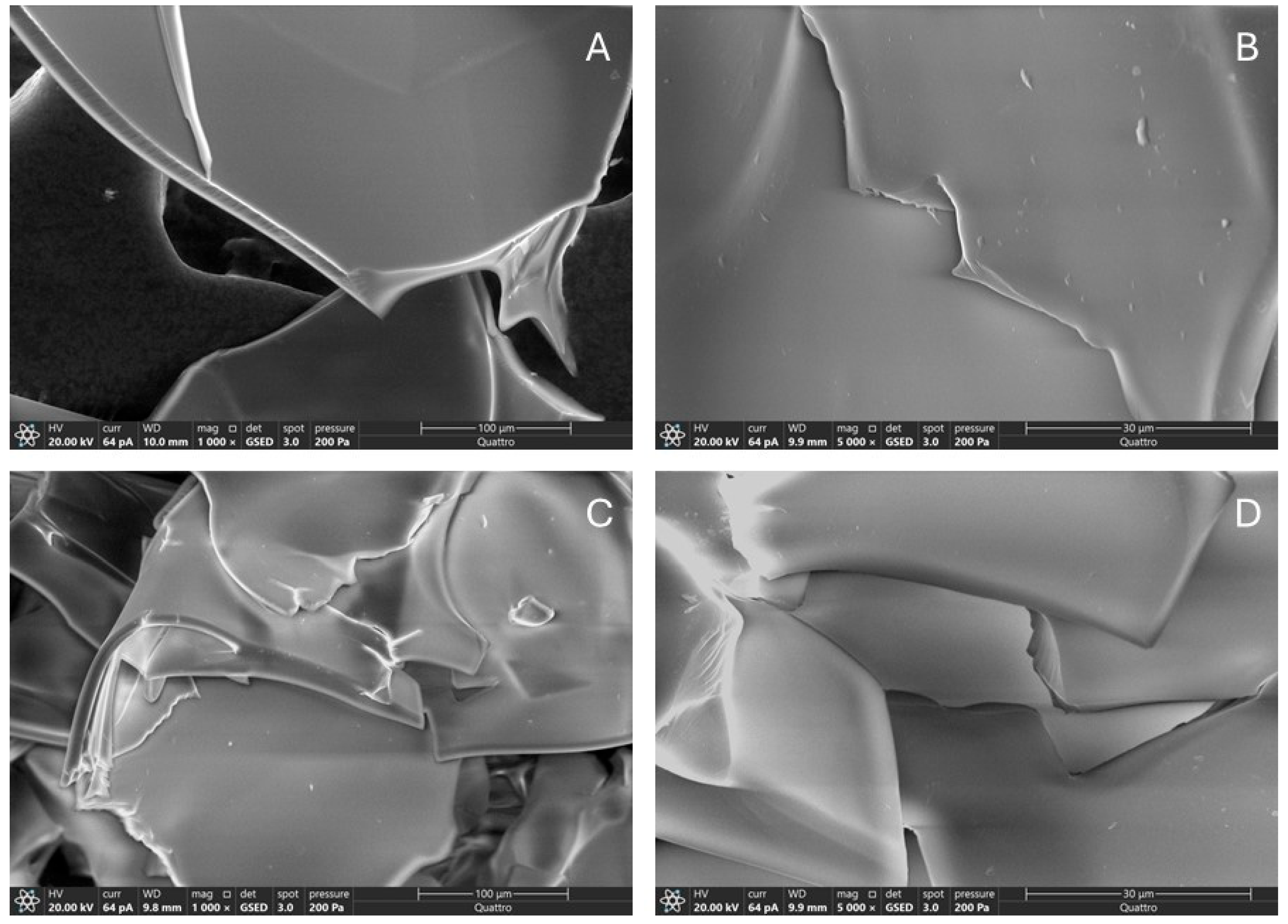
Scanning electron microscopy (SEM) was used to examine the surface morphology of pure chitosan and the molecularly imprinted polymers (MIP-Gs). The corresponding micrographs are shown in Figure 3.
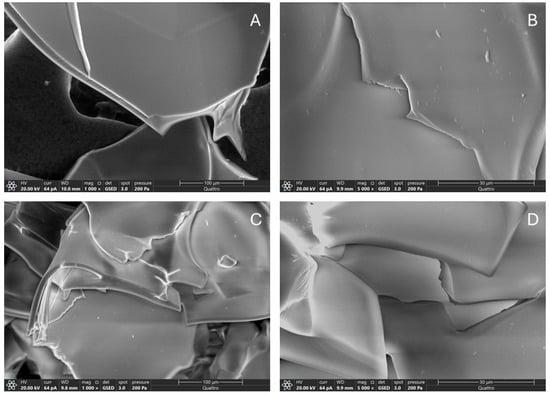
Figure 3.
SEM images of neat chitosan (A,B) at different magnifications of 100 µm and 30 µm, respectively. SEM images of the most crosslinked polymer (MIP-G3) (C,D), at different magnifications of 100 µm and 30 µm, respectively.
Figure 3A,B show that neat chitosan exhibits a fractured structure with sharp edges, suggesting a laminar or foliate morphology. The surface has smooth texture and displays some fractured points, likely associated with the drying process of the films. Figure 3B confirms the uniform and continuous surface of film, characterized by fewer irregularities. A similar morphology was reported by Nunes et al. [13], who described chitosan films as generally homogeneous and compact, though prone to small structural discontinuities.
Figure 3C,D, corresponding to the chitosan films crosslinked with glutaraldehyde, display a denser and more heterogeneous morphology. The presence of larger folds, smooth edges, and layered domains suggests the formation of a compact three-dimensional network. This densification can be attributed to the crosslinking reaction between the amino groups of chitosan and the aldehyde groups of glutaraldehyde, which restricts molecular mobility and reduces porosity. Similar morphological changes upon crosslinking have been reported by de Oliveira et al. [15] and Pavoni et al. [17], who observed that glutaraldehyde enhances the rigidity and hydrophobicity of chitosan films, leading to decreased pore formation and greater mechanical stability.
The laminar and fractured structures observed in some regions may result from internal stresses generated during gelation and drying. These effects have also been associated with variations in component interactions and solvent evaporation rates [14]. Overall, the SEM analysis confirms that glutaraldehyde crosslinking produces a denser and more compact morphology, consistent with the successful formation of a stable chitosan-based network suitable for molecular imprinting.
3.2.3. Thermogravimetric Analysis
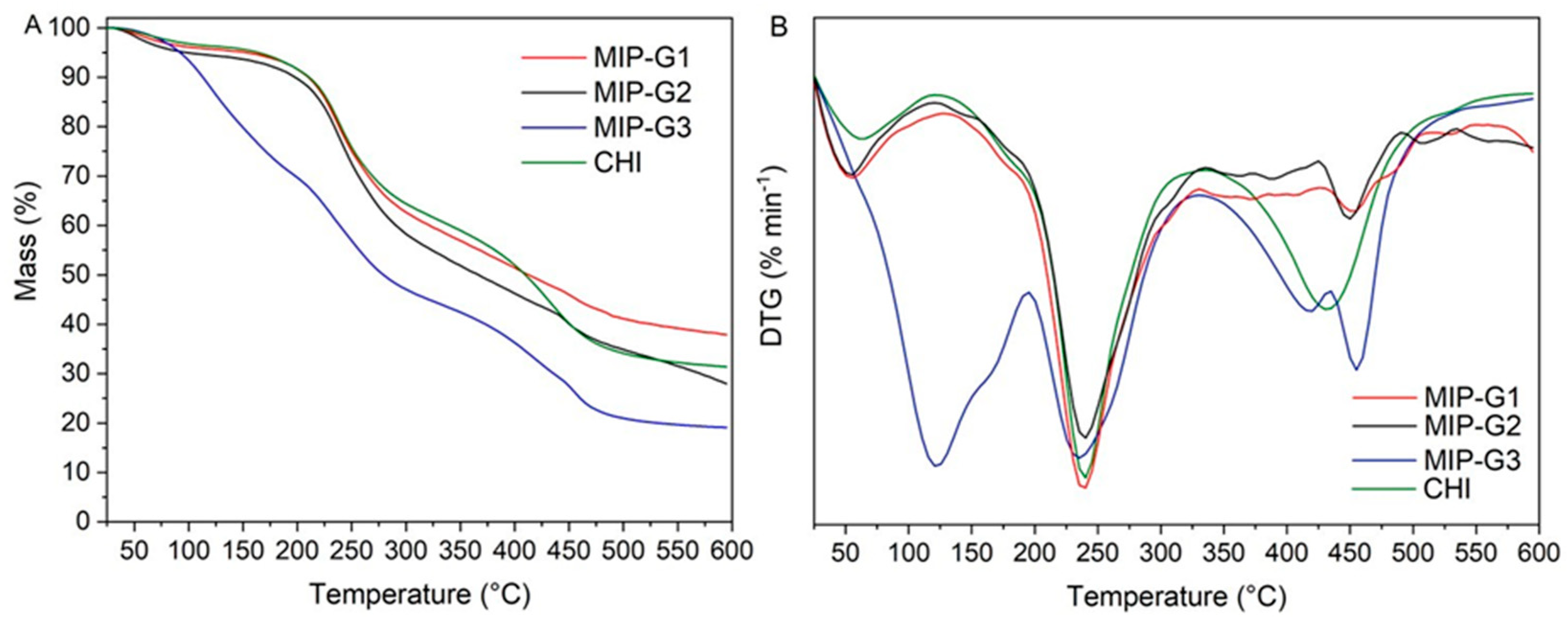
Thermogravimetric analysis (TGA) is widely employed to evaluate the thermal behavior and stability of polymeric materials. Figure 4 displays the TG and DTG curves for raw chitosan and molecularly imprinted derivatives, while Table 2 summarizes the main thermal parameters obtained.
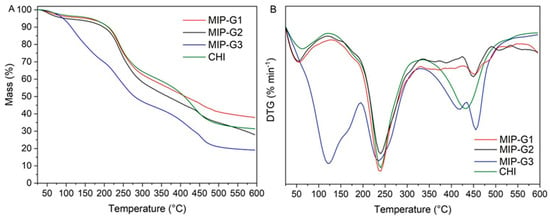
Figure 4.
(A) Thermogravimetric (TG) and (B) derivative thermogravimetric (DTG) curves of chitosan (CHI) and the molecularly imprinted derivatives under N2 atmosphere.
Table 2.
Thermogravimetric analysis of chitosan and the molecularly imprinted derivatives under N2 atmosphere.
The thermal decomposition of chitosan and MIP-Gs occurred in multiple stages. The first weight-loss step, with a maximum decomposition temperature (T_peak) below 100 °C and a mass loss lower than 4.6% for chitosan, MIP-G1, and MIP-G2, corresponds to the loss of physically adsorbed and bound water [36]. In contrast, the highly crosslinked derivative MIP-G3 exhibited this process within a wider temperature range (30–193 °C), with a T_peak at 119 °C and a higher mass loss of 29.2%. This broader dehydration range (mainly adsorbed water) suggests that increased crosslinking induced minor porosity, which aligns with the SEM results. However, the absorbed water retention increases due to the formation of swelling capacity enhancement through crosslinking in the polymer matrix [21].
A second major thermal event was observed at approximately 124 °C for chitosan, MIP-G1, and MIP-G2, and at 195 °C for MIP-G3, extending up to 315–328 °C. The main degradation peaks (T_peak ≈ 240 °C) were similar for chitosan and the less crosslinked MIPs, whereas the shift toward higher temperature in MIP-G3 indicates improved thermal stability. The corresponding mass loss (26.7–40.8%) was attributed to the decomposition of acetylated and deacetylated chitosan units through complex mechanisms involving dehydration, depolymerization, and release of volatile species (CO2, CO, and H2O) [37,38].
A third decomposition stage was observed for chitosan between 317–514 °C (mass loss ≈ 28.5%), corresponding to the degradation of residual polysaccharide structures and newly formed intermediates from the previous stage. For MIP-Gs, this process occurred in two steps and at higher temperatures (T_peak ≈ 450 °C), demonstrating the enhanced thermal resistance of the crosslinked materials. The cumulative mass loss of these high-temperature stages increased with the degree of crosslinking, from 7.7% in MIP-G1 to 23.9% in MIP-G3, while the final char yield at 600 °C decreased accordingly.
These results indicate that crosslinking with glutaraldehyde significantly modified the degradation pattern of chitosan. The formation of imine (C=N) bonds and other crosslinked structures likely restricted polymer chain mobility and increased structural rigidity, producing a more thermally stable material. These findings are consistent with the FTIR analysis and with previous reports on the thermal behavior of glutaraldehyde-crosslinked chitosan networks [21].
3.3. m-Cresol Adsorption Capacity of Imprinted and Non-Imprinted Chitosan Resin
The adsorption performance of chitosan-based molecularly imprinted polymers (MIP-Gs) and their corresponding non-imprinted counterparts (NIP-Gs) toward m-cresol was evaluated using solid-phase extraction (SPE) cartridges packed with the synthesized polymers. Experiments were conducted using a Cabernet Sauvignon wine spiked with 25, 62.5, or 100 µg·L−1 of m-cresol. Wine samples were passed through the cartridges as described in Table 1 and Section 2.4. These concentrations were selected because the olfactory thresholds of volatile phenols such as guaiacol, 4-methylguaiacol, and 4-ethylguaiacol in red and white wines typically fall within this range, as reported by Summerson et al. (2021) [39]. Moreover, Favell et al. (2022) [40] used similar m-cresol concentrations (41 µg·L−1) to evaluate interlaboratory variability, confirming that this range is suitable to assess polymer adsorption performance as a function of increasing m-cresol concentration. The concentration of m-cresol in the eluted wines is presented in Table 3.
Table 3.
Content of m-cresol (µg·L−1) in a Cabernet Sauvignon wine after extraction with cartridges containing MIP-G resins and NIPs.
At the lowest tested concentration (25 µg·L−1), MIP treatments reduced m-cresol content by approximately 35–41%, achieving residual levels below its reported sensory threshold in wine (20 µg·L−1) [1,41]. Notably, the removal efficiency was largely independent of polymer dose and crosslinking degree, as similar performances were observed for MIP-G1 and MIP-G3. This behavior suggests that, under low analyte loading, the number of available imprinted binding sites is sufficient to accommodate m-cresol molecules regardless of network density. The removal efficiencies obtained in this study are comparable to those reported for conventional synthetic MIPs based on methacrylate systems, which have demonstrated 38–63% removal of volatile phenols such as 4-ethylphenol and 4-ethylguaiacol in red wines [42]. Similar reductions (35–57%) have also been reported for proprietary commercial MIPs applied to smoke-affected wines [43], indicating that the chitosan–glutaraldehyde system provides competitive adsorption performance while relying on a bio-based polymer matrix.
In contrast, when the wine was spiked with 100 µg·L−1 of m-cresol, the least crosslinked MIP-G1 applied at 2.5 and 5 mg·mL−1 (treatments 2 and 6) achieved reductions of 11–13%, while higher doses (7.5 and 15 mg·mL−1) (treatments 4 and 8) resulted in smaller and statistically insignificant reductions (~10%) compared to the control (C3). This behavior may be explained by increased variability among replicates, potentially caused by channel formation within the packed bed, which would hinder uniform contact between the wine and the polymer, or by inconsistencies during cartridge packing. Conversely, the most crosslinked polymer (MIP-G3) showed more consistent performance, achieving significant reductions of 15–18% at 5–15 mg.mL−1 of polymer dose (treatments 10, 12, and 16). This enhanced performance can be attributed to the greater structural rigidity and stabilization of imprinted cavities in MIP-G3, which favors retention of m-cresol at higher analyte loadings. In contrast, treatments 8 and 14 did not differ significantly from the control, likely due to the high data dispersion. Finally, at the medium tested concentration (62.5 µg·L−1 of m-cresol), MIP-G2 reduced the m-cresol content by 21.6%, resulting in wine with 49.16 µg·L−1 of m-cresol after treatment.
Although it is expected that if the concentration of m-cresol in the wine increases, the polymer will be able to remove a greater amount of the volatile phenol, this trend was not observed, likely due to competition with other low-molecular-weight phenols naturally present in wine for the available binding sites. Additional factors could also have played a role, such as insufficient contact time for interaction, channel formation in the cartridges, or the trapping of volatile phenol not occurring at the specific site. Nevertheless, across all treatments, the MIPs reduced m-cresol levels by 10–17 µg·L−1, suggesting that chitosan-based molecularly imprinted polymers could be further explored as alternatives to lower m-cresol levels in wines.
Based on the adsorption experiments performed in this study, the practical sorbent requirement for m-cresol mitigation in wine can be estimated. By extrapolating the experimental conditions, approximately 7.5–15 g of polymer per liter of wine would be required to achieve a m-cresol reduction of 10–17 µg·L−1, depending on the polymer formulation and crosslinking density. This level of removal is sufficient to decrease m-cresol concentrations toward, or below, its reported olfactory detection threshold in red wine (~20 µg·L−1) for wines containing initial m-cresol concentrations of approximately 25–30 µg·L−1. Consequently, under these conditions, the application of the developed MIP-G materials may contribute to a perceptible mitigation of smoke-taint-related sensory attributes.
The performance of MIP-Gs was also compared with that of their corresponding NIPs. For wines containing 25 µg·L−1 of m-cresol, NIP-Gs achieved 17–30% reduction, which in most cases was insufficient to bring m-cresol levels below the sensory threshold (20 µg·L−1). Similar to MIPs, the removal efficiency of NIPs was independent of polymer dosage, crosslinking degree, and wine volume. In wines containing 100 µg·L−1 of m-cresol, only the most crosslinked NIPs (treatments 12 and 16) produced significant reductions (~14%). The partial m-cresol removal by NIP-Gs may be attributed to the inherent ability of chitosan to interact with phenolic compounds through hydrogen bonding and π–π stacking interactions [44,45]. However, the higher removal percentages obtained with MIP-Gs confirm the presence of specific recognition sites within the imprinted polymers, resulting in greater selectivity toward m-cresol. These findings are consistent with Filipe-Ribeiro et al. (2020) [42], who reported superior performance of MIPs compared to non-imprinted counterparts in the removal of 4-ethylphenol and 4-ethylguaiacol from wine. Overall, these results demonstrate that chitosan-based molecularly imprinted polymers exhibit enhanced selectivity and adsorption performance toward m-cresol compared to non-imprinted materials. The degree of crosslinking plays a critical role at higher analyte concentrations, where increased network rigidity contributes to improved stabilization of imprinted cavities and more reliable adsorption behavior
Regarding reusability, regeneration experiments were not conducted in the present study. From a chemical perspective, the non-covalent interactions between m-cresol and the imprinted cavities, together with the structural robustness of glutaraldehyde-crosslinked chitosan, suggest that regeneration and repeated use of the MIP-Gs could be feasible after appropriate desorption and washing steps, as reported for other chitosan-based and molecularly imprinted sorbents. However, from a practical standpoint, regeneration would require the use of organic or hydroalcoholic solvents and additional processing time, which may reduce its economic and environmental attractiveness for real winemaking applications. The MIP-Gs developed here are synthesized from low-cost and widely available raw materials (chitosan, glutaraldehyde, and acetic acid), and their effective dosage is relatively low.
Therefore, from an industrial perspective, these materials could be considered as low-cost, single-use sorbents, consistent with current fining and adsorption practices in oenology (e.g., bentonite, activated carbon, and chitosan-based fining agents), rather than as fully regenerable materials. Future work will focus on evaluating regeneration efficiency, adsorption stability over repeated cycles, and solvent consumption to determine whether reuse could be implemented in a technically and economically sustainable manner.
3.4. Molecular Dynamics Simulation Results
Molecular dynamics (MD) simulations of 25 ns were conducted to complement the experimental results and elucidate the molecular-level mechanisms underlying the adsorption of m-cresol by chitosan-based molecularly imprinted polymers. This computational approach enabled visualization of the spatial positioning of m-cresol within the polymeric matrix, identification of key non-covalent interactions (hydrogen bonding and hydrophobic forces), and evaluation of the conformational stability of the chitosan network in a simulated wine-like environment. Together, these results provide mechanistic insight into the selective recognition process observed experimentally.
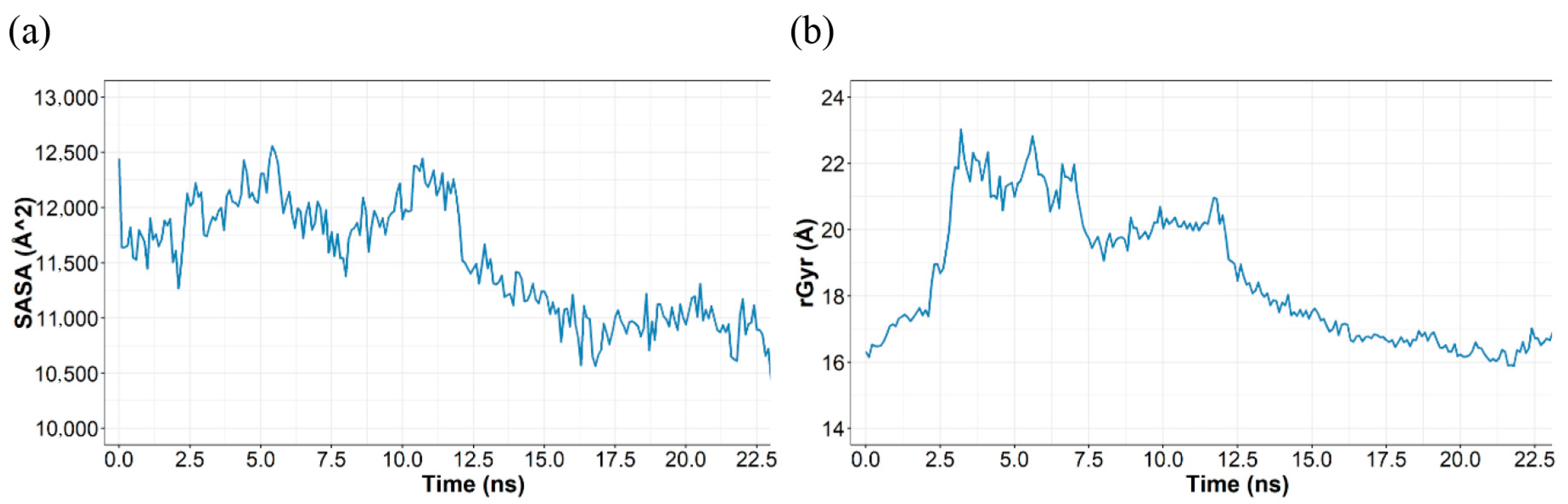
Figure 5a presents the evolution of the solvent-accessible surface area (SASA) of chitosan throughout the simulation. A slight decrease in SASA was observed, indicating progressive incorporation of m-cresol into less accessible regions of the polymer, likely within internal cavities. This reduction in solvent exposure suggests the gradual entrapment of m-cresol within the polymer matrix. Correspondingly, the radius of gyration (rGyr) shown in Figure 5b exhibited an initial increase followed by a decrease, reflecting a structural reorganization of chitosan that facilitates the formation of binding cavities. This conformational adaptability is a key feature that enables chitosan to accommodate and retain m-cresol molecules.
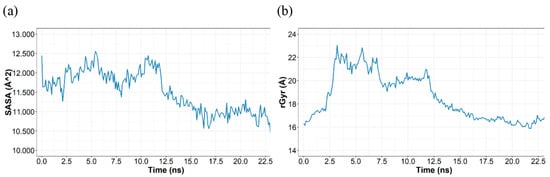
Figure 5.
(a) Solvent-accessible surface area (SASA) of chitosan polymer during the 25-nanosecond molecular dynamics simulation and (b) radius of gyration (rGyr) of chitosan polymer during the 25 ns molecular dynamics simulation.
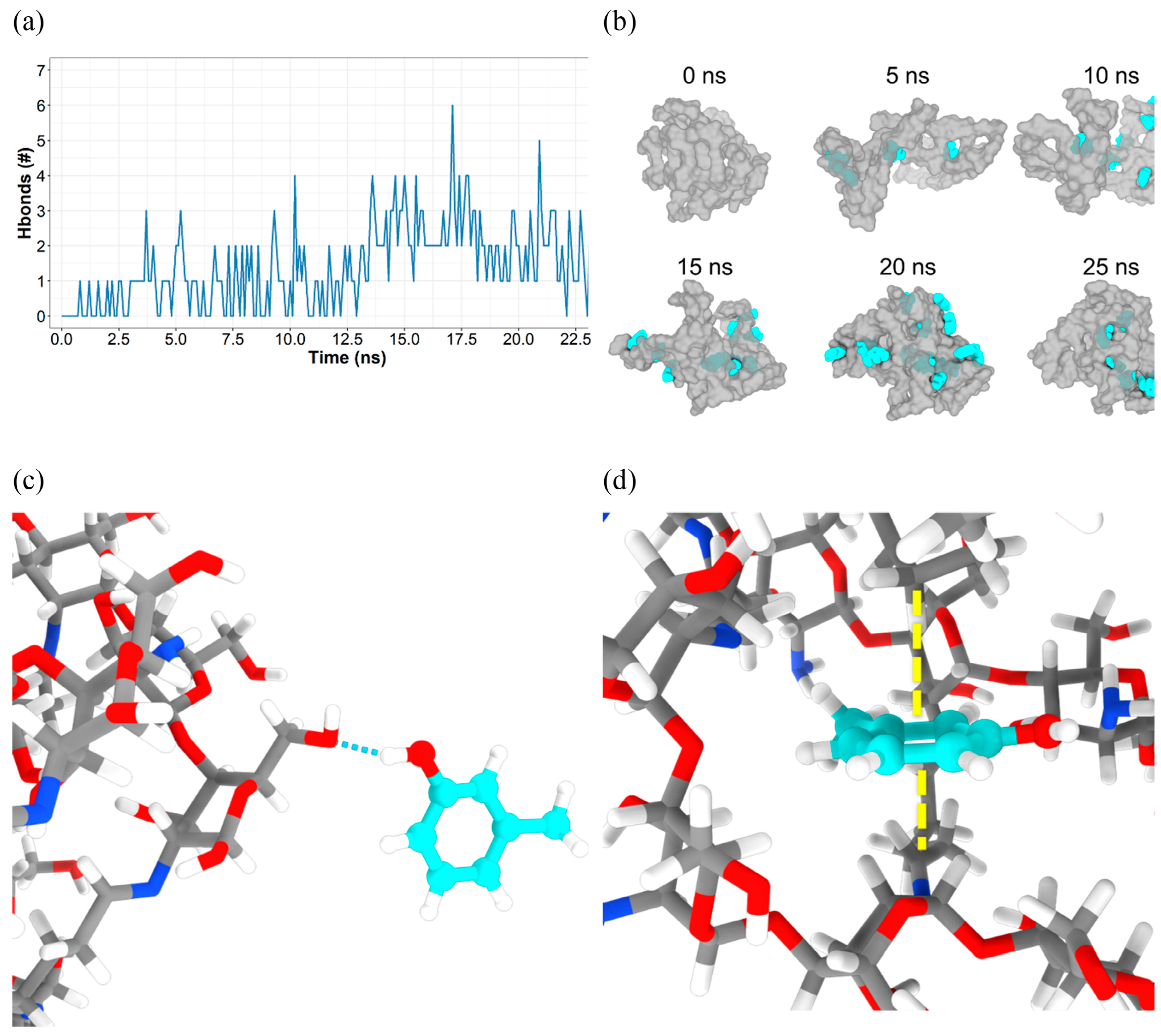
Figure 6 further characterizes the nature of the interactions between m-cresol and MIP-Gs. In Figure 6a, hydrogen bonding between chitosan and m-cresol was detected but remained limited, suggesting these interactions are not the primary stabilizing forces. Instead, as shown in Figure 6b, m-cresol preferentially resides within internal cavities of the polymer, where stabilization occurs mainly through hydrophobic interactions. Figure 6c provides a spatial depiction of hydrogen bonding sites, confirming that such interactions occur primarily at the polymer surface rather than within the core regions. Finally, Figure 6d highlights the dominant contribution of hydrophobic interactions to the retention of m-cresol within the internal hydrophobic domains of the polymer matrix. These domains are further stabilized by glutaraldehyde crosslinks, which enhance structural rigidity and hydrophobicity.
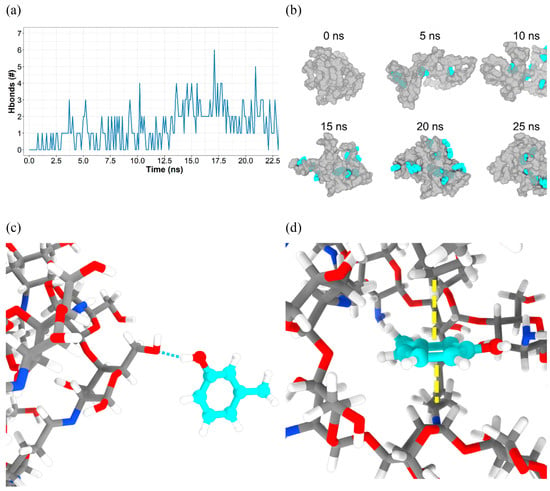
Figure 6.
Interaction between the m-cresol and the MIP-Gs. (a) Intermolecular hydrogen bonds (Hbonds) formed between chitosan polymer and m-cresol during the 25 ns molecular dynamics simulation, (b) snapshots from molecular dynamics simulations showing the capture of m-cresol within the polymer, (c) intermolecular hydrogen bond (Hbond) formed between chitosan (surface) and m-cresol, and (d) the hydrophobic interactions formed between chitosan (cavity) and m-cresol.
Overall, the MD simulation results indicate that m-cresol adsorption by MIP-Gs is primarily governed by hydrophobic interactions, reinforced by the presence of glutaraldehyde crosslinks that stabilize the polymer network and the internal cavities. The observed reduction in SASA and the compactness suggested by the rGyr evolution support the formation of stable, hydrophobic microenvironments capable of trapping m-cresol. Although hydrogen bonding contributes marginally to stabilization, the predominant mechanism involves hydrophobic retention within glutaraldehyde-stabilized cavities.
This structural adaptability and chemical affinity endow the chitosan–glutaraldehyde matrix with selective recognition capacity toward m-cresol in complex wine matrices. In such systems, the imprinted cavities preferentially bind m-cresol over less hydrophobic phenolic compounds, explaining the experimental selectivity observed for MIP-Gs and their minimal impact on the overall phenolic profile and color parameters of the treated wines.
3.5. Interaction of Chitosan-Based Imprinted Polymers with Phenolic Components and Color Parameters
It is known that chitosan can alter the content of polyphenolic compounds in red wine [46]. Therefore, beyond evaluating the removal efficiency of m-cresol, it is essential to assess the impact of the synthesized MIP-Gs on phenolic composition and chromatic parameters of treated wine. In this context, total phenolics, total anthocyanins, total tannins, and colorimetric parameters of the treated wine were tested and reported in Table 4 and Table 5, respectively.
Table 4.
Total anthocyanins, total phenolics and total tannins in a Cabernet Sauvignon wine after extraction with cartridges containing MIP-G resins and NIP-Gs.
Table 5.
Luminosity, Tonality and Color intensity of a Cabernet Sauvignon wine after extraction with cartridges containing MIP-G resins and NIP-Gs.
For the wine spiked with 25 µg·L−1 of m-cresol, all MIP-Gs treatments reduced total polyphenols by 5–10%. In contrast, for the wine containing 100 µg·L−1 of m-cresol, only the highest dose of the most crosslinked MIP produced a significant reduction (≈11%, treatment 12). Regarding anthocyanin content, treatment 1 (100 mg of polymer; 20 mL of wine) significantly reduced total anthocyanins (17%) in the 25 µg·L−1 m-cresol wine, while treatment 4 (300 mg of polymer; 20 mL of wine) reduced anthocyanins by 13% in the wine spiked with 100 µg·L−1 of m-cresol. These results indicate that although low-molecular-weight phenolic compounds naturally present in wine can partially interact with chitosan-based MIPs, their co-adsorption is limited and strongly dependent on both polymer crosslinking density and applied dose. These slight decreases in anthocyanins and phenolic compounds are consistent with previous studies where MIPs or commercial fining agents were added to wine [6,42,43,47]. Importantly, total tannin content was largely unaffected by MIP-G treatments across all experimental conditions, suggesting that high-molecular-weight polyphenols exhibit limited affinity for the imprinted polymer network. This behavior indicates a degree of size and interaction selectivity, favoring low-molecular-weight phenolic species over larger condensed tannins.
In contrast, NIP-G treatments generally resulted in more pronounced and less selective reductions in phenolic parameters. Most NIP-G formulations caused significant decreases in total phenolics and anthocyanins, particularly at higher polymer masses, and some treatments also affected total tannin levels. This broader adsorption profile reflects the absence of specific recognition sites in NIP-Gs, highlighting the advantage of molecular imprinting in limiting non-specific interactions.
According to the study results, MIP-Gs slightly decreased total phenols and anthocyanins but did not significantly affect tannin content. This suggests that low molecular weight compounds compete for the imprinted sites or interact with chitosan, whereas high molecular weight tannins are not retained. This feature is advantageous, as treatments with MIPs would not affect wine astringency, a sensory property directly related to tannin concentration.
The impact of polymer treatments on colorimetric parameters was evaluated through luminosity (L*), tonality, and color intensity measurements (Table 5). Despite reductions in total phenolics and anthocyanins, none of the MIP-G treatments produced statistically significant changes in color intensity, tonality, or luminosity of wine samples relative to the untreated controls. This result indicates that partial co-adsorption of phenolic compounds did not lead to perceptible changes in visual color parameters. These findings differ from those reported by Filipe-Ribeiro et al. (2020) [42] and Huo et al. (2024) [43], who observed a decrease in color intensity in wines treated with molecularly imprinted polymers. Conversely, NIP-G treatments at higher polymer doses led to a significant decrease in color intensity (≈9–11%), consistent with their lower selectivity and stronger affinity toward colored phenolic fractions. This behavior is in agreement with the results reported by Teixeira et al. (2015) [47], who showed that treatment with non-imprinted polymers resulted in wines with lower color intensity.
From a practical standpoint, the results suggest that, under the conditions yielding the highest m-cresol removal efficiencies, only minor reductions in total polyphenols and anthocyanins were observed. In contrast, total tannin levels and chromatic parameters remained largely unchanged. These findings demonstrate that chitosan–glutaraldehyde-based MIPs exhibit a favorable balance between targeted adsorption of m-cresol and minimal interference with other phenolic components. The preservation of tannin content and color-related parameters suggests that molecular imprinting effectively restricts non-specific adsorption, enhancing selectivity relative to non-imprinted materials. From a materials perspective, these results highlight the potential of chitosan-based MIPs as functional adsorbents capable of operating in chemically complex matrices while maintaining controlled interaction profiles. Moreover, the modest decrease in total phenolics implies that the antioxidant potential and nutritional value of the treated wine would be only minimally affected. moderate decreases in total phenolic content of this magnitude generally do not result in significant losses of antioxidant activity or sensory quality, particularly when high-molecular-weight tannins are not affected.
4. Conclusions
In this work, chitosan-based molecularly imprinted polymers cross-linked with glutaraldehyde were successfully synthesized using m-cresol as a model template molecule. ATR-FTIR analysis confirmed the formation of Schiff base linkages between chitosan and glutaraldehyde, as well as the effective removal of the template molecule after the washing process. Morphological observations by SEM revealed that crosslinking led to denser and more compact polymer networks compared to neat chitosan, while thermogravimetric analysis demonstrated that increasing the degree of crosslinking enhanced thermal stability and modified water retention behavior, particularly in the most cross-linked formulation (MIP-G3).
Adsorption experiments demonstrated that the imprinted polymers exhibited higher affinity toward m-cresol than their non-imprinted counterparts, confirming the successful creation of specific recognition sites within the chitosan matrix. Depending on polymer formulation and initial m-cresol concentration, the MIP-Gs achieved removals in the range of approximately 10–15 µg·L−1, with the most cross-linked polymer reaching removal efficiencies of up to 40%. These results highlight the role of crosslinking density in controlling cavity stability, accessibility, and overall adsorption performance.
Regarding wine composition, MIP-Gs caused only a slight reduction (5–10%) in total polyphenols and anthocyanins, without significantly affecting total tannins or chromatic parameters (lightness, hue, and color intensity). This behavior underscores the potential of chitosan-based imprinted networks as selective functional materials rather than non-specific adsorbents.
Future work should focus on tuning crosslinking chemistry, imprinting conditions, and polymer architecture to further enhance selectivity and capacity, as well as extending this approach to other target molecules and application environments. In addition, future studies should incorporate advanced analytical techniques such as HPLC–MS to investigate potential low-molecular-weight degradation products from chitosan–glutaraldehyde crosslinked MIPs in wine matrices, thereby strengthening the assessment of their chemical stability and suitability for food-related applications.
Supplementary Materials
The following supporting information can be downloaded at: https://www.mdpi.com/article/10.3390/colloids10010018/s1, Figure S1: Glutaraldehyde-crosslinked chitosan polymer structure.
Author Contributions
Conceptualization, O.V., L.L.P.-R. and V.F.L.; methodology, O.V., L.L.P.-R. and V.F.L.; software, L.L.P.-R., A.M. and A.P.; validation, O.V.; formal analysis, O.V., L.L.P.-R., R.I.C., G.C.-B., A.P., A.M. and E.F.D.-L.; investigation, O.V., D.A., E.L.P. and L.L.P.-R.; resources, O.V., V.F.L., G.C.-B. and L.L.P.-R.; data curation, O.V., L.L.P.-R. and V.F.L.; writing—original draft preparation, O.V., D.A., G.C.-B., A.P., A.M., E.F.D.-L. and L.L.P.-R.; writing—review and editing, O.V., D.A. and L.L.P.-R.; visualization, O.V., R.I.C. and L.L.P.-R.; supervision, O.V.; project administration, O.V.; funding acquisition O.V., L.L.P.-R., V.F.L. and G.C.-B. All authors have read and agreed to the published version of the manuscript.
Funding
This research was funded by ANID through Fondecyt grants 1210107 (O.V.), 1231484 (V.F.L.), and 1221609 (G.C.-B.).
Data Availability Statement
The original contributions presented in this study are included in the article/Supplementary Material. Further inquiries can be directed to the corresponding authors.
Conflicts of Interest
The authors declare no conflicts of interest.
References
- Parker, M.; Osidacz, P.; Baldock, G.A.; Hayasaka, Y.; Black, C.A.; Pardon, K.H.; Jeffery, D.W.; Geue, J.P.; Herderich, M.J.; Francis, I.L. Contribution of Several Volatile Phenols and Their Glycoconjugates to Smoke-Related Sensory Properties of Red Wine. J. Agric. Food Chem. 2012, 60, 2629–2637. [Google Scholar] [CrossRef]
- Hayasaka, Y.; Parker, M.; Baldock, G.A.; Pardon, K.H.; Black, C.A.; Jeffery, D.W.; Herderich, M.J. Assessing the Impact of Smoke Exposure in Grapes: Development and Validation of a HPLC-MS/MS Method for the Quantitative Analysis of Smoke-Derived Phenolic Glycosides in Grapes and Wine. J. Agric. Food Chem. 2013, 61, 25–33. [Google Scholar] [CrossRef]
- Krstic, M.P.; Johnson, D.L.; Herderich, M.J. Review of Smoke Taint in Wine: Smoke-Derived Volatile Phenols and Their Glycosidic Metabolites in Grapes and Vines as Biomarkers for Smoke Exposure and Their Role in the Sensory Perception of Smoke Taint. Aust. J. Grape Wine Res. 2015, 21, 537–553. [Google Scholar] [CrossRef]
- Mirabelli-Montan, Y.A.; Marangon, M.; Graça, A.; Mayr Marangon, C.M.; Wilkinson, K.L. Techniques for Mitigating the Effects of Smoke Taint While Maintaining Quality in Wine Production: A Review. Molecules 2021, 26, 1672. [Google Scholar] [CrossRef]
- Fudge, A.L.; Ristic, R.; Wollan, D.; Wilkinson, K.L. Amelioration of Smoke Taint in Wine by Reverse Osmosis and Solid Phase Adsorption. Aust. J. Grape Wine Res. 2011, 17, S41–S48. [Google Scholar] [CrossRef]
- Fudge, A.L.; Schiettecatte, M.; Ristic, R.; Hayasaka, Y.; Wilkinson, K.L. Amelioration of Smoke Taint in Wine by Treatment with Commercial Fining Agents. Aust. J. Grape Wine Res. 2012, 18, 302–307. [Google Scholar] [CrossRef]
- Wilkinson, K.L.; Ristic, R.; Szeto, C.; Capone, D.L.; Yu, L.; Losic, D. Novel Use of Activated Carbon Fabric to Mitigate Smoke Taint in Grapes and Wine. Aust. J. Grape Wine Res. 2022, 28, 500–507. [Google Scholar] [CrossRef]
- Yang, G.; Chen, H.; Qin, H.; Feng, Y. Amination of Activated Carbon for Enhancing Phenol Adsorption: Effect of Nitrogen-Containing Functional Groups. Appl. Surf. Sci. 2014, 293, 299–305. [Google Scholar] [CrossRef]
- Ristic, R.; Osidacz, P.; Pinchbeck, K.A.; Hayasaka, Y.; Fudge, A.L.; Wilkinson, K.L. The Effect of Winemaking Techniques on the Intensity of Smoke Taint in Wine. Aust. J. Grape Wine Res. 2011, 17, S29–S40. [Google Scholar] [CrossRef]
- Xu, L.; Zhao, Z.-X.; Huang, Y.-A.; Zhu, Q.-J. Preparation of Chitosan Molecularly Imprinted Polymers and the Recognition Mechanism for Adsorption of Alpha-Lipoic Acid. Molecules 2020, 25, 312. [Google Scholar] [CrossRef] [PubMed]
- Chen, L.; Wang, X.; Lu, W.; Wu, X.; Li, J. Molecular Imprinting: Perspectives and Applications. Chem. Soc. Rev. 2016, 45, 2137–2211. [Google Scholar] [CrossRef]
- Cabrera-Barjas, G.; Banerjee, A.; Valdes, O.; Moncada, M.; Sirajunnisa, A.R.; Surendhiran, D.; Ramakrishnan, G.; Rani, N.S.; Hamidi, M.; Kozani, P.S.; et al. Food Biotechnology: Innovations and Challenges. In Future Foods; Elsevier: Amsterdam, The Netherlands, 2022; pp. 697–719. [Google Scholar]
- Nunes, C.; Castro, A.; Ferreira, A.S.; Ferreira, P.; Coimbra, M.A. Surface Morphology of Chitosan Films with Incorporation of Grape Pomace. Microsc. Microanal. 2015, 21, 35–36. [Google Scholar] [CrossRef]
- Nulens, I.; Ben Zvi, A.; Vankelecom, I.F.J.; Ramon, G.Z. Re-Thinking Polyamide Thin Film Formation: How Does Interfacial Destabilization Dictate Film Morphology? J. Memb. Sci. 2022, 656, 120593. [Google Scholar] [CrossRef]
- Oliveira, A.C.S.; Ugucioni, J.C.; Borges, S.V. Effect of Glutaraldehyde/Glycerol Ratios on the Properties of Chitosan Films. J. Food Process. Preserv. 2021, 45, e15060. [Google Scholar] [CrossRef]
- Frick, J.M.; Ambrosi, A.; Pollo, L.D.; Tessaro, I.C. Influence of Glutaraldehyde Crosslinking and Alkaline Post-Treatment on the Properties of Chitosan-Based Films. J. Polym. Environ. 2018, 26, 2748–2757. [Google Scholar] [CrossRef]
- Pavoni, J.M.F.; dos Santos, N.Z.; May, I.C.; Pollo, L.D.; Tessaro, I.C. Impact of Acid Type and Glutaraldehyde Crosslinking in the Physicochemical and Mechanical Properties and Biodegradability of Chitosan Films. Polym. Bull. 2021, 78, 981–1000. [Google Scholar] [CrossRef]
- Valdes, O.; Bustos, D.; Guzmán, L.; Muñoz-Vera, M.; Urra, G.; Castro, R.I.; Morales-Quintana, L. The Controlled Release of Abscisic Acid (ABA) Utilizing Alginate–Chitosan Gel Blends: A Synergistic Approach for an Enhanced Small-Molecule Delivery Controller. Gels 2024, 10, 185. [Google Scholar] [CrossRef]
- Velásquez, C.L. Chitosan and Its Applications in Oenology. OENO One 2023, 57, 121–132. [Google Scholar] [CrossRef]
- Poon, L.; Wilson, L.D.; Headley, J.V. Chitosan-Glutaraldehyde Copolymers and Their Sorption Properties. Carbohydr. Polym. 2014, 109, 92–101. [Google Scholar] [CrossRef] [PubMed]
- Li, B.; Shan, C.-L.; Zhou, Q.; Fang, Y.; Wang, Y.-L.; Xu, F.; Han, L.-R.; Ibrahim, M.; Guo, L.-B.; Xie, G.-L.; et al. Synthesis, Characterization, and Antibacterial Activity of Cross-Linked Chitosan-Glutaraldehyde. Mar. Drugs 2013, 11, 1534–1552. [Google Scholar] [CrossRef]
- Monteiro, O.A.C.; Airoldi, C. Some Studies of Crosslinking Chitosan–Glutaraldehyde Interaction in a Homogeneous System. Int. J. Biol. Macromol. 1999, 26, 119–128. [Google Scholar] [CrossRef]
- Zhou, Z.; Lin, S.; Yue, T.; Lee, T.-C. Adsorption of Food Dyes from Aqueous Solution by Glutaraldehyde Cross-Linked Magnetic Chitosan Nanoparticles. J. Food Eng. 2014, 126, 133–141. [Google Scholar] [CrossRef]
- Tavassoli, M.; Abedi-Firoozjah, R.; Bahramian, B.; Hashemi, M.; Noori, S.M.A.; Oladzadabbasabadi, N.; Nagdalian, A.; Jafari, S.M. Glutaraldehyde Cross-Linking for Improving the Techno-Functional Properties of Biopolymeric Food Packaging Films; a Comprehensive Review. Food Chem. 2025, 478, 143740. [Google Scholar] [CrossRef] [PubMed]
- Mulyasuryani, A.; Haryanto, E.; Sulistyarti, H.; Rumhayati, B. Molecularly Imprinted Polymers Chitosan-Glutaraldehyde for Monosodium Glutamate. IOP Conf. Ser. Mater. Sci. Eng. 2018, 299, 012010. [Google Scholar] [CrossRef]
- Campos, E.; Coimbra, P.; Gil, M.H. An Improved Method for Preparing Glutaraldehyde Cross-Linked Chitosan–Poly(Vinyl Alcohol) Microparticles. Polym. Bull. 2013, 70, 549–561. [Google Scholar] [CrossRef]
- Valente, I.M.; Santos, C.M.; Moreira, M.M.; Rodrigues, J.A. New Application of the QuEChERS Methodology for the Determination of Volatile Phenols in Beverages by Liquid Chromatography. J. Chromatogr. A 2013, 1271, 27–32. [Google Scholar] [CrossRef]
- Mercurio, M.D.; Dambergs, R.G.; Herderich, M.J.; Smith, P.A. High Throughput Analysis of Red Wine and Grape PhenolicsAdaptation and Validation of Methyl Cellulose Precipitable Tannin Assay and Modified Somers Color Assay to a Rapid 96 Well Plate Format. J. Agric. Food Chem. 2007, 55, 4651–4657. [Google Scholar] [CrossRef]
- Ayala, F.; Echávarri, J.F.; Negueruela, A.I. MSCV®. 2014. Available online: http://www.unirioja.es/color/descargas.shtml (accessed on 10 November 2024).
- Halgren, T.A. Merck Molecular Force Field. I. Basis, Form, Scope, Parameterization, and Performance of MMFF94. J. Comput. Chem. 1996, 17, 490–519. [Google Scholar] [CrossRef]
- Martínez, L.; Andrade, R.; Birgin, E.G.; Martínez, J.M. PACKMOL: A Package for Building Initial Configurations for Molecular Dynamics Simulations. J. Comput. Chem. 2009, 30, 2157–2164. [Google Scholar] [CrossRef] [PubMed]
- Jorgensen, W.L.; Maxwell, D.S.; Tirado-Rives, J. Development and Testing of the OPLS All-Atom Force Field on Conformational Energetics and Properties of Organic Liquids. J. Am. Chem. Soc. 1996, 118, 11225–11236. [Google Scholar] [CrossRef]
- Bowers, K.J.; Sacerdoti, F.D.; Salmon, J.K.; Shan, Y.; Shaw, D.E.; Chow, E.; Xu, H.; Dror, R.O.; Eastwood, M.P.; Gregersen, B.A.; et al. Molecular Dynamics—Scalable Algorithms for Molecular Dynamics Simulations on Commodity Clusters. In Proceedings of the 2006 ACM/IEEE Conference on Supercomputing—SC’06; ACM Press: New York, NY, USA, 2006; p. 84. [Google Scholar]
- dos Santos, J.E.; Dockal, E.R.; Cavalheiro, É.T.G. Synthesis and Characterization of Schiff Bases from Chitosan and Salicylaldehyde Derivatives. Carbohydr. Polym. 2005, 60, 277–282. [Google Scholar] [CrossRef]
- Wahba, M.I. Enhancement of the Mechanical Properties of Chitosan. J. Biomater. Sci. Polym. Ed. 2020, 31, 350–375. [Google Scholar] [CrossRef] [PubMed]
- Cárdenas, G.; Paredes, J.C.; Cabrera, G.; Casals, P. Synthesis and Characterization of Chitosan Alkyl Carbamates. J. Appl. Polym. Sci. 2002, 86, 2742–2747. [Google Scholar] [CrossRef]
- Taboada, E.; Cabrera, G.; Cardenas, G. Synthesis and Characterization of New Arylamine Chitosan Derivatives. J. Appl. Polym. Sci. 2004, 91, 807–812. [Google Scholar] [CrossRef]
- Cabrera-Barjas, G.; Jimenez, R.; Romero, R.; Valdes, O.; Nesic, A.; Hernández-García, R.; Neira, A.; Alejandro-Martín, S.; de la Torre, A.F. Value-Added Long-Chain Aliphatic Compounds Obtained through Pyrolysis of Phosphorylated Chitin. Int. J. Biol. Macromol. 2023, 238, 124130. [Google Scholar] [CrossRef] [PubMed]
- Summerson, V.; Gonzalez Viejo, C.; Pang, A.; Torrico, D.D.; Fuentes, S. Review of the Effects of Grapevine Smoke Exposure and Technologies to Assess Smoke Contamination and Taint in Grapes and Wine. Beverages 2021, 7, 7. [Google Scholar] [CrossRef]
- Favell, J.W.; Wilkinson, K.L.; Zigg, I.; Lyons, S.M.; Ristic, R.; Puglisi, C.J.; Wilkes, E.; Taylor, R.; Kelly, D.; Howell, G.; et al. Correlating Sensory Assessment of Smoke-Tainted Wines with Inter-Laboratory Study Consensus Values for Volatile Phenols. Molecules 2022, 27, 4892. [Google Scholar] [CrossRef]
- Kennison, K.R.; Wilkinson, K.L.; Williams, H.G.; Smith, J.H.; Gibberd, M.R. Smoke-Derived Taint in Wine: Effect of Postharvest Smoke Exposure of Grapes on the Chemical Composition and Sensory Characteristics of Wine. J. Agric. Food Chem. 2007, 55, 10897–10901. [Google Scholar] [CrossRef]
- Filipe-Ribeiro, L.; Cosme, F.; Nunes, F.M. New Molecularly Imprinted Polymers for Reducing Negative Volatile Phenols in Red Wine with Low Impact on Wine Colour. Food Res. Int. 2020, 129, 108855. [Google Scholar] [CrossRef]
- Huo, Y.; Ristic, R.; Puglisi, C.; Wang, X.; Muhlack, R.; Baars, S.; Herderich, M.J.; Wilkinson, K.L. Amelioration of Smoke Taint in Wine via Addition of Molecularly Imprinted Polymers during or after Fermentation. J. Agric. Food Chem. 2024, 72, 18121–18131. [Google Scholar] [CrossRef]
- Spagna, G.; Pifferi, P.G.; Rangoni, C.; Mattivi, F.; Nicolini, G.; Palmonari, R. The Stabilization of White Wines by Adsorption of Phenolic Compounds on Chitin and Chitosan. Food Res. Int. 1996, 29, 241–248. [Google Scholar] [CrossRef]
- Yamada, K.; Akiba, Y.; Shibuya, T.; Kashiwada, A.; Matsuda, K.; Hirata, M. Water Purification through Bioconversion of Phenol Compounds by Tyrosinase and Chemical Adsorption by Chitosan Beads. Biotechnol. Prog. 2008, 21, 823–829. [Google Scholar] [CrossRef]
- Picariello, L.; Errichiello, F.; Coppola, F.; Rinaldi, A.; Moio, L.; Gambuti, A. Effect of Chitosan on the Removal of Different Types of Tannins from Red Wines. Appl. Sci. 2021, 11, 11743. [Google Scholar] [CrossRef]
- Teixeira, R.; Dopico-García, S.; Andrade, P.B.; Valentão, P.; López-Vilariño, J.M.; González-Rodríguez, V.; Cela-Pérez, C.; Silva, L.R. Volatile Phenols Depletion in Red Wine Using Molecular Imprinted Polymers. J. Food Sci. Technol. 2015, 52, 7735–7746. [Google Scholar] [CrossRef] [PubMed]
Disclaimer/Publisher’s Note: The statements, opinions and data contained in all publications are solely those of the individual author(s) and contributor(s) and not of MDPI and/or the editor(s). MDPI and/or the editor(s) disclaim responsibility for any injury to people or property resulting from any ideas, methods, instructions or products referred to in the content. |
© 2026 by the authors. Licensee MDPI, Basel, Switzerland. This article is an open access article distributed under the terms and conditions of the Creative Commons Attribution (CC BY) license.