


Abstract
The present investigation manages the thermal radiation influences on MHD stagnation point stream over a stretching sheet with slip boundary conditions. The governing equations are reduced set of nonlinear ODEs with boundary conditions by using the similarity transformations and the numerical velocity and temperature distribution calculations are performed with the assistance of MATLAB in the built problem solver. The outcomes of the non-dimensional factors on velocity, temperature distributions are exhibited graphically.
1. Introduction
A great deal of research has been done on stagnation-point flow. As a result of its huge applications in industries, for instance, cooling of gadgets by fans, nuclear reactors cooling in the midst of emergency shutdown and hydrodynamic methods, stagnation point flows extracted in various investigators. With free stream conditions with consideration of natural 2D nonlinear laminar flow and mixed convection over variable surfaces was studied by Devi and Kandasamy [1]. In the existence of suction/ blowing with heat source effect on an accelerating surface of heat and mass transfer flow was analyzed by Acharya et.al [2], Chemically Reaction effect by Bhattacharyya and Layek [3], chemical reaction effect and Viscous dissipation by Yirga and Shankar [4], Reddy and Shamshuddin [5], variable temperature and viscous dissipation influences was investigated by Kishore et.al [6], buoyancy and effect of radiation influences with heat source/sink impacts was analyzed by Chamkha [7]. Vajravelu and Hadjinicolaou [8] analyzed the convective heat flow in an electrically conductive fluid over a stretching surface with the uniform free stream. Ishak [9] considered on a horizontal plate with thermal radiation effect on mixed convection boundary layer.BalReddyet.al [10] studied Investigated on an exponentially stretching sheet nanofluid MHD boundary layer flow using the Keller Box technique. Influence of radiation, chemical reaction and thermal source/suction intake of permeable moving plate on a semi-infinite vertical on an unsteady MHD convection flow was examined by Ibrahim et.al [11]. Viscous dissipation and radiation effect on an exponentially stretching sheet investigated by Goud et.al [12,14,15], Kandasamyet.al [13] described the effects of chemical reactions and when suction or injection, heat, and mass transfer occurs along with the wedge. Uddin et.al [16] studied numerical simulation of convective heat transport within the nanofluid filled vertical tube of plain and uneven sidewalls. The Effects of Thermocapillarity on the Thin Film Flow of MHD UCM Fluid over an Unsteady Elastic Surface with Convective Boundary Conditions was studied by Vaidya [17].
Inspired by the above referenced work, the main aim of the examination manages the examination of the impacts of thermal radiation on MHD stagnation point flow of a stretching sheet with slip parameters. The fundamental governing equations are changed over into ODEs are worked out through MATLAB programmer inbuilt solver bvp4c and variations of temperature and velocity are represented through graphs.
2. Mathematical Formulation
Consider steady 2-D laminar, electrically conducting, and incompressible, viscous boundary layer flow on MHD stagnation point flow over a stretching sheet. The x -axis is picked out in the path of a stream along with the plate and y axis, Magnetic field are perpendicular to it. Assume the magnetic Reynolds number is negligible; pressure gradient, the induced magnetic field, external forces are ignored and suppose that the thermal physical attributes of the flow are constant.
Based on the above hypotheses, the flow and temperature equations are governed by the heat source/sink:
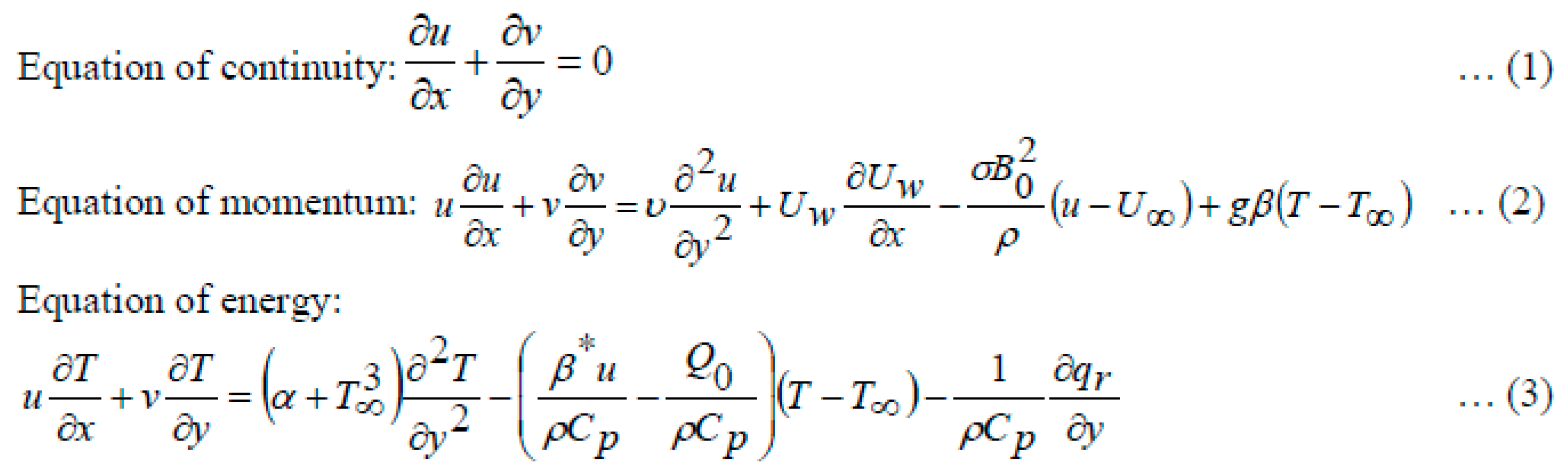
Where u, v are the velocity factors in the direction of x and y , respectively and T is the fluid velocity components in the x & y directions and temperature, respectively and α be thermal diffusivity, ρ be fluid density, υ be kinematics viscosity, B0 be applied magnetic induction, g is the acceleration due to gravity, σ be electric conductivity, k be thermal conductivity, Cp be specific heat at constant pressure respectively, T∞ and β are the temperature of free stream and the thermal radiation. By Rosselant approximation and qr is the thermal heat flux such that

where k * is the coefficient of mean absorption, σ * is the Stefan-Boltzmann constant. Taking over that the temperature changes within the flow are appropriately less so that T 4 can be worked out in Taylor series formula into T∞ and omitting the higher term expressions which gives in the way

By applying Eqs. (4) and (5), Eqns. (2) become

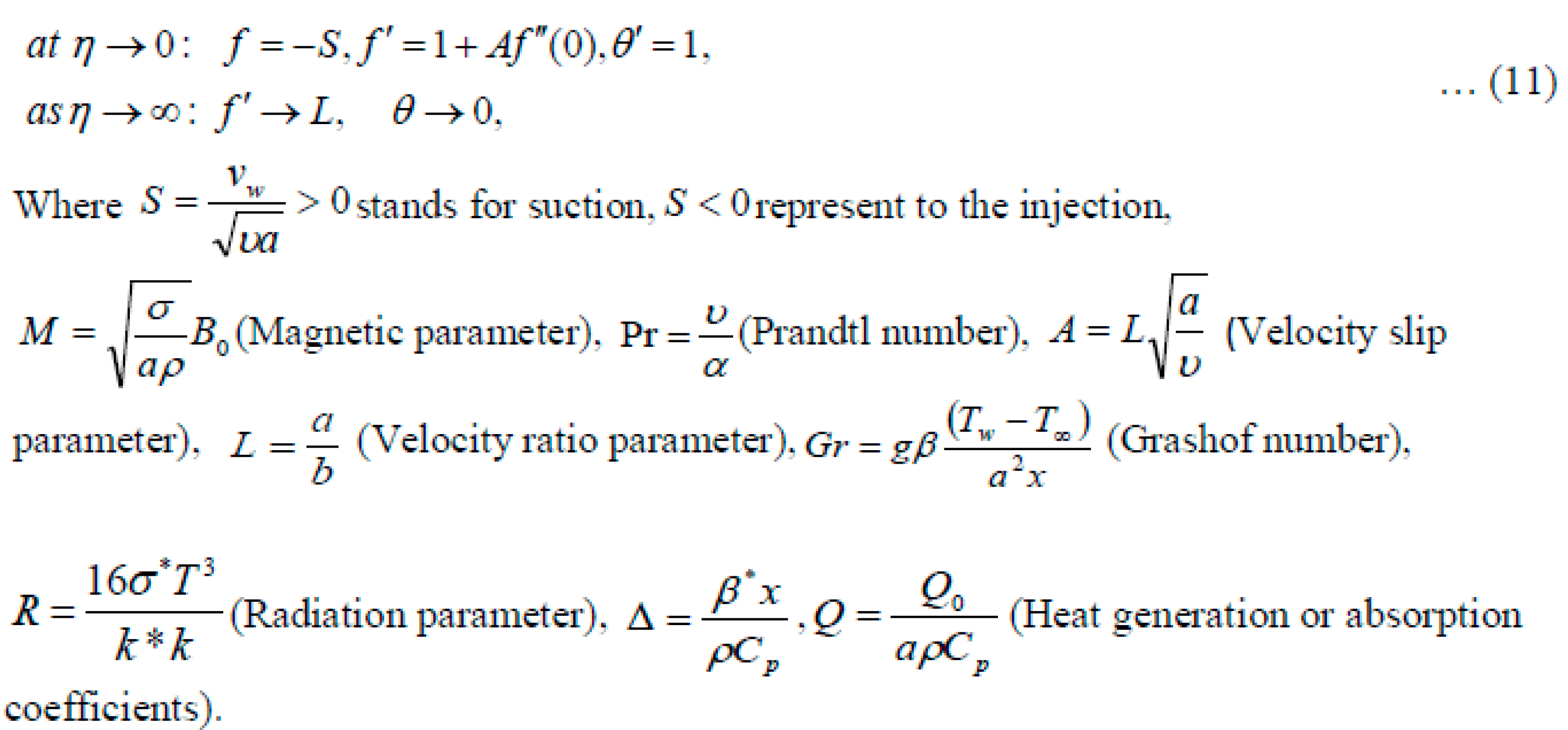
The suitable boundary condition are given by where

Now introducing the stretching velocity Uw (x) is given byUw (x) = ax ,( a constant), vw is the wall suction vw < 0 or injection vw > 0 .Equation (1) justifies that the stream functions are defined as

The following similarity transformation are

. Using the non-dimensional and similarity variables, eqns. (2) & (6) makeover to the resulting form

The boundary conditions (8) and (4) are converted as follows:
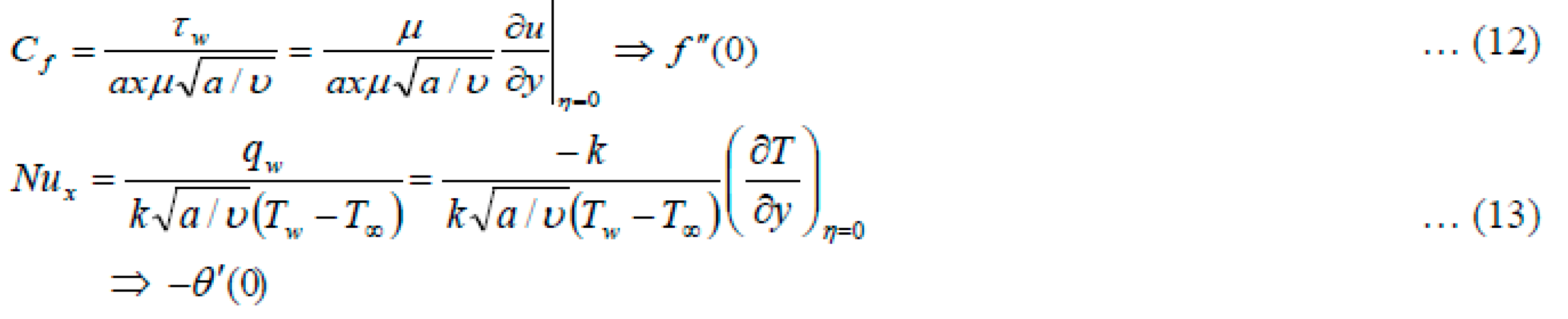
The amounts of physical meaning for such task are the local skin friction and local Nusselt number explains as is specified by
4. Results and Discussion
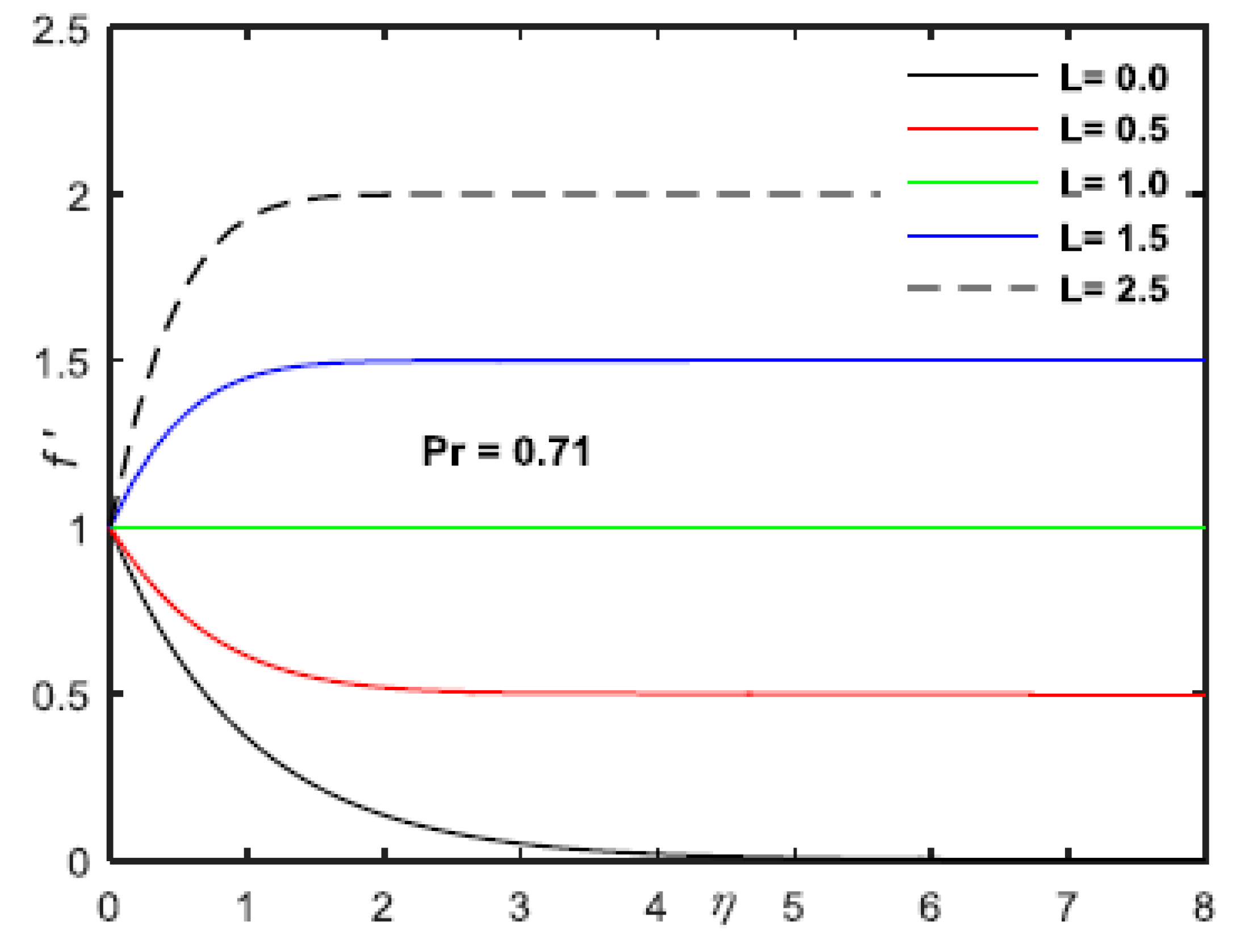
Eqs (9) – (10) are the ordinary non-linear differential equations obtained with the boundary conditions (11). These are numerically solved by MATLAB’s inbuilt solver bvp5c. The numerical calculations were carried out for the various values of the non-dimensional parameter under consideration namely, Prandtl number (Pr) , Grashof number (Gr), Radiation parameter (R) , Suction parameter (S ) , Heat generation coefficient (Q) , Heat absorption coefficient (Δ) , Velocity slip parameter ( A) , and Magnetic parameter (M ) . The temperature &velocity distributions foe various nondimensional parameters have examined. The stagnation parameter (L) effects on the velocity curves for a fixed Pr = 0.71 and nonappearance of the remaining parameters are seen in figure 1. On an increase of the stagnation parameter L , the velocity is observed to increase. Physically it represents a state when L < 1 the surface of the flow moving with a stretching velocity exceeds the stream velocity of the flow. Comparatively, these outcomes are plotted for L ≤ 1and L > 1.
Figure 1.
Velocity profile v/s Stagnation parameter.
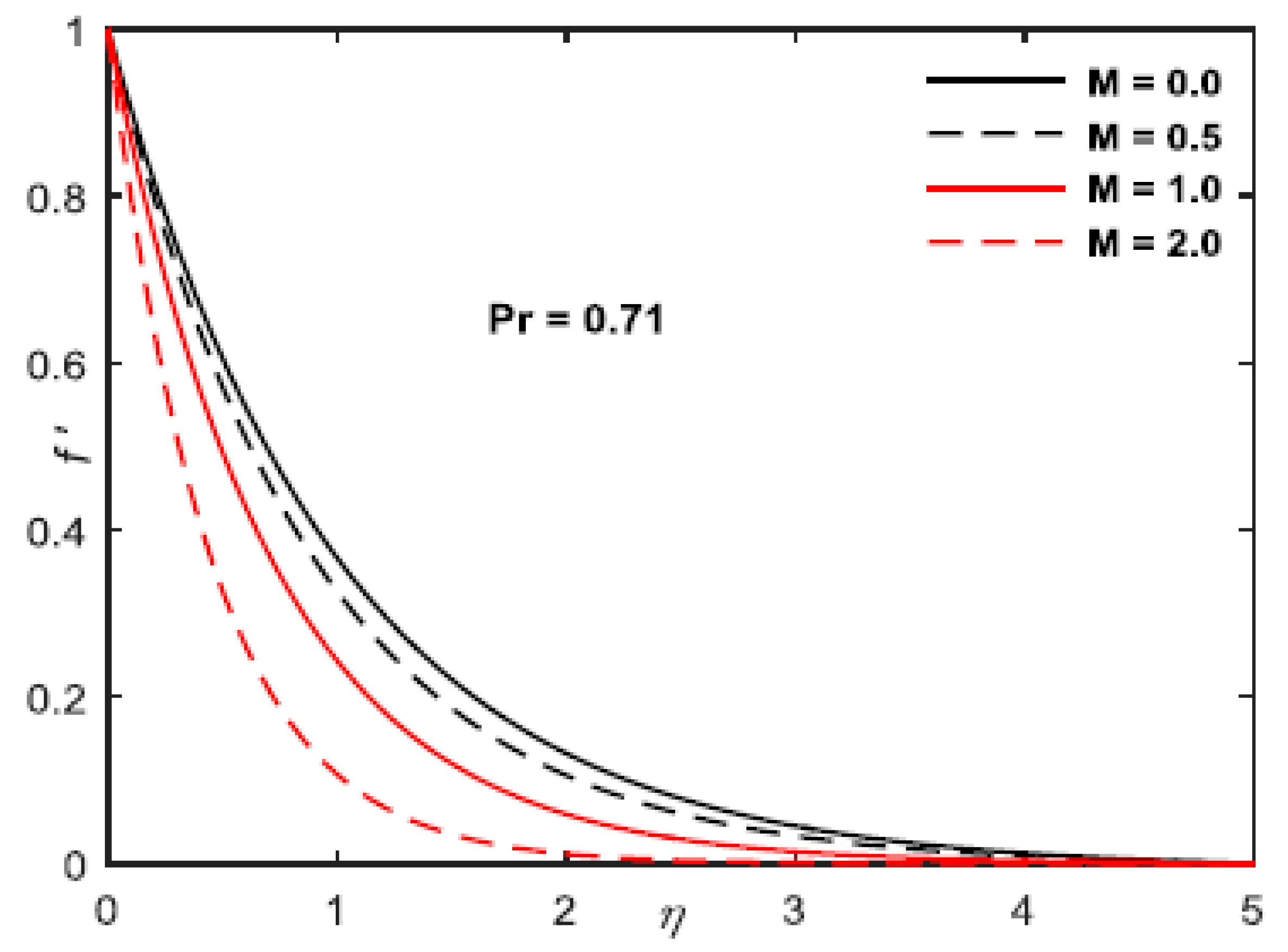
Figs.2 depicts the velocity profile for influence by magnetic parameter M. In order to illustrate the influences of various limitations under analysis, consider a fixed value of Pr = 0.71 and all other non-dimensional factors under consideration equated to zero. This figure mentioned that high values of the Magnetic parameter lead to a diminishing velocity due to the Lorentz force. Figure3 depicts that as the Suction factor increases, the velocity profile raises. The outcome of the radiation constraint R on the temperature and velocity curves within the boundary layer is demonstrated in figures 4 & 8 with Pr = 0.71& Gr = 1.0 and the absence of the remaining parameters.
Figure 2.
Velocity profile v/s Magnetic parameter.
It is evident that, on increasing the thermal radiation parameters, there can be a significant increase in velocity as well as temperature curves. For varying values of the Grashaf number Gr , Figure 5 & 6, describe the results on the velocity and the temperature curves respectively. Velocity is observed to increase while temperature diminishes on an increase of Grashaf number Gr.
Figure 3.
Velocity profile v/s Suction parameter.
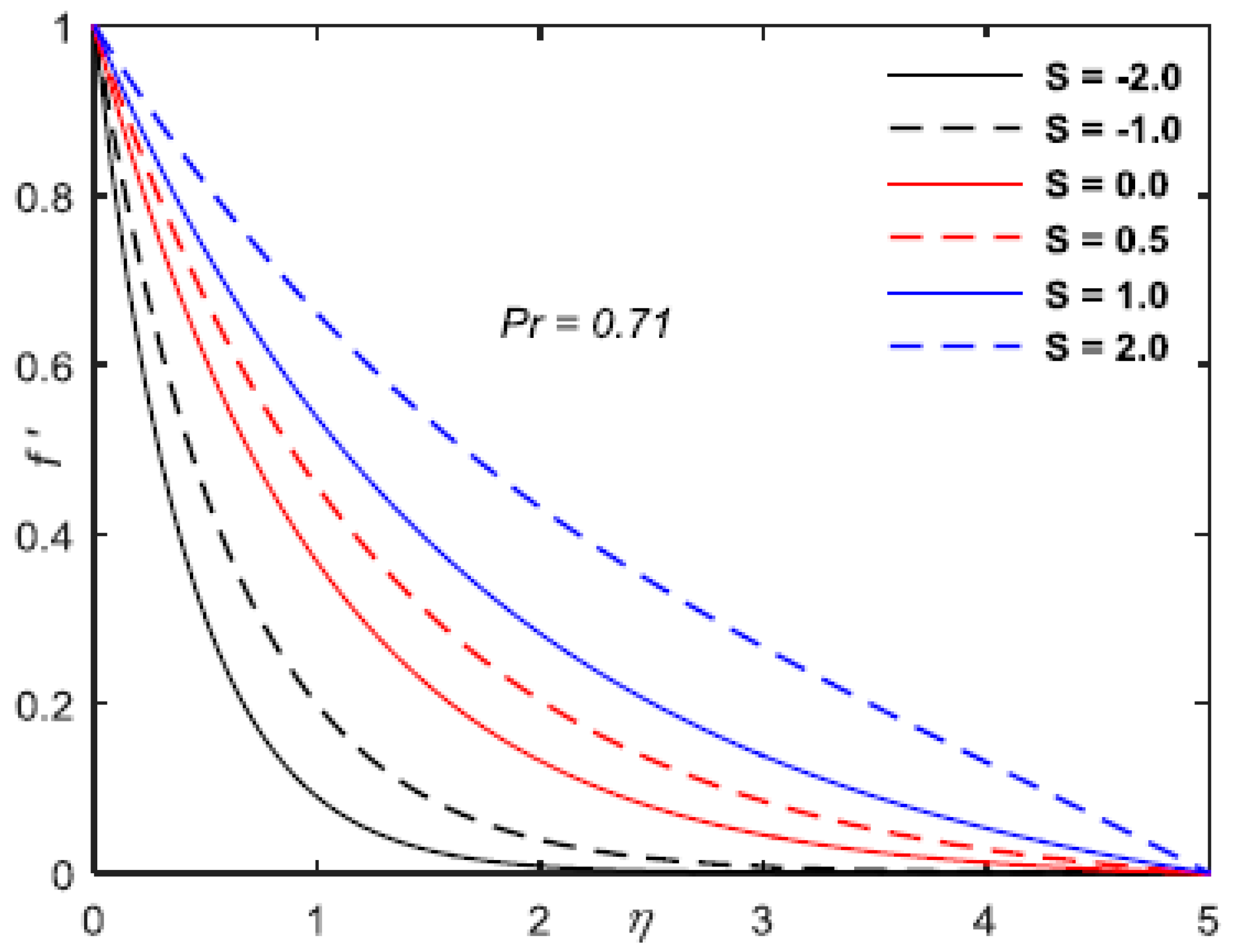
Figure 4.
Velocity profile v/s thermal radiation parameter.
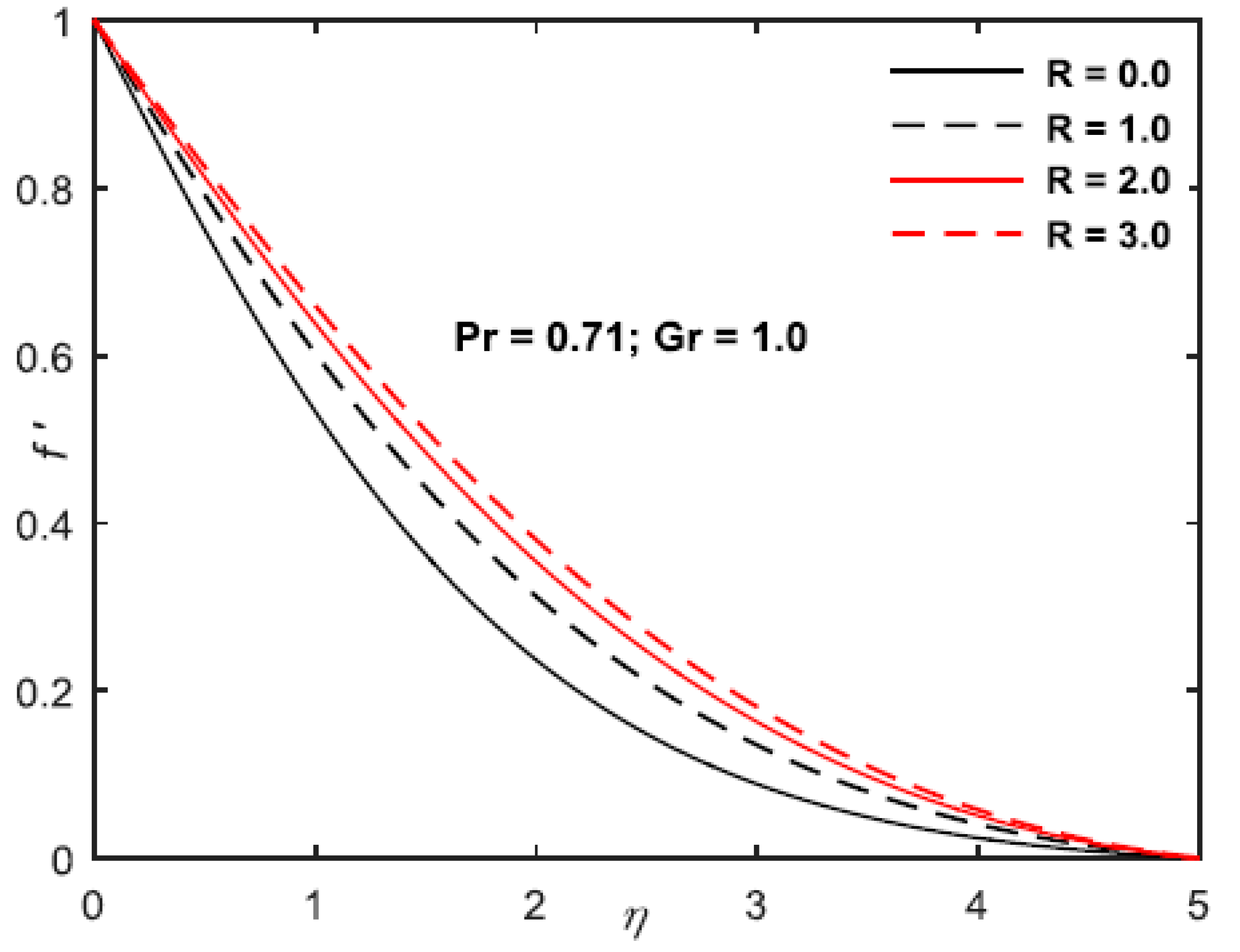
Figure 7 shows the effects on the temperature profile of the varying Prandtl number. It can be inferred from the numerical results that temperature can decrease on increasing Prandtl number. The impact of the heat generation factor (Q) on temperature profile is displayed in figure 9. As the heat generation parameter Q increases, the distribution of temperature increases. Velocity in addition to temperature curves are depicted for varying slip parameter (A) values as in figures 10 and 11. Clearly, it can be analyzed that with enhance of slip parameter (A), the velocity diminishes and increases the temperature profile.
Figure 5.
Velocity profile v/s Grashaf number Gr.
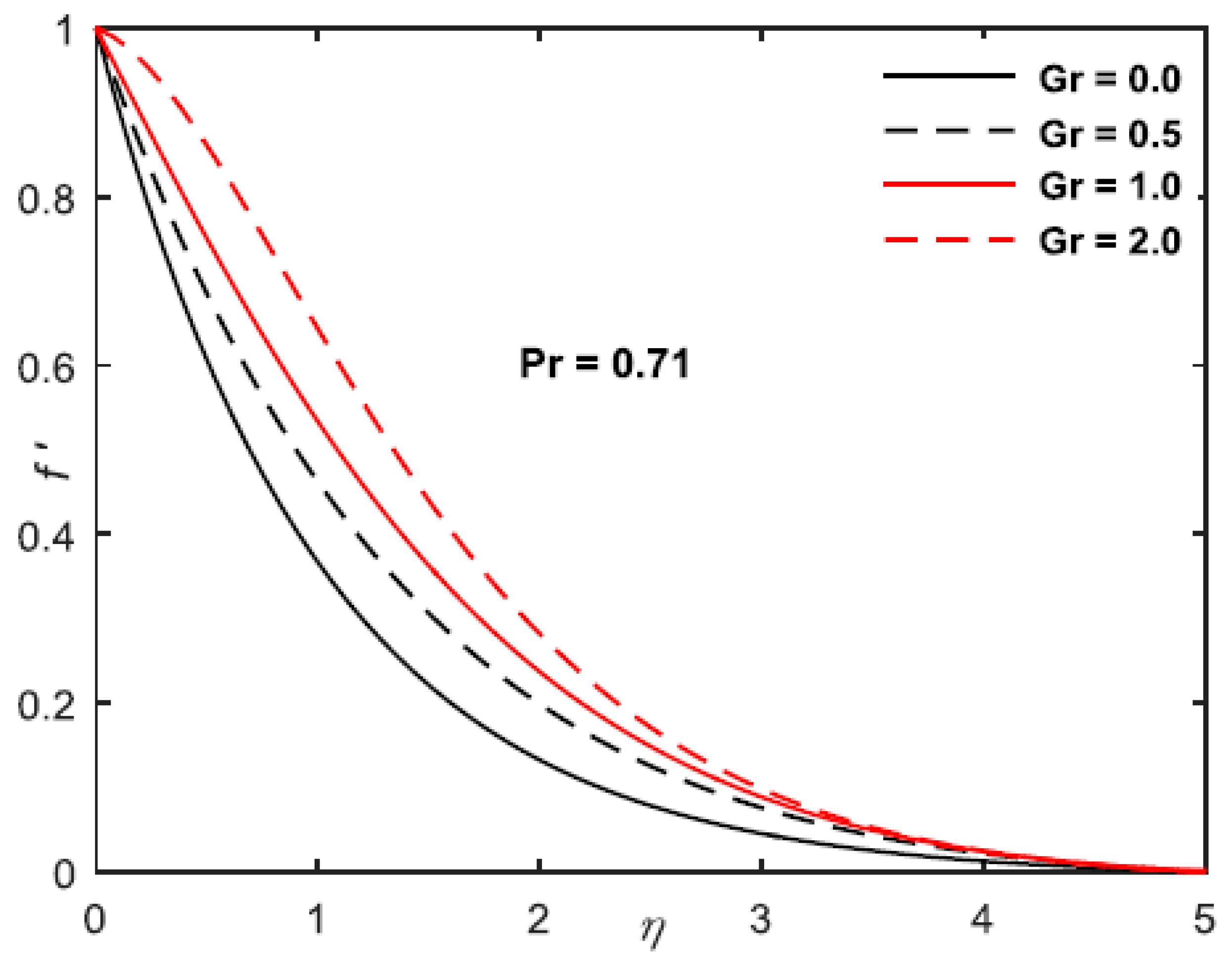
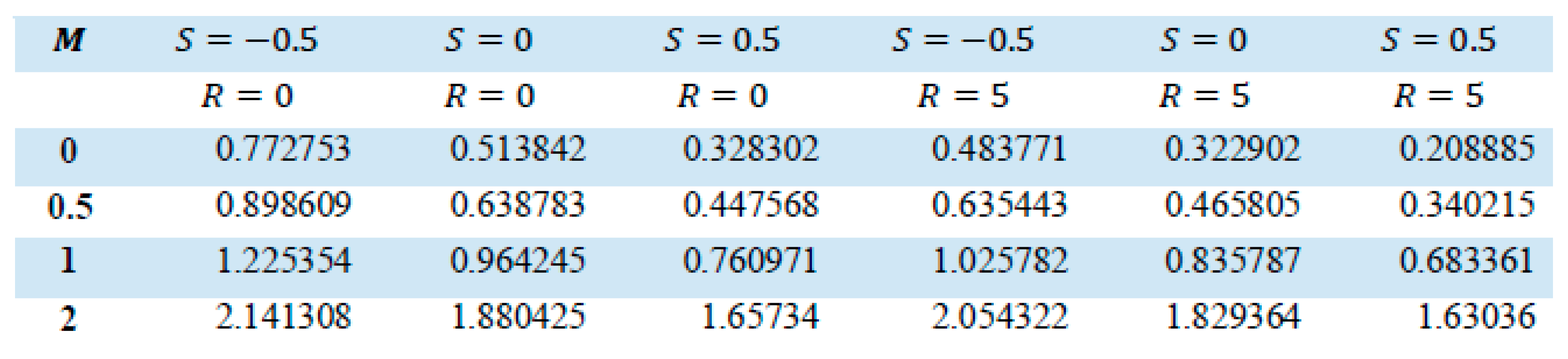
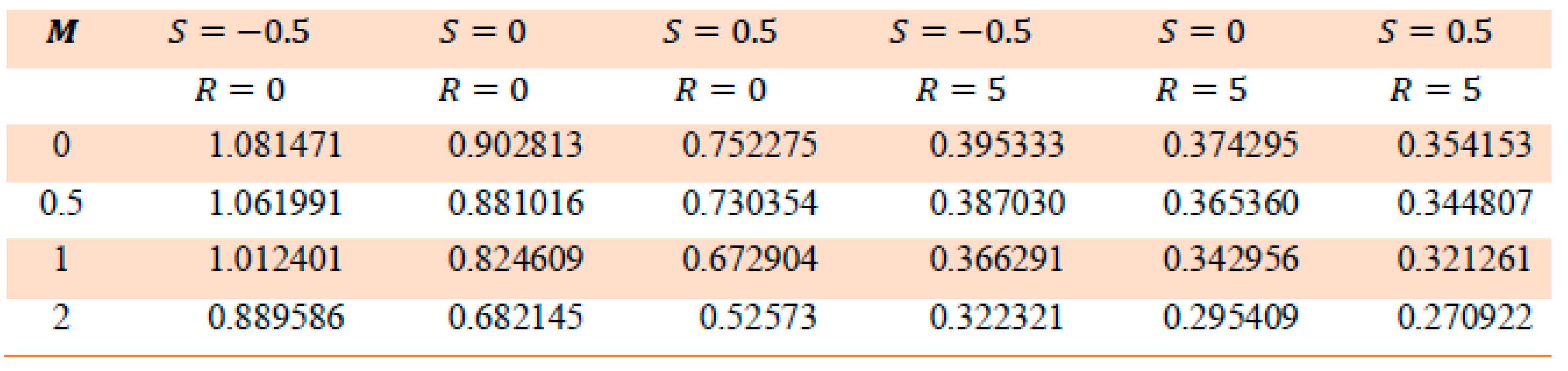
Table 1andTable 2 represents the impact on Nusselt number and skin friction coefficient stretching case by the considered non-dimensional constraints. From the table, a raise in the suction parameter, Magnetic, and radiation parameters leads to the coefficient of skin friction increases and Nusselt number decreases.
Table 1.
Velocity gradient at the wall−f''(0) for Gr = 1, Δ = 0; Pr = 0. 71 and Q = 0.
Table 2.
Temperature gradient at the wall −ϴ′(0)for S = 0; Δ = 0; Gr = 1, Pr = 0. 71 and Q = 0.
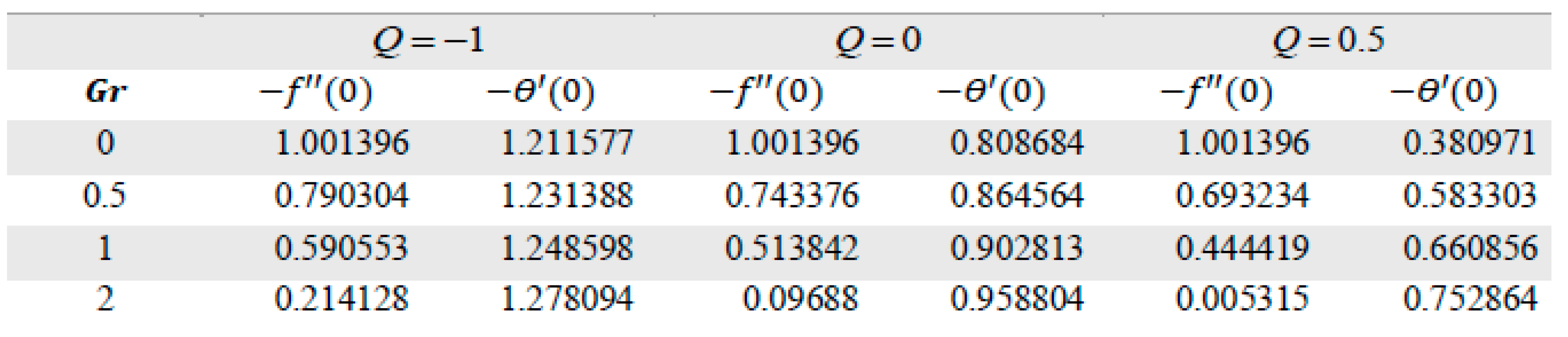
The impact of non-dimensional parameters on Nusselt number & skin friction coefficient are exhibited in Table 3.From the table it’s evident that an increase in the values of the Grashof number and the parameter of heat generation raises the quantity of skin friction declines and increases the number of Nusselt.
Table 3.
Velocity& temperature gradient at the wall are:−f′′(0) − ϴ′(0) for various Gr and values Δ : S = 0; M = 0; R = 0; Pr = 0. 71 and ∆= 0.
Figure 6.
Temperature profile v/s Grashaf number Gr.
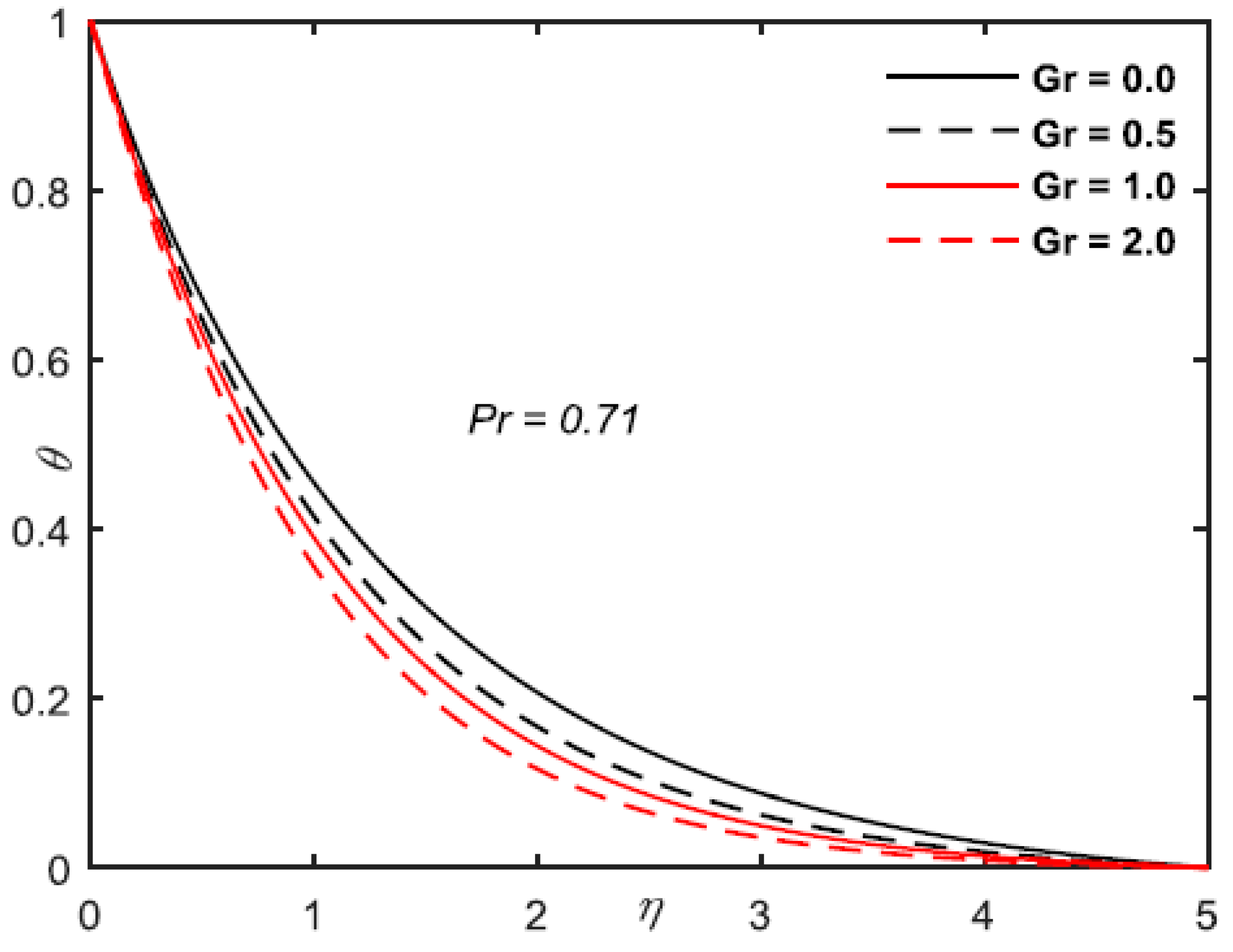
Figure 7.
Temperature profile v/s Prandtl number.
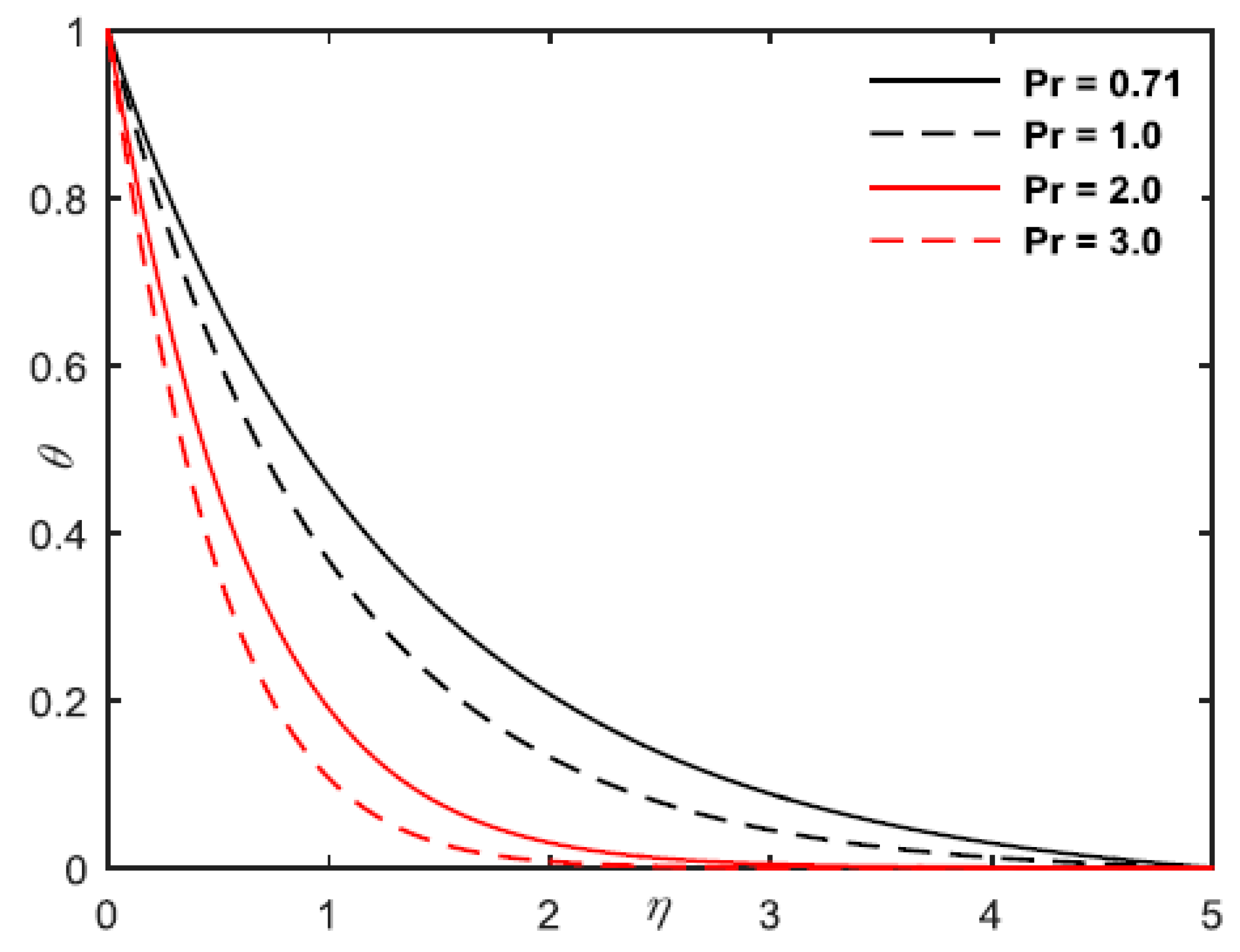
Figure 8.
Temperature profile v/s thermal radiation parameter.
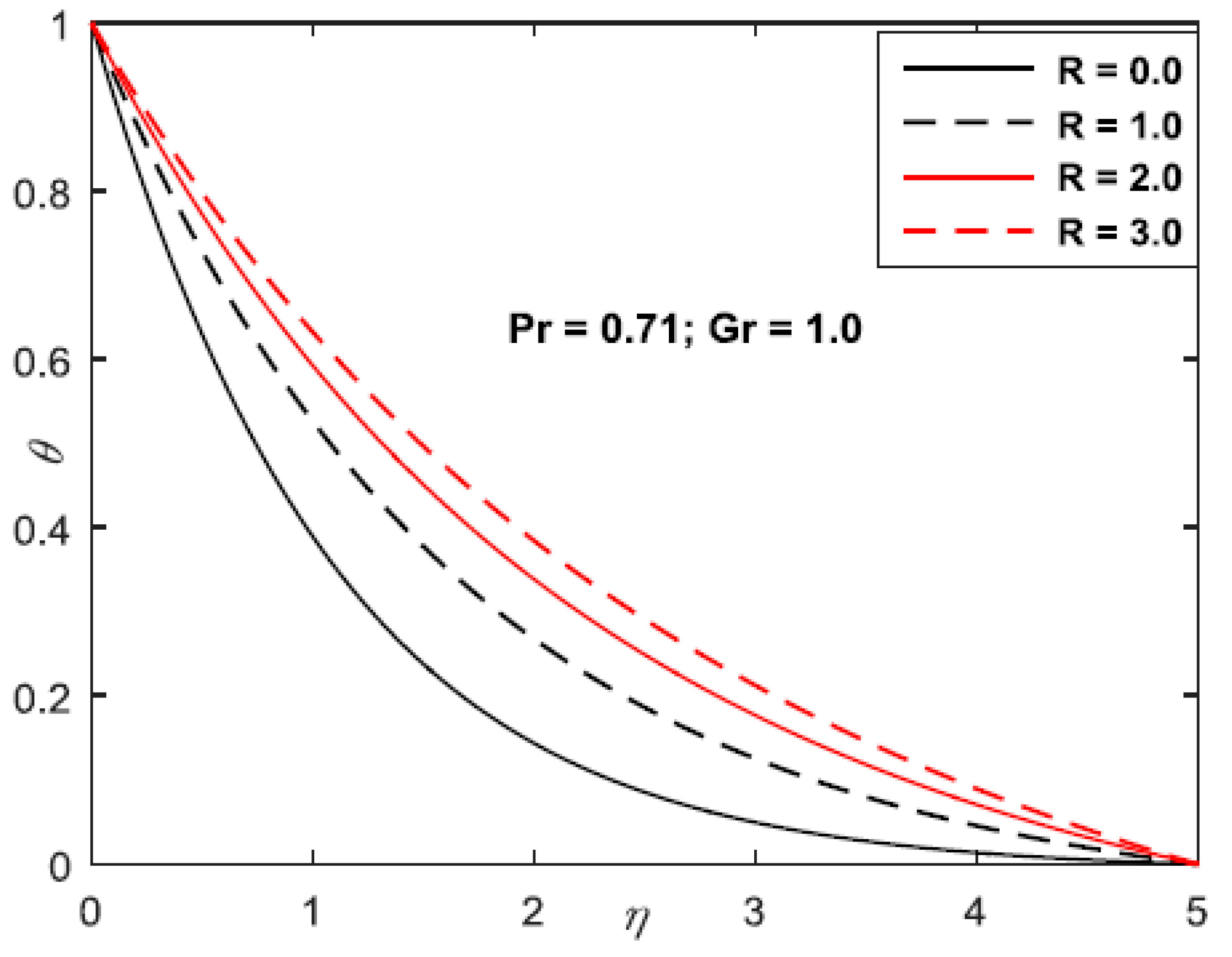
Figure 9.
Temperature profile v/s heat generation parameter.
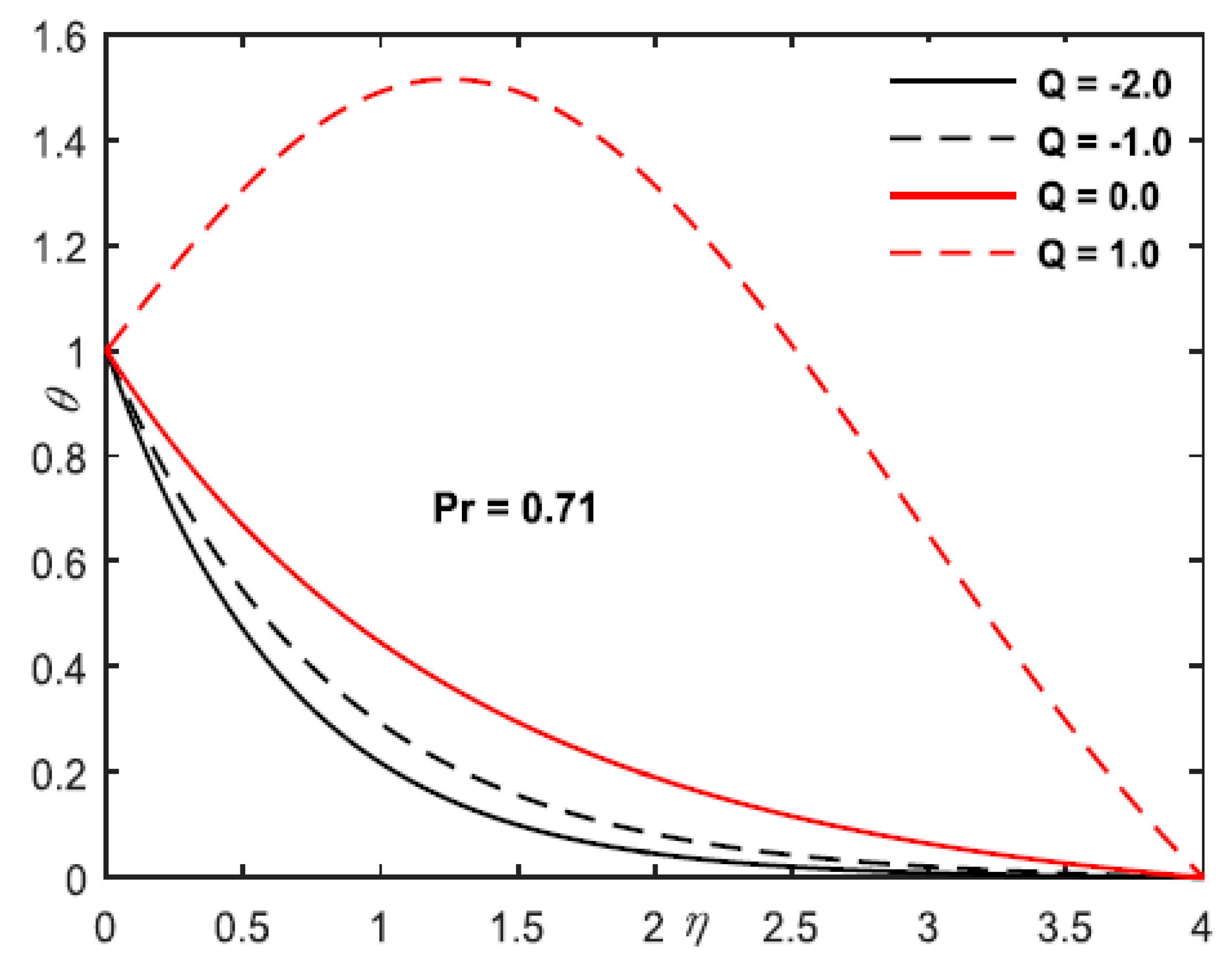
Figure 10.
Velocity profile v/s slip parameter.
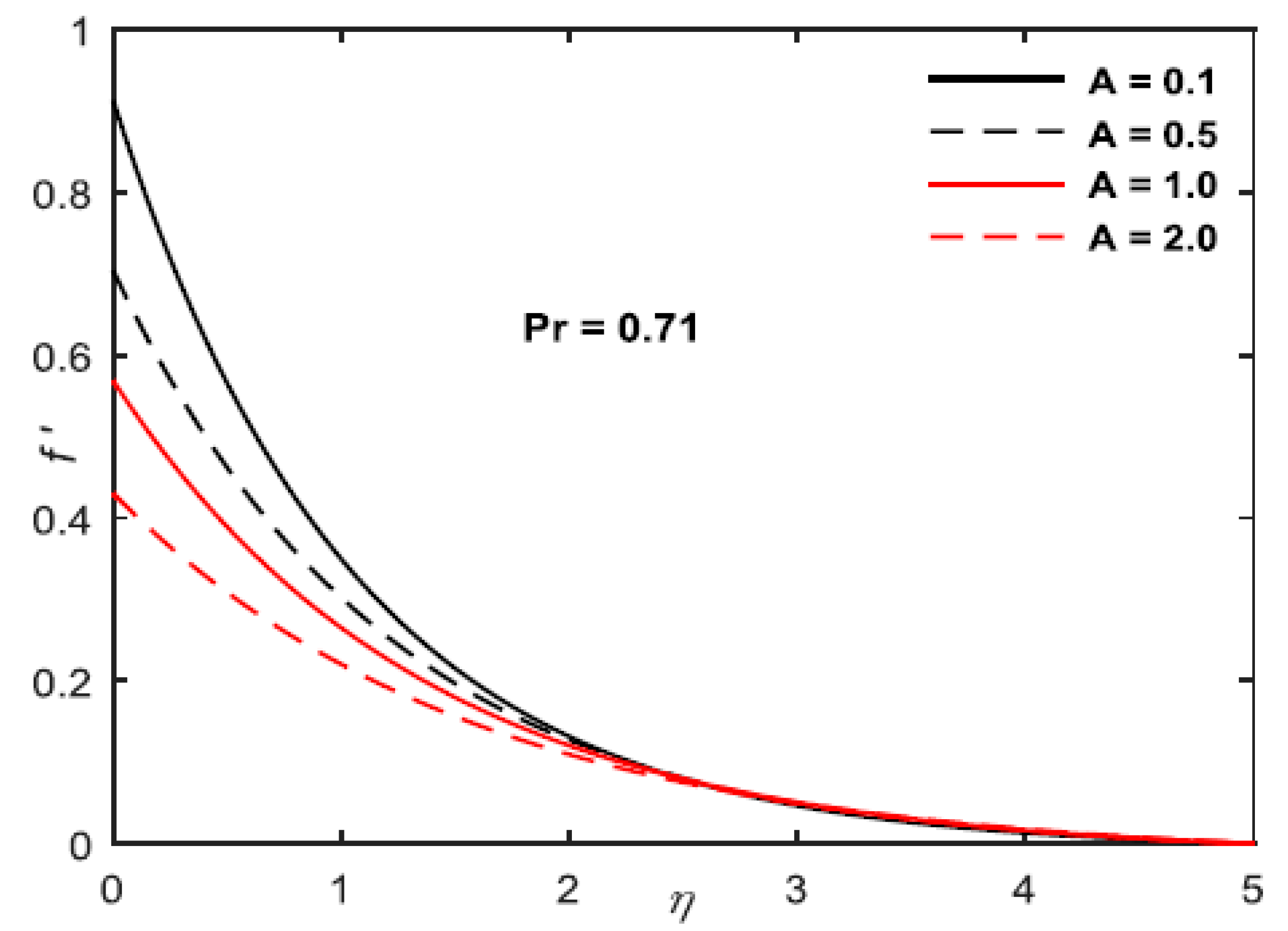
Figure 11.
Temperature profile v/s slip parameter.
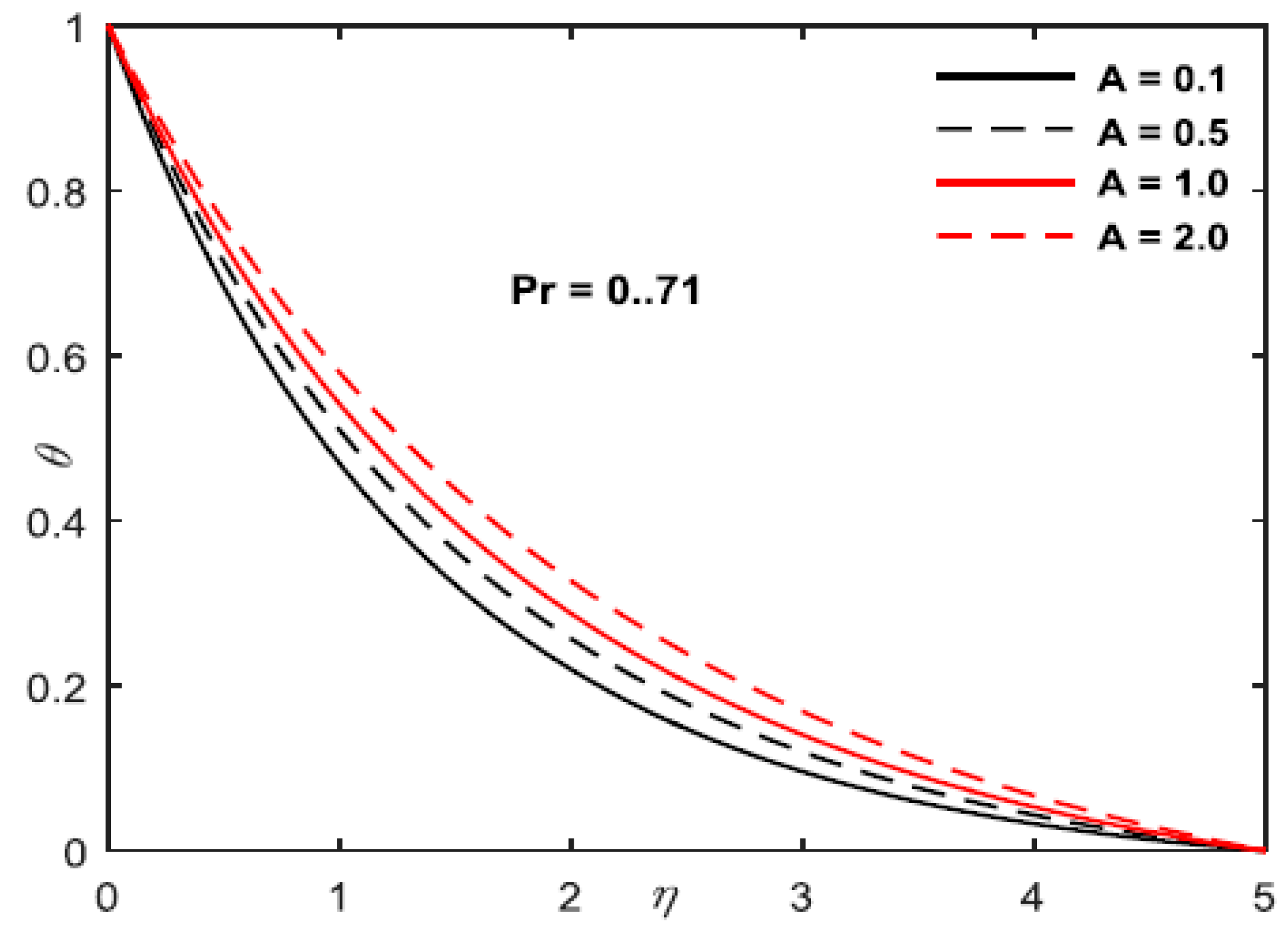
5. Conclusion
In the current study, the focus is on the behaviour of thermal radiation influences on MHD stagnation point stream over a stretching sheet with slip boundary conditions applied. With the help of MATLAB’s inbuilt solver bvp4c, a numerical solution of the transformed system of non-linear ordinary differential equations is obtained. The fundamental perceptions of the present investigation are as per the following:
- Changed values of M, S, and A are observed to decrease the fluid velocity.
- On increasing both Gr and Pr, the thermal boundary layer thickness decreases.
- An increase in Δ or Q and A results in temperature decrease.
- On an increase in both, Gr, and R the velocity of the fluid increases.
- R or A enhance causes thermal boundary layer thickness increase.
References
- Devi, S. P.; Kandasamy, R. Analysis of nonlinear two dimensional laminar natural flow andmixed convection over variable surface with free stream conditions. Journal of Computational and Applied Mathematics 2002, 3(2), 107–116. [Google Scholar]
- Acharya, M.; Singh, L. P.; Dash, G. C. Heat and mass transfer over an accelerating surface with heat source in presence of suction and blowing. International Journal of Engineering Science 1999, 37(2), 189–211. [Google Scholar] [CrossRef] [Scilit]
- Bhattacharyya, K. G. C. Layek: Chemically Reactive Solute Distribution in MHD Boundary Layer Flow over a Permeable Stretching Sheet with Suction or Blowing”. Chem. Eng. Comm 2010, 197, 1527–1540. [Google Scholar] [CrossRef] [Scilit]
- Yirga, Y.; Shankar, B. MHD Flow and Heat Transfer of Nanofluids through a Porous Media Due to a Stretching Sheet with Viscous Dissipation and Chemical Reaction Effects. International Journal for Computational Methods in Engineering Science and Mechanics 2015, 16(5), 275–284. [Google Scholar] [CrossRef] [Scilit]
- Siva Reddy, S.; Shamshuddin, M. : Heat and Mass Transfer on the MHD Flow of a Micropolar Fluid in the Presence of Viscous Dissipation and Chemical Reac-tion. In International Conference on Computational Heat and Mass Transfer. Procedia Engineering. Elsevier; 2015; Volume 127, pp. 885–892. [Google Scholar]
- Kishore, P.M.; Rajesh, V.; Verma, S.V. K: Effects of Heat Transfer and Viscous Dissipation on MHD Free Convection Flow past an Exponentially Accelerated Vertical Plate with Variable Temperature. Journal of Naval Architecture and Marine Engineering 2010, 7, 101–110. [Google Scholar] [CrossRef] [Scilit]
- Chamkha, Ali J. “Thermal radiation and buoyancy effects on hydromagnetic flow over an accelerating permeable surface with heat source or sink”. International Journal of Engineering Science 2000, 38, 1699–1712. [Google Scholar] [CrossRef] [Scilit]
- Vajravelu, K.; Hadjinicolaou, A. Convective heat transfer in an electrically conducting fluid at a stretching surface with uniform free stream”. Int. J. Eng. Sci. 1997, 35, 1237–1244. [Google Scholar] [CrossRef] [Scilit]
- Ishak, A. Mixed convection boundary layer flow over a horizontal plate with thermal radiation. In Heat Mass Transfer; 2009b; Volume 46, pp. 147–151. [Google Scholar]
- Bal Reddy, G; Goud, B. Shankar; RajaShekar, MN. “Keller Box solution of Magnetohydrodynamic boundary layer flow of nanofluid over an exponentially stretching permeable sheet”. International Journal of Mechanical Engineering and Technology 2018, 9(10), 1646–1656. [Google Scholar]
- Ibrahim, F.S.; Elaiw, A.M.; Bakr, A.A. : Effect of the chemical reaction and radiation absorption on the unsteady MHD free convection flow past a semi-infinite vertical permeable moving plate with heat source and suction. Communication in Nonlinear Science and Numerical Simulation 2008, 13, 1056–1066. [Google Scholar] [CrossRef] [Scilit]
- Goud, B. Shankar; Jilugu, RatnaKumari; Gugulothu, Ravi; Shivakumar, K. Effects of the thermal radiation on the boundary layer flow over an exponentially stretching sheet in the presence of viscous dissipation. International Journal of Modern Engineering and Research Technology 2019, 6(1), pp: 240–245. [Google Scholar]
- Kandasamy, R.; Periasamy, K.; Prabhu, K. K. S. Effects of chemical reaction, heat and mass transfer along a wedge with heat source and concentration in the presence of suction or injection. Int. J. of Heat and Mass Transfer 2005, 48(7), 1388–1394. [Google Scholar] [CrossRef] [Scilit]
- Goud, B. Shankar; Madhu, J. Venkata; Shekar, MN Raja. “MHD Viscous Dissipative Fluid Flows In a Channel with a Stretching and Porous Plate with Radiation Effect”. International Journal of Innovative Technology and Exploring Engineering 2019, 8(11), pp 1877–1882. [Google Scholar] [CrossRef] [Scilit]
- Goud, B. Shankar; Babu, B. Suresh; Shekar, MN Raja; Srinivas, G. Mass transfer effects on MHD flow through porous medium past an exponentially accelerated inclined plate with variable temperature and thermal radiation. International Journal of Thermofluid Science and Technology 2019, 6(4). [Google Scholar] [CrossRef] [Scilit]
- Uddin, M. J.; Fazlul Hoque, A. K. M.; Rahman, M. M.; Vajravelu, K. “Numerical simulation of convective heat transport within the nanofluid filled vertical tube of plain and uneven side walls”. International Journal of Thermofluid Science and Technology (2019) Volume 6(Issue 1), Paper No. 19060101. [CrossRef] [Scilit]
- Vaidya, Hanumesh; Prasad, K.V.; Vajravelu, K.; Ng, Chiu-On; Nadeem, S.; Vishwanatha, U.B. “The effects of thermocapillarity on the thin film flow of MHD UCM fluid over an unsteady elastic surface with convective boundary conditions”. Int. Journal of Thermofluid Science and Technology 2019, 6(3), No. 19060303. [Google Scholar] [CrossRef] [Scilit]

Publisher’s Note: MDPI stays neutral with regard to jurisdictional claims in published maps and institutional affiliations. |
Copyright © 2020. This article is licensed under a CC BY-NC-ND 4.0.