


Abstract
This study investigates the laminar transport process due to a cone-shaped moving body of revolution, considering the effects of temperature-dependent viscosity and thermal conductivity. Considering variable flow properties and a cone-shaped surface introduces a variable viscosity parameter (θe), a variable thermal conductivity parameter (ϵ), and a curvature parameter (K) in the self-similar transformed equations derived from the governing equations of fluid and heat transfer using non-dimensional variables. The effects of these parameters on the flow and heat transfer characteristics, comprising flow velocity, skin-friction coefficient, temperature, and Nusselt number, are investigated numerically using the bvp4c command implemented in MATLAB. Results reveal that the transport process within the boundary layer is considerably altered by variations in the parameters θe and ϵ, demonstrating significant deviations from the outcomes obtained with constant flow properties. Current calculations are aligned well with the limiting case of constant flow properties. These findings can aid in optimizing heat dissipation and enhancing the efficiency of thermal systems, including polymer extrusion, metal forming, chemical reactors, and filtration systems.
1. Introduction
The transport processes within the laminar Boundary Layer (BL) induced by the moving continuous surfaces play a substantial role in various engineering applications. These phenomena are particularly relevant in the aerodynamics of polymeric sheet extrusion, fiberglass manufacturing, BL formation over conveyor belts, hot and cold extrusion, and liquid film condensation. In each of these cases, the analysis of transport process is essential, as it directly influences the quality and performance of the final product. Unlike conventional BL flows induced by an external potential flow, BL in these scenarios develops solely due to the motion of the solid surface. Sakiadis [1] was the first to demonstrate that moving continuous surfaces exhibit BL flow characteristics. He formulated the governing BL equations for both flat and axially symmetric moving surfaces and provided solutions using integral techniques, as detailed in a series of seminal papers [2,3].
The investigations of BL flow over bodies of revolution has attained significant interest due to its extensive applications across various engineering fields. When the thickness of BL is considerably smaller than the body’s radius, the flow behavior over such bodies closely resembles to a two-dimensional BL [4]. Nonetheless, in certain flow conditions where the thickness of BL is comparable to the body’s radius, the Mangler’s theory is no longer applicable and the assumption of two-dimensional BL flow becomes invalid. Under such circumstances, the Transverse Curvature (TVC) of the body plays a crucial role, significantly influencing the BL characteristics. Seban and Bond [5] were the first to establish that BL flows over bodies of revolution differ from those over flat surfaces. Using a series solution technique, they experienced that the transport process over the surfaces of revolution is larger compared to the Blasius solution [6]. Kelly [7] introduced modifications to the solution of [5], considering the BL flow without taking an external pressure-gradient. This revised solution is commonly referred to as the “Seban-Bond-Kelly solution”. Mark [8] investigated the BL flow over a slender parabolic surface, assuming small body radius values and presented an asymptotic solution for the problem. Glaurt and Lighthill [9] revisited the solution reported in [5] for long thin cylinders and utilized the Pohlhausen’s type [10] integral method to obtain results for regions with larger curvature. Stewartson [11] investigated the asymptotic solution of BL flow in the absence of an external pressure-gradient, specifically for cases where the BL thickness was higher than the body’s radius. Lee [12] examined the BL flow over a paraboloid surface, which led him to formulate the governing equation and to provide both analytical and numerical solutions to this problem.
Cebeci and Na [13] conducted a study on laminar free convection in BL flow on a revolution surface. Utilizing similarity analysis, they determined the skin-friction coefficient and heat transfer rate for such surfaces. Wei [14] examined the compressible BL flow over bodies of revolution. Utilizing the singular perturbation method, he analyzed the problem and reported the influence of transverse curvature on the compressible BL flow characteristics. Cebeci [15] conducted a comprehensive investigation of laminar and turbulent BLs and analyzed the deviation of shear stress. Cooper and Tullin [16] applied the linearized theory to analyze the influence of TVC on laminar BL flow characteristics. Their findings revealed that TVC leads to an increase in wall shear stress. Probstein and Elliot [17] investigated the TVC effects on compressible BLs over surfaces of revolution, which can be characterized by the “ratio of the BL thickness to the body radius”, i.e., δ/r0.
Despite extensive research on this topic, contemporary researchers continue to explore the TVC effects on BL flows under various configurations. Recently, Mehmood and Usman [18] observed the influence of TVC on BL separation over the slender cylinder, considering a varying body radius. Mehmood et al. [19] investigated TVC effects on decelerated BL flow over a body of revolution and reported that TVC behaves like a favorable pressure-gradient, helping to mitigate BL separation to some extent. Mehmood and Shah [20] analyzed TVC effects on a retarded BL induced by a moving continuous circular cylinder and found that, despite strong retardation, TVC contributed to delaying the separation length. Mehmood et al. [21] explored the surface sharpness and TVC effects on the decelerating thermal BL flow. Their findings indicate that surface sharpness reduces the heat transfer rate, while an increase in the TVC of the surface enhances heat transfer efficiency. Shah et al. [22] theoretically investigated the transport process over a cone-shaped body of revolution and concluded that streamlined bodies of revolution exhibit higher heat transfer rates compared to parabolic bodies of revolution. Awais and Mehmood [23] extended Thwaites’ integral method to study TVC effects on retarded BL flow and validated their approximate results by comparing them with numerical solutions.
The variable flow properties in the BLs play an important role in shaping the overall flow behavior. For instance, variations in viscosity influence shear stress and velocity profiles, while changes in thermal conductivity affect the rate of heat transfer. Similarly, density variations result in changing velocity gradients and BL thickness, impacting flow stability, whereas specific heat variations alter the temperature distribution and energy transport. Collectively, these variable properties determine the growth, stability, and separation characteristics of the BL, highlighting their significance in engine-ering and fluid dynamics applications.
The earliest study on variable flow properties was contributed by Shuh [24], who examined their effects on BL flow over a stationary plate. Building upon this investigation, Seban [25] extended the study by proposing broader ranges for the Prandtl number and viscosity ratio, defined by Shuh [24] earlier. The effects of non-uniform flow properties on BL flow over a flat plate, a rotating disk, and a circular cylinder were explored by Poots and Raggett [26]. Herwig and Wickern [27] explored the effects of time-dependent fluid properties on Falkner-Skan type flows [28]. By utilizing asymptotic expansion for small heat transfer rates, they analyzed the flow behavior under constant wall temperature and constant heat flux boundary conditions. Herwig [29] investigated the effects of pressure-dependent density on compressible BL flow using asymptotic theory. To account for the influence of variable flow properties, he employed the regular perturbation method. Shang and Wang [30] analyzed the effects of variable thermal conductivity, dynamic viscosity, and density on laminar free convection of gas.
The effects of temperature-dependent viscosity, thermal conductivity, and density on laminar BL flow induced by a moving flat surface were investigated by Thakar et al. [31]. The generalized similarity transformations were devised to investigate the effects of temperature-dependent fluid properties on laminar BL flow induced by a moving flat surface by Anderson and Arseth [32]. Mukhopadhyay and Layek [33] examined the impact of variable viscosity on BL flow induced by a stretching sheet, considering the effects of porosity, heat generation, and heat absorption. Ragni and Ahmad [34] investigated the momentum and thermal BL flow over a cylinder stretching with a linear velocity, considering the effects of variable thermal conductivity. Umavathi et al. [35] analyzed the effects of variable viscosity and thermal conductivity on the momentum and thermal transport processes of a viscous, incompressible fluid in a vertical channel. Prasad et al. [36] examined mixed convection phenomenon in BL flow due to a non-linearly stretching flat surface, assuming temperature-dependent fluid properties. They considered an inverse relationship between dynamic viscosity and temperature, while a linear dependence of thermal conductivity on temperature. Naganthran et al. [37] discussed the duality of solutions for BL flow over a disk while considering the effects of temperature-dependent viscosity and thermal conductivity. Akbar and Mustafa [38] investigated the effects of variable fluid properties on the BL flow induced by an impulsively started rotating and vertically stretching disk. Shakeel and Mustafa [39] analyzed the Bödewadt flow on a permeable surface assuming the temperature-dependent physical properties. They reported that drag force on the disk surface differs significantly from the case with constant physical properties. Afridi et al. [40] examined heat and entropy transfer in an incompressible fluid over a slender needle surface with variable thermophysical properties, employing the differential quadrature method. Qasim et al. [41] analyzed the two-dimensional BL flow of a Jeffrey fluid over a radially stretching disk, incorporating nonlinear Rosseland thermal radiation along with temperature-dependent thermal conductivity and viscosity, by employing the generalized differential quadrature method. Qasim et al. [42] conducted a numerical study on BL flow over a thin needle, considering variable thermal conductivity and viscosity with the effects of frictional heating, by employing the MATLAB bvp5c solver. Qasim et al. [43] investigated the generalized two-dimensional peristaltic motion of an incompressible fluid with temperature-dependent physical properties in a non-symmetric channel. Their study also examined the generation of entropy in the system, along with the effects of Joule heating and Lorentz force. Further studies on the flow and heat transport process subject to various flow assumptions including variable flow properties can be found in [44,45,46,47,48,49].
This study aims to analyze the flow and heat transfer process induced by a cone-shaped moving surface while considering the temperature-dependent physical properties. Moreover, the effects of TVC on the flow characteristics are examined. The governing equations describing the fluid flow are transformed into a system of ordinary differential equations using an appropriate set of similarity variables, which are then solved numerically using the built-in MATLAB solver bvp4c. The findings are presented in both tabular and graphical formats and are validated through comparison with previously published results.
2. Problem description and modeling
2.1. Governing equations
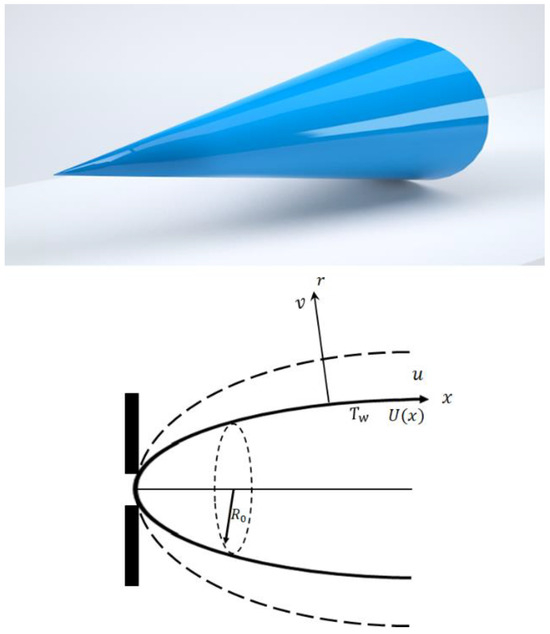
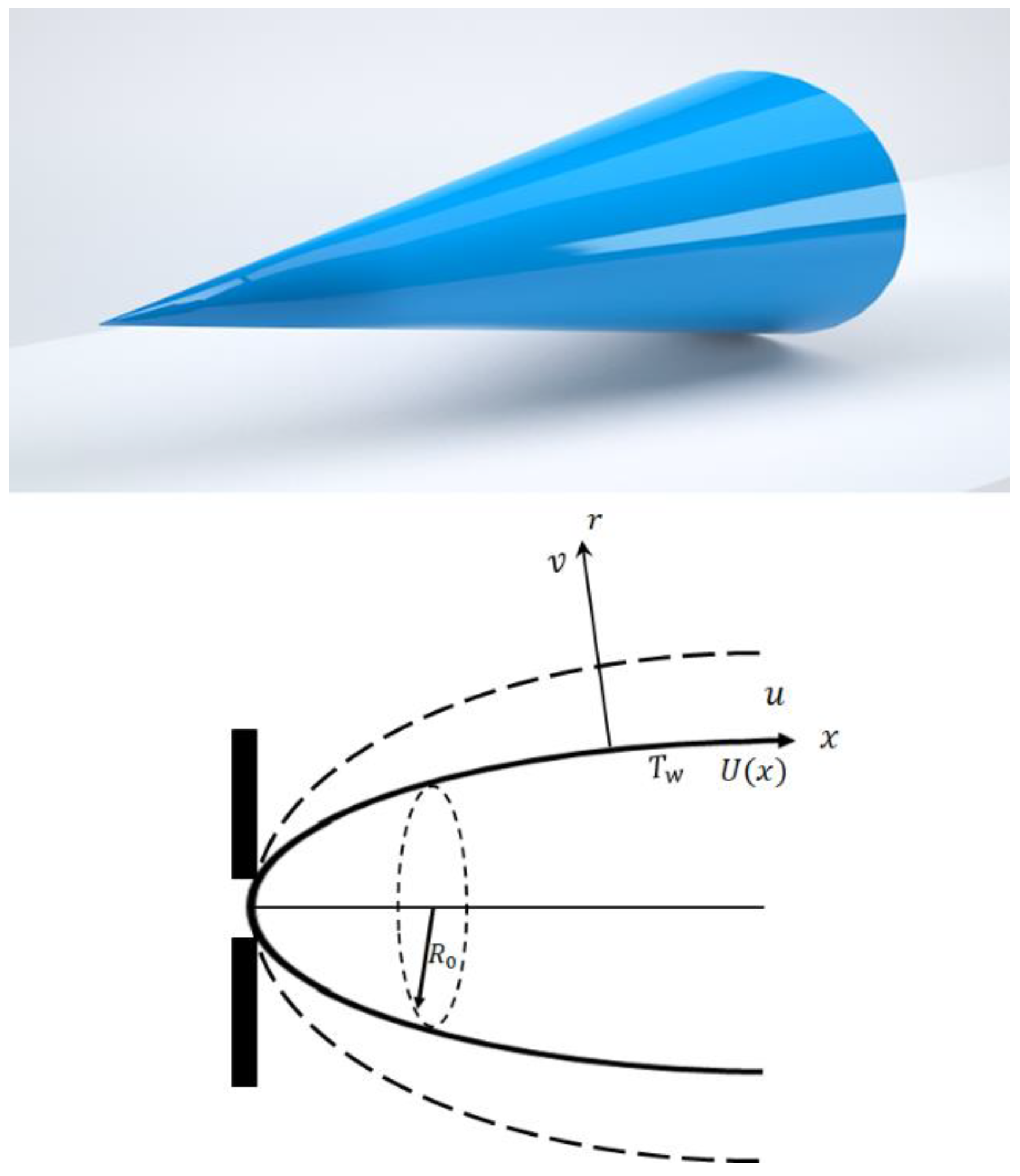
We consider a steady, axisymmetric, viscous, and incompressible laminar BL flow with variable fluid properties induced by a cone-shaped surface moving within a quiescent fluid. The axially symmetric surface assumes a variable stretching wall velocity ; thereby generating the BL flow. The assumed flow configuration can be generated with a linear function R(x) = R0x; where R0 specifies the reference uniform radius. The temperature at the wall is maintained at a constant value, denoted as Tw, while the ambient temperature is given by T∞. Body force and viscous dissipation effects are neglected. A schematic representation of the BL flow induced by the axially symmetric moving cone-shaped surface and coordinates system is illustrated in Figure 1. The governing equations describing this flow phenomenon include the continuity equation, momentum equation, and energy equation, which are formulated as follows:
Figure 1.
Flow geometry and coordinates.
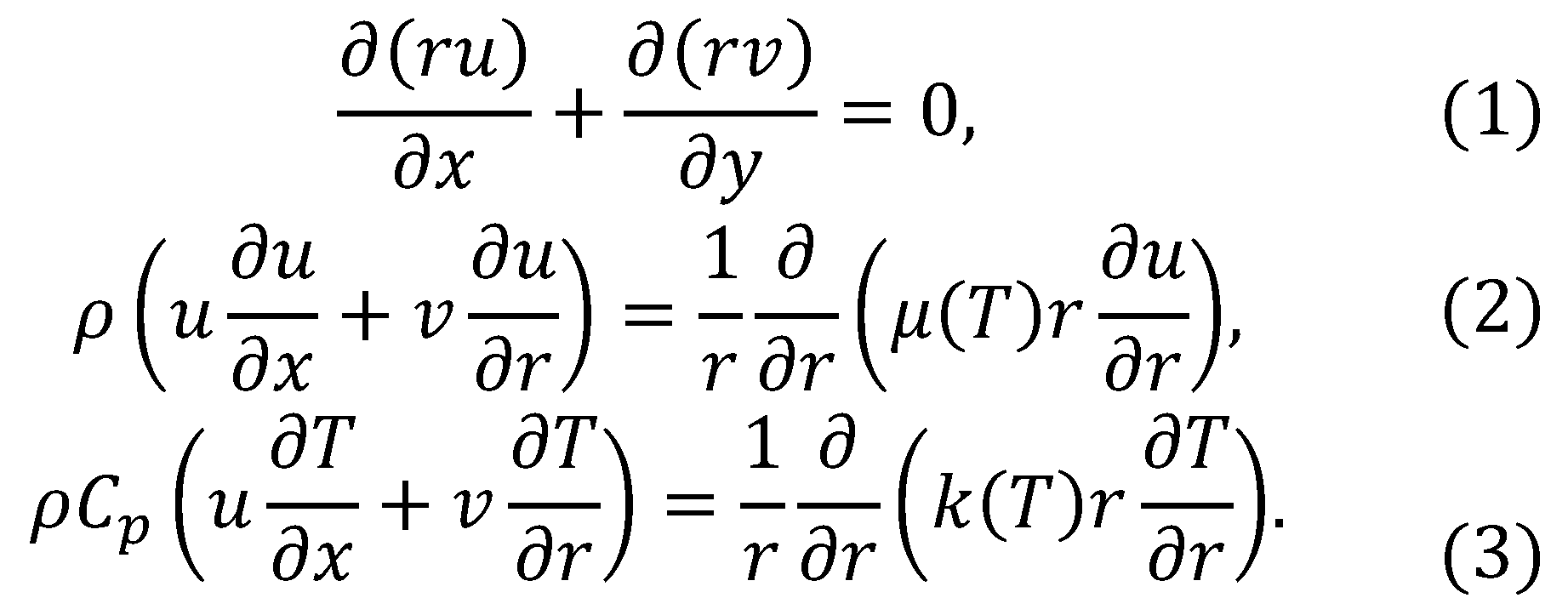
In the described flow configuration, u and v denote the velocity components in the axial (x) and radial (r) directions, respectively, while T represents the temperature. Additionally, ρ indicates the fluid density, μ(T) stands for the dynamic viscosity, and k(T) refers to the thermal conductivity. Following the established formulations [50], we model the temperature dependence of viscosity and thermal conductivity as
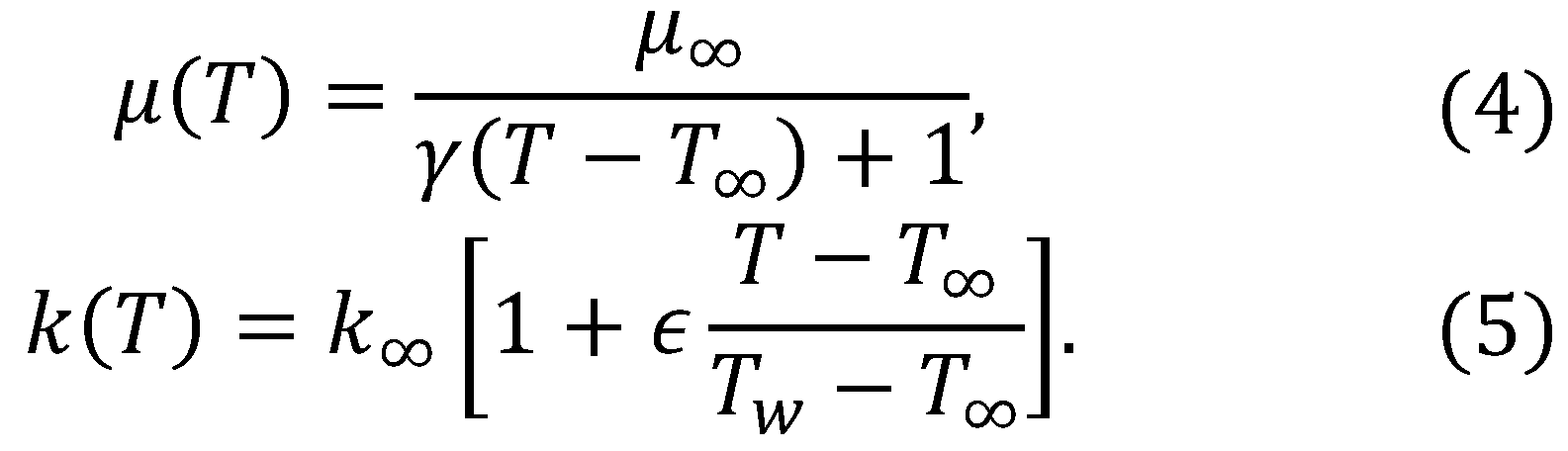
In this formulation, μ∞ and k∞ denote the dynamic viscosity and thermal conductivity (both evaluated at the free-stream temperature T∞), respectively. The parameters γ and ϵ represent temperature-dependent modification coefficients for viscosity and thermal conductivity. Moreover, Equation (4) demonstrates that the viscosity of liquids diminishes as temperature rises (γ < 0), while it increases for air and other gases (γ > 0). This equation can also be expressed in the following form:

The flow and thermal boundary conditions are specified as follows:
Wall boundary conditions
The boundary conditions on the flow surface (r = R(x)):
- In the absence of wall suction or injection, the no-slip conditions at the moving surface are applied: u = U(x), v = 0.
- The cone surface is heated at the constant wall temperature: T = Tw.
Ambient boundary conditions
Far from the cone surface (r → ∞), the boundary conditions are as follows:
- As the flow is only due to the moving cone configuration, the fluid should be at rest away from the surface: u = 0.
- The ambient temperature is specified by: T = T∞.
3. Solution procedure
To obtain a solution for the problem under consideration, the governing Equations (1)-(3) are transformed into a more tractable form by employing an appropriate set of dimensionless variables. While multiple sets of dimensionless variables exist in the literature, the present study adopts the similarity transformations proposed by Mehmood [51].
3.1. Non-dimensionalization
We consider the dimensionless variables of the form:
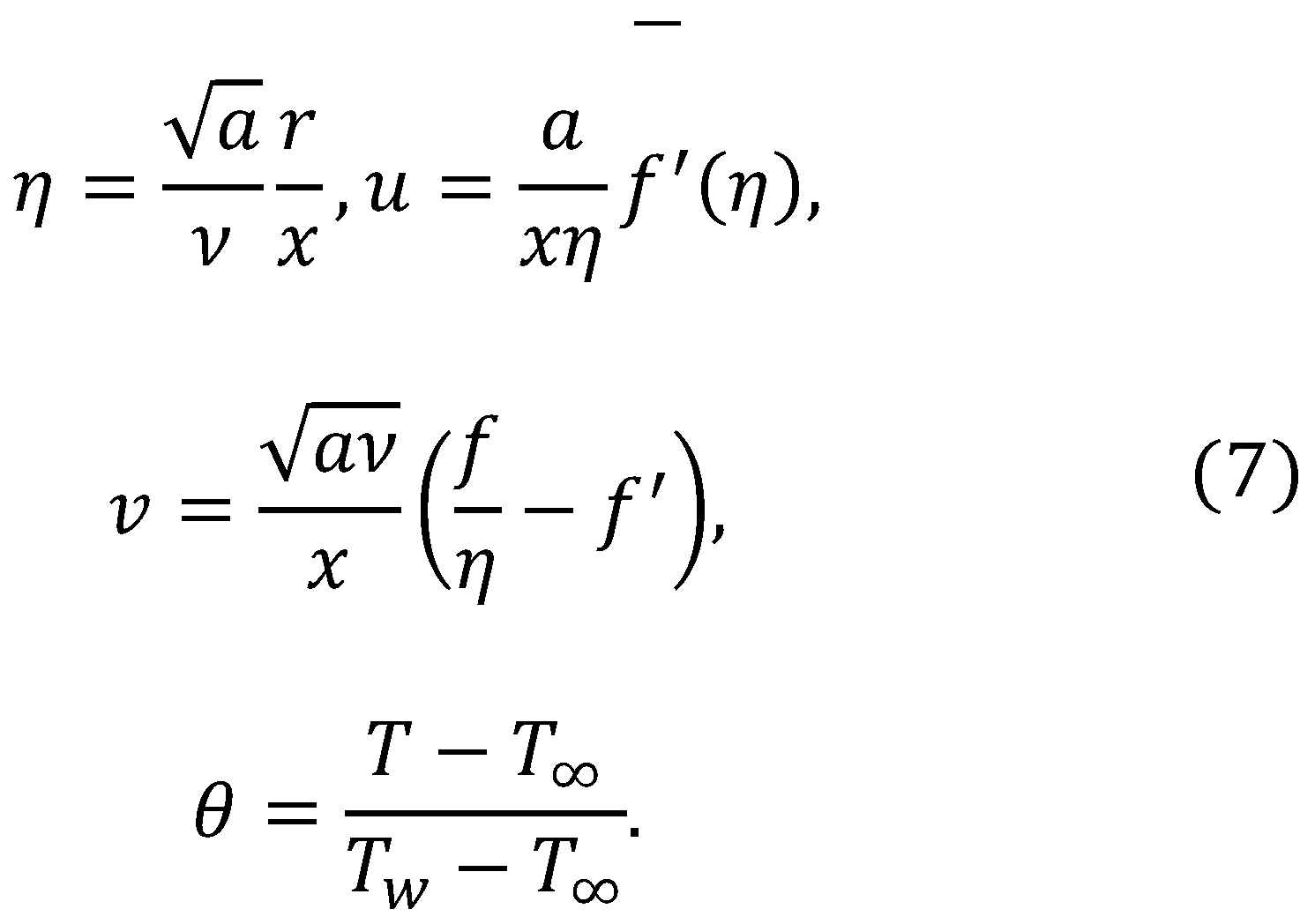
In view of the introduced non-dimensional variables, the continuity equation Equation (1) is satisfied identically. Consequently, the momentum and energy equations, given in Equations (2) and (3), are transformed into the following dimensionless form:
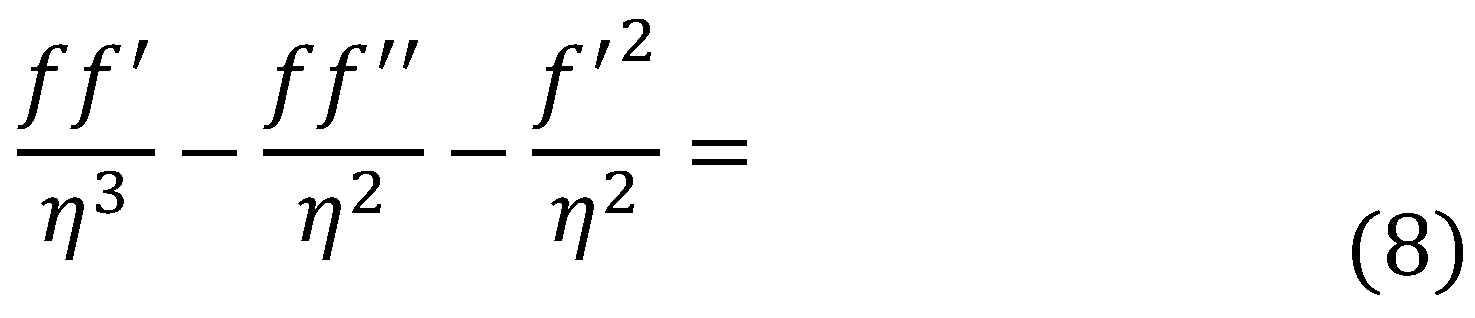
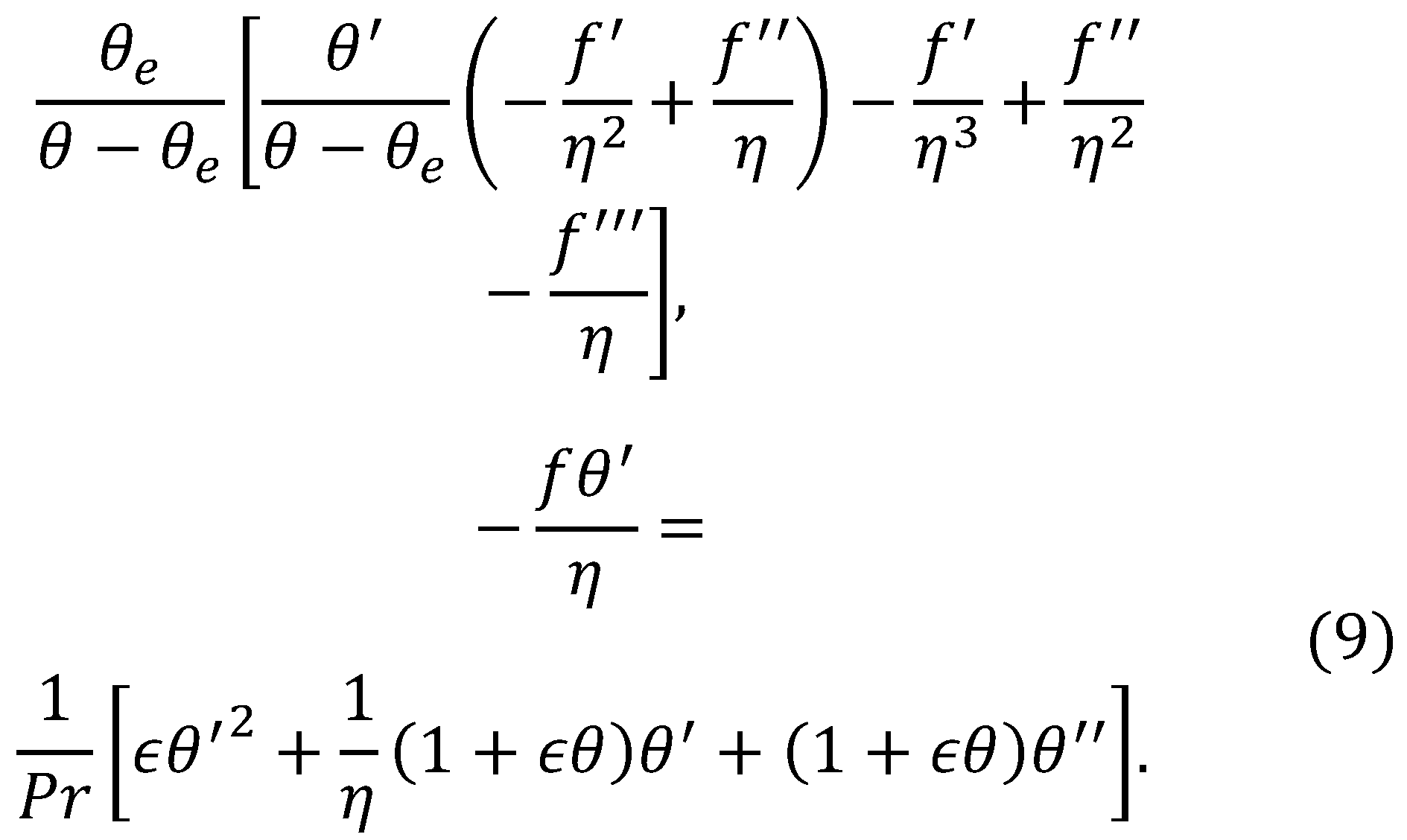
The associated boundary conditions, expre-ssed in dimensionless form, are given by:
 where is the Reynolds number defined as based on the cone’s radius R0.
In the current flow configuration, the Reynolds number governs the surface curvature of the stretching cone, expressed by =. Equations (8) and (9) pose mathematical challenges due to the appearance of the term η and its higher-order powers in the denominator. Moreover, the dependence of the boundary conditions (10) and (11) on introduces further complexity in both numerical integration and analytical treatment. To address these issues, a simplification can be achieved by transforming Equations (8) and (9) along with boundary conditions (10) and (11) into a simplified form over an infinite domain [0,∞). The new formulation is facilitated by introducing a dimensionless variable , defined as
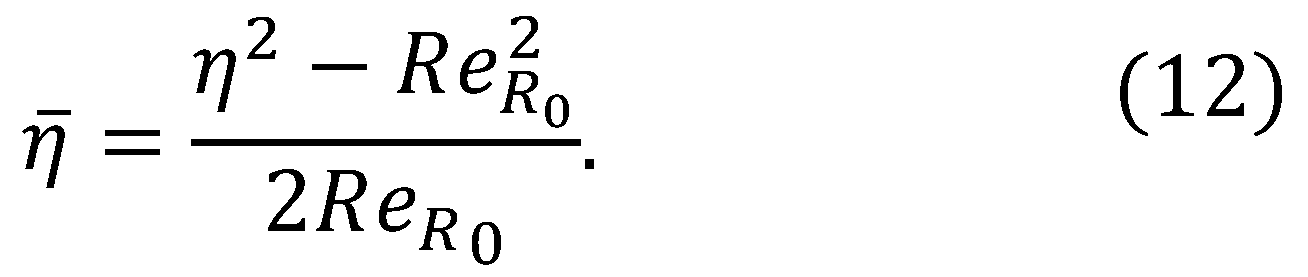
Utilizing newly defined dimensionless variable in Equations (8) and (9), and dropping the bars, one can obtain
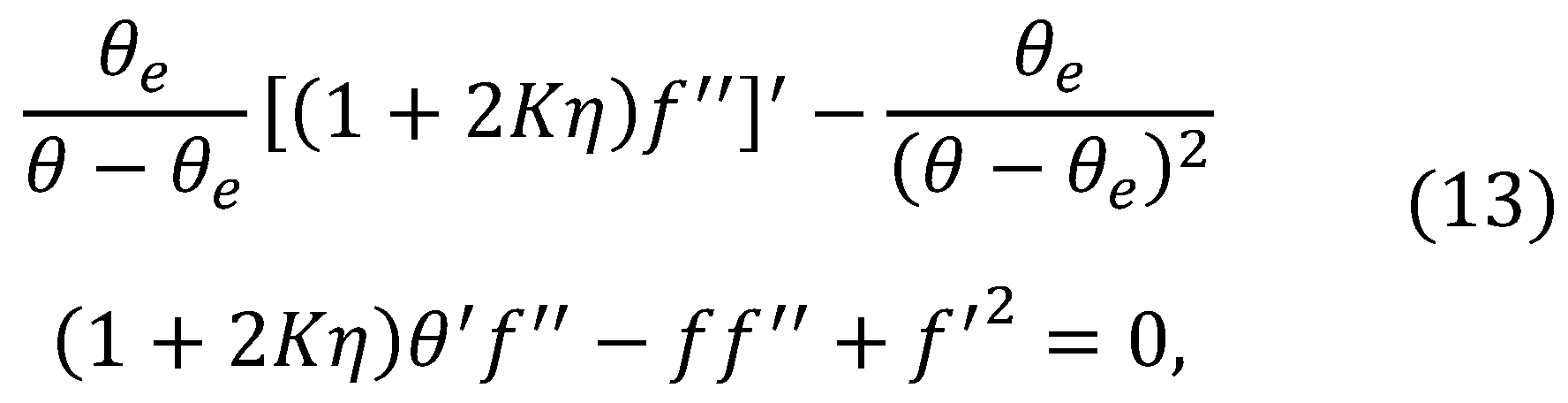
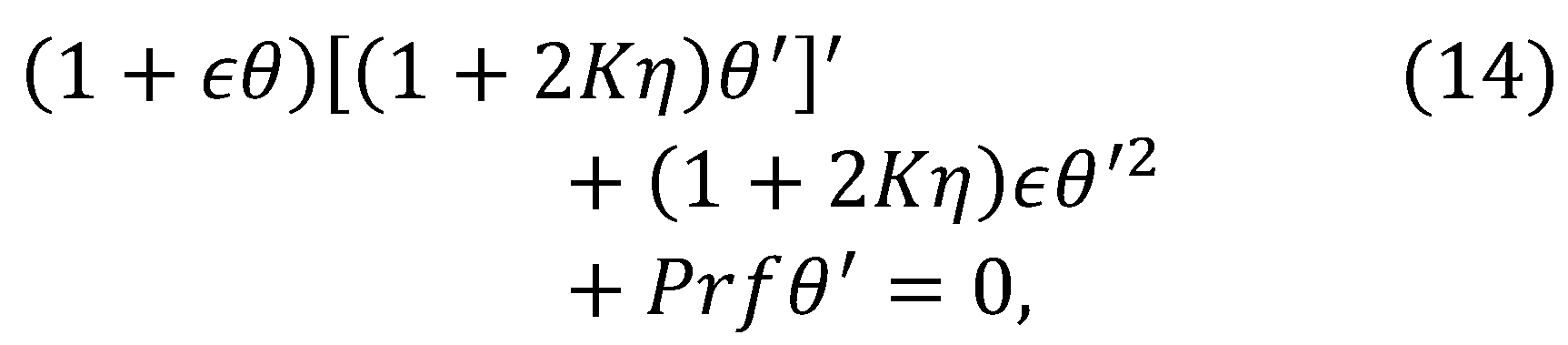 where ϵ characterizes the thermal conductivity and Pr = μ∞Cp/k∞ is the Prandtl number. In addition, θe represents the variable viscosity parameter, defined as:

Lai and Kulacki [52] suggested θe = 5.62 for air and θe = −0.37 for water. Pop et al. [53] considered negative values of θe within the range −10 ≤ θe ≤ −0.001.
In a similar fashion, the boundary conditions are presented in Equations (10)−(11) transform into the following form

3.2. Limiting Cases
The transformed Equations (13) and (14) are coupled due to the application of variable viscosity. Corresponding to the constant flow properties, θe→∞ and ϵ = 0. In this way, such coupling disappears, and Equations (13) and (14) reduce to the following form:
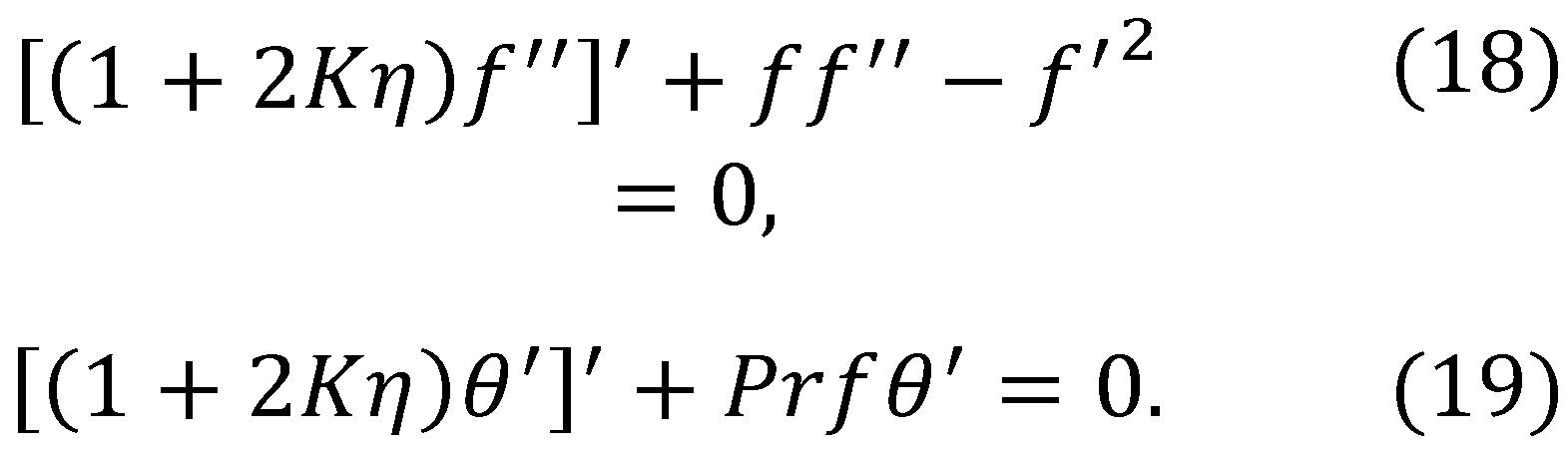
The Equations (18) and (19) also represent the limiting case of flow induced by a moving sheet when K = 0:
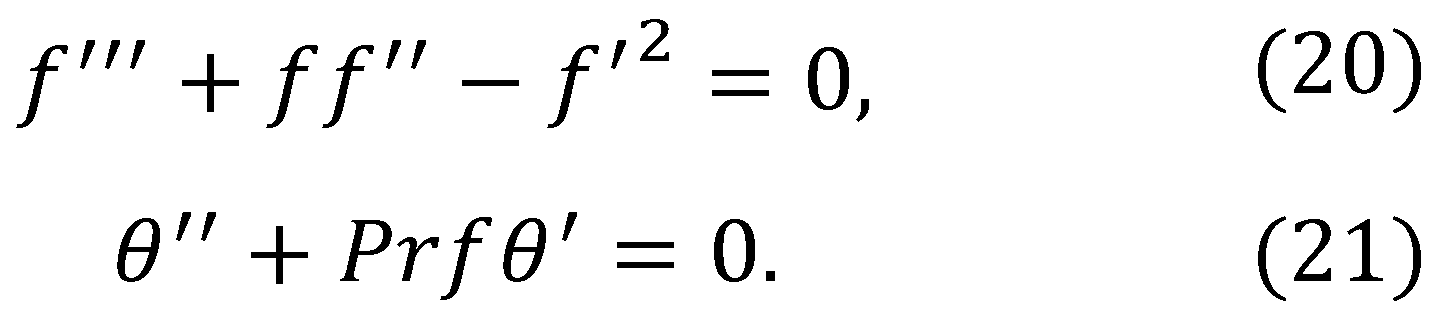
The boundary conditions of these limiting cases are the same as given by Equations (16) and (17).
3.3. Physical quantities
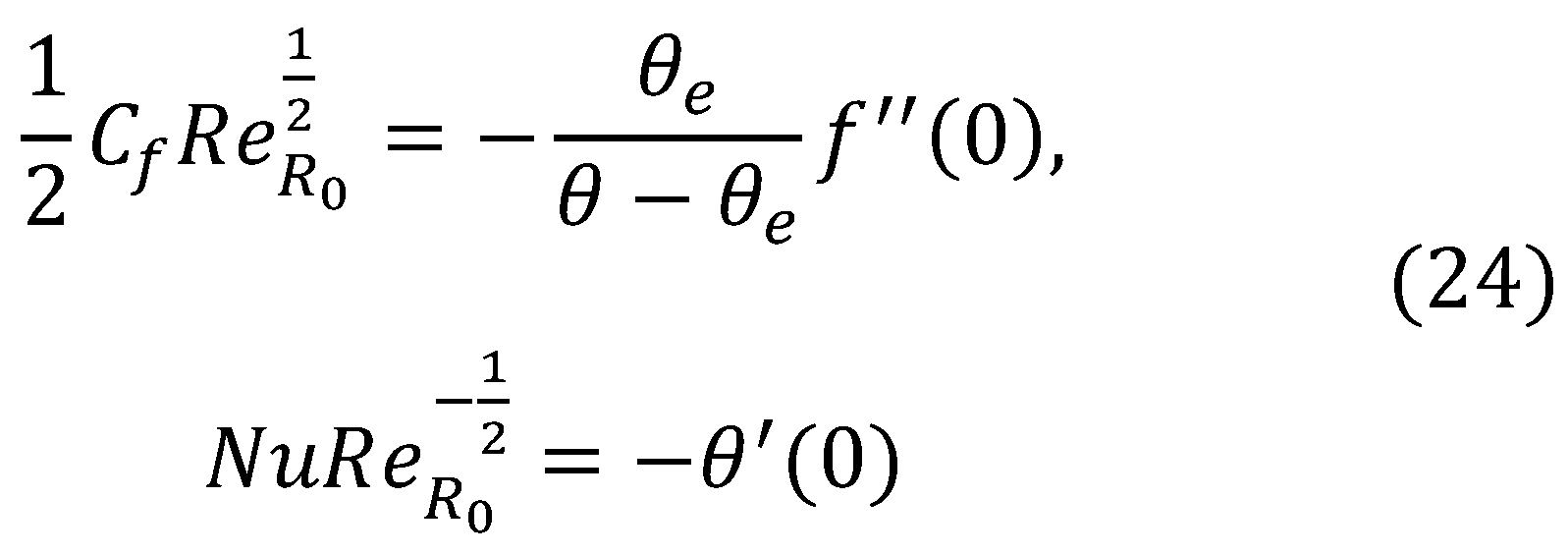
From an engineering perspective, the skin-friction coefficient and Nusselt number are physical quantities of interest. These dimensionless parameters quantify the wall shear stress and heat transfer rate, respectively. They are defined as:
 where τw and h represent the wall shear stress and heat transfer coefficient, respectively, and are defined as
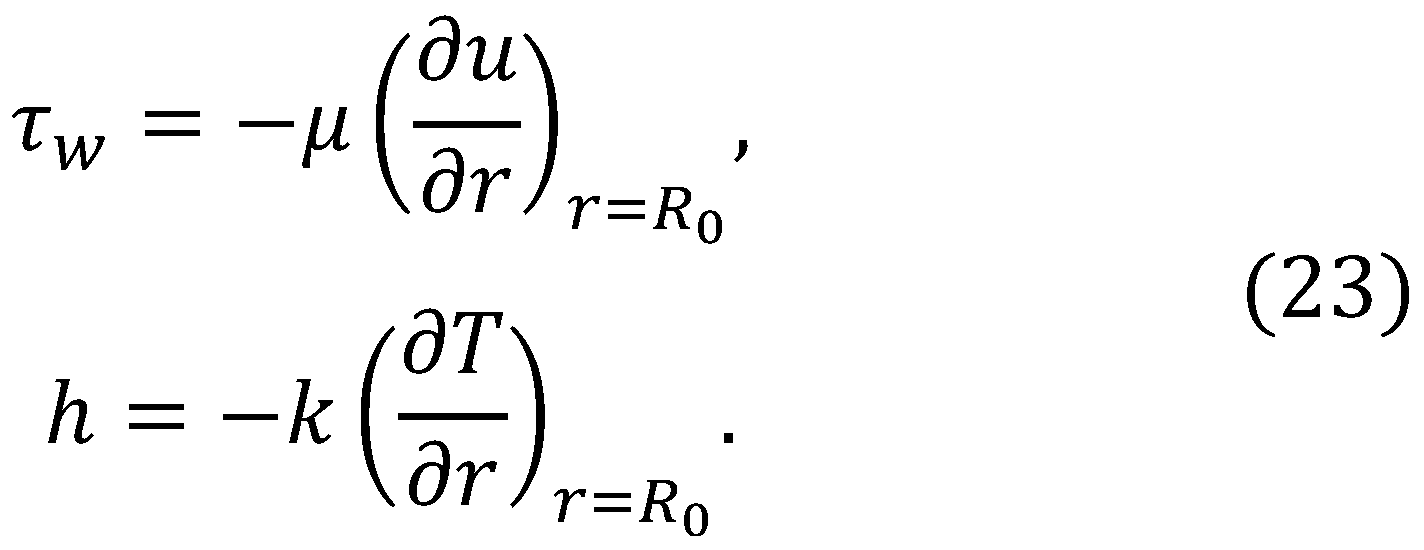
Utilizing the dimensionless variables defined in Equation (7), these quantities take the form
4. Results and discussion
The flow and heat transfer process resulting from a moving cone-shaped configuration with variable flow properties is calculated numerically from Equations (13) and (14), along with boundary conditions (16) and (17), using the bvp4c method implemented in MATLAB. This method is a built-in package that uses a finite-difference code and provides an accurate fourth-order solution in the spatial domain. Before solving the problem at hand, it is important to validate this code by reproducing data previously reported in the literature. A comparison of currently computed values of skin-friction coefficient with the data reported by Ragni and Ahmad [34] is provided in Table 1, showing a good agreement between both the data-sets, thus confirming the validity of the current solution. The solutions to equations (13) and (14), subject to the boundary conditions (16) and (17), are obtained for the parameters involved within the following range: −100 ≤ θe ≤ 100, 0 ≤ ϵ ≤ 10, 0 ≤ K ≤ 1, and 0.1 ≤ Pr ≤ 20.
Table 1.
Comparison of currently calculated values of with Ragni and Ahmed [34] when θe→∞.
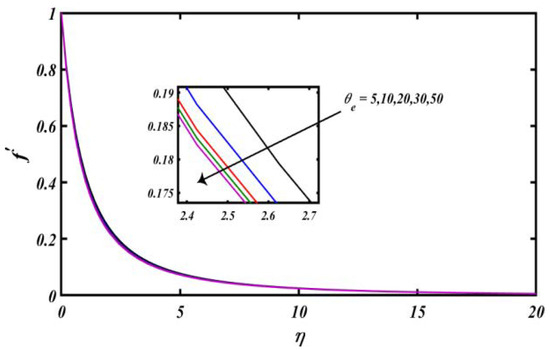
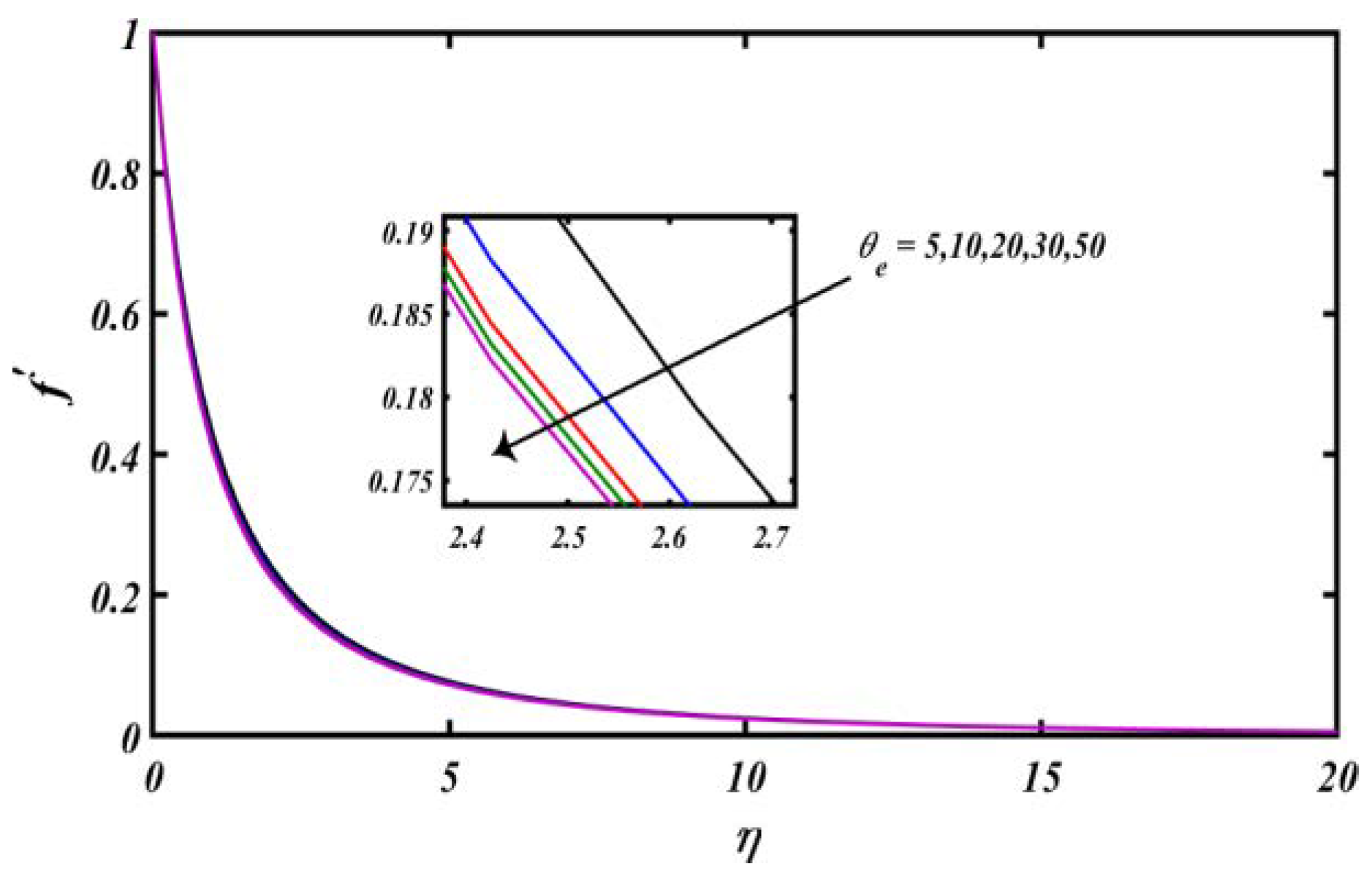
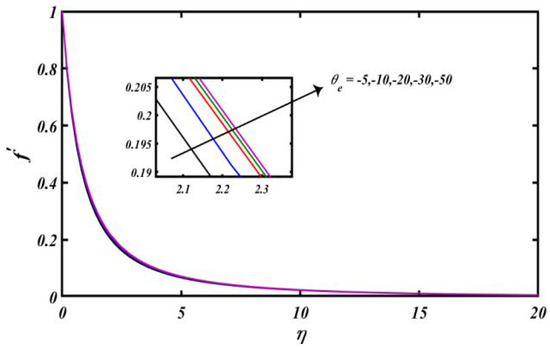
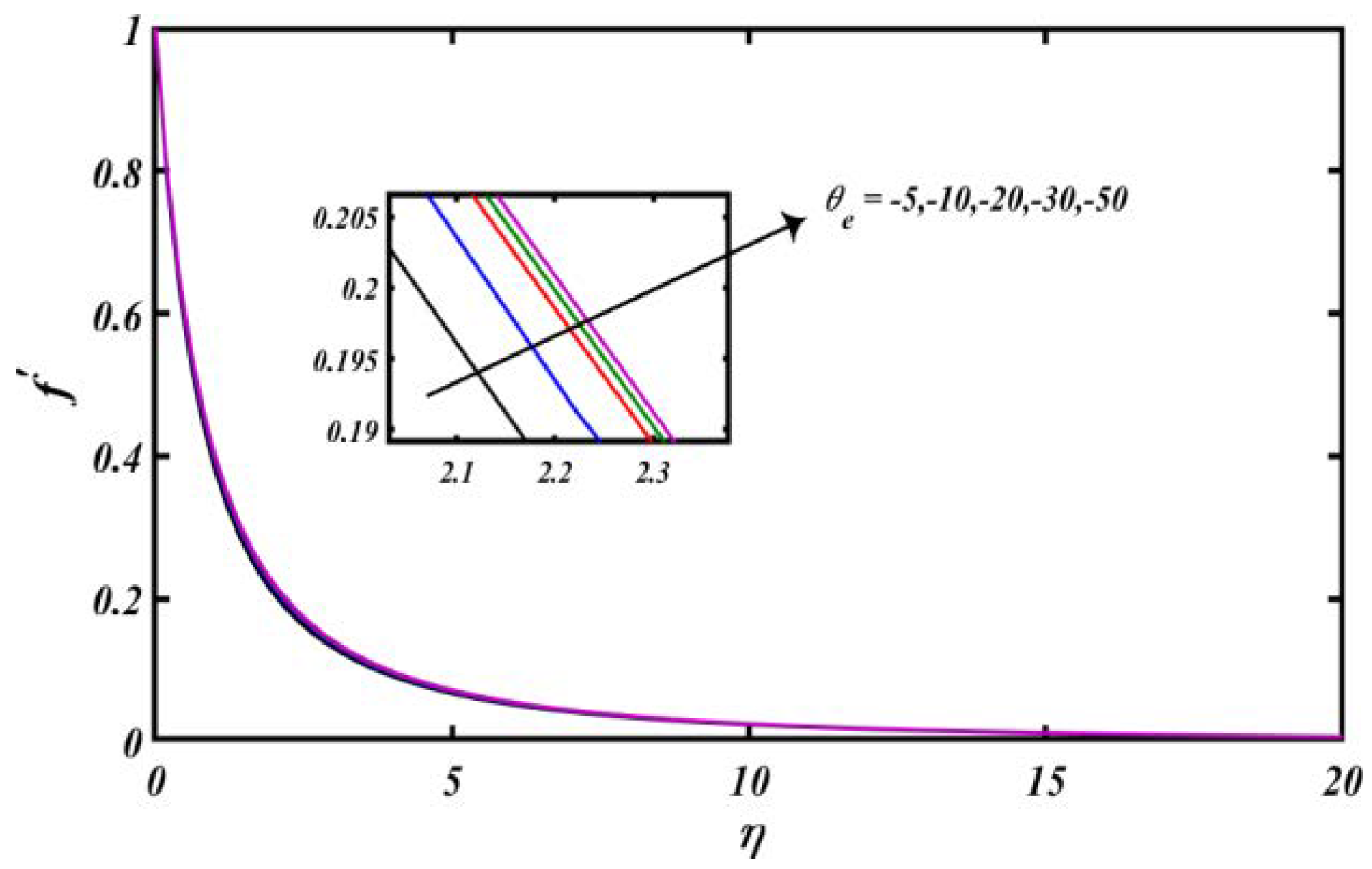
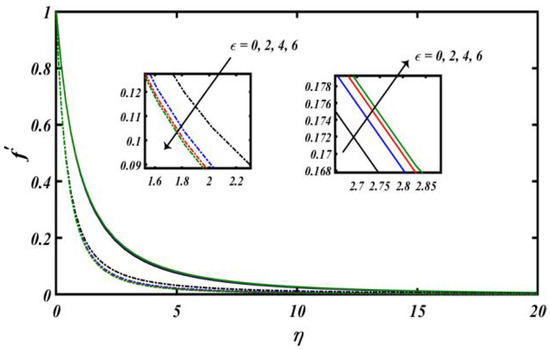
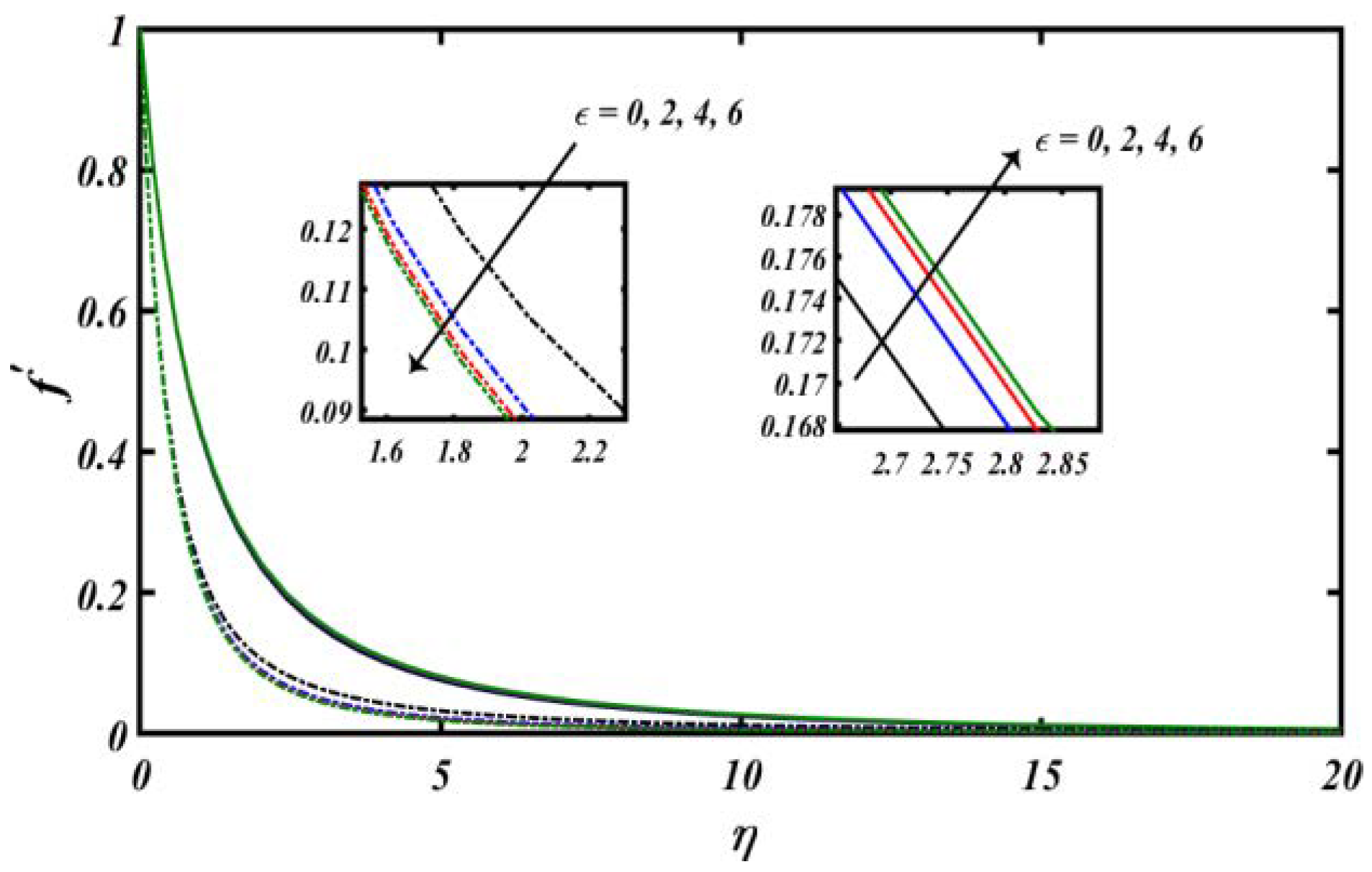
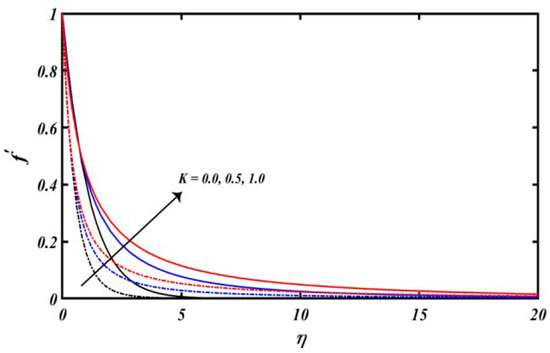
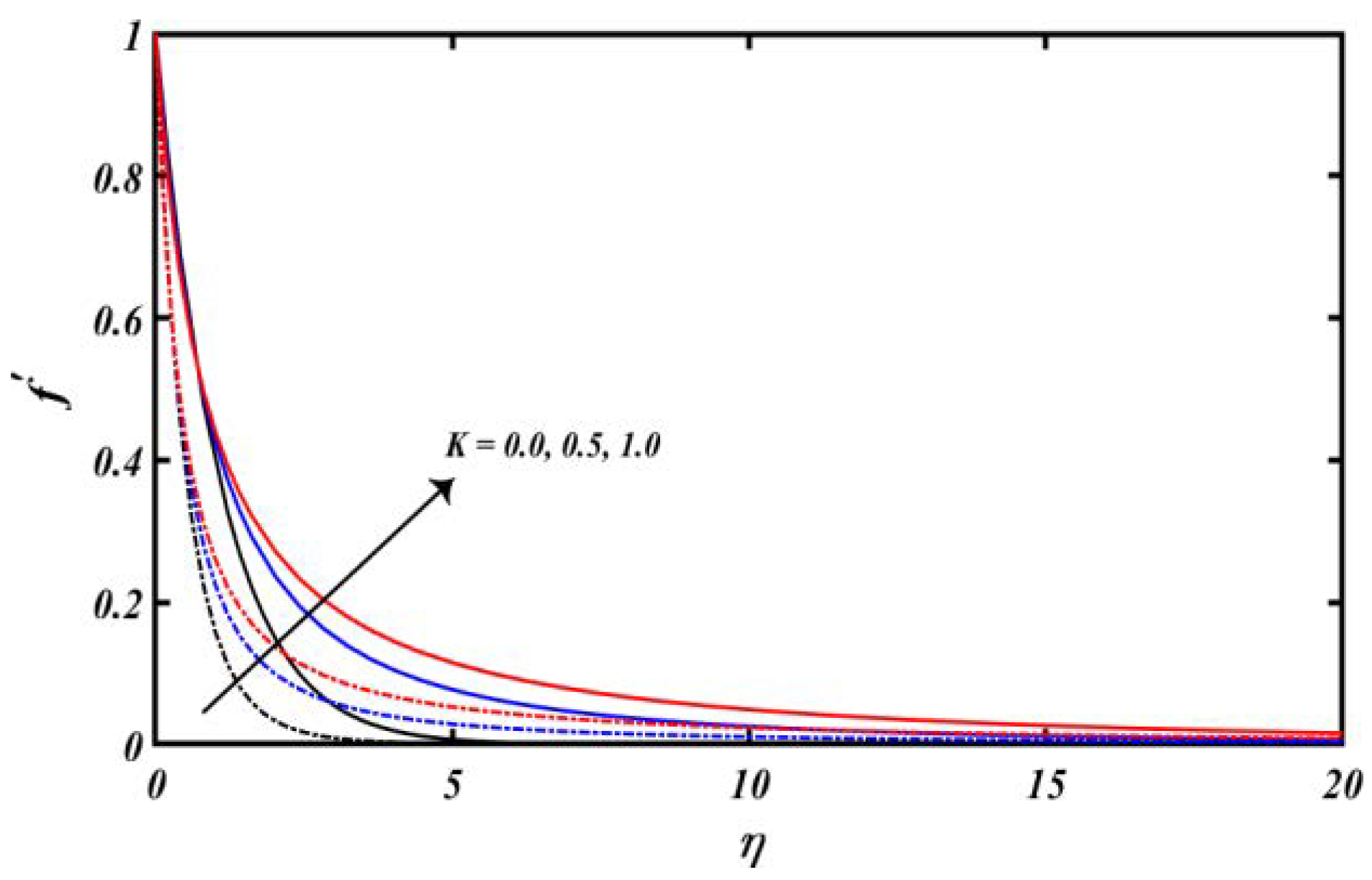
Figure 2 and Figure 3 demonstrate the impact of θe on the velocity profile, indicating that the velocity profile decreases for θe > 0 while it increases for θe < 0. Physically, a positive (θe > 0) indicates an increase in viscosity, which leads to greater internal resistance, thereby slowing down the flow and resulting in a lower velocity profile near the surface. In contrast, a negative (θe < 0) suggests a decrease in viscosity, providing a lower viscosity that allows the fluid to flow more freely, reducing resistance and allowing higher flow velocities. The effect of the parameter ϵ on the velocity profile is shown in Figure 4. Higher values of ϵ are observed to enhance the flow velocity when θe > 0, while the flow velocity is reduced when θe < 0. Figure 5 shows that the effect of the curvature parameter K on the velocity profile is insignificant near the surface, while it tends to zero asymptotically far from the surface. Near the surface, the no-slip condition influences the fluid velocity due to viscous effects inside the BL. As K increases, the curvature leads to higher fluid velocities away from the surface; thereby, a more pronounced velocity is achieved. The variable viscosity parameter θe leads to an increased velocity profile when θe > 0, while it results in a reduction of the velocity profile when θe < 0.
Figure 2.
Influence of variable viscosity parameter θe > 0 on velocity profile f′ at = 0.5, ϵ = 0.5, Pr = 0.71.
Figure 3.
Influence of variable viscosity parameter θe < 0 on velocity profile f′ at K = 0.5, ϵ = 0.5, Pr = 0.71.
Figure 4.
Influence of variable thermal conductivity parameter ϵ on velocity profile f′ (solid lines) and θe = −0.37 (dashed lines) at K = 0.5, Pr = 0.71.
Figure 5.
Influence of curvature parameter K on velocity profile f′ (solid lines) and θe = −0.37 (dashed lines) at ϵ = 0.5, Pr = 0.71 for θe = 5.62.
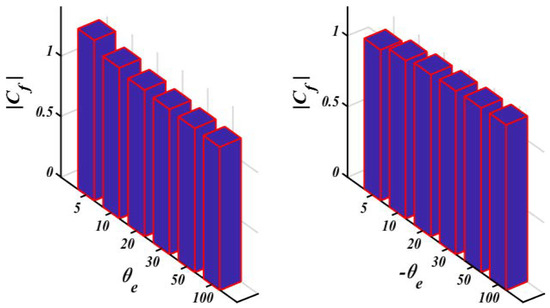
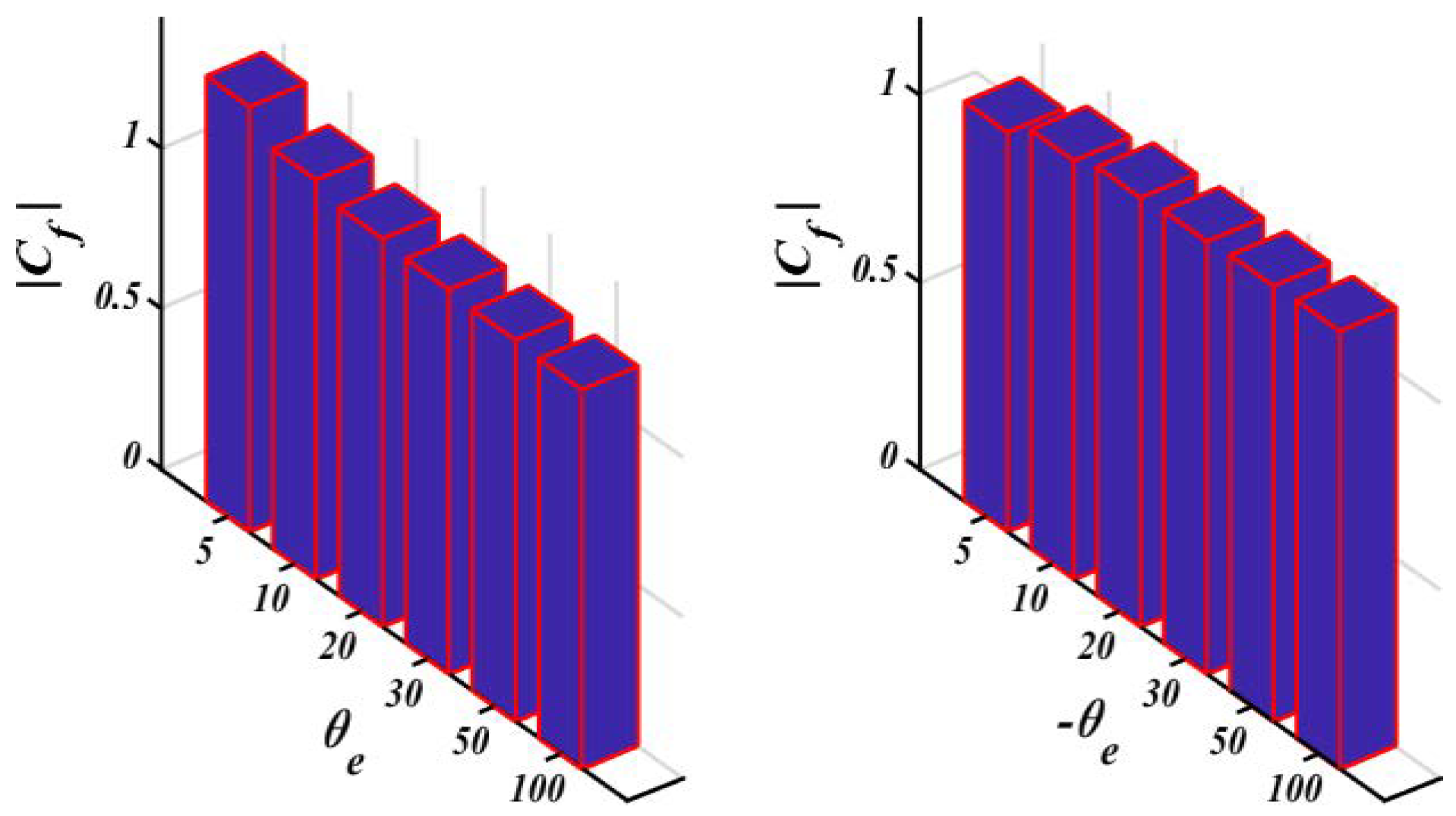
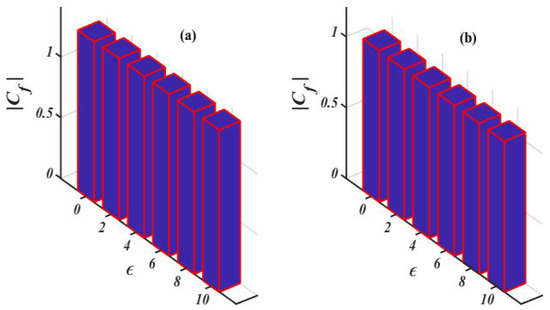
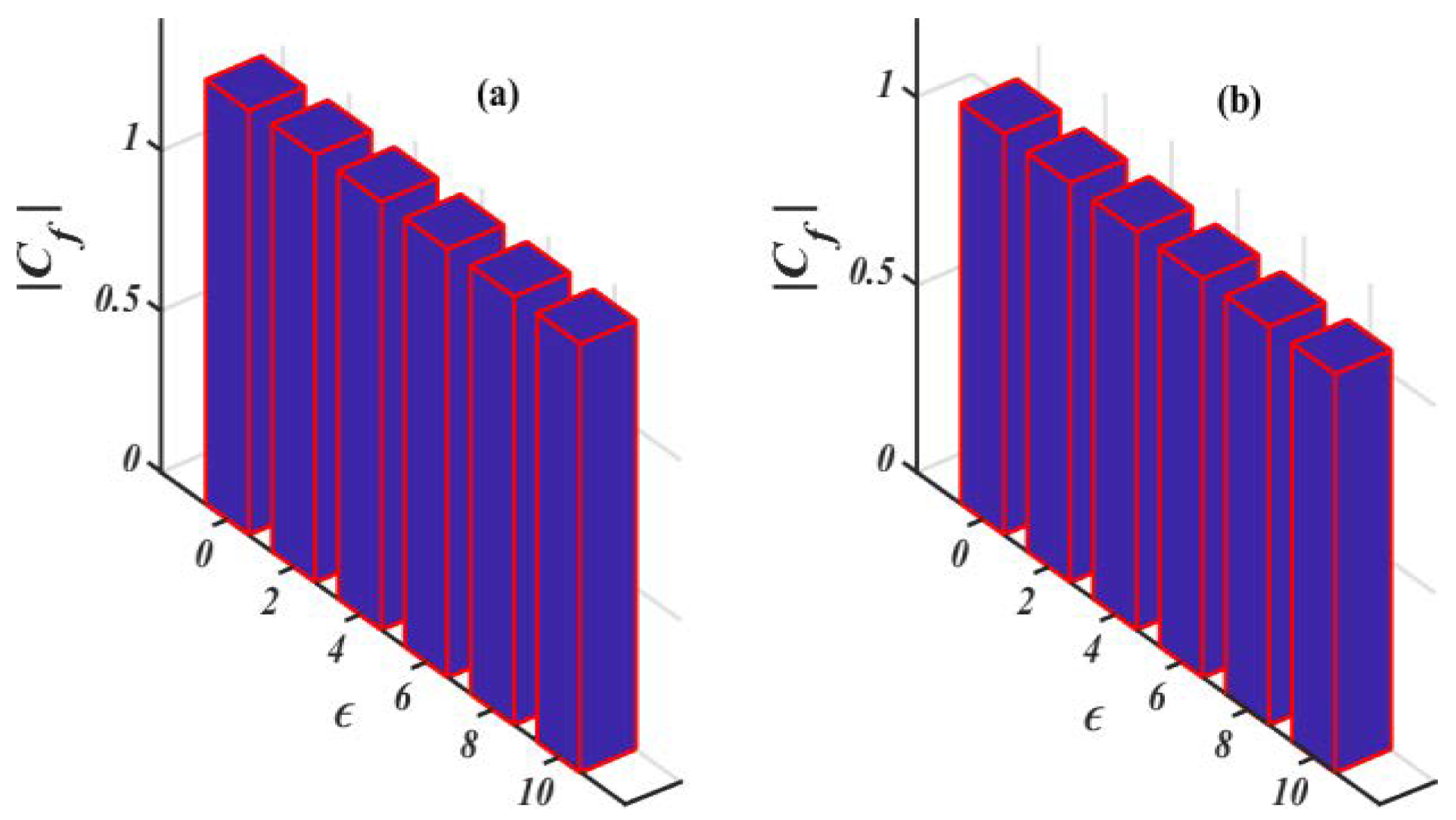
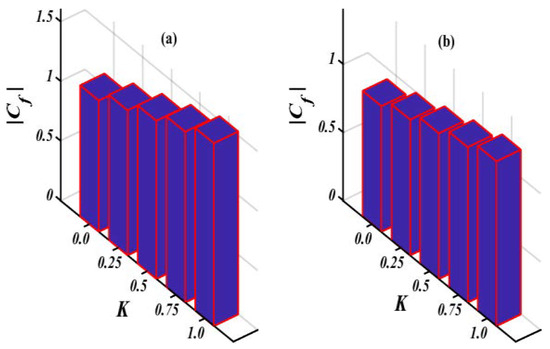
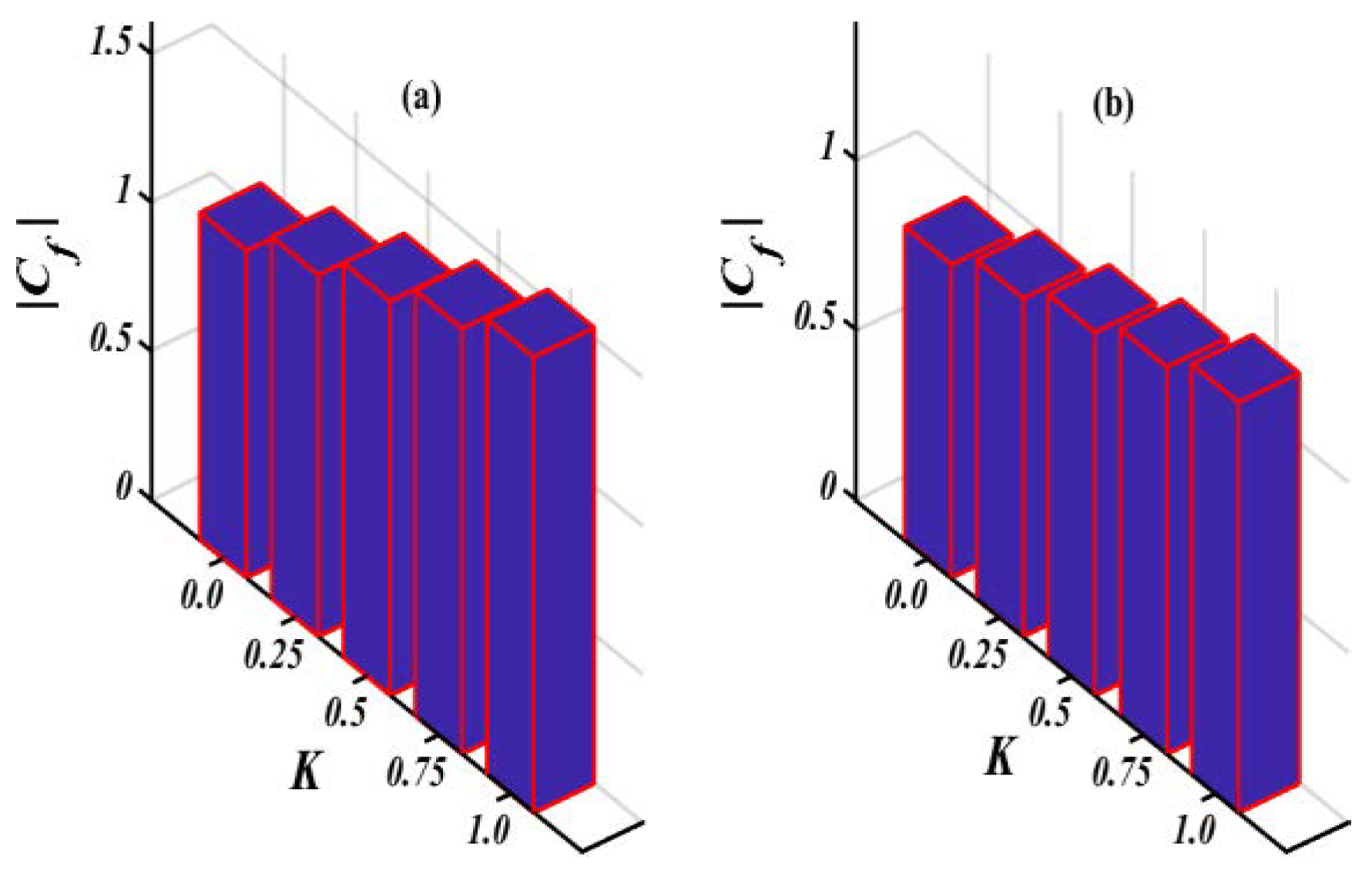
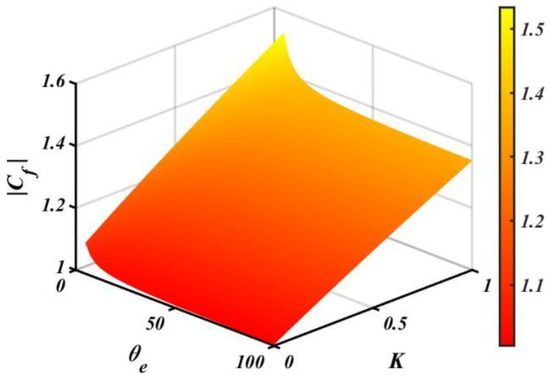
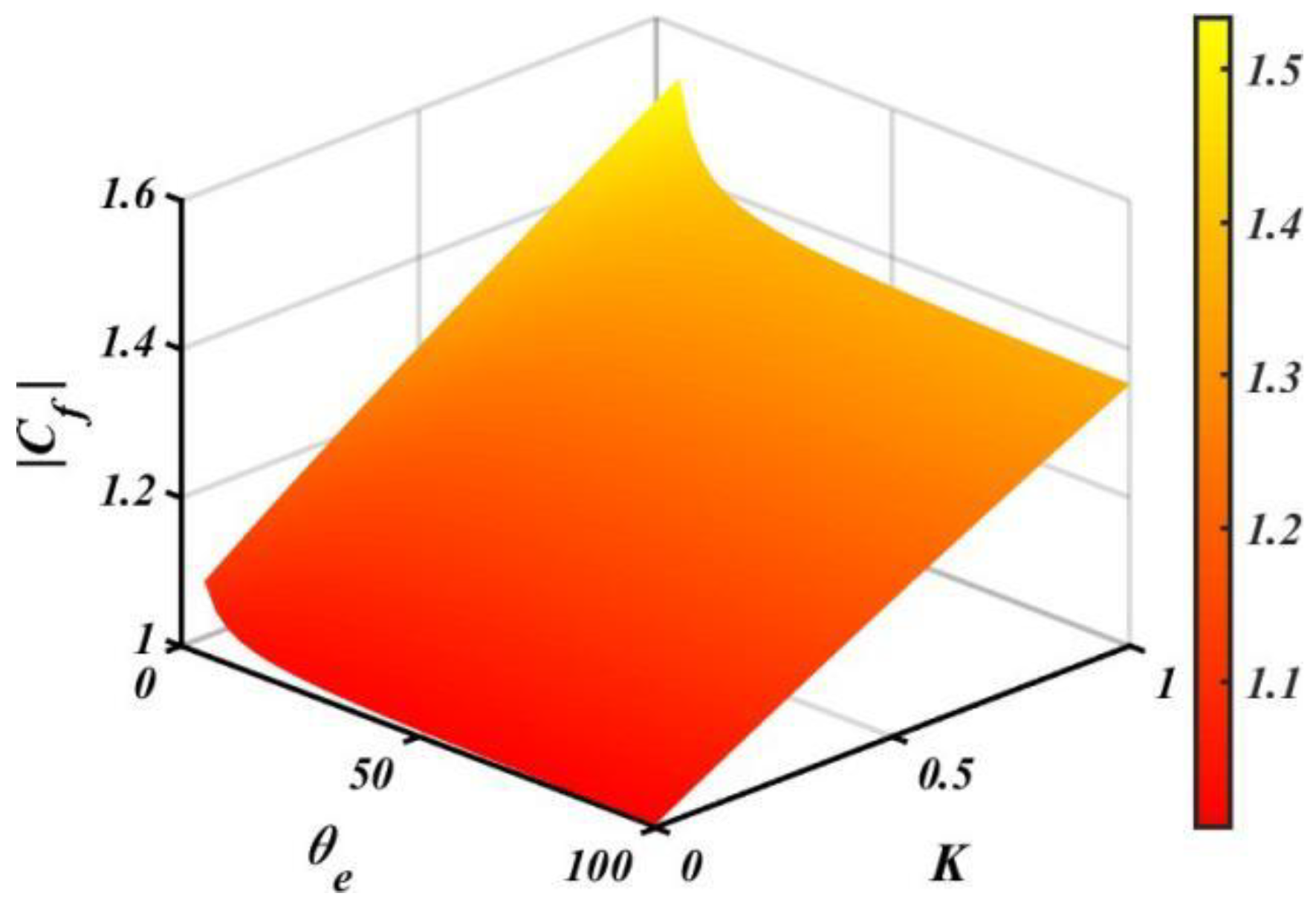
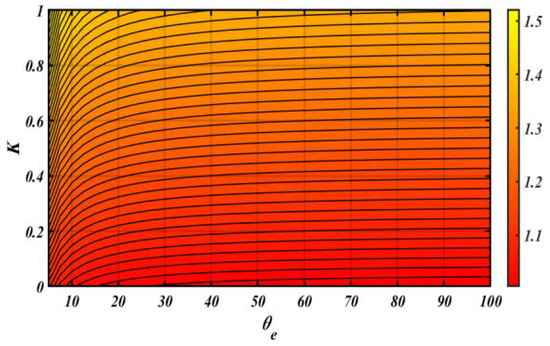
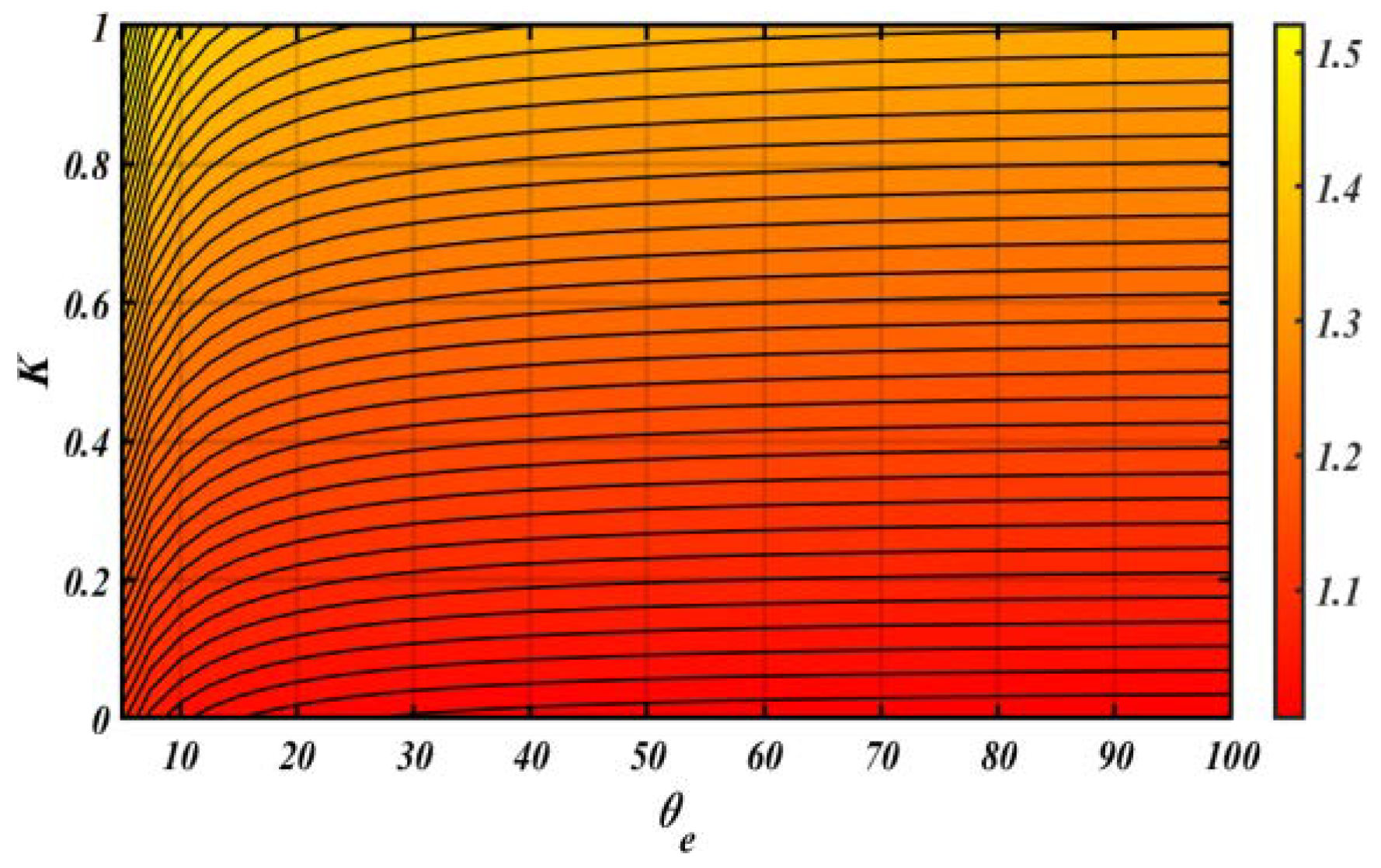
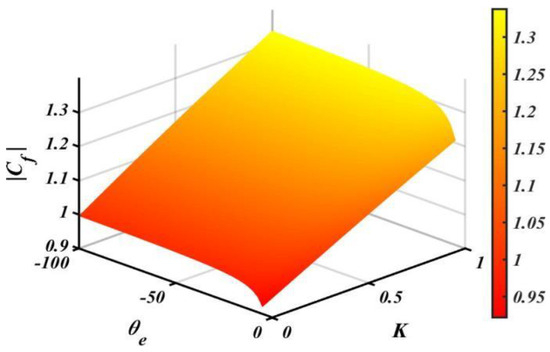
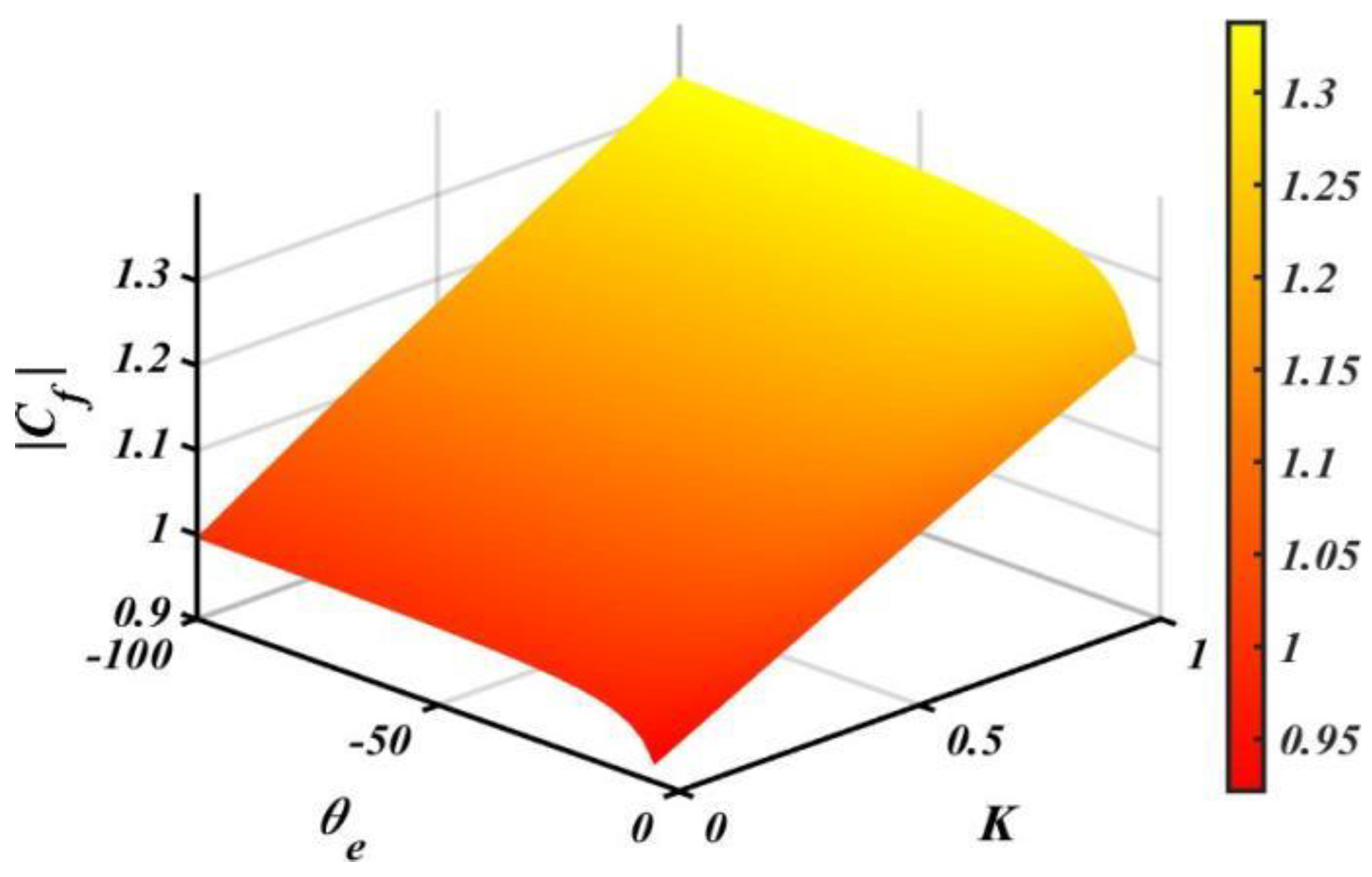
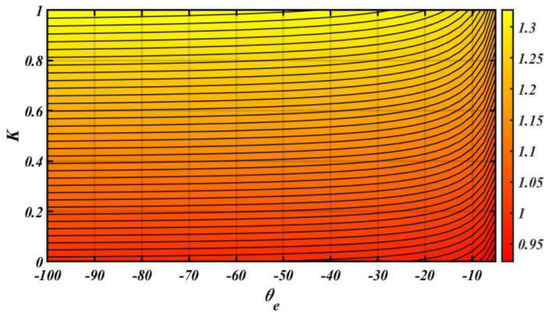
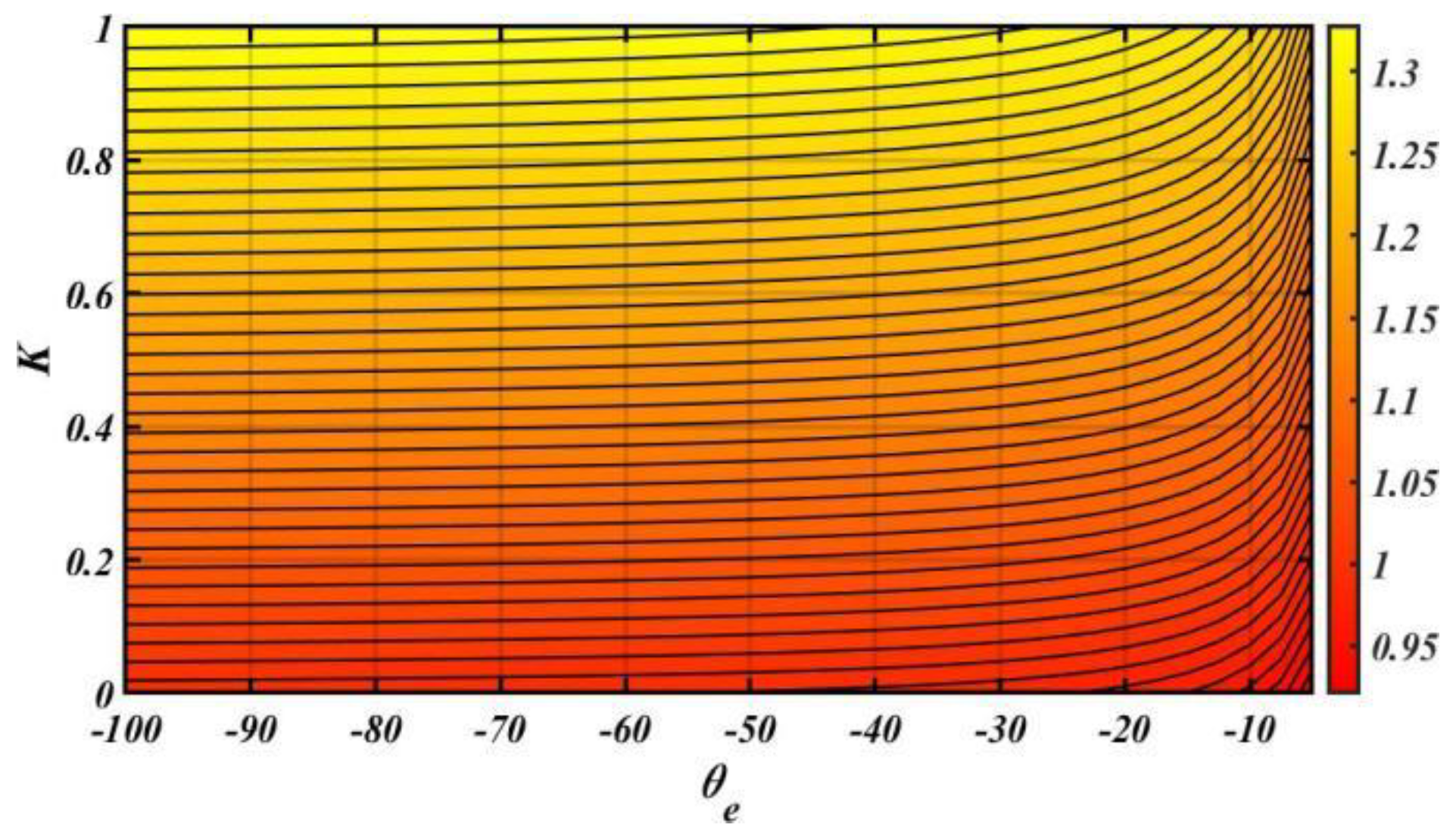
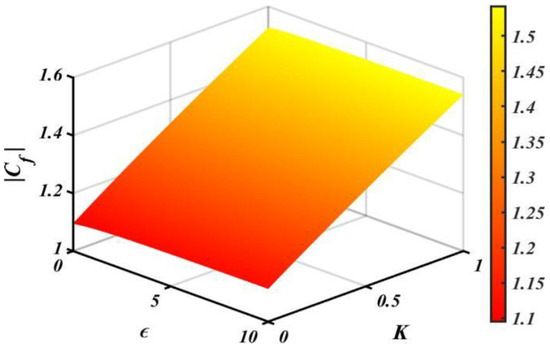
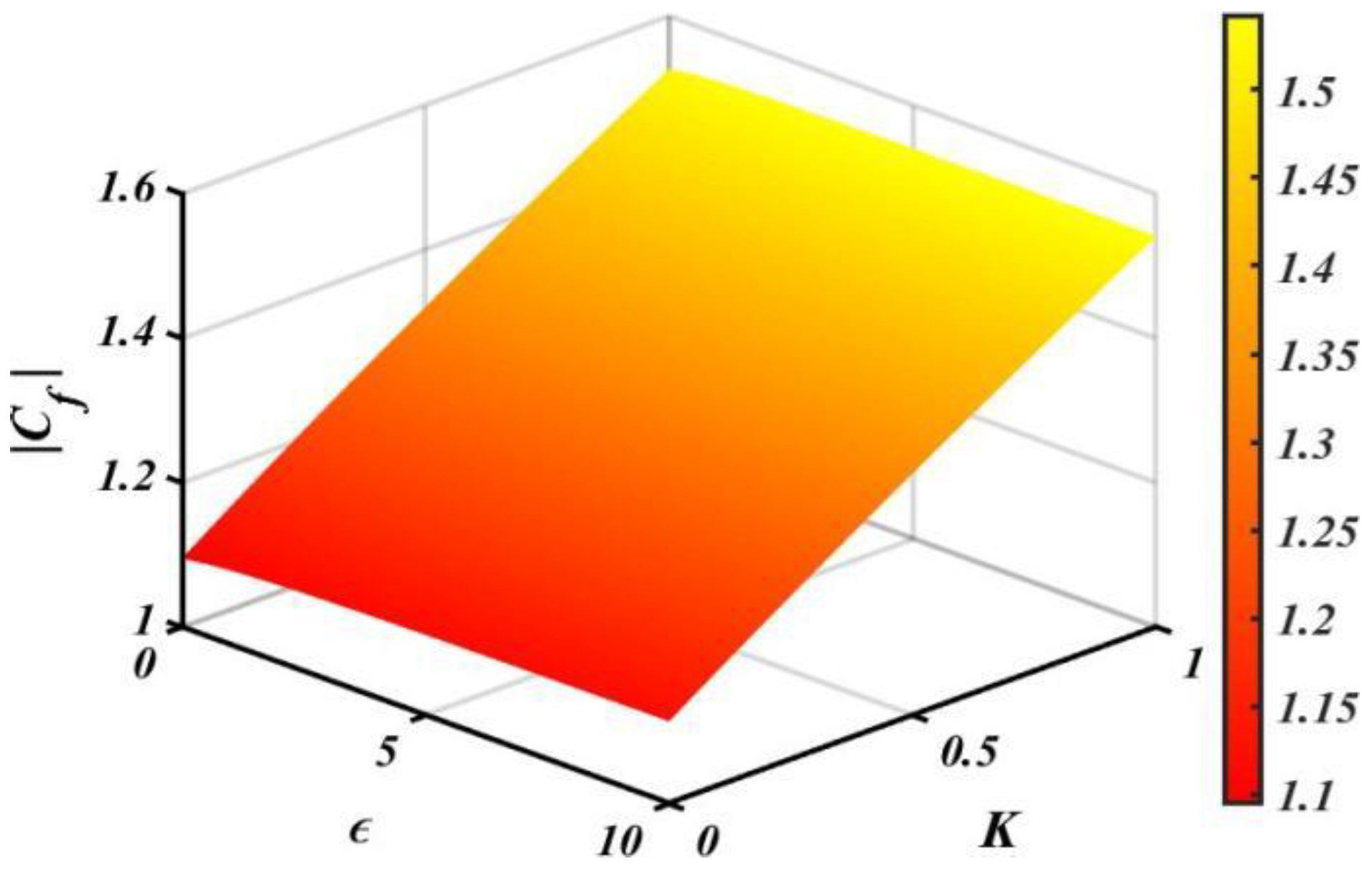
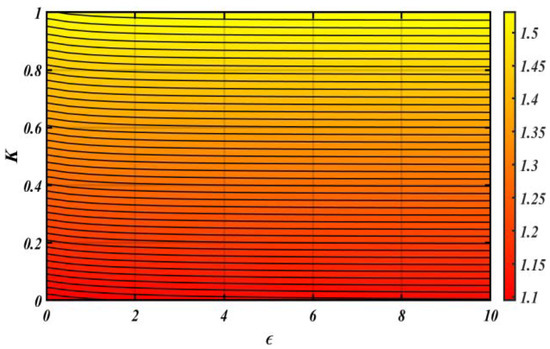
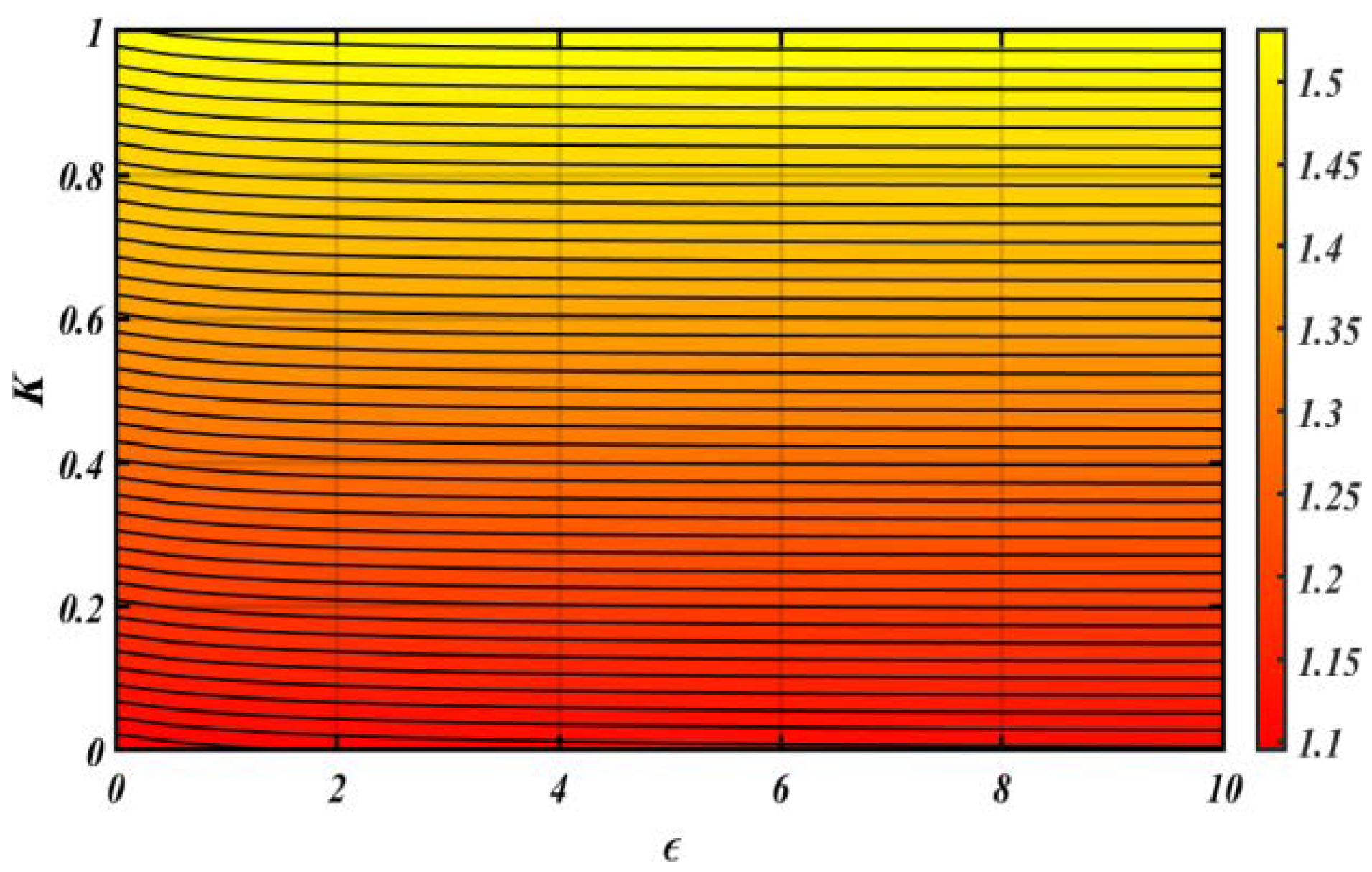
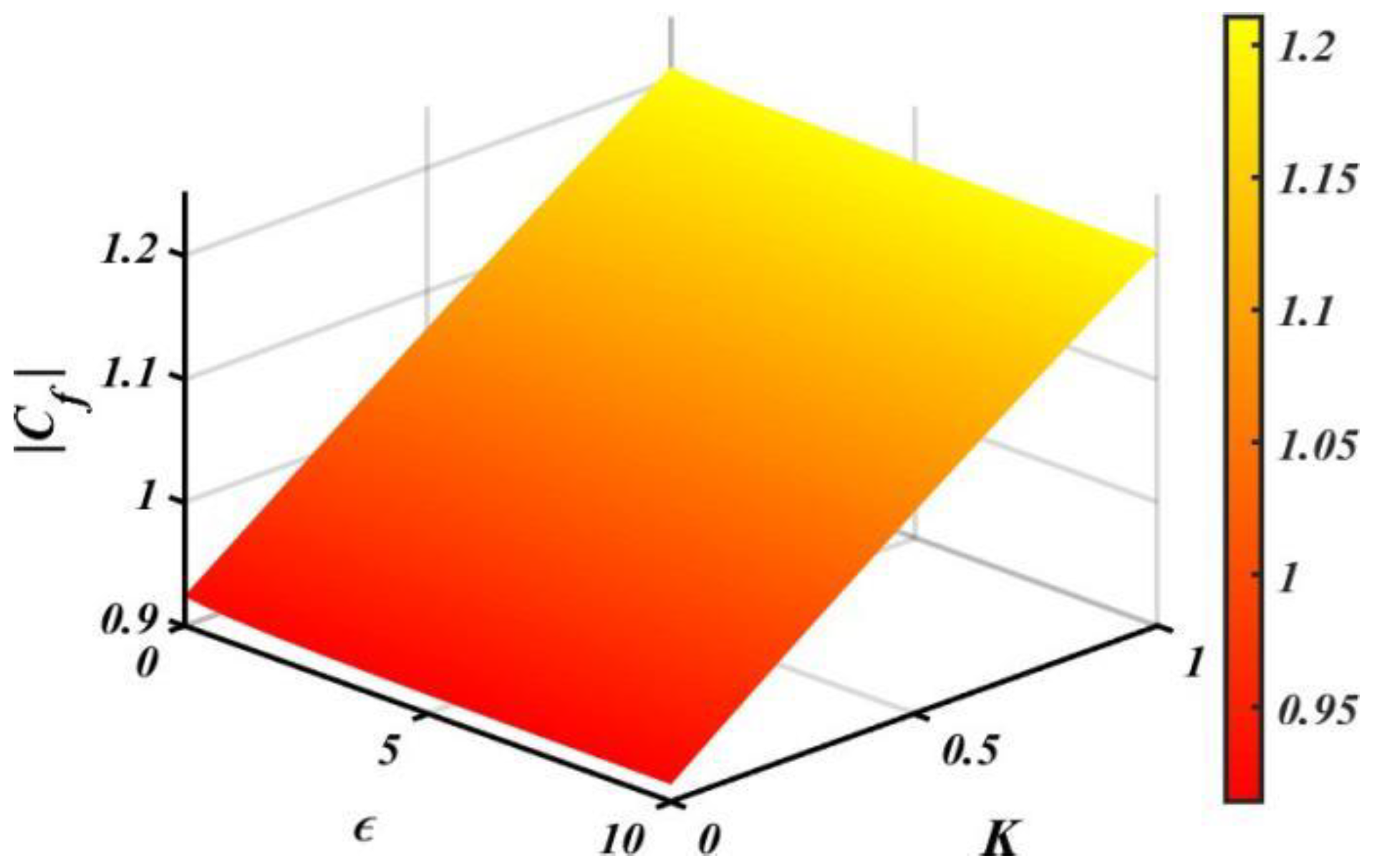
Figure 6 shows the effect of the parameter θe on the coefficient of skin-friction for both cases θe > 0 and θe < 0. It is clear that |Cf| decreases for θe > 0 while it increases for θe < 0. This behavior is also evident from Figure 2 and Figure 3, which reflect the corresponding decreasing and increasing trends in fluid velocity for θe > 0 and θe < 0. Figure 7 describes the influence of the parameter ϵ on the coefficient of skin-friction for both θe > 0 and θe < 0. It can be observed that |Cf| increases when θe > 0, while it decreases for θe <0. However, the variations in |Cf| are minimal for both cases. Figure 8 reflects that the coefficient of skin-friction Cf increases with greater values of the curvature parameter K for both θe >0 and θe < 0. The relationship Cf∝1/Re indicates that as the Reynolds number Re increases, the viscous forces decrease, leading to a decrease in |Cf|. However, in the present case, Cf is influenced by the curvature parameter K, resulting in higher values of |Cf|. This suggests that the curvature of the flow configuration helps reduce the viscous forces. Figure 9, Figure 10, Figure 11, Figure 12, Figure 13, Figure 14, Figure 15 and Figure 16 present surface and contour plots that illustrate the effects of both θe > 0 and θe < 0, along with ϵ and K, on the skin-friction coefficient |Cf|. These plots indicate that these parameters exert a similar influence on |Cf|, consistent with the previous results shown in the bar plots.
Figure 6.
Influence of variable viscosity parameter θe on coefficient of skin-friction |Cf| at K = 0.5, ϵ = 0.5, Pr = 0.71.
Figure 7.
Influence of variable thermal conductivity parameter ϵ on coefficient of skin-friction |Cf| for θe = 5 (a) and θe = −5 (b) at K = 0.5, Pr = 0.71.
Figure 8.
Influence of curvature parameter K on coefficient of skin-friction |Cf| for θe = 5 (a) and θe = −5 (b) at ϵ = 0.5, Pr = 0.71.
Figure 9.
Surface plot of |Cf| against θe > 0 and K at ϵ = 0.5.
Figure 10.
Contour plot of |Cf| against θe > 0 and K at ϵ = 0.5.
Figure 11.
Surface plot of |Cf| against θe < 0 and K at ϵ = 0.5.
Figure 12.
Contour plot of |Cf| against θe < 0 and K at ϵ = 0.5.
Figure 13.
Surface plot of |Cf| against ϵ and K at θe = 5.
Figure 14.
Contour plot of |Cf| against ϵ and K at θe = 5.
Figure 15.
Surface plot of |Cf| against ϵ and K at θe = −5.
Figure 16.
Contour plot of |Cf| against ϵ and K at θe = −5.
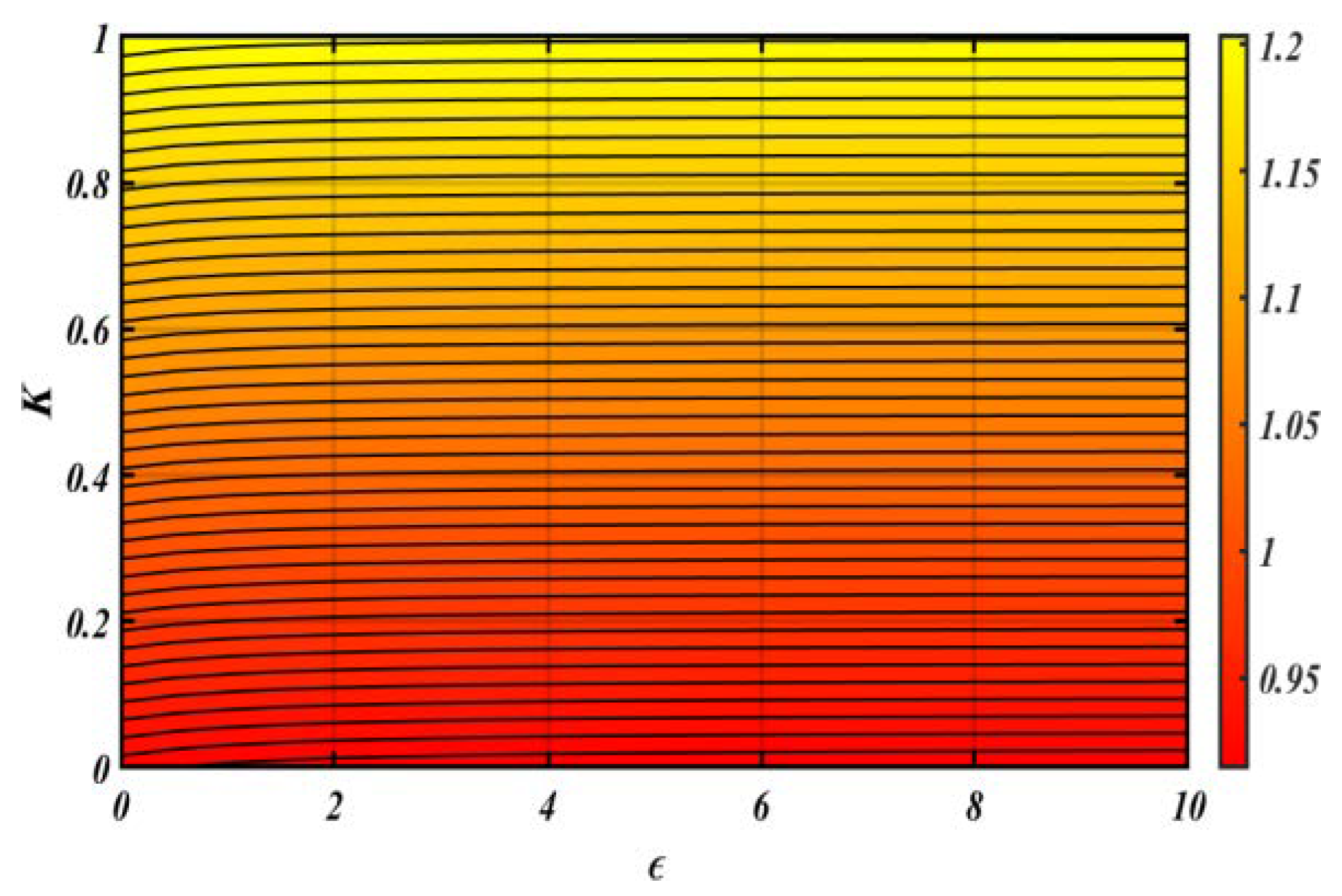
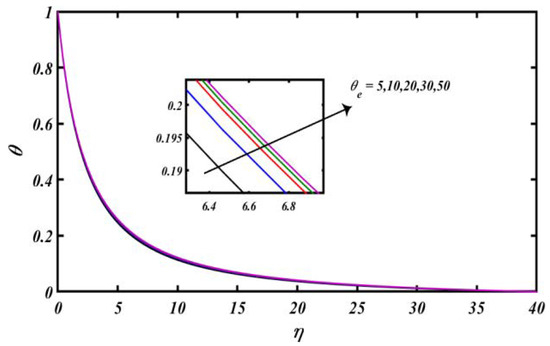
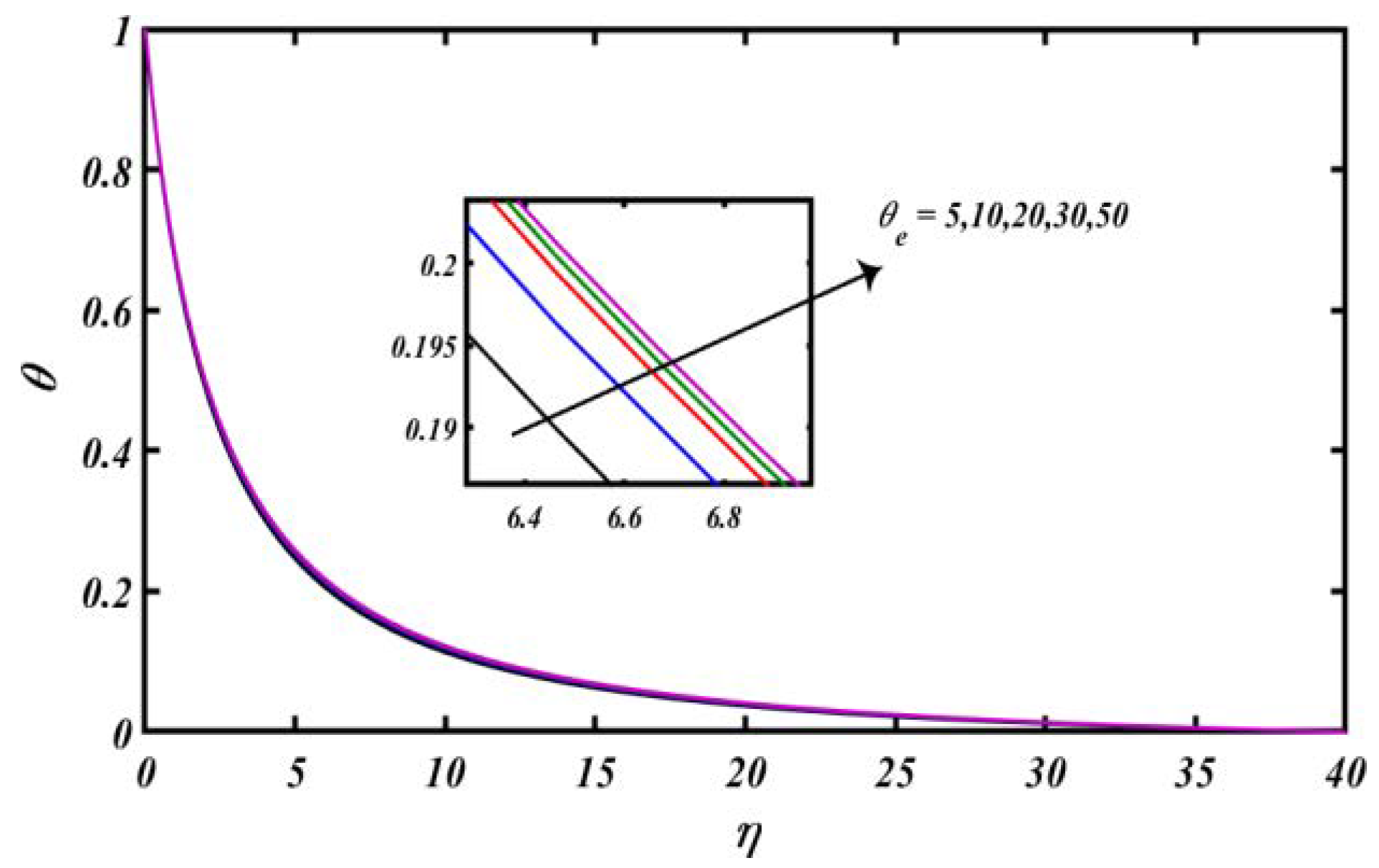
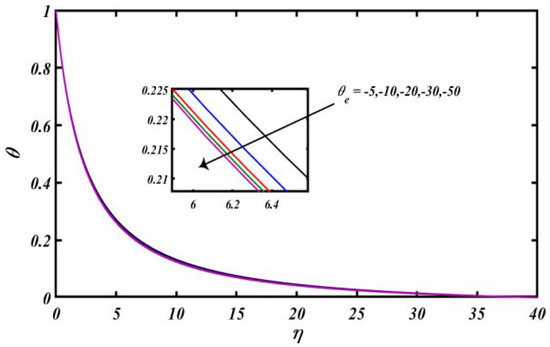
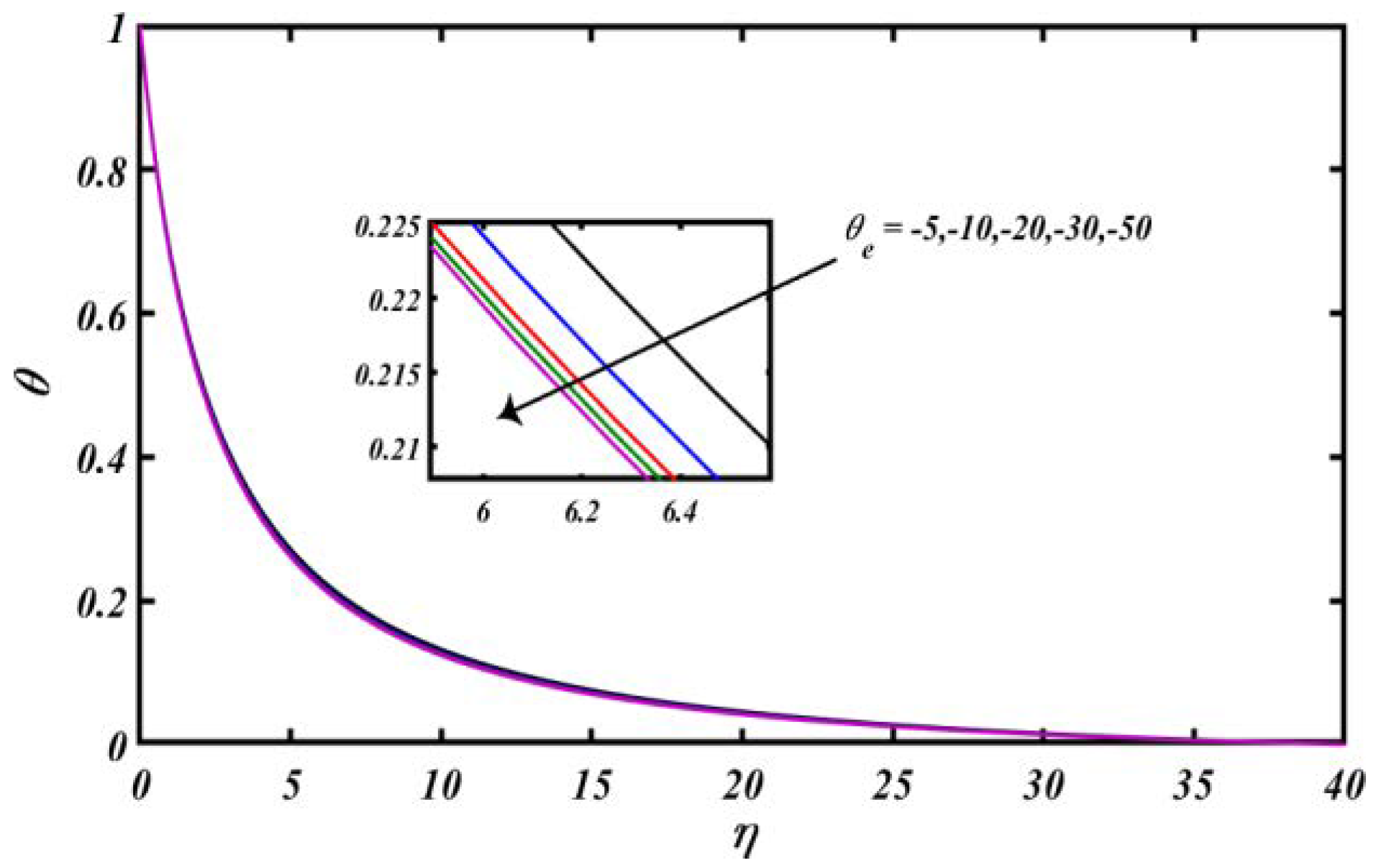
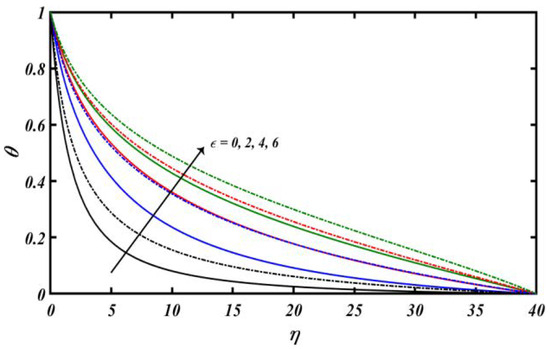
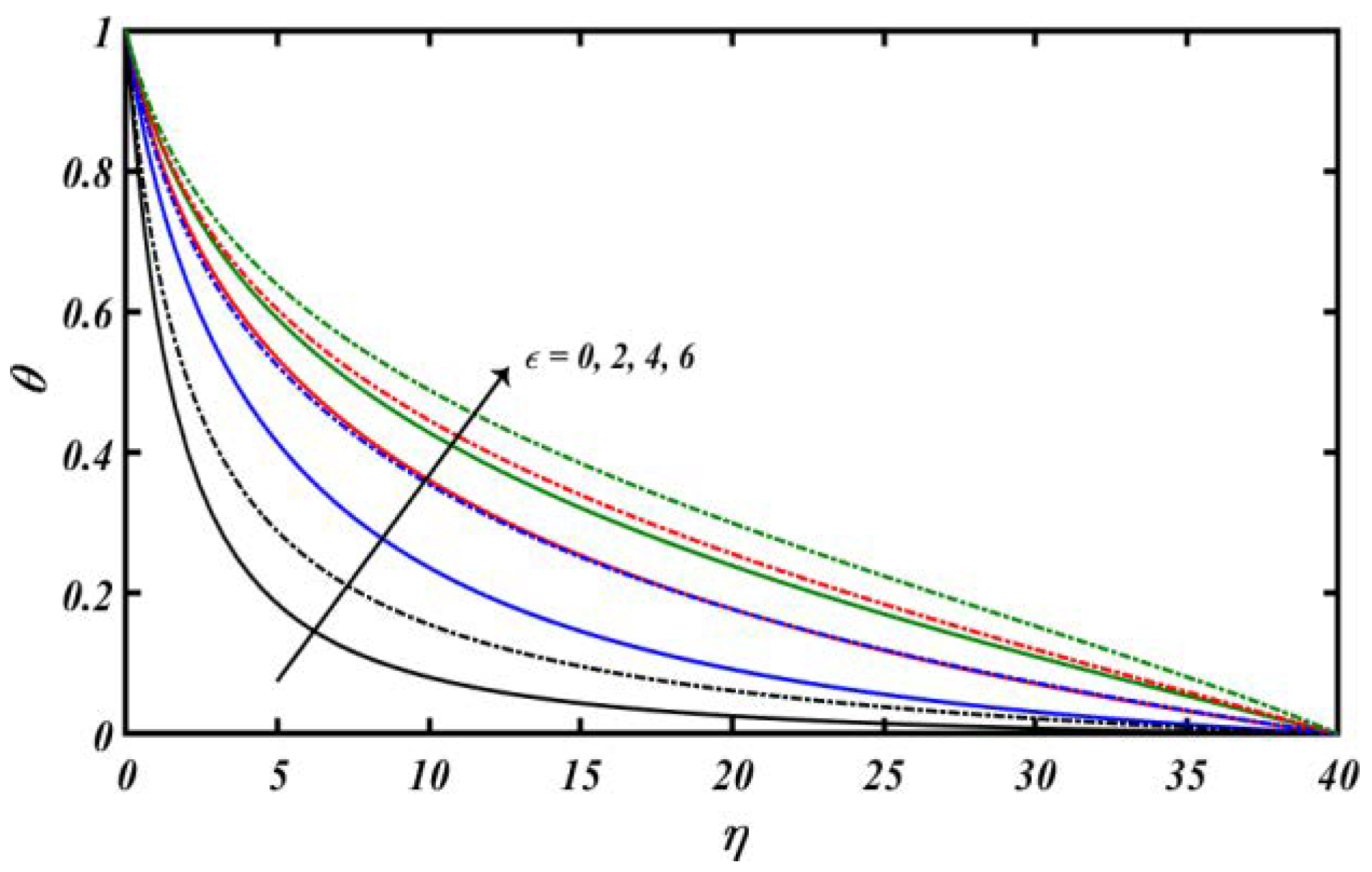
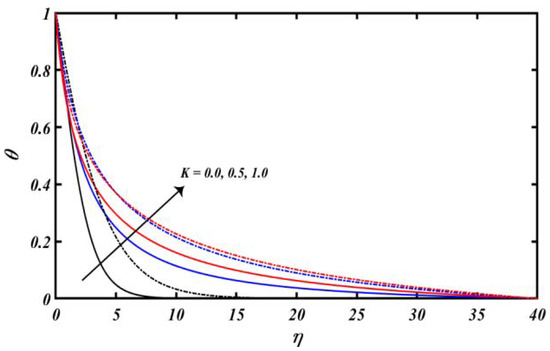
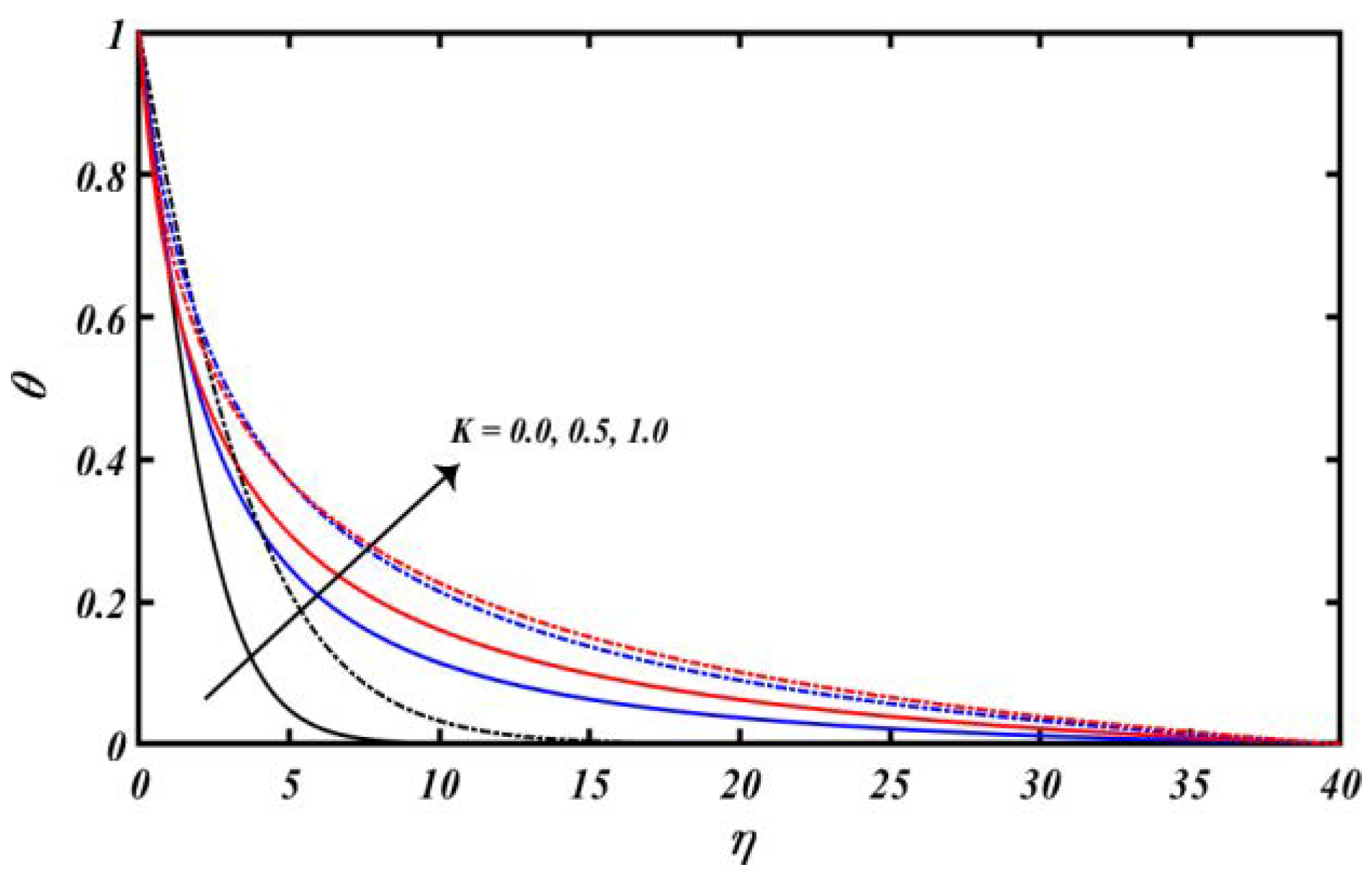
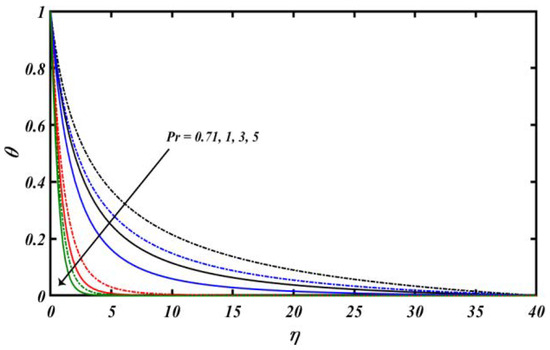
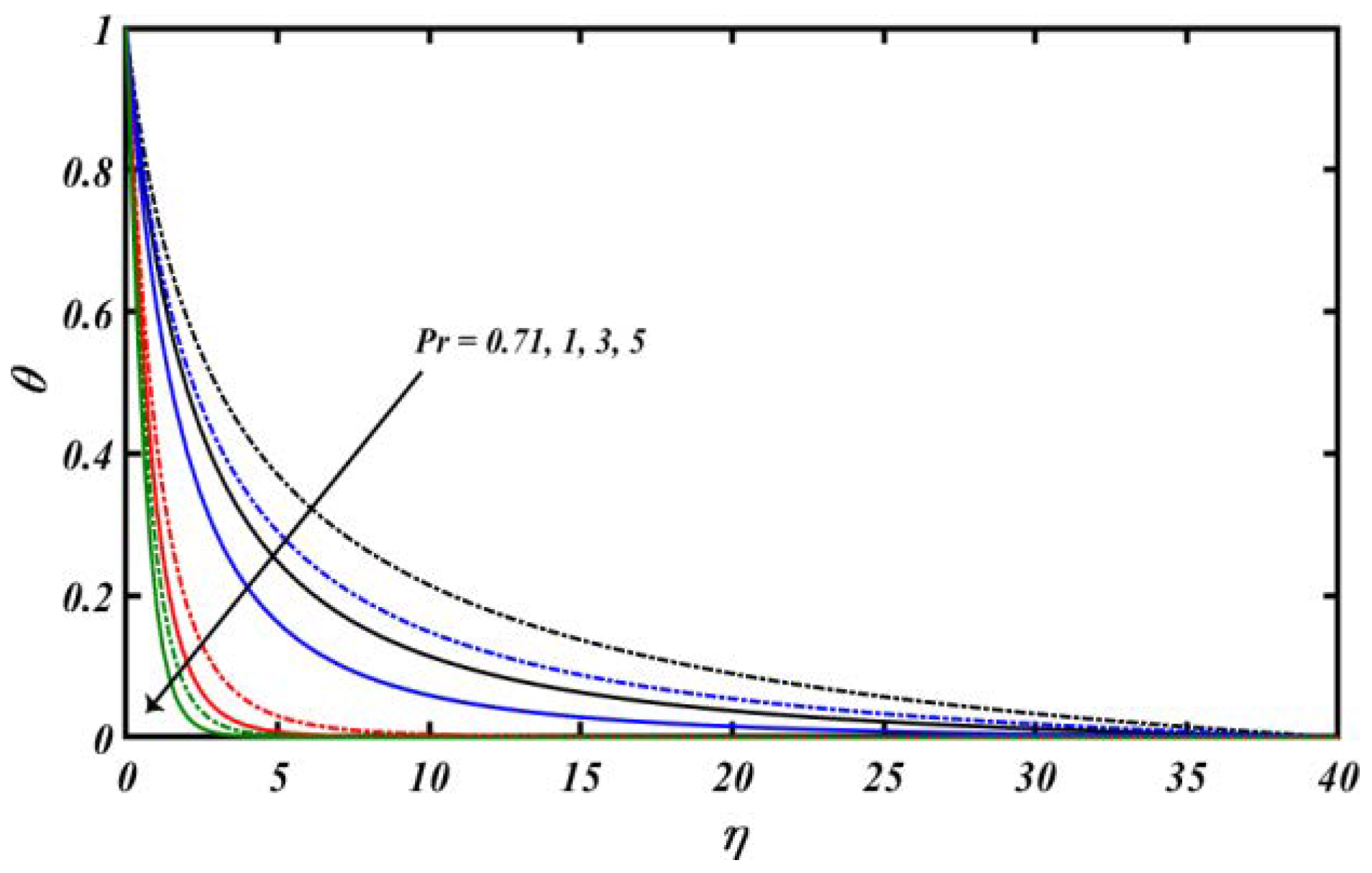
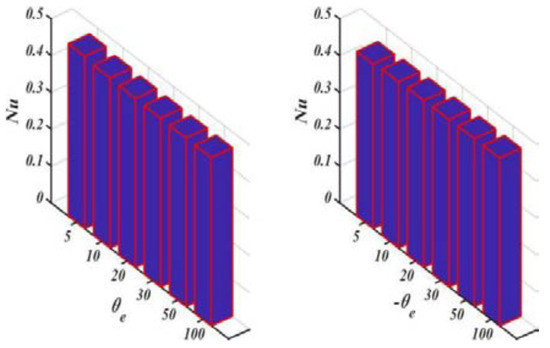
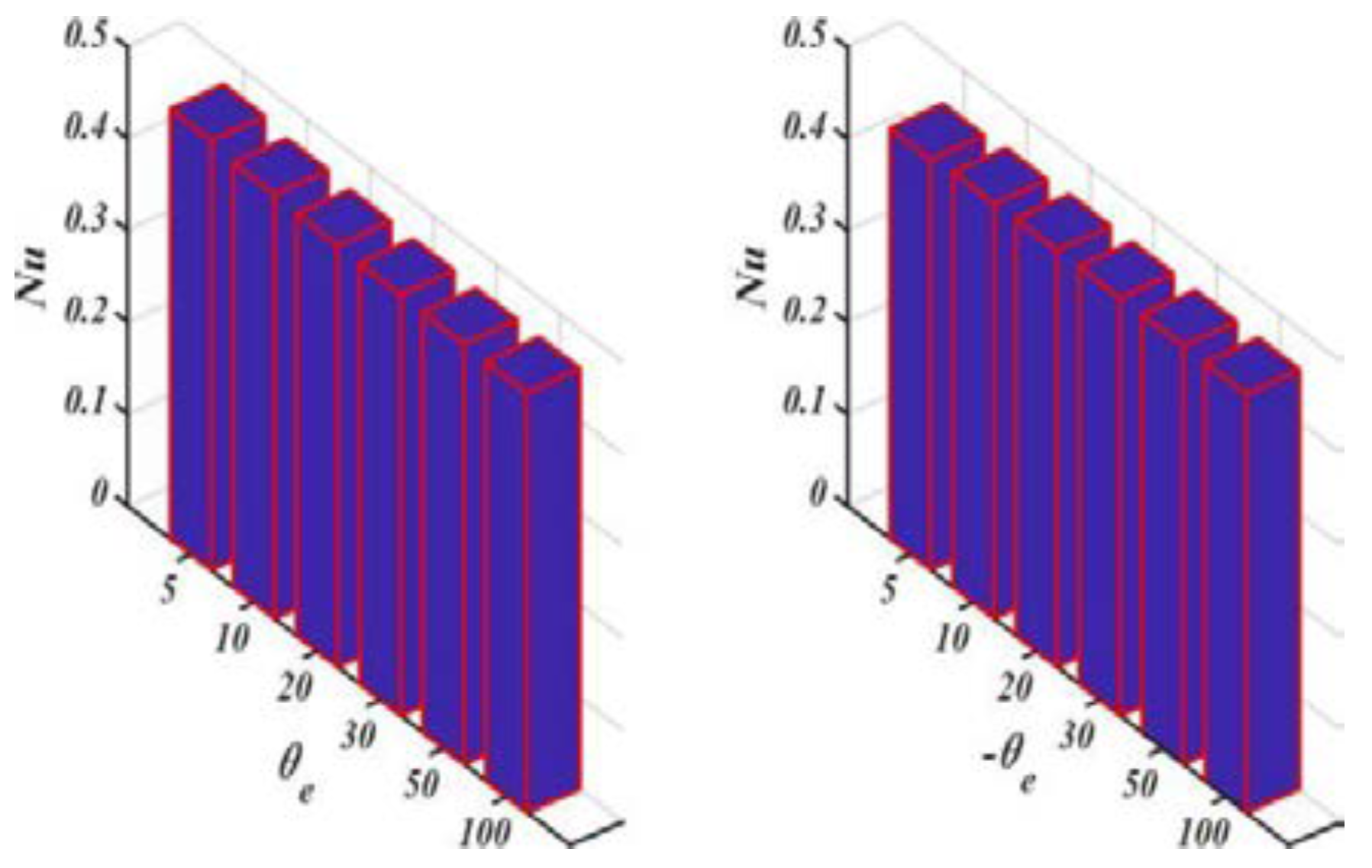
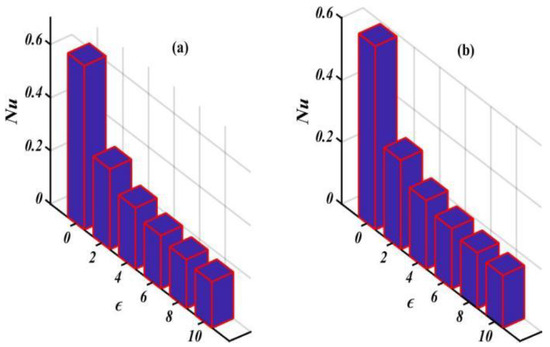
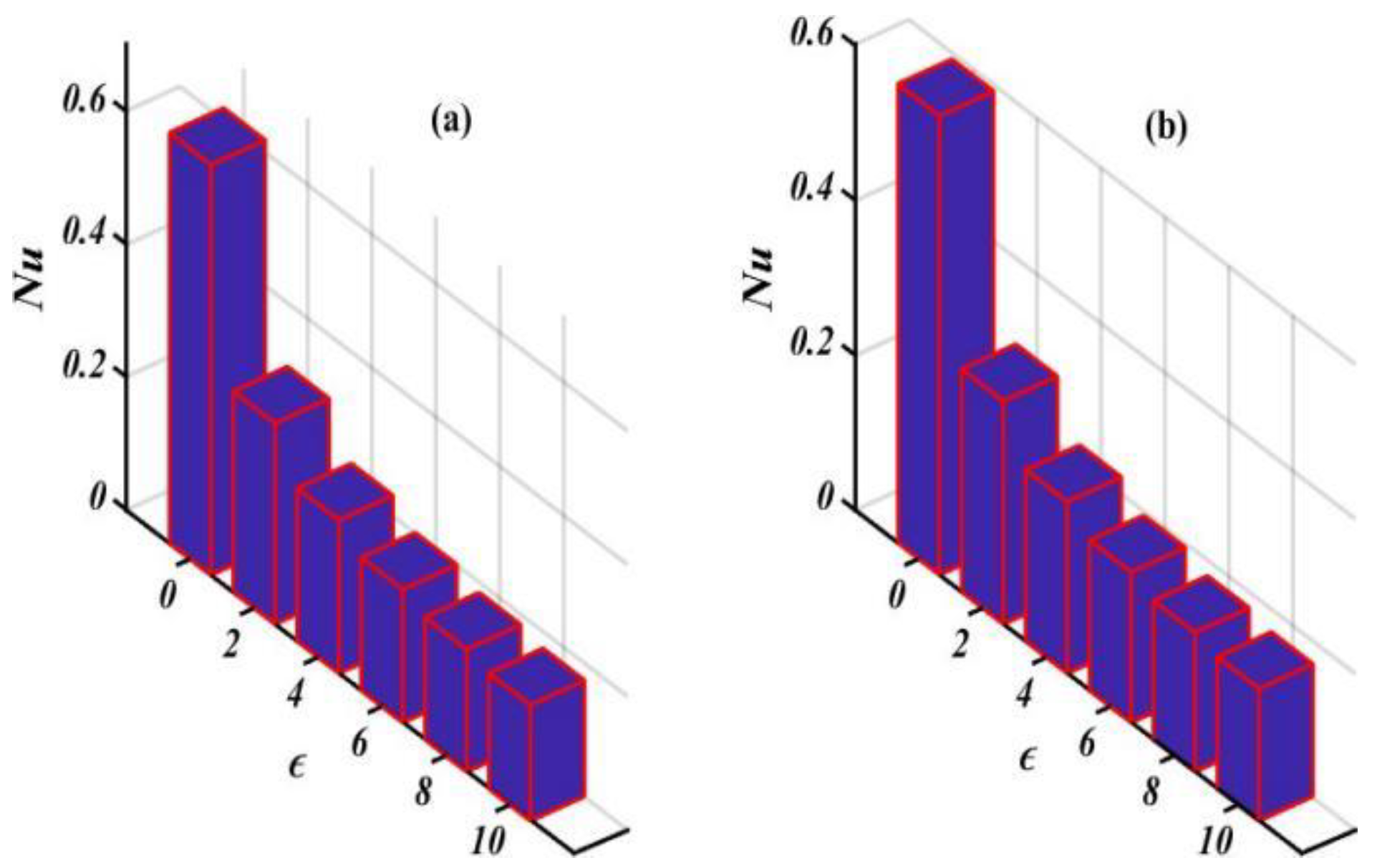
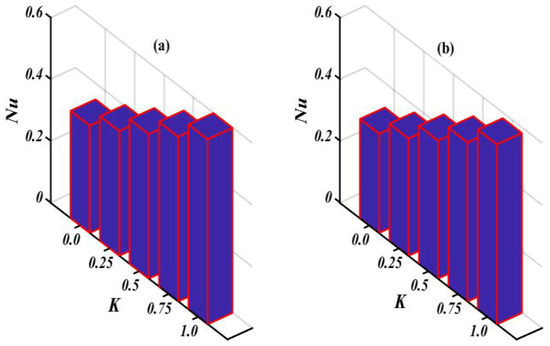
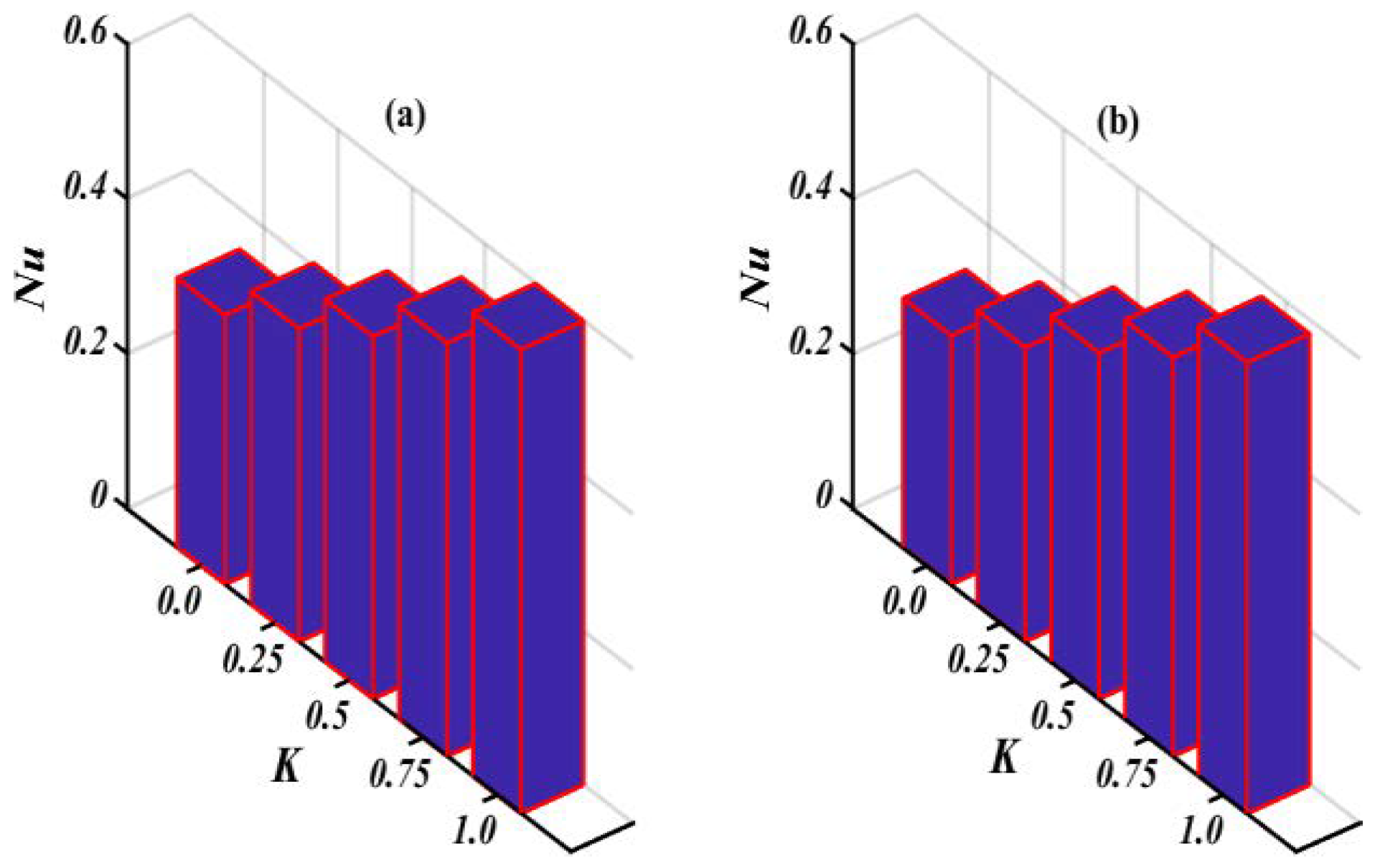
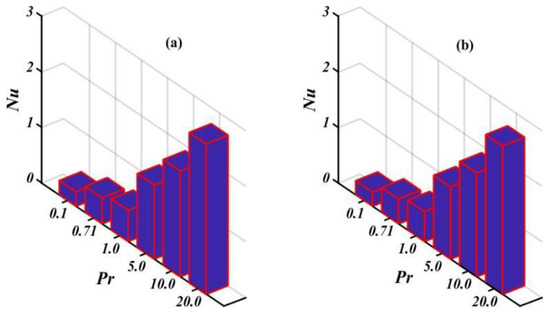
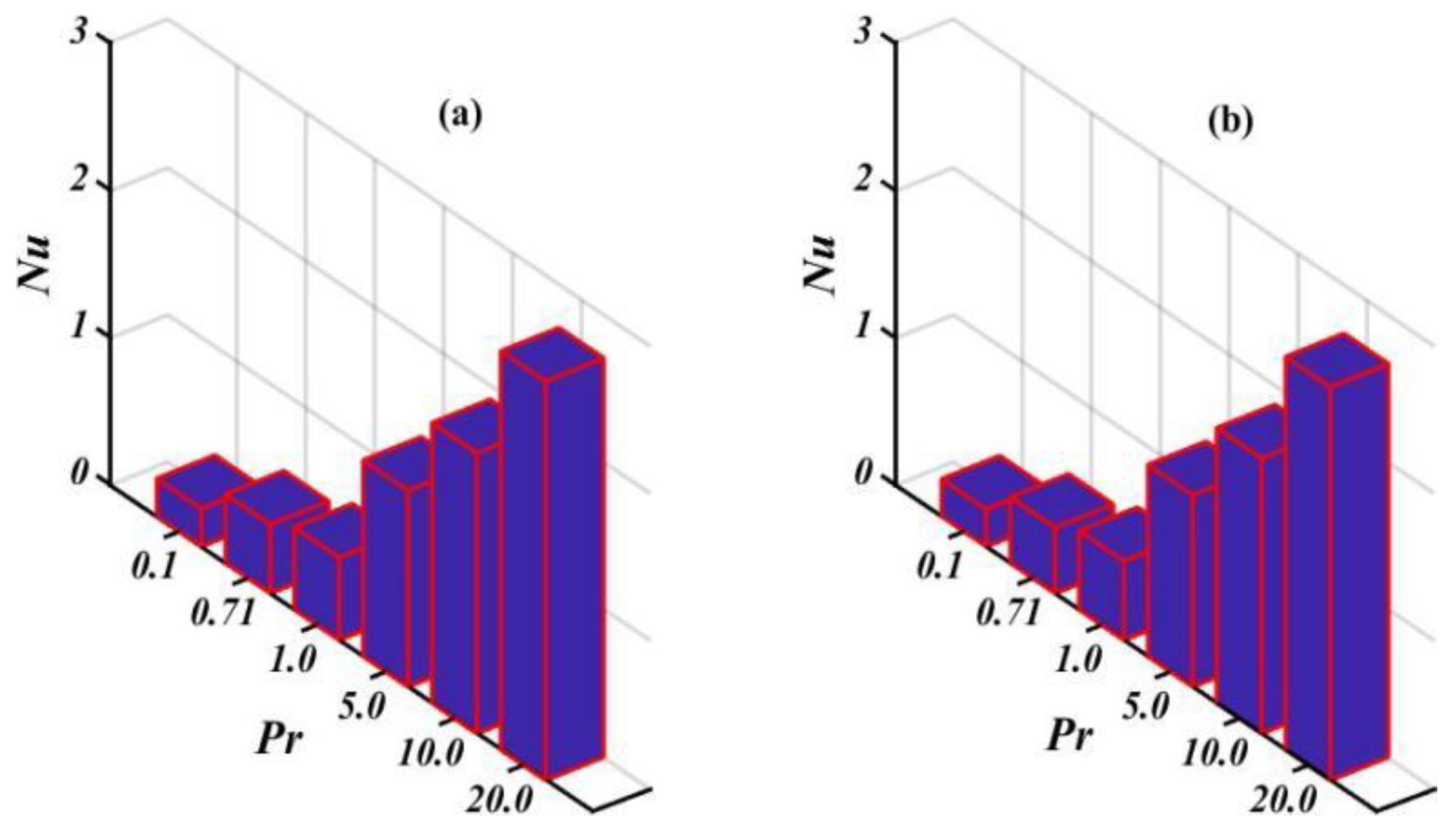
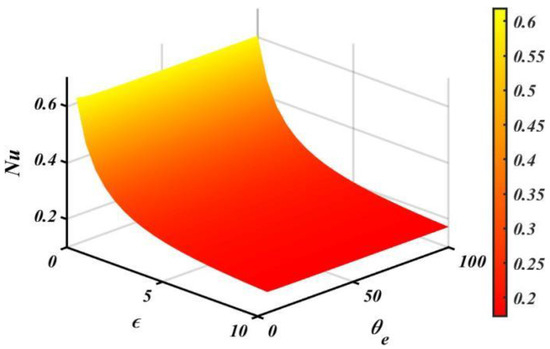
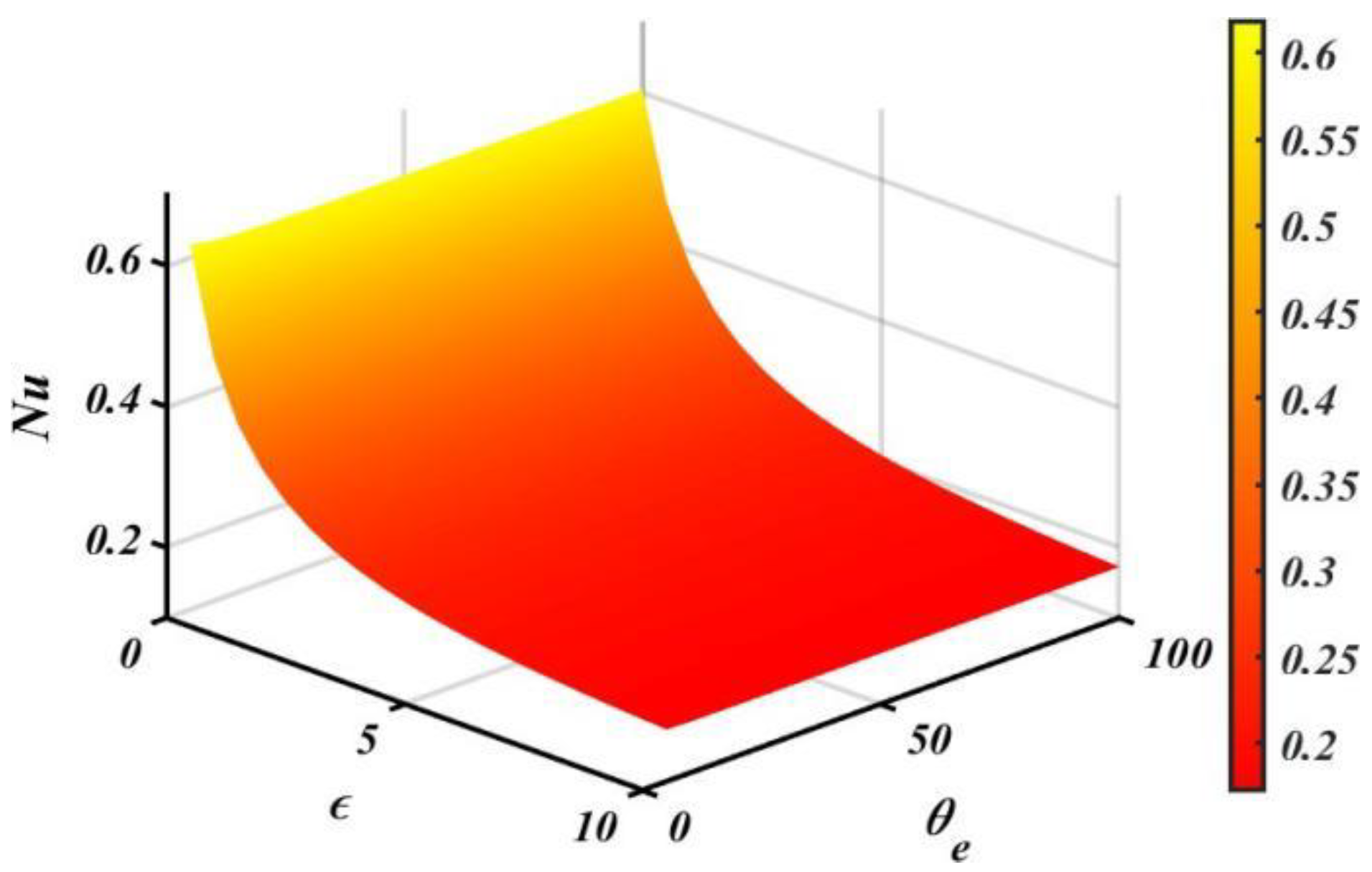
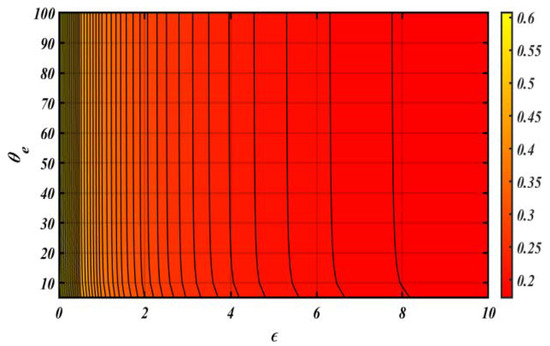
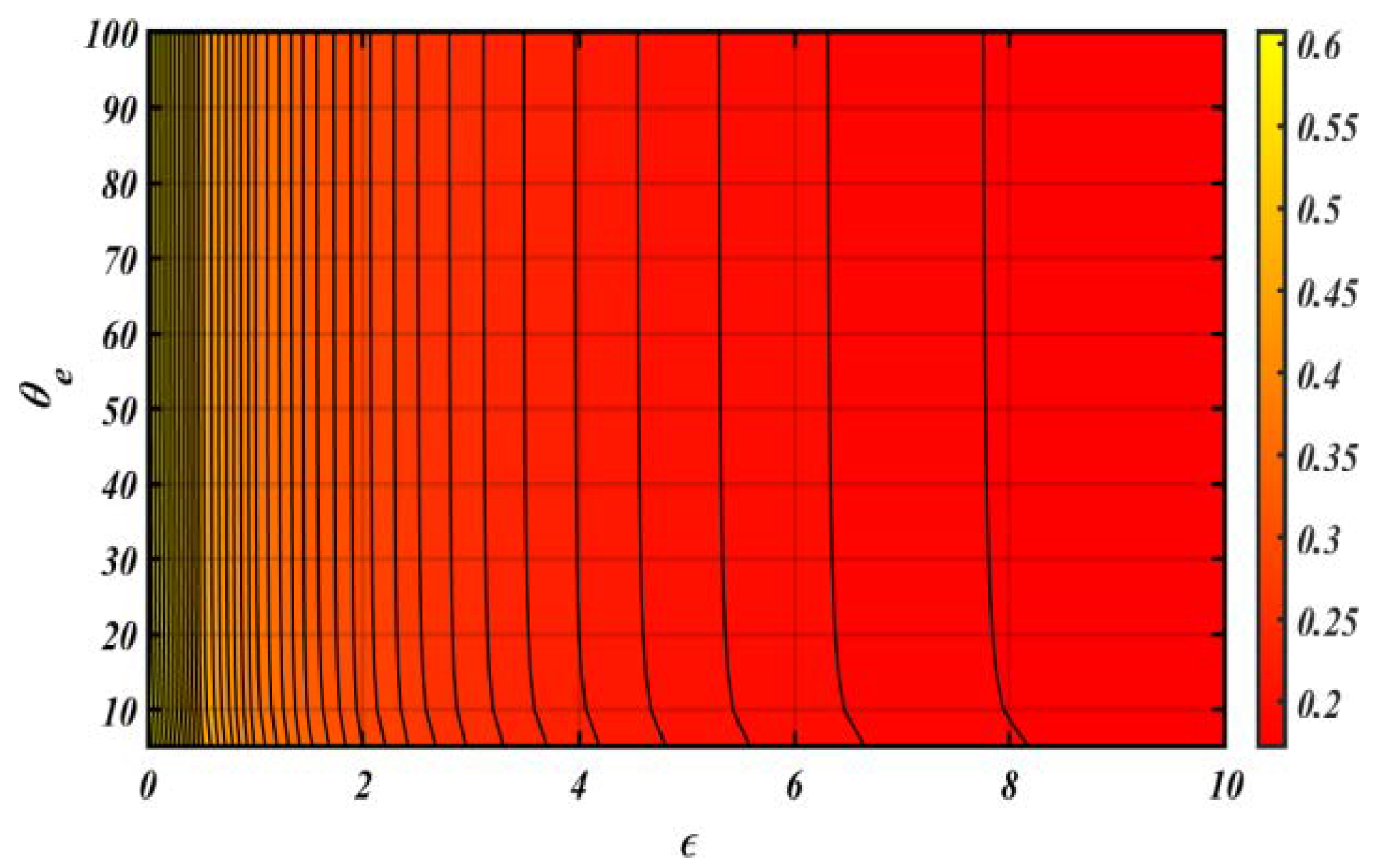
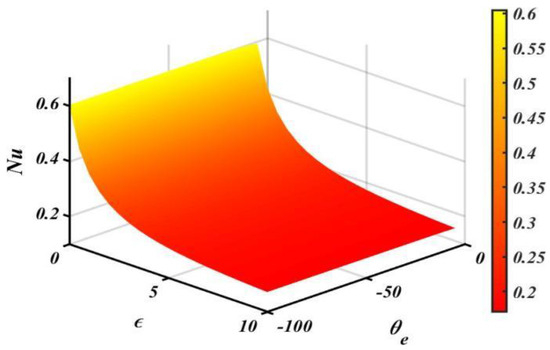
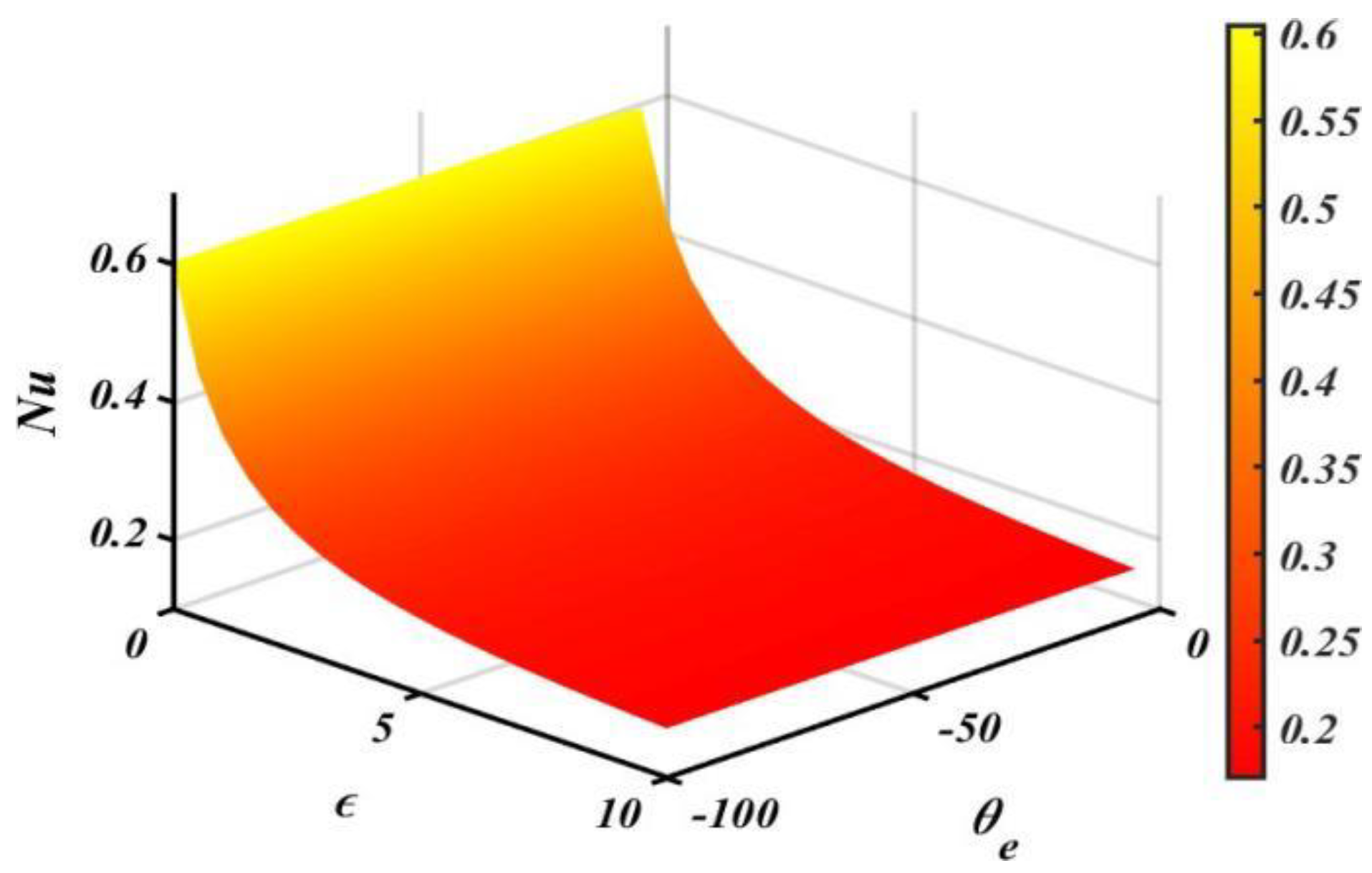
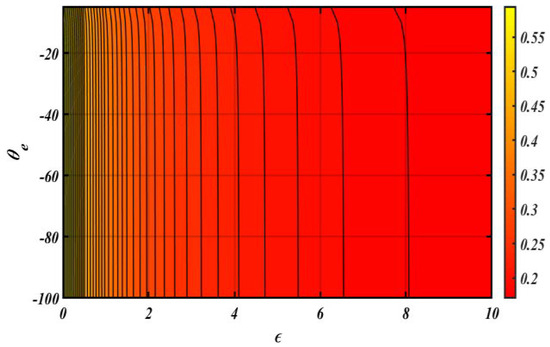
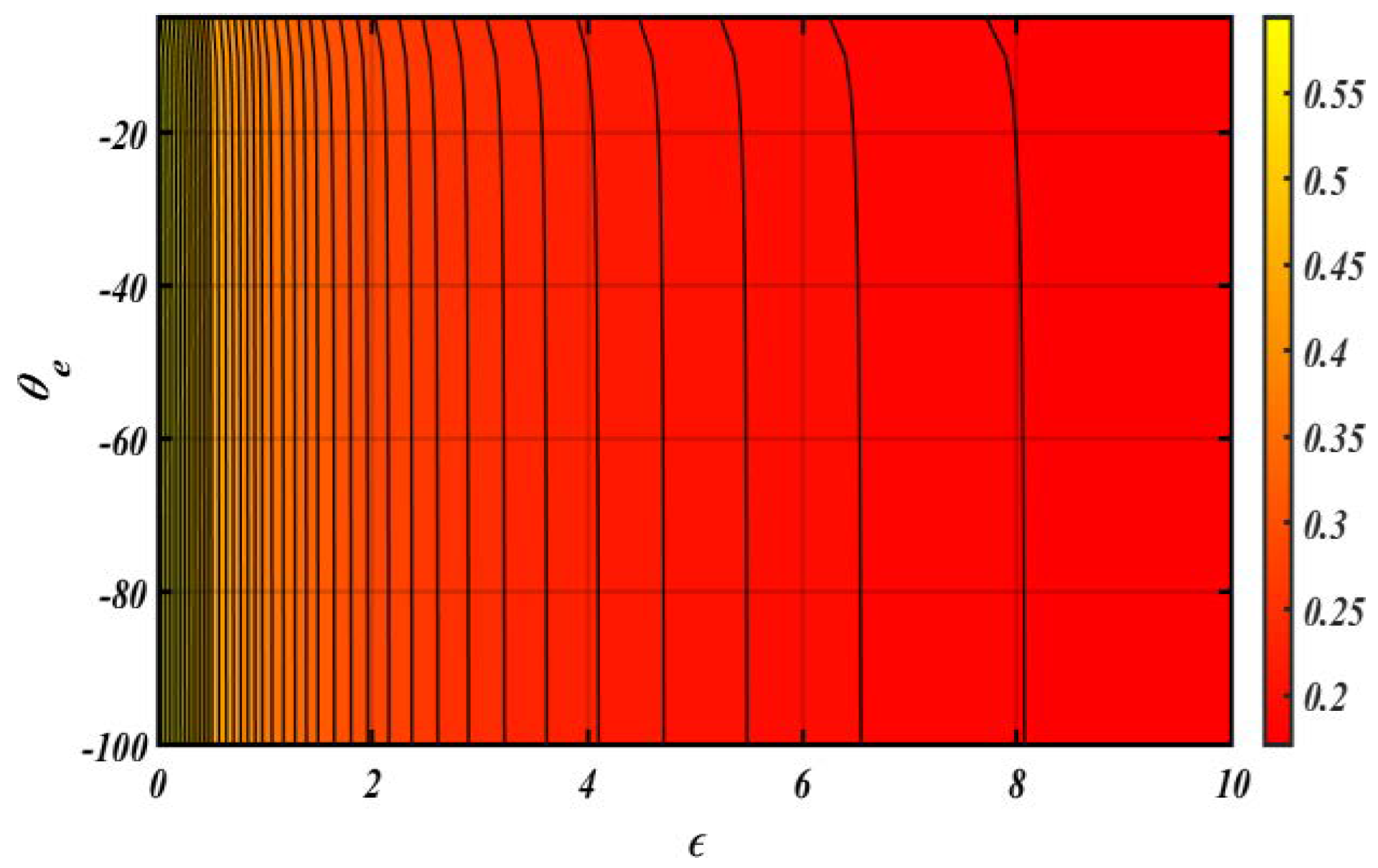
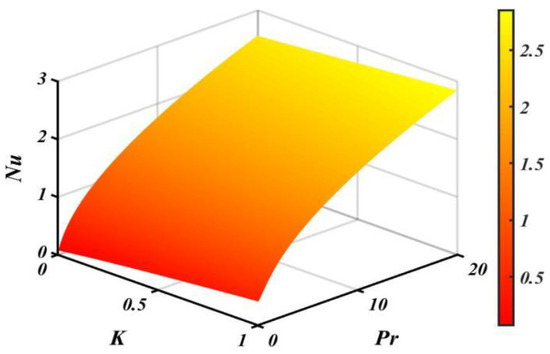
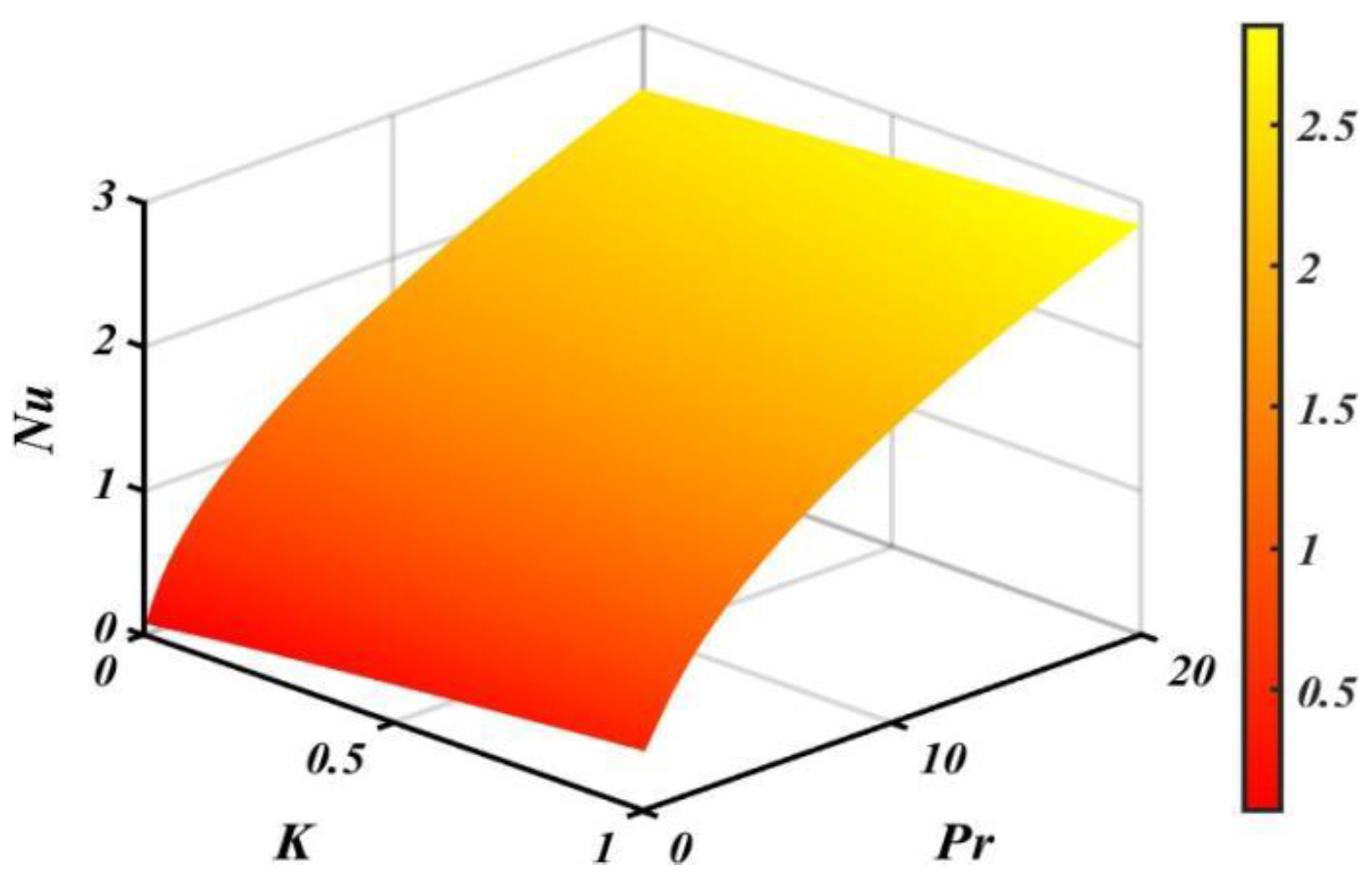
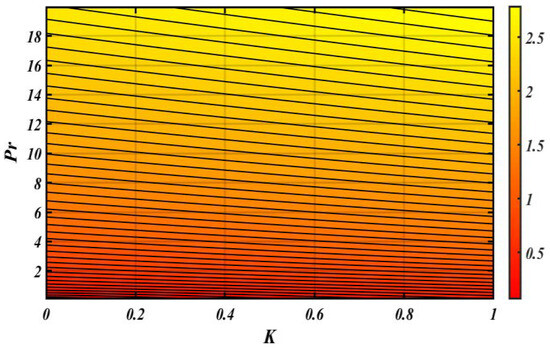
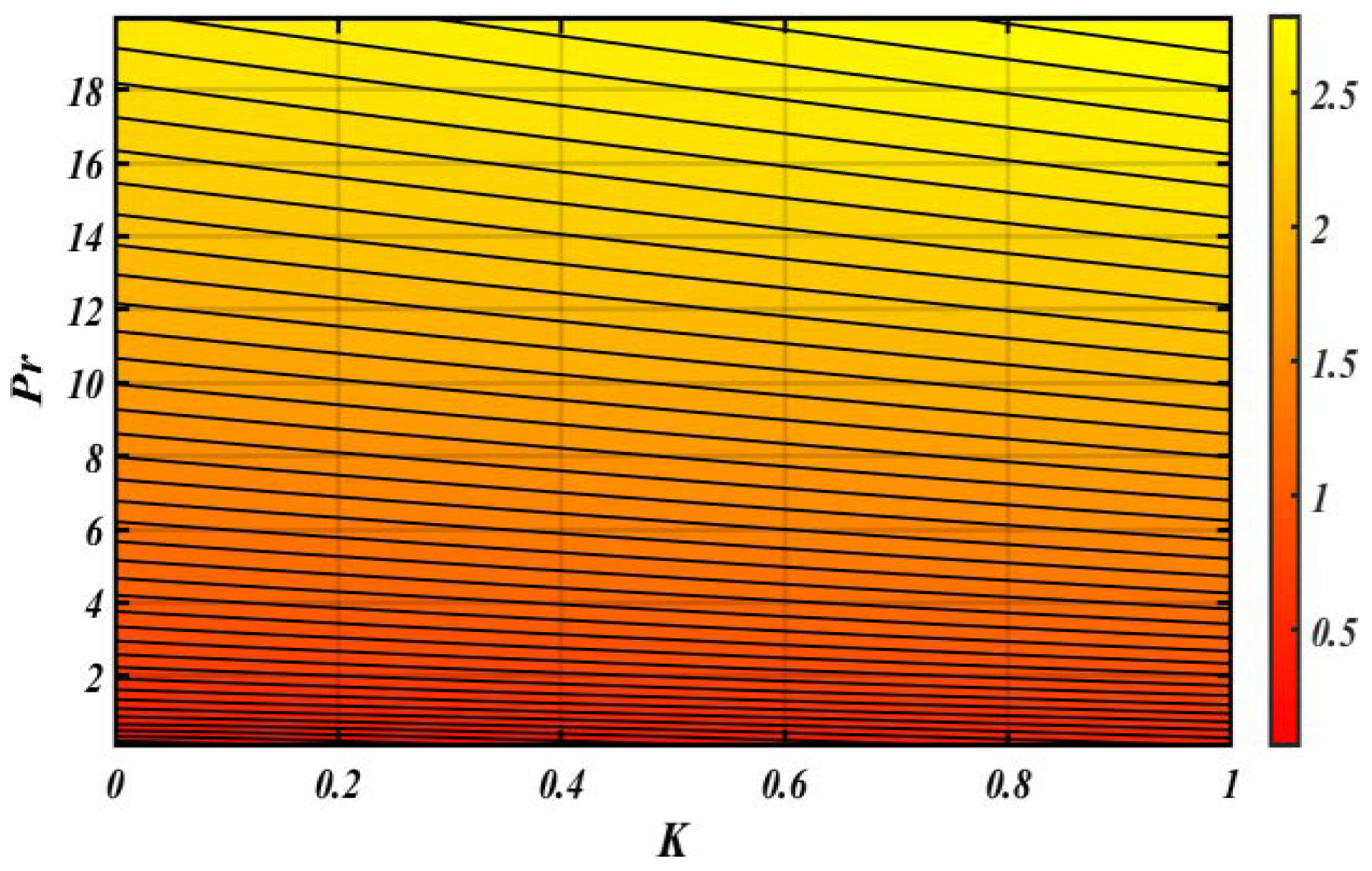
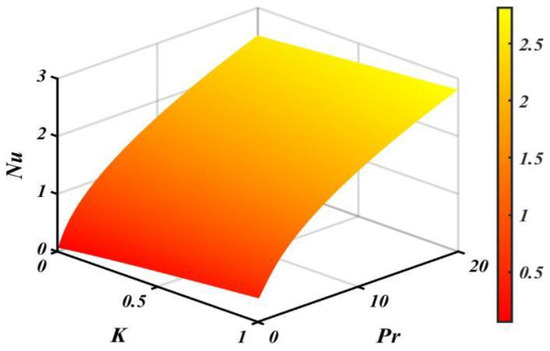
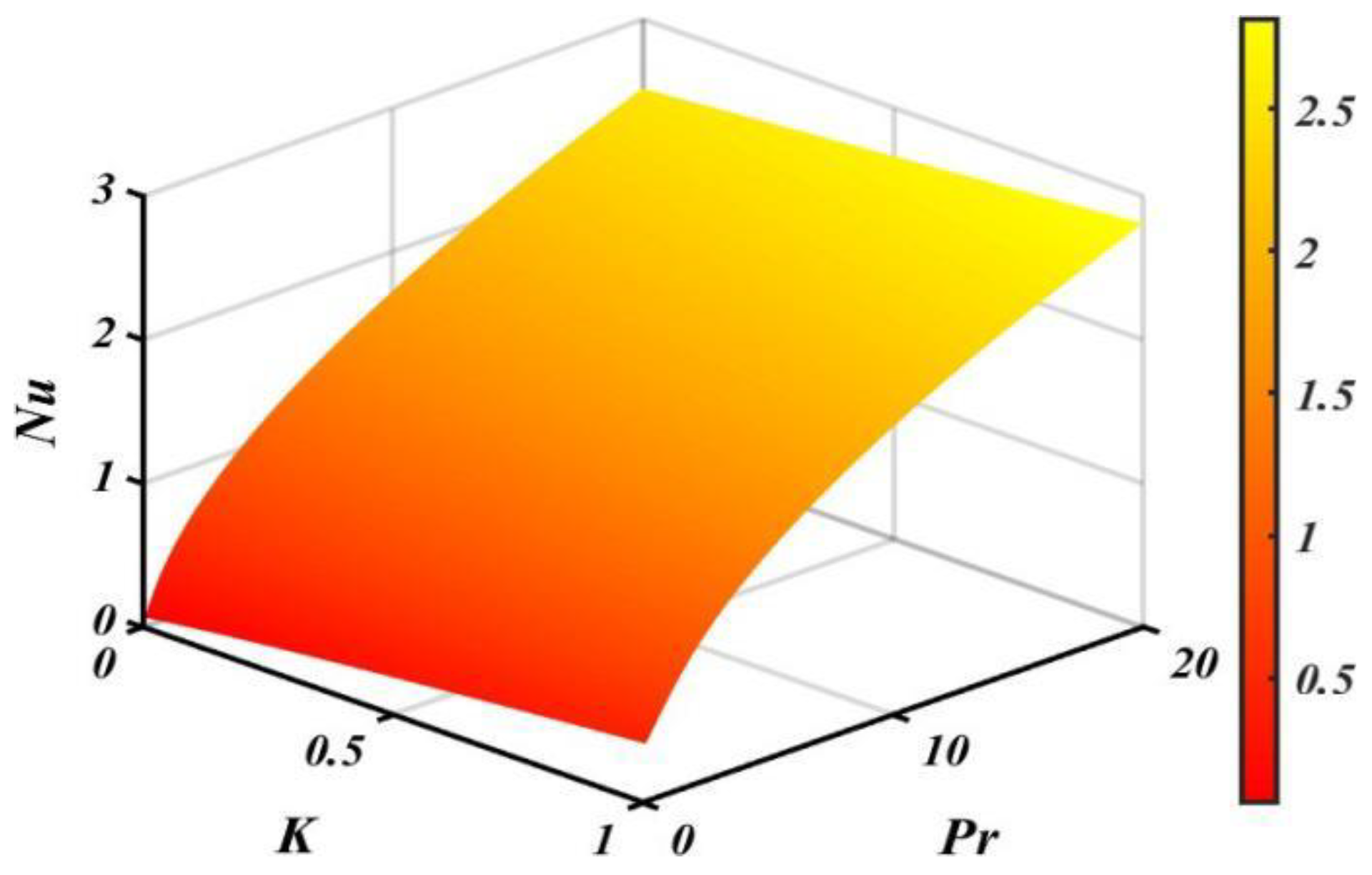
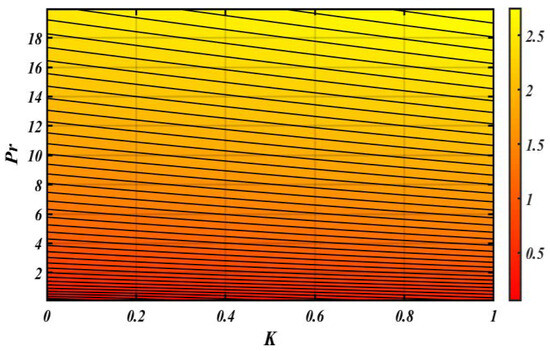
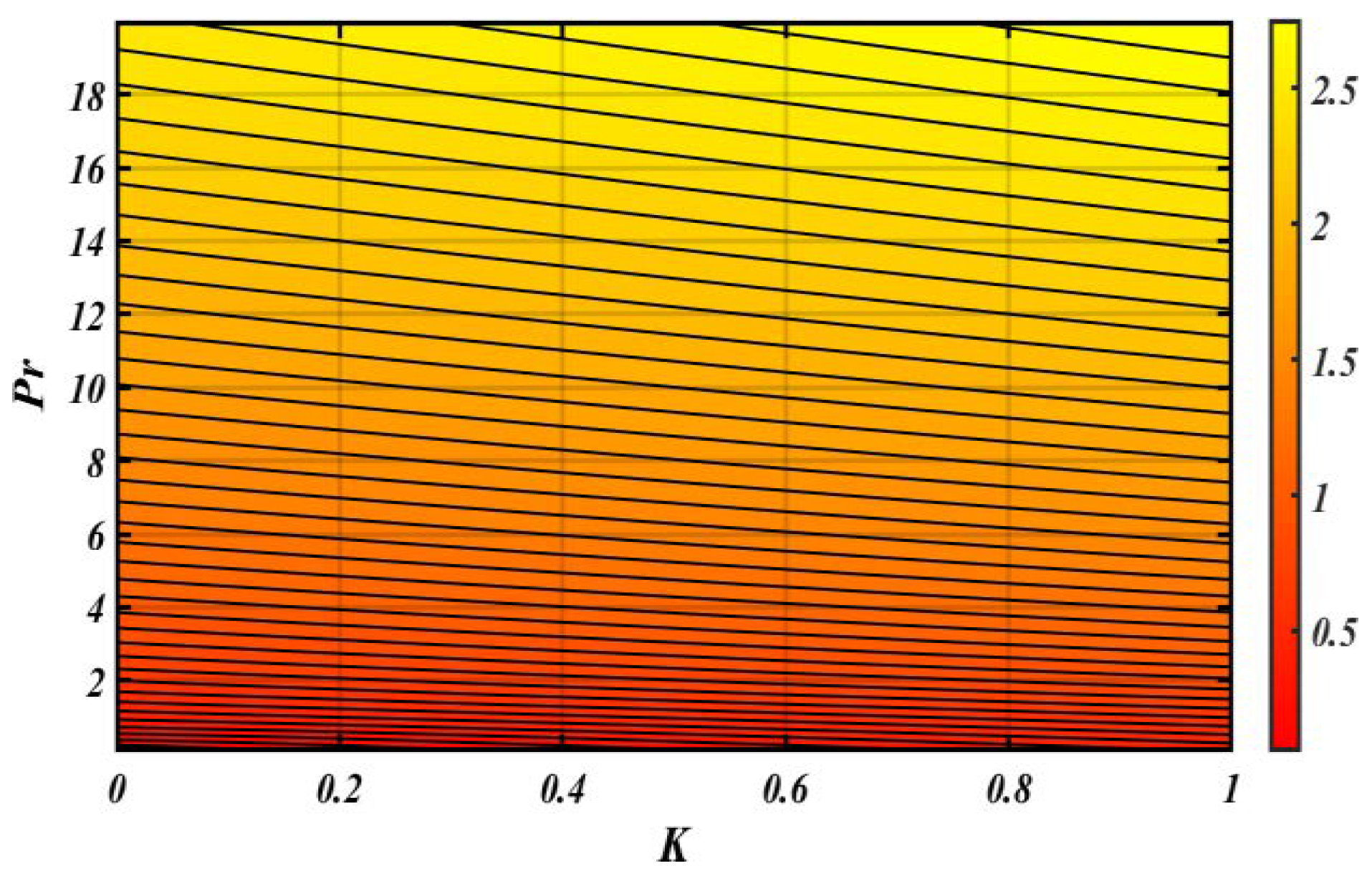
The influence of the variable viscosity parameter θe on the temperature profile can be observed in Figure 17 and Figure 18, indicating that the temperature profile (unlike the velocity profiles in Figure 2 and Figure 3) increases for θe > 0, while it decreases for θe < 0. Physically, the thermal BL becomes thicker for θe > 0, which reduces the temperature gradient. Conversely, for θe < 0, the thermal BL gets thinner, resulting in a steeper temperature gradient near the surface. Figure 19 demonstrates the impact of ϵ on the temperature profile. It is noticed that higher values of ϵ result in increased temperature profiles; however, these profiles are greater for θe < 0 compared to θe > 0. The impact of K on the temperature profile, depicted in Figure 20, is similar to that of the velocity profile (see Figure 5). The temperature profile shows an increasing trend with higher values of K. However, these profiles become more pronounced when θe < 0 compared to θe > 0. Figure 21 illustrates the effect of the Prandtl number on the temperature profiles. It indicates that higher values of Pr lead to a decrease in the temperature profiles; however, these profiles are more distinct for θe < 0 compared to θe > 0. The impact of the variable viscosity parameter θe on the Nusselt number is depicted in Figure 22. Variations in the Nusselt number are not that significant for both θe > 0 and θe < 0; however, it exhibits a slight decrease for θe > 0 and shows an increasing trend for θe < 0. Physically, θe > 0 signifies an increase in viscosity, leading to a thicker thermal BL due to the reduced motion of the fluid, which may limit heat transfer. For θe < 0, a decrease in viscosity allows for higher fluid velocities, resulting in a thinner thermal BL and enhancing convective heat transfer. Figure 23 shows the effect ϵ on the Nusselt number, reflecting that the heat transfer rate decreases with increasing values of ϵ for both θe > 0 and θe < 0. Higher values of ϵ contribute to developing a thicker thermal BL (as evident from Figure 19), providing a larger region where the temperature gradient is lower, thus a reduced heat transfer rate. Figure 24 demonstrates the influence of the curvature parameter K on the Nusselt number Nu, indicating that heat transfer is enhanced for a larger curvature of the flow geometry for both θe > 0 and θe < 0. However, for θe > 0, the heat transfer is greater than that for θe < 0. Figure 25 illustrates the behavior of the Nusselt number in response to variations in the Prandtl number, which increases heat transfer for both θe > 0 and θe < 0. For fluids with a high Prandtl number, the thermal BL is thinner, leading to steeper temperature profiles and, as a result, an increase in the Nusselt number. The surface and contour plots of the Nusselt number against the parameter θe (both positive and negative), ϵ, K, and Pr are shown in Figure 26, Figure 27, Figure 28, Figure 29, Figure 30, Figure 31, Figure 32 and Figure 33. These results demonstrate that the impact of these parameters is analogous to what was observed in the bar plots for the Nusselt number presented in the previous results.
Figure 17.
Influence of variable viscosity parameter θe > 0 on temperature profile at K = 0.5, ϵ = 0.5, Pr = 0.71.
Figure 18.
Influence of variable viscosity parameter θe < 0 on temperature profile at K = 0.5, ϵ = 0.5, Pr = 0.71.
Figure 19.
Influence of variable thermal conductivity parameter ϵ on temperature profile for θe = 5.62 (solid lines) and θe = −0.37 (dashed lines) at K = 0.5, Pr = 0.71.
Figure 20.
Influence of curvature parameter K on temperature profile for θe = 5.62 (solid lines) and θe = −0.37 (dashed lines) at ϵ = 0.5, Pr = 0.71.
Figure 21.
Influence of Prandtl number Pr on temperature profile for θe = 5.62 (solid lines) and θe = −0.37 (dashed lines) at K = 0.5, ϵ = 0.5.
Figure 22.
Influence of variable viscosity parameter θe on Nusselt number Nu at K = 0.5, ϵ = 0.5, Pr = 0.71.
Figure 23.
Influence of variable thermal conductivity parameter ϵ on Nusselt number Nu for θe = 5 (a) and θe = −5 (b) at K = 0.5, Pr = 0.71.
Figure 24.
Influence of curvature parameter K on Nusselt number Nu for θe = 5 (a) and θe = −5 (b) at ϵ = 0.5, Pr = 0.71.
Figure 25.
Influence of Prandtl number Pr on Nusselt number Nu for θe = 5 (a) and θe = −5 (b) at K = 0.5, ϵ = 0.5.
Figure 26.
Surface plot of Nu against ϵ and θe > 0 at K = 0.5 and Pr = 0.71.
Figure 27.
Contour plot of Nu against ϵ and θe > 0 at K = 0.5 and Pr = 0.71.
Figure 28.
Surface plot of Nu against ϵ and θe < 0 at K = 0.5 and Pr = 0.71.
Figure 29.
Contour plot of Nu against ϵ and θe < 0 at K = 0.5 and Pr = 0.71.
Figure 30.
Surface plot of Nu against K and Pr at θe = 5 and ϵ = 0.5.
Figure 31.
Contour plot of Nu against K and Pr at θe = 5 and ϵ = 0.5.
Figure 32.
Surface plot of Nu against K and Pr at θe = −5 and ϵ = 0.5.
Figure 33.
Contour plot of Nu against K and Pr at θe = −5 and ϵ = 0.5.
Conclusion
The application of temperature-dependent viscosity and thermal conductivity on the laminar transport process around a moving cone-shaped body of revolution has been investigated numerically. In this context, the flow and heat transfer characteristics have been analyzed considering the influence of the viscosity parameter θe, thermal conductivity parameter ϵ, curvature parameter K, and Prandtl number Pr, respectively. The key observations are listed below:
- For θe > 0, the velocity profiles reduce while the temperature profiles elevate. In contrast, velocity profiles increase and temperature profiles decrease when θe > 0. As a result, the skin-friction coefficient decreases for θe > 0 but exhibits an increasing trend for θe < 0. While the parameter θe does not significantly influence the Nusselt number, however, there is a slight increase when θe < 0 and a decrease for θe > 0.
- Higher values of ϵ lead to an increase in velocity profiles for θe > 0 while decreasing them when θe < 0. The temperature profiles rise with higher values of ϵ; however, they are more pronounced for θe < 0 compared to θe > 0. Consequently, the skin-friction coefficient increases with higher values of ϵ when θe > 0 and decreases for θe < 0. However, the variation in the skin-friction coefficient with increasing values of ϵ is relatively small. The Nusselt number decreases with higher values of ϵ for both θe > 0 and θe < 0.
- The velocity and temperature profiles increase for higher values of K, which subsequently leads to higher values of the skin-friction coefficient and Nusselt number.
- The temperature profiles decrease with higher values of the Prandtl number Pr, leading to an increase in the Nusselt number.
References
- Sakiadis, B. C. Boundary-layer behavior on continuous solid surfaces: I. Boundary-layer equations for two-dimensional and axisymmetric flow. AIChE Journal 1961, 7(1), 26–28. [Google Scholar] [CrossRef] [Scilit]
- Sakiadis, B. C. Boundary-layer behavior on continuous solid surfaces: II. The boundary layer on a continuous flat surface. AIChE Journal 1961, 7(2), 221–225. [Google Scholar] [CrossRef] [Scilit]
- Sakiadis, B. C. Boundary-layer behavior on continuous solid surfaces: I. Boundary-layer equations for two-dimensional and axisymmetric flow. AIChE Journal 1961, 7(3), 467–472. [Google Scholar] [CrossRef] [Scilit]
- Mangler, W. Boundary layers on bodies of revolution in symmetrical flow, Ber. aerodyn. VersAnst., Gottingen, 45/A/17, (1945).
- Seban, R.A.; Bond, R. Skin-friction and heat transfer characteristics of a laminar boundary-layer on a cylinder in axial incompressible flow. J. aeronaut. Sci. 1951, 18, 671–675. [Google Scholar] [CrossRef] [Scilit]
- Blasius, H. Grenzschichten in flu¨ssigkeiten mit kleiner reibung. Z. Math. u. Phys. 56, 1908.
- Kelly, H. R. A note on the laminar boundary layer on a circular cylinder in axial incompressible flow. J. Aero. Sci. 1954, 21(9), 634. [Google Scholar] [CrossRef] [Scilit]
- Mark, R. M. Laminar boundary layers on slender bodies of revolution in axial flow, GALCIT Hypersonic Wind Tunnel Memo., No. 21, (1954).
- Glaurt, M.B.; Lighthill, M.J. The axisymmetric boundary-layer on a long thin cylinder. Proc. R. Soc. London. A 1955, 230, 188–203. [Google Scholar] [CrossRef] [Scilit]
- Pohlhausen, K. Zur näherungsweisen integration der differentialgleichung der laminaren reibungsschicht. ZAMM 1921, 1. [Google Scholar] [CrossRef] [Scilit]
- Stewartson, K. The asymptotic boundary layer on a circular cylinder in axial incompressible flow. Q. App. Math. 1955, 13, 113–122. [Google Scholar] [CrossRef] [Scilit]
- Lee, L. L. Boundary layer over a thin needle. Phys. Fluids 1967, 10, 820–822. [Google Scholar] [CrossRef] [Scilit]
- Cebeci, T.; Na, T. Y. Laminar free-convection heat transfer from a needle. Phys. Fluids 1969, 12, 463–465. [Google Scholar] [CrossRef] [Scilit]
- Wei, M. H. Asymptotic boundary-layer over a slender body of revolution in axial compressible flow. AIAA J. 1965, 3(5), 809–816. [Google Scholar] [CrossRef] [Scilit]
- Cebeci, T. Laminar-free-convective-heat transfer from the outer surface of a vertical slender circular cylinder, Int. Heat Transf. Conf. Digit. Libr., Begel House, 1974.
- Cooper, R.D. and Tulin, M. P. The Laminar flow about very slender cylinders in axial motion, including the effect of pressure-gradients and unsteady motions, David Taylor Model. Basin, Rep. 838, NS 715-102, (1953).
- Probstein, R. F.; Elliot, D. The transverse curvature effect in compressible axially symmetric laminar boundary layer flow. J. Aeronaut. Sci. 1956, 23, 208–224. [Google Scholar] [CrossRef] [Scilit]
- Mehmood, A.; Usman, M. TVC effects on flow separation on slender cylinders. Thermophys. Aeromech. 2018, 25, 507–513. [Google Scholar] [CrossRef] [Scilit]
- Mehmood, A.; shah, B. H.; Usman, M.; Raza, I. Analysis of laminar boundary-layer separation in retarded flow over bodies of revolution. Can. J. Phys. 2022, 100, 86–95. [Google Scholar] [CrossRef] [Scilit]
- Mehmood, A.; Shah, B. H. Analyzing TVC effects on seizing flow due to retarded motion of a continuous cylinder. Int. J. Fluid Mech. Res. 2021, 48, 27–40. [Google Scholar] [CrossRef] [Scilit]
- Mehmood, A.; Shah, B. H.; Raza, I. Combined effects of surface sharpness and transverse curvature on thermal transport in separating flow region. Phys. Scr. 2023, 98, 035705. [Google Scholar] [CrossRef] [Scilit]
- Shah, B.H.; Mehmood, M.; Ayub, M.; Raza, I. Theoretical analysis of convective transport over a slender body of revolution. Numer. Heat Transf. A: Appl. 2023, 85(1), 137–153. [Google Scholar] [CrossRef] [Scilit]
- Awais, M.; Mehmood, A. Evaluating the impact of surface transverse curvature on boundary layer flows: An extended Thwaites integral approach. Int. J. Fluid Mech. 2025, 52(2), 79–101. [Google Scholar] [CrossRef] [Scilit]
- Schuh, H. The solution of the laminar boundary layer equations for the flat plate for velocity and temperature fields for variable physical properties and for the diffusion field at high concentration, NACA TM1275, (1950).
- Seban, R. A. The laminar boundary layer of a liquid with variable viscosity. In Boelter anniversary volume heat transfer, thermodynamics and education; Johnson, H. A., Ed.; 1964; pp. 319–329. [Google Scholar]
- Poots, G.; Raggett, G. I. Theoretical results for variable property, laminar boundary layers in water. Int. J. Heat Mass Transf. 1967, 10, 597–610. [Google Scholar] [CrossRef] [Scilit]
- Herwig, H.; Wickern, G. The effect of variable properties on laminar boundary layer flow. Wärme-und Stoffübertragung 1986, 20, 47–57. [Google Scholar] [CrossRef] [Scilit]
- Falkner, V. M. and Skan, S. W. Some approximate solutions of the boundary layer equations, Res. Coun. Rep. and Mem. no. 1314, (1930).
- Herwig, H. An asymptotic approach to compressible boundary layer flow. Int. J. Heat Mass Transf. 1987, 30, 59–68. [Google Scholar] [CrossRef] [Scilit]
- Shang, D. Y.; Wang, B. X. Effect of variable thermophysieal properties on laminar free convection of gas. Int. J. Heat Mass Transf. 1990, 33, 1387–1395. [Google Scholar]
- Thakar, H. S.; Nitu, S.; Pop, I. Boundary layer flow due to a moving plate: variable fluid properties. Acta Mechanica 1991, 90, 37–42. [Google Scholar] [CrossRef] [Scilit]
- Andersson, H. I.; Aarseth, J. B. Sakiadis flow with variable fluid properties revisited. Int. J. Eng. Sci. 2007, 45, 554–561. [Google Scholar] [CrossRef] [Scilit]
- Mukhopadhyay, S.; Layek, G.C. Effects of variable fluid viscosity on flow past a heated stretching sheet embedded in a porous medium in presence of heat source/sink. Meccanica 2012, 47, 863–876. [Google Scholar] [CrossRef] [Scilit]
- Rangi, R. R.; Ahmad, N. Boundary layer flow past a stretching cylinder and heat transfer with variable thermal conductivity. Appl. Math. 2012, 3, 205–209. [Google Scholar] [CrossRef]
- Umavathi, J. S.; Shermet, M. A.; Mohiuddin, S. Combined effect of variable viscosity and thermal conductivity on mixed convection flow of a viscous fluid in a vertical channel in the presence of first order chemical reaction. Eur. J. Mech. B Fluids 2016, 58, 98–108. [Google Scholar] [CrossRef] [Scilit]
- Parsad, K. V.; Vajravelu, K.; Datti, P. S. Mixed convection heat transfer over a non-linear stretching surface with variable fluid properties. Int. J. Non-linear Mech. 2010, 45(3), 320–330. [Google Scholar] [CrossRef] [Scilit]
- Naganthran, K.; Mustafa, M.; Mushtaq, A.; Nazar, R. Dual solutions for fluid flow over a stretching/shrinking rotating disk subject to variable fluid properties. Physica A 2020, 56, 124773. [Google Scholar] [CrossRef] [Scilit]
- Akbar, S. S.; Mustafa, M. Unsteady flow over a rotating and vertically moving disk with variable fluid properties. Proc. Inst. Mech. Eng., Part E 2022, 237(5), 1679–1687. [Google Scholar] [CrossRef] [Scilit]
- Shakeel, A.; Mustafa, M. Assessment of Bödewadt flow over a stretchable porous surface with variable physical properties: A comparative study. Numer. Heat Transf. B-Fund. 2023, 1–14. [Google Scholar]
- Afridi, M. I.; Wakif, A.; Alanazi, A. K.; Chen, Z. M.; Ashraf, M. U.; Qasim, M. A comprehensive entropic scrutiny of dissipative flows over a thin needle featured by variable thermophysical properties. Waves Random Complex Media 2025, 35(2), 3114–3130. [Google Scholar] [CrossRef] [Scilit]
- Qasim, M.; Afridi, M. I.; Wakif, A.; Saleem, S. Influence of variable transport properties on nonlinear radioactive Jeffrey fluid flow over a disk: utilization of generalized differential quadrature method. Arab. J. Sci. Eng. 2019, 44(6), 5987–5996. [Google Scholar] [CrossRef] [Scilit]
- Qasim, M.; Riaz, N.; Lu, D.; Afridi, M. I. Flow over a needle moving in a stream of dissipative fluid having variable viscosity and thermal conductivity. Arab. J. Sci. Engr. 2021, 44(6), 7295–7302. [Google Scholar] [CrossRef] [Scilit]
- Qasim, M.; Ali, Z.; Farooq, U.; Lu, D. Investigation of entropy in two-dimensional peristaltic flow with temperature dependent viscosity, thermal and electrical conductivity. Entropy 2020, 22(2), 200. [Google Scholar] [CrossRef] [Scilit]
- Manjunatha, G.; Rajashekhar, C.; Prasad, K. V.; Vaidya, H. Peristaltic flow of a Jeffery fluid over a porous conduit in the presence of variable liquid properties and convective boundary. Int. J. Thermofluid Sci. Tech. 2019, 6, 19060201. [Google Scholar] [CrossRef] [Scilit]
- Nayak, M. K.; Hakeem, A. A.; Ganga, B. Influence of non-uniform heat source/sink and variable viscosity on mixed convection flow of third grade nanofluid over an inclined stretched Riga plate. Int. J. Thermofluid Sci. Tech. 2019, 6(4), 19060401. [Google Scholar] [CrossRef] [Scilit]
- Gudekote, M.; Baliga, D.; Choudhari, R.; Vaidya, H.; Prasad, K. V.; Makinde, O. D. Influence of variable viscosity and wall properties on the peristalsis of Jeffrey fluid in a curved channel with radial magnetic field. Int. J. Thermofluids. Sci. Tech. 2020, 7(2), 1–16. [Google Scholar] [CrossRef] [Scilit]
- Gangadharaiah, Y. H.; Nagarathnamma, H.; SP, S.; Ananda, K. Combined impact of variable viscosity and throughflow effects on the onset of convection in an anisotropic porous layer. Int. J. Thermofluid Sci. Tech. 2022, 9(3), 090303. [Google Scholar] [CrossRef] [Scilit]
- Mehmood, A.; Mehmood, H.; Raza, I.; Awais, M.; Usman, M. Flow and thermal performance of nanofluids on a rotating porous disk with forced flow. Int. J. Thermofluid Sci. Tech. 2025, 12(1), 120103. [Google Scholar] [CrossRef] [Scilit]
- Gangadharaiah, Y. H.; Nagarathnamma, H. Influence of variable viscosity and gravity fluctuation on double diffusive convection in a fluid layer with boundary slab of finite conductivity. Int. J. Thermofluid Sci. Tech. 2023. [Google Scholar]
- Rafiq, T.; Mustafa, M.; Farooq, M. A. Numerical assessment of Bödewadt flow and heat transfer over a permeable disk with variable fluid properties. Phys. A: Stat. Mech. Appl. 2019, 534, 122138. [Google Scholar] [CrossRef] [Scilit]
- Mehmood, A. Viscous flows: Stretching and Shrinking of surfaces, Springer, (2017).
- Lai, F. C.; Kulacki, F. A. The effect of variable viscosity on convective heat transfer along a vertical surface in a saturated porous medium. Int. J.Heat Mass Transf. 1990, 33, 1028–1031. [Google Scholar] [CrossRef] [Scilit]
- Pop, I.; Gorla, R. S. R.; Rashidi, M. The effect of variable viscosity on flow and heat transfer to a continuous moving flat plate. Internat. J. Engr. Sci. 1992, 30, 1–6. [Google Scholar] [CrossRef] [Scilit]

Copyright © 2022. This article is licensed under a CC BY-NC-ND 4.0.