


Abstract
Background: Long-term excessive alcohol use can result in persistent cognitive impairments that negatively affect daily functioning and quality of life. It remains unclear whether cognitive recovery contributes to functional improvement following sustained abstinence. This study examined changes in cognition, day-to-day functioning, and quality of life in abstinent patients with alcohol use disorder (AUD) and (suspected) alcohol-induced neurocognitive disorder. Methods: Assessments were conducted after at least six weeks of abstinence (T0) and at treatment completion (T1; median follow-up 3.1, IQR = 3.8). Of the total sample of 245 patients, 143 had follow-up data, and 69 completed the full assessment battery at both time points. Longitudinal changes were examined using mixed-effects models. Results: Significant improvements over time were observed for the MoCA (β = 0.10), CFQ (β = -0.13), MANSA-12 (β = 0.11), and PCRS (β = 0.09; all FDR-adjusted p < 0.05). Greater improvements in MoCA scores were associated with steeper improvements in MANSA-12 scores (β = 0.17, p < 0.03), but not with changes in HoNOS-65+ or PCRS scores. Discussion: While sustained abstinence was associated with functional improvements over time, cognitive recovery appeared to be particularly relevant to improvements in perceived quality of life. Conclusion: Our findings show that outcome measurement during recovery provides relevant information, which may help to tailor ongoing interventions and future treatment selection in individuals with alcohol-related cognitive disorders.
1. Introduction
Long-term and excessive alcohol use is frequently associated with a range of cognitive impairments that may persist well beyond the acute phases of intoxication and withdrawal [1,2]. Such deficits are usually referred to as alcohol-related cognitive impairment or alcohol-induced neurocognitive disorder [3,4] and may have a profound impact on daily functioning and quality of life. In particular, problems with executive functioning, memory, processing speed, and the acquisition of new information may compromise an individual’s ability to perform everyday activities, maintain functional independence, and engage effectively in social and occupational roles.
Although sustained abstinence can be accompanied by significant cognitive recovery [2,5], some individuals continue to experience persistent cognitive difficulties even after prolonged periods of sobriety. Moreover, the exact extent and course of cognitive recovery remain uncertain, and the mechanisms underlying these processes are still not fully understood [6]. In addition, little is known about whether and to what extent cognitive recovery translates into meaningful improvements in everyday life. This relationship is likely complex, given that everyday functioning relies on multiple cognitive abilities, with different cognitive domains contributing to different activities [7,8]. A better understanding of individual cognitive recovery may therefore provide insight into a patient’s functional capacities and support needs and may ultimately help to inform rehabilitation goals and interventions.
Understanding the link between cognitive recovery and everyday functioning is relevant as successful treatment outcomes are increasingly viewed as extending beyond symptom reduction, relapse prevention, and cognitive performance alone. Accordingly, treatment evaluation should encompass aspects that are meaningful to patients and their caregivers, including psychosocial functioning, participation, and overall well-being [9]. This broader perspective is particularly important in the context of cognitive recovery, as improvements in cognitive test performance alone may not necessarily capture how patients experience their functioning and well-being in everyday life. For example, Dewitte and colleagues [10] found that quality of life in patients with severe cognitive disorders was more strongly related to factors such as motivation, enjoyment, energy, and social functioning than to memory performance per se. Patient-centered outcome measures may overcome this gap and have been implemented in mental health care (including addiction care [11]) as well as in neuropsychological rehabilitation [12]. Findings from studies on patient-centered outcome measures, including patient-reported outcome measures (PROMs), in addiction care show that these are clinically meaningful measures with a strong predictive validity [13], which may also benefit addiction treatment, e.g., when outcomes are used to inform the patients themselves [14,15], referred to as Measurement-Based Care (MBC) [16]. However, evidence using trajectories of PROMs to better understand the relationship between cognition, everyday functioning, and quality of life is lacking to date.
In this context, Routine Outcome Monitoring (ROM) as part of MBC may offer a valuable means of capturing aspects of functioning and well-being that are directly relevant to patients and their caregivers and extend beyond cognitive performance alone. ROM is widely used to evaluate and improve treatment effectiveness by systematically assessing patients’ treatment outcomes over time. ROM data can be used to provide feedback to clinicians and patients, facilitating timely treatment adjustment, identifying patients at risk of poor outcomes, or supporting shared decision-making about treatment goals and progress between clinicians and their patients [15,16,17,18]. A broad range of validated measures are available for this purpose, enabling the repeated assessment of clinical symptoms, functioning, quality of life, and recovery-related outcomes [19]. Commonly used instruments in addiction care include the Measurements in the Addictions for Triage and Evaluation (MATE) [20] for assessing substance use and related problems, generic symptom measures such as the Brief Symptom Inventory (BSI) [21], as well as quality-of-life instruments such as the Manchester Short Assessment of Quality of Life (MANSA) [22].
Despite the growing availability of ROM data in addiction care, studies have demonstrated that these data remain insufficiently utilized both to provide feedback to patients and to evaluate treatment effectiveness. A recent scoping review [23] concluded that, while ROM is a promising tool for tracking and communicating treatment progress in addiction care, its implementation and its contribution to meaningful patient outcomes require further investigation. Moreover, the outcome measures routinely used in addiction treatment settings may be less suitable for individuals with (suspected) alcohol-related neurocognitive impairments. In particular, deficits in memory, executive functioning, and insight may compromise the accuracy (and thus the validity) of self-reported functioning and quality of life.
In the present study, we first examined changes over time in cognitive functioning, everyday functioning, and quality of life among abstinent individuals with AUD with or without cognitive disorder (ranging from no deficits to severe neurocognitive disorder, including Korsakoff’s syndrome [KS]). Second, we examined whether baseline cognitive functioning and cognitive recovery over time were associated with improvements in everyday functioning and quality of life. To this end, we used ROM data collected at treatment start and at treatment completion. Given the limitations of standard outcome measures for individuals with co-occurring alcohol-related neurocognitive impairments, a tailored ROM battery was employed to assess multiple domains of recovery.
2. Materials and Methods
2.1. Participants
Patients who were admitted to the Center of Excellence for Korsakoff and Alcohol-Related Cognitive Disorders in Venray, between January 2022 and October 2025, were included in this study. All participants met the DSM-5-TR criteria for AUD [3]. The study population comprised patients with probable (mild to major) alcohol-related cognitive impairments, including KS, at the time of referral. Neurocognitive diagnoses were established through a comprehensive multidisciplinary assessment, including documentation of previous episodes of Wernicke encephalopathy, extensive neuropsychological evaluation, neurological examination, brain neuroimaging, and clinical observations. Prior to assessment, all patients received adequate thiamine supplementation. In addition, all participants were sufficiently proficient in the Dutch language.
Data were collected as part of the ROM. Participants underwent assessments after a minimum of six weeks of continuous alcohol abstinence verified by urinalysis (baseline: T0), and again at treatment completion (T1). The interval between assessments varied according to individual treatment duration (Median = 3.1 months; IQR = 3.8). A total of n = 245 patients were enrolled in the study, of whom n = 143 (58.3%) had any follow-up measure available, and n = 59 (24.1%) completed the full assessment battery at both time points. Education level was classified into seven categories based on the Dutch educational system [24]. The mean age of the sample was 61.8 years (SD = 9.6), and 62 participants (30%) were women. Educational attainment was moderate overall, with a median education level of 5.0 (IQR = 2.0). 34.8% of the patients were diagnosed with AUD only (i.e., no cognitive impairments), 31.4% with alcohol-related cognitive impairments not meeting the criteria for KS (ARCI), and 24.0% met the criteria for KS. The rest of the patients had dementia due to a neurodegenerative disease (5.4%) or another diagnosis (4.4%). An overview of the demographic and clinical characteristics of the study sample is shown in Table 1.
Table 1.
Demographic and clinical characteristics of the included sample (n = 245).
2.2. Instruments
The Montreal Cognitive Assessment (MoCA) [25] was included as a brief cognitive screening instrument. The MoCA assesses several domains of cognition, including attention, executive functioning, memory, language, visuospatial abilities, abstraction, and orientation. The total score ranges from 0 to 30, with higher scores indicating better overall cognitive functioning; scores below 26 are generally considered indicative of cognitive impairment. The MoCA has shown to be a useful screening measure for detecting cognitive impairment in addiction care and has demonstrated sensitivity to cognitive changes over the course of inpatient treatment in patients with AUD only, ARCI, and KS [26,27].
Subjective cognitive complaints were evaluated using the Cognitive Failures Questionnaire (CFQ) [28], a 25-item self-report measure of everyday cognitive lapses in attention, memory, perception, and action in daily life. Items are rated on a 5-point Likert scale ranging from 0 (“never”) to 4 (“very often”). Total scores range between 0 and 100, and higher scores indicate greater subjective cognitive difficulties. The CFQ has demonstrated good reliability and validity across both clinical and non-clinical populations and is widely used as a measure of subjective cognitive functioning [28,29].
Everyday functioning was assessed using the informant version of the Patient Competency Rating Scale (PCRS) [30]. The PCRS was developed for individuals with traumatic brain injury to assess perceived competence across multiple domains, including activities of daily living (ADL), cognitive skills, interpersonal functioning, and emotional functioning. The PCRS consists of 30 items, rated on a Likert scale ranging from 1 to 5. Total scores range from 30 to 150, with higher scores indicating better everyday functioning. This study only includes the proxy-version of the PCRS that was completed by the patient’s primary responsible nurse. Previous research has demonstrated good psychometric properties in acquired brain injury, including good internal consistency and test–retest reliability [31].
The Health of the Nation Outcome Scales for Older Adults (HoNOS 65+) [32] is a clinician-rated instrument designed to assess the severity of mental health problems and psychosocial functioning. The HoNOS 65+ was developed as an extension of the original Health of the Nation Outcome Scales (HoNOS) [33] with the aim to improve the applicability of the instrument to older adults and individuals with cognitive impairments. The HoNOS is widely used in mental health care both as a treatment outcome measure and as part of ROM. Also, given its close conceptual overlap with the HoNOS Acquired Brain Injury (HoNOS-ABI), the HoNOS 65+ was considered the most appropriate measure for evaluating overall functioning in patients with alcohol-related neurocognitive disorder. The scale consists of 12 items covering behavioral problems, cognitive and physical impairments, psychiatric symptoms, and social functioning, with higher scores indicating greater levels of disability and psychopathology. The HONOS 65+ was completed by the primary responsible nurse. The HoNOS 65+ has demonstrated satisfactory psychometric properties in older adult psychiatric populations, including adequate inter-rater reliability, concurrent validity, and sensitivity to change [32,34]. Although studies have reported limitations regarding the internal consistency and factor structure of the total score, the instrument has been shown to possess good clinical utility and discriminative validity in routine mental health care settings [35].
Quality of life was measured using the Manchester Short Assessment of Quality of Life (MANSA-12) [22]. The MANSA-12 is a self-report measure that evaluates overall life satisfaction across several life domains (i.e., social relationships, physical and mental health, financial situation, leisure activities, and living conditions). The instrument consists of 12 items, rated on a 7-point Likert scale ranging from 1 to 7, with higher scores indicating better perceived quality of life. The MANSA has demonstrated satisfactory psychometric properties, including adequate internal consistency, good test–retest reliability, and good convergent validity [22,36].
2.3. Procedure
All instruments and all data were part of the ROM protocol of the Center of Excellence for Korsakoff and Alcohol-Related Cognitive Disorders; as all assessments were administered within routine clinical care, participation in the study did not impose any additional burden on the patients. In addition, ROM data were linked to demographic and clinical information routinely collected and stored in the center’s electronic data capture system (Castor EDC). All data were pseudonymized prior to analysis.
The MoCA was administered by trained psychologists and psychology technicians, whereas informant-based measures were completed by the patient’s primary responsible nurse.
Written informed consent for the use of routinely collected clinical data for scientific research was obtained from all participants prior to inclusion. This study was preregistered on the Open Science Framework (https://osf.io/ba8re, accessed on 29 July 2026). The use of anonymized ROM data for scientific research was approved by the local ethics committee of Vincent van Gogh Institute for Psychiatry (CWOP #2026-JE/HR/ts/009, date of approval 31 August 2026).
2.4. Data Analysis
Baseline demographic and clinical characteristics were compared between patients with follow-up data available and patients with no follow-up data available due to dropout using analysis of variance or chi-square tests where appropriate.
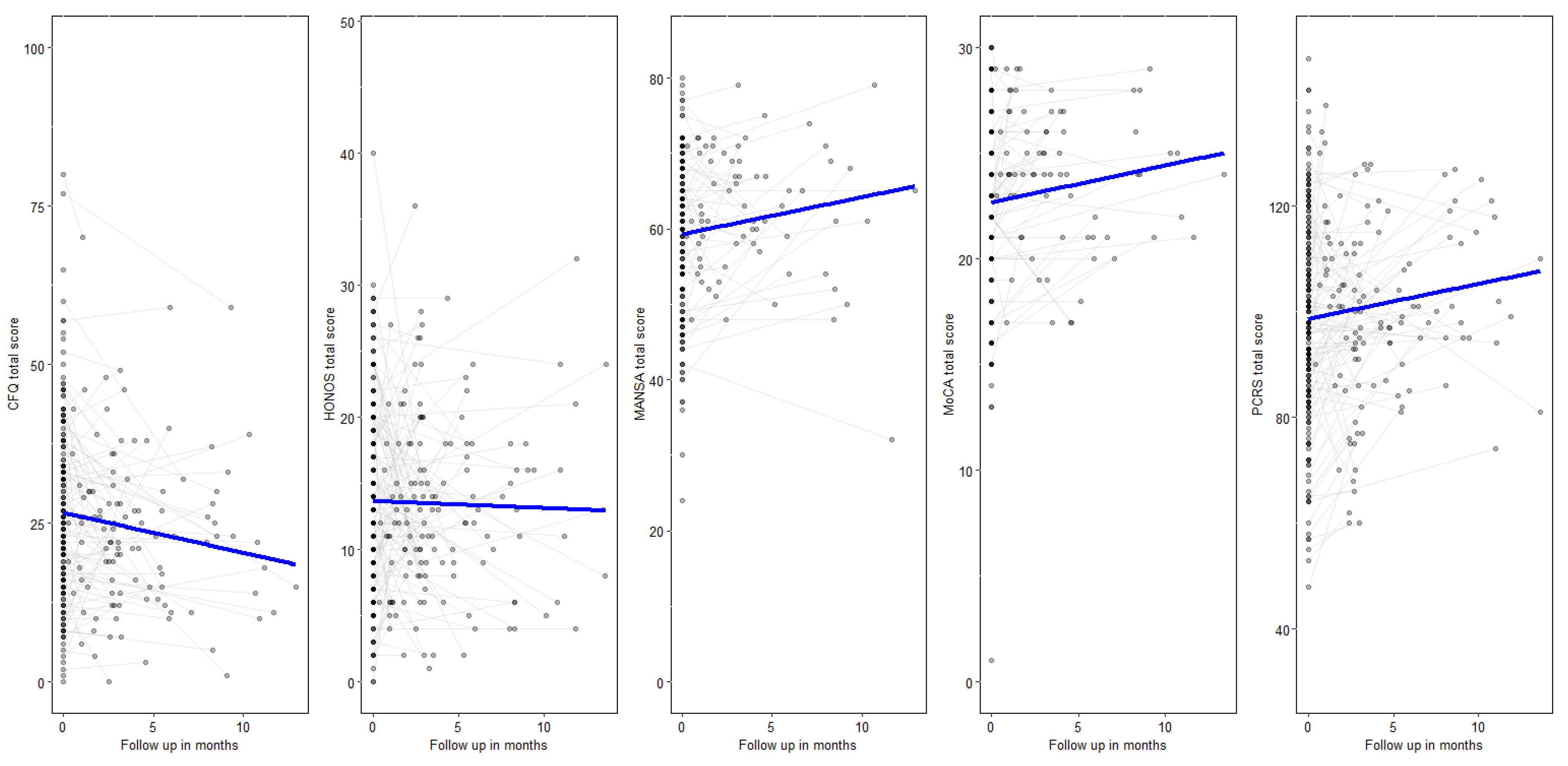
We plotted individual trajectories of the CFQ, HoNOS 65+, MANSA-12, PCRS, and MoCA scores over time for each patient and added model-based trends to the graphs for descriptive purposes. Next, we examined change over time for each outcome measure using linear mixed models, including time in months as a fixed effect and random intercepts for each outcome measure, including age, sex, and level of education as covariates, in individuals with both a baseline and follow-up assessment of that measure. We studied associations between baseline cognitive functioning (baseline MoCA total score) and change in cognitive functioning (delta scores of MoCA total scores T1–T0) and change over time for the HoNOS 65+, MANSA-12, and PCRS using linear mixed models including random intercepts. These analyses were also corrected for age, sex, and education. For descriptive purposes, we also computed the number of individuals who improved or deteriorated on each outcome measure at follow-up based on the 20% Change Index. That is, the delta score was considered a meaningful improvement or deterioration when it was greater than 20% of the baseline score [37].
Assumptions were checked by visual inspection of QQ-plots. As normality of CFQ total scores, HoNOS 65+ total scores, MANSA-12 total scores, and MoCA total scores slightly deviated, sensitivity analyses were performed using a bootstrap procedure with 200 bootstrap samples to calculate confidence intervals. These analyses yielded similar results.
Analyses were performed using SPSS version 30.0 and R version 4.2.2 (lme4, lmerTest, effectsize, and boot packages).
3. Results
Baseline characteristics were compared between participants with and without follow-up data. Participants with follow-up data were older (M = 63.0 vs. 60.0 years), had lower baseline MoCA scores (M = 22.0 vs. M = 23.6), and were more often diagnosed with KS (29.8% vs. 15.0%), whereas AUD was more common among participants without follow-up data (43.8% vs. 29.0%). No significant group differences were observed for the remaining demographic and clinical characteristics. Given the overall similarity between groups, Table 2 shows the baseline and follow-up data for individual outcome measures, along with the number of individuals who showed a meaningful change (based on the 20% Change Index), either positive (improvement) or negative (deterioration).
Table 2.
Raw baseline and follow-up data for the routine outcome measurements (ROM) based on all individuals with either a baseline or follow-up assessment, and the number of individuals who improved or deteriorated based on the 20% Change Index.
Visual inspection of the individual trajectories and model-based trends (Figure 1), together with the linear mixed-model analyses (Table 3) showed significant improvements over time in subjective cognitive functioning (CFQ), quality of life (MANSA-12), informant-rated everyday functioning (PCRS), and objective cognitive functioning (MoCA). CFQ scores decreased over time (β = −0.13, 95% CI [−0.20, −0.05], FDR-adjusted p < 0.05), indicating fewer self-reported cognitive complaints. In contrast, MANSA-12 (β = 0.11, 95% CI [0.03, 0.20], FDR-adjusted p < 0.05), PCRS-informant (β = 0.09, 95% CI [0.01, 0.17], FDR-adjusted p < 0.05), and MoCA scores (β = 0.10, 95% CI [0.03, 0.18], FDR-adjusted p < 0.05), increased, reflecting improvements in quality of life, everyday function, and cognitive functioning, respectively. No significant changes over time were observed for HoNOS 65+ scores (β = −0.03, 95% CI [−0.13, 0.07], FDR-adjusted p > 0.05), suggesting that clinician-rated severity of mental health problems remained relatively stable throughout abstinence. All models were adjusted for age, sex, and education.
Figure 1.
Individual data points of the routine outcome measurements (ROM) over time following abstinence (note that darker circles represent overlapping data points). The blue lines represent the model-based trends.
Table 3.
Effects of time in months on routine outcome measures during admission, adjusted for age, sex, and education.
Using linear mixed models adjusted for age, sex, and education, higher baseline MoCA scores were associated with lower HoNOS 65+ scores at baseline (β = −0.44, 95% CI [−0.66, −0.22], p < 0.001), and higher PCRS scores at baseline (β = 0.64, 95% CI [0.43, 0.85], p < 0.001). Older age was associated with higher MANSA-12 scores at baseline (β = 0.37, 95% CI [0.15, 0.58], p < 0.001). Participants who showed greater improvement on MoCA scores during treatment also had higher informant-rated PCRS scores at baseline (β = 0.27, 95% CI [0.07, 0.46], p < 0.01). To examine whether cognitive recovery was associated with meaningful improvements in daily life, we related changes in global cognition to changes in day-to-day functioning and the perceived quality of life. As shown in Table 4, greater improvements in MoCA scores were associated with steeper improvements in MANSA-12 scores over time (β = 0.17, 95% CI [0.02, 0.33], p < 0.03). However, no significant associations were observed between change in MoCA scores and change in HoNOS 65+ or PCRS scores over time (all p-values > 0.05).
Table 4.
Associations between change in global cognition and the progression of quality of life and functioning over time (in days).
4. Discussion
In this study, we examined longitudinal changes in cognition, everyday functioning, and quality of life in abstinent individuals with AUD and varying degrees of alcohol-related cognitive impairment, including KS. Moreover, we explored whether cognitive recovery during sustained abstinence was associated with improvements in day-to-day functioning and quality of life. Overall, our findings demonstrated significant improvements over time in subjective and objective cognitive functioning (i.e., the actual or perceived capacity), everyday functioning (i.e., the performance in everyday life), and quality of life (that is, the patient’s own experience of their situation), while clinician-rated symptom severity remained stable. In addition, higher (baseline) levels of cognitive functioning were generally associated with better day-to-day functioning and lower problem severity, and participants who showed greater cognitive improvement over time tended to be rated as having better day-to-day functioning at baseline. Lastly, greater cognitive improvement over time was associated with better quality of life. Although a trend was found toward fewer clinician-rated mental health problems and improved psychosocial functioning over time, as assessed with the HONOS 65+, this change did not reach statistical significance. This may partly reflect the broad measurement scope and consequent limited sensitivity to change in this instrument in our population. That is, while sustained abstinence may be more directly associated with improvements in cognition and activities of daily living, other domains assessed by the HoNOS 65+, such as living circumstances and general mental health problems, may be less responsive to abstinence and may require a longer period of recovery to improve.
The abovementioned findings are very much in line with previous research demonstrating that many alcohol-related cognitive deficits show improvements in different domains (i.e., capacity, performance and experience) following sustained abstinence [1,27]. Here, recovery does not necessarily mean full recovery to the premorbid state of functioning, but may also entail engaging in new activities, performing new routines, or compensating for deficits. Our results underscore the close relationship between cognitive functioning and day-to-day functioning in individuals with AUD with and without alcohol-related cognitive disorders [38,39] and stress the importance of relapse prevention. Interestingly, greater improvements in cognitive functioning, as measured with the MoCA, were associated with steeper improvements in self-reported quality of life over time. Possibly, improvements in attention, memory, and executive functioning may enable individuals to re-engage in meaningful activities and pursue their personal goals, which may, in turn, contribute to greater social and emotional well-being, a more positive outlook on the future, and higher perceived quality of life. This interpretation is in line with findings demonstrating that better cognitive functioning in a general population of older adults was associated with greater life satisfaction, mediated by higher levels of emotional well-being [40]. In addition, all participants received comprehensive AUD relapse prevention treatment throughout the recovery period, which may have contributed to improvements in quality of life independent of, or in interaction with, cognitive recovery over time. This is consistent with previous findings showing improvements in quality of life following addiction treatment, particularly in individuals who achieved abstinence or reduced their substance use [41]. Age may also have played a role. Participants with follow-up data were significantly older compared to those without follow-up data, and older age was associated with higher self-reported quality of life at baseline. This result is consistent with the age and well-being paradox, whereby subjective well-being may remain relatively stable or even increase with age, despite declines in health and overall functioning [42,43]. Nevertheless, the observed association remains of interest and warrants further research to disentangle the underlying mechanism and clarify the pathways through which cognitive recovery relates to individuals’ perception and evaluation of their overall quality of life.
While these results provide valuable insights into recovery during sustained abstinence in individuals with AUD, they should be interpreted with some caution. Although its longitudinal design is an important strength of this study, enabling the examination of within-subject changes over time, the present study also comes with several limitations. Importantly, ROM does not capture all possibly relevant factors that may contribute to recovery. For instance, contextual factors such as housing, social support, and (stable) relationships may also affect treatment outcome and successful participation. Furthermore, while all participants met the criteria for AUD, the severity of the alcohol-related cognitive impairments varied considerably. Also, we do not have data on the exact amount and duration of the excessive alcohol misuse, as these are based on self-report and cannot be reliably verified. While abstinence was at least 6 weeks for all individuals, verified by urinalysis, we also do not have data on total abstinence duration (which may have been much longer). Although the heterogeneity of the sample increases the external validity of the findings (as it is more representative of the target population that in clinical practice also shows large individual differences in their cognitive status, abstinence duration and drinking history), it may also obscure diagnosis-specific recovery trajectories. Also, the mean age of our study sample is relatively high (61.8). Although we did not used in- or exclusion criteria with respect to age, our results showed that individuals with (suspected) alcohol-related cognitive disorders are older than the typical population in addiction care in the Netherlands (which has a mean age of 46) [44]. Moreover, without a control group, our data cannot identify the key ingredients that underlie improvement, as patients received a mixture of interventions, including thiamine supplementation, participation in a care program, individual treatments targeting relapse prevention, emotion regulation therapy, or other pharmacological or psychotherapeutic interventions. Also, test–retest effects cannot be accounted for. Future research should therefore examine recovery in more clearly defined and larger subgroups of individuals with AUD, distinguishing between those without cognitive impairment and those with varying degrees of alcohol-induced cognitive impairment, as well as specific treatment programs to also investigate the interaction between cognitive improvement and its effect on craving, coping, and treatment adherence. Another limitation concerns the selective availability of follow-up data, which is often reported in observational ROM data [45]. Although participants with and without follow-up data were comparable on most demographic and clinical characteristics, those without follow-up data were younger, had higher baseline MoCA scores, and were more often diagnosed with AUD only (no cognitive impairment). This selective dropout may result in bias and consequently limit the generalizability of the longitudinal findings, particularly to individuals with AUD without severe cognitive impairment.
5. Conclusions
Taken together, our findings showed that while sustained abstinence was associated with improvements in cognition and day-to-day functioning over time, cognitive recovery in itself appeared to be particularly relevant for improvements in perceived quality of life. The absence of a corresponding association with other domains suggests that the translation of cognitive recovery into functional gains may depend on additional factors beyond cognitive improvement alone. Future research should further clarify the relative contributions of sustained abstinence, cognitive recovery, treatment-related factors, and age to changes in functioning and quality of life, and identify which individuals are most likely to benefit from specific treatment approaches. Ideally, this would be done by means of cross-validation in populations with various stages of alcohol-induced cognitive functioning. ROM, as part of an MBC framework, should not be considered an endpoint in itself, but an ongoing process of systematically monitoring recovery during sustained abstinence. ROM data thus not only provide a basis for evaluating treatment goals, but also for delivering more personalized and responsive care. Insights into individual recovery trajectories may guide the selection and application of interventions tailored to individuals’ specific needs, including relapse prevention interventions adapted for patients with alcohol-related cognitive disorders. An example of such an intervention, which uses shorter sessions, repetition, external aids to promote knowledge transfer, written prompts, and social support, is a cognitive-behavioral-therapy-based addiction intervention for relapse prevention for patients with alcohol-related cognitive disorders [46]. Finally, it should be stressed that while improvements found at treatment completion are an important milestone, they are not the endpoint of a recovery process, which may still require continuing care or additional interventions aimed at craving or coping.
Author Contributions
Conceptualization, G.T.L.J.; methodology, G.T.L.J.; formal analysis, W.S.E.; investigation, G.T.L.J. and W.S.E.; data curation, G.T.L.J.; writing—original draft preparation, G.T.L.J.; writing—review and editing, R.P.C.K. and Y.C.M.R.; visualization, W.S.E.; supervision, R.P.C.K.; project administration, G.T.L.J. All authors have read and agreed to the published version of the manuscript.
Funding
This research received no external funding.
Institutional Review Board Statement
The study was conducted according to the guidelines of the Declaration of Helsinki, and the design was approved by the Institutional Review Board of the Vincent van Gogh Institute for Psychiatry CWOP (#2026-JE/HR/ts/009; date of approval: 31 August 2026).
Informed Consent Statement
Written informed consent was obtained from all patients involved in the study.
Data Availability Statement
As the data were collected as part of routine outcome monitoring, the informed consent form did not explicitly ask permission for sharing the data in a data repository, which is required under the EU Data Protection Regulation 2016/679. Consequently, the data cannot be shared in a publicly accessible repository. The data reported in this manuscript are available upon reasonable request from the corresponding author.
Acknowledgments
The authors would like to thank the Functional Management team of VIGO group for the assistance in the data collection and data management. No Generative AI tools were used during the preparation or editing of this manuscript.
Conflicts of Interest
The authors declare no conflicts of interest.
Abbreviations
The following abbreviations are used in this manuscript:
| ARCI | Alcohol-Related Cognitive Impairment |
| AUD | Alcohol Use Disorder |
| CFQ | Cognitive Failures Questionnaire |
| HoNOS 65+ | Health of Nations Outcome Scales (65+ version) |
| KS | Korsakoff’s Syndrome |
| MANSA-12 | Manchester Short Assessment of Quality of Life (12-item version) |
| MBC | Measurement-Based Care |
| MoCA | Montreal Cognitive Assessment |
| PCRS | Patient Competency Rating Scale |
| PROM | Patient-Reported Outcome Measure |
| ROM | Routine Outcome Monitoring |
References
- Powell, A.; Sumnall, H.; Smith, J.; Kuiper, R.; Montgomery, C. Recovery of neuropsychological function following abstinence from alcohol in adults diagnosed with an alcohol use disorder: Systematic review of longitudinal studies. PLoS ONE 2024, 19, e0296043. [Google Scholar] [CrossRef] [Scilit]
- Stavro, K.; Pelletier, J.; Potvin, S. Widespread and sustained cognitive deficits in alcoholism: A meta-analysis. Addict. Biol. 2013, 18, 203–213. [Google Scholar] [CrossRef] [Scilit]
- American Psychiatric Association. Diagnostic and Statistical Manual of Mental Disorders, 5th ed.; text rev; APA: Arlington, VA, USA, 2022. [Google Scholar]
- Heirene, R.; John, B.; Roderique-Davies, G. Identification and evaluation of neuropsychological tools used in the assessment of alcohol-related cognitive impairment: A systematic review. Front. Psychol. 2018, 9, 2618. [Google Scholar] [CrossRef] [Scilit]
- Crowe, S.F.; Cammisuli, D.M.; Stranks, E.K. Widespread cognitive deficits in alcoholism persistent following prolonged abstinence: An updated meta-analysis of studies that used standardized neuropsychological assessment tools. Arch. Clin. Neuropsychol. 2019, 35, 31–45. [Google Scholar] [CrossRef] [Scilit]
- Staudt, J.; Kok, T.; de Haan, H.A.; Walvoort, S.J.W.; Egger, J.I.M. Neurocognitive recovery in abstinent patients with alcohol use disorder: A scoping review for associated factors. Neuropsychiatr. Dis. Treat. 2023, 19, 2039–2054. [Google Scholar] [CrossRef] [Scilit]
- Cipriani, G.; Danti, S.; Picchi, L.; Nuti, A.; Fiorino, M.D. Daily functioning and dementia. Dement. Neuropsychol. 2020, 14, 93–102. [Google Scholar] [CrossRef] [Scilit]
- Raimo, S.; Maggi, G.; Ilardi, C.R.; Cavallo, N.D.; Torchia, V.; Pilgrom, M.A.; Cropano, M.; Roldán-Tapia, M.D.; Santangelo, G. The relation between cognitive functioning and activities of daily living in normal aging, mild cognitive impairment, and dementia: A meta-analysis. Neurol. Sci. 2024, 45, 2427–2443. [Google Scholar] [CrossRef] [Scilit]
- Black, N.; Chung, S.; Tisdale, C.; Fialho, L.S.; Aramrattana, A.; Assanangkornchai, S.; Blaszczynski, A.; Bowden-Jones, H.; van den Brink, W.; Brown, A.; et al. An international, multidisciplinary consensus set of patient-centered outcome measures for substance-related and addictive disorders. J. Clin. Med. 2024, 13, 2154. [Google Scholar] [CrossRef] [Scilit]
- Dewitte, L.; Chi Cheung, S.; Foxe, D.; Ahmed, R.M.; Piguet, O.; Irish, M. Understanding the multifaceted nature of quality of life in dementia using a transdiagnostic network analysis approach. Aging Ment. Health 2026, 30, 1457–1470. [Google Scholar] [CrossRef] [Scilit]
- Trujols, J.; Portella, M.J.; Iraurgi, I.; Campins, M.J.; Siñol, N.; de Los Cobos, J.P. Patient-reported outcome measures: Are they patient-generated, patient-centered or patient-valued? J. Ment. Health 2013, 22, 555–562. [Google Scholar] [CrossRef] [Scilit]
- Shen, Y.; Jiang, L.; Lai, J.; Hu, J.; Liang, F.; Zhang, X.; Ma, F. A comprehensive review of rehabilitation approaches for traumatic brain injury: Efficacy and outcomes. Front. Neurol. 2025, 16, 1608645. [Google Scholar] [CrossRef] [Scilit]
- Reese, T.J.; Tindle, H.A.; Bachmann, J.; Wright, A.; Ancker, J.S.; Audet, C.M.; Shah, M.V.; Steitz, B.D.; Levin, M.H.; Kast, K.A.; et al. Patient-reported outcomes for monitoring substance use treatment: A systematic review of single-item measures. Addiction 2026, 121, 2292–2316. [Google Scholar] [CrossRef] [Scilit]
- Crits-Christoph, P.; Ring-Kurtz, S.; Hamilton, J.L.; Lambert, M.J.; Gallop, R.; McClure, B.; Kulaga, A.; Rotrosen, J. A preliminary study of the effects of individual patient-level feedback in outpatient substance abuse treatment programs. J. Subst. Abus. Treat. 2012, 42, 301–309. [Google Scholar] [CrossRef] [Scilit][Green Version]
- Carlier, I.V.E.; van Eeden, W.A. Routine outcome monitoring in mental health care and particularly in addiction treatment: Evidence-based clinical and research recommendations. J. Addict. Res.Ther. 2017, 8, 332. [Google Scholar] [CrossRef]
- Sonsbeek; van, M.A.M.S.; Hutschemaekers, G.J.M.; Veerman, J.W.; Vermulst, A.; Tiemens, B.G. The results of clinician-focused implementation strategies on uptake and outcomes of Measurement-Based Care (MBC) in general mental health care. BMC Health Serv. Res. 2023, 23, 326. [Google Scholar] [CrossRef] [Scilit]
- Cordony, I.; Mills, L.; Mammen, K.; Lintzeris, N. A systematic review on the effect of routine outcome monitoring and feedback on client outcomes in alcohol and other drug treatment. Drug Alcohol Rev. 2023, 42, 1701–1722. [Google Scholar] [CrossRef] [Scilit]
- de Beurs, E.; den Hollander-Gijsman, M.E.; van Rood, Y.R.; van der Wee, N.J.; Giltay, E.J.; van Noorden, M.S.; van der Lem, R.; van Fenema, E.; Zitman, F.G. Routine outcome monitoring in the Netherlands: Practical experiences with a web-based strategy for the assessment of treatment outcome in clinical practice. Clin. Psychol. Psychother. 2011, 18, 1–12. [Google Scholar] [CrossRef] [Scilit]
- Marsden, J.; Farrell, M.; Bradbury, C.; Dale-Perera, A.; Eastwood, B.; Roxburgh, M.; Taylor, S. Development of the Treatment Outcomes Profile. Addiction 2008, 103, 1450–1460. [Google Scholar] [CrossRef] [Scilit]
- Schippers, G.M.; Broekman, T.G.; Buchholz, A.; Koeter, M.W.J.; van den Brink, W. Measurements in the Addictions for Triage and Evaluation (MATE): An instrument based on the World Health Organization family of international classifications. Addiction 2010, 105, 862–871. [Google Scholar] [CrossRef] [Scilit]
- Derogatis, L.R. Brief Symptom Inventory (BSI): Administration, Scoring, and Procedures Manual; National Computer Systems: Minneapolis, MN, USA, 1993. [Google Scholar]
- Priebe, S.; Huxley, P.; Knight, S.; Evans, S. Application and results of the Manchester Short Assessment of Quality of Life (MANSA). Int. J. Soc. Psychiatry 1999, 45, 7–12. [Google Scholar] [CrossRef] [Scilit]
- Beck, A.K.; Hides, L.; Stirling, R.; Larance, B.; Campbell, G.; Baker, A.L.; Hudson, S.; Marsden, J.; Pocuca, N.; Connor, J.P.; et al. Scoping review of the characteristics and implementation of routine outcome monitoring and feedback for adults and young people accessing alcohol and other drug use treatment. Int. J. Drug Policy 2026, 147, 105071. [Google Scholar] [CrossRef] [Scilit]
- Kessels, R.; Hendriks, M.; Gorissen, M.; Schmand, B.; Duits, A. Testselectie en testafname. In Neuropsychologische Diagnostiek; Boom: Amsterdam, The Netherlands, 2014; pp. 91–114. [Google Scholar]
- Nasreddine, Z.S.; Phillips, N.A.; Bédirian, V.; Charbonneau, S.; Whitehead, V.; Collin, I.; Cummings, J.L.; Chertkow, H. The Montreal Cognitive Assessment, MoCA: A brief screening tool for mild cognitive impairment. J. Am. Geriatr. Soc. 2005, 53, 695–699. [Google Scholar] [CrossRef] [Scilit]
- Bruijnen, C.J.W.H.; Jansen, M.; Dijkstra, B.A.G.; Walvoort, S.J.W.; Lugtmeijer, S.; Markus, W.; De Jong, C.A.J.; Kessels, R.P.C. The Montreal Cognitive Assessment (MoCA) as a cognitive screen in addiction health care: A validation study for clinical practice. J. Subst. Use 2019, 24, 47–54. [Google Scholar] [CrossRef] [Scilit]
- Bruijnen, C.J.W.H.; Walvoort, S.J.W.; Dijkstra, B.A.G.; De Jong, C.A.J.; Kessels, R.P.C. The course of cognitive performance during inpatient treatment in patients with alcohol use disorder with no, mild or major neurocognitive disorders. Alcohol Alcohol. 2021, 56, 89–100. [Google Scholar] [CrossRef] [Scilit]
- Broadbent, D.E.; Cooper, P.F.; FitzGerald, P.; Parkes, K.R. The Cognitive Failures Questionnaire (CFQ) and its correlates. Br. J. Clin. Psychol. 1982, 21, 1–16. [Google Scholar] [CrossRef] [Scilit]
- Wallace, J.C. Confirmatory factor analysis of the Cognitive Failures Questionnaire: Evidence for dimensionality and construct validity. Pers. Individ. Dif. 2004, 37, 307–324. [Google Scholar] [CrossRef] [Scilit]
- Leathem, J.M.; Murphy, L.J.; Flett, R.A. Self- and informant-ratings on the Patient Competency Rating Scale in patients with traumatic brain injury. J. Clin. Exp. Neuropsychol. 1998, 20, 694–705. [Google Scholar] [CrossRef] [Scilit]
- Hellebrekers, D.M.J.; Winkens, I.; Kruiper, S.M.A.; Van Heugten, C.M. Psychometric properties of the Awareness Questionnaire, Patient Competency Rating Scale and Dysexecutive Questionnaire in patients with acquired brain injury. Brain Inj. 2017, 31, 1469–1478. [Google Scholar] [CrossRef] [Scilit]
- Burns, A.; Beevor, A.; Lelliott, P.; Wing, J.; Blakey, A.; Orrell, M.; Mulinga, J.; Hadden, S. Health of the Nation Outcome Scales for elderly people (HoNOS 65+). B. J. Psychiatry 1999, 174, 424–427. [Google Scholar] [CrossRef] [Scilit]
- Wing, J.K.; Beevor, A.S.; Curtis, R.H.; Park, S.B.; Hadden, S.; Burns, A. Health of the Nation Outcome Scales (HoNOS). Research and development. B. J. Psychiatry 1998, 172, 11–18. [Google Scholar] [CrossRef] [Scilit]
- Aartsen, M.J.; Spitsbaard, A.K.; van Baarsen, C.; Dhondt, A.D.F.; Mascini, M.; Nefs, A.; Snoeijers, A.; van Diest, M.; Wilting, R. Een multicenterstudie naar betrouwbaarheid, validiteit en gevoeligheid voor verandering van de HoNOS65+ binnen de ouderenpsychiatrie. Tijdschr. Psychiatr. 2010, 52, 543–553. [Google Scholar]
- Veerbeek, M.A.; Oude Voshaar, R.C.; Pot, A.M. Psychometric properties of the Dutch version of the Health of the Nation Outcome Scales for older adults (HoNOS 65+) in daily care. Int. J. Geriatr. Psychiatry 2013, 28, 1088–1096. [Google Scholar] [CrossRef] [Scilit]
- Björkman, T.; Svensson, B. Quality of life in people with severe mental illness: Reliability and validity of the Manchester Short Assessment of Quality of Life (MANSA). Nord. J. Psychiatry 2005, 59, 302–306. [Google Scholar] [CrossRef] [Scilit]
- Collie, A.; Darby, D.G.; Falleti, M.G.; Silbert, B.S.; Maruff, P. Determining the extent of cognitive change after coronary surgery: A review of statistical procedures. Ann. Thorac. Surg. 2002, 73, 2005–2011. [Google Scholar] [CrossRef] [Scilit]
- Streel, E.; Jones, M.; Iulita, M.F. Cognitive functioning as an underutilized determinant of treatment planning: A review in alcohol use disorder. Front. Psychol. 2026, 17, 1913195. [Google Scholar] [CrossRef] [Scilit]
- Praharaj, S.K.; Menon, V.; Ameen, S. Cognitive impairment in alcohol use disorder and clinical practice guidelines for management of long-stay alcohol use disorder patients. Indian J. Psychiatry 2025, 67, 144–157. [Google Scholar] [CrossRef] [Scilit]
- McFeeley, B.; Peng, C.; Burr, J. Cognitive function and life satisfaction in later life: Is emotional well-being a pathway? Innov. Aging 2023, 21, 812–813. [Google Scholar] [CrossRef] [Scilit]
- Manning, V.; Garfield, J.B.B.; Lam, T.; Allsop, S.; Berends, L.; Best, D.; Buykx, P.; Room, R.; Lubman, D.I. Improved quality of life following addiction treatment is associated with reductions in substance use. J. Clin. Med. 2019, 8, 1407. [Google Scholar] [CrossRef] [Scilit]
- Wettstein, M.; Schilling, O.K.; Wahl, H.W. “Still feeling healthy after all these years”: The paradox of subjective stability versus objective decline in very old adults’ health and functioning across five years. Psychol. Aging 2016, 31, 815–830. [Google Scholar] [CrossRef] [Scilit]
- Hansen, T.; Blekesaune, M. The age and well-being “paradox”: A longitudinal and multidimensional reconsideration. Eur. J. Ageing 2022, 19, 1277–1286. [Google Scholar] [CrossRef] [Scilit]
- Netherlands Institute of Mental Health and Addiction. Nationale Drug Monitor; Trimbos-Instituut: Utrecht, The Netherlands, 2025; Available online: https://www.nationaledrugmonitor.nl (accessed on 22 October 2026).
- De Beurs, E.; Warmerdam, L.; Twisk, J. Bias through selective inclusion and attrition: Representativeness when comparing provider performance with routine outcome monitoring data. Clin. Psychol. Psychother. 2019, 26, 430–439. [Google Scholar] [CrossRef] [Scilit]
- Janssen, G.T.L.; Rensen, Y.C.M.; Kessels, R.P.C. Feasibility of a cognitive-behavioral-therapy-based addiction intervention for relapse prevention for patients with alcohol-related cognitive impairments: A controlled pilot study. J. Clin. Med. 2025, 14, 7307. [Google Scholar] [CrossRef] [Scilit]

Disclaimer/Publisher’s Note: The statements, opinions and data contained in all publications are solely those of the individual author(s) and contributor(s) and not of MDPI and/or the editor(s). MDPI and/or the editor(s) disclaim responsibility for any injury to people or property resulting from any ideas, methods, instructions or products referred to in the content. |
© 2026 by the authors. Licensee MDPI, Basel, Switzerland. This article is an open access article distributed under the terms and conditions of the Creative Commons Attribution (CC BY) license.