


Abstract
The resurgence of measles in Canada has raised concerns about poor vaccination coverage and disruptions to routine immunization programs following the COVID-19 pandemic. In 2025, Canada lost its measles elimination status due to sustained measles transmission across multiple provinces. The reported cases primarily involved populations that were unvaccinated or under-vaccinated. This paper reviews successful vaccination strategies implemented during COVID-19 and assesses their applicability to measles prevention efforts. The return of measles cases in Canada after the COVID-19 outbreak demonstrates some of the difficulties in sustaining immunization rates in the general population. Even though Canada eliminated measles from its territory in the past, some challenges remain today.
1. Introduction
Canada achieved measles elimination status in 1998 through strict routine vaccination, a robust surveillance system, and active outbreak response measures [1,2]. Although sporadic cases have been identified, these have primarily been associated with international travel [1]. Imported cases have been closely monitored through national surveillance systems such as the Canadian Measles and Rubella Surveillance System [1].
Unfortunately, in 2025, Canada lost its measles elimination status due to sustained measles transmission across multiple provinces. The reported cases primarily involved populations that were unvaccinated or under-vaccinated. The Government of Canada has stated that the COVID-19 pandemic played a significant role in the decline in measles vaccination rates, largely due to disruptions in routine childhood immunization programs, reduced access to healthcare services, increased vaccine hesitancy, diminished trust in public health authorities, and the spread of misinformation [2].
It is well known that herd immunity is a fundamental tool for maintaining measles elimination, which requires 95% vaccination coverage. This rate has fallen below 95%, and in some areas, it has decreased to 60% [3], placing Canada on the list of countries with poor measles outbreak control. The decline in vaccination rates is associated with the COVID-19 pandemic; therefore, rigorous vaccination programs and improved communication strategies are essential to support measles prevention and to help Canada regain its measles elimination status.
This paper aims to highlight how effective COVID-19 vaccination methods used in Canada can be applied to improve routine immunizations and support efforts to control measles. Furthermore, ways of improving access to vaccines, surveillance mechanisms, and public health communication strategies will be discussed to control measles outbreaks in Canada.
2. Successful COVID-19 Vaccination Strategies and Application to Measles Prevention
COVID-19 vaccination programs in Ontario encompassed strategies to improve vaccine accessibility, increase vaccine uptake, and enhance public understanding of the role of public health. The successful outcomes of these initiatives suggest that immunization programs can evolve during public health emergencies through effective collaboration among public health units, healthcare providers, pharmacies, and community agencies.
Important aspects of the COVID-19 vaccination program included pharmacy-based vaccination, mobile and community clinics, digital immunization tracking systems, enhanced surveillance tools, and targeted public health campaigns. As a result, vaccine accessibility, as well as the monitoring of vaccine coverage and uptake, improved.
Some of these strategies may be used to address the current public health concern regarding measles resurgence. As such, community-based vaccination delivery, improvements in immunization monitoring systems, and the development of effective public communication programs are fundamental to addressing gaps in measles vaccination. Lessons learned from the COVID-19 vaccination response may help identify opportunities to strengthen routine immunization programs and reinforce the ultimate goal of measles elimination in Canada.
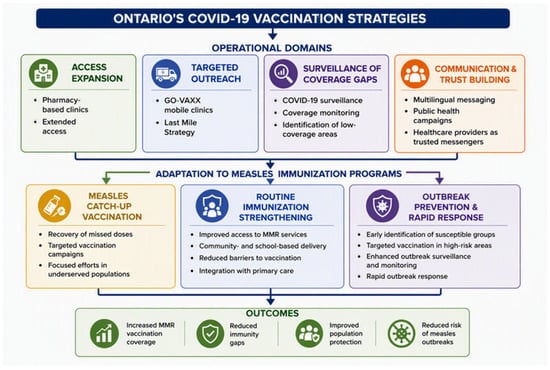
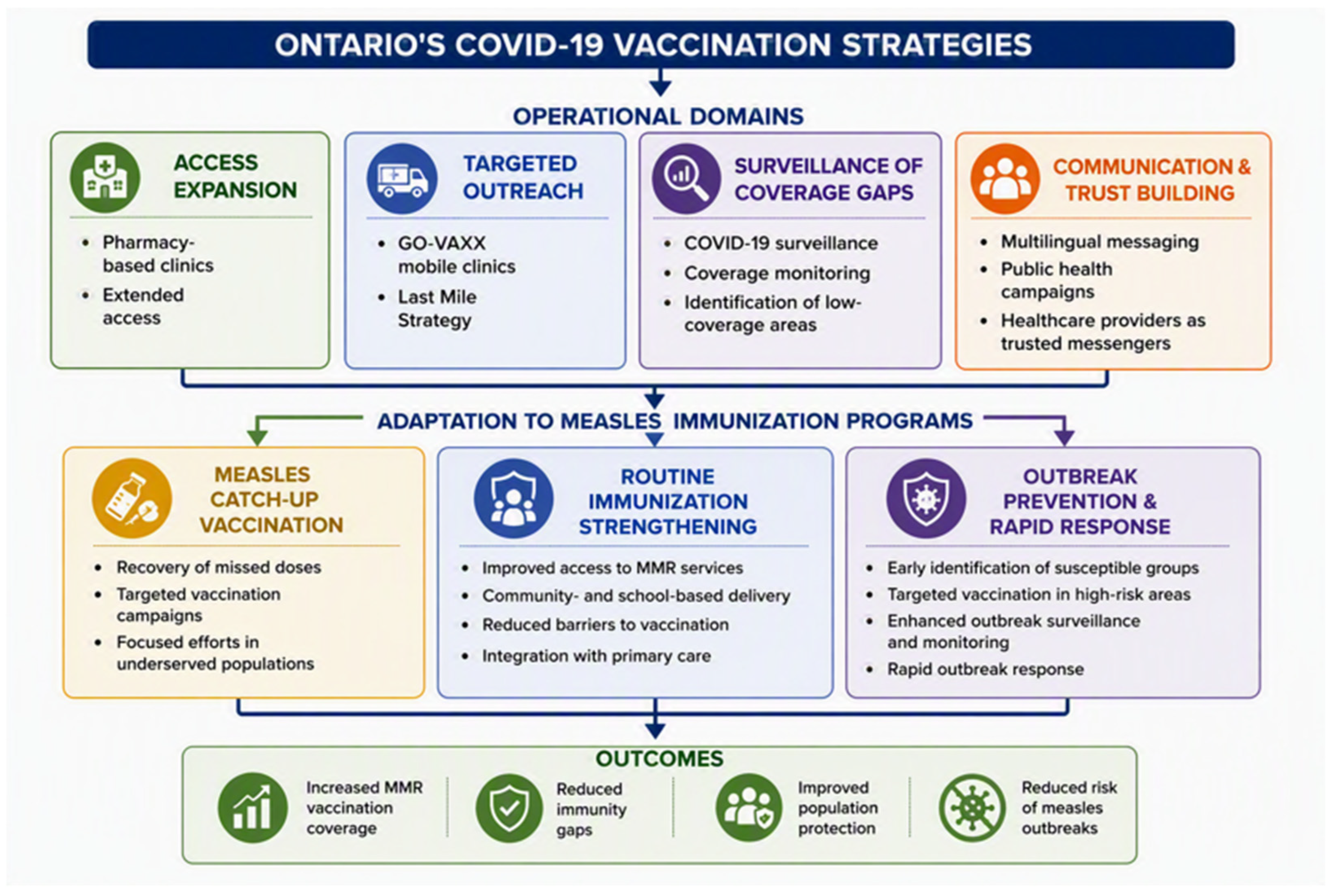
It is important to conduct a retrospective review of the COVID-19 emergency response to evaluate which strategies were most effective in addressing the pandemic. The following diagram illustrates the key strategies discussed in this paper (Figure 1).
Figure 1.
Conceptual framework illustrating how key operational components of Ontario’s COVID-19 vaccination strategy can be adapted to strengthen measles prevention and control efforts. Operational domains, including access expansion, targeted outreach, surveillance of coverage gaps, and communication and trust-building, can support measles catch-up vaccination, routine immunization strengthening, and outbreak prevention and rapid response activities. Together, these approaches may contribute to increased MMR vaccination coverage, reduced immunity gaps, improved population protection, and a lower risk of measles outbreaks.
In Ontario, the “COVID-19 Vaccination Program” [4] included the establishment of pharmacy-based vaccination sites in communities. This initiative enabled convenient access to healthcare providers through extended hours, resulting in increased vaccination rates across different age groups. Currently, pharmacies in Ontario do not administer the MMR vaccine; however, integration with primary care and public health units could streamline vaccination and help mitigate a measles resurgence. Moreover, co-administration of the MMR and influenza vaccines, where appropriate, could further improve vaccination uptake and coverage.
The “GO-VAXX Mobile Vaccine Clinics” [5] program was implemented during the pandemic to improve access to COVID-19 vaccinations by deploying buses and mobile clinics to various locations across Ontario. These clinics were specifically designed to reach under-immunized communities. Such community-based delivery models, in collaboration with primary care providers and public health units, could provide an effective means of administering the MMR vaccine by enabling targeted outreach and improving accessibility.
In addition, GO-VAXX Mobile Vaccine Clinics incorporated a “Last Mile Strategy” [5] to further enhance vaccination uptake. This strategy focused on making vaccines readily accessible and conveniently located, particularly by proactively reaching out to individuals who might otherwise face barriers to access. This approach could be adapted to address under-vaccinated populations and individuals who have missed routine childhood MMR vaccinations, as its core principle is to bring vaccines directly to the community.
Another strategic tool used during the COVID-19 pandemic was the development of a digital immunization and surveillance system, such as “COVID-19 Data and Surveillance” [6]. This system supported large-scale vaccination campaigns and facilitated vaccine documentation, surveillance, reporting, and monitoring. The digital infrastructure established during the COVID-19 pandemic can be leveraged to strengthen measles prevention and routine immunization programs in Canada. Public health authorities could use these systems to identify under-vaccinated populations and geographic areas with low vaccination coverage, enabling early interventions before outbreaks occur.
It is also worth noting that modernizing school immunization monitoring systems could improve reporting accuracy and help identify unvaccinated students. Such strategies may strengthen routine immunization programs and reduce the risk of measles resurgence. Notably, Public Health Ontario (PHO) recently published “An Immunization Action Plan for Ontario: Lessons from the Provincial Measles Outbreak” [7], which emphasizes the importance of enhanced vaccination monitoring and the modernization of immunization information systems.
Lastly, vaccine communication and trust-building played an essential role in combating the COVID-19 pandemic [8,9]. Approaches such as multilingual educational materials, vaccine counselling, public health campaigns, and culturally adapted community outreach initiatives helped address misinformation, improve public understanding of vaccines, and support informed decision-making [10,11]. Measles resurgence has similarly been driven by vaccine hesitancy, misinformation, and a lack of confidence in routine immunization programs [12,13].
3. Discussion
The recent rise in measles cases across Canada shows how fragile our regular vaccination programs can be when long-term planning and public trust break down. Ontario’s COVID-19 vaccine rollout proved that we can quickly organize large-scale immunizations, but those methods were made for adults in an emergency, not for kids as part of routine care. In addition, measles is more contagious than COVID-19 and require at least 95% coverage with both doses to maintain herd immunity and prevent outbreaks. COVID-19 programs worked because there was a sense of urgency, extra funding, and short-term flexibility. In contrast, preventing measles means having a system that runs smoothly all the time, keeps families and children engaged, and focuses on long-term, ongoing care.
While there are differences between measles and the current COVID-19 outbreak, some aspects of the coronavirus response remain relevant. Establishing vaccine centers in pharmacies and deploying GO-VAXX units enabled people, including those in underrepresented communities, to be vaccinated easily. In the case of measles vaccination programs, however, such an approach is more beneficial when implemented as part of routine health care in primary care practices and schools, rather than as a standalone strategy during crises. Measles vaccination services provided by pharmacies would also require regulatory changes, integration with provincial immunization records and close collaboration with primary care providers. The use of innovative monitoring systems and data tools during the recent pandemic proved highly effective for identifying under-vaccinated populations and addressing immunization gaps. However, these innovations work properly with credible data and regional connectivity. Among the strategies discussed, enhanced surveillance and immunization monitoring are likely to provide the greatest long-term benefit as they strengthen routine immunization programs and enable earlier public health intervention.
Communication tactics were vital in determining vaccine adherence amid the COVID-19 outbreak and will be equally important in addressing the resurgence of measles. From the experience of the pandemic, it is clear that there is increased compliance among individuals who trust their health care practitioners and receive culturally relevant information. Community-based efforts seem to be far more effective than general information campaigns. These communication approaches are among the most transferable lessons from the COVID-19 response because they can be incorporated into routine immunization programs without requiring emergency resources or infrastructure. Given how contagious this disease is, maintaining 95% herd immunity is imperative and can be achieved through effective communication and public trust.
Overall, the best way to do this is to ensure that the successful components are integrated into the routine immunization process rather than mimicking the processes used in the COVID-19 vaccine administration program. To move from reacting to taking a proactive approach, we must ensure that we enhance the connected surveillance system, improve monitoring in schools, and place emphasis on communication as well. Rather than adopting every COVID-19 strategy, priority should be given to sustainable interventions that strengthen routine immunization, including enhanced surveillance, improved communication and targeted outreach to the under-vaccinated population. This approach is fundamental in eliminating measles in Canada.
4. Conclusions
The return of measles cases in Canada after the COVID-19 outbreak demonstrates some of the difficulties in sustaining immunization rates in the general population. Even though Canada eliminated measles from its territory in the past, some challenges remain today.
The response to the COVID-19 vaccination program illustrated the success of interventions such as community-based clinics, stronger surveillance measures, digitized immunization record-keeping, and public health information campaigns. Using some of these methods for routine vaccinations and measles prevention may contribute to easier access to vaccines, more effective outbreak response, and vaccination recovery in Canada.
Author Contributions
Conceptualization: S.T.; writing: S.T., Review and editing: F.S. All authors have read and agreed to the published version of the manuscript.
Funding
This research received no external funding.
Data Availability Statement
No new data were created or analyzed in this study. Data sharing is not applicable to this article.
Conflicts of Interest
The authors declare no conflict of interest.
References
- Public Health Ontario. Measles in Ontario. Available online: https://www.publichealthontario.ca/-/media/Documents/Surveillance-Reports/Measles/measles-ontario-epi-summary.pdf (accessed on 15 June 2026).
- Government of Canada. Measles: Canada’s Response. Available online: https://www.canada.ca/en/public-health/services/diseases/measles/canada-response.html (accessed on 15 June 2026).
- McNichol, J.; Valizadeh, J.; Chaudhury, S.; Colijn, C. Measles in Canada: Modelling outbreaks with variable vaccine coverage and interventions. BMC Infect. Dis. 2025, 25, 236. [Google Scholar] [CrossRef] [Scilit] [PubMed]
- Government of Ontario. COVID-19 Vaccine Program. Available online: https://www.ontario.ca/page/covid-19-vaccine-program (accessed on 15 June 2026).
- Government of Ontario. GO-VAXX Mobile Vaccine Clinics Now Accepting Walk-Ins. Available online: https://news.ontario.ca/en/release/1001551/go-vaxx-mobile-vaccine-clinics-now-accepting-walk-ins (accessed on 15 June 2026).
- Public Health Ontario. COVID-19 Data and Surveillance. Available online: https://www.publichealthontario.ca/en/Data-and-Analysis/Infectious-Disease/COVID-19-Data-Surveillance (accessed on 15 June 2026).
- Public Health Ontario. An Immunization Action Plan for Ontario: Lessons from the Provincial Measles Outbreak. Available online: https://www.publichealthontario.ca/-/media/Documents/O/26/oiac-immunization-ontario-measles-outbreak.pdf (accessed on 15 June 2026).
- Abdelkader, S.; Jefferson, A.A. Trust, A Key to Counter Vaccine Hesitancy. J. Infect. Dis. 2025, 232, 274–277. [Google Scholar] [CrossRef] [Scilit] [PubMed]
- Sommers, T.; Dockery, M.; Burke, N.; D’Souza, S.; Troupe, B.; Agbonyinma, T.; Raghuram, H.; Hopkins, K.L.; Kohlway, E.; Stojicic, P.; et al. Building trust and equity in vaccine communication through community engagement. Hum. Vaccin. Immunother. 2025, 21, 2518636. [Google Scholar] [CrossRef] [Scilit] [PubMed]
- Public Health Ontario. Building Confidence in Vaccines. Available online: https://www.publichealthontario.ca/-/media/documents/ncov/vaccines/2021/04/covid-19-building-confidence-in-vaccines.pdf?la=en (accessed on 15 June 2026).
- Government of Canada. Realizing the Future of Vaccination for Public Health. Available online: https://www.canada.ca/en/public-health/corporate/publications/chief-public-health-officer-reports-state-public-health-canada/state-public-health-canada-2024/report.html (accessed on 14 June 2026).
- Government of Canada. Question Period Note: Measles and Vaccine Hesitancy. Available online: https://search.open.canada.ca/qpnotes/record/hc-sc%2CMH-%202024-QP%200026 (accessed on 15 June 2026).
- Dalhousie University. Ask an Expert: Why Are We Seeing Measles Outbreaks Across Canada and Who Should Get Vaccinated? Available online: https://www.dal.ca/news/2025/03/27/measles-outbreak-expert.html (accessed on 15 June 2026).
Disclaimer/Publisher’s Note: The statements, opinions and data contained in all publications are solely those of the individual author(s) and contributor(s) and not of MDPI and/or the editor(s). MDPI and/or the editor(s) disclaim responsibility for any injury to people or property resulting from any ideas, methods, instructions or products referred to in the content. |
© 2026 by the authors. Licensee MDPI, Basel, Switzerland. This article is an open access article distributed under the terms and conditions of the Creative Commons Attribution (CC BY) license.