


Abstract
While most individuals recover from mild traumatic brain injury (mTBI) within 3 months, 10–20% continue to experience chronic post-concussive symptoms such as headaches, dizziness, and imbalance. These individuals may benefit from vestibular rehabilitation, but military medicine needs a device that can standardize key elements of vestibular rehabilitation while allowing customization and targeting military-relevant tasks. We designed RehabXR, a portable mixed-reality-based platform for assessment and rehabilitation of multisensory and cognitive impairments after mTBI. RehabXR includes a virtual reality headset, controller, custom 3D-printed replica M4 rifle, and three first-person shooter games targeting common impairments post-mTBI. To assess usability, facilitated group discussions were conducted with ten military clinicians with post-mTBI rehabilitation experience and ten individuals with a history of mTBI. Clinicians and individuals with a history of mTBI rated RehabXR prototype usability favorably, with average System Usability Scale scores of 84.5 (range 55.0–97.5) and 85.2 (range 77.5–95.0), respectively. Clinicians liked the realism, engagement, interactivity, applicability, portability, and transparency (availability of quantitative outcome metrics). Individuals with a history of mTBI liked the ease of use and reported the games were realistic, fun, and engaging. After four weeks of use, patients rated RehabXR usability favorably (although somewhat lower than the prototype) with an average System Usability Scale score of 70.89 (range 55.0–87.5). These findings support RehabXR’s feasibility and acceptability and provide a foundation for studies of clinical effectiveness and return-to-duty applications.
1. Introduction
Over the past 25 years, more than 533,500 military personnel have sustained traumatic brain injuries (TBI), with 82% of these being mild traumatic brain injuries (mTBI) [1]. While most individuals recover from mTBI in about 3 months, 10–20% of individuals continue to experience chronic post-concussive symptoms like headaches, dizziness, and imbalance [2]. The Department of War (DoW) Clinical Recommendation for Progressive Return to Activity: Primary Care for Acute Concussion Management recommends specialty referral for vestibular therapy to alleviate dizziness and other problems associated with vestibular disorders when persistent and functionally limiting symptoms are present [3].
While the DoW Clinical Recommendation for Assessment and Management of Dizziness and Visual Disturbances Following Concussion/Mild Traumatic Brain Injury: Guidance for the Primary Care Manager recommends specialty referral to occupational therapists or physical therapists with specialized training in vestibular rehabilitation [4], there is no specific guidance on the type of treatments or dosage parameters that should be administered. Gottshall et al. found that a customized exercise program of gaze stabilization, static and dynamic postural stability, habituation, and aerobic exercises decreased dizziness and imbalance in patients with mTBI [5]. Vander Vegt et al., however, did not find differences in clinical outcomes between patients receiving generalized versus customized vestibular rehabilitation [6]. We, therefore, propose a device to standardize delivery of a few key elements of vestibular rehabilitation (i.e., gaze stabilization, static and dynamic postural stability, habituation) while allowing some customization for individual patient needs. This model may improve dosing accuracy and reproducibility across clinicians and sites while accommodating individual impairments and symptom tolerance; and is intended to resolve the apparent tension between generalized and customized approaches, support higher-quality comparative effectiveness research, and facilitate consistent translation to clinical practice.
Rosen et al. found that virtual environments in the Computer-Assisted Rehabilitation Environment (CAREN) (Motek Medical, Houten, Netherlands) showed promise for assessing balance in individuals with a history of mTBI [7]. Simulated military tasks in the CAREN were described as “particularly effective at addressing barriers to participation” in individuals with blast-induced TBI [8]. A limitation to widespread use of such assessments and treatments across the Military Health System is the cost and availability of the CAREN, in addition to the need for a specialized engineer operator to build the virtual environments and run the system. In military medicine, devices may need to be rapidly maneuverable to remain close to service members engaged in combat, precluding use of large, heavy, and non-portable equipment [9].
To meet the above needs, we designed a portable mixed-reality-based platform for assessment and rehabilitation of multisensory and cognitive impairments after mTBI called RehabXR (formerly known as Praxis [10]). RehabXR is considered a mixed-reality system because the headset continuously tracks a physical replica M4 rifle, allowing participants to interact with virtual objects while using the real-world rifle during rehabilitation. RehabXR targets service members by gamifying complex tasks in an operationally relevant context. The immersive serious games are intended to assess and rehabilitate balance, mobility, eye movement (gaze stabilization, smooth pursuits, saccades, convergence), and cognition (executive function, working and spatial memory, attention). Therapists can modify the visual complexity and cognitive demand imposed by the serious games to adapt to patient needs. The purpose of this communication is to describe the two-stage approach used to develop the RehabXR device. Although the RehabXR system (formerly Praxis) and its clinical evaluation have been described in previous publications [10,11], the present manuscript provides the first report of the iterative device-development process and associated usability findings from clinicians, individuals with a history of mTBI, and patients who used the final system.
2. Materials and Methods
2.1. Description of the Prototype System and Final System
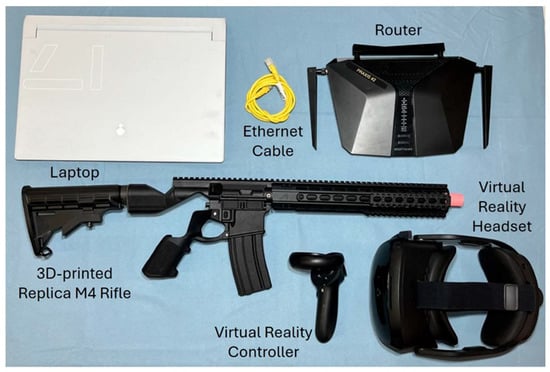
The prototype system was comprised of a laptop (Alienware x17 R2, Dell Technologies, Round Rock, TX, USA), router (NIGHTHAWK AX6 AX5400 6-Stream Wi-Fi router, NETGEAR, San Jose, CA, USA), ethernet cord, virtual reality headset with eye tracker (VIVE Focus 3, HTC America Inc., Berkeley, CA, USA), controller (VIVE Focus 3, HTC America Inc., Berkeley, CA, USA), and a metal-and-plastic rifle-form that positioned the virtual reality controller as the trigger and provided a forward support surface for contralateral hand placement. The first usability evaluation described herein was performed using this metal-and-plastic rifle-form. Feedback obtained during the evaluation informed subsequent hardware refinements, including development of a replica M4 rifle (National Equipment Corporation [NECO], College Station, TX, USA). The final, custom 3D-printed replica M4 rifle was made of Nylon 12 with tungsten carbide inserts for weight/balance. According to the manufacturer, industrial 3D printers produced components with fully isotropic part strength and full density. Additionally, off-the-shelf Picatinny rails, an adjustable M4 buttstock, and a sling were added for realism. The final replica M4 rifle weighed approximately 2.19 kg and measured 79.5–87.0 cm in overall length (depending on adjustable buttstock position to the end of the replica A2 flash hider), 22.0 cm in height, and 9.93 cm in width (at the controller), including the attached components. The headset tracks the position and orientation of the replica M4 rifle, enabling real-time interaction between the physical replica M4 rifle and the virtual environment. This final system, RehabXR (see Figure 1), was then evaluated by patients with chronic dizziness and/or imbalance post-mTBI during the second usability evaluation.
Figure 1.
The final RehabXR system.
RehabXR includes three first-person shooter serious games designed to target common impairments post-mTBI. A summary of each game, its rehabilitation targets, and the performance metrics collected is provided in Table 1. In addition to other listed rehabilitation targets, the games were designed to deliver gaze stabilization exercises by requiring participants to maintain visual fixation while performing head movements during task performance. The serious games provide a variety of outcome metrics such as response times, hit rates (accuracy), head velocity and rotation, and time on target (eye gaze). Preliminary findings suggest that the RehabXR system effectively integrates Go/No-Go cognitive training into mixed-reality and offers quantifiable metrics of inhibitory control [12]. A feasibility pilot study found modest, statistically fragile correlations between select Automated Neuropsychological Assessment Metrics (ANAM) and RehabXR metrics in healthy military cadets in processing speed, memory, and visuospatial ability [13]. Video demonstrations of the three serious games are provided as Supplementary Materials.
Table 1.
Summary of the RehabXR serious games.
2.2. Description of Therapist Interaction with the System
In Barricade Wave Defense, the therapist can configure the difficulty (easy, medium, hard, or custom). The number of rounds and number of targets per round can be manipulated, as well as the visual complexity (light, medium, or high). Weather effects can also be selected (clear, haze, fog, rain, snow) to add visual complexity. The time of day can also be changed, as service members must be able to perform in low-light conditions and at night. Civilian characters can be added to provide a cognitive challenge (e.g., shoot versus no-shoot scenario). The therapist view allows selection of four camera viewpoints, enabling the therapist to monitor the patient’s avatar in relation to the enemy characters (and civilian characters, if selected). During the rounds, the therapist can monitor the game and session time, round and targets remaining numbers, and civilian targets hit. Plus, real-time eye tracking is displayed. The After Action Report provides the therapist with the following performance metrics: game and session time; number of targets per round; and shots taken, enemy hit rate, and friendly hit rate per round with the time to complete the round.
In Stroop Target Shoot, the therapist can configure the difficulty (easy, medium, hard, or custom). The location can be set to interior (an easier setting inside a room with little visual complexity) or exterior (a more difficult setting outdoors with greater visual complexity). Four to eight colored drones can be selected to progressively increase the task difficulty. The number of rounds and number of cues (provided as a word on a virtual radio display that can be placed on the patient’s right side, left side, or alternating to induce head/body movement) per round can be manipulated. Environmental distractions and visual complexity can be independently set to light, medium, or high. Weather effects can also be selected (clear, haze, fog, rain, snow). The time of day can also be changed. The target spread can be set to low, medium, or high to progressively induce larger head/body movement. The therapist can select if the patient should identify the target based on the text or color (provided as a word on a virtual radio display) for the Stroop task. Lastly, the therapist can set the Target Color Display to memorize (target color is displayed only prior to initiation of gameplay and all targets are white during the round) or constant (target color is displayed constantly during the round). The therapist view allows selection of four camera viewpoints, enabling the therapist to monitor the patient’s avatar in relation to the drones. During the rounds, the therapist can monitor the game and session time, round and target numbers, current target, last target, last target hit, and total inverted targets. Plus, real-time eye tracking is displayed. The After Action Report provides the therapist with the following performance metrics: game and session time; percent correct and percent inverted; average time to engage the drones plus the minimum and maximum times; and correct target hits, inverted hits, and average time to engage the drones per round with the time to complete the round. Graphical displays also represent the target prompt (with an incongruent prompt indicated by an asterisk) and target hit, and whether this was correct (green), incorrect (red), or inverted (orange). A spider diagram displays the average time to engage each colored drone per round, and there is a reminder of the radio location (left, right, or alternating).
In Directional Memorization, the therapist can configure the difficulty (easy, medium, hard, or custom). The number of rounds and number of cues (provided as a word on a virtual radio display to induce head/body movement) per round can be manipulated, as well as the number of targets (4 or 8). Environmental distractions and visual complexity can be independently set to light, medium, or high. Weather effects can also be selected (clear, haze, fog, rain, snow). The time of day can also be changed. The therapist view allows selection of four camera viewpoints, enabling the therapist to monitor the patient’s avatar in relation to the enemy characters. During the rounds, the therapist can monitor the game and session time, round and target numbers, compass rotation, current target, last target, and last target hit. Plus, real-time eye tracking is displayed. The After Action Report provides the therapist with the following performance metrics: game and session time; percent correct; average time to engage the enemies plus the minimum and maximum times; and correct target hits and average time to engage the enemies per round with the time to complete the round. Graphical displays also represent the target prompt and target hit (with an abbreviation for the directions), and whether this was correct (green) or incorrect (red). A spider diagram displays the target locations per round.
2.3. Description of Exercise Data Acquisition and Processing
After putting on the headset and holding the replica M4 rifle with the embedded controller/tracker, the patient sees the virtual environment corresponding to one of the three gamified therapy scenarios and starts interacting with the virtual environment to achieve the goals of each game. The immersive environments and the corresponding virtual reality software were developed in Unity 2021.3.16f1 (https://unity.com/releases/editor/whats-new/2021.3.16f1, accessed on 3 November 2026), with the headset providing 2448 × 2448 pixels per eye, with 120° field of view, and 90 Hz refresh rate. At the beginning of each session, patients complete the headset’s built-in eye-tracking calibration. To this end, patients put the headset on and adjust the physical position and the interpupillary distance so that the lenses fit their physical face structure. Keeping their head still, they then follow a calibration dot on the headset screen until the sequence finishes. The headset then acknowledges that it has been correctly calibrated for eye tracking. We created a matching 3D model of the replica M4 rifle that is rendered in the software: the hand tracker embedded in the replica M4 rifle provides the origin object to which the 3D model is attached. In this way, the patient sees the virtual representation of the rifle in the simulations.
To calculate the performance metrics in each of the serious games (described in Table 1), patient performance data is collected via the VIVE Focus 3 Eye Tracker (HTC Corporation, Taiwan, China), tracking sensors, and event recorders. The VIVE Focus 3 system uses built-in cameras and sensors to determine the patient’s position; the controller’s position is tracked via emitting infrared light, which is detected by the headset camera. The headset and controller also use accelerometers and gyroscopes for six-degrees-of-freedom motion sensing. To determine the patient’s position the VIVE Focus 3 system utilizes sensors and cameras built into the headset, which scan the environment. This data is processed in real time to determine the performance metrics. The data is also logged to the laptop to allow for further post-processing.
The eye tracker operated at 120 Hz [14], and head and controller movement data were recorded at 90 Hz. Response time was defined as the time between the appearance of a cue on the screen and when the patient shot the corresponding virtual target. Hit rate was calculated as the number of correct target hits per minute within each round of a game. Head velocity and rotation were derived from head position and orientation data recorded by the headset, while eye-gaze/time-on-target was calculated as the time the patient was directly looking at/pointing the replica M4 rifle at the virtual target within a 1.1° error threshold.
2.4. Facilitated Group Discussions During the First Usability Evaluation
Facilitated group discussions were conducted at Joint Base San Antonio—Fort Sam Houston, Texas to obtain feedback on the prototype system that informed iterative system refinement (not as formal qualitative research). Clinicians with experience caring for individuals with mTBI and individuals with a history of mTBI were invited to participate in the first usability evaluation. The objective was to obtain broad user feedback during device development rather than to characterize participant demographics; therefore, detailed demographic and injury-related information and clinician experience were not collected. In total, ten military clinicians with post-mTBI rehabilitation experience and ten individuals with a history of mTBI were included. Throughout this manuscript, the term clinician refers specifically to the clinicians who participated in the first usability evaluation, healthcare provider refers more broadly to the range of potential users of the RehabXR system, and therapist refers to the rehabilitation professional operating and configuring the system during a treatment session.
Participants interacted with the RehabXR games while a member of the study team facilitated the evaluation. Because this evaluation was conducted as a formative device-development activity, detailed records of evaluation dates, gameplay duration, task order, game settings, and the extent of procedural standardization were not maintained. Following each game, participants completed the corresponding usability questionnaires and were invited to provide additional verbal feedback regarding system usability and potential improvements. Participant comments were documented on the evaluation forms or in notes taken by research team members. This feedback was reviewed by the device manufacturer and discussed during research team meetings to inform iterative system refinements; no formal qualitative analysis was performed. The group discussions were moderated by a member of the study team and were intended to supplement survey-based usability evaluation; they were not conducted as a formal qualitative research study. Clinicians and individuals with a history of mTBI completed the System Usability Scale (SUS) [15], as well as game-specific surveys (using a 5-point Likert scale, with higher values reflecting a favorable response) about instructions, difficulty and realism of the games, configuration choices, therapeutic value, equipment, after-action screens, and outcome metrics. The SUS contained sentences alternating between positive and negative framing to reduce acquiescence bias and ensure respondents critically evaluate each usability dimension rather than responding automatically. SUS scores were calculated by subtracting 1 from responses to odd-numbered items and subtracting responses to even-numbered items from 5, summing the adjusted item scores, and multiplying the total by 2.5 to obtain a score ranging from 0 to 100. Descriptive statistics were calculated using sample standard deviations (SDs; n − 1 denominator). Scores above 70 on the SUS are good and scores above 85 are excellent [16]. The game-specific surveys were developed specifically for the study, have not been validated, and are provided as Supplementary Materials.
All participants voluntarily agreed to participate prior to providing usability feedback. They completed the evaluation under the supervision of a member of the study team. No adverse events occurred during the usability evaluation.
2.5. Patient Ratings During the Second Usability Evaluation
The final system with the custom 3D-printed replica M4 rifle was then evaluated by patients with chronic dizziness and/or imbalance post-mTBI during the second usability evaluation. Patients from the Praxis study [10] completed the SUS [15] after 4 weeks of using RehabXR. They did not complete the game-specific surveys. These patients represent the same clinical cohort described in a previous publication of the Praxis study [11]; however, their usability findings have not been previously reported. SUS summary statistics were calculated using available complete questionnaires, without imputation of missing data.
All patients provided written informed consent to participate in the Praxis study [10] prior to providing usability feedback. They completed the evaluation under the supervision of a member of the study team. No adverse events occurred during the usability evaluation.
3. Results
3.1. Evaluation of the Prototype System by Clinicians
Clinicians rated the prototype system usability favorably, with average SUS scores of 84.5 (range 55.0–97.5) (see Table 2). One clinician assigned an overall SUS score of 55.0, reflecting individual variability in usability perceptions; she also expressed being uncomfortable with the use of technology in general, which may have influenced her ratings of items like, “I think that I would need the support of a technical person to be able to use this system.” Clinicians liked the realism, engagement, interactivity, wide range of applicability, portability, and transparency (availability of quantitative outcome metrics). In the game-specific surveys, the clinicians reviewed all three games favorably in terms of instruction clarity, number of configuration choices, on-screen information, after-action gameplay metrics, and rehabilitative ability, with similar ratings across the three games within each category. Specifically, the clinicians rated the instruction clarity and rehabilitative ability in each of the serious games the highest, with averages ranging from 4.4 to 4.8 for each of the serious games. However, the clinicians rated the serious games slightly less favorable regarding the number of configuration choices, with average scores ranging from 2.9 to 3.1 for each of the three serious games.
Table 2.
System Usability Scale (SUS) scores for the prototype system reported by ten military clinicians (C1–C10) with experience caring for individuals with mild traumatic brain injury.
3.2. Evaluation of the Prototype System by Individuals with a History of mTBI
Individuals with a history of mTBI rated the prototype system usability favorably, with average SUS scores of 85.2 (range 77.5–95.0) (see Table 3). They liked the ease of using the system and reported the games were realistic, fun, and engaging. In the game-specific surveys, the individuals with a history of mTBI reviewed all three games favorably (and similarly) in terms of induced motion sickness, instruction clarity, playing difficulty, after-action gameplay metrics, and rehabilitative ability. Motion sickness ratings were minimal across all three games. On a 5-point scale (1 = no sickness, 5 = severe sickness), the individuals with a history of mTBI reported average ratings of 1.20 for Barricade Wave Defense, 1.20 for Stroop Target Shoot, and 1.00 for Directional Memorization, indicating minimal self-reported motion sickness during gameplay. However, these ratings were obtained using study-specific questions rather than a validated instrument, and future studies should confirm these findings using a validated measure. The individuals with a history of mTBI specifically rated the instruction clarity and after-action gameplay metrics the highest, with average scores ranging from 4.3 to 4.7 for each of the three serious games. Importantly, individuals with a history of mTBI provided feedback about the absence of the distal barrel in the metal-and-plastic rifle-form (often reaching to hold the virtual barrel in their typical elbow fully extended and supinated grip). This feedback led to pursuit of a custom 3D-printed replica M4 rifle with off-the-shelf Picatinny rails, an adjustable M4 buttstock, and a sling for realism.
Table 3.
System Usability Scale (SUS) scores for the prototype system reported by ten individuals (I1–I10) with a history of mild traumatic brain injury.
3.3. Evaluation of the Final System by Patients with Chronic Dizziness and/or Imbalance Post-mTBI
Fifteen patients (all male service members; age mean ± std. dev. = 37.0 ± 5.0 years old) with chronic dizziness and/or imbalance post-mTBI participated in the Praxis study [10]. Fourteen patients rated the final system usability favorably, with average SUS scores of 70.89 (range 55.0–87.5) (see Table 4). One patient (P1) did not complete the SUS due to an administrative oversight. Compared with the prototype evaluations, patients rated the final system less favorably, particularly regarding perceived inconsistency (mean = 2.71), need for technical support (mean = 2.50), perceived complexity (mean = 2.07), and integration of system functions (mean = 3.14).
Table 4.
System Usability Scale (SUS) scores for the final system reported by fifteen patients (P1–P15) with chronic dizziness and/or imbalance post-mild traumatic brain injury.
4. Discussion
RehabXR is intended as a clinician-directed rehabilitation platform rather than a standardized treatment protocol. The therapist selects game parameters and modifies task demands based on the patient’s impairments and response to treatment, consistent with established principles of vestibular rehabilitation. Determining the optimal exercise dosage, progression criteria, and effectiveness of the platform is beyond the scope of this usability study and is being evaluated in ongoing work. Although the final system received lower usability ratings than the prototype, differences in participant populations and evaluation conditions limit direct comparisons. The mean SUS score of 70.89 was only modestly above the prespecified acceptability threshold of 68, with individual scores ranging from 55.0 to 87.5, indicating variability in patient perceptions of usability. The reasons for the lower ratings remain unclear and cannot be determined from the available data.
Clinicians assigned the lowest ratings to the prototype system configuration options, suggesting opportunities to improve workflow and interface usability. This feedback informed subsequent refinements to the configuration menus and overall system setup. Feedback from the clinicians and individuals with a history of mTBI was used to refine the final version of the system before it was entered into a serious games competition. RehabXR (then known as Praxis), a partnership between military (Center for the Intrepid’s Department of Occupational Therapy and Brooke Army Medical Center’s Department of Radiology), academia (University of Pittsburgh and Army-Baylor University Doctoral Program in Physical Therapy), and industry (AV and NECO), received an Innovation Award at the Serious Games Showcase and Challenge (SGS&C) competition, recognizing its novel approach to military-focused rehabilitation.
The RehabXR system was designed to address critical gaps in the delivery of vestibular rehabilitation following mTBI by combining portability, standardization, and engagement within an operationally relevant framework. Existing clinical recommendations emphasize specialty referral but lack specificity on treatment types, dosing parameters, and reproducible methods—leading to variability across providers and facilities. RehabXR was designed to address this gap by standardizing key vestibular rehabilitation elements (gaze stabilization, postural stability, and habituation) within configurable, therapist-controlled mixed-reality scenarios that can be adapted to individual symptom profiles and tolerance levels. Unlike large, stationary systems such as the CAREN, RehabXR’s lightweight, laptop-based mixed-reality platform was designed for rapid deployment in clinical or field environments, with its feasibility in these settings requiring further evaluation. Its gamified, first-person scenarios emulate military-relevant tasks designed to target balance, cognition, and visual–vestibular integration, while embedded sensors, eye tracking, and motion capture provide quantitative performance metrics that may ultimately support clinicians in monitoring rehabilitation progress. By integrating evidence-based therapeutic principles with immersive, data-driven mixed-reality technology, RehabXR was designed to potentially improve rehabilitation precision, engagement, and scalability—with the goal of bridging the gap between laboratory-based innovation and real-world military medicine.
Further assessment of the effectiveness of the RehabXR system is ongoing at the Center for the Intrepid’s Special Operations Performance and Recovery (SPaR) program with additional measures as part of a clinical trial. The details of the clinical trial are described by Alroumi et al. [10]. Future studies should explore the use of RehabXR for rehabilitation of mTBI, which may be complicated by comorbid conditions like post-traumatic stress disorder [2]; blast exposure; vestibular neuritis/labyrinthitis; vestibular migraine; Meniere’s disease; and other causes of dizziness and/or imbalance.
The primary contribution of this manuscript is the first report of the iterative development and usability evaluation of RehabXR, including previously unpublished usability findings, rather than an independent assessment of clinical effectiveness. These usability evaluations were conducted to refine the prototype system during device development and to obtain patient feedback during the Praxis study [10]. The clinicians and individuals with a history of mTBI who evaluated the prototype system were recruited as a convenience sample to provide iterative feedback during device development and were not intended to be representative of the broader military mTBI population. Because the first usability evaluation was conducted to inform device development, detailed demographic and clinical characteristics of participants were not collected. Consequently, the findings reflect overall user perceptions of system usability and cannot be used to determine whether usability differed according to participant characteristics or injury status. Additionally, motion sickness was assessed using study-specific usability questions intended to identify participant discomfort during device development. Future clinical evaluations should incorporate validated measures, such as the Simulator Sickness Questionnaire [17], in addition to standardized clinical outcome measures. Finally, this study was designed to evaluate system usability and was not intended to assess the clinical effectiveness of RehabXR or its impact on rehabilitation outcomes or return-to-duty decision-making.
5. Conclusions
The favorable usability findings demonstrate that the prototype system was well accepted by both clinicians and individuals with a history of mTBI during device development. Similarly, patients with chronic dizziness and/or imbalance post-mTBI rated the final RehabXR system usability favorably after four weeks of use. These findings support further evaluation of the system to determine its clinical effectiveness and potential role in military vestibular rehabilitation and return-to-duty decision making.
6. Patents
A PORTABLE INTEGRATED MULTI-SENSORY, EXTENDED-REALITY (XR) SYSTEM FOR COGNITIVE AND PHYSICAL REHABILITATION WITH JOB-RELEVANT CAPABILITY ASSESSMENT with application number 19/684,718 was filed on 21 May 2026.
Supplementary Materials
The following supporting information can be downloaded at https://www.mdpi.com/article/10.3390/ijmd1020009/s1, Video S1: Video demonstrations of Barricade Wave Defense; Video S2: Video demonstrations of Stroop Target Shoot; Video S3: Video demonstrations of Directional Memorization; Supplementary Material S4: The game-specific surveys.
Author Contributions
Conceptualization, C.W.H., S.L.W., L.S.H. and P.H.; methodology, C.W.H., S.L.W., L.S.H. and P.H.; software, A.V., P.V.H., C.Z. and B.S.; formal analysis, Z.L. and S.R.; investigation, C.W.H., S.S. and H.R.; resources, R.C.; design and fabrication of the custom 3D printed replica M4 rifle, R.C.; writing—original draft preparation, C.W.H., S.R. and P.H.; writing—review and editing, C.W.H., S.R., R.C., Z.L. and P.H.; visualization, C.W.H. and S.R.; supervision, C.W.H., S.L.W., L.S.H. and P.H.; project administration, C.W.H., S.S., H.R. and P.V.H.; funding acquisition, P.H. All authors have read and agreed to the published version of the manuscript.
Funding
This work was supported by the Assistant Secretary of Defense for Health Affairs endorsed by the Department of War, through the Congressionally Directed Medical Research Programs, Traumatic Brain Injury and Psychological Health Research Program, Translational Research Award, in the amount of $1,446,754, under Award No. W81XWH2220083. Opinions, interpretations, conclusions, and recommendations are those of the authors and are not necessarily endorsed by the Department of War or the Defense Health Agency.
Institutional Review Board Statement
The first usability evaluation conducted during device development was determined not to constitute human subjects research and did not require Institutional Review Board approval. The Praxis study was conducted in accordance with the Declaration of Helsinki and approved by the San Antonio Institutional Review Board (protocol C.2023.055, approved 3 November 2023).
Informed Consent Statement
All participants voluntarily agreed to participate prior to providing usability feedback. Patients participating in the Praxis study provided written informed consent prior to providing usability feedback.
Data Availability Statement
The data are available on request from the corresponding author.
Acknowledgments
The authors would like to thank the military clinicians, individuals with a history of mTBI, and patients with chronic dizziness and/or imbalance post-mTBI for their valuable feedback.
Conflicts of Interest
Carrie Hoppes is an employee of The Geneva Foundation. Holly Richard, Shane Salter, Andrew Vetter, Pearson Van Horn, Chad Zalkin, Brian Sink, Lisa Holt, Zhihao Li, Sridhar Ramakrishnan, and Pedram Hovareshti are all employees of AV. Susan Whitney is a paid consultant for AV, a company that may be affected by the findings reported in the enclosed paper. Susan Whitney has in place an approved plan for managing any potential conflicts arising from financial interest with AV. Robert Collier is an employee of National Equipment Corporation (NECO). The views expressed in this manuscript reflect the results of research conducted by the author(s) and do not necessarily reflect the official policy or position of the Defense Health Agency, Department of War, nor the U.S. Government. Reference herein to any specific commercial products, process, or service by trade name, trademark, manufacturer, or otherwise, does not necessarily constitute or imply its endorsement, recommendation, or favoring by the U.S. Government.
Abbreviations
The following abbreviations are used in this manuscript:
| mTBI | Mild traumatic brain injury |
| TBI | Traumatic brain injury |
| DoW | Department of War |
| CAREN | Computer-Assisted Rehabilitation Environment |
| NECO | National Equipment Corporation |
| ANAM | Automated Neuropsychological Assessment Metrics |
| SUS | System Usability Scale |
| SGS&C | Serious Games Showcase and Challenge |
| SPaR | Special Operations Performance and Recovery |
References
- Traumatic Brain Injury Center of Excellence. DOD TBI Worldwide Numbers. Available online: https://www.health.mil/Military-Health-Topics/Centers-of-Excellence/Traumatic-Brain-Injury-Center-of-Excellence/DOD-TBI-Worldwide-Numbers (accessed on 13 September 2026).
- O’Neil, M.E.; Carlson, K.; Storzbach, D.; Brenner, L.; Freeman, M.; Quiñones, A.; Motu’apuaka, M.; Ensley, M.; Kansagara, D. VA Evidence-based Synthesis Program Reports. In Complications of Mild Traumatic Brain Injury in Veterans and Military Personnel: A Systematic Review; Department of Veterans Affairs (US): Washington, DC, USA, 2013. [Google Scholar]
- Traumatic Brain Injury Center of Excellence. Progressive Return to Activity: Primary Care for Acute Concussion Management. Available online: https://www.health.mil/Reference-Center/Publications/2024/02/23/Progressive-Return-to-Activity-Primary-Care-for-Acute-Concussion-Management (accessed on 13 September 2026).
- Traumatic Brain Injury Center of Excellence. Assessment and Management of Dizziness and Visual Disturbances Following Concussion/Mild Traumatic Brain Injury: Guidance for the Primary Care Manager. Available online: https://health.mil/Reference-Center/Publications/2026/02/04/Assessment-and-Management-of-Dizziness-and-Visual-Disturbances-Following-Concussion-Mild-Traumatic-Brain-Injury (accessed on 13 September 2026).
- Gottshall, K. Vestibular rehabilitation after mild traumatic brain injury with vestibular pathology. NeuroRehabilitation 2011, 29, 167–171. [Google Scholar] [CrossRef] [Scilit]
- Vander Vegt, C.B.; Hill-Pearson, C.A.; Hershaw, J.N.; Loftin, M.C.; Bobula, S.A.; Souvignier, A.R. A Comparison of Generalized and Individualized Vestibular Rehabilitation Therapy in a Military TBI Sample. J. Head Trauma Rehabil. 2022, 37, 380–389. [Google Scholar] [CrossRef] [Scilit]
- Rosen, K.B.; Delpy, K.B.; Pape, M.M.; Kodosky, P.N.; Kruger, S.E. Examining the Relationship Between Conventional Outcomes and Immersive Balance Task Performance in Service Members With Mild Traumatic Brain Injury. Mil. Med. 2021, 186, 577–586. [Google Scholar] [CrossRef] [Scilit]
- Scherer, M.R.; Schubert, M.C. Traumatic brain injury and vestibular pathology as a comorbidity after blast exposure. Phys. Ther. 2009, 89, 980–992. [Google Scholar] [CrossRef] [Scilit]
- Hoppes, C.W.; Lambert, K.H.; Whitney, S.L.; Erbele, I.D.; Esquivel, C.R.; Yuan, T.T. Leveraging Technology for Vestibular Assessment and Rehabilitation in the Operational Environment: A Scoping Review. Bioengineering 2024, 11, 117. [Google Scholar] [CrossRef] [Scilit]
- Alroumi, A.M.; Hoppes, C.W.; Whitney, S.L.; Li, Z.; Holt, L.; Ramakrishnan, S.; Barnicott, S.L.; Logeais, M.T.; Richard, H.; Salter, S.R.; et al. A virtual reality system for delivery of military-specific vestibular rehabilitation after mild traumatic brain injury: The Praxis study protocol. Front. Neurol. 2025, 16, 1558795. [Google Scholar] [CrossRef] [Scilit]
- Li, Z.; Hoppes, C.W.; Ramakrishnan, S.; Hovareshti, P.; Van Horn, P.; DiSalvo, M.; Holt, L.S.; Salter, S.R.; Richard, H.; Barnicott, S.L.; et al. Evaluation of the “RehabXR” virtual reality system for vestibular rehabilitation: Evidence of changes in functional brain connectivity in warfighters with chronic mild traumatic brain injury. Front. Hum. Neurosci. 2026, 20, 1850913. [Google Scholar] [CrossRef] [Scilit]
- Ramakrishnan, S.; Hoppes, C.W.; DiSalvo, M.; Holt, L.S.; Vetter, A.; Zalkin, C.; Van Horn, P.; Li, Z.; Whitney, S.L.; Hovareshti, P. Toward Effective Virtual Reality-Based Go/No-Go Cognitive Training to Support Return-to-Activity Following Mild Traumatic Brain Injury in Service Members. Mil. Med. 2026, usag160. [Google Scholar] [CrossRef] [Scilit]
- Manetta, C.; Whitney, S.L.; Ramakrishnan, S.; Alroumi, A.M.; Hoppes, C.W.; Li, Z.; Vetter, A.; Zalkin, C.; Holt, L.S.; Van Horn, P.; et al. Neurocognitive Scores and Performance on Virtual Reality-Based Return-to-Duty Scenarios: A Pilot Study in Reserve Officers’ Training Corps Cadets. Mil. Med. 2026, usag326. [Google Scholar] [CrossRef] [Scilit]
- HTC VIVE. VIVE Focus 3 Eye Tracker. Available online: https://developer.vive.com/us/hardware/focus-3-eye-tracker/ (accessed on 20 October 2026).
- Jordan, P.W.; Thomas, B.; Weerdmeester, B.A.; McClelland, I.L. (Eds.) SUS: A “quick and dirty” usability scale. In Usability Evaluation In Industry; Taylor & Francis: London, UK, 1996; pp. 189–194. [Google Scholar]
- Bangor, A.; Kortum, P.; Miller, J. Determining what individual SUS scores mean: Adding an adjective rating scale. J. Usability Stud. 2009, 4, 114–123. [Google Scholar]
- Kennedy, R.S.; Lane, N.E.; Berbaum, K.S.; Lilienthal, M.G. Simulator Sickness Questionnaire: An Enhanced Method for Quantifying Simulator Sickness. Int. J. Aviat. Psychol. 1993, 3, 203–220. [Google Scholar] [CrossRef] [Scilit]

Disclaimer/Publisher’s Note: The statements, opinions and data contained in all publications are solely those of the individual author(s) and contributor(s) and not of MDPI and/or the editor(s). MDPI and/or the editor(s) disclaim responsibility for any injury to people or property resulting from any ideas, methods, instructions or products referred to in the content. |
© 2026 by the authors. Licensee MDPI, Basel, Switzerland. This article is an open access article distributed under the terms and conditions of the Creative Commons Attribution (CC BY) license.