- Article

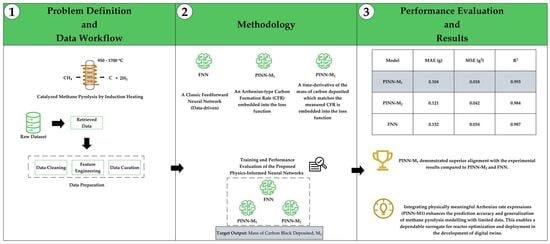
Carbon deposition during catalytic methane pyrolysis under induction heating governs reactor operability and carbon recovery; however, the available datasets are sparse. In this study, literature-derived experimental data were curated and split into training, validation and test sets (70%, 15%, 15%) to develop physics-informed neural networks (PINNs) that predict the deposited carbon mass (MC) from the operating variables. Two models were proposed: PINN-M1, which embeds an Arrhenius-type carbon formation rate in the loss function, and PINN-M2, which constrains the time derivative of the MC to match the measured carbon formation rate (CFR). Both models shared an optimized neural network architecture and were benchmarked against a classic feedforward neural network (FNN). PINN-M1 achieved the closest agreement with the experiments (MAE∼0.104 g, MSE∼0.018 g2, R2∼0.993), outperforming FNN (MAE∼0.152 g, R2∼0.987) and PINN-M2 (MAE∼0.121 g, R2∼0.984). Loss tracking indicated rapid convergence as well as the predictions of the mass of carbon deposited. The results demonstrate that embedding physically meaningful rate expressions can improve accuracy and generalization in scarce-data methane pyrolysis modelling, providing a practical surrogate for optimizing operating conditions and supporting future digital twin development.
9 October 2026