


Abstract
Materials experimentation is an increasingly important practice in product design education, but exploratory material interaction does not automatically produce knowledge that is explicit or transferable across disciplinary boundaries. This exploratory study asks how product design students can move from material tinkering toward more explicit materials experimentation without suppressing exploratory inquiry. A multi-method case study was conducted in a bachelor’s programme in Manual & Material Culture between 2023 and 2026, combining participant observation, a focus group, document analysis and problem-centered interviews. The observed presentations and project documentation showed students’ strong exploratory engagement and material sensitivity, whereas research questions, variables, experimental conditions, process reflection and transferable knowledge were rarely made explicit. Students requested continuous methodological guidance and a clearer translation of scientific knowledge into a design-accessible language. The pedagogical challenge is therefore not to replace open-ended tinkering, but to foster greater experimental explicitness in students’ work. Building on these findings and a literature review, we propose a five-phase pedagogical framework: exploratory interaction; explicit problem and hypothesis formulation; systematic experimental design; characterization and analysis; and abstraction and transfer. We acknowledge that further research is needed to validate the proposed pedagogical framework, as it has not yet been implemented and evaluated as a whole, and students’ collaboration with other disciplines was not assessed. With this article, we aim to contribute to the ongoing discussion and support the further development of approaches to materials experimentation for preparing students in transdisciplinary research.
1. Introduction
Materials have become increasingly important in product design education as ecological challenges, local production, material innovation and the development of new materials have expanded the role of materiality in design practice. Early work on materials selection established the technical dimension of materials in product design, while subsequent approaches increasingly addressed sensory, experiential, cultural and emotional dimensions [1,2,3,4,5]. Materials experimentation has therefore become a significant educational practice rather than a marginal studio activity. Material tinkering, material-driven design and approaches to DIY-material development provide students with ways to learn through direct engagement with matter and to generate material possibilities through iterative exploration [6,7,8,9].
At the same time, the context in which product designers work is increasingly transdisciplinary. Materials development may involve materials science, engineering, biology, manufacturing and other established research fields. In such collaborations, the relevant question is not whether materials experimentation in product design should become identical to experimentation in the natural sciences. Rather, design needs to make those aspects of its experimental practice explicit that allow observations, procedures and conclusions to be communicated, examined and connected across disciplinary boundaries. The distinction between design practice and academic research is important here: design practice is often solution-oriented, whereas academic research is oriented toward questions, understanding and the generation of new knowledge [10]. Design research itself is heterogeneous and frequently combines methods from several disciplines [10,11,12]. For bachelor-level design education, this implies that students need to learn to navigate both the language of design practice and the language of design research, and to understand when and how these modes of working can be productively connected.
The present study originated in a basic materials-research collaboration in which product-design researchers and natural scientists encountered differences in how materials research was conceptualized, documented and communicated. The experience raised a pedagogical question: if product-design graduates are expected to collaborate with established scientific disciplines in materials research, what must they learn during their studies, and what must educators themselves be able to teach?
This question is related to, but more specific than, the broader discussion of scientific standards in design education. While design education increasingly engages with research-oriented ways of working, a central pedagogical challenge remains: students need to understand not only how to explore and develop materials through design practice, but also how to make the questions, procedures, observations and knowledge claims arising from such exploration sufficiently explicit to communicate and connect their work across disciplinary boundaries [10,11,12,13]. In materials research, this challenge becomes particularly relevant because product-design students may encounter established scientific disciplines whose conventions for formulating questions, documenting experimental conditions and communicating results differ from those of studio-based design practice [10,14,15]. The question is therefore not whether design students should adopt scientific methods wholesale, but how they can learn to recognize when a more explicit experimental mode is required and how to move between exploratory design practice and more systematic forms of inquiry [14,15,16]. Table 1 summarizes the differences between materials research in the natural sciences and materials experimentation in product design that are relevant to teaching.
Table 1.
Materials research in natural sciences and materials experimentation in product design: differences relevant to teaching.
The reviewed literature already offers several relevant approaches. Material tinkering explicitly values open-ended manipulation and learning through materials [6,7]. Material-Driven Design provides a structured route from material understanding to material-experience visions and product concepts [8]. Ayala Garcia’s Materials Generation Roadmap combines tinkering with iterative optimization, characterization and documentation [9]. Pedgley, Rognoli and Karana develop materials-experience education as a specific field of design education [17]. Zhou and Rognoli identify competence, tools, space and service as central areas of materials education and highlight the underdeveloped question of how material knowledge is generalized and shared [18]. Romani, Rognoli and Levi likewise argue that materials experiments in design are diverse, while the transfer and organization of the knowledge generated remain insufficiently developed [19].
The methodological problem can be framed more broadly through research on design methods. Badke-Schaub and Voute have called for empirical investigation of the quality and validity of design methods, while Gericke, Eckert and Stacey propose that methods should be described in terms of aims, steps, use cases and tools and evaluated transparently within specified contexts [11,12]. Cash and colleagues similarly emphasize the evaluation of design methods and the need to make methodological claims assessable [13]. These discussions are directly relevant to teaching materials experimentation: if students are to learn a method rather than merely perform a sequence of activities, the purpose, procedure, criteria and expected knowledge contribution need to be made explicit.
This study therefore addresses the following research question:
How can materials experimentation be taught in product design education so that exploratory material inquiry is preserved while students develop the methodological explicitness required for transdisciplinary collaboration with established scientific disciplines?
The paper has three objectives. First, it reconstructs what students actually do when they conduct materials experiments in a studio-based bachelor’s programme. Second, it identifies the recurring pedagogical difficulties that become visible when exploratory practice is examined in relation to methodological explicitness, documentation and transfer. Third, it derives a proposed teaching model and curricular implications, including implications for the educators who must mediate between design practice and scientific knowledge cultures. The model is put forward as a pedagogical framework derived from an exploratory case study and a literature review, not as a validated teaching model. Its relation to existing material-driven approaches is delineated in Section 4.3.
The aim is not to establish a universal scientific standard for design. Instead, the paper proposes a pedagogical framework for developing what may be termed experimental explicitness with regard to materials experimentation: the ability to state what is being investigated, how the investigation is structured, what was observed, how the observations were interpreted, and what can reasonably be communicated or transferred beyond the individual design project.
2. Materials and Methods
2.1. Research Design and Educational Context
The study is a multi-method case study conducted between October 2023 and April 2026 at an Austrian design university, within a bachelor’s product design programme combining craft, artistic practice and scientific working methods. In the third semester, students conduct material-experimentation projects over one semester. They receive a thematic brief and carry out material and/or design projects that are presented during the semester and in a final studio presentation.
The empirical study developed iteratively. The first phase examined existing student practice without changing the teaching situation. The second phase used a focus group to investigate how students understood their own approaches to materials experimentation and the problems they encountered. The focus-group findings informed the development of a more explicit methodological scaffold, which was refined and introduced in the third phase. The third phase examined how students responded to this scaffold through observation, project documentation and interviews. The five-phase model presented in Section 4.3 was formulated subsequently by integrating the empirical findings with the literature; it has not yet been implemented or evaluated as a complete model.
The phases followed one another chronologically and involved different student cohorts. Phase 1 took place in the winter semester 2023–24 and concerned the final presentations of that semester’s third-semester students. Phase 2 followed subsequently over the summer semester 2024 involving six students from the same group. Phase 3 was conducted with a later cohort of 21 third-semester students in the winter semester 2025–26. The two interviews were held after the final presentations. The overall study period ended in April 2026.
In Phase 1, the presentations were observed without interference with the teaching process (Section 2.2). Data collection and preliminary analysis were carried out throughout the case study by a social scientist not involved in teaching activities. Further analysis, conceptual development as well as selection of participants for the focus group and the problem centered interviews involved input and expertise from the researchers with product design background, who were actively involved in teaching. The possible influence of researcher involvement on the findings is addressed in Section 4.8.
The analysis focused on four dimensions: degree of exploration, degree of documentation, explicitness of hypothesis or research-question formation, and ability to reflect on and abstract knowledge from the experimental process. The experiential learning cycle of Kolb and Fry was used in the first phase as an interpretive framework, distinguishing active experimentation, concrete experience, reflective observation and abstract conceptualization [20]. The study did not treat this framework as a measurement scale; rather, it was used to identify which dimensions of learning students made visible in their presentations. The relation between these four dimensions and the six analytical categories applied across the phases is set out in Section 2.5 and Table 2.
Table 2.
Analytical categories, guiding questions applied to analyzed data, and related dimensions named in Section 2.1.
2.2. Phase 1: Participant Observation of Existing Materials Experimentation
In the winter semester 2023–24, 14 third-semester students presented materials-research projects. Their final presentations, which were open to the university community, were observed without interference with the teaching process. Presentations lasted approximately 10–23 min and included material samples, objects and, in some cases, posters or slides.
The analysis considered whether students articulated objectives or questions, how they described the sequence and organization of their work, whether variations were deliberately introduced, whether observation categories were made explicit, and whether students reflected on the process or derived transferable statements. The results were analyzed in relation to the four stages of the experiential learning cycle.
2.3. Phase 2: Focus Group
A focus group with six students was conducted on 22 April 2024. The discussion lasted approximately 1.5 h and was audio-recorded. Participation was voluntary, and informed consent was obtained from the participants. The participants were selected from students whose projects had been observed in Phase 1. The selection criteria were based on the research question and the analytic dimensions used during participant observation of project presentations (e.g., degree of material manipulation, extent of structured documentation). The discussion addressed students’ approaches, the role of open and more criteria-led experimentation, documentation, communication of results and reflections on approaching future materials experiments. The focus-group discussion was used as an exploratory method for eliciting different perspectives and generating further questions [21].
The analysis distinguished two broad approaches reported by students: open materials experimentation, in which the material and its possibilities were explored without a predefined target, and more closed or criteria-led experimentation, in which specific technical properties or a design objective structured the work. Particular attention was paid to students’ descriptions of what helped or hindered their ability to work systematically.
2.4. Phase 3: Structured Teaching Situation and Subsequent Interviews
In the third phase, 21 third-semester students were introduced to a structured approach to materials experimentation within a semester project focused on sheep’s wool. At the beginning of the semester, students received material-specific input and examples of processed wool. An intensive introductory week addressed the methodological approach to materials experiments, preliminary research on the material’s historical and cultural context, historical and contemporary processing techniques, and current research and development. Students were asked to conduct three initial materials experiments during the first month and to work across at least two dimensions of material tinkering described by Rognoli and Parisi: tinkering with the material’s visual and tactile effects, its composition, and/or its processing [6].
Students received methodological input and documentation templates. After the initial tinkering phase, they were asked to formulate a research question, hypothesis and objectives for the subsequent project. The semester then continued in a studio context with weekly consultations, mid-term and final presentations. Students could continue working either on a materials-experimentation project or a design/product-development project, and they could change direction during the semester. This freedom is important when interpreting the results because the teaching intervention did not require every student to maintain a materials-experimentation trajectory.
Participant observation was conducted at several relevant points in the semester (semester kick-off, presentation of initial tinkering, mid-term presentations, final presentations). Mid-term presentations were recorded, final presentations were observed, and project books documenting the work were included in the analysis. Of the 21 students, 18 presented results of their initial material tinkering. The degree of structure and documentation varied considerably. After the final presentations, two problem-centered interviews were conducted and audio-recorded with students who had presented materials-experimentation projects. The interviews aimed to understand their experiences with the semester set-up and the pedagogical approach, in order to identify implications for future teaching. Participation was voluntary, and informed consent was obtained from both interviewees. The problem-centered interviews were used to connect concrete experiences with broader reflections on learning and teaching.
2.5. Analytical Procedure
Across the phases, the analysis was qualitative and comparative. The empirical material was not treated as a statistically representative sample of product-design education. Instead, the phases were compared to identify recurring pedagogical patterns and changes in students’ explicit handling of materials experimentation.
The analytical categories were: (1) exploratory engagement with materials; (2) articulation of objectives and research questions; (3) explicit handling of variables, parameters and conditions; (4) documentation of procedures and observations; (5) reflection on the experimental process; and (6) abstraction or transfer of findings. The categories were derived from the combination of the empirical material and the literature reviewed in the study, particularly work on materials education, material tinkering, experimental systems and design-method evaluation [6,7,12,13,17,18,19].
The four analytical dimensions initially defined in Section 2.1, degree of exploration, degree of documentation, explicitness of hypothesis or research-question formation, and ability to reflect on and abstract knowledge from the experimental process, provided the overarching framework for the analysis. During the iterative examination and comparison of the empirical material across the three phases, these dimensions were further differentiated into six analytical categories. Their development combined deductive and inductive elements: the literature informed the initial dimensions and provided methodological reference points, while the empirical material helped refine and specify the categories. Category 3, addressing the explicit handling of variables, parameters and conditions, was introduced as a separate category to capture an aspect of experimental practice not sufficiently represented by the initial four dimensions.
The data sources differed between the phases. In Phase 1, the material consisted of the observed final presentations, including the material samples, objects, posters and slides shown. In Phase 2, it consisted of the audio-recorded focus-group discussion. In Phase 3, data sources involved the documented participant observation at several points in the semester, the recorded mid-term presentations, the documented observation of final presentations, the project books and the two interviews. Table 2 lists the guiding questions with which the categories were applied to analyze the material. The categories were applied descriptively to identify and compare recurring patterns in students’ experimental practices; they were not used as a scoring scale to assign quantitative ratings.
The analysis developed iteratively across the three phases. Data collection and preliminary analysis were carried out by a social scientist not involved in teaching, while further analysis and conceptual development involved input from the product-design researchers. The analytical categories were progressively refined through engagement with the empirical material and the relevant literature.
2.6. Generative AI Disclosure
During the preparation of this manuscript, the authors used ChatGPT (OpenAI, GPT-5.6 Luna) and Claude (Anthropic, Fable 5.2) for the synthesis and organization of author-provided project documentation and previously prepared manuscript material, drafting, revising, structural and language editing, and the creation and revision of two figures. Claude was also used during the review process to support the assessment and refinement of manuscript revisions. Neither tool was used to generate empirical data or to replace the authors’ verification of empirical findings against the underlying project documentation. All scientific claims, interpretations, references, figures and the final manuscript were reviewed by the authors, who take full responsibility for the content of the publication.
3. Results
3.1. Students’ Existing Materials Experimentation: Strong Exploration, Limited Methodological Articulation
The first phase showed that students engaged intensively with materials and were generally able to formulate an objective for their work. Ten of the 14 observed students stated a goal or self-imposed task. These goals ranged from achieving particular material properties to relatively open plans. Technical properties were more frequently articulated than sensory aspects.
Almost all presentations drew on substantial background research into the material, including material databases, properties, applications, cultural meanings or existing material studies. Students therefore did not approach experimentation without preparation. The problem was not a lack of interest in information, but how information and material interaction were translated into an organized experimental process.
Students described their steps and, in several cases, showed unsuccessful experiments or adaptations. Some changed material composition, processing methods or ratios. Nevertheless, only one presentation explicitly stated the categories used to observe and to analyze the experiments. In the other cases, the researchers had to infer the categories and process logic from the presentation.
The presentations predominantly made active experimentation and concrete experience visible. Reflective observation and abstract conceptualization were marginal or absent. In other words, students could demonstrate that they had experimented and could describe what they had experienced, but they rarely articulated what had been learned about the process itself or how a future material-research project could be structured. These observations concern what was made explicit in the final presentations. They do not show that students lacked the corresponding competencies: reflection and abstraction that were not articulated in a presentation may nevertheless have taken place.
3.2. Students’ Reflections: Openness Is Productive, but Students Also Request Structure
The focus group confirmed that students value open-ended experimentation, particularly when encountering unfamiliar materials. Open exploration allowed them to discover possibilities that they could not have formulated in advance. Students described how ideas for subsequent experiments emerged from direct manipulation of the material.
At the same time, students explicitly identified the lack of systematics as a problem. When considering the development of materials for production or answering specific questions about material properties, they wanted a more structured and criteria-led approach.
The students also identified a discrepancy between design-studio experimentation and scientific materials research. They considered time, technological infrastructure and their own expertise as limitations for conducting materials experiments “in a scientific way”. They did not necessarily interpret this as a problem of being designers rather than natural scientists; rather, it revealed a need to understand which elements of scientific research they could meaningfully adopt, and which required collaboration or specialist expertise.
The focus group also showed that material experimentation changed students’ understanding of materials. Students described gaining a different kind of knowledge through prolonged haptic engagement, including a better sense of what materials could and could not do and a stronger appreciation of material resources. They also emphasized the importance of sharing results so that others could build on previous work. However, they found it difficult to communicate experimental knowledge in a form that would allow others to reproduce or develop it.
3.3. Structured Teaching: Methodological Guidance Became Visible, but Uptake Remained Uneven
The third phase introduced explicit methodological scaffolding. Students were asked to conduct initial experiments across different dimensions of material tinkering and were given documentation templates. This made the methodological process more visible within the studio.
All 18 students who presented initial material-tinkering results had manipulated the material. The experiments included different treatments and modifications, such as changing processing conditions or attempting different coloration approaches. However, the quality of documentation and the degree of structured experimentation varied substantially.
The documentation ranged from subjective descriptions without precise information about temperature, quantity or duration to detailed experimental plans, tables of results organized according to criteria, and follow-up questions derived from the findings. Thus, the intervention did not produce a uniform methodological practice. It did, however, make the difference between merely having experimented and being able to document an experiment more visible.
Because the student cohorts, teaching conditions and project topics differed between the first and the third phase, differences between the phases cannot be attributed to the teaching intervention. The first phase is, moreover, based on final presentations, whereas the third phase also includes project books, so that the documentary basis is not the same. The observations reported in this section therefore describe the range of practices within the third-phase cohort; they are not a measure of the effect of the intervention.
A further finding concerned project trajectories. Students could choose whether to pursue materials experimentation or design/product development and could change direction. Although nine students initially expressed an interest in materials experimentation, only two final projects could be considered materials experiments. Because the course explicitly allowed students to move toward design or product development, this result should not be read as a measure of the effectiveness of the teaching approach. It indicates that, in this case, a structured introduction was not by itself followed by a sustained materials-experimentation trajectory for most students.
The uneven uptake and the changes in project trajectories may also be related to the structure itself and to how students used it. Two aspects of the teaching situation might be considered relevant. First, the methodological input was concentrated in an introductory week, whereas the subsequent studio work proceeded through weekly consultations; both interviewees later asked for the guidance to continue throughout the semester (Section 3.4). Second, the documentation ranged from subjective descriptions to detailed experimental plans, which suggests that the documentation templates were taken up to very different degrees. The available data do not allow for these possible influences of the imposed structure to be separated from other factors, such as individual interests, the project brief or the time available. These possible explanations have to be examined in future work.
3.4. Students’ Experience of the Structured Teaching Situation
The two problem-centered interviews provided a more detailed account of the instructional experience. Both interviewees valued the introductory input on how to conduct materials experimentation and described the approach as new compared to their previous design work. As the interviews were conducted with students who had presented materials-experimentation projects, they do not represent the experience of students who moved to design or product development.
At the same time, both interviewees wanted the methodological instruction to continue throughout the semester and to be aligned across all relevant courses, including the studio. They described a need for clearer and more frequent guidance at specific points in the process. Both reported using a structured procedure but felt that greater rigor could have prevented them from getting lost in the process. They also identified practical improvements such as starting with smaller samples and conducting more tests and variations.
A further difficulty concerned disciplinary knowledge. The interviewees reported that it was not always easy to understand literature from materials research or to identify the relevant chemical and technical properties needed for their experiments. They also conducted experiments in university and home environments rather than controlled laboratory settings. Importantly, they did not regard the absence of a laboratory as automatically disqualifying design experimentation; instead, they positioned themselves as designers who needed to understand which aspects required specialist knowledge or collaboration.
The interviews therefore identified two connected pedagogical requirements. First, methodological guidance needs to be distributed throughout the learning process rather than concentrated in a single introductory intervention. Second, scientific concepts and methods need to be translated into a language and sequence that product-design students can use within their own practice.
3.5. Synthesis of the Empirical Findings
Across the three phases, the central pattern is consistent (Table 3). Students demonstrate substantial exploratory competence and material sensitivity. They are able to manipulate materials, identify interesting effects, adapt procedures and develop material ideas. The recurring difficulty lies not in experimentation as activity, but in making the experimental logic explicit, as far as the presentations and the project documentation show.
Table 3.
Empirical phases, observed pedagogical challenges and teaching implications.
The aspects that were least often made explicit concern: (1) moving from an objective to a researchable question; (2) identifying what is deliberately varied and what is held constant; (3) documenting conditions sufficiently for comparison; (4) reflecting on why a procedure was changed; and (5) abstracting findings beyond the individual sample or object.
At the same time, the students’ accounts indicate that greater methodological explicitness should not replace open exploration. The open phase serves an important epistemic function in design because students may not know in advance which material properties, processing possibilities or questions will become relevant. The pedagogical challenge is therefore not to eliminate tinkering but to teach when and how to transition from open exploration toward a more explicit experimental mode.
4. Discussion
4.1. From Material Tinkering to Experimental Explicitness
The findings support a distinction between exploratory material interaction and formalized materials experimentation, but they do not support treating these as mutually exclusive practices. Material tinkering is valuable precisely because it allows students to discover material possibilities that cannot necessarily be specified beforehand [6,7]. This is consistent with accounts of studio experimentation that emphasize openness and problem finding [14,16]. The problem arises when exploratory activity is presented as if it automatically generated transferable experimental knowledge.
Rheinberger’s concept of experimental systems provides a useful theoretical lens because it shifts attention from whether an activity “looks scientific” to how an experimental configuration generates and stabilizes knowledge [15]. An experimental system includes material, instruments and technical know-how, with the elements affecting one another in a circular process. This perspective is particularly compatible with design education because it does not require a simplistic linear sequence from hypothesis to result. It does, however, require the elements of the experimental situation to become sufficiently explicit to allow the production and interpretation of knowledge to be followed.
The literature on design experimentation similarly argues against a simple opposition between scientific and creative experimentation. Marguin et al. describe experimentation as a heterogeneous field in which exploratory and hypothesis-oriented practices can alternate [16]. Farías and Wilkie distinguish studio processes, which often include finding and defining the problem, from experimental systems oriented toward answering more specifically defined problems [14]. The empirical findings of the present study suggest that design education needs to teach students how to move between these modes deliberately.
4.2. What Students Need to Learn
The empirical findings suggest five interconnected learning requirements.
First, students need to learn to recognize the epistemic status of a material activity. “I am trying something” and “I am testing whether changing parameter X affects outcome Y” are not equivalent statements. Both can be valuable, but they support different forms of knowledge.
Second, students need to learn how to formulate questions and hypotheses after an initial exploratory phase. This is compatible with the existing design literature rather than opposed to it. Material Driven Design begins with understanding the material and then develops a material-experience vision [8]. The Materials Generation Roadmap likewise allows repeated movement between exploration, iteration, characterization and application [9]. The teaching model proposed here adds an explicit transition point at which exploratory findings are used to formulate a more focused question.
Third, students need to learn basic variable logic. This does not mean reproducing the full methodological apparatus of materials science in a bachelor’s design studio. It means being able to state what is changed, what is observed, what is held sufficiently stable for comparison, and why the selected variation is relevant.
Fourth, documentation needs to be taught as part of knowledge production rather than as an administrative record. Zhou and Rognoli identify tools, competence, space and service as important dimensions of materials education [18]. Romani et al. extend this concern to the transfer of experimental knowledge through material libraries and prototypes [19]. The present findings suggest that documentation must be embedded in the experiment itself: students need to record the conditions and decisions that make comparison possible.
Fifth, students need to learn abstraction and transfer. The first study showed that concrete experience and active experimentation were much more visible than reflective observation and abstract conceptualization. This aligns with Kolb and Fry’s experiential-learning framework [20] and with Romani et al.’s concern about the transferability and generalization of material knowledge [19]. For transdisciplinary work, this step is essential because collaborators outside design need access not only to the material outcome but also to the knowledge claim and the conditions under which it was produced.
4.3. The Proposed Five-Phase Teaching Model
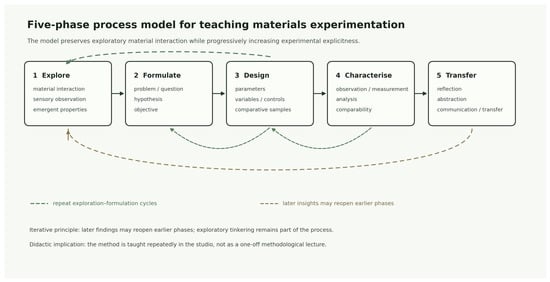
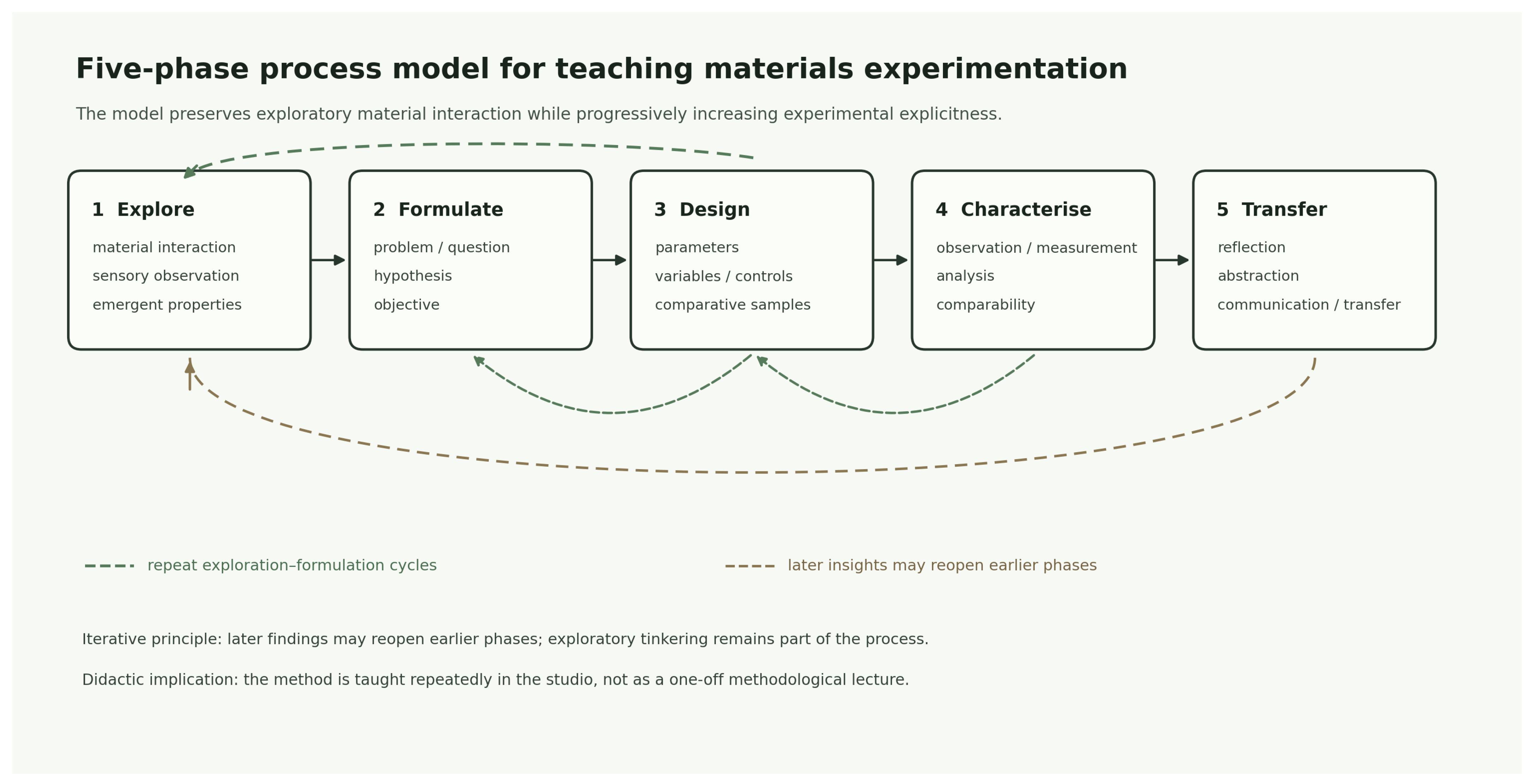
Based on the literature and empirical findings, we propose a five-phase model (Figure 1). The model is a proposed pedagogical framework derived from the case-study findings and the literature. It was formulated on the basis of the empirical phases and has not been implemented and evaluated as a complete model; it should therefore not be read as a validated teaching model.
Figure 1.
Proposed five-phase process model for teaching materials experimentation. The model increases experimental explicitness progressively while preserving exploratory material interaction. The phases are shown in sequence; exploratory and hypothesis-oriented stages may alternate several times within one project (see text).
Phase 1—Exploratory material interaction. Students work openly with the material and document emerging observations. This phase preserves the productive uncertainty of material tinkering. It can include manipulation of composition, processing and material effect [6].
Phase 2—Explicit problem and hypothesis formulation. Students select an aspect that has become relevant through exploration and formulate a research question, hypothesis and objective. The aim is not to force a hypothesis before the material has been encountered, but to make the transition from exploration to explicit investigation visible.
Phase 3—Systematic experimental design. Students define parameters, identify variables, establish comparison conditions and specify a documentation protocol. Existing materials-research education already contains elements of this logic. Ayala Garcia’s roadmap, for example, combines tinkering with iteration, optimization, characterization and documentation [9].
Phase 4—Characterization and analysis. Students determine how observations or measurements will be described and compared. Depending on the research question, characterization may be qualitative, quantitative or mixed. The educational objective is methodological fit: students should understand why a particular form of observation or measurement is appropriate rather than simply adding measurements for their own sake.
Phase 5—Abstraction and transfer. Students reflect on what the experiment allows them to say, what remains uncertain, and how the findings could be communicated or used by others. The output may be a design decision, a material demonstrator, a documented material sample, a database entry, or a more general methodological statement. The important point is that the knowledge claim is made explicit.
The model is deliberately iterative. Students may return from Phase 5 to Phase 1 or from characterization to experimental design. In particular, the model does not assume a single exploratory stage followed by a single hypothesis-oriented stage. Open, divergent exploration (Phase 1) and convergent, hypothesis-oriented work (Phases 2–4) can alternate several times within one project: a first cycle may end with a provisional question, the results of a first systematic comparison may open a new exploratory stage, and a more focused question may follow from it. This corresponds to accounts of experimentation in which exploratory and hypothesis-oriented practices alternate [16], and it reflects the circularity of experimental systems and the iterative nature of design practice [15]. The model therefore does not prescribe a linear scientific workflow; it provides checkpoints at which epistemic explicitness is increased. Whether several shorter cycles of exploration and formulation support students better than one extended cycle is an open question that the present study cannot answer: in the third empirical phase, a single initial tinkering stage preceded the formulation of a research question (Section 2.4).
The individual phases overlap with existing approaches, and the model does not claim novelty for its components. Open material tinkering is described by Rognoli and Parisi [6]. Material-Driven Design leads from an understanding of the material to a material-experience vision and product concepts [8]. The Materials Generation Roadmap combines tinkering with iterative optimization, characterization and documentation [9]. Controlled conditions, characterization and reproducibility are established principles of experimentation in materials science [22,23,24], and the movement between active experimentation, concrete experience, reflective observation and abstract conceptualization follows the experiential learning cycle [20]. What the proposed model adds is a different orientation and three pedagogical emphases that follow from the case study.
First, the intended outcome differs. Material-Driven Design and the Materials Generation Roadmap are oriented toward material experiences, product concepts or the development of a material [8,9]. The model proposed here is oriented toward the communicability of the experimental process itself: its endpoint is an explicit knowledge claim stating the conditions under which it was produced and whether it resulted in a product concept or a new material. Second, the model treats the transition from exploration to explicit investigation as an object of teaching in its own right. In the empirical phases, this transition, from an objective to a researchable question, and from trying something to deliberately varying it, was among the aspects least often made explicit. The model therefore places a separate phase (Phase 2) and explicit checkpoints at this point instead of assuming that the transition follows from tinkering. Third, the model is formulated for bachelor-level studio teaching and is tied to curricular integration and to educator learning (Section 4.4 and Section 4.5). The contribution is thus a pedagogical recombination and re-orientation of known elements around the concept of experimental explicitness; it is not a new theory of materials experimentation.
4.4. Why Curricular Integration Matters
The results from the presented case study suggest that a one-week methodological introduction is not sufficient to stabilize the proposed practice. Students explicitly requested continuous guidance and stronger alignment between the methodological input and the studio project. This finding is consistent with the broader materials-education literature, which treats materials learning as involving competence, tools, spaces and services rather than a single method lesson [18].
The curricular implication is that materials experimentation should not be isolated as a special workshop. The same terminology and methodological expectations need to recur in studio consultations, project books, mid-term presentations and final reviews. A documentation template is useful only if teachers refer to it during the process and if assessment recognizes the quality of experimental reasoning rather than only the attractiveness of the final material or object. Table 4 summarizes the proposed curricular scaffold.
Table 4.
Proposed curricular scaffold for teaching materials experimentation and developing transdisciplinary readiness.
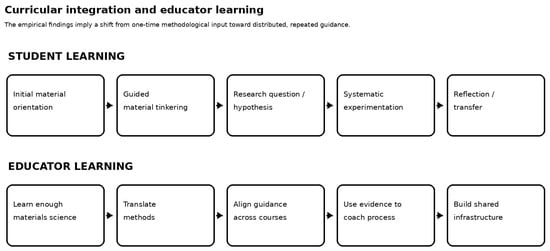
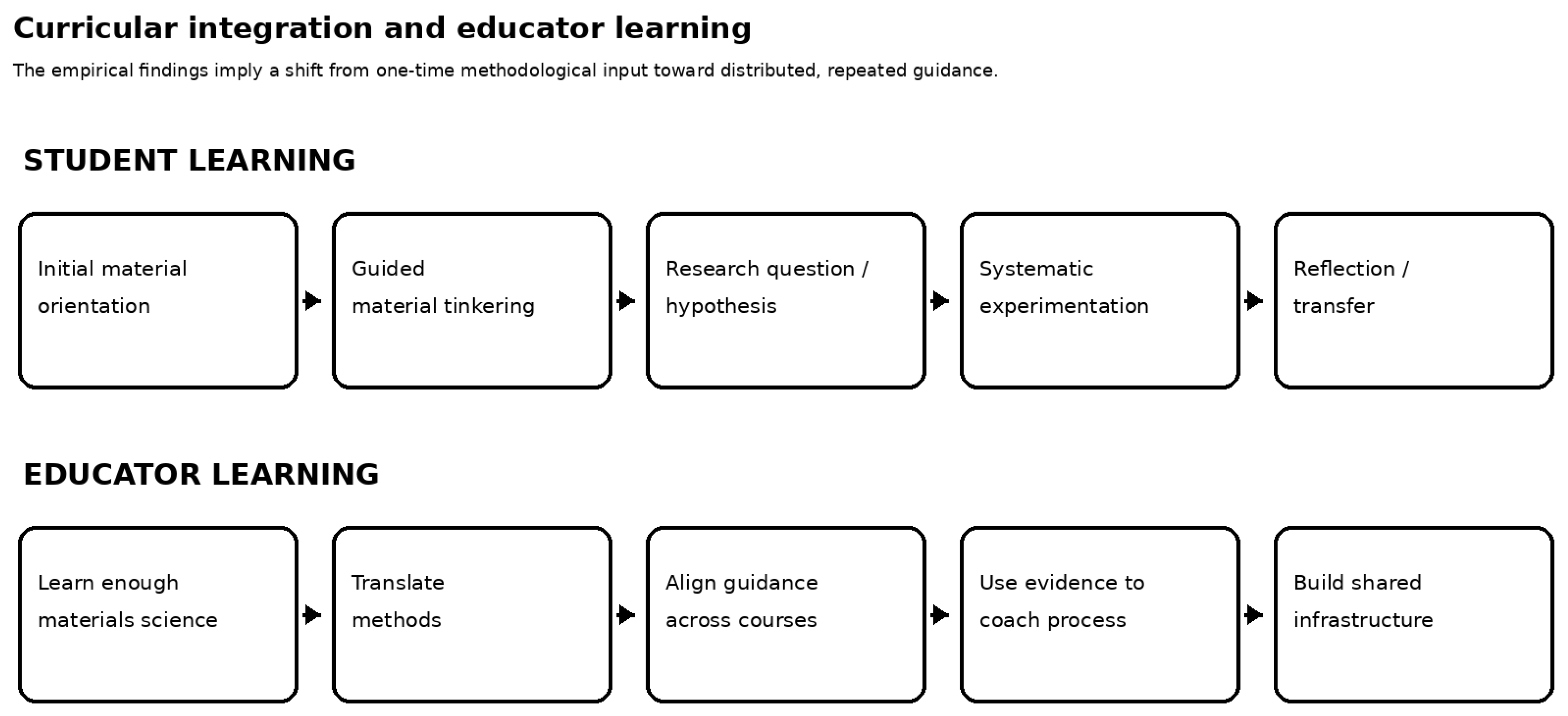
Figure 2 therefore proposes curricular integration at two levels: student learning and educator learning. Students encounter the five phases repeatedly across the semester, while educators develop the knowledge and coordination required to support the transition between phases.
Figure 2.
Curricular integration and parallel educator learning. The model translates the empirical finding that methodological guidance needs to recur across the semester and across teaching contexts.
4.5. The Educator as a Boundary-Spanning Learner
A central implication of the study concerns the educators themselves. The empirical material shows that students encounter scientific literature and concepts from materials research that they do not always understand. If educators are expected to help students interpret these sources, formulate suitable experimental questions and select appropriate methods, educators also need sufficient methodological and material-science literacy.
This is a substantial requirement, and it should be stated without reservation. Formulating experimental questions, selecting methods and interpreting specialist sources are activities that scientists perform, and educators who teach material-oriented design need enough proficiency and confidence in material manipulation and experimental methods to perform and to teach them. Such educators do not thereby cease to be designers. Their competence is boundary-spanning: knowing enough about neighboring research cultures to recognize what a student can investigate independently, what requires specialist support, how a scientific concept can be translated into a design-education context, and when collaboration is needed and knowing the underlying principles well enough not only to follow them, but also to depart from them deliberately and creatively when a design question calls for it.
The need for continuing material knowledge is already recognized in the literature. Santulli and Rognoli explicitly argue for continuous education about materials because materials and processes continually develop [25]. Henriksson’s teaching of Material Driven Design to engineering students provides another example of methodological translation across educational contexts [26]. The present study extends this issue to the educators who teach design students: transdisciplinary readiness is partly a pedagogical capacity.
This is also where the distinction between design practice and academic research becomes important. Hohl describes differences in questions and forms of knowledge between practice and academic design research [10]. The educator’s task is therefore not simply to “teach science” but to help students understand which knowledge claims their design experiments can support and how those claims can be articulated so that collaborators from other fields can engage with them.
4.6. Design Should Not Be Assimilated to Natural Science
The comparison with natural-science materials research (Table 1) is useful as a pedagogical reference point, but it should not be interpreted as a hierarchy in which scientific methods are inherently superior. Materials science uses controlled conditions, characterization methods and reproducibility to answer particular questions about material properties [22,23,24]. Product design operates with different objects, purposes and forms of knowledge, and material experience includes sensory, interpretive, affective and performative dimensions [4,17].
The educational objective is therefore selective compatibility. Students should learn the principles that allow their experimental work to connect with other disciplines—explicit questions, variable logic, transparent procedures, appropriate characterization, documented results and clear limits of inference—while retaining design-specific exploration and sensory-material inquiry.
This position is also consistent with the literature on experimental material research, which describes the relationship between material knowledge and design competence as productive rather than reducible to one disciplinary model [27]. It also corresponds with the need for systematic approaches in design-for-sustainability contexts, where methodological diversity can make comparison and accumulation difficult [28].
4.7. Implications for Transdisciplinary Collaboration
The pedagogical contribution can be stated in terms of a threshold for collaboration. Students do not need to reproduce a materials-science laboratory protocol in order to collaborate with materials scientists. They do need to make their own experimental situation legible enough for collaborators to understand what was investigated, under which conditions, what was observed and what remains uncertain.
This is where the concept of experimental explicitness is useful. It describes a minimum common methodological language rather than a demand for disciplinary assimilation. The goal is to enable designers to participate as competent and confident partners in collaborative knowledge production, with sufficient command of experimental method to contribute their own questions and procedures and not merely to adopt those of other disciplines.
The implications extend beyond individual projects. Documentation standards, shared material databases, materials libraries and recurring cooperation projects can provide infrastructures through which experimental knowledge accumulates. The students’ expressed desire to share findings and build on previous work supports this direction, as does the literature on material libraries as knowledge-transfer infrastructures [19].
These implications describe pedagogical objectives. The present case study did not examine collaboration between students and researchers from other disciplines, and it did not assess whether students’ experimental findings can be understood, reproduced or applied by such researchers. The proposed model is therefore put forward as having potential value for fostering transdisciplinary research; its contribution to students’ transdisciplinary research capabilities remains to be demonstrated.
4.8. Limitations
The study is a single institutional case and should not be interpreted as representative of product-design education as a whole. As a case study it offers exploration and analysis of one specific example, thus selecting methods and data sources in relation to research questions and case specifics. The empirical phases involve different student cohorts and different teaching conditions, and the third phase allowed students to change their project orientation. The qualitative design supports detailed interpretation of pedagogical processes but does not permit statistical claims about effects across design education. Differences between the phases therefore cannot be attributed to the teaching intervention.
A further limitation concerns the level of technical characterization. The study examines the educational process rather than validating students’ material findings through independent materials-science testing. Consequently, the proposed model is a pedagogical framework derived from design-education evidence and literature, not a validated materials-testing protocol.
Finally, the study does not include a separate empirical investigation of educators’ learning. The argument concerning educator learning is therefore an implication derived from the students’ reported needs, the curricular observations and the literature on materials education and interdisciplinary research. It should be investigated directly in future work.
5. Conclusions
This study began with a practical problem: product-design students increasingly encounter material research contexts in which collaboration with established scientific disciplines requires more explicit experimental reasoning than is typically made visible in studio-based material exploration. The exploratory case study indicates that students already possess substantial exploratory competence. What their presentations and documentation rarely made explicit were the transitions between exploration, question formulation, systematic comparison, documentation, reflection and transfer.
The proposed five-phase model—exploratory material interaction; explicit problem and hypothesis formulation; systematic experimental design; characterization and analysis; and abstraction and transfer—offers a teaching structure for making these transitions explicit. Its purpose is not to replace material tinkering but to connect tinkering with a more systematic mode of inquiry when the research question requires it. The model is a pedagogical framework derived from the case-study findings and the literature; it has not yet been implemented and evaluated as a whole.
The findings also suggest that a single methodological introduction is unlikely to be sufficient to bring about this change. Students requested repeated guidance and stronger integration with studio teaching. For educators, this creates a corresponding learning requirement. To teach transdisciplinary materials experimentation, design educators need sufficient methodological and material-science literacy to translate concepts between disciplinary cultures, recognize the limits of student-led experimentation and establish meaningful connections with specialist research.
The principal contribution of the paper is therefore pedagogical and conceptual: it identifies experimental explicitness as a teachable objective and proposes a framework for teaching it while retaining design-specific material exploration. The present evidence supports the description of students’ practices, of what they made explicit and of the guidance they requested. It does not demonstrate that the framework improves students’ capabilities for transdisciplinary research: knowledge transferability and transdisciplinary applicability are pedagogical objectives whose attainment requires independent assessment. Future research should examine the proposed model across additional cohorts, materials and institutions, investigate educator learning directly, and evaluate—including through assessment by researchers from other disciplines—whether the model improves the quality, transferability and interdisciplinary usability of student-generated materials knowledge.
Author Contributions
Conceptualization, S.D., S.M. and A.R.; Methodology, S.D. and A.R.; Investigation, S.D., S.M. and A.R.; Formal analysis, A.R.; Writing—original draft preparation, S.D. and A.R.; Writing—review and editing, visualization, supervision, and project administration, S.D., S.M. and A.R. All authors have read and agreed to the published version of the manuscript.
Funding
This research received no external funding.
Institutional Review Board Statement
The study was conducted in accordance with the applicable institutional rules and procedures for educational research.
Informed Consent Statement
Informed consent was obtained from all students who participated in the recorded focus group and problem-centered interviews.
Data Availability Statement
The empirical material consists of teaching observations, student presentations and project books, a recorded focus group and problem-centered interviews held by the authors. Because these materials concern student participants and potentially identifiable educational work, access is subject to applicable privacy and ethical restrictions. No public repository identifier is available in the supplied documentation.
Acknowledgments
This manuscript substantially extends a previously published conference paper [29]. It retains the earlier study as part of the research trajectory but shifts the focus to the pedagogical problem of teaching materials experimentation for transdisciplinary collaboration, incorporating the extended empirical teaching phases and the educator-learning implications.
Conflicts of Interest
The authors declare no conflicts of interest.
References
- Ashby, M.; Johnson, K. Materials and Design: The Art and Science of Materials Selection in Product Design; Butterworth-Heinemann: Oxford, UK, 2002. [Google Scholar]
- Rognoli, V.; Levi, M. How, What and Where Is It Possible to Learn Design Materials? In The Changing Face of Design Education, DS 33: Proceedings of the Engineering and Product Design Education Conference, Delft University of Technology, Delft, The Netherlands, 2–3 September 2004; The Design Society: Glasgow, UK, 2004; pp. 647–654. [Google Scholar]
- Karana, E. Meanings of Materials. Ph.D. Thesis, Delft University of Technology, Delft, The Netherlands, 2009. [Google Scholar]
- Karana, E.; Pedgley, O.; Rognoli, V. Materials Experience: Fundamentals of Materials and Design; Elsevier/Butterworth-Heinemann: Amsterdam, The Netherlands, 2014. [Google Scholar]
- van Kesteren, I.E.H.; Stappers, P.J.; de Bruijn, J.C.M. Materials in product selection: Tools for including user-interaction aspects in materials selection. Int. J. Des. 2007, 1, 41–55. [Google Scholar]
- Rognoli, V.; Parisi, S. Material Tinkering and Creativity. In Material Designers: Boosting Talent towards Circular Economies; Clèries, L., Rognoli, V., Solanki, S., Llorach, P., Eds.; Faculty of Design and Art, Elisava Barcelona School of Design and Engineering: Barcelona, Spain, 2020; pp. 20–26. [Google Scholar]
- Rognoli, V.; Bianchini, M.; Maffei, S.; Karana, E. DIY Materials. Mater. Des. 2015, 86, 692–702. [Google Scholar] [CrossRef] [Scilit]
- Karana, E.; Barati, B.; Rognoli, V.; Zeeuw van der Laan, A. Material Driven Design (MDD): A Method to Design for Material Experiences. Int. J. Des. 2015, 9, 35–54. [Google Scholar]
- Ayala Garcia, C. The Materials Generation: The Emerging Experience of DIY-Material. Ph.D. Thesis, Politecnico di Milano, Milan, Italy, 2019. [Google Scholar]
- Hohl, M. Wissenschaftliches Arbeiten in Kunst, Design und Architektur: Kriterien für Praxisgeleitete Ph.D.-Forschung; DOM Publishers: Berlin, Germany, 2019. [Google Scholar]
- Badke-Schaub, P.; Voute, E. Design Methodology: Where do you go? In Proceedings of the DESIGN 2018 15th International Design Conference, Dubrovnik, Croatia, 21–24 May 2018; pp. 25–32. [Google Scholar] [CrossRef] [Scilit]
- Gericke, K.; Eckert, C.; Stacey, M. Elements of a design method—A basis for describing and evaluating design methods. Des. Sci. 2022, 8, e29. [Google Scholar] [CrossRef] [Scilit]
- Cash, P.; Daalhuizen, J.; Hekkert, P. Evaluating the efficacy and effectiveness of design methods: A systematic review and assessment framework. Des. Stud. 2023, 88, 101204. [Google Scholar] [CrossRef] [Scilit]
- Farías, I.; Wilkie, A. Introduction. In Studio Studies: Operations, Topologies and Displacements; Farías, I., Wilkie, A., Eds.; Routledge: London, UK, 2015. [Google Scholar]
- Rheinberger, H.-J. Toward a History of Epistemic Things: Synthesizing Proteins in the Test Tube; Stanford University Press: Stanford, CA, USA, 1997. [Google Scholar]
- Marguin, S.; Rabe, H.; Schäffner, W.; Schmidgall, F. Einleitung. In Experimentieren: Einblicke in Praktiken und Versuchsaufbauten zwischen Wissenschaft und Gestaltung; Marguin, S., Rabe, H., Schäffner, W., Schmidgall, F., Eds.; Transcript: Bielefeld, Germany, 2019; pp. 9–24. [Google Scholar] [CrossRef] [Scilit]
- Pedgley, O.; Rognoli, V.; Karana, E. Materials experience as a foundation for materials and design education. Int. J. Technol. Des. Educ. 2016, 26, 613–630. [Google Scholar] [CrossRef] [Scilit]
- Zhou, Z.; Rognoli, V. Material Education in Design: From Literature Review to Rethinking. In Proceedings of the 5th International Conference for Design Education Researchers: Insider Knowledge, Ankara, Türkiye, 9–11 July 2019. [Google Scholar] [CrossRef]
- Romani, A.; Rognoli, V.; Levi, M. Materials Libraries: Designing the Experiential Knowledge Transfer through Prototyping. In Proceedings of the EKSIG 2023—From Abstractness to Concreteness: Experiential Knowledge and the Role of Prototypes in Design Research, Milan, Italy, 19–20 June 2023; pp. 398–411. [Google Scholar]
- Kolb, D.A.; Fry, R. Toward an applied theory of experiential learning. In Theories of Group Process; Cooper, C., Ed.; John Wiley: London, UK, 1975; pp. 33–57. [Google Scholar]
- Schulz, M. Quick and easy!? Fokusgruppen in der angewandten Sozialwissenschaft. In Fokusgruppen in der Empirischen Sozialwissenschaft: Von der Konzeption bis zur Auswertung; Schulz, M., Mack, B., Renn, O., Eds.; Springer VS: Wiesbaden, Germany, 2012; pp. 9–23. [Google Scholar]
- Callister, W.D.; Rethwisch, D.G. Materials Science and Engineering: An Introduction, 10th ed.; Wiley: Hoboken, NJ, USA, 2020. [Google Scholar]
- Ashby, M.; Jones, D. Engineering Materials 1: An Introduction to Properties, Applications, and Design; Butterworth-Heinemann: Oxford, UK, 2012. [Google Scholar]
- Shackelford, J.F. Introduction to Materials Science for Engineers, 9th ed.; Pearson: Boston, MA, USA, 2023. [Google Scholar]
- Santulli, C.; Rognoli, V. Material tinkering for design education on waste upcycling. Des. Technol. Educ. Int. J. 2020, 25, 50–73. [Google Scholar]
- Henriksson, F. Ending up at the beginning—Teaching Material Driven Design to Engineering Students. In DS 117: Proceedings of the 24th International Conference on Engineering and Product Design Education (E&PDE 2022), London, UK, 8–9 September 2022; Bohemia, E., Buck, L., Grierson, H., Eds.; The Design Society: Glasgow, UK, 2022. [Google Scholar] [CrossRef] [Scilit]
- Berzina, Z.; Sauer, C. (Eds.) Design and Experimental Material Research, 2nd ed.; Weißensee Kunsthochschule Berlin: Berlin, Germany, 2016. [Google Scholar]
- Langer, V.; Tampe, A.; Götze, U. Design for Sustainability in Manufacturing—Taxonomy and State-of-the-Art. In Manufacturing Driving Circular Economy; Kohl, H., Seliger, G., Dietrich, F., Eds.; Springer: Cham, Switzerland, 2023. [Google Scholar] [CrossRef] [Scilit]
- Dittenberger, S.; Moritsch, S.; Raschauer, A. Teaching materials experiments in product design. In Learn X Design 2025, Aveiro, Portugal, 22–24 September 2025; Clemente, V., Gomes, G., Reis, M., Félix, S., Ala, S., Jones, D., Eds.; Design Research Society: Glasgow, UK, 2025. [Google Scholar] [CrossRef] [Scilit]

Disclaimer/Publisher’s Note: The statements, opinions and data contained in all publications are solely those of the individual author(s) and contributor(s) and not of MDPI and/or the editor(s). MDPI and/or the editor(s) disclaim responsibility for any injury to people or property resulting from any ideas, methods, instructions or products referred to in the content. |
© 2026 by the authors. Licensee MDPI, Basel, Switzerland. This article is an open access article distributed under the terms and conditions of the Creative Commons Attribution (CC BY) license.