


Abstract
Workers employed in clay brick manufacturing are at risk of developing chronic respiratory diseases stemming from work-related aerosol exposures. Prior studies characterize respirable dust and respirable silica (SiO2) exposures among brick workers in Nepal, but these assessments were based on relatively small sample sizes and incomplete representation of job categories with potentially high exposures. In this study we combine exposure data previously reported with data from two subsequent sampling periods. The expanded data set (N = 205) allowed for exposure characterization across ten common job categories. Partial-shift breathing zone respirable dust and respirable SiO2 exposures were measured using personal pump and cyclone samplers with a 4.0 µm aerodynamic diameter cut-point. Job categories that involved handling red (fired) bricks in any capacity, and top loading, are associated with geometric mean SiO2 exposure concentrations exceeding 25 µg/m3 that were significantly higher than job categories that did not handle red bricks (p < 0.01). Similarly, job categories where red bricks are handled in any capacity are associated with significantly higher respirable dust concentrations than other job categories (p < 0.01). Understanding task-specific exposure profiles may help prioritize interventions aimed at decreasing workers’ aerosol exposures, which may decrease chronic respiratory diseases in this population of workers.
1. Introduction
Chronic respiratory diseases (CRD) are the third leading cause of global mortality [1], and occupational exposures to particulate matter (PM), gases, and fumes are the third leading risk factors of CRDs [1]. Respirable dust (RD), defined as particles with an aerodynamic diameter less than 4.0 µm, and respirable silica (SiO2), a subtype of RD that contains crystalline SiO2, are among the most common occupational inhalation exposures globally [2,3]. Occupational dust exposures are implicated in the progression of many CRDs, including asthma, chronic obstructive pulmonary disease (COPD), emphysema, bronchitis, silicosis, and other acute and chronic health outcomes, depending on the dust’s composition [4].
The clay soils found in the Kathmandu Valley originated as fluvio-lacustrine sediments in the now-extinct paleo-Kathmandu Lake, beginning in the late Pliocene Epoch (~2.8 Ma) [5,6]. The source of the lake bed sediments was erosion of rocks that form the Lesser Himalaya that line the valley [5]. Among the rock types exposed to weathering are quartz-containing gneiss, granite, schist, metasandstone, siliceous limestone, and quartzite [5,7,8], which explains the presence of free (crystalline) SiO2 found in ancient and modern bricks sourced from clay in the Kathmandu Valley [9,10]. X-ray diffraction (XRD) of drilled sediments from the western central valley found that quartz makes up 20–44% of the mineral composition within the top 50 m of soil [11]. In some locations in the valley, quartz accounts for >50% of soil minerals by weight [8].
Brick making globally is a dusty occupation [12,13,14], and this holds true in Nepal, where most brick making tasks are associated with RD exposures [15,16]. Sanjel et al. (2017) reported mean RD concentrations across five job categories ranging from 0.7 to 5.9 mg/m3, with lowest and highest exposures belonging to workers engaged in green brick molding and red brick loading, respectively [17]. Beard et al. (2024) reported a mean RD concentration of 0.2 mg/m3 across five job categories, with the highest exposures belonging to workers engaged in top loading (GM = 1.5, 95% CI: 1.1, 2.1) [15]. Nicolaou et al. (2025) reported a mean RD concentration of 0.9 mg/m3 across four job categories [16]. The highest exposures were among brick haulers, whose mean 8-h time-weighted-average (TWA) was 2.6 mg/m3 (95% CI: 1.4, 4.9).
Previous exposure monitoring shows crystalline SiO2 makes up 2–20% of the respirable dust fraction during clay brick manufacturing, globally [12,18,19,20]. This translates into inhalation exposure when brick dust is suspended in the workers’ breathing zone. Specific to brick making in Nepal, Sanjel et al. (2018) reported 13.8% of respirable brick dust was crystalline SiO2, in the form of quartz [20]. Beard et al. (2024) reported respirable SiO2 exposure levels ranging from 7.8 to 173.1 µg/m3 across workers in five job categories, with the highest exposures belonging to workers engaged in top loading [15]. The overall geometric mean across all five job categories was 15.3 µg/m3 [15]. Nicolaou et al. (2025) reported a mean 8-h TWA respirable SiO2 exposure level of 57.4 µg/m3 across workers in five job categories (n = 56), with the highest exposures belonging to workers engaged in brick stacking (117.3 µg/m3) [16]. Nepal does not currently have an occupational exposure limit (OEL) for respirable crystalline SiO2, but a level of 50 µg/m3 has been proposed [21], which is lower than the exposure levels reported for several brick making tasks, including stacking, hauling, and top loading [15,16].
Understanding RD and SiO2 exposures across brick worker job categories may help identify workers at higher risk of contracting occupational lung diseases. Similar approaches have been used to characterize exposures and identify target intervention areas among artisanal small-scale mining workers in Ghana [22]. One gap in the literature specific to Nepal is that prior studies report exposures based on relatively small sample sizes, ranging from 46 to 88 participants [15,16,17,20]. Furthermore, direct comparison by job category is limited because no single study to date includes exposure data for the most common brick kiln job categories. For example, Nicolaou et al. (2025), reported SiO2 exposure data for 88 participants from four job categories, including green brick molders, green brick stackers, green and red brick carriers (haulers), and “other” [16]. Beard et al. (2024) reported RD and SiO2 exposure data for 49 participants from five job categories, including administration, fire masters, green brick hand molders, green brick machine molders, and top loaders [15]. Sanjel et al. (2018) and Sanjel et al. (2017) reported RD and SiO2 exposures among 72 and 46 workers, respectively, across five job categories: green brick molders, green brick stackers/carriers, red brick loaders/carriers, coal preparation/carriers, and firemen [17,20]. This study expands on the previous work reported by Beard et al. (2024) [15]. The results reported by Beard et al. included workers (n = 49) monitored in 2023 from a single induced draught zigzag kiln in Bhaktapur, Nepal [15]. Herein, we include findings from three additional kilns sampled in 2024 and 2025 in Bhaktapur, with an approximately four-fold increase in the number of participants. The addition of participants from the 2024 and 2025 cohorts also doubles the number of job categories considered in previous studies, providing a more complete characterization of exposures among brick workers in Nepal.
2. Materials and Methods
2.1. Study Design
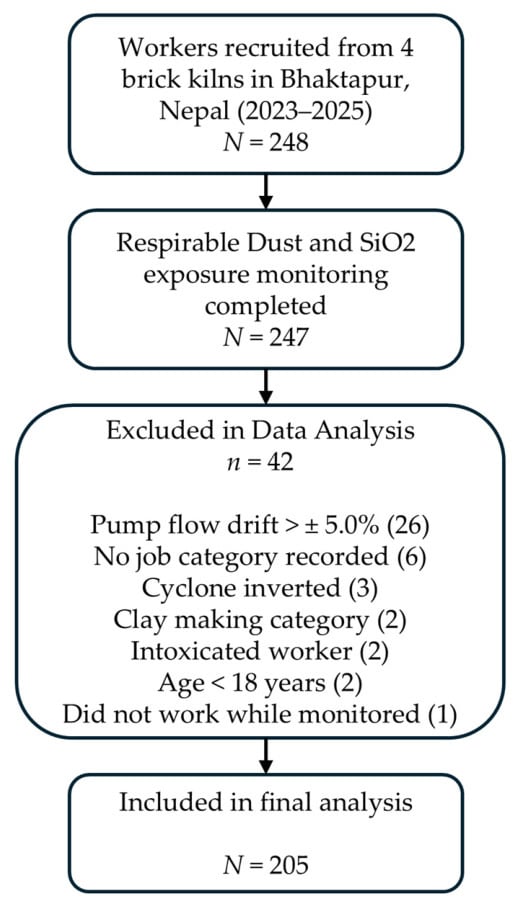
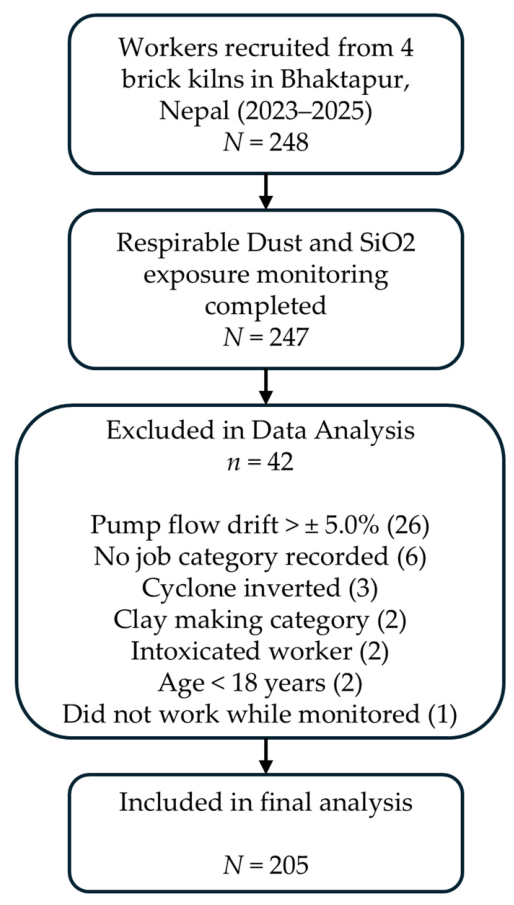
A quantitative, cross-sectional study was conducted over an approximately three-year period with sample collection events occurring 13–21 March 2023, 17–23 March 2024, and 18–26 February 2025. Samples were taken across 4 brick kilns in Bhaktapur, Nepal, including Kiln 1 in 2023, Kiln 2 in 2024, and Kilns 3 and 4 in 2025. Participants (N = 248) were recruited by convenience sampling from kiln 1 (n = 49), kiln 2 (n = 70), kiln 3 (n = 69), and kiln 4 (n = 60). Brick kilns were selected for inclusion based on membership in the Brick Kiln Owner’s Association and willingness to host our research team. Participants were recruited from among common job categories, including truck driver and excavator operators, top loaders, red and green brick carriers/stackers, green brick machine molders, green brick hand molders, fire masters, coal carriers, and administrators. Inclusion criteria included being over the age of 18 and being employed at the brick kiln. Participants were compensated with NPR 1000 upon completion of data collection. A total of 43 participants were excluded, leaving N = 205 in the final analysis (Figure 1). Participants were excluded based on pump flow rate drift > ±5.0% from pre- to post-calibration (n = 26), no job category listed (n = 6), cyclone was inverted (n = 3), being in a clay making category (n = 2) which was too small for analysis, worker was intoxicated at the end of the work shift (n = 2), participant was less than 18 years old (n = 2), sample not collected on worker (n = 1), and participant did not work while wearing monitor (n = 1). This research was conducted as part of a larger study on brick worker health and safety, entitled “Respiratory, vascular, and inflammatory health effects associated with brick workers’ aerosol exposures”. The results presented here are limited to partial shift exposure monitoring for RD and respirable SiO2. Health outcomes from the larger study will be reported elsewhere. This study was approved by the Nepal Health Research Council (ID# 554/2022 P; 6032024) and by Brigham Young University’s Institutional Review Board (IRB2022-370; IRB2024-359). All participants provided informed consent prior to the study.
Figure 1.
Flow diagram of participant enrollment and sample exclusions.
2.2. Exposure Monitoring
The National Institute for Occupational Safety and Health (NIOSH) methods 0600 and 7500 were used for RD and respirable crystalline SiO2 monitoring, respectively [23,24]. Samples were collected on matched-weight, 5 µm PVC filters placed on a cellulose support pad and housed in three-piece, 37 mm styrene sampling cassettes (Zefon International, Ocala, FL, USA). Cassettes were fitted to 37 mm aluminum cyclones separators (SKC Inc., Eighty Four, PA, USA) to create a 4.0 µm respirable fraction cut point. Research personnel applied a light coat of deionized water to the O-ring on the cyclone to aid in attaching the filter cassette and to prevent the O-ring from slipping out of place during sampler assembly. The cyclone/cassette assembly was placed in a filter cassette holder (SKC Inc., Eighty Four, PA, USA) and attached within the participant’s breathing zone (~23 cm from the nares). Tygon® tubing (Saint-Gobain Performance Plastics Corp., Malvern, PA, USA) was used to connect the filter cassette holder to AirLite® Model 110-100 personal sampling pumps (SKC Inc., Eighty Four, PA, USA). Pump flow rate was calibrated using a representative calibration cassette blank/cyclone in-line between the pump and a DryCal Defender 510-H or 510-M calibrator (Mesa Labs, Lakewood, CO, USA). Nine different DryCal calibrators were used over the 3-year study period. All DryCals were calibrated by the manufacturer within one year of their use. AirLite pumps were calibrated to 2.5 L/min with a 1% variation acceptance (2.475–2.525 L/min). Pre- and post-calibration measurements were taken by collecting the average of 10 continuous burst readings. Fresh AA batteries were installed in the pumps between participants.
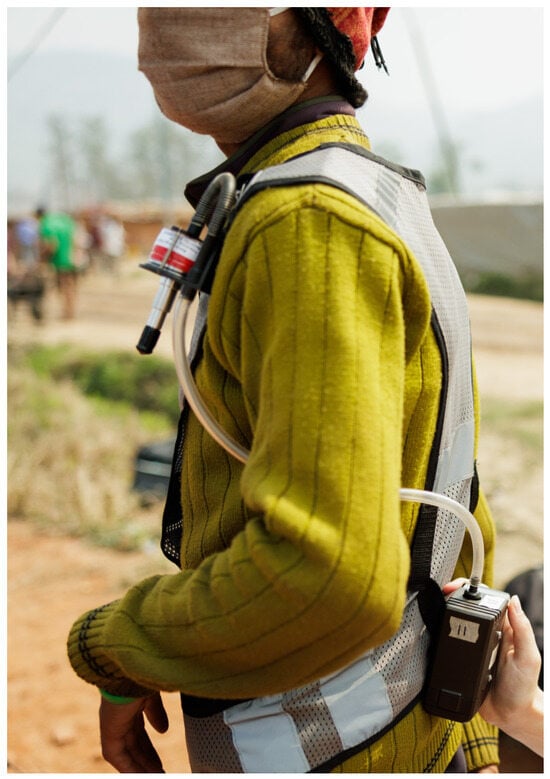
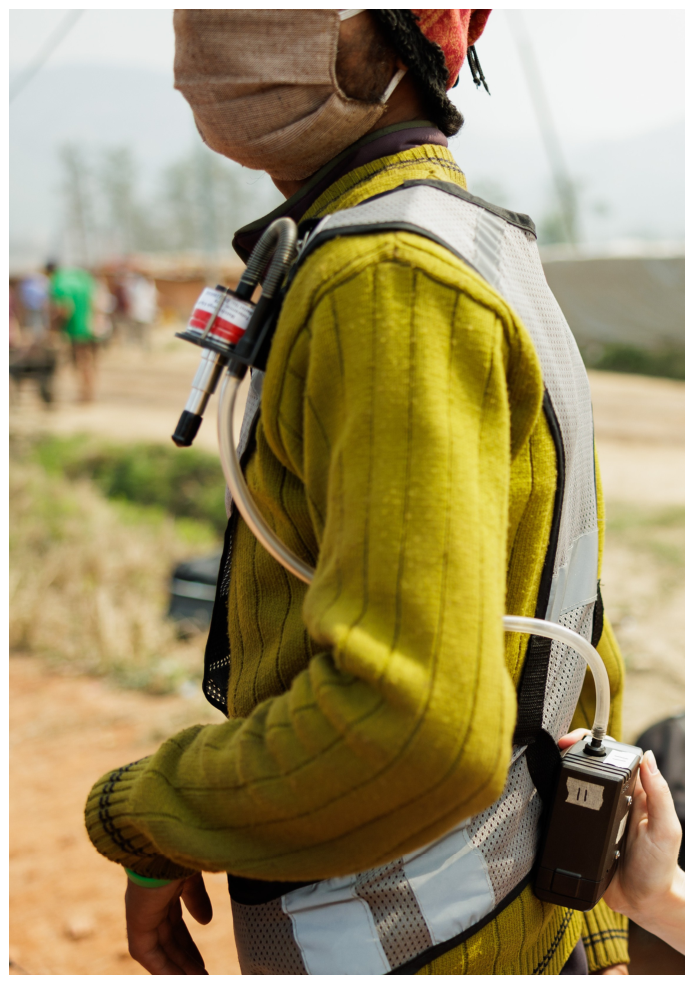
Data collection teams differed from year to year with consistent training on methodology and quality control. A total of 11 study personnel were involved in collecting RD and SiO2 samples over the 3-year study. Verbal communication with participants occurred through Nepali-speaking study personnel. Because participants enrolled in the study at varying times throughout the workday, partial-shift samples were collected. Brick workers’ clothing did not always allow for secure pump and sampler attachment, so sampling vests were worn by participants. Pumps were secured to a 100% polyester reflective running vest, and cyclone holders were attached via an alligator clip to the vest and positioned in the participants’ breathing zone (Figure 2). After being fitted with the sampling vest and pump and cyclone assembly, workers were asked to confirm comfort and workability of wearing the equipment while doing their jobs. Adjustments to fit were made as needed. Participants were then instructed not to cover the cyclone with clothing, and not to tip the cyclone upside down as this might cause particles in the grit pot to fall onto the filters. The pumps were then turned on and participants returned to their work areas. For sample collection in 2023, study personnel changed sample cassettes approximately every two hours at the participants’ work area. For 2024 and 2025 sample collection periods, cassettes were changed after approximately four hours of sampling. This change was based on analysis of samples from 2023 showing that filter overloading had not occurred, and longer sampling times per cassette were justified [15]. Following the sampling period, pumps were post-calibrated using the same calibrator that was used for pre-calibration.
Figure 2.
Placement of respirable dust/SiO2 cyclone and pump assembly on worker with sampling cassette located in the breathing zone. Photograph by Jaren Wilkey, University Communications, Brigham Young University, Provo, UT, USA.
Field notes were collected on a hard-copy standardized form that included the following: Participant name, participant ID number, job category, pump serial number, pre- and post-calibration flow rates, calibrator serial number, person who performed calibration, cassette ID numbers, date of sampling, and start and stop times for each cassette. Data, excluding participant name, were transferred from the hard copy forms to an Excel spreadsheet (Microsoft Corporation, Redmond WA, USA). Job descriptions provided by participants were categorized into one of the following: administration, coal carrier, fire master, green brick carrier/loader/stacker, green brick hand molder, green brick machine molder, green/red brick carrier/loader/stacker, red brick carrier/loader/stacker, top loader, truck driver/excavator operator, and clay making. Administrators’ job tasks included indoor office work, as well as overseeing work done by all other job categories throughout the entire kiln. The brickmaking process involves each of the other job categories. First, excavator operators scoop up dry soil, which clay makers moisten to create wet clay. Green brick hand and machine molders use the clay, molds, and a dry release agent to shape the clay into bricks, which are left to dry. Green brick carriers/loaders/stackers both stack drying bricks, carry them to the kiln, and load them inside to be fired. Coal carriers prepare coal by mixing it with organic material and crushing it into granules, and then carry it to the fire masters, who work atop the kiln, dropping the coal down chutes to stoke the fire. Once bricks have been fired, top loaders manually remove the top layer of insulating soil from the kiln. Red brick carriers/loaders/stackers then take the now red, fired brick from the kiln. Truck drivers assist in transporting the bricks and raw materials. Participant demographic data was collected using an extant questionnaire [25].
2.3. Laboratory Analysis
Sampling cassettes were delivered in-person by study personnel to ALS Environmental (Salt Lake City, UT, USA), an AIHA-accredited laboratory, for gravimetric and XRD analysis. Participants’ names and all other personal information were de-identified before analysis. Samples were analyzed gravimetrically for RD. The ALS-Environmental-modified NIOSH Method 0600 was used, with matched weight filters. Modification included conditioning filters in the lab for 30 min prior to weighing. Samples were analyzed for crystalline SiO2 (quartz, cristobalite, and tridymite) by XRD following NIOSH Method 7500. Reporting limits were 5.0, 5.0, and 20.0 µg/sample for quartz, cristobalite, and tridymite, respectively. All samples were below the reporting limit for cristobalite and tridymite. Field blanks for 2023 (n = 10), 2024 (n = 4), and 2025 (n = 10) were submitted with participant cassettes. Field blanks were analyzed gravimetrically for RD and by XRD for SiO2. Mean field blank values were subtracted from exposure values in the analyses.
2.4. Statistical Analyses
All statistical analyses were conducted in R (version 4.6.1; R Foundation for Statistical Computing, Vienna, Austria). Exposure concentrations for RD were calculated as mass (mg) divided by volume of air (m3), based on the NIOSH Method 0600. Similarly, exposure concentrations for SiO2 were calculated as mass of SiO2 (µg) divided by volume of air (m3) per NIOSH Method 7500. The reporting limit was used to indicate left censoring for SiO2 in cases where the sample value was below 5.0 µg/sample and total dust was below 0.02. This differed from the analysis used in Beard et al. (2024), where sample values below the reporting limit were handled using multiple imputation [15]. Additionally, Beard et al. (2024) did not exclude samples where the pump flow rate drifted more than ±5.0% from pre- to post-calibration [15]. Considering the effect that pump flow rate has on particle sizing when pre-separators are used, such as the 4.0 µm cut-point cyclones used in this study, we excluded samples that were outside the acceptable ± 5.0% flow rate drift criterion recommended by the U.S. Occupational Safety and Health Administration (OSHA) and NIOSH [23,26]. Because the mass of SiO2 and RD cannot be negative and tended to be right skewed, the analyses were done using the log-normal distribution. Mass concentrations were standardized by the total time and flow rate of the collection equipment. Maximum likelihood regression models, accounting for left censoring and using the log-normal distribution, were fit to the SiO2 and RD concentrations, with the response variables, standardized job categories, and sampling duration as the predictors. Tukey’s pairwise differences were computed to compare between the job categories. The results were back transformed to concentration values using e^(logged value). The Compact Letter Display (CLD) method was used to show significance after the Tukey’s pairwise adjustment. In CLD, any groups that share a common letter are not statistically significantly different from each other. If 2 groups do not share any letter in common, then the difference is statistically significant.
2.5. Use of GenAI
Microsoft 365 Copilot version number: bizchat.20260610.20.11 was used during manuscript preparation to assist with searching the literature and to provide suggestions for title development, grammar, clarity, and language refinement. All scientific content, study design, data collection, analysis, interpretation, figures, tables, and conclusions were developed and verified by the authors. The authors reviewed, edited, and approved all manuscript content and take full responsibility for the final version.
3. Results
3.1. Demographics
Participants sampled were between the ages of 18 and 65, with a median age of 31. Workers were ~65% male (n = 133) and ~35% female (n = 72). Administrators made up 8.29% (n = 17) of our sample, coal carriers 2.93% (n = 6), fire masters 7.80% (n = 16), green brick carriers/loaders/and stackers 15.61% (n = 32), green brick hand molders 27.32% (n = 56), green brick machine molders 5.37% (n = 11), green and red brick carriers/loaders/and stackers 19.02% (n = 39), red brick carriers/loaders/and stackers 5.37% (n = 11), top loaders 2.93% (n = 6), and truck drivers/excavator operators 5.37% (n = 11).
3.2. Respirable Dust Concentrations
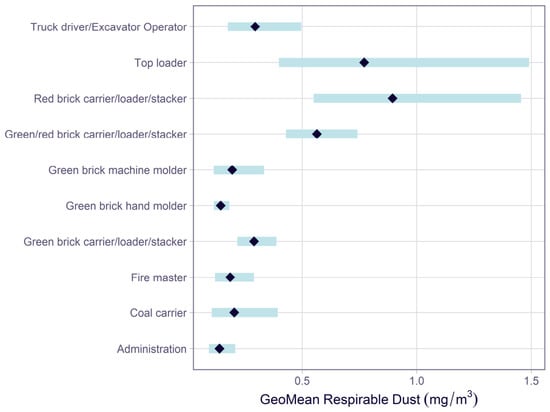
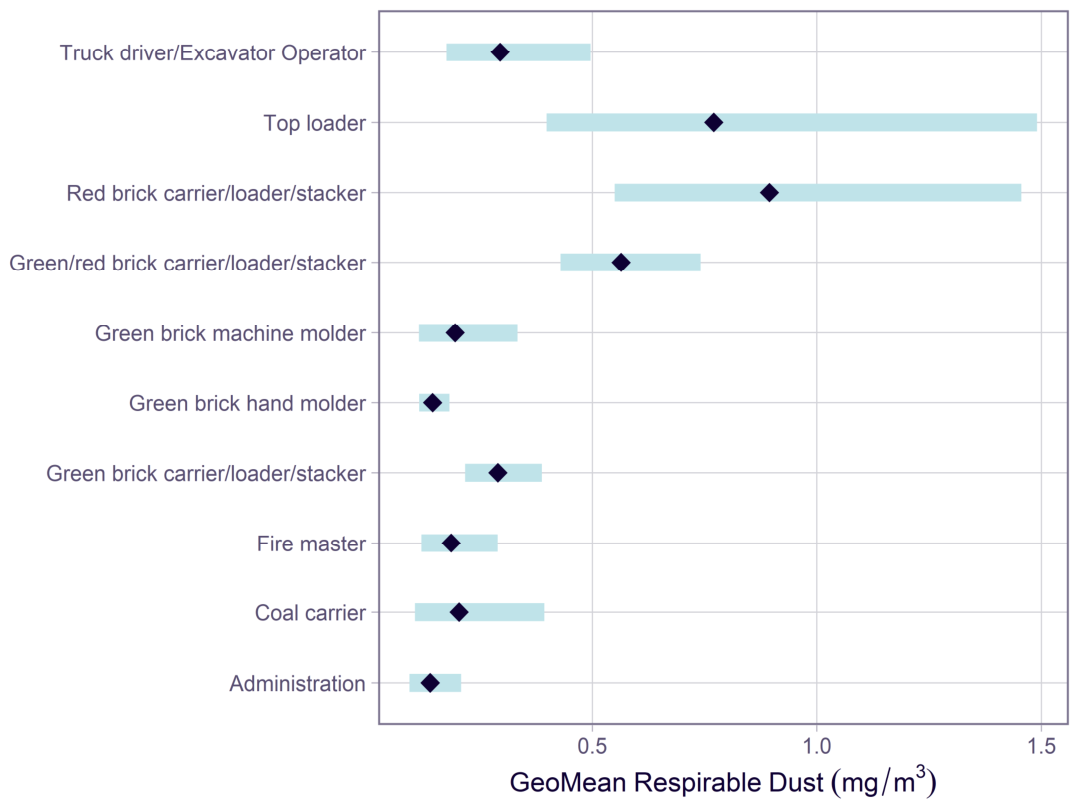
Workers sampled were exposed to a geometric mean RD concentration of 0.34 mg/m3. Exposure differed significantly by job category (p < 0.01). Individuals working with red brick in any capacity had the highest exposures, including red brick carriers/loaders/and stackers, 0.9 mg/m3 (95%CI: 0.5, 1.5); top loaders, 0.8 mg/m3 (95%CI: 0.4, 1.5); and green and red brick carriers/loaders/and stackers 0.6 mg/m3 (95%CI: 0.4, 0.7). Administrators 0.1 mg/m3 (95% CI: 0.1, 0.2) and green brick hand molders 0.1 mg/m3 (95% CI: 0.1, 0.2) were among those with the lowest exposures. Geometric mean RD exposure levels with 95% confidence intervals are shown in Figure 3. Pairwise comparisons of concentration by job category are represented in the Compact Letter Display (Table 1) [27]. Job categories without statistically significant differences are represented with a common letter (A, B, C, D, E). Job categories with prominent similarities in exposure include administrators, fire masters, individuals molding green brick, coal carriers, and truck drivers/excavator operators. Green and red brick carriers/loaders/stackers, top loaders, and red brick carriers/loaders/stackers also had similar exposures. The green/red brick carrier/loader/stacker, top loader, and red brick carrier/loader/stacker were statistically significantly different from administration, green brick hand molder, and fire master because the two clusters of jobs do not share any letters. Arithmetic mean, standard deviation, median, and quartiles can be found in Supplemental Table S1.
Figure 3.
Geometric mean and 95% confidence intervals of respirable dust exposures among brick workers in Nepal, 2023–2025.
Table 1.
Compact Letter Display (CLD) of respirable dust exposures among brick kiln workers in Nepal.
3.3. Respirable Silica Concentrations
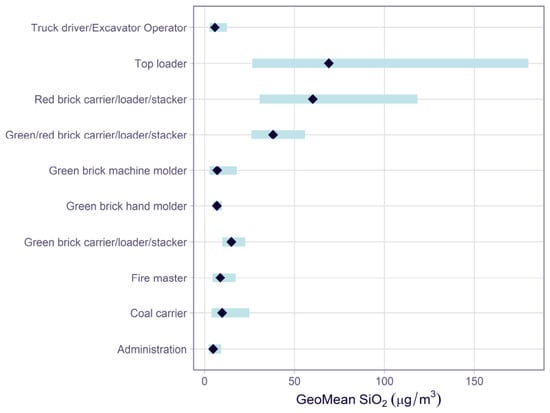
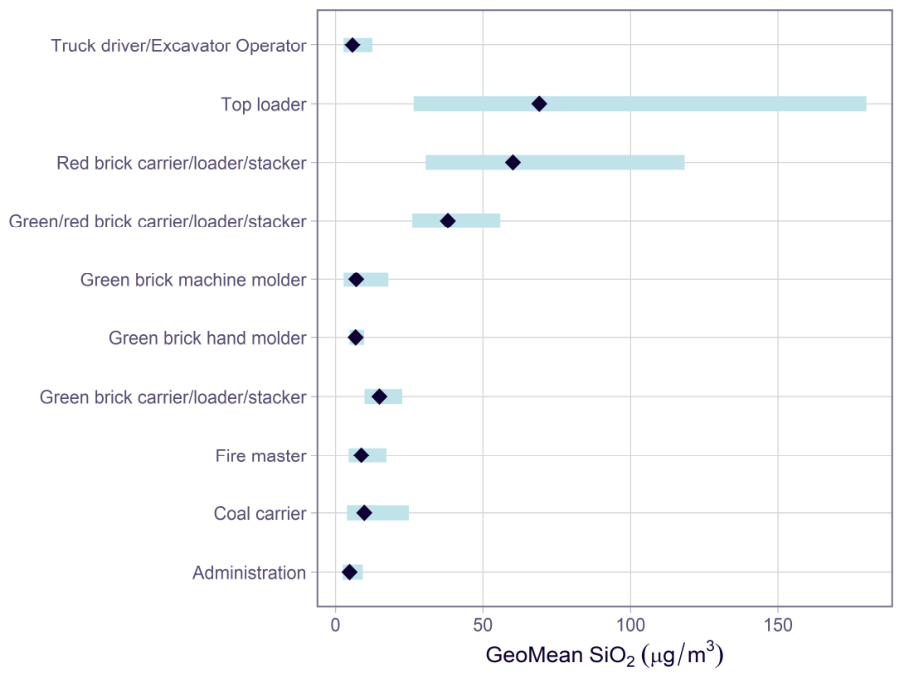
No worker samples were positive for cristobalite or tridymite. The geometric mean exposure concentration across job categories for respirable quartz SiO2 was 27.0 µg/m3. Significant differences were found for SiO2 exposures between job categories (p < 0.01) (Figure 4). Job categories with significantly higher exposure concentrations included green and red brick carriers/loaders/stackers, 38.1 µg/m3 (95% CI: 26.0, 55.9); red brick carriers/loaders/stackers, 60.1 µg/m3 (95% CI: 30.6, 118.4); and top loaders, 69.1 µg/m3 (95% CI: 26.5, 180.1). Pairwise comparisons of SiO2 concentration by job category are shown in Table 2. Arithmetic mean, standard deviation, median, and quartiles can be found in Supplemental Table S2. Similarities between job categories distinctly separate individuals working with only green brick, truck drivers/excavator operators, and in administration from those that work with red brick in any capacity (green/red brick carriers/loaders/stackers, red brick carriers/loaders/stackers, and top loaders).
Figure 4.
Geometric mean and 95% confidence intervals of respirable silica exposures among brick workers in Nepal, 2023–2025.
Table 2.
Compact Letter Display (CLD) of respirable silica exposures among brick kiln workers in Nepal.
4. Discussion
In this paper, we expand upon exposure data collected in 2023 [15] by adding two additional sampling periods (2024 and 2025) across three additional kilns. These additional sampling periods resulted in an approximately four-fold increase in the number of participants included in the 2023 study alone. Furthermore, we report findings based on a more complete characterization of RD and SiO2 exposures by doubling the number of job categories reported in previous studies. Stratifying exposures by job category revealed that workers who handle red bricks in any capacity, and workers involved in top loading, experience significantly higher exposures to both RD and SiO2. These findings are most appropriately interpreted as indicators of which job tasks should be prioritized for exposure reduction interventions, particularly for SiO2. Because our measurements were based on partial-shift samples, they do not represent full-shift TWA exposures. Furthermore, workers may transition between tasks throughout the workday, or work longer than eight hours. Thus, we recommend caution in making direct comparisons between our exposure measurements and the recommended 8-h SiO2 occupational exposure limit for Nepal of 50 µg/m3 [21]. Future studies may benefit from capturing full shift samples and more detailed task-duration profiles to more accurately characterize brick workers’ daily exposures.
Observations suggest that the insulation soil on top of the kiln (top-coat) may be a significant contributing factor to RD and SiO2 inhalation by workers who handle red bricks. XRD analysis of bulk soil samples from a brick kiln in Bhaktapur, Nepal showed quartz accounted for 24% of brick clay, 27% of release agent (soil used to coat the inside of brick molds), and 16% of top-coat [15]. The top-coat soil has low water content because it has been exposed to heat from the kiln. Due to gravity, this dry soil percolates down through the layers of bricks during firing. Soil percolation is enhanced as fire masters and other workers walk on the top-coat during brick firing. Although SiO2 is present throughout the brick making process, the water content of green bricks and raw clay materials prevents high levels of aerosolization of soil particles, resulting in lower exposures for those job categories. In contrast, job categories where red bricks are handled tend to be dustier, as evidenced in our study and others [16,17]. Top loader exposures seem obvious because application and removal of the top-coat is labor intensive and dusty. Substituting top-coat soil with another suitable insulating material, such as fire brick or ceramic block, may improve kiln efficiency while reducing dust exposures.
The GM concentration of RD in this expanded study (0.34 mg/m3) was higher than the GM concentration, 0.20 mg/m3, reported in the initial (2023) study [15]. One factor contributing to this higher average could be the addition of red brick worker job categories, which are inherently dusty in nature. Another factor could be the exclusion of samples where the sampling pump flow rate drift exceeded ±5.0% from pre- to post-calibration. These samples were not removed prior to data analysis in the 2023 study. Our findings regarding RD exposure remain lower than concentrations reported in other studies in Nepal. One possible explanation may be differences in job categories and the number of participants within each category. Administrators, whose average exposure was low, have not been included in some previous studies [16,17]. Furthermore, our sample of brick workers included a high proportion of workers from less dusty job categories, with administrators accounting for 8.29% of our sample and green brick molders (hand and machine) accounting for 32.69%. Although our GM concentrations are lower than studies by Sanjel et al. (2017) and Nicolaou et al. (2025), the general finding remains that workers handling red bricks appear to have significantly higher exposures [16,17].
The GM concentration for SiO2 was higher in this expanded sample, increasing from 15.3 to 27.0 µg/m3 over the 2023 study [15]. As with our analysis of RD, the overall increase may reflect the inclusion of workers in the 2024 and 2025 cohorts who handled red bricks in any capacity. These workers made up ~25% of our study population, but they were not included in the 2023 analysis. However, our overall results remain below values reported in previous studies [16,20]. This could be partially due to the inclusion of low-exposure job categories such as administrators and truck/excavator operators, which were not evaluated by Sanjel et al. (2018) and Nicolaou et al. (2025) [16,20]. Although we recognize differences in overall exposure levels, there is continuity between studies showing that workers who handle red bricks face the highest exposures. All three studies report higher SiO2 exposures among red brick workers compared to other job categories. Our study adds top loaders as a high-risk job category for SiO2 exposure. Special attention to these groups and interventions focused on reducing their exposure is recommended.
One explanation for the lower exposure levels found in this study is that we had a high number of SiO2 samples that were below the lab’s reporting limit of 5.0 µg/sample. For the 2023 cohort we replaced cassettes every two hours to prevent overloading. Cassette change-out was increased to four hours in 2024 and 2025. The shorter sampling duration in 2023 likely resulted in too little SiO2 on the filters for the lab to detect, particularly from samples of workers in low-exposure job categories. For the 2023 cohort, 68% of quartz results were below the reporting limit. By comparison, only 10.4% and 23.2% of samples from the 2024 and 2025 cohorts, respectively, were below the reporting limit. We recommend a minimum sampling time of four hours before cassette change-out in future studies of brick workers, assuming similar exposure conditions.
Cutting, crushing, blasting, or performing other tasks that aerosolize SiO2 and RD can lead to worker inhalation, increasing their risk of silica-related diseases like lung cancers, COPD, emphysema, bronchitis, other CRDs, and silicosis. The pathophysiology of silicosis has been commonly understood to occur as alveolar macrophages phagocytize SiO2 particles, initiating an inflammatory pathway mediated by proteins such as NLRP3 that results in the release of cytokines and the recruitment of other immune cells and fibroblasts, instigating the development of silicotic nodules and fibrosis, hallmark characteristics of silicosis. However, recent research indicates that other cells, including epithelial cells within the lungs, may be an alternative source of NLRP3 and may be heavily involved in initiating and contributing to the pathology of SiO2 [28,29]. This has significant implications for our understanding of disease incidence, progression, and even potential treatment. Though our findings would suggest that workers in job categories that involve red brick handling would have higher rates of silicosis, the verdict remains inconclusive. Though many studies report pulmonary deficits and symptoms among brick workers in Nepal, evidenced by reduced forced expiratory volume (FEV) and indicators of early interstitial disease, Nicolaou, et al. (2025) found no evidence of silicosis among Nepali brick workers using chest radiography, the gold-standard method for detection and diagnosis [14,16,30,31,32,33].
One potential explanation for the apparent absence of silicosis among brick workers in Nepal is that kaolinite and illite found in regional soils “coat” SiO2 particles, reducing cytotoxic effects [18]. Other studies support the theory that different soil components can interact with and alter the molecular environment of SiO2 particles, which could theoretically make oxygen radicals less reactive and reduce worker’s risk of developing silicosis, though these hypotheses are speculative and require further analysis within this specific context [34]. Further research regarding freshly cut and older silica particles also demonstrates that pathogenicity is highly dependent upon work activities and the silica source [35,36].
Though our findings demonstrate high exposures to respirable SiO2 and RD among brick workers in specific job categories, there are limitations to this study. We used a convenience sample with participants drawn from four kilns, representing about 3.0% of the total kilns in Kathmandu Valley, which may not be representative of the whole valley or the industry overall. The cross-sectional design also affects generalizability of findings, as the period of study may not represent the entire brick-making season. The partial-shift sampling may also be an underestimate of worker exposure, particularly due to samples with concentrations beneath the LDL. Further research is recommended to investigate factors leading to high rates of pump flow-rate drift. Additionally, future research should be directed toward increasing sample size among clay makers, top loaders, coal carriers, and other groups with limited sample sizes. This study sought to quantify worker exposure to respirable SiO2 and RD. While these exposures are important in understanding worker risk, they do not completely characterize synergistic effects of all chemical and physical hazards. Future studies may also benefit from a combined objective and subjective exposure assessment, which may help to further characterize brick worker health and wellbeing [37].
5. Conclusions
To our knowledge, this is the largest study to date of SiO2 and RD exposures among brick workers in Nepal in terms of both number of participants and number of job categories sampled. Our study confirms the findings of previous work showing that workers in Nepal who handle red bricks in any capacity have significantly higher SiO2 and RD exposures compared to workers in other job categories. Furthermore, our findings identify workers engaged in top loading as a high-exposure group. RD and SiO2 exposures among top loaders and red brick workers appear to have a common source: the top-coat soil that is used to insulate the brick kiln during firing. Future interventions focused on substitution of insulating soil with ceramic tiles or other suitable products may significantly reduce worker exposures. However, the economic feasibility of this approach needs further evaluation. More near-term studies directed at assessing the feasibility and efficacy of wet methods, ventilation, job rotation, and respiratory protection to reduce dust exposures among workers handling red bricks or those engaged in top loading are also needed. We likewise recommend hazard communication, job-specific exposure reduction training, and regular respiratory health evaluations, for brick workers in Nepal. Due to financial constraints at Nepali brick kilns, we recommend a phased and incremental implementation of exposure controls, progressing from simple to more comprehensive interventions. A structured assessment framework using occupational safety maturity models has been used within broader occupational contexts and may be a feasible guide for phased implementation of safety measures [38].
Supplementary Materials
The following supporting information can be downloaded at: https://www.mdpi.com/article/10.3390/occuphealth1040048/s1, Table S1. Arithmetic mean, standard deviation, minimum, 1st quartile, median, 3rd quartile, and maximum on the non-log transformed respirable dust. Table S2. Arithmetic mean, standard deviation, minimum, 1st quartile, median, 3rd quartile, and maximum on the non-log transformed silica dust.
Author Contributions
Conceptualization, S.S., J.D.L., N.E.P., A.J.S., C.B.F., J.G., S.C.C. and J.D.J.; methodology, B.O., W.A.C., G.L.S., S.S., J.D.L., N.E.P., A.J.S., C.B.F., J.G., S.C.C. and J.D.J.; validation, B.O., W.A.C., G.L.S. and J.D.J.; formal analysis, B.O., W.A.C., G.L.S. and J.D.J.; investigation, B.O., W.A.C., P.D.W., C.O., G.L.S., S.S., J.D.L., N.E.P., A.J.S., C.B.F., J.G., S.C.C. and J.D.J.; resources, G.L.S., S.S., J.D.L., N.E.P., A.J.S., C.B.F., J.G., S.C.C. and J.D.J.; data curation, B.O., W.A.C., G.L.S. and J.D.J.; writing—original draft preparation, B.O., W.A.C., P.D.W., C.O., G.L.S. and J.D.J.; writing—review and editing, B.O., W.A.C., P.D.W., C.O., G.L.S., S.S., J.D.L., N.E.P., A.J.S., C.B.F., J.G., S.C.C. and J.D.J.; visualization, B.O., W.A.C., G.L.S. and J.D.J.; supervision, G.L.S., S.S., J.D.L., N.E.P., A.J.S., C.B.F., J.G., S.C.C. and J.D.J.; project administration, G.L.S., S.S., J.D.L., N.E.P., A.J.S., C.B.F., J.G., S.C.C. and J.D.J.; and funding acquisition, J.D.L., N.E.P., A.J.S., C.B.F., J.G., S.C.C. and J.D.J. All authors have read and agreed to the published version of the manuscript.
Funding
External funding was provided by the National Institute for Occupational Safety and Health (NIOSH), award number T42OH008414. Several internal funding sources also made this research possible, including the BYU Simmons Research Endowment, which partially funded this study through an internal Interdisciplinary Research (IRD) grant. Internal funding from BYU was also provided by the John A. Widtsoe Innovative Research Grant, the Roger and Victoria Sant Educational Endowment for a Sustainable Environment, and through College of Life Sciences Undergraduate Research Awards (CURAs).
Institutional Review Board Statement
The study was conducted in accordance with the Declaration of Helsinki and was approved by the Nepal Health Research Council (ID# 554/2022 P; 6032024, initial date of approval 13 March 2023), and by Brigham Young University’s Institutional Review Board (IRB2022-370; IRB2024-359; initial date of approval 25 October 2022).
Informed Consent Statement
Informed consent was obtained in writing from all subjects involved in the study.
Data Availability Statement
The original data presented in the study are openly available in ScholarsArchive Data at https://scholarsarchive.byu.edu/data/113 (accessed on 23 September 2026).
Acknowledgments
We express our thanks to Jagat Lama and his staff for providing logistical support for this work to take place. We are also grateful for the expertise and support provided by BYU’s Kennedy Center for International Studies. Our special thanks to the brick kiln owners and management for providing access, and especially to the workers who participated in this study. Microsoft 365 Copilot version number: bizchat.20260610.20.11 was used during manuscript preparation to assist with searching the literature and to provide suggestions for title development, grammar, clarity, and language refinement. All scientific content, study design, data collection, analysis, interpretation, figures, tables, and conclusions were developed and verified by the authors. The authors reviewed, edited, and approved all manuscript content and take full responsibility for the final version.
Conflicts of Interest
The authors declare no conflicts of interest.
Abbreviations
The following abbreviations are used in this manuscript:
| CRD | chronic respiratory diseases |
| RD | respirable dust |
| SiO2 | respirable crystalline silica (quartz) |
| COPD | chronic obstructive pulmonary disease |
| XRD | X-ray diffraction |
| GM | geometric mean |
| NPR | Nepalese rupee |
| NIOSH | National Institute for Occupational Safety and Health |
| ANOVA | analysis of variance |
| CLD | Compact Letter Display |
| TWA | 8-hour time-weighted average |
| GenAI | generative artificial intelligence |
| OSHA | Occupational Safety and Health Administration |
References
- Momtazmanesh, S.; Moghaddam, S.S.; Ghamari, S.-H.; Rad, E.M.; Rezaei, N.; Shobeiri, P.; Aali, A.; Abbasi-Kangevari, M.; Abbasi-Kangevari, Z.; Abdelmasseh, M. Global burden of chronic respiratory diseases and risk factors, 1990–2019: An update from the Global Burden of Disease Study 2019. EClinicalMedicine 2023, 59, 101936. [Google Scholar] [CrossRef] [Scilit] [PubMed]
- Leung, C.C.; Yu, I.T.S.; Chen, W. Silicosis. Lancet 2012, 379, 2008–2018. [Google Scholar] [CrossRef] [Scilit] [PubMed]
- Brown, J.S.; Gordon, T.; Price, O.; Asgharian, B. Thoracic and respirable particle definitions for human health risk assessment. Part. Fibre Toxicol. 2013, 10, 12. [Google Scholar] [CrossRef] [Scilit] [PubMed]
- Balmes, J.; Becklake, M.; Blanc, P. Occupational contribution to the burden of airway disease (an official statement of the American Thoracic Society). Am. J. Respir. Crit. Care Med. 2003, 167, 787–797. [Google Scholar] [CrossRef] [Scilit] [PubMed]
- Sakai, H. The Kathmandu Basin: An archive of Himalayan uplift and past monsoon climate. J. Nepal Geol. Soc. 2001, 25, 1–8. [Google Scholar] [CrossRef] [Scilit]
- Paudel, M.R.; Sakai, H. Stratigraphy and depositional environments of basin-fill sediments in southern kathmandu Valley Central Nenal. Bull. Dep. Geol. Tribhuvan Univ. 2008, 11, 61–70. [Google Scholar]
- Subedi, L.; Acharya, K.K. Tracing the Mahabharat Thrust (MT) on the basis of lithology and microstructures around Bhainse-Manahari area, central Nepal. J. Nepal Geol. Soc. 2016, 51, 39–48. [Google Scholar] [CrossRef] [Scilit]
- Paudel, M.R. Late Pleistocene paleoenvironmental changes of the Kathmandu Basin-fill sediments revealed by the minerals composition. J. Nepal Geol. Soc. 2013, 46, 121–132. [Google Scholar] [CrossRef] [Scilit]
- Dhakal, M.; Bhattarai, J. Chemical and mineralogical investigations on clay minerals deposited in Sanothimi area of Kathmandu valley. In Proceedings of the 8th International Conference and Exhibition on Materials Science and Engineering, Osaka, Japan, 29–31 May 2017. [Google Scholar]
- Ghale, D.; Bohara, N.; Duwal, N.; Bhattarai, J. Investigation on the mineralogical phase of ancient brick samples of Kathmandu valley (Nepal) using XRD and FTIR analysis. Rasayan J. Chem. 2019, 12, 402–408. [Google Scholar] [CrossRef] [Scilit]
- Fujii, R.; Kuwahara, Y.; Sakai, H. Mineral composition changes recorded in the sediments from a 284-m-long drill-well in central part of the Kathmandu Basin, Nepal. J. Nepal Geol. Soc. 2001, 25, 63–69-63–69. [Google Scholar] [CrossRef] [Scilit]
- Myers, J.E.; Lewis, P.; Hofmeyr, W. Respiratory health of brickworkers in Cape Town, South Africa: Background, aims and dust exposure determinations. Scand. J. Work Environ. Health 1989, 15, 180–187. [Google Scholar] [CrossRef] [Scilit] [PubMed]
- Mokarami, H.; Gharibi, V.; Kalteh, H.O.; Faraji Kujerdi, M.; Kazemi, R. Multiple environmental and psychosocial work risk factors and sleep disturbances. Int. Arch. Occup. Environ. Health 2020, 93, 623–633. [Google Scholar] [CrossRef] [Scilit] [PubMed]
- Aa, A.-S.; Km, S. Respiratory health study of brick industry workers, survey and environmental assessment. Egypt. J. Occup. Med. 2023, 47, 1–15. [Google Scholar] [CrossRef] [Scilit]
- Beard, J.D.; Collingwood, S.C.; LeCheminant, J.D.; Peterson, N.E.; Reynolds, P.R.; Arroyo, J.A.; South, A.J.; Farnsworth, C.B.; Fong, G.; Cisneros, T. Respirable dust and crystalline silica concentrations among workers at a brick kiln in Bhaktapur, Nepal. J. Occup. Environ. Hyg. 2024, 21, 247–258. [Google Scholar] [CrossRef] [Scilit] [PubMed]
- Nicolaou, L.; Rowell, E.; Gaviola, C.; Chandyo, R.K.; Sharma, A.K.; Shrestha, L.P.; Das, S.; Parker, D.L.; Thygerson, S.M.; Jacob, J. Personal exposures to air pollutants and respiratory health among brick kiln workers and household members. Environ. Res. 2025, 279, 121760. [Google Scholar] [CrossRef] [Scilit] [PubMed]
- Sanjel, S.; Khanal, S.N.; Thygerson, S.M.; Carter, W.S.; Johnston, J.D.; Joshi, S.K. Respiratory symptoms and illnesses related to the concentration of airborne particulate matter among brick kiln workers in Kathmandu valley, Nepal. Ann. Occup. Environ. Med. 2017, 29, 1–12. [Google Scholar] [CrossRef] [Scilit] [PubMed]
- Love, R.; Waclawski, E.; Maclaren, W.; Wetherill, G.; Groat, S.; Porteous, R.; Soutar, C. Risks of respiratory disease in the heavy clay industry. Occup. Environ. Med. 1999, 56, 124–133. [Google Scholar] [CrossRef] [Scilit] [PubMed]
- Wiecek, E.; Gościcki, J.; Indulski, J.; Stroszejn-Mrowca, G. Dust and occupational diseases in brickyards. Med. Pr. 1982, 34, 35–45. [Google Scholar]
- Sanjel, S.; Khanal, S.N.; Thygerson, S.M.; Carter, W.; Johnston, J.D.; Joshi, S.K. Exposure to respirable silica among clay brick workers in Kathmandu valley, Nepal. Arch. Environ. Occup. Health 2018, 73, 347–350. [Google Scholar] [CrossRef] [Scilit] [PubMed]
- Mishra, A.; Baniya, A. Establishing effective dust exposure limits in Nepal: A global imperative for worker safety and health. J. UTEC Eng. Manag. 2024, 2, 1–11. [Google Scholar] [CrossRef] [Scilit]
- Stemn, E.; Fosu, S.; Addo, L.N.A. Assessment of occupational hazards exposures of artisanal and small-scale mining in Ghana. J. Saf. Sustain. 2025, 3, 71–81. [Google Scholar] [CrossRef] [Scilit]
- The National Institute for Occupational Safety and Health (NIOSH). Silica, Crystalline, by XRD (NIOSH Method 7500). In NIOSH Manual of Analytical Methods, 4th ed.; CDC: Atlanta, GA, USA, 2003; p. 9. [Google Scholar]
- NIOSH. NIOSH 0600: Particulates not otherwise regulated, respirable. In NIOSH Manual of Analytical Methods, 4th ed.; CDC: Atlanta, GA, USA, 1998; pp. 1–6. [Google Scholar]
- Schubauer-Berigan, M.K.; Dahm, M.M.; Erdely, A.; Beard, J.D.; Eileen Birch, M.; Evans, D.E.; Fernback, J.E.; Mercer, R.R.; Bertke, S.J.; Eye, T. Association of pulmonary, cardiovascular, and hematologic metrics with carbon nanotube and nanofiber exposure among US workers: A cross-sectional study. Part. Fibre Toxicol. 2018, 15, 1–14. [Google Scholar] [CrossRef] [Scilit] [PubMed]
- Occupational Safety and Health Administration. OSHA Technical Manual; Occupational Safety and Health Administration: Washington, DC, USA, 2023. [Google Scholar]
- Piepho, H.-P. An algorithm for a letter-based representation of all-pairwise comparisons. J. Comput. Graph. Stat. 2004, 13, 456–466. [Google Scholar] [CrossRef] [Scilit]
- Barry, K.T.; Harpur, C.M.; Ambrose, R.L.; Hodges, C.J.; Mansell, A.; Lam, M.; Tate, M.D. Myeloid cell-derived NLRP3 is dispensable for silica-induced pulmonary inflammation and pathology. Immunol. Cell Biol. 2026, 104, 20–34. [Google Scholar] [CrossRef] [Scilit] [PubMed]
- Lam, M.; Barry, K.T.; Hodges, C.J.; West, A.C.; Harpur, C.M.; Mansell, A.; Tate, M.D. Epithelial NLRP3 drives silica-induced lung injury and fibrosis through IL-18 and pro-fibrotic neutrophil recruitment. Part. Fibre Toxicol. 2026, 23, 30. [Google Scholar] [CrossRef] [Scilit] [PubMed]
- Zuskin, E.; Mustajbegovic, J.; Schachter, E.N.; Kern, J.; Doko-Jelinic, J.; Godnic-Cvar, J. Respiratory findings in workers employed in the brick-manufacturing industry. J. Occup. Environ. Med. 1998, 40, 814–820. [Google Scholar] [CrossRef] [Scilit] [PubMed]
- Rezazaheh, A.M.; Sahatfardi, F.; Zarei, F.; Salehpour, S.; Soori, H.; Ranjbarian, M. Comparison of the Respiratory Health Effects of Traditional and Mechanical Brick Factories on the Workers Exposed to Dust. J. Hum. Environ. Health Promot. 2020, 6, 35–39. [Google Scholar] [CrossRef] [Scilit]
- Liou, S.-H.; Chen, Y.-P.; Shih, W.-Y.; Lee, C.-C. Pneumoconiosis and pulmonary function defects in silica-exposed fire brick workers. Arch. Environ. Health Int. J. 1996, 51, 227–233. [Google Scholar] [CrossRef] [Scilit] [PubMed]
- Kumari, P.; Poudel, L.; Chaudhary, L.; Choulagai, B.P. Prevalence and associated factors of respiratory symptoms and illnesses among brick kiln workers in Nepal—A cross-sectional study. Environ. Occup. Health Pract. 2024, 6, 2024-0003-OA. [Google Scholar] [CrossRef] [Scilit] [PubMed]
- Bellomo, C.; Lagostina, V.; Pavan, C.; Paganini, M.C.; Turci, F. Reaction with water vapor defines surface reconstruction and membranolytic activity of quartz milled in different molecular environments. Small 2024, 20, 2308369. [Google Scholar] [CrossRef] [Scilit] [PubMed]
- Vallyathan, V.; Castranova, V.; Pack, D.; Leonard, S.; Shumaker, J.; Hubbs, A.; Shoemaker, D.; Ramsey, D.; Pretty, J.; McLaurin, J. Freshly fractured quartz inhalation leads to enhanced lung injury and inflammation. Potential role of free radicals. Am. J. Respir. Crit. Care Med. 1995, 152, 1003–1009. [Google Scholar] [CrossRef] [Scilit] [PubMed]
- Vallyathan, V.; Kang, J.; Van Dyke, K.; Dalai, N.; Castranova, V. Response of alveolar macrophages to in vitro exposure to freshly fractured versus aged silica dust: The ability of Prosil 28, an organosilane material, to coat silica and reduce its biological reactivity. J. Toxicol. Environ. Health Part A Curr. Issues 1991, 33, 303–315. [Google Scholar] [CrossRef] [Scilit] [PubMed]
- Hanning, N.A.; Bier, M.; Brückner, D.; Kahl, A. Combined Chemical, Physical, and Climatic Exposures and Their Objective–Subjective Assessment in Indoor and Therapy Pool Employees. J. Saf. Sustain. 2026, 3, 131–137. [Google Scholar] [CrossRef] [Scilit]
- Kusma, V.V.; Gerônimo, B.M.; Zola, F.C.; Aragão, F.V.; Chiroli, D.M.D.G.; Kovaleski, J.L. A maturity model of occupational safety and health in industry 4.0: An analysis in Brazilian organizations. J. Saf. Sustain. 2024, 1, 234–246. [Google Scholar] [CrossRef] [Scilit]

Disclaimer/Publisher’s Note: The statements, opinions and data contained in all publications are solely those of the individual author(s) and contributor(s) and not of MDPI and/or the editor(s). MDPI and/or the editor(s) disclaim responsibility for any injury to people or property resulting from any ideas, methods, instructions or products referred to in the content. |
© 2026 by the authors. Licensee MDPI, Basel, Switzerland. This article is an open access article distributed under the terms and conditions of the Creative Commons Attribution (CC BY) license.