


Abstract
This article conceptualizes hospitality as a form of living heritage through which migrants and refugees preserve cultural practices, negotiate belonging, and reshape relations of welcome in receiving societies. Drawing on Walker and Avant’s concept analysis approach, literature from heritage studies, migration studies, hospitality, tourism, sociology, and intercultural inclusion was reviewed and thematically synthesized. The analysis identified four core dimensions of hospitality as living heritage: cultural rootedness and heritage transmission, relational care and reciprocity, adaptation and negotiation across contexts, and intercultural connection and belonging. These dimensions are shaped by migration and displacement, collective memory, experiences of exclusion, and opportunities for intercultural encounter. The findings position migrants not only as guests or recipients of support, but as active hosts, heritage makers, and contributors to social cohesion. By linking hospitality, living heritage, and the cultural politics of welcome, this article offers a conceptual framework for understanding how everyday practices of care, sharing, and reciprocity sustain cultural continuity and foster belonging in migration contexts.
1. Introduction
Global migration has intensified scholarly attention to the social, cultural, and ethical conditions through which migrants, refugees, asylum seekers, and newcomers negotiate belonging in receiving societies. Hospitality is central to these negotiations, yet it is rarely experienced as a simple or one-directional act of welcome [1]. Critical hospitality scholarship shows that hospitality and hostility often coexist across interpersonal, institutional, and state contexts, shaping whether migrants are recognized as neighbours, guests, burdens, or legitimate members of society [2,3]. In migration contexts, hospitality may provide shelter, care, and emotional support, but it may also be conditional, unequal, and tied to expectations of gratitude, compliance, deservingness, or eventual departure [4,5]. Thus, hospitality is not only a moral practice; it is also a social and political relation through which inclusion and exclusion are enacted. Societies’ cultures of hospitality are themselves historically rooted and evolving forms of cultural heritage, shaped by inherited moral traditions, local customs, religious and ethical values, migration histories, and changing political conditions [2,3]. In this sense, hospitality is not only an immediate response to the arrival of strangers but also a cultural repertoire through which societies remember, perform, regulate, and transform practices of welcome over time.
Recent studies of refugee and migrant reception demonstrate that welcome is shaped by multiple scales of interaction, including the intimate space of the home, community organizations and national borders [1,6]. Private hosting schemes can create affective responsibility and family-like relationships between hosts and refugees, while also generating informal boundaries when reciprocity or intimacy is expected from guests [5,6]. State-orchestrated hosting initiatives, such as the Homes for Ukraine scheme in the United Kingdom, reveal how humanitarian hospitality may produce uneven hierarchies of belonging based on race, gender, class, and legal status [7]. Similarly, asylum accommodation in hotels may offer temporary shelter while undermining homemaking, stability, and a sense of belonging when commercial hospitality is repurposed as state-managed reception [8]. These studies underscore that migrant hospitality is simultaneously relational, spatial, institutional, and political. Building on this multilayered understanding, this article approaches migrants not only as guests within receiving societies, but also as legitimate social members and cultural actors who actively shape practices of welcome, care, and heritage-making. This perspective shifts attention from hospitality as something extended to migrants toward hospitality as something migrants also enact, negotiate, and transform across interpersonal, institutional, and state contexts.
A growing body of literature also shows that migrants are not only guests or recipients of hospitality but active producers of welcome, care, and community life. Refugee-background women, migrant workers, undocumented migrants, and migrant women entrepreneurs often reshape the conventional host–guest relationship by becoming hosts themselves through food, labour, entrepreneurship, community engagement, and everyday acts of reciprocity [9,10,11,12]. In this article, hospitality is understood as a relational practice enacted by multiple actors. Receiving societies, institutions, community organizations, and local residents may extend, restrict, or condition hospitality toward migrants and refugees. At the same time, migrants and refugees also practice hospitality by welcoming others, sharing cultural knowledge, sustaining traditions, offering care, and creating spaces of belonging within and across communities. Food-based hospitality is particularly important because shared meals allow migrants to express gratitude, reclaim agency, generate income, foster intercultural dialogue, and renegotiate asymmetrical relations of dependency [9,13]. These practices suggest that hospitality is not merely extended toward migrants by receiving societies; it can also be enacted by migrants as a culturally meaningful practice of agency, recognition, and belonging.
At the same time, migrant belonging is inseparable from cultural heritage. Living and intangible cultural heritage includes practices, knowledge, expressions, rituals, crafts, foodways, language, performance, and traditions that communities continuously recreate in response to changing contexts [14]. In this manuscript, “living heritage” is understood as heritage that remains active in everyday life rather than fixed in the past. It includes cultural practices, knowledge, values, expressions, rituals, foodways, language, crafts, storytelling, and forms of social interaction that communities continue to perform, transmit, reinterpret, and adapt across generations and changing contexts. For migrants and refugees, living heritage is especially important because it supports cultural continuity while also allowing traditions to be reshaped through displacement, resettlement, and encounters with receiving societies.
In migration and displacement, heritage is not simply preserved as a fixed remnant of the past; it is reworked through homemaking, intergenerational transmission, community participation, and encounters with new social environments [15,16,17,18]. This interpretation also highlights that receiving societies have their own historically situated cultures of hospitality. These cultures are neither fixed nor uniformly inclusive; rather, they evolve through encounters among migrants, local communities, institutions, and state policies. Heritage-Informed Migrant Hospitality therefore involves not only migrants carrying and adapting their own cultural practices, but also their participation in reshaping the receiving society’s inherited norms of welcome, reciprocity, and belonging.
Studies of resettled Syrian Ukrainian and Congolese refugees show that crafts, domestic objects, clothing, food preparation, parenting practices, and other cultural traditions support identity continuity, psychological comfort, and belonging after displacement [15,19,20]. Diasporic leisure and cultural practices similarly transmit heritage across generations while producing hybrid cultural spaces shaped by both homeland and host-society contexts [16].
Heritage scholarship increasingly recognizes migrants as heritage makers rather than passive carriers of culture. Migrants create, preserve, reinterpret, and communicate heritage through family rituals, informal archives, public performance, digital storytelling, community-led initiatives, and participation in cultural institutions [18,21,22,23]. This perspective challenges authorized or nation-centred heritage frameworks that often marginalize migrant and refugee communities within mainstream heritage systems [21,24]. It also expands the meaning of heritage in displacement: refugee camps and other protracted displacement contexts may become sites where new cultural practices, traditions, and collective identities emerge as living heritage in their own right [25]. Consequently, migrant heritage should be understood as dynamic, relational, and situated within broader struggles for recognition, inclusion, and cultural legitimacy.
Belonging provides a further conceptual bridge between hospitality and living heritage. Migrants’ sense of welcome is shaped not only by formal policies but also by institutional support, community spaces, everyday interpersonal encounters, and broader sociopolitical climates [26]. Supportive integration and social relationships are associated with resilience, self-compassion, and reduced loneliness among migrant populations, suggesting that belonging is a protective social and psychological resource [27,28]. Conversely, hostile hospitality and contested welcome can harm migrants’ well-being by producing insecurity, exclusion, bodily distress, microaggressions, and liminal feelings of being neither fully included nor fully outside the receiving society [29,30].
Despite these important contributions, the literature remains fragmented across hospitality studies, migration studies, heritage studies, tourism, sociology, cultural studies, and health-related scholarship. Hospitality scholarship has often emphasized commercial service, tourism, private hosting, or state reception, while heritage scholarship has focused on cultural preservation, safeguarding, representation, and migrant heritage-making. This article contributes to heritage studies by extending living heritage beyond ritual, performance, language, foodways, and material practices to include relational practices of welcome, hosting, reciprocity, and care. Although several studies show that migrants enact hospitality through culturally rooted practices such as food, crafts, rituals, storytelling, performance, homemaking, and community care [1,6], these insights have not yet been integrated into a unified concept that explains hospitality itself as a form of living cultural heritage. This article argues that migrant hospitality challenges “authorized” heritage frameworks because it occurs in homes, kitchens, community spaces, digital platforms, and informal networks rather than only museums, monuments, or state-recognized heritage sites. As a result, the field lacks conceptual clarity regarding the defining attributes, antecedents, consequences, and empirical referents of hospitality when it is culturally rooted, migrant-led, adaptive, reciprocal, and oriented toward belonging.
The term “Heritage-Informed Migrant Hospitality” was therefore coined to name a concept that is not fully captured by existing terms such as hospitality, migrant inclusion, living heritage, or migrant heritage-making alone. “Heritage-informed” emphasizes that practices of welcome, care, and reciprocity are shaped by inherited cultural values, collective memories, traditions, and everyday forms of cultural transmission. “Migrant hospitality” foregrounds migrants as active hosts and cultural actors, rather than only as guests or recipients of support. Together, the term captures how migrants enact hospitality as a living heritage practice that is culturally rooted, relational, adaptive, and oriented toward belonging within receiving societies.
This gap is pressing because contemporary migration contexts require frameworks that move beyond deficit-based views of migrants as guests, recipients, or service users and instead recognize migrants as hosts, heritage bearers, cultural actors, and contributors to social cohesion. Without a clear conceptual framework, policy and practice risk overlooking the ways everyday acts of welcome, care, sharing, and reciprocity sustain cultural continuity and foster intercultural belonging. This article theorizes hospitality as a form of living migrant heritage. Therefore, the aim of this manuscript is to clarify and develop “Heritage-Informed Migrant Hospitality” as a concept by examining how migrants and refugees enact, transmit, and adapt cultural practices of welcome, care, reciprocity, and belonging across displacement and resettlement contexts.
2. Methods
2.1. Design
This concept analysis was guided by Walker and Avant’s [31] method, which is appropriate for clarifying concepts that are complex, interdisciplinary, or insufficiently defined. The analysis followed eight steps: (1) selecting the concept; (2) determining the purpose of the analysis; (3) identifying uses of the concept; (4) determining defining attributes; (5) developing a model case; (6) identifying additional cases, including borderline and contrary cases; (7) identifying antecedents and consequences; and (8) defining empirical referents [31]. In this manuscript, Walker and Avant’s [31] approach was used as the analytic framework for concept development, while the literature review provided the evidence base for the analysis. Given the interdisciplinary nature of Heritage-Informed Migrant Hospitality, literature from migration, heritage, hospitality, tourism, sociology, and cultural studies was reviewed. Rigour was supported through structured searching, screening, data extraction, and thematic synthesis, with PRISMA guidance and checklist used to report record identification, screening, eligibility, and inclusion [32] (See Appendix A).
2.2. Step 1: Concept Selection: Data Sources and Analytic Process
A structured search was conducted in Scopus, MEDLINE, CINAHL, and PsycINFO to identify literature relevant to Heritage-Informed Migrant Hospitality. Search terms combined keywords related to hospitality, hosting, migration, refugees, immigrants, diaspora, cultural heritage, living heritage, intangible cultural heritage, belonging, identity, and social inclusion. Searches were limited to English-language publications from 2010 to 2026. The 2010–2026 time frame was selected to capture contemporary and evolving conceptualizations of hospitality, migration, and living heritage, particularly the increasing scholarly attention to migrant heritage, belonging, and intercultural inclusion. Additional sources were identified through citation searching, reference list review, and grey literature searching. The full search strategy is provided in Appendix B.
2.3. Step 2: Purpose of the Analysis
The purpose of this analysis was to clarify and develop Heritage-Informed Migrant Hospitality as a concept that explains how hospitality functions as a culturally rooted, relational, and living heritage practice in migration contexts. Eligible sources included empirical, theoretical, conceptual, policy, and practice-based literature addressing hospitality as a cultural, relational, social, or heritage-informed practice within migration contexts. Studies focused only on commercial hospitality or tourism without relevance to migration, heritage, or belonging were excluded. Records were managed in Covidence, screened for eligibility, and extracted into a structured table including author, year, country, aim, methods, key findings, and relevance to the concept. Thematic analysis [33] was then used to identify recurring patterns and refine the concept’s attributes, antecedents, consequences, empirical referents, cases, and conceptual model. The extraction table is provided in Appendix C.
2.4. Step 3: Uses of the Concept/ Overview of the Concept
Hospitality as living heritage sits at the intersection of migration, heritage, and hospitality scholarship. While hospitality is often understood as welcoming, hosting, and caring for others, it has commonly been framed in hospitality and tourism studies as service provision or host–guest exchange [34]. Broader ethical and migration scholarship, however, conceptualizes hospitality as a relational and often contested practice shaped by generosity, reciprocity, openness, and shifting host–guest roles [10,11,35]. This article extends these perspectives by positioning hospitality as a form of living cultural heritage embedded in cultural traditions, collective memories, and everyday practices of care. Living cultural heritage refers to practices, knowledge, expressions, and traditions that communities continuously recreate and transmit in response to changing contexts [14]. In migrant communities, language, food, storytelling, crafts, performance, rituals, family traditions, digital storytelling, and place-making all function as dynamic forms of heritage-making and belonging [15,17,18,22,36,37]. By conceptualizing hospitality as living heritage, this article recognizes migrants as active heritage makers and cultural actors whose practices of welcome, care, and reciprocity preserve, adapt, and transmit heritage across generations and places [24].
3. Results
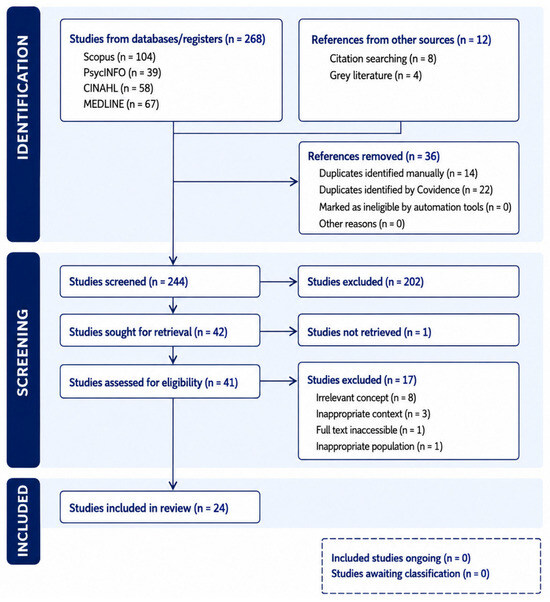
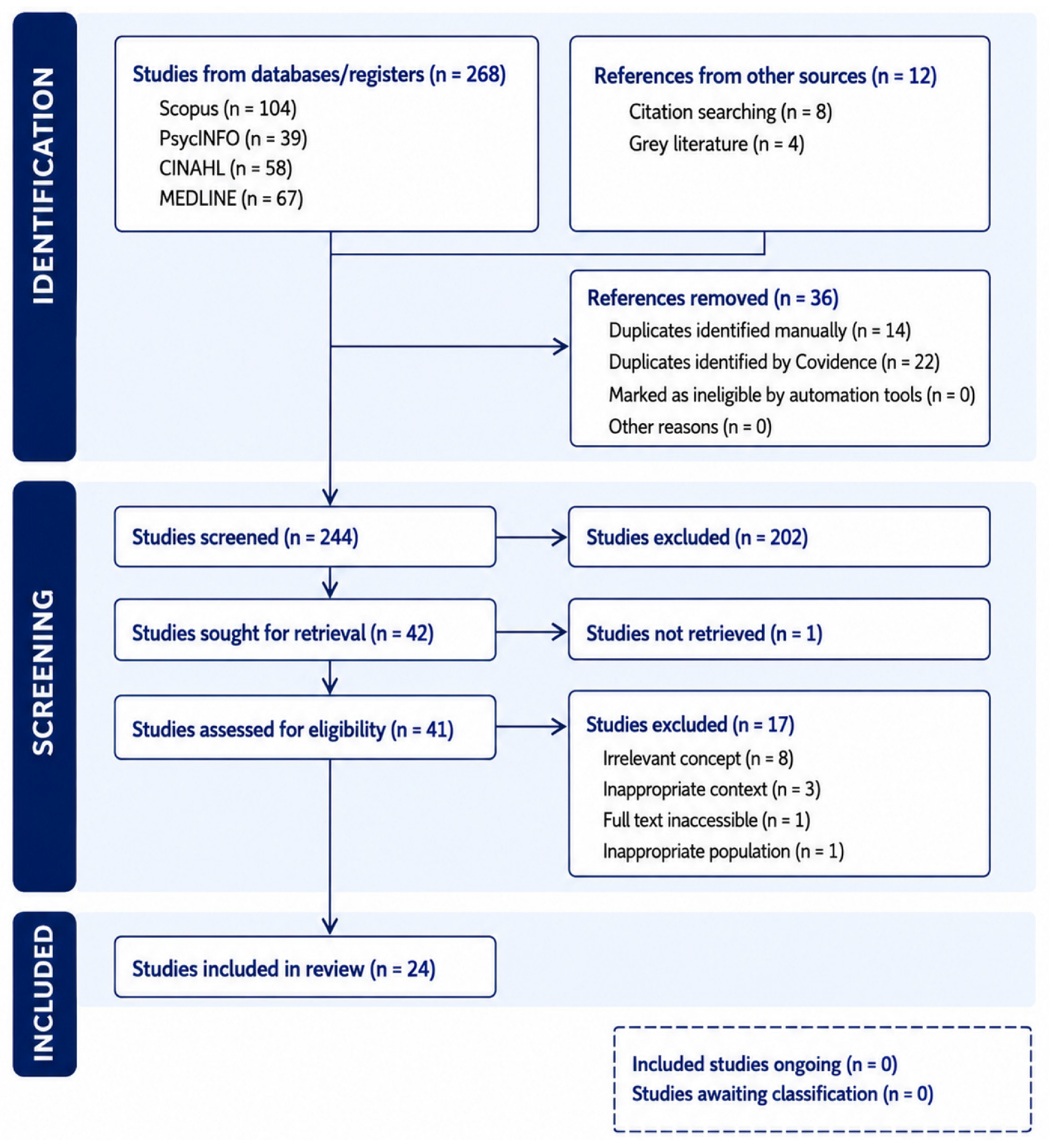
The structured search was conducted in Scopus, PsycINFO, CINAHL, and MEDLINE for literature published between 2010 and March 2026 to capture contemporary scholarship on Heritage-Informed Migrant Hospitality, migration, hospitality, and living cultural heritage. Search terms combined concepts related to hospitality, hosting, migration, migrants, refugees, immigrants, diaspora, cultural heritage, living heritage, intangible cultural heritage, belonging, identity, and social inclusion. After duplicates were removed, 244 records were screened, 41 full texts were assessed for eligibility, and 24 studies were included in the final analysis (see Figure 1). The results are presented according to Walker and Avant’s eight steps to clarify how the concept was selected, defined, illustrated, and operationalized through its uses, defining attributes, cases, antecedents, consequences, and empirical referents.
Figure 1.
PRISMA flow diagram. Source: Authors’ own work based on the PRISMA-ScR diagram and the study screening process.
3.1. Step 4: Defining Attributes: Core Dimensions of Hospitality as Living Heritage
Defining attributes are the recurring features identified in the literature that distinguish a concept from related concepts and clarify its essential meaning [31]. The following attributes characterize Heritage-Informed Migrant Hospitality:
3.1.1. Cultural Rootedness and Heritage Transmission
Across the included studies, hospitality is presented as more than a social act of welcoming; it is a culturally embedded practice shaped by memory, tradition, language, material culture, and intergenerational knowledge. Migrants draw on inherited cultural values and everyday practices to preserve identity and sustain continuity after migration. For example, heritage language classrooms reveal how hospitality can become a mechanism for maintaining linguistic and cultural belonging, while migrant craft, domestic objects, and material culture support home-making and identity continuity in exile [15,38]. Similarly, studies of migrant heritage-making show that heritage is transmitted through family rituals, festive practices, performance, informal archives, and community memory rather than only through formal institutions [17,18,22,39]. In heritage and tourism settings, cultural hospitality is also rooted in traditional codes, local values, vernacular architecture, cultural landscapes, and sustainable heritage practices [40,41,42,43].
3.1.2. Relational Care and Reciprocity
Refugee-background women, for instance, actively host newly arrived families through rituals of welcome, intra-community support, and shared cultural knowledge, thereby redefining who can be understood as a host [10]. Similarly, migrant workers in hospitality occupy a dual position of “hosting while being hosted,” showing how hospitality is shaped by emotional labour, adaptation, and unequal social conditions [11]. Urban hospitality studies further show that care may emerge through civil society, public spaces, and community solidarity in response to exclusionary migration policies [44]. In cultural and digital heritage settings, reciprocity appears through co-production, participatory storytelling, and institutional–community collaboration, where hospitality requires openness to others and recognition of different forms of contribution [21,23].
3.1.3. Adaptation and Negotiation Across Contexts
The studies consistently show that migrant hospitality and heritage are not static traditions transferred unchanged from one country to another. Instead, migrants reinterpret and adapt cultural practices in response to new social, spatial, political, and institutional environments. Nikielska-Sekuła [17,18] demonstrates that migrant heritage is recreated through micro-practices, family traditions, transnational ties, and multiscalar negotiations that extend beyond authorized heritage discourse. Similarly, Trzeszczyńska et al. [37] show that heritage is reworked through encounters between established local Ukrainian communities and newer Ukrainian migrants in Poland, highlighting how diaspora formation is relational and ongoing. Digital storytelling studies also show that migrants construct heritage through everyday journeys, place attachment, memories, and claims to habitation in urban contexts shaped by gentrification and social change [36]. In tourism and heritage landscapes, adaptation is also evident through the transformation of heritage into visitor experiences, branding, architectural design, and sustainable development, although these processes may create tensions around authenticity and commodification [42,45,46,47].
3.1.4. Intercultural Connection and Belonging
Cultural heritage can support migrant inclusion by making migrant histories, values, and practices visible within receiving societies [21,24]. Participatory digital heritage tools, for example, can strengthen social inclusion and community visibility by enabling marginalized groups to share stories, connect with place, and participate in cultural meaning-making [23,48]. Heritage classrooms, museums, and community-based cultural initiatives further demonstrate that hospitality can foster belonging when migrants are recognized as cultural actors rather than passive recipients of integration efforts [38,39]. In refugee and diaspora contexts, intercultural connection is also produced through rituals of welcome, shared cultural practices, and encounters among migrant groups and host communities [10,15,37].
3.2. Step 5&6: Model, Borderline, and Contrary Cases
To enhance conceptual clarity, model, borderline, and contrary cases were developed to illustrate the complete, partial, and absent expression of the defining attributes [31] respectively (see Table 1). Following Walker and Avant’s [31] approach, the model, borderline, and contrary cases were developed by the authors as analytic examples to illustrate the complete, partial, and absent expression of Heritage-Informed Migrant Hospitality. These cases are not taken from a single empirical study; rather, they are constructed examples informed by the synthesis of the included literature.
Table 1.
Model, Borderline, and Contrary Cases of Heritage-Informed Migrant Hospitality.
3.3. Conditions Enabling Heritage-Informed Hospitality (Antecedents)
Antecedents refer to the conditions, experiences, or contextual factors that occur before a concept and enable its development [31]. In this analysis, the following antecedents were identified as key conditions that support the emergence and enactment of Heritage-Informed Migrant Hospitality:
3.3.1. Migration and Displacement Experiences
Heritage-Informed Migrant Hospitality emerges in response to movement across borders, forced displacement, diaspora formation, labour migration, and resettlement. These experiences create the need to rebuild home, preserve identity, negotiate belonging, and form new relationships in unfamiliar social contexts. Studies of Syrian resettlement show how displacement produces loss of home and continuity, prompting migrants to use crafts, domestic objects, and intangible heritage to reconstruct identity and belonging [15]. Refugee-background women’s hosting practices similarly arise from resettlement experiences and shared understandings of newcomer needs [10]. Studies of Ukrainian migration, migrant labour, and the Mediterranean refugee crisis further demonstrate that mobility, border regimes, and host-society conditions shape how hospitality is experienced, offered, or denied [11,37,49].
3.3.2. Cultural Heritage and Collective Memory
Hospitality becomes heritage-informed when migrants and communities have cultural memories, traditions, language, rituals, objects, landscapes, or practices that can be activated in acts of welcome and belonging. Heritage language education illustrates how collective memory and linguistic heritage shape practices of inclusion and obligation within community classrooms [38]. Migrant heritage studies also show that family rituals, festive practices, embodied skills, performance, and informal archives provide the foundation for cultural continuity after migration [17,18,22]. In heritage tourism and hospitality settings, built heritage, rural traditions, architectural symbolism, local values, and cultural landscapes provide the resources through which hospitality is staged, interpreted, and experienced [40,42,43,46].
3.3.3. Experiences of Exclusion or Marginalization
Many included studies show that migrant heritage is often under-recognized within dominant cultural narratives, institutional heritage systems, public spaces, or host-society policies. This lack of recognition creates the need for hospitality practices that affirm migrant agency and cultural legitimacy. Giglitto et al. [21] identify gaps between migrant communities’ intangible cultural heritage and institutional safeguarding systems, emphasizing the need for collaboration between institutions, civic society, and migrant communities. Desille and Nikielska-Sekuła [24] similarly argue that cultural heritage must be linked to migrant inclusion and intercultural recognition rather than assimilation. Urban hospitality research shows that exclusionary policies and inadequate arrival infrastructure can push migrants into precarious public spaces, where civil society hospitality becomes a response to institutional hostility [44]. Digital heritage studies also show that participatory tools can respond to under-recognition by creating safe spaces for marginalized communities to share their stories and assets [36,48].
3.3.4. Opportunities for Intercultural Encounter
Heritage-Informed Migrant Hospitality requires spaces where migrants, host communities, institutions, tourists, educators, and civic actors can interact. These spaces may be classrooms, museums, digital platforms, public spaces, heritage sites, accommodations, national parks, or community initiatives. Heritage language classrooms create encounters where host–guest roles are negotiated through teaching, welcome, and community expectations [38]. Museums and digital heritage platforms create opportunities for co-production, access, and source-community engagement [23,39]. Heritage tourism settings, including accommodations, rural guesthouses, national parks, and cultural landscapes, also function as spaces where hospitality and heritage are enacted, consumed, and contested [40,43,45,46,50]. These encounters enable hospitality to become visible as a living cultural practice and provide the conditions for intercultural connection and belonging [23,39].
3.4. Heritage and Belonging Outcomes (Consequences)
Consequences are the outcomes, effects, or changes that arise following the occurrence and enactment of a concept [31]. The following consequences were identified as the principal outcomes associated with Heritage-Informed Migrant Hospitality:
3.4.1. Cultural Continuity and Heritage Preservation
When migrants enact hospitality through culturally rooted practices, they preserve and transmit heritage in everyday life. This may occur through language, crafts, domestic objects, rituals, performance, storytelling, digital collections, or community archives. Alsalloum [15] shows that resettled Syrians use intangible heritage, crafts, and material culture to rebuild home and sustain identity in exile. Istvandity [22] similarly demonstrates that migrant communities preserve heritage through performance, informal archiving, and public representation. Digital and museum-based studies show that migration heritage can be preserved and made accessible through digitization, co-production, and institutional collaboration, although representation and source-community engagement remain important concerns [23,39]. In tourism and heritage hospitality, preservation is also linked to adaptive reuse, traditional practices, cultural codes, and sustainable heritage development [40,41,43].
3.4.2. Enhanced Belonging and Identity Formation
In contexts of exile and resettlement, heritage practices such as craft-making, domestic memory, and cultural rituals support psychosocial resilience and belonging [15]. Migrants also create belonging through everyday heritage-making, storytelling, and claims to urban space, particularly when their cultural assets are recognized rather than marginalized [36]. Diaspora studies further show that identity is shaped through encounters between older and newer migrant communities, as well as through the adaptation of ancestral and hostland heritage practices [17,18,37]. Refugee-background women’s hosting practices show that belonging can be strengthened through intra-community care and rituals of welcome, even when mainstream host-community relationships are limited [10].
3.4.3. Social Inclusion and Intercultural Understanding
Heritage-Informed Migrant Hospitality can create opportunities for recognition, participation, and dialogue across cultural groups. Studies on migrant inclusion argue that cultural heritage can bridge gaps between migrant communities and receiving societies when migrants are treated as heritage actors rather than objects of integration [21,24]. Digital storytelling and participatory heritage tools can support social inclusion by allowing marginalized communities to express their values, histories, and connections to place [23,48]. Museum digitization can similarly increase access to minority heritage and support source-community relationships [39]. In urban and refugee contexts, hospitality may also generate solidarity and public awareness, although it can remain shaped by unequal power relations and institutional constraints [44,49].
3.4.4. Community Resilience and Collective Well-Being
Heritage-Informed Migrant Hospitality strengthens social networks, reciprocal support, community visibility, and collective capacity to adapt to change. Refugee-background women’s hosting practices illustrate how shared cultural knowledge and rituals of welcome can support newcomers and strengthen diaspora-based networks [10]. Urban hospitality studies show that civil society care can provide humanitarian support and solidarity in contexts of exclusion, even when broader systems remain hostile [44]. Heritage tourism and hospitality studies also show that culturally grounded hospitality can contribute to local development, sustainable tourism, visitor experience, and community resilience when linked to preservation, small-scale enterprise, and landscape stewardship [43,47,50]. However, several studies caution that heritage hospitality may also produce tensions, including commodification, authenticity concerns, unequal representation, and the commercialization of Indigenous or local heritage [42,45,46].
Identifying antecedents, defining attributes, and consequences is important because it clarifies how Heritage-Informed Migrant Hospitality emerges, what distinguishes it from related concepts, and what outcomes may follow from its enactment. Within Walker and Avant’s [31] approach, antecedents identify the conditions that enable the concept, defining attributes specify its essential characteristics, and consequences describe its possible effects. Together, these elements strengthen conceptual clarity and provide a foundation for future empirical research, practice, and policy development. The identified antecedents, defining attributes, and consequences of Heritage-Informed Migrant Hospitality are summarized in Table 2. To demonstrate how each model component was grounded in the reviewed literature, Table 3 maps the antecedents, attributes, and consequences with their corresponding supporting references.
Table 2.
Antecedents, Defining Attributes, and Consequences.
Table 3.
Mapping of Concept Elements and Supporting References.
3.5. Step 8: Empirical Referents: Observable Practices and Indicators
Empirical referents are observable indicators that demonstrate the presence of a concept in practice and support its operationalization [31]. Empirical referents are observable indicators that demonstrate the presence of Heritage-Informed Migrant Hospitality in practice. In this analysis, empirical referents include migrant-led sharing of food, language, stories, rituals, crafts, performances, and cultural traditions; participation in community hosting, mutual aid, and intercultural events; engagement in migrant-led heritage initiatives; and reported experiences of recognition, inclusion, belonging, reciprocity, and social connection. These indicators reflect the observable ways hospitality becomes culturally rooted, relational, adaptive, and oriented toward belonging.
For Heritage-Informed Migrant Hospitality, empirical referents may be understood through three theoretical perspectives: Theory of Belonging, Social Capital Theory, and the Living Heritage Approach. Theory of Belonging explains emotional attachment, recognition, and social inclusion [51,52]. This perspective supports the identification of empirical referents related to intercultural connection and belonging, such as migrants’ sense of being recognized, valued, included, and connected within receiving communities. Social Capital Theory explains the development of trust, reciprocity, and social networks [53]. This perspective supports empirical referents related to relational care and community participation, including mutual aid, reciprocal support, community hosting, intercultural relationships, and participation in migrant or community networks. The Living Heritage Approach conceptualizes heritage as dynamic, adaptive, and continuously recreated [14]. This perspective supports empirical referents related to cultural rootedness, heritage transmission, and adaptation, including the sharing of cultural practices, preservation of language and traditions, storytelling, cultural celebrations, food practices, crafts, performance, and the adaptation of heritage practices in new contexts. Collectively, these theoretical perspectives suggest that Heritage-Informed Migrant Hospitality is expressed through culturally embedded practices that foster reciprocal relationships, sustain cultural continuity, and strengthen belonging and social cohesion. Observable empirical referents may therefore include participation in cultural and heritage practices, sharing of food, language, stories, rituals, and traditions, involvement in community hosting and mutual aid, participation in intercultural events, engagement in migrant-led heritage initiatives, and reported experiences of recognition, inclusion, belonging, and social connection.
Conceptual Definition
Heritage-Informed Migrant Hospitality refers to the culturally rooted and relational practices through which migrants welcome, host, care for, and engage with others by drawing upon inherited traditions, collective memories, and lived cultural values. These hospitality practices function as forms of living cultural heritage that are continuously adapted and transmitted across contexts, fostering cultural continuity, belonging, social inclusion, and intercultural understanding within receiving societies.
Conceptual Model of Heritage-Informed Migrant Hospitality
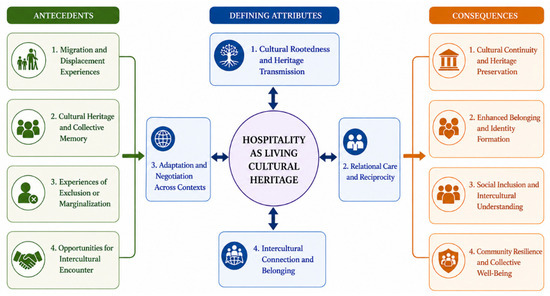
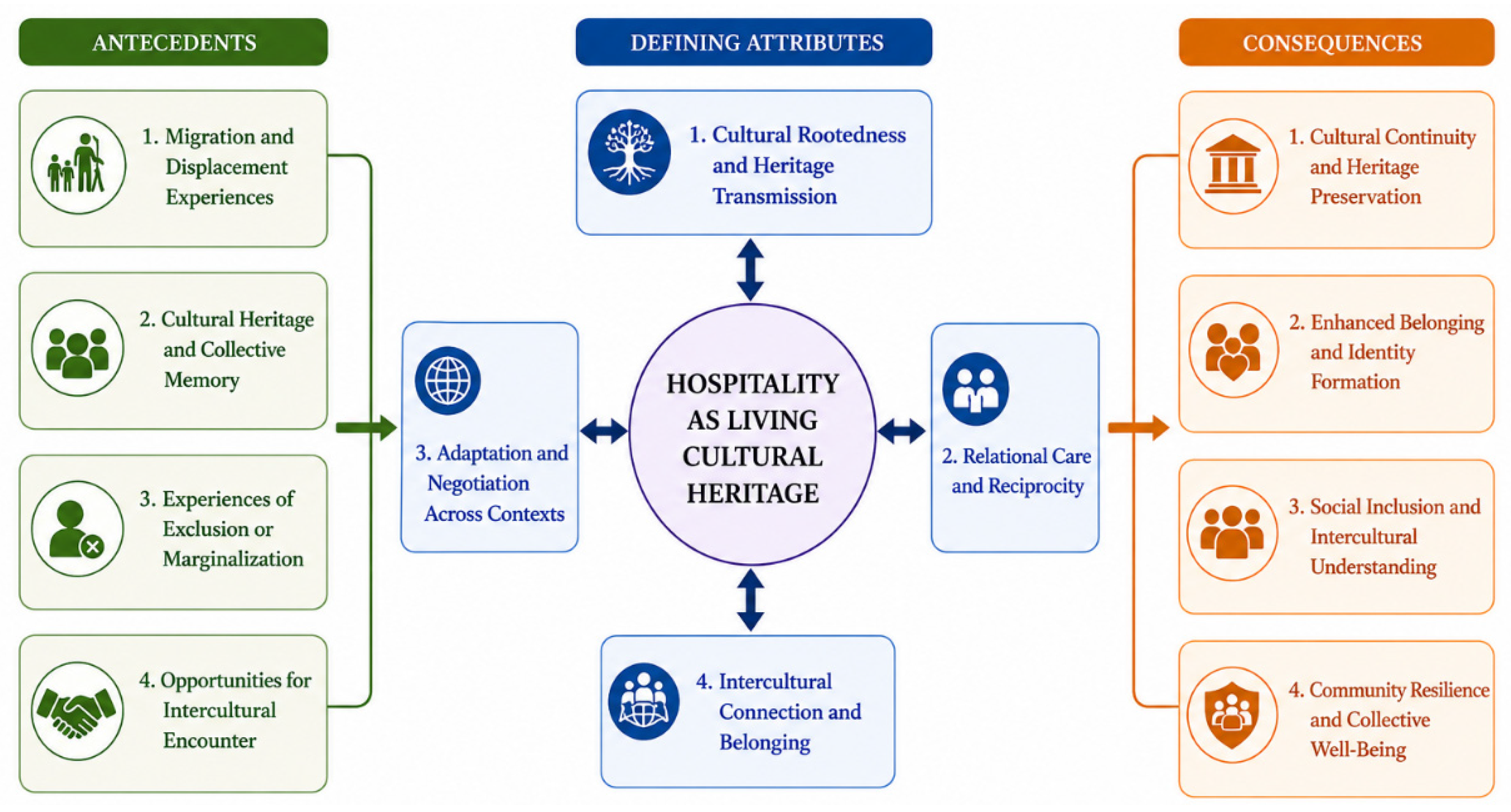
The findings of this concept analysis informed the development of a conceptual model of Heritage-Informed Migrant Hospitality as Living Cultural Heritage (Figure 2). The model illustrates the dynamic relationships among the antecedents, defining attributes, and consequences of the concept and provides a visual representation of how hospitality operates as a culturally embedded and relational process. As shown in Table 3, the synthesis of the included literature identified four antecedents that create the conditions necessary for Heritage-Informed Migrant Hospitality to emerge: migration and displacement experiences, cultural heritage and collective memory, experiences of exclusion or marginalization, and opportunities for intercultural encounter. These antecedents establish the social, cultural, and structural contexts in which hospitality becomes both necessary and meaningful. Migration and displacement often disrupt social relationships and continuity, while collective memory and cultural heritage provide the symbolic and practical resources through which hospitality practices can be enacted. Experiences of exclusion and marginalization create a need for recognition and belonging, and opportunities for intercultural encounters provide the spaces in which hospitality can be expressed and negotiated. At the centre of the model is Hospitality as Living Cultural Heritage, representing the core phenomenon of the concept. The four defining attributes are connected to this central concept through bidirectional relationships, indicating that hospitality simultaneously shapes and is shaped by these attributes. Cultural rootedness and heritage transmission position hospitality as a vehicle for preserving and transmitting cultural knowledge and traditions across generations and contexts. Relational care and reciprocity emphasize the ethical and relational dimensions of hospitality through mutual support, trust, and care. Adaptation and negotiation across contexts acknowledge that hospitality practices are dynamic and continuously recreated in response to changing social, political, and cultural environments. Finally, intercultural connection and belonging highlight the role of hospitality in fostering recognition, participation, and social connectedness among migrants and receiving communities.
Figure 2.
Conceptual model of Heritage-Informed Migrant Hospitality. Source: Authors’ own work based on the concept analysis.
The model further demonstrates that the enactment of Heritage-Informed Migrant Hospitality results in four interconnected consequences: cultural continuity and heritage preservation, enhanced belonging and identity formation, social inclusion and intercultural understanding, and community resilience and collective well-being. These outcomes suggest that hospitality extends beyond individual acts of welcoming and contributes to broader processes of cultural sustainability, social cohesion, and community development. The bidirectional relationships depicted in Figure 2 also suggest that the consequences of Heritage-Informed Migrant Hospitality may reinforce and sustain the concept over time. For example, strengthened belonging and social inclusion may create additional opportunities for intercultural encounters, while cultural continuity and community resilience may further support the transmission and adaptation of hospitality practices across generations. Consequently, the model illustrates the relationships among the conditions, core dimensions, and outcomes of Heritage-Informed Migrant Hospitality. While Figure 2 primarily represents the structural integrity of the concept, the dynamic character of the process is reflected in the way these components may interact over time as migrants adapt, transmit, and renegotiate practices of welcome, care, reciprocity, and belonging across changing social and cultural contexts.
4. Contribution to Heritage and Hospitality Studies
This concept analysis makes several important contributions to both heritage and hospitality scholarship. Within heritage studies, the concept advances contemporary understandings of living heritage by positioning hospitality itself as a form of intangible cultural heritage that is continuously recreated and transmitted through everyday social practices. While heritage research has increasingly recognized migrants as heritage makers and active participants in cultural production, limited attention has been given to hospitality as a mechanism through which cultural heritage is preserved, adapted, and transmitted. By conceptualizing hospitality as living cultural heritage, this analysis extends existing heritage scholarship beyond material artifacts and institutional heritage practices to include relational, embodied, and everyday experiences of care, welcome, and reciprocity.
Within hospitality studies, the concept challenges dominant perspectives that largely frame hospitality within commercial, tourism, or service-oriented contexts. The findings demonstrate that hospitality is also a social, cultural, and ethical practice that plays a significant role in identity construction, community building, and intercultural belonging. By integrating insights from migration, heritage, and belonging literature, this analysis broadens the conceptual boundaries of hospitality studies and emphasizes the importance of reciprocal relationships, cultural continuity, and social inclusion.
More broadly, this concept analysis contributes to the growing interdisciplinary dialogue between migration studies, heritage studies, and hospitality scholarship. The proposed model provides a novel theoretical framework for understanding how migrants enact hospitality through culturally rooted practices that simultaneously preserve heritage and foster belonging and social cohesion. In doing so, the concept of Heritage-Informed Migrant Hospitality offers a new lens for examining the intersections of migration, culture, and community and provides a foundation for future theoretical and empirical work at the nexus of heritage and hospitality studies.
5. Discussion
The aim of this concept analysis was to clarify Heritage-Informed Migrant Hospitality as a form of living cultural heritage and to develop a conceptual model that explains its antecedents, defining attributes, consequences, and empirical referents. Drawing on 24 included studies, the analysis identified four defining attributes: cultural rootedness and heritage transmission, relational care and reciprocity, adaptation and negotiation across contexts, and intercultural connection and belonging. Overall, the findings suggest that hospitality in migration contexts is not simply an act of welcome or service provision; rather, it is a culturally embedded, relational, and adaptive practice through which migrants preserve heritage, negotiate identity, and contribute to belonging in receiving societies.
The findings are aligned with and extend previous scholarship that conceptualizes hospitality as an ethical and relational practice rather than a purely commercial activity. Earlier hospitality scholarship has distinguished hospitableness from service provision and emphasized generosity, welcome, and relational openness [1,34,35]. More recent migration-focused work similarly demonstrates that hospitality is shaped through everyday encounters, intimate relations, institutional arrangements, and power-laden host–guest dynamics [2,3,4,54]. The present analysis is congruent with these studies but advances them by showing that hospitality can also operate as living cultural heritage when practices of welcome are rooted in collective memory, cultural values, language, food, rituals, storytelling, and intergenerational transmission.
Cultural rootedness and heritage transmission is consistent with studies showing that displaced and migrant communities sustain identity and belonging through everyday cultural practices. Alsalloum [15] demonstrated that resettled Syrians used intangible cultural heritage, crafts, domestic objects, and practices such as Arabic coffee-making to rebuild home and preserve identity in exile. Similar findings were reported among resettled Congolese refugee women, who maintained traditions related to clothing, food preparation, and parenting as sources of continuity and psychological comfort [20]. Studies of diasporic leisure and migrant heritage-making further show that heritage is actively transmitted and adapted through family practices, rituals, performance, and hybrid cultural spaces rather than simply preserved unchanged from the homeland [16,17,18,22]. These studies are congruent with the present findings because they support the interpretation of hospitality as a vehicle through which living heritage is carried, enacted, and shared across migration contexts.
The findings related to relational care and reciprocity are also consistent with studies that challenge one-directional understandings of migrants as guests and host societies as providers of welcome. Gardner et al. [10] showed that refugee-background women actively host other newcomers through culturally meaningful rituals of welcome, shared knowledge, and intra-community care. Similarly, food-based hospitality enabled undocumented migrants and migrant women to reposition themselves as hosts, express gratitude, generate income, and create spaces of intercultural encounter [9,13]. Zeinali et al. [12] also demonstrated that migrant women entrepreneurs enact hospitality toward local communities through business and community engagement, even while navigating exclusion. These findings are highly congruent with the present concept analysis because they show that migrants are not passive recipients of hospitality but active cultural actors who produce care, reciprocity, and belonging. This interpretation reinforces the central contribution of the analysis: migrant hospitality is not limited to reception or assistance but is also a form of cultural participation and heritage-making. By enacting welcome through food, storytelling, rituals, community support, and reciprocal care, migrants assert belonging and legitimacy within receiving societies while also reshaping the cultural meanings of hospitality across everyday, institutional, and political spaces.
At the same time, the analysis is consistent with studies showing that hospitality is often ambivalent, conditional, and entangled with hostility. Private refugee hosting may generate care, intimacy, and family-like relationships, but it can also create expectations of emotional reciprocity and informal boundaries that shape whether guests feel welcome or obligated [5]. State-organized and institutional forms of hospitality may provide shelter while producing unequal hierarchies of belonging, as seen in the Homes for Ukraine scheme, asylum hotel accommodation, and hostile environment policies [7,8,29]. Airport borders similarly reveal how hospitality can be withheld through surveillance, suspicion, and microaggressions that leave non-citizen residents suspended between belonging and non-belonging [30].
Adaptation and negotiation across contexts are also supported by previous studies on migrant heritage-making and homemaking. Migrant heritage is not a fixed inheritance transferred intact across borders; it is continuously recreated through micro-practices, multiscalar participation, family rituals, digital storytelling, and encounters between established and newer diaspora communities [17,18,36,37]. This finding is congruent with the living heritage approach, which defines intangible cultural heritage as dynamic, community-based, and continuously recreated in response to changing environments [14]. These findings are also congruent with heritage hospitality research in non-migrant cultural landscape contexts. For example, Tsamos et al. [43] showed that policy incentives and adaptive reuse frameworks in the UNESCO cultural landscape of Zagori, Greece, supported the development of small-scale heritage hospitality enterprises that strengthened cultural preservation, local entrepreneurship, and community resilience. However, the analysis also reveals a tension with some heritage tourism and hospitality studies, where cultural heritage may be packaged through branding, visitor experience, architectural design, or commercial hospitality [40,42,43,45,46]. While these studies demonstrate the visibility and economic value of heritage-informed hospitality, they also raise concerns about authenticity, commodification, and unequal representation.
The findings on intercultural connection and belonging are aligned with literature demonstrating that welcome is produced through community spaces, everyday interactions, institutional support, and opportunities for participation. Ramachandran [26] found that asylum seekers and refugees experienced Glasgow as welcoming through a combination of institutional support, community spaces, and daily interpersonal encounters. Similarly, Al-Hamad et al. [6] found that informal hosting can foster emotional safety, relational care, cultural continuity, and a negotiated sense of belonging within displacement contexts. Digital and participatory heritage studies similarly show that cultural heritage tools can support social inclusion, cohesion, and recognition by enabling marginalized groups to share stories, values, and connections to place [23,48]. These findings are also congruent with studies linking social integration, supportive relationships, and heritage-based relational capacities to resilience, self-compassion, and reduced loneliness among migrants [27,28]. Together, this literature supports the present analysis by demonstrating that belonging is not only an emotional outcome but also a socially produced condition shaped by cultural recognition, reciprocal relationships, and inclusive spaces.
The analysis further aligns with scholarship arguing that migrant inclusion requires recognition of migrants as heritage makers and cultural contributors. Desille and Nikielska-Sekuła [24] argued that cultural heritage can bridge migrant inclusion and intercultural recognition when migrants are positioned as active participants in heritage-making rather than objects of integration. Giglitto et al. [21] similarly identified a gap between migrant communities’ intangible cultural heritage and institutional safeguarding systems, calling for stronger collaboration among institutions, civil society, and migrant communities. The present findings extend this work by identifying hospitality itself as one of the mechanisms through which migrant heritage is enacted, shared, and sustained.
6. Implications
Heritage-Informed Migrant Hospitality has implications for practice, policy, and research. Community organizations, cultural institutions, educators, settlement agencies, and heritage practitioners can use the conceptual model to support migrant-led sharing, preservation, and adaptation of cultural heritage through food, storytelling, language, crafts, performance, rituals, and other cultural practices. Such initiatives may strengthen reciprocal relationships, intercultural connection, belonging, community resilience, and the preservation of living heritage.
At the policy level, the concept challenges integration approaches that position migrants only as recipients of support. Instead, it recognizes migrants as active hosts, heritage bearers, and contributors to social cohesion. Migrant inclusion and heritage policies should therefore create meaningful opportunities for migrant communities to participate in heritage governance, cultural programming, museum practices, and community development.
Future research should empirically test the model across diverse migrant populations, cultural groups, and sociopolitical contexts. Comparative, longitudinal, and participatory studies are needed to examine how gender, generation, migration status, legal precarity, race, class, and settlement duration shape hospitality, cultural continuity, reciprocity, and belonging.
7. Strengths and Limitations
This concept analysis addresses a gap at the intersection of migration, heritage, and hospitality studies by positioning hospitality as a form of living cultural heritage. Guided by Walker and Avant’s [31] method, the analysis identified the concept’s core dimensions, enabling conditions, outcomes, empirical referents, and conceptual model. Its interdisciplinary evidence base offers a broad foundation for understanding how hospitality supports belonging, cultural continuity, and social inclusion among migrant communities.
Several limitations should be noted. The analysis was limited to English-language sources published between 2010 and 2026, which may have excluded relevant scholarship from other languages, regions, or periods. The included literature was also heterogeneous, and many sources addressed hospitality, heritage, or migration indirectly. Finally, the proposed model has not yet been empirically tested; future qualitative, quantitative, and participatory studies are needed to examine its relevance across diverse migrant populations and sociopolitical contexts.
8. Conclusions
This concept analysis conceptualizes hospitality as a form of living cultural heritage that is culturally rooted, relational, adaptive, and oriented toward belonging. Synthesizing 24 studies, the analysis identified four core dimensions: cultural rootedness and heritage transmission, relational care and reciprocity, adaptation and negotiation across contexts, and intercultural connection and belonging. The findings show that hospitality extends beyond commercial or service-based understandings and functions as a mechanism through which migrants preserve heritage, foster reciprocal relationships, and negotiate identity within receiving societies. By positioning migrants as active hosts, heritage makers, and contributors to social cohesion, this concept challenges deficit-based views of migrants as passive recipients of support. It offers a framework for understanding how everyday practices of welcome, care, and reciprocity sustain cultural continuity, social inclusion, and community resilience in migration contexts.
Author Contributions
Conceptualization, A.A.-H.; methodology, A.A.-H. and Y.M.Y.; validation, A.A.-H. and Y.M.Y.; formal analysis, A.A.-H., Y.M.Y., L.Y., T.K. and H.T.; investigation, A.A.-H., Y.M.Y., L.Y., T.K. and H.T.; resources, A.A.-H.; data curation, A.A.-H., Y.M.Y., L.Y., T.K. and H.T.; writing—original draft preparation, A.A.-H.; writing—review and editing, A.A.-H., Y.M.Y., L.Y., T.K. and H.T.; visualization, A.A.-H.; supervision, A.A.-H.; project administration, A.A.-H.; funding acquisition, not applicable. All authors have read and agreed to the published version of the manuscript.
Funding
This research received no external funding.
Institutional Review Board Statement
Not applicable.
Informed Consent Statement
Not applicable.
Data Availability Statement
All data generated or analyzed during this study are included in this article and its Appendixes A–C.
Acknowledgments
During the preparation of this manuscript, the authors used ChatGPT-4, developed by OpenAI, for the purposes of language refinement, organization, and clarity. The authors have reviewed and edited the output and take full responsibility for the content of this publication.
Conflicts of Interest
The authors declare no conflict of interest.
Appendix A
Table A1.
Preferred Reporting Items for Systematic Reviews and Meta-Analyses Extension for Scoping Reviews (PRISMA-ScR) Checklist.
Appendix B. Search Strategy
A comprehensive literature search was conducted to identify publications relevant to the concept of Heritage-Informed Migrant Hospitality. The search was undertaken in March 2026 using four electronic databases: Scopus, MEDLINE (via Ovid), CINAHL (via EBSCOhost), and PsycINFO (via Ovid). Additional studies were identified through citation searching and grey literature searches.
The search was limited to studies published between January 2010 and March 2026 to capture contemporary scholarship on hospitality, migration, and living cultural heritage.
The search strategy combined terms related to three core concepts: hospitality, migration, and cultural heritage. Controlled vocabulary (where applicable) and keyword searches were used. Search terms were adapted according to the indexing requirements of each database.
- Core Search Concepts and Keywords
- Concept 1: Hospitality
- Hospitality
- Host*
- Hosting
- Welcoming
- Guest-host relations
- Social hospitality
- Cultural hospitality
- Urban hospitality
- Concept 2: Migration
- Migrant*
- Immigrant*
- Refugee*
- Asylum seeker*
- Newcomer*
- Diaspora*
- Forced migration
- Migration
- Concept 3: Cultural Heritage
- Cultural heritage
- Living heritage
- Intangible cultural heritage
- Heritage
- Cultural tradition*
- Cultural practice*
- Cultural preservation
- Cultural transmission
- Belonging
- Social inclusion
- Identity
- Search Strategy (Scopus)
(TITLE-ABS-KEY(hospitality OR host* OR hosting OR welcoming OR “guest-host relations” OR “social hospitality” OR “cultural hospitality” OR “urban hospitality”))
AND
(TITLE-ABS-KEY(migrant* OR immigrant* OR refugee* OR “asylum seeker” OR newcomer OR diaspora* OR migration OR”forced migration”))
AND
(TITLE-ABS-KEY(“cultural heritage” OR “living heritage” OR “intangible cultural heritage” OR heritage OR “cultural tradition” OR “cultural practice” OR “cultural preservation” OR “cultural transmission” OR belonging OR “social inclusion” OR identity))
Limits: English language; publication years 2010–2026.
Example Search Strategy (MEDLINE and PsycINFO)
- Hospitality.mp.
- Host*.mp.
- Hosting.mp.
- Welcoming.mp.
- Migrant*.mp.
- Immigrant*.mp.
- Refugee*.mp.
- Asylum seeker*.mp.
- Diaspora*.mp.
- Cultural heritage.mp.
- Intangible cultural heritage.mp.
- Living heritage.mp.
- Belonging.mp.
- Social inclusion.mp.
- Identity.mp.
- 1 OR 2 OR 3 OR 4
- 5 OR 6 OR 7 OR 8 OR 9
- 10 OR 11 OR 12 OR 13 OR 14 OR 15
- 16 AND 17 AND 18
- Limits: English language; publication years 2010–2026.
- Search Strategy (CINAHL)
- S1: (MH “Hospitality+”) OR hospitality OR host* OR hosting OR welcoming
- S2: (MH “Immigrants+”) OR (MH “Refugees+”) OR migrant* OR immigrant* OR refugee* OR asylum seeker* OR diaspora*
- S3: “cultural heritage” OR “living heritage” OR “intangible cultural heritage” OR heritage OR belonging OR identity OR “social inclusion”
- S4: S1 AND S2 AND S3
Limits: English language; publication years 2010–2026.
Additional Search Methods
- Citation searching of included studies and relevant review articles.
- Manual searching of reference lists.
- Grey literature searches, including reports, policy documents, and organizational publications relevant to migration, hospitality, and cultural heritage.
Appendix C
Table A2.
Data Extraction Table.
References
- Al-Hamad, A.; Yasin, Y.M.; Yasin, L. Hospitableness at home: Informal hospitality practices in homestay hosting for displaced Ukrainian women. Cornell Hosp. Q. 2026, 67, 389–399. [Google Scholar] [CrossRef] [Scilit]
- Farahani, F. Hospitality and hostility: The dilemmas of intimate life and refugee hosting. J. Sociol. 2021, 57, 664–673. [Google Scholar] [CrossRef] [Scilit]
- Rydzik, A.; Chanamuto, N.; Chambers, D. Conceptualizing the intersections between migration, (in)hospitality and belonging in uncertain times. Hosp. Soc. 2025, 15, 3–22. [Google Scholar] [CrossRef] [Scilit]
- DeMaria Harney, N.; Boccagni, P. Calibrating home, hospitality and reciprocity in migration. Anthropol. Theory 2023, 23, 313–331. [Google Scholar] [CrossRef] [Scilit] [PubMed]
- Monforte, P.; Maestri, G.; d’Halluin, E. ‘It’s like having one more family member’: Private hospitality, affective responsibility and intimate boundaries within refugee hosting networks. J. Sociol. 2021, 57, 674–689. [Google Scholar] [CrossRef] [Scilit]
- Al-Hamad, A.; Yasin, Y.M.; Metersky, K.; Guruge, S. “Home away from home”: A critical metaphor analysis of displaced Ukrainian women’s experiences with their Canadian hosts. Glob. Qual. Nurs. Res. 2025, 12, 23333936251353210. [Google Scholar] [CrossRef] [Scilit] [PubMed]
- Berg, M.L.; Zschomler, S. Superdiversity, the ‘new bespokism’, and hierarchies of belonging: The Homes for Ukraine scheme in the UK. Ethn. Racial Stud. 2025, 48, 1804–1822. [Google Scholar] [CrossRef] [Scilit]
- Petie, O.; Phillimore, J.; Allsopp, J. Exploring hospitality, hostility and (un)home in hotel accommodation for asylum seekers in the United Kingdom. Hosp. Soc. 2025, 15, 23–44. [Google Scholar] [CrossRef] [Scilit]
- Clarebout, A.; Mescoli, E. Food hospitality and the negotiation of subjectivities through meals in the context of migration: Case studies from Belgium. Food Cult. Soc. 2023, in press. [Google Scholar] [CrossRef] [Scilit]
- Gardner, J.; Lenette, C.; Al Kalmashi, R. Who is the host? Interrogating hosting from refugee-background women’s perspectives. J. Intercult. Stud. 2022, 43, 621–638. [Google Scholar] [CrossRef] [Scilit]
- Irimiás, A.; Michalkó, G. Hosting while being hosted: A perspective of Hungarian migrant hospitality workers in London, UK. Tour. Hosp. Res. 2016, 16, 172–183. [Google Scholar] [CrossRef] [Scilit]
- Zeinali, M.; Rydzik, A.; Bosworth, G. Navigating hostility, pursuing hospitality: Conceptualizing community engagement among migrant women entrepreneurs in peripheral areas. Hosp. Soc. 2025, 15, 177–200. [Google Scholar] [CrossRef] [Scilit]
- Arcadu, M.; Tubertini, E.; Reyes Espejo, M.I.; Migliorini, L. Identity construction and community building practices through food: A case study. Behav. Sci. 2025, 15, 1675. [Google Scholar] [CrossRef] [Scilit] [PubMed]
- UNESCO. Convention for the Safeguarding of the Intangible Cultural Heritage; UNESCO: Paris, France, 2003. [Google Scholar]
- Alsalloum, A. Building home in exile: The role of intangible cultural heritage, crafts, and material culture among resettled Syrians in Liverpool, UK. Architecture 2024, 4, 1020–1046. [Google Scholar] [CrossRef] [Scilit]
- Mukherjee, U. ‘Only so that my daughter gets exposure to the culture’: Ethnic leisure practices and intangible cultural heritage in British Indian diasporic families. Loisir Soc./Soc. Leis. 2021, 44, 399–414. [Google Scholar] [CrossRef] [Scilit]
- Nikielska-Sekuła, K. Migrating heritage? Recreating ancestral and new homeland heritage in the practices of immigrant minorities. Int. J. Herit. Stud. 2019, 25, 1113–1127. [Google Scholar] [CrossRef] [Scilit]
- Nikielska-Sekuła, K. Migrants as heritage makers: Micro practices and multiscalar perspectives in post-migration cultural heritage participation. Int. J. Herit. Stud. 2025, 31, 1613–1634. [Google Scholar] [CrossRef] [Scilit]
- Al-Hamad, A.; Metersky, K.; Parada, H.; Yasin, Y.; Hingorani, M.; Gare, C. Blossoming through creativity: Unveiling sense of belonging among Ukrainian and Syrian refugee women in Ontario. J. Int. Migr. Integr. 2024, 25, 887–910. [Google Scholar] [CrossRef] [Scilit]
- Kirkland, C.; Evans, N.; Spates, K.; Kabasele, C.M. Perceptions of resettled refugee Congolese women: Maintaining cultural traditions during resettlement. Int. J. Environ. Res. Public Health 2022, 19, 16714. [Google Scholar] [CrossRef] [Scilit] [PubMed]
- Giglitto, D.; Ciolfi, L.; Bosswick, W. Building a bridge: Opportunities and challenges for intangible cultural heritage at the intersection of institutions, civic society, and migrant communities. Int. J. Herit. Stud. 2022, 28, 74–91. [Google Scholar] [CrossRef] [Scilit]
- Istvandity, L. Performing cultural heritage as a method of preservation in migrant communities. Int. J. Cult. Policy 2026. advance online publication. [Google Scholar] [CrossRef] [Scilit]
- Ross, J. Casting a line: Digital co-production, hospitality and mobilities in cultural heritage settings. Curator Mus. J. 2018, 61, 575–592. [Google Scholar] [CrossRef] [Scilit]
- Desille, A.; Nikielska-Sekuła, K. (Inter)Cultural heritage and inclusion for migrants: Bridging the gap. J. Intercult. Stud. 2024, 45, 1–12. [Google Scholar] [CrossRef] [Scilit]
- Neikirk, A.; Nickson, R.; Rijal, S. Intangible cultural heritage and the protection of refugees and refugee camps. J. Refug. Stud. 2024, 37, 117–133. [Google Scholar] [CrossRef] [Scilit]
- Ramachandran, N. Asylum seekers and refugees’ perspectives and experiences of what makes Glasgow welcoming. Hosp. Soc. 2025, 15, 87–106. [Google Scholar] [CrossRef] [Scilit]
- Arici, A.; Artan, T.; Cebeci, F. From displacement to belonging: How social integration shapes psychological resilience and self-compassion in migrant children. Int. J. Soc. Psychiatry 2026, 72, 471–482. [Google Scholar] [CrossRef] [Scilit] [PubMed]
- Heu, L.C.; van Zomeren, M.; Hansen, N. Far away from home and (not) lonely: Relational mobility in migrants’ heritage culture as a potential protection from loneliness. Int. J. Intercult. Relat. 2020, 77, 140–150. [Google Scholar] [CrossRef] [Scilit]
- Tomkow, L. Health and hostile hospitality: Understanding asylum applicants’ narratives of life and health in the UK. Soc. Sci. Med. 2020, 265, 113509. [Google Scholar] [CrossRef] [Scilit] [PubMed]
- Zare, S. Contested hospitality and welcome at the airport borders: The narratives of non-citizen residents. Hosp. Soc. 2025, 15, 45–66. [Google Scholar] [CrossRef] [Scilit]
- Walker, L.O.; Avant, K.C. Strategies for Theory Construction in Nursing, 6th ed.; Pearson: London, UK, 2022. [Google Scholar]
- Tricco, A.C.; Lillie, E.; Zarin, W.; O’Brien, K.K.; Colquhoun, H.; Levac, D.; Moher, D.; Peters, M.D.J.; Horsley, T.; Weeks, L.; et al. PRISMA extension for scoping reviews: Checklist and explanation. Ann. Intern. Med. 2018, 169, 467–473. [Google Scholar] [CrossRef] [Scilit] [PubMed]
- Braun, V.; Clarke, V. Thematic analysis. In APA Handbook of Research Methods in Psychology: Research Designs: Quantitative, Qualitative, Neuropsychological, and Biological, 2nd ed.; Cooper, H., Coutanche, M.N., McMullen, L.M., Panter, A.T., Rindskopf, D., Sher, J.K., Eds.; American Psychological Association: Washington, DC, USA, 2023; Volume 2, pp. 65–81. [Google Scholar] [CrossRef] [Scilit]
- Lashley, C. Hospitality and hospitableness. Res. Hosp. Manag. 2015, 5, 1–7. [Google Scholar] [CrossRef] [Scilit]
- Derrida, J. Of Hospitality; Stanford University Press: Redwood, CA, USA, 2000. [Google Scholar]
- Nisi, V.; Bala, P.; Bostock, H.; Cesário, V.; Nunes, N.J. “Before gentrification, we claim for habitation”: Eliciting values and assets through cultural heritage storytelling. In Proceedings of the 18th DIS ’23, Pittsburgh, PA, USA, 10–14 July 2023. [Google Scholar] [CrossRef] [Scilit]
- Trzeszczyńska, P.; Demel, G.; Błaszczak-Rozenbaum, B. Heritage in diaspora-forming processes: Encounters of local Ukrainians and migrants from Ukraine in Poland. J. Int. Migr. Integr. 2024, 25, 171–190. [Google Scholar] [CrossRef] [Scilit]
- Karrebæk, M.S.; Ghandchi, N. Guests and hosts: What hospitality may reveal in the heritage language classroom. Linguist. Educ. 2017, 39, 37–47. [Google Scholar] [CrossRef] [Scilit]
- Marselis, R. Digitizing migration heritage: A case study of a minority museum. MedieKultur J. Media Commun. Res. 2011, 27, 16. [Google Scholar] [CrossRef] [Scilit]
- Chhabra, D. A cultural hospitality framework for heritage accommodations. J. Herit. Tour. 2015, 10, 184–190. [Google Scholar] [CrossRef] [Scilit]
- Munjal, P.G. How does the hospitality industry integrate heritage? Worldw. Hosp. Tour. Themes 2023, 15, 249–253. [Google Scholar] [CrossRef] [Scilit]
- Poon, S.T.F. Reimagining the place and placelessness: Heritage symbolism and hospitality architectural designs. Place Brand. Public Dipl. 2019, 15, 288–296. [Google Scholar] [CrossRef] [Scilit]
- Tsamos, G.; Vlami, A.; Sarantakou, E.; Christidou, A. Heritage hospitality and sustainable tourism in mountain cultural landscapes: The case of Zagori within the UNESCO framework. Heritage 2025, 8, 523. [Google Scholar] [CrossRef] [Scilit]
- Carlier, L. Experience of urban hospitality: An ecological approach to the migrants’ world. Urban Plan. 2020, 5, 241–251. [Google Scholar] [CrossRef] [Scilit]
- Baker, C.; Hover, M. Leveraging historical hospitality in the national parks: Fred Harvey, Mary Colter, and the heritage of the American Southwest. J. Herit. Tour. 2024, 19, 816–838. [Google Scholar] [CrossRef] [Scilit]
- Catrina, S. Branding an authentic rural Maramureş in tourism practices: Interplay of hospitality, heritage and social memory. Tour. Hosp. Res. 2016, 16, 267–281. [Google Scholar] [CrossRef] [Scilit]
- Seyitoğlu, F.; Costa, C.; Breda, Z. Systematic review and future research agenda on coastal heritage in tourism and hospitality. J. Tour. Cult. Change 2025, 23, 227–246. [Google Scholar] [CrossRef] [Scilit]
- Nisi, V.; Bala, P.; Cesário, V.; James, S.; Del Bue, A.; Nunes, N.J. ‘Connected to the people’: Social inclusion and cohesion in action through a cultural heritage digital tool. Proc. ACM Hum.-Comput. Interact. 2023, 7, 319. [Google Scholar] [CrossRef] [Scilit]
- Melotti, M. The Mediterranean refugee crisis: Heritage, tourism, and migration. N. Engl. J. Public Policy 2018, 30, 11. Available online: https://scholarworks.umb.edu/nejpp/vol30/iss2/11 (accessed on 16 September 2026).
- Mansour, J.S.A.; Ariffin, A.A.M. The effects of local hospitality, commercial hospitality and experience quality on behavioral intention in cultural heritage tourism. J. Qual. Assur. Hosp. Tour. 2017, 18, 149–172. [Google Scholar] [CrossRef] [Scilit]
- Levett-Jones, T.; Lathlean, J. Belongingness: A prerequisite for nursing students’ clinical learning. Nurse Educ. Pract. 2008, 8, 103–111. [Google Scholar] [CrossRef] [Scilit] [PubMed]
- Yuval-Davis, N. Belonging and the politics of belonging. Patterns Prejud. 2006, 40, 197–214. [Google Scholar] [CrossRef] [Scilit]
- Putnam, R.D. Bowling Alone: The Collapse and Revival of American Community; Simon & Schuster: New York, NY, USA, 2000. [Google Scholar]
- Al-Hamad, A.; Yasin, Y.M.; Metersky, K.; Guruge, S.; Jung, G.; Mahsud, K. Homestay hosting dynamics and refugee well-being: Scoping review. Interact. J. Med. Res. 2024, 13, e58613. [Google Scholar] [CrossRef] [Scilit] [PubMed]

Disclaimer/Publisher’s Note: The statements, opinions and data contained in all publications are solely those of the individual author(s) and contributor(s) and not of MDPI and/or the editor(s). MDPI and/or the editor(s) disclaim responsibility for any injury to people or property resulting from any ideas, methods, instructions or products referred to in the content. |
© 2026 by the authors. Licensee MDPI, Basel, Switzerland. This article is an open access article distributed under the terms and conditions of the Creative Commons Attribution (CC BY) license.