


Abstract
This conceptual paper develops a Universal Design for Learning (UDL)-aligned framework for disability-inclusive education that treats Indigenous and locally rooted African storytelling traditions as context-dependent pedagogical and epistemic resources rather than as a single pan-African practice. The aim is to explain how culturally grounded storytelling, when co-designed with learners, families, disabled people’s organizations, cultural knowledge holders, and educators, may support access, participation, identity affirmation, and belonging. The paper uses a theory-guided conceptual synthesis; it is non-empirical and involved no participants or study site. It integrates Indigenous Knowledge Systems (IKS), decolonizing and culturally sustaining pedagogy, critical disability perspectives, social inclusion, and the CAST UDL Guidelines 3.0. The resulting logic model distinguishes inputs and design principles from mediators, proximal and distal outcomes, contextual moderators, and ethical implementation requirements. A barrier-based storytelling toolkit and five testable propositions translate the model into researchable hypotheses while treating disability labels as insufficient guides to learner needs. The framework is intended as a flexible heuristic for diverse African educational settings, not a continent-wide prescription, and it requires critical review of narratives that may reproduce ableist, gendered, linguistic, ethnic, or other exclusions.
1. Introduction
Inclusive education is a rights-based commitment reflected in the Convention on the Rights of Persons with Disabilities and Sustainable Development Goal 4, yet its implementation is mediated by local histories, languages, school structures, resource conditions, and understandings of disability [1,2,3]. In African education systems, these conditions vary markedly within and across countries. Accordingly, this paper does not treat Africa as a homogeneous educational or cultural space. It uses African school contexts as a broad regional frame while locating claims in the particular countries, communities, or traditions supported by the cited literature.
One persistent concern in debates on inclusion and decolonization is the marginalization of locally grounded knowledge and pedagogical practices. Indigenous Knowledge Systems (IKS) are plural, dynamic, and community-specific, not a single continental body of knowledge. They may include locally developed ecological, social, moral, artistic, historical, linguistic, and spiritual understandings transmitted through multiple practices, including oral narrative [4,5,6]. Re-centering such resources can support epistemic plurality, but it should not imply that all Indigenous practices are inclusive or that cultural authenticity by itself guarantees educational justice.
Storytelling is one possible resource within this wider landscape. Oral narrative traditions are documented in many African societies, although their genres, languages, performers, social authority, and educational functions differ substantially by place and historical period [7,8]. For example, the term griot describes particular West African traditions and is not an appropriate label for every African knowledge custodian. In classrooms, locally selected narratives may be combined with sign languages, oral language, visual media, objects, rhythm, movement, dramatization, or learner-created stories. These options are pedagogical possibilities, not universal characteristics of African teaching.
The conceptual problem addressed here is therefore more specific than the general claim that storytelling is culturally responsive. Existing work does not sufficiently explain how locally rooted narrative practices can be translated into a disability-inclusive design logic while preserving learner agency, attending to ableism and other intersecting exclusions, and making the proposed mechanisms empirically testable. Universal Design for Learning (UDL) offers a design architecture for learner variability, while decolonizing and culturally sustaining perspectives foreground power, language, cultural repertoires, and epistemic hierarchy. Critical disability scholarship adds a necessary focus on structural barriers, disabled learners’ knowledge, and co-design rather than positioning students only as recipients of accommodations [9,10,11].
This conceptual study aims to develop and justify a context-sensitive Storytelling-for-Inclusion Logic Model that explains how locally grounded storytelling, when designed through UDL and co-designed with relevant communities, may support communicative access, identity affirmation, perceived cultural relevance, belonging, participation, and learning. Its specific objectives are to (1) make the theoretical synthesis explicit; (2) distinguish mediators, outcomes, moderators, and ethical requirements; (3) provide a flexible, barrier-based design menu rather than diagnosis-based prescriptions; and (4) formulate testable propositions and measurement options for future research.
The paper’s novelty lies not in claiming that oral storytelling or multimodality is unprecedented. Rather, it systematizes the relationship among culturally grounded narrative practice, UDL 3.0, critical disability perspectives, and decolonizing education for disability-inclusive African schooling. Relocating UDL within this relational and epistemic frame changes the model in three ways: cultural and linguistic relevance becomes part of design rather than an optional adaptation; disabled learners and community knowledge holders become co-designers and knowledge producers; and ethical questions of representation, ownership, and exclusion are treated as implementation requirements rather than peripheral considerations.
2. Method of Conceptual Synthesis
This article is a non-empirical conceptual model-building study. It is neither a quantitative nor qualitative participant study, and it uses no participants, sampling frame, or geographic study site. It is also not presented as a systematic review with an exhaustive, reproducible search corpus. Instead, consistent with guidance on transparent conceptual research, it uses a theory-guided synthesis in which the reasons for selecting bodies of scholarship and the role of each theoretical component are made explicit [12,13,14].
The literature was purposively retained when it performed at least one of five analytic functions: (a) documenting IKS or oral storytelling in identified African settings; (b) explaining decolonizing, culturally responsive, or culturally sustaining pedagogy; (c) theorizing disability, ableism, Deaf/sign-language access, or disabled people’s participation in knowledge production; (d) specifying UDL design principles and learner variability; or (e) addressing ethical co-design and cultural ownership, intellectual property, or implementation context. Foundational works were combined with more recent scholarship where available. Sources from non-African Indigenous contexts are used only when they provide transferable conceptual or ethical principles; they are not treated as empirical evidence about African schools. Evidentiary weight was calibrated to source function and context: empirical studies were used for claims about the settings and populations they actually examined, whereas broader or non-African sources were used for conceptual, ethical, or design principles rather than as direct evidence about African schools. The relevant literature was located through a combination of targeted database searching (including ERIC, Google Scholar, and PsycINFO), citation tracing from foundational works, and purposive identification of African and disability-specific scholarship. No exhaustive or reproducible search corpus is claimed.
The synthesis proceeded in four analytic stages. First, the explanatory problem was defined as the gap between culturally grounded narrative practice and operational disability-inclusive design. Second, each lens was assigned a distinct explanatory function: IKS locates knowledge in community histories and relations; decolonial theory interrogates epistemic hierarchy and whose knowledge counts; culturally responsive and sustaining pedagogies connect instruction to learners’ cultural and linguistic repertoires; critical disability perspectives identify ableist and structural barriers and center disabled learners’ agency; UDL 3.0 provides a flexible design architecture; and social inclusion specifies participation and belonging as relational concerns. Third, concepts were mapped into model roles—inputs, design principles, mediators, proximal outcomes, distal outcomes, moderators, and ethical implementation requirements. Fourth, we derived propositions only where the conceptual mapping indicated a directional relationship. These propositions are hypotheses for future testing, not causal findings established by this paper.
This approach increases traceability without overstating the evidentiary status of a conceptual article. It also permits disconfirming considerations—including cultural practices that may reproduce stigma, gender hierarchy, ethnic exclusion, linguistic marginalization, or ableism—to shape the framework rather than being reserved for a final limitations paragraph.
3. Theoretical Foundations
3.1. Indigenous Knowledge Systems and Decolonizing Education
IKS can be understood as situated, evolving bodies of knowledge, practice, values, and interpretation developed within communities over time. African scholarship on IKS emphasizes both the importance of cognitive justice and the danger of treating Indigenous knowledge as static, premodern, or interchangeable across communities [4,5,6,15]. A decolonizing orientation therefore asks not only whether local knowledge is present in the curriculum, but how authority is distributed: who selects the story, whose language is legitimate, who may interpret or adapt cultural material, and whose knowledge is excluded.
In this framework, storytelling is valuable when it creates room for locally meaningful knowledge and participation, not because it is presumed inherently benevolent. Narratives can carry collective memory and ethical reflection, but they can also encode hierarchies or stigmatizing representations. The decolonial task is thus critical and reconstructive: community knowledge is recognized as intellectually consequential while particular narratives are still examined for ableist, gendered, ethnic, religious, age-based, or other exclusions.
3.2. Culturally Responsive and Culturally Sustaining Pedagogy
Culturally responsive pedagogy links teaching to learners’ cultural references, experiences, and languages while pursuing academic learning and equity [16,17]. Culturally sustaining pedagogy extends this orientation by sustaining plural cultural and linguistic practices rather than treating them only as bridges to dominant norms [18]. For storytelling, this means that relevance cannot be inferred merely because a narrative is labeled traditional. Relevance should be established with learners and communities, and the classroom should permit learners to question, revise, counter-story, or create narratives rather than only reproduce inherited versions.
This emphasis is especially important for learners whose disability, language, gender, ethnicity, religion, or rural/urban location intersects with cultural expectations. A story may be culturally familiar yet still position a disabled character as dependent, cursed, heroic only through overcoming disability, or outside ordinary community life. Culturally grounded pedagogy therefore requires both recognition and critique.
3.3. UDL 3.0 and Learner Variability
UDL is used here as a design framework rather than as a theory of culture. The CAST UDL Guidelines version 3.0 emphasize learner agency, identity, belonging, multiple ways of knowing and communicating, accessible tools, and the need to challenge exclusionary practices [19]. These emphases align more directly with the present framework than the earlier 2018 guidelines. UDL 3.0 also rejects the assumption that one mode of representation, engagement, action, or expression is optimal for every learner.
Accordingly, disability labels do not determine a fixed storytelling technique. A Deaf learner may prefer a locally used sign language and access to a signing peer community; another learner may use speech, captioning, residual hearing, or multiple modes. Kenyan and Zimbabwean scholarship illustrates why sign-language access must be situated within national linguistic and educational contexts rather than reduced to generic “visual support” [20,21]. Research from Ghana similarly demonstrates the importance of multilingual ecologies in Deaf children’s lives [22]. Thus, the relevant unit of design is the barrier, communicative repertoire, learner preference, and learning goal—not the diagnostic category alone.
3.4. Critical Disability Perspectives, Social Inclusion, and Co-Design
Critical disability perspectives shift attention from presumed individual deficits to disabling social, curricular, linguistic, attitudinal, and institutional arrangements [9,10]. African disability scholarship further cautions against importing disability frameworks without attention to local political, economic, cultural, and institutional conditions [3,23]. In this paper, disabled learners are therefore treated as knowledge holders and co-designers of storytelling practice, not only as beneficiaries of adaptation. Where appropriate, disabled people’s organizations (DPOs), Deaf organizations, families, interpreters, and other accessibility professionals should participate in design decisions.
Social inclusion provides the relational outcome logic: access is insufficient if a learner remains peripheral to classroom interaction or if participation requires assimilation into a dominant communication mode. Belonging is therefore conceptualized as an outcome of inclusive participation and recognition, while identity affirmation, communicative access, and perceived cultural relevance are modeled as mechanisms through which a storytelling design may contribute to that outcome.
4. Integrated Storytelling-for-Inclusion Conceptual Model
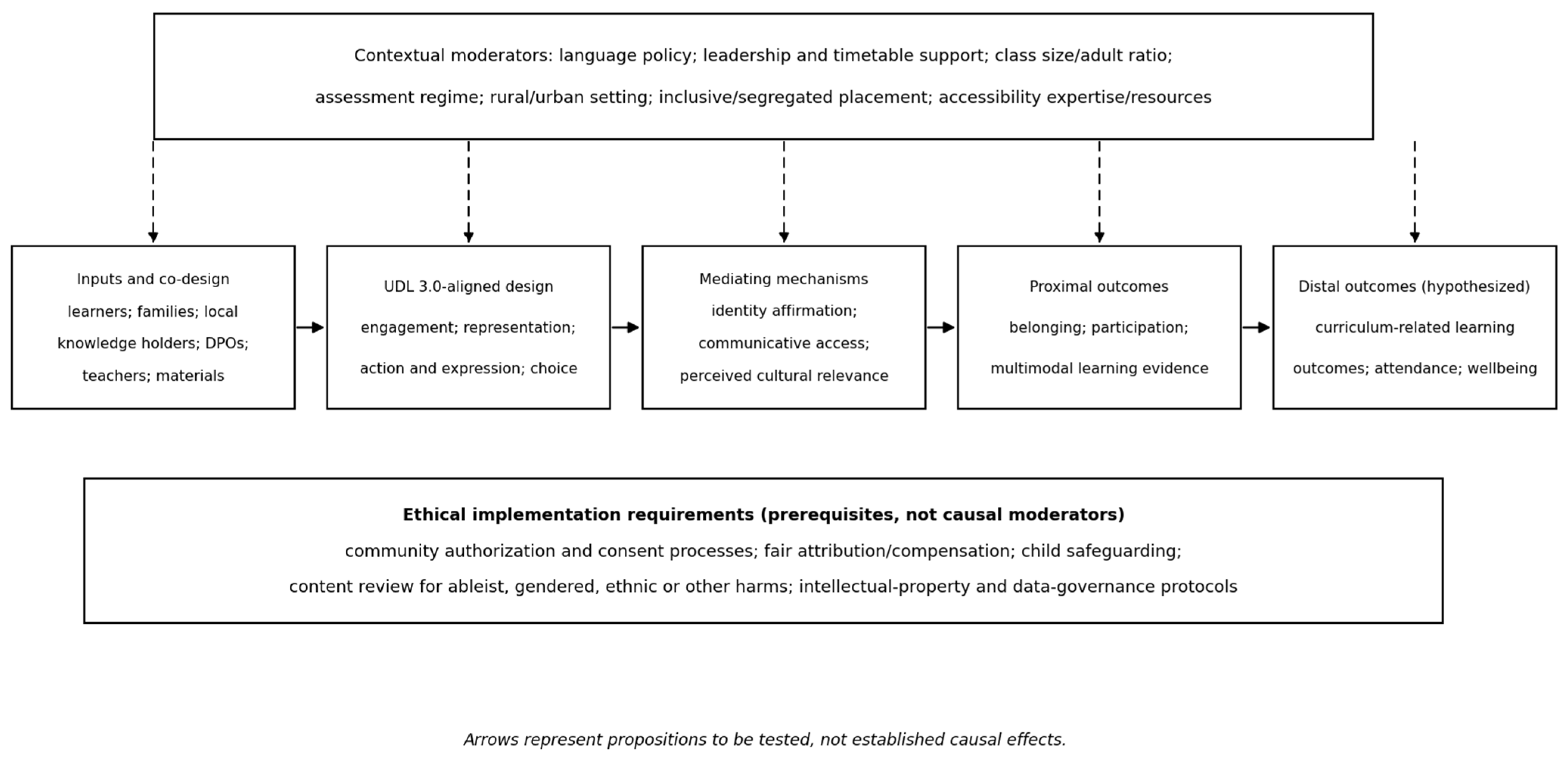
Figure 1 presents the logic model. The model begins with inputs and co-design resources, including locally selected narratives, learners, families, community knowledge holders, DPOs, teachers, accessible materials, and language resources. These inputs are translated through UDL 3.0-aligned design choices that provide options for engagement, representation, action, and expression. Three primary hypothesized mediating mechanisms are proposed: identity affirmation, communicative access, and perceived cultural relevance. The proximal outcomes are belonging, participation, and the quality of multimodal learning evidence. More distal outcomes such as curriculum-related learning outcomes, attendance, or wellbeing are intentionally placed later in the chain because they require additional mechanisms, time, and stronger empirical evidence.
Figure 1.
Storytelling-for-Inclusion Logic Model. Contextual moderators condition implementation and pathways; ethical implementation requirements are prerequisites rather than causal moderators. Solid arrows indicate the hypothesized sequence of pathways; dashed arrows indicate that contextual moderators may condition each stage. All directional arrows represent propositions for empirical testing.
The distinction between moderators and ethical requirements is substantive. Contextual moderators are conditions that may alter whether or how strongly a proposed pathway operates, such as leadership support, language policy, timetable flexibility, class size and adult-to-learner ratio, assessment pressure, rural or urban location, inclusive or segregated placement, and the availability of accessibility expertise. Ethical implementation requirements—community authorization and consent processes, fair attribution or compensation, child safeguarding, critical content review, and intellectual-property/data-governance protocols—are not modeled as statistical moderators. They establish whether implementation is ethically permissible and responsible.
The model also allows competing explanations. If participation increases during storytelling, the change may reflect novelty, teacher enthusiasm, additional adult attention, peer interaction, or reduced text demands rather than the Indigenous character of the narrative itself. Future evaluations should therefore measure plausible alternative mechanisms and, where feasible, compare culturally grounded storytelling with other equally multimodal and participatory designs.
4.1. Storytelling as a Context-Dependent Pedagogical Resource
Oral storytelling has long been used in many African societies for entertainment, historical narration, ethical reflection, social learning, memory, and the transmission of community knowledge; however, no single origin, form, or educational function can be generalized to the continent [7,8].
In a school context, a locally appropriate story may be narrated, signed, dramatized, illustrated, represented through objects, or re-authored by learners. The educational value lies in how the narrative and its modes are selected in relation to a learning goal, local cultural protocols, and learner access. A story should not be assumed accessible because it is oral, or inclusive because it is Indigenous. Its language, pace, sensory demands, social roles, symbolism, and disability representations can all create barriers.
Recent empirical evidence is emerging but remains context-specific. In Ibadan, Nigeria, Jacob et al. [24] examined Indigenous-language storytelling with 40 pupils with mild intellectual disability in two schools and reported improvements in moral values and social skills. This study is directly relevant to the present argument, but its specific population, outcomes, and local context do not justify continent-wide claims. It is treated here as evidence that culturally and linguistically grounded storytelling warrants further disability-inclusive investigation rather than as proof of the full conceptual model.
4.2. UDL-Aligned Storytelling Design Menu
Table 1 presents a flexible menu organized around access barriers and learner preferences. The options are illustrative rather than prescriptive. Selection should be individualized and, where possible, co-designed with the learner and relevant supporters. The same learner may require different options across tasks, and learners who share a diagnosis may prefer different modes. Local sign languages, cultural protocols, available technologies, sensory conditions, and the intended learning construct should guide implementation [19,20,21].
Table 1.
Illustrative UDL-Aligned Storytelling Design Menu Organized by Access Barrier.
5. Testable Propositions and Measurement
The propositions summarized in Table 2 distinguish predictors, mediators, outcomes, moderators, and ethical requirements. They also avoid unsupported implementation thresholds. No class-size cutoff or fixed weekly 30–45 min session is treated as an evidence-based parameter. Schools may pilot different frequencies and durations, but these are local implementation decisions that should be documented and examined rather than assumed to constitute fidelity.
Table 2.
Conceptual Propositions for Testing the Storytelling-for-Inclusion Logic Model.
Restated as complete hypotheses, P1 proposes that culturally grounded UDL storytelling is associated with stronger classroom belonging through identity affirmation and perceived cultural relevance. P2 proposes that flexible multimodal design is associated with greater participation through improved communicative access and engagement. P3 proposes that co-design with learners, disability stakeholders, and locally legitimate knowledge holders increases perceived cultural relevance and, in turn, participation. P4 proposes that construct-equivalent multimodal assessment options may yield more complete evidence of learning than written-only tasks when written production is not the target construct. P5 proposes that professional learning increases implementation fidelity through teacher self-efficacy.
Measurement Considerations
Measurement should preserve the distinction among constructs. Belonging is an outcome in P1, not a mediator. Perceived cultural relevance is a mediator in P1 and P3; teacher self-efficacy is a mediator in P5; and implementation fidelity is the P5 outcome. Identity affirmation and communicative access are mechanisms rather than distal educational outcomes. Operational definitions and illustrative indicators are summarized in Appendix A to maintain the conceptual flow of the main text.
Measures should not be transferred uncritically across languages or school systems. Researchers should examine translation, cultural meaning, accessibility, reliability, and construct validity in each study. Participation may be assessed through structured observation and learner report; communicative access through accessibility audits and learner-experience data; and multimodal learning evidence through common construct-aligned rubrics. For P4, rater training, double-rating where feasible, and reliability analysis are important because apparent modality effects may otherwise reflect scoring inconsistency rather than better access [25,26].
6. Ethical, Policy, and Implementation Considerations
6.1. Ethical Co-Design, Cultural Ownership, and Safeguarding
Using community narratives in formal schooling raises questions of authority, attribution, adaptation, storage, and benefit. Schools and researchers should not assume that publicly told stories are automatically free for institutional reproduction. Community authorization, informed consent where applicable, culturally legitimate decision-making, fair attribution or compensation, and clear agreements about recording and reuse should be established before stories are documented or redistributed. WIPO guidance on traditional cultural expressions and the CARE principles for Indigenous data governance provide useful ethical heuristics for intellectual-property and data-governance questions [27,28]. Because these frameworks are not specific to every African community, they should be adapted through local law, community protocol, and governance rather than imported as universal rules.
Child protection and representation require equal attention. Story content should be reviewed with educators, relevant cultural knowledge holders, learners where age-appropriate, and disability advocates to identify ableist tropes, gender stereotypes, ethnic or religious denigration, fear-based portrayals, or disclosure of culturally restricted knowledge. Disabled learners should have meaningful opportunities to reject, reinterpret, or counter-story representations of disability rather than being required to identify with them.
6.2. Policy and Practice Implications
Policy implications should be framed as adaptable design directions rather than continent-wide prescriptions. Curriculum authorities can create legitimate space for locally selected oral and multimodal genres where these advance curriculum goals, while teacher education can prepare educators to distinguish cultural relevance from cultural essentialism and to design for learner variability. Professional learning should include disability rights, accessible communication, local language policy, UDL 3.0, critical content review, and co-design with learners and disability stakeholders.
School-community partnerships require role clarity. Where schools engage elders, storytellers, artists, or other knowledge custodians, model memoranda of understanding (MoUs) can be adapted locally to address scope of participation, attribution, compensation, intellectual property, recording, safeguarding, and withdrawal from specific uses. A standardized national template may be useful administratively, but it should not override community-specific protocols or assume that all knowledge is available for classroom circulation.
Accessibility must also be structural. A storytelling lesson cannot compensate for the absence of qualified sign-language access, assistive and accessible technologies, accessible materials, appropriate teacher preparation, or supportive assessment policy. Examples from Kenya, Zimbabwe, and Ghana show why language ecology and Deaf community access matter to educational design [20,21,22]. Similarly, class size, examination pressure, rural/urban resource differences, school placement, and availability of specialist support can constrain implementation. These factors are therefore explicit boundary conditions in the model rather than afterthoughts.
Assessment policy should permit multiple ways of demonstrating a common learning construct when the mode of response is not itself the target. Oral, signed, visual, tactile, AAC-supported, or performative responses may reduce construct-irrelevant access barriers for some learners, but they are not automatically more valid than written assessment. P4 deliberately treats this as a testable proposition requiring equivalent task design, common rubrics, reliability evidence, and attention to curriculum and examination rules.
7. Limitations, Boundary Conditions, and Future Research
The framework has several limitations. First, a conceptual synthesis cannot establish effectiveness. The proposed pathways are theoretically reasoned and literature-informed, but causal effects on belonging, participation, learning, attendance, stigma, or wellbeing remain to be tested. Second, the regional frame is necessarily broad. African countries and communities differ in language policy, religious traditions, oral genres, disability politics, schooling structures, assessment systems, and availability of accessibility support. Results from one setting should not be generalized to another without contextual analysis.
Third, neither IKS nor storytelling should be romanticized. Indigenous practices may sustain collective identity and knowledge while also carrying contested authority structures, gendered roles, ableist representations, ethnic exclusions, or restrictions on who may speak and what may be shared. Critical content review and learner/community co-design are therefore constitutive of the model, not optional safeguards. Fourth, disability categories contain substantial within-group variability, and disability intersects with language, gender, poverty, geography, ethnicity, religion, and other dimensions of experience. The barrier-based toolkit cannot substitute for direct consultation with learners. Fifth, because the evidence base is purposive rather than exhaustive, the framework may not capture all relevant country-specific or disabled-led scholarship; future refinements should test and extend the model against additional locally grounded evidence.
Future research should begin with context-rich feasibility and co-design studies before large-scale effectiveness trials. Mixed methods can examine whether the proposed mechanisms occur as expected and identify unanticipated harms or alternative explanations. Comparative studies should test the model across named countries and communities rather than treating “Africa” as a single sampling frame. Studies should also include disabled learners as research partners where feasible, document locally used sign and spoken languages, report inclusive versus segregated school placement, and describe class size, assessment regime, rural/urban context, accessibility resources, and community governance arrangements.
For causal questions, cluster-randomized, quasi-experimental, or stepped-wedge designs may be appropriate only after the intervention and measures have been locally validated. Designs should compare culturally grounded storytelling with credible alternative multimodal pedagogies to distinguish the effect of Indigenous/cultural relevance from novelty, adult attention, performance, or reduced print demands. Longitudinal work is needed before distal outcomes such as attendance or wellbeing are attributed to the model.
8. Conclusions
This paper proposes a context-sensitive model for examining how locally rooted storytelling may contribute to disability-inclusive education when it is co-designed through UDL 3.0 and informed by decolonizing, culturally sustaining, and critical disability perspectives. The central contribution is a structured, testable account of the mechanisms linking storytelling design to identity affirmation, communicative access, perceived cultural relevance, belonging, participation, and multimodal evidence of learning. The model distinguishes those mechanisms from contextual moderators, distal outcomes, and ethical implementation requirements.
The framework is deliberately not a claim about a singular African epistemology or a prescription for all African classrooms. Oral traditions, languages, disability experiences, and school systems are heterogeneous, and some inherited narratives may reproduce exclusion. Inclusive use therefore depends on local knowledge, learner choice, disability and Deaf community participation, critical content review, and appropriate accessibility resources. Under those conditions, storytelling can be studied not as an intrinsically inclusive tradition but as a potentially valuable, culturally grounded design resource whose benefits, limits, and mechanisms should be established empirically.
Funding
This research received no external funding.
Data Availability Statement
No new data were created or analyzed in this study. Data sharing is not applicable to this article.
Conflicts of Interest
The authors declare no conflicts of interest.
Appendix A. Construct Definitions and Illustrative Measurement Options
This appendix consolidates definitions of the constructs referenced in the main text. The measures are examples for future research and require local linguistic, cultural, and accessibility validation.
Table A1.
Construct Roles, Operational Definitions, and Illustrative Indicators.
References
- United Nations. Convention on the Rights of Persons with Disabilities; United Nations: New York, NY, USA, 2006. [Google Scholar]
- United Nations. Transforming Our World: The 2030 Agenda for Sustainable Development; United Nations: New York, NY, USA, 2015. [Google Scholar]
- Chataika, T.; McKenzie, J.A.; Swart, E.; Lyner-Cleophas, M. Access to education in Africa: Responding to the United Nations Convention on the Rights of Persons with Disabilities. Disabil. Soc. 2012, 27, 385–398. [Google Scholar] [CrossRef] [Scilit]
- Kaya, H.O.; Seleti, Y.N. African Indigenous Knowledge Systems and relevance of higher education in South Africa. Int. Educ. J. Comp. Perspect. 2013, 12, 30–44. [Google Scholar]
- Odora Hoppers, C.A. Transformation and change in knowledge generation paradigms in the African and global contexts: Implications for education research in the 21st century. Educ. Res. Soc. Change 2017, 6, 1–11. [Google Scholar] [CrossRef] [Scilit]
- Khupe, C.; Keane, M. Towards an African education research methodology: Decolonising new knowledge. Educ. Res. Soc. Change 2017, 6, 25–37. [Google Scholar] [CrossRef] [Scilit]
- Okpewho, I. Storytelling in the African world. J. Afr. Lit. Assoc. 2009, 3, 110–122. [Google Scholar] [CrossRef] [Scilit]
- Tuwe, K. The African oral tradition paradigm of storytelling as a methodological framework: Employment experiences for African communities in New Zealand. Int. J. Afr. Renaiss. Stud.-Multi- Inter-Transdiscipl. 2016, 11, 53–70. [Google Scholar]
- Goodley, D. Dis/ability Studies: Theorising Disablism and Ableism; Routledge: London, UK, 2014. [Google Scholar]
- Chataika, T. (Ed.) The Routledge Handbook of Disability in Southern Africa; Routledge: London, UK, 2019. [Google Scholar]
- Waitoller, F.R.; King Thorius, K.A. Cross-pollinating culturally sustaining pedagogy and Universal Design for Learning: Toward an inclusive pedagogy that accounts for dis/ability. Harv. Educ. Rev. 2016, 86, 366–389. [Google Scholar] [CrossRef] [Scilit]
- Jabareen, Y. Building a conceptual framework: Philosophy, definitions, and procedure. Int. J. Qual. Methods 2009, 8, 49–62. [Google Scholar] [CrossRef] [Scilit]
- Jaakkola, E. Designing conceptual articles: Four approaches. AMS Rev. 2020, 10, 18–26. [Google Scholar] [CrossRef] [Scilit]
- Snyder, H. Literature review as a research methodology: An overview and guidelines. J. Bus. Res. 2019, 104, 333–339. [Google Scholar] [CrossRef] [Scilit]
- Odora Hoppers, C.A.; Richards, H. Rethinking Thinking: Modernity’s “Other” and the Transformation of the University; University of South Africa: Pretoria, South Africa, 2011. [Google Scholar]
- Gay, G. Culturally Responsive Teaching: Theory, Research, and Practice, 3rd ed.; Teachers College Press: New York, NY, USA, 2018. [Google Scholar]
- Aronson, B.; Laughter, J. The theory and practice of culturally relevant education: A synthesis of research across content areas. Rev. Educ. Res. 2016, 86, 163–206. [Google Scholar] [CrossRef] [Scilit]
- Paris, D.; Alim, H.S. (Eds.) Culturally Sustaining Pedagogies: Teaching and Learning for Justice in a Changing World; Teachers College Press: New York, NY, USA, 2017. [Google Scholar]
- CAST. CAST Universal Design for Learning Guidelines Version 3.0; CAST: Lynnfield, MA, USA, 2024; Available online: https://udlguidelines.cast.org (accessed on 20 September 2026).
- Mweri, G.J. The acquisition of Kenyan Sign Language (KSL) and its significance as a mother tongue and medium of instruction in schools for the Deaf in Kenya. Univ. Nairobi J. Lang. Linguist. 2016, 5, 85–100. Available online: http://erepository.uonbi.ac.ke/handle/11295/96019 (accessed on 20 September 2026).
- Musengi, M. The place of sign language in the inclusive education of deaf learners in Zimbabwe amid CRPD (mis)interpretation. Afr. Disabil. Rights Yearb. 2019, 7, 96–111. [Google Scholar] [CrossRef] [Scilit]
- Swanwick, R.; Fobi, J.; Appau, O. The multilingual context of the early care and support of deaf children in Ghana. J. Multiling. Multicult. Dev. 2024, 45, 3648–3661. [Google Scholar] [CrossRef] [Scilit]
- Botha, M.; Ohajunwa, C. Seeing the human behind the research: Strengthening emerging African disability researchers. Afr. J. Disabil. 2024, 13, a1494. [Google Scholar] [CrossRef] [Scilit] [PubMed]
- Jacob, U.S.; Busari, I.O.; Pillay, J.; Oyefeso, E.O. Moral values and social skills of pupils with mild intellectual disability: Does indigenous language storytelling and gender play any role? J. Pedagog. Sociol. Psychol. 2024, 6, 17–29. [Google Scholar] [CrossRef] [Scilit]
- Darling-Hammond, L.; Adamson, F. Beyond the Bubble Test: How Performance Assessments Support 21st Century Learning; Jossey-Bass: San Francisco, CA, USA, 2014. [Google Scholar]
- Wiggins, G. The case for authentic assessment. Pract. Assess. Res. Eval. 1990, 2, 2. [Google Scholar] [CrossRef]
- World Intellectual Property Organization. Protect and Promote Your Culture: A Practical Guide to Intellectual Property for Indigenous Peoples and Local Communities; WIPO: Geneva, Switzerland, 2017. [Google Scholar]
- Carroll, S.R.; Garba, I.; Figueroa-Rodriguez, O.L.; Holbrook, J.; Lovett, R.; Materechera, S.; Parsons, M.; Raseroka, K.; Rodriguez-Lonebear, D.; Rowe, R.; et al. The CARE principles for Indigenous data governance. Data Sci. J. 2020, 19, 43. [Google Scholar] [CrossRef] [Scilit]

Disclaimer/Publisher’s Note: The statements, opinions and data contained in all publications are solely those of the individual author(s) and contributor(s) and not of MDPI and/or the editor(s). MDPI and/or the editor(s) disclaim responsibility for any injury to people or property resulting from any ideas, methods, instructions or products referred to in the content. |
© 2026 by the authors. Licensee MDPI, Basel, Switzerland. This article is an open access article distributed under the terms and conditions of the Creative Commons Attribution (CC BY) license.